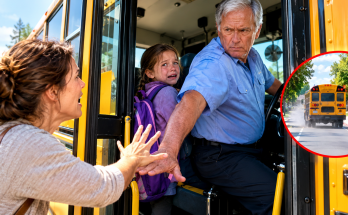
Deputy Reed was waiting outside the interview room when I arrived at the police station on Monday morning. He greeted me with a brief nod and asked whether Ellie had gone to school without difficulty. I told him she had boarded Route 24 at the usual time, waved to Frank, and taken her place in the second row. Reed seemed relieved, though his expression remained serious. He led me into the same room where we had reviewed the pickup photographs. This time, the folder on the table was considerably thinner. A single photograph lay facedown beside it. Before sitting, Reed told me investigators had established who had been driving Daniel Mercer's silver pickup when the stranger approached my daughter's bus.
I lowered myself into the chair without answering. For nearly three weeks, I had been waiting for someone to connect the truck, the brown jacket, and the false hospital story to an identifiable person. Reed turned over the photograph. It showed a middle-aged man with a narrow face, close-cropped dark hair, and a slightly uneven nose. Without the baseball cap, his appearance was ordinary. I searched his features for something familiar but found nothing. Reed identified him as Robert Hale, a forty-six-year-old acquaintance of Daniel Mercer. Hale had access to the pickup because he occasionally helped Mercer with property maintenance and equipment deliveries.
I looked at the photograph again. The name Robert Hale meant nothing to me. I had never invited him into our house, introduced him to Ellie, or authorized him to collect her. Reed explained that Mercer had initially provided an incomplete account of the truck's use because he believed Hale had borrowed it only for a short errand. Additional interviews, vehicle records, and camera footage established that Hale possessed the pickup during the period surrounding the school dismissal and bus route. Investigators had also obtained evidence placing him near Oak Street and Briar Street. Reed emphasized that the conclusions rested on several independent sources rather than the vehicle registration alone.
I asked whether Frank had identified Hale. Reed said the driver's account remained consistent with the available footage and that investigators had used an appropriate identification procedure. He did not describe every detail, but he confirmed that the evidence supported Hale being the man who approached Route 24. The description of the brown jacket, dark cap, and distinctive movements aligned with the recordings. I stared at the photograph until the features began to blur. A stranger now had a name and a face, but knowing them did not make him less frightening. It made his actions more deliberate, because he was no longer a vague figure assembled from uncertain glimpses.
Reed explained that Hale had been questioned about his presence near Maple Ridge Elementary. His first account was that he had been carrying out routine work and had encountered the bus by coincidence. When investigators presented the timing of the recordings, he acknowledged approaching Frank but described the situation as a misunderstanding. He claimed he believed Ellie needed transportation because of an emergency involving her mother. Reed's voice remained neutral while he described this explanation. I felt anger rise immediately. No one had been injured. No family member had sent him. The school had received no authorization, and Ellie had never met him.
I asked the question that had troubled me since the first afternoon. Who had supposedly told Hale that I was in the hospital? Reed said investigators had found no evidence of a legitimate message conveying that information. Hale had offered shifting explanations about where he obtained it. At one point, he suggested an acquaintance had mentioned a family problem. At another, he claimed he had misunderstood something he overheard. Neither version had been independently substantiated. Reed said the inconsistencies mattered, but he would not claim to know Hale's private intentions merely because his statements were unreliable.
The photograph remained between us. I remembered Ellie's description of the man speaking as though he expected Frank to obey. His knowledge of her teacher, her full name, and her route had made the lie more convincing. I asked how Hale knew those details. Reed opened the folder and explained that investigators had examined materials available through local school events and online postings. Hale appeared to have obtained at least some information from publicly accessible material. Other details might have come from observing school transportation patterns. They had not established that private school records were compromised.
I thought of the photograph from the spring reading fair. Ellie had stood beside Mrs. Benton holding a certificate, her face bright with pride. I had shared it because I wanted relatives to see something she had accomplished. Now I wondered whether someone had used that harmless image to make a false claim sound credible. Reed noticed my expression and reminded me that the source of every detail had not been confirmed. He did not want me treating a family photograph as the proven cause of the incident. I understood, but I could not help seeing the picture differently.
The most disturbing information concerned the folded paper. Investigators had found a sheet among Hale's belongings containing handwritten notes about Maple Ridge Elementary, the approximate dismissal period, and a reference to Route 24. It also included Ellie's first name. Reed did not show me the document, explaining that portions remained part of the active investigation. He confirmed, however, that its existence was consistent with the paper Ellie and Frank remembered seeing outside the bus. It was not an authorized pickup form, and nothing established that a school employee had issued it.
I gripped the arms of my chair. For days, I had wondered whether the man carried something that only appeared official. Now investigators had recovered a document connecting him to my daughter's school routine. I asked whether Hale had admitted preparing it. Reed said he had acknowledged writing some notes but disputed why he had made them. He described them as reminders connected to an errand. The explanation did not account for the false claim of family authorization or the repeated approaches to the bus. Investigators were examining those contradictions rather than accepting his description at face value.
Reed then explained that Hale's movements appeared inconsistent with an accidental encounter. The truck had been recorded near the school before dismissal. It was later positioned near Mason's stop when Hale approached Frank and asked for Ellie. After being refused, Hale drove toward Briar Street, where he appeared again as Ellie prepared to descend. That sequence, combined with the notes and false statements, supported concern that he had deliberately targeted her transportation routine. Reed did not describe the evidence as proof of every intention Hale might have held, but the progression was clear enough to leave me shaken.
I asked whether Hale had been arrested. Reed said officers had taken action in connection with the investigation, and the matter was being reviewed by prosecutors for appropriate charges. He explained that he could not promise a particular outcome or disclose every investigative step. I wanted a simpler answer, something that would let me tell Ellie the danger had ended completely. Yet Reed had been careful with us from the beginning. I respected him too much to demand certainty he could not honestly provide. Instead, I asked what steps were in place to protect my daughter while the case continued.
He told me investigators had informed the school district of the relevant safety concerns and were coordinating with officials about appropriate precautions. I should continue using established pickup arrangements and report any unexpected contact. Reed also asked me not to approach Hale, Mercer, or anyone associated with the vehicle. I agreed immediately. I had no desire to confront the person who had frightened Ellie. My anger was powerful, but I had learned that acting from anger without understanding the full situation could create consequences that were difficult to repair.
Before leaving, I asked whether investigators believed Hale had intended to abduct Ellie. Reed considered his answer carefully. He said the available evidence supported the conclusion that Hale had attempted to persuade a responsible adult to release a child without authorization through a false emergency claim. His purpose beyond gaining access to her remained a matter for investigation and legal determination. Those words were less emotionally satisfying than a definitive accusation, but they were grounded in what could be established. I knew the distinction mattered. I had once mistaken what Frank appeared to be doing for what he intended.
Outside the station, I stood beside my car and took several slow breaths. The morning traffic moved along the road, indifferent to the fact that I had just learned the name of the man who had approached my child. I looked at the photograph Reed had allowed me to study but not retain. Robert Hale. The name sounded ordinary enough to belong to a neighbor, a coworker, or someone standing ahead of me in a grocery line. I found that ordinariness unsettling. There had been no obvious sign marking him as dangerous. His power came from information, confidence, and the assumption that an adult would accept his story.
I called my brother from the parking lot. He answered on the second ring. I told him investigators had identified a person associated with the pickup and were pursuing the case through legal channels. He asked whether Ellie was safe. I said she was at school and that the authorities had informed the district about relevant concerns. He offered to collect her that afternoon so I could rest. I thanked him but declined. I wanted to stand at the usual stop and watch her come home. Not because I doubted Frank, but because that ordinary moment had become something I valued deeply.
At work, Helen listened while I explained that the investigation had progressed. I did not give her Hale's name or share evidence that Reed had asked me to keep private. She asked whether I needed the afternoon off. I told her I could manage the remaining appointments and would leave at my usual time. She studied my face through the video call and suggested I take a short break before returning to work. I agreed. After the call, I sat at my desk and looked toward the window. I could see cars passing outside the clinic, including several pickup trucks. I no longer tried to compare each one with the silver vehicle from the footage.
At 3:19, Route 24 stopped beside the curb. Frank checked the intersection and opened the doors. Ellie stepped down wearing her purple backpack and carrying a sheet of artwork. She waved to him, then approached me with a question about dinner. I answered automatically before realizing how much the moment meant. She had come home safely. She expected the afternoon to continue with snacks, homework, and an argument about whether vegetables were necessary. I did not want to replace that ordinary happiness with the details of my police interview before she had time to settle.
We walked home together. Ellie described a classmate who had spilled water across a science worksheet and another who had accidentally called Mrs. Benton "Mom." She laughed at the second story, and I laughed with her. At the house, she removed her shoes, placed her backpack beside the stairs, and went to wash her hands. I watched her disappear into the hallway. For a moment, I thought about how close we had come to losing the familiar shape of our afternoons. Frank's decision had preserved more than her physical safety. It had protected the possibility that she could keep living as a child.
I told Ellie about the police update after dinner. We sat at the kitchen table with her stuffed rabbit resting beside the napkin holder. I explained that investigators had identified the man they believed approached the bus and were taking the matter seriously. I did not describe every inconsistency in his statements or the notes recovered during the investigation. She asked whether the man had known us. I told her I did not know of any legitimate connection between him and our family. She looked relieved, then troubled. She wanted to understand why someone unfamiliar would claim to be her uncle.
I told her that some adults lied to get other people to do what they wanted. It was a difficult truth, but Ellie had already experienced it. I reminded her that knowing names or school details did not make a person trustworthy. She asked whether Frank had known the man was lying. I explained that Frank had recognized the claim was unverified and that Ellie herself had told him she did not know the person. Together, those facts gave him reason to refuse the request. Ellie nodded and looked down at her hands. She said she was glad she had answered honestly when Frank asked whether she recognized the man.
Later that evening, Mrs. Shaw called to confirm that the district had received an official update relevant to transportation safety. She said Route 24 would continue its usual schedule and that Frank had been informed of the precautions appropriate to his work. I thanked her and asked whether he knew investigators had identified a suspect. She said he was cooperating with the authorities and had been given information necessary for his responsibilities. I respected the limits of her answer. Frank had already done more than enough. He did not need to become the center of a public drama while the case proceeded.
When the house became quiet, I opened my notebook and wrote Robert Hale's name beneath the vehicle information. For the first time, the blank space beside the stranger's description contained a verified investigative identification. I noted the recovered handwritten information, the inconsistent explanations, and the continuing legal review. Then I closed the notebook. The evidence had moved us closer to understanding what happened, but it had not answered why Hale chose Ellie or what he intended beyond removing her from her normal route. I could not fill those gaps with fear.
I stood at the living-room window for a while. Across the street, porch lights illuminated the sidewalk, and a neighbor carried groceries inside. The vacant house near Briar Street remained dark. I had once believed that knowing the stranger's name would make everything feel resolved. Instead, the information brought a different kind of unease. He had apparently gathered details about a child who did not know him and used those details to support a false emergency. Frank had interrupted the approach, but the investigation still needed to establish the full circumstances and consequences.
Before going upstairs, I checked that the doors were locked and the outside lights were working. Then I looked in on Ellie. She was asleep beneath her lavender blanket, one hand resting against the stuffed rabbit's worn ear. Her face was peaceful. I stood beside the bed without waking her. The questions surrounding Robert Hale remained important, and I would continue cooperating with investigators. But I understood something I had not understood on that first terrible afternoon: protecting Ellie did not mean keeping her suspended inside my fear. It meant giving her dependable adults, clear boundaries, and the freedom to continue growing while the truth was established.