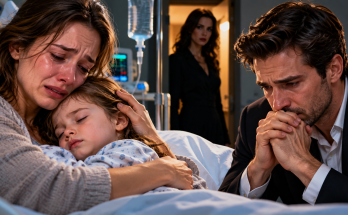
Dr. Patel had scarcely finished examining Lily when I asked whether a monitoring device could report a normal temperature while a baby was seriously ill. She looked from my face to the band around Lily's ankle, then asked why I was concerned about the equipment. I explained that my husband had brought it home from the company where he worked and that its readings were contradicting our thermometer. She listened without interrupting, but I could see that she was considering the information carefully.
“The device isn't part of her medical care here,” she said. “We'll use our own equipment and evaluate what we're seeing clinically. I would also like to know whether it has been tested and approved for this purpose.”
She did not speculate about what had caused Lily's fever. Instead, she ordered the appropriate tests and instructed Nurse Leah to continue monitoring her vital signs. Lily cried while the staff examined her, and I held her tiny hand whenever they allowed me close enough. There was something unbearable about watching the people who could help her perform procedures that made her cry. I understood why they were necessary, but that knowledge did nothing to quiet my instinct to gather her up and carry her somewhere safe.
Leah had a warm, steady manner and moved with the efficiency of someone accustomed to frightened parents. She explained each step before performing it. When I apologized for repeatedly asking whether Lily was all right, she told me I could ask as many questions as I needed. Nobody in that room seemed offended by the idea that a mother wanted to understand her child's condition. The contrast with the previous few hours left me unexpectedly close to tears.
Around three-thirty in the morning, my father arrived. He wore jeans, a navy sweater, and an old overcoat with a frayed cuff. His silver hair was flattened on one side, as if he had run his hand through it while driving. He came straight to me, embraced me carefully, and waited while I tried to stop crying. Then he moved to Lily's bedside and studied her with an expression I remembered from the night my mother died: fear held tightly beneath the surface.
He asked what the doctors had told me. I repeated their concerns about infection and the tests still pending. He listened, nodded, and asked whether there was anything Lily needed that he could arrange. Only after we had discussed her care did he look toward the doorway and ask about Ethan.
“I don't know where he went,” I admitted. “He and Sylvia disappeared after I came back here.”
Dad pulled a chair beside mine and sat down. He didn't seem surprised. I thought he would begin with a lecture about my marriage. Instead, he reached into his coat and removed a folded packet of documents. He placed it on his knee without opening it.
“I have information about LittleLight that involves you personally,” he said. “Some of it came to my attention only yesterday. I need to tell you what we know, but I don't want to confuse confirmed facts with things we're still investigating.”
The distinction mattered to me. I had spent years evaluating systems where poorly understood information could lead to disastrous decisions. I asked him to begin with what had actually been established. Dad explained that he had accepted an interim chairmanship at Aster Health three months earlier, following a board restructuring. The company operated a network of healthcare services and partnerships across several states. LittleLight had submitted a proposal to supply infant-monitoring technology throughout parts of that network.
I knew Aster by reputation, but I hadn't realized Dad was involved. He explained that the potential agreement carried a value far beyond anything Ethan had described at home. Approval could lead to commercial commitments worth tens of millions of dollars and provide LittleLight with credibility needed for additional financing. Ethan's presentation was therefore important, although not in the innocent way I had assumed.
Dad opened the first document. Corporate records identified Ethan as one of LittleLight's principal shareholders, not merely the salaried business-development director he claimed to be. Another substantial ownership interest belonged to an investment company controlled by Sylvia. I read the names twice. Ethan had repeatedly told me the startup was struggling and that his personal financial position was uncertain. Sylvia had urged me to return to consulting sooner because, she said, her son couldn't carry the entire household indefinitely.
“So they've been investing in the company together?” I asked.
“More than investing,” Dad replied. “They stand to gain considerably if the proposed transaction succeeds.”
I looked toward Lily, who had fallen into a restless sleep. Suddenly I remembered the mortgage conversations, Ethan's complaints about money, and the expensive watch Sylvia had given him after a supposedly difficult quarter. None of those details proved anything by itself. Together, they suggested a life I hadn't been permitted to see.
Dad turned another page. He asked whether I had ever signed authorization allowing LittleLight to gather Lily's medical information for a research program. I told him no. He repeated the question, more carefully, asking whether I might have signed a general consent form without realizing how broadly it was written. I could hear the lawyerly caution in his wording. I was irritated that he seemed to be testing my memory, until he handed me the document.
Lily's name appeared near the top, along with her birth date and our address. The authorization permitted the company to collect information from a pediatric monitoring device and use it in a performance study. A signature resembling mine appeared beneath the consent language. There were other pages concerning research data and parental participation. I examined the signature, noticing how accurately the writer had reproduced the general shape of my name while missing the way I joined two particular letters.
“I didn't sign this,” I said.
Dad asked me to examine the remaining pages before answering again. One authorized broader collection of health measurements. Another dealt with supposedly anonymized information. Ethan appeared on the paperwork as the participating parent responsible for the home study. My signature appeared more than once. Each version looked slightly different, as though someone had practiced copying it and then stopped worrying about consistency.
I remembered being seven months pregnant and exhausted by a consulting deadline. Ethan had brought me several documents connected, he said, to refinancing our mortgage. He had complained that I was making a simple administrative task unnecessarily difficult when I insisted on reading everything. I had signed legitimate mortgage paperwork after reviewing it. But none of the pages Dad showed me had been included in that packet, and none bore my real signature.
I felt a wave of nausea. The thought of forged financial documents was frightening enough. The thought that someone had used my name to authorize medical experimentation on Lily made the room seem suddenly unsafe. I reached down to the gray band, intending to remove it immediately. Dad caught the movement and asked me to speak with Dr. Patel first. He explained that the device might contain information relevant to an investigation, but its preservation could never take precedence over Lily's care.
Leah came when I pressed the call button. I told her that the monitor was an experimental company prototype and that serious questions had emerged about the consent documents. She called Dr. Patel, who examined the band and confirmed that the hospital had no medical need for it. They removed it carefully, recording what they had done. At my request, Leah placed the device in a labeled bag for safekeeping while the appropriate arrangements were considered.
The little green light went dark beneath the plastic. I hadn't expected to feel anything when it disappeared, yet I found myself shaking. For hours that light had told Ethan that Lily was fine, even as her fever climbed. It represented his confidence in a machine and his refusal to listen to me. Now it might represent something considerably worse.
Dad waited until the staff had left before opening another section of his folder. This time I recognized a name that had nothing to do with Ethan's company. Blue Lantern. Seeing it printed on the page brought back a period of my life I had rarely discussed since becoming a mother. It was a research project I had developed during graduate school with my close friend Nora Hart, a talented software engineer whose sense of humor had carried us through more than one disastrous testing session.
My mother had inspired the project long before I knew enough programming to build it. She worked with premature and critically ill infants and believed that monitoring equipment should always communicate its limitations honestly. She had told me about occasions when a reassuring display distracted inexperienced staff from symptoms they could plainly observe. The problem wasn't that medical technology was useless. It was that people sometimes trusted a neat number more readily than a complicated human situation.
During my studies, I became interested in detecting unreliable sensor information. Rather than simply generating an alert when a measurement crossed a numerical threshold, Blue Lantern examined the quality and consistency of incoming data. When confidence was insufficient, it warned the user that the result required verification instead of displaying an unjustifiably reassuring status. It was never intended as a finished medical device. It was research into how software might identify uncertainty before uncertainty harmed someone.
Nora and I spent years improving the prototype. We worked with simulated measurements, deliberately corrupted datasets, and complicated edge cases. Sometimes we stayed in the laboratory until the cleaning staff asked us to move our coffee cups. We named the project Blue Lantern in memory of my mother's belief that even a modest warning could prevent a serious mistake. When our careers eventually moved in different directions, we archived the work and agreed that any future commercial use would require proper discussion and authorization.
Ethan knew about Blue Lantern. Early in our relationship, I had shown him the documentation and explained its central idea. He seemed interested, although he usually steered the conversation toward potential markets rather than technical reliability. Later, after we married, he asked whether he could examine the original code. I allowed him to read portions of the documentation but made clear that the software itself was not available for commercial reuse. He laughed at my caution and suggested that I had become too suspicious from working in medical compliance.
The code remained on an encrypted external drive in my home office, or so I believed. Some older versions also existed in protected research archives maintained with Nora. I hadn't examined those files in months. Pregnancy, consulting deadlines, and Lily's arrival had consumed my attention. Ethan sometimes referred to the project as an unfinished academic exercise. I had begun to think of it that way myself.
Dad showed me a technical memorandum prepared by an Aster reviewer. LittleLight's software contained structures remarkably similar to those of Blue Lantern. Several sections appeared to reflect research material archived under my maiden name, Claire Bennett. The reviewer had noticed the similarities while examining the company's final presentation package and traced them back to the university research record.
I read the memorandum slowly. The similarities weren't merely conceptual. Certain descriptions reflected decisions Nora and I had made after extensive experiments. A few unusual conventions appeared where I would have expected them if the software had been derived from our work. The possibility that Ethan had borrowed ideas without asking was bad enough. The possibility that he had taken actual code made my stomach tighten.
“Who provided these materials to Aster?” I asked.
Dad hesitated only briefly. “Ethan submitted the relevant technical package.”
I thought about our conversations during the previous year. Ethan had encouraged me to reduce my workload while preparing for Lily's birth. He had suggested reorganizing my home office and placing old research equipment in storage. At the time, his interest seemed thoughtful. Now I wondered whether he had wanted access to things I would otherwise have noticed were missing.
The due-diligence review had raised other concerns. LittleLight claimed extensive clinical validation involving a large number of infants across several participating facilities. But some institutional details in the materials did not match the responses obtained during preliminary verification. Dad was careful not to call the entire study fraudulent before the investigation was complete. Still, he said the discrepancies were serious enough to require independent review.
I asked whether Lily had actually been included in the company's study records. Dad touched the stack of consent forms. Her name was there. Her device appeared in the system. Someone had represented her participation as authorized. Whether information had been altered or misused remained an open question, but the paperwork alone demonstrated how deeply the company's activities had reached into my home.
At a little after four, Dr. Patel returned with preliminary results. Lily appeared to have a urinary tract infection, and the doctor wanted her kept under observation while additional testing confirmed the diagnosis and guided treatment. She explained the plan carefully. Lily had received appropriate care and supportive treatment, and there were reasons for cautious optimism. I listened so intently that I could have repeated almost every word afterward.
When the doctor left, Dad asked whether I wanted him to put the documents away. I looked at Lily, exhausted but sleeping more comfortably, and considered how much I had already learned. My husband had hidden his ownership of LittleLight, misrepresented our finances, placed an unapproved prototype on our daughter, and allowed documents bearing my false signature to circulate in a commercial research package. The possibility that he had also appropriated my work was no longer remote.
“There's more, isn't there?” I asked.
Dad studied me. He admitted that Aster's legal team had requested the documentation establishing LittleLight's right to use the underlying Blue Lantern software. The company had supplied what it described as a signed intellectual-property assignment. It was dated eleven months earlier, during the final months of my pregnancy.
He handed it to me. The document claimed that I had transferred substantial rights in my research to LittleLight Innovations. At the bottom appeared another imitation of my signature. Beside the execution details was a reference to compensation that I had never received. I looked at the paper until the words stopped behaving like ordinary words.
Outside the room, someone moved a trolley down the corridor. Lily stirred, and I placed my palm gently against her back. Then I looked at Dad and asked him to arrange for a copy of every document bearing my name. I wanted the original research records preserved, and I wanted independent legal advice before Ethan had an opportunity to explain any of it away.
It was the first time in our marriage that I made a consequential decision without worrying about how angry my husband might become. I expected to feel frightened. Instead, looking at the forged signature on the assignment form, I understood that the decision had already been made for me by someone who believed I would never discover what he had taken.