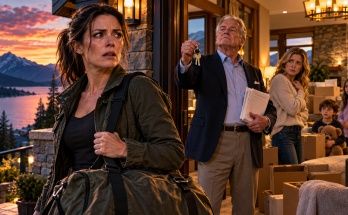
Eleven months after Ethan struck me in our kitchen, I returned to the Blackwood house alone.
Not completely alone.
A court-appointed property officer waited outside while I completed the final inventory required by the divorce settlement.
But inside, for the first time, no Blackwood was watching me.
No investigators moved through the halls.
No agents photographed drawers.
No lawyers occupied the dining room.
The servers had been removed months earlier.
The lower archive had been emptied and sealed.
The house sounded like any large old house on a cold morning.
Wood settling.
Pipes ticking.
Wind pressing against glass.
I stood in the kitchen where everything had started.
The walnut table remained.
I had chosen not to take it.
Some objects become too crowded with memory to remain furniture.
The divorce became final three days earlier.
There had been no trial.
Ethan’s criminal attorneys advised him not to contest the financial findings, and his family-law counsel had little room to argue against records documenting forged signatures, hidden assets and deliberate efforts to undermine my legal capacity.
I received the portion of lawful marital property to which I was entitled.
Assets connected to Blackwood Strategic Trust remained under separate court supervision.
I waived no claims.
I demanded no private advantage.
The historical restitution process would determine what belonged to whom.
That mattered to me more than the number.
Blackwood Development survived.
Not in the form Ethan knew.
The merger died.
Several divisions were sold.
Projects with clean financing continued under independent management.
Hundreds of employees kept their jobs.
Others did not.
That consequence hurt people who had never entered the hidden archive and never heard Arthur Blackwood’s name.
There was no honest way to pretend otherwise.
Accountability rarely confines its damage neatly to the guilty.
But the alternative—another cover-up in the name of protecting innocent employees—was exactly the argument Richard and Ethan had used for decades.
The company’s board created a restitution and historical review fund under court supervision.
Blackwood Strategic Trust supplied much of the money after judges determined that substantial portions derived from transactions linked to fraudulent land practices.
Richard’s private list became evidence.
Families received notices.
Some claims were straightforward.
Others were contested.
A few descendants wanted nothing except records.
One elderly man told investigators he had spent sixty years believing his father sold the family farm because he was weak.
Richard’s files showed the bank had threatened foreclosure after Blackwood pressure.
The man cried when he learned it.
Not because money could repair childhood.
Because shame had finally moved to the people who created it.
Helen Bishop was buried beside my mother.
The cemetery allowed me to place a second marker near Evelyn’s grave after legal identification was complete.
HELEN BISHOP.
Mother.
Accountant.
Witness.
No grand language.
No attempt to turn her into a flawless hero.
My mother would have disliked that.
At the burial, I stood beside distant relatives I had met only because DNA comparisons and old records brought us together.
Margaret attended.
She remained at the back until I walked over and asked her to sit closer.
That did not mean everything between us was repaired.
Some relationships do not return to their original shape because the original shape depended on lies.
We were learning something more modest.
How to speak without pretending.
Raymond Blackwood received his own burial two weeks later.
Margaret arranged it.
She placed him beside the Blackwood family plot but not directly beneath Arthur’s monument.
When the cemetery staff asked whether Arthur’s headstone should remain, Margaret said yes.
I understood.
Erasing a name from stone did not erase what he did.
She wanted the grave marked accurately.
Arthur Blackwood.
The man responsible for much of the original corruption.
The father whose choices taught two generations that family loyalty required silence.
Margaret no longer visited Richard’s grave.
She told me that once, then never mentioned it again.
Samuel Price’s newspaper published a special investigation using his surviving notes and newly opened records.
His family contributed photographs.
The front page carried one of his old newsroom portraits beside the words:
THE STORY HE NEVER GOT TO FINISH.
I kept a copy.
Not because the article concerned my family.
Because Samuel died trying to make facts public before powerful people could turn them into secrets.
Howard Mercer pleaded guilty to offenses connected to obstruction, evidence concealment and corruption after prosecutors reconstructed what remained legally chargeable.
His age did not erase responsibility.
It did affect proceedings.
The retired state investigator who betrayed my mother’s meeting entered a separate agreement and publicly acknowledged taking money from a Blackwood intermediary.
Other cases continued.
Some people were dead.
Some statutes had expired.
Some conduct could be exposed but no longer prosecuted.
That frustrated me at first.
Then Daniel reminded me of something I already knew from my own investigative work.
Legal judgment and historical truth are not identical systems.
One can fail while the other still matters.
Olivia pleaded guilty to financial offenses related to the attempted transfer, fraudulent certifications and concealment.
Her cooperation substantially expanded the historical investigation.
That did not transform her into a whistleblower.
She had years to speak.
She did not.
She protected Bellweather until protection became impossible.
But when the final moment arrived, she stopped lying.
Sometimes that is the only useful thing left for a person to do.
I saw her once during a hearing.
Our eyes met across the courtroom.
She looked smaller than she did in the photographs.
No glamorous terrace.
No private terminal.
No hand at her back.
For a second, I wondered whether I hated her.
I discovered I did not.
Hatred required more space than I wanted to keep giving the people who had already occupied too much of my life.
Ethan’s case took longer.
His attorneys challenged searches.
Questioned digital authentication.
Argued that some corporate structures reflected aggressive but lawful planning.
Certain charges narrowed.
Others strengthened.
In the end, he entered guilty pleas covering financial fraud, conspiracy, forged authorization and obstruction-related conduct connected to the plan against me.
The court considered his cooperation after Olivia’s disclosures, but it also considered the duration of the conduct, the money involved and the deliberate attempt to strip another person of decision-making power.
I attended sentencing.
Not because I wanted to see him punished.
Because I wanted the last official version of our marriage to include my voice.
My statement was short.
I told the court Ethan had not merely hidden money.
He created documents designed to make truth look like illness.
He used intimacy as access.
He studied which doubts other people would believe about me and prepared to turn those doubts into legal control.
Then, when confronted, he hit me and blamed me for the blow.
I did not ask the judge for a particular sentence.
That decision was not mine.
I asked only that the conduct be described accurately.
It was.
Ethan looked at me before marshals led him away.
He did not say my name.
I appreciated that.
Some boundaries arrive late.
Late does not mean useless.
Margaret sold the Blackwood house to the restitution trust.
That surprised me.
It was valuable enough that keeping it would have been easy to justify as separate family property.
She refused.
“What would I do with it?” she asked.
“Live there?”
She shook her head.
“Above those rooms?”
The trust planned to sell it on the open market after removing sensitive infrastructure.
A portion of proceeds would support claims related to historical land misconduct.
Before the sale, I was allowed to retrieve personal belongings.
That was why I had returned.
I walked upstairs.
The guest-room door still carried a faint mark where I had wedged the chair beneath the handle after Ethan struck me.
I ran my fingers over the wood.
That woman—me, eleven months earlier—had believed the most frightening truth she possessed was that her husband planned to steal from her and have her declared unstable.
She knew nothing about Helen.
Nothing about Raymond.
Nothing about Samuel.
Nothing about my mother bargaining with Richard.
Nothing about the fact that Ethan had recognized my family name before our first conversation.
Yet she had done the one thing that made everything else possible.
She believed the evidence in front of her.
That sounds simple.
It is not.
Especially when someone you love has spent years teaching you to distrust your own conclusions.
I packed three boxes.
My books.
Two paintings that belonged to my mother.
A ceramic bird she gave me after my first promotion.
I left the wedding photographs.
I left the silver.
I left the furniture chosen with Ethan.
Objects were not guilty.
I simply did not want them.
In Richard’s study, the antique cabinet stood open and empty.
The old television was gone.
The drawer where agents found the bank key had been removed.
I placed my palm against the desk.
This was where my mother sat in 2001 and traded the Bishop ledger for my safety.
This was where Richard called Ethan after she left.
This was where a decision made before Ethan and I met began guiding the shape of our marriage.
For months I had been angry that my mother never told me.
That anger remained.
Love did not erase it.
Neither did understanding.
She protected me by withholding truth.
It worked for a while.
Then the secret traveled forward anyway.
But my mother left something Richard never did.
A correction.
In her letter, she admitted she had been wrong to decide what truths I could handle.
That humility separated her from him.
Richard believed control became moral when he called it protection.
My mother eventually understood that protection without choice has a cost.
I carried that lesson downstairs.
Margaret was waiting in the foyer.
I had not heard her enter.
She wore a plain gray coat.
No pearls.
She looked older than she had a year earlier.
Perhaps she was.
Perhaps I had simply stopped seeing the role she performed.
“I wanted to say goodbye to the house.”
I nodded.
“So did I.”
She looked toward my boxes.
“Is that everything?”
“Yes.”
We stood beneath the chandelier.
Margaret glanced toward the basement door.
“I dream about Raymond.”
I waited.
“He is always twenty-eight. I keep asking where he went.”
Her voice shook.
“And he keeps asking why I believed Richard.”
I could not answer that for her.
Neither could a dream.
She rubbed one hand across the other.
“I used to think I needed you to forgive me.”
I looked at her.
“Now?”
“Now I think I need to live differently whether you do or not.”
I nodded.
“That sounds right.”
She looked almost relieved.
“I am sorry, Claire.”
“I know.”
It was the first time I had answered that apology.
Not I forgive you.
Not it is all right.
I know.
Sometimes accuracy is kinder than comfort.
Outside, Daniel waited beside his car.
He had stopped representing me formally after the asset litigation moved to specialist counsel, but he remained a friend.
He helped carry one box.
“Last time?”
“Last time.”
“You sure?”
I looked at the house.
“Yes.”
Before getting into my car, I checked my phone.
An email waited from the historical claims administrator.
Subject: BISHOP/CALDWELL DETERMINATION.
I opened it.
The review board had recognized Helen Bishop’s estate as directly harmed by Blackwood misconduct.
My mother’s estate also held a documented claim based on illegal surveillance and coercive actions connected to Richard’s attempt to recover evidence.
Robert Caldwell’s participation complicated the paternal side.
His earlier corruption reduced one category of claim while his later cooperation created no financial entitlement.
Exactly as my mother warned.
No family emerged clean.
The amount offered to Helen and Evelyn’s descendants was significant.
Not life-changing by Blackwood standards.
More than enough by mine.
I accepted only through the ordinary process.
No special negotiation.
No private agreement.
A second portion would fund preservation of Samuel Price’s papers and public access to the Bellweather records.
That mattered more to me than money.
The archive would not disappear underground again.
Weeks later, the county historical center opened the first portion of the collection.
The Bishop ledger sat behind protective glass.
Helen’s transcription was available to researchers.
Samuel’s surviving notebook pages were displayed beside articles he published.
Raymond’s story appeared too.
So did Robert Caldwell’s corruption.
So did Charles Harrington’s confession.
So did Richard’s instructions.
Nothing was cleaned up for family pride.
Margaret attended the opening.
She stood beside a photograph of Richard for almost ten minutes.
Then she walked away.
I found my mother’s photograph near the final exhibit.
Evelyn outside that medical building in 2001.
The same image Richard once stored as surveillance.
Now the caption explained that she was secretly documenting coercion while terminally ill.
The photograph had changed without changing at all.
Context had returned her agency.
I stood there until visitors moved around me.
A teenage girl beside her father read Helen’s story aloud under her breath.
She had no connection to us.
To her, Helen was history.
That realization gave me peace I had not expected.
Family secrets survive by making everyone involved believe the story belongs only to them.
It did not.
The corruption affected workers.
Landowners.
Journalists.
Families.
Institutions.
It belonged to the public record.
My responsibility was never to carry it forever.
Only to stop carrying it alone.
A year after the morning federal agents entered my house, I moved into a smaller place near the river.
No gates.
No hidden basement.
No rooms I was told not to enter.
The first night, I sat on the floor because the sofa had not arrived.
I ate takeout from the carton.
Rain tapped the windows.
For several minutes I kept expecting another feeling.
Loneliness.
Fear.
Regret.
Instead there was quiet.
Real quiet.
Not the silence Ethan created when questions became inconvenient.
Not the silence Margaret used to preserve a family.
Not my mother’s protective silence.
Nothing was being hidden from me.
I took out the final item from one of my boxes.
My mother’s green scarf.
The evidence team returned it after processing.
I held the silk between my hands.
For years, I had thought inheritance meant houses, money, names, habits.
The Blackwoods inherited secrecy.
The Harringtons inherited complicity.
The Caldwells inherited fear and unfinished attempts at repair.
My mother left me something else.
The chance to know all of it and decide what did not have to continue.
I folded the scarf and placed it in the top drawer of my dresser.
Not inside a wall.
Not beneath a floor.
Not in a locked archive.
Just a drawer I could open whenever I wanted.
Then I turned off the light.
For the first time in generations, nothing needed to remain hidden for morning.
The End
Read more original stories on Feel Every Story.