The second letter was a commercial broker’s inquiry asking whether I would consider selling the 60 acres. It was not an offer, and it named no price. But the restrictions had lifted, and someone in the business had noticed.
I read it twice, then called the attorney I had spoken with privately before the notice arrived. He had helped me prepare and sign a new will. I told him the land was cleared for commercial development and asked him to come to the hospital when he could.
“Did you tell anyone about the document?” he asked.
“No.”
“Then I’ll bring the old folder, too.”
I put the broker’s letter beside the notice. A few days earlier, I had been trying to find the money for surgery. Now I had a letter asking about land I had spent years believing would never be useful to anyone.
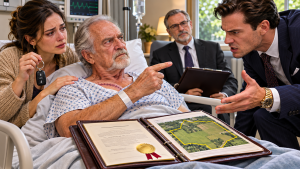
The surgery went ahead. Four days later, while I was still in my hospital room, Julian came in without knocking. He looked from me to the attorney seated beside the bed.
“What is this?” he said.
“Hello to you, too,” I said.
He ignored that. “Mom told me the restrictions are lifted. Is that true?”
“It is.”
“And you didn’t call me?”
“You didn’t call me when I told you I needed surgery.”
His mouth tightened. For a moment he looked toward the attorney, as if there were a better way to begin with a witness present.
“I came to talk about the land,” he said.
“I gathered that.”
The attorney had brought the old folder. He opened it on the small table beside him and took out the postnuptial agreement Eleanor and I had signed five years earlier. Julian glanced at the pages, then at me.
“What does that have to do with this?”
“It sets out what your mother and I agreed to,” I said. “She kept the house, her retirement funds, and her savings. I kept the land and its liabilities.”
“I know what the agreement says.”
“Then you know whose land it is.”
He shifted his attention back to me. “You’re acting like I came in here asking you to hand it over.”
“You came in asking why I hadn’t called you.”
“Because I work in commercial real estate. I might be able to help.”
The attorney turned one page in the folder. He did not interrupt.
“Help how?” I asked.
“Look at development options. Talk to people. Find out what it’s worth. You don’t need to make a decision before you know what you’re dealing with.”
“I have a letter from a broker asking if I’d consider selling.”
“That’s not the same as knowing the market.”
“No,” I said. “It isn’t.”
Julian rubbed his forehead. He looked tired, but not apologetic.
“You could have called me first,” he said.
“I did call you first. I needed $3,200 for surgery.”
“That’s not what I mean.”
“I know.”
He glanced again at the attorney. “Are we going to do this with him sitting here?”
The attorney closed the folder partway. “I can step out if Arthur wants to speak privately.”
“Stay,” I said.
Julian let out a breath through his nose. “Fine. But I’m not trying to take anything from you.”
“Then tell me what you want.”
“I want you to make a sensible decision.”
“That’s not an answer.”
He looked at the floor. “The land could be valuable now. You shouldn’t sign something or sell it without understanding what you have.”
The words sounded reasonable. That was what made them hard to answer. Julian had made a career out of understanding property and transactions. He could have been offering useful advice. But he had not offered help when my need was immediate and plain. His concern arrived after the land became commercially developable.
“Why didn’t you help me?” I asked.
He lifted his head. “We already talked about that.”
“No. You told me the money was allocated. You didn’t tell me why helping your father with surgery wasn’t worth changing those plans.”
His jaw moved. “I didn’t want to get into a pattern where you expected me to cover everything.”
“I asked once.”
“I know.”
“And you said no.”
“I had just closed a major deal. There were obligations.”
“To investments and other things.”
“Yes.”
The attorney’s hand rested on the open folder. Julian noticed it and looked annoyed.
“Dad, I’m not saying the call went well,” he said. “I had people around me, I was celebrating, and I wanted to get back to it. I made a bad call.”
The sentence was quieter than the rest of what he had said. It did not change the fact that Clara had sold her car to cover the deposit.
“I needed you to answer me as my son,” I said. “Not as someone deciding whether I was a bad investment.”
“That’s not how I see you.”
“It’s how it felt.”
He opened his mouth, then stopped. “I didn’t know Clara sold the Toyota.”
“She did.”
“Why?”
“Because I needed the money.”
He looked at me for a second, then away. “She shouldn’t have had to do that.”
“No. She shouldn’t.”
“Did she tell you she was selling it?”
“She told me after she’d done it.”
He sat down in the chair near the bed. His first hurry seemed to leave him, though his attention kept returning to the folder.
“What’s in there?” he asked.
The attorney answered before I did. “The agreement between your parents, and a copy of the document Arthur recently signed.”
Julian looked at me. “What document?”
“I updated my will.”
“You did that now?”
“Yes.”
“Because of the land?”
“Because I needed to make a decision about what I wanted done with it.”
He leaned forward. “And what did you decide?”
The attorney opened the folder again and turned the copy so Julian could see it. He did not read the document aloud. He explained that I had directed what remained of the land or its proceeds to go to Clara. The decision was mine, and the will did not give Julian a role in managing the property.
Julian read the page. His face changed, but he did not raise his voice.
“You left it to Clara.”
“I did.”
“Why?”
“Because she showed up when I needed help.”
“So this is about the car?”
“It’s about the car. It’s about the money she had saved. It’s about the fact that she didn’t make me explain why I deserved help before she gave it.”
“She’s your daughter. I’m your son.”
“I know who you are.”
He looked at the document again. “You could have talked to me before you signed this.”
“I had already talked to you when I called about surgery.”
“That was different.”
“It was the moment I needed to know what I could count on.”
He pressed his lips together. I could see him preparing another argument, then setting it aside.
“I didn’t think the land would ever be worth anything,” he said.
“Neither did I.”
“I thought you’d just keep paying taxes on it.”
“I did.”
“And now it’s suddenly a development property.”
“It’s land that’s been cleared for commercial development. That’s what the notice says. I haven’t accepted an offer, and I haven’t agreed to anything.”
“Then let me help you figure out the next step.”
“I’m going to speak with the broker and get an independent assessment. I’ll decide after that.”
“Why an independent assessment?”
“Because I want advice from someone who isn’t my son and who isn’t expecting to be involved.”
He sat back. For a second, neither of us spoke. The attorney waited, his fingers resting on the folder.
Julian said, “You really think I’d take advantage of you?”
“I think you were comfortable telling me no when I was asking for help, and comfortable coming here when the land might be valuable. I don’t need to turn that into anything more complicated.”
He looked hurt then, though whether at my words or at the will, I couldn’t tell. I didn’t ask.
“I can still be useful,” he said.
“You can. That doesn’t mean I have to put you in charge.”
“I never asked to be in charge.”
“You asked why I didn’t call you. You asked what I’d decided. I’m telling you.”
He stood. “I came because I thought you might need help with the land.”
“You came after you heard the restrictions were lifted.”
“I can’t change the timing.”
“No,” I said. “You can’t.”
He waited, perhaps for me to soften it. I was too tired to pretend the timing did not matter.
“I’m sorry about the surgery call,” he said. “I should have helped you.”
I nodded. It was the first thing he had said that did not have a defense attached to it.
“I’m not asking you to forget it,” he added.
“I’m not going to.”
He glanced at the attorney once more. “What happens now?”
“I recover. Then I decide whether to sell.”
“And if you do?”
“I’ll choose the broker and the terms. I’ll pay Clara back for what she spent helping me. The rest will be handled the way the document says.”
He frowned. “You don’t have to pay her back first.”
“I know.”
“Then why?”
“Because I want to.”
That ended the argument more effectively than anything else I had said. Julian nodded once, not agreeing so much as accepting that I would not debate it further.
He left without asking to see the papers again.
The attorney stayed while I called Clara. She answered quickly.
“Are you all right?” she asked.
“I’m fine. Julian came by.”
“What did he want?”
“To talk about the land.”
She was quiet for a beat. “And what did you tell him?”
“That I’ll make my own decision. The attorney showed him the will.”
“You didn’t have to do that for me.”
“I know.”
“I didn’t give you the money so you’d feel like you owed me.”
“I know that, too. I’m going to repay you when I can.”
“Dad, you need to recover first.”
“I will. Then I’ll take care of it.”
She exhaled. “All right. But don’t make this into a debt between us.”
“It isn’t.”
I meant that. Her help had not been a bargain, and the document was not payment for her kindness. I had made it because I wanted the land to go to the person whose actions had shown me what family support looked like when there was no advantage in it.
When I was out of the hospital, I spoke with the broker who had written to me and arranged for an independent assessment before deciding anything. The land was no longer the useless burden it had been when Eleanor and I signed the agreement. I listened to the advice, considered the terms, and chose to sell. I did not let Julian negotiate for me or represent my interests.
After the sale, I repaid Clara for the money she had used toward the surgery deposit. She accepted it without making a speech about what she had done. I kept the rest for my own needs, and the updated will reflected what remained of the land proceeds.
Julian and I spoke again later. He did not ask for a share. He said he had been wrong to refuse me, and I told him I heard him. We did not return to the closeness I had assumed we had before that call. I stopped treating his success as proof that I could rely on him.
Clara took the repayment, but she kept the bus schedule she had used while she was without a car. She said she would replace the Toyota when it made sense for her. I couldn’t fix the fact that she had needed to sell it. I could make sure she did not carry the cost of my surgery alone.
The land had been mine through the years when it was worth little and the liabilities were mine to bear. Once it had value, I chose where that value would go. That decision belonged to me.