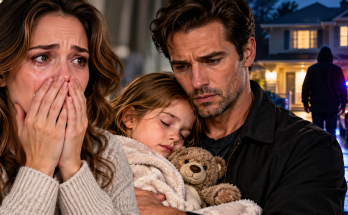
The first time Malcolm used the new key, I was not home.
My mother called me at the bookstore shortly after noon.
“Miles is sick.”
My stomach tightened immediately.
“How sick?”
“Fever. He threw up once.”
“Where are you?”
“At your house.”
I checked the clock.
My shift ended at four.
“I’m leaving.”
“Nina will kill you.”
“Nina has threatened me before.”
My mother sighed.
“He’s asking for Malcolm.”
That stopped me.
“Did you call him?”
“No. I wanted to ask.”
“You don’t need permission for that.”
Old habits.
Even my mother had begun treating access to our family as something carefully negotiated.
“Call him.”
Then I called Malcolm myself.
He answered on the first ring.
“Hey.”
“Miles is sick.”
His tone changed instantly.
“What happened?”
I explained.
“I’m twenty minutes away.”
“My mom’s there.”
“Do you want me to go?”
The question mattered.
“Yes.”
“Okay.”
He arrived before me.
When I pulled into the driveway thirty-five minutes later, his car was parked outside.
The front door was closed.
I entered using my own key.
Malcolm was sitting on the floor beside the sofa while Miles slept under a blanket.
My mother stood in the kitchen making tea.
“Fever’s down a little,” Malcolm whispered.
I touched Miles’s forehead.
Warm.
Too warm.
“What did he take?”
“Children’s acetaminophen at twelve forty-five.”
“Dose?”
Malcolm showed me the bottle.
Correct.
“He kept water down.”
My mother said, “I’m going home before all three of you decide I’m decorative.”
I kissed her cheek.
“Thank you.”
She looked at Malcolm.
“Behave.”
“Yes, ma’am.”
After she left, I noticed something.
Malcolm’s shoes were still beside the front door.
His jacket hung on the hook.
But nothing else had moved.
No coffee cup.
No opened cabinet.
No sign he had entered any part of the house beyond what was necessary.
I should not have cared.
I did.
“How did you get in?” I asked, though I knew.
“The key.”
“Obviously.”
“I called your mom first and asked whether you’d told her I could come in.”
I looked at him.
“You didn’t have to.”
“I know.”
That was exactly why it mattered.
By evening, Miles’s fever climbed.
We called the pediatrician.
The nurse advised fluids, monitoring, and an urgent-care visit if certain symptoms appeared.
At eight, one did.
A sharp pain developed on his right side.
We took him in together.
The urgent-care doctor examined him and sent us directly to the emergency room to rule out appendicitis.
Fear stripped away months of careful relational boundaries in less than ten minutes.
At the hospital, we became parents before we became separated spouses.
Malcolm handled registration while I sat beside Miles.
I answered medical questions.
Malcolm remembered the date of his last antibiotic.
I knew which foods he had eaten.
Between us, the full picture existed.
The doctor ordered imaging.
Miles hated the hospital gown.
“It’s open in the back.”
“That’s high fashion,” Malcolm said.
“It’s stupid.”
“That too.”
I sat beside the bed.
He reached for both our hands.
Mine in his left.
Malcolm’s in his right.
None of us moved.
The scan showed no appendicitis.
A stomach virus.
By one in the morning, we were driving home with instructions and anti-nausea medication.
Miles fell asleep in the back seat.
Again.
Some family scenes repeated until their meaning changed.
At the house, Malcolm helped carry him upstairs.
We settled him into bed.
I placed a trash bin beside the mattress.
Malcolm found the thermometer.
When we stepped into the hall, exhaustion hit both of us.
“You should stay,” I said.
He looked at me.
“Guest room?”
“Yes.”
“Okay.”
No interpretation.
At three fifteen, I heard movement.
I went into Miles’s room.
Malcolm was already there, kneeling beside the bed while Miles vomited into the bin.
“Sorry,” Miles whispered.
“Don’t be,” Malcolm said.
I brought a wet cloth.
For twenty minutes we worked together without speaking much.
Fresh pajamas.
Water.
New sheets.
Medicine.
When Miles finally settled, Malcolm stood in the hallway.
“You sleep.”
“You too.”
“I’ll take the next check.”
“You don’t have to.”
“I know.”
Again.
Not obligation.
Choice.
At six, I woke on the sofa downstairs.
I had fallen asleep there accidentally.
A blanket covered me.
My first reaction was suspicion.
Malcolm must have placed it there.
Then I saw him asleep in the armchair across the room.
He had not carried me upstairs.
Not entered my bedroom.
Not turned a practical act of care into intimacy.
He had simply covered me and stayed where he belonged.
The distinction made my eyes burn.
Miles recovered over the next two days.
Malcolm stayed until the fever broke, but each night he asked where I wanted him to sleep.
Each morning he returned the guest room to order.
When the crisis ended, he packed his overnight clothes into a grocery bag.
“You can leave a few things,” I said.
He stopped.
“Here?”
“In the guest-room drawer.”
He stared at me.
“For emergencies.”
“Right.”
I could see hope trying to turn the moment into more.
Then he breathed.
“Emergencies.”
“Yes.”
He placed two shirts and a pair of sweatpants in the drawer.
Nothing else.
At counseling that week, Dr. Ortiz asked how the hospital experience affected us.
“I forgot we were separated,” I said.
Malcolm looked down.
“For a few hours.”
“What was that like?”
“Easy.”
The word scared me.
Ortiz noticed.
“Why does easy frighten you?”
“Because easy was part of how I ignored problems before.”
Malcolm turned toward me.
I continued.
“He was good in emergencies. He always has been. When Miles was sick at four, Malcolm barely slept for two days. When my mom broke her wrist, he reorganized our whole week without complaining.”
“So competence became evidence of safety?”
“Yes.”
“And now?”
“Now I know someone can be caring and dishonest.”
Malcolm’s face tightened.
Dr. Ortiz asked him, “What is it like to hear that?”
“Fair.”
She waited.
He corrected himself.
“Painful.”
“Better.”
He breathed.
“I hate that the good things I did are contaminated for her.”
I looked at him.
“They’re not all contaminated.”
His eyes lifted.
“Some are.”
“Yes.”
“But not all.”
That was difficult to admit.
The hospital had reminded me why I loved him.
Not the charm.
Not the plans.
The way he became steady when someone else needed him.
The way he could sit beside a frightened child at three in the morning without needing appreciation.
That part had been real.
Maybe always.
After the session, Malcolm walked me to my car.
“Can I ask something?”
“Yes.”
“Did you mean that?”
“What?”
“That not everything good is contaminated.”
“Yes.”
His eyes filled.
“Okay.”
He did not ask which parts remained good.
I noticed.
A month later, the state bar formally disbarred Richard Bell.
The decision cited intentional misuse of client signature files, misleading submissions, conflicts of interest, and multiple unrelated matters discovered during the investigation.
His criminal sentencing was still pending.
Malcolm read the public order once.
Then closed it.
“Feel anything?” I asked.
“Embarrassed.”
“Why?”
“I wanted someone to tell me yes badly enough that I picked the person willing to do it.”
The sentence was more perceptive than blaming Bell.
“Do you hate him?”
“Some days.”
“And others?”
“I think about how easy I made his job.”
That was painful.
Also true.
Bell had crossed legal and ethical lines.
Malcolm had created demand for exactly the kind of adviser who would tell him those lines could be treated as technical problems.
Neither erased the other.
Later that evening, Miles asked whether Grandpa Arthur was “mean.”
We were all in the kitchen.
The question came from nowhere.
Malcolm put down the glass he was drying.
“Why?”
“Grandma Linda said he was difficult.”
That sounded like Linda.
Malcolm looked at me.
I let him answer.
“Grandpa could be mean sometimes.”
“Was he mean to you?”
“Yes.”
“Did you still love him?”
“Yes.”
Miles frowned.
“People are confusing.”
Malcolm almost laughed.
“Very.”
“Was the money thing mean?”
“Yes.”
The answer came without hesitation.
“Then why did he fix it?”
“Because people can realize they were wrong.”
Miles looked at him.
“Like you?”
The room went completely still.
Malcolm swallowed.
“Like me.”
Miles considered this.
“So Grandpa changed his paper and you changed your brain.”
I covered my mouth to hide a laugh.
Malcolm failed completely.
“Something like that.”
“Which is harder?”
Malcolm looked at our son for several seconds.
“Your brain.”
Miles nodded solemnly.
“I thought so.”
Then he went back to drawing.
Later, while Malcolm put the dishes away, I said, “He’s going to destroy us when he’s a teenager.”
“Absolutely.”
I leaned against the counter.
“Are you staying for dinner tomorrow?”
He stopped.
“Do you want me to?”
“Yes.”
“I’d like that.”
No calendar.
No counseling assignment.
No emergency.
Just dinner.
The following night, we cooked together.
After Miles went upstairs, Malcolm reached for his jacket.
I looked at the guest-room hallway.
Then at him.
“You can stay.”
His face changed.
“Emergency?”
“No.”
“Are you sure?”
“Yes.”
“Guest room?”
I hesitated.
That pause changed the air.
Malcolm did not move.
I heard my own heartbeat.
Then I said, “Yes. Guest room.”
For now.
He nodded.
“Okay.”
The important part was not that I almost invited him upstairs.
The important part was that when I didn’t, nothing bad happened.
No disappointment became pressure.
No hesitation became negotiation.
At midnight, I lay alone in our bed listening to the familiar sounds of Malcolm moving quietly downstairs.
For the first time, they did not feel like an intrusion.
They felt like possibility.