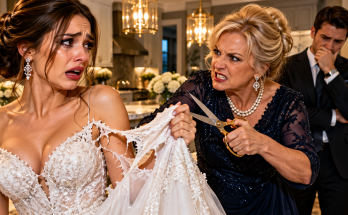
“Don’t,” Jenna said before I could speak.
I hadn’t actually asked anything yet.
That made it worse.
She pressed both hands together beneath her chin, looking briefly guilty. “Please. Just trust her.”
There are sentences that calm you because they provide information, and sentences that make you nervous because they confirm information exists.
That belonged firmly in the second category.
“Trust her about what?”
Jenna closed her eyes.
“See? This is why I didn’t want to say anything.”
Aaron, standing beside me, looked delighted by the sudden mystery.
I was less entertained.
“Jenna.”
“She is not leaving.”
“I didn’t think she was.”
“She is not sick.”
“I didn’t ask that either.”
“And she absolutely wants to marry you.”
Aaron leaned toward me. “These are all excellent facts.”
I ignored him.
Jenna lowered her voice. “Claire is doing something she decided was important. That’s all I’m telling you.”
“What kind of something?”
“A Claire kind of something.”
“That means nothing.”
“It means you’ll understand when you see her.”
She started to move away.
I caught myself before asking her to stop.
Whatever Claire was planning, I suddenly understood that half the people closest to her had been recruited into protecting it. Pushing harder would only turn me into the groom trying to interrogate bridesmaids minutes before the ceremony.
So I let Jenna go.
Aaron waited until she was beyond earshot.
“A Claire kind of something,” he repeated.
“I heard her.”
“What does that mean?”
“I have no idea.”
“Flash mob?”
“She hates flash mobs.”
“Horse?”
“There is no horse.”
“Choir?”
“Why would she hide a choir?”
“Maybe she hired your high school principal.”
I looked at him.
“I’m trying to help.”
“You’re failing.”
The coordinator appeared again and waved us toward the rear terrace.
It was time.
We stepped outside.
Warm air moved through the trees and carried the scent of cut grass, roses, and whatever the catering staff had begun cooking inside. The late-afternoon light had softened enough that the lawn looked almost unreal, green beneath rows of pale wooden chairs.
Guests turned as we emerged.
I smiled automatically.
My hands had gone cold.
Aaron murmured greetings to people we passed while I recognized faces in flashes: one of Claire’s cousins, my former roommate, an aunt I hadn’t seen since Christmas, two coworkers trying unsuccessfully to look as though they hadn’t already started drinking.
At the front, the officiant greeted us quietly.
“You ready?”
“I think so.”
“That’s all anybody gets.”
He smiled and took his place.
I stood where the coordinator had marked the ground earlier, beneath the crossing branches of two old trees.
For a few seconds, logistics took over my brain.
The microphone.
The floral arrangement.
The rows of chairs.
The space where Claire would stand.
Then I looked at the front row.
My mother was already seated.
She wore deep blue, a color Claire had helped her choose after weeks of indecision. Her silver-blond hair was pinned back, and she was holding a small folded tissue despite insisting all morning that she would not cry until the vows.
She caught my eye and smiled.
I smiled back.
Then I saw the empty chair beside her.
Nobody had placed a photograph on it.
There was no reserved sign.
No flower.
Nothing announced that the chair meant anything.
But to me, it did.
In every version of the wedding I had imagined as a kid, and even in the careless versions I imagined as an adult before I met Claire, my father had been somewhere near that chair.
Richard had been sixty-two when he died.
No long illness had prepared us.
No doctor had sat the family down to explain what came next.
I had spoken to him on a Tuesday evening.
The subject was my car.
He had been irritated because I had waited too long to replace the brake pads.
“You don’t negotiate with brakes, Danny.”
“They’re making a little noise.”
“That’s the brake system asking why its owner is an idiot.”
“They’re fine.”
“They’re not fine if they’re making noise.”
“It’s probably dust.”
“It’s probably you trying to save eighty dollars.”
That was one of the last full conversations I ever had with him.
The next morning my phone rang while I was getting ready for work.
My mother was on the other end, crying so violently that at first I couldn’t understand her words.
Dad had collapsed.
Heart attack.
Ambulance.
Hospital.
I remember driving too fast, which would have infuriated him.
I remember parking badly.
I remember running through sliding glass doors and finding Aaron in the corridor with a look I had never seen on his face before.
Dad was gone before I arrived.
For months afterward, the most ordinary objects could undo me.
A screwdriver in his garage.
A voicemail I couldn’t delete.
The smell of the soap he used.
A hardware-store receipt with his handwriting across the back.
Eventually those ambushes happened less often.
People called that healing.
I wasn’t sure that was the correct word.
Four years later, I could speak about him without losing my voice. I could tell funny stories. I could help Mom sort through old boxes. I could even joke with Aaron about Dad’s obsession with checking tire pressure.
But the wedding exposed a different layer.
There were roles dead parents were supposed to play in their children’s futures, and I kept discovering them only when I reached the moment where he should have been.
When I bought the ring, I imagined calling him.
When I proposed, I imagined telling him.
When Claire and I chose the venue, I imagined him criticizing the parking.
When Aaron started planning his best-man speech, I could practically hear Dad complaining that the younger generation had no respect for speech length.
I never told Claire most of that.
Partly because she already knew.
Partly because I didn’t know how to say it without making the entire engagement sound sad.
Claire had never met him.
Dad died about a year after she and I started dating, but by a combination of bad timing and family schedules, their paths had never properly crossed. She knew him through stories, photographs, my mother, and the habits Aaron and I didn’t realize we had inherited.
Sometimes she would catch me doing something and say, “That came from your dad, didn’t it?”
Usually she was right.
Once, while I was checking all four tires before a long drive, she leaned against the car and smiled.
“You know you’re becoming him.”
“I’m being responsible.”
“You checked them yesterday.”
“Pressure changes.”
“It changed overnight?”
“Possibly.”
She laughed. “Richard would be proud.”
The name had caught me unexpectedly.
I had turned away under the excuse of tightening a valve cap.
Claire noticed.
She didn’t apologize for mentioning him.
That mattered.
Some people treated dead relatives like names that could summon disaster if spoken casually. Claire never did. She understood that remembering Dad wasn’t the thing that made me miss him.
The missing already existed.
From the front row, Mom gave me a small wave.
I lifted my hand.
For half a second I imagined Dad sitting beside her.
He would have hated the narrow ceremony chairs. He would already have loosened his tie. He would have been whispering inappropriate commentary to Mom until she told him to behave.
And at some point he would have looked at me with that amused, assessing expression he used whenever I did something unexpectedly adult.
I pictured him after the ceremony.
He would wait until the crowd moved away, grip the back of my neck, and say the name nobody else used anymore.
Danny.
He called me that when I was six.
He called me that when I was thirty.
At some point in my twenties I told him I was too old for it.
He stared at me as if I’d said something medically concerning.
“You’re always going to be Danny to me.”
“That sounds threatening.”
“It is.”
Now nobody called me Danny.
My mother occasionally came close, then seemed to stop herself.
Aaron had never used it.
Claire knew the nickname only because she had heard Mom mention it once.
Standing beneath those trees, staring at the empty chair, I felt the absence with an intensity I had been avoiding for months.
Aaron noticed.
He stepped closer without looking directly at me.
“You good?”
“Yeah.”
“Actual yeah?”
I inhaled.
“Actual enough.”
He nodded.
That was how we talked about Dad when the feeling was too large for ordinary sentences.
Music began quietly from the speakers hidden near the terrace.
Conversations faded.
Guests turned forward.
The coordinator made a small hand signal from the back of the aisle.
My mother folded her tissue once more and held it tightly between both hands.
I looked down, adjusted my cuff, then raised my head.
For the first time all day, everything strange about Jenna, the closed preparation room, and Claire’s secret stopped mattering.
This was the moment I had pictured.
Soon Claire would appear.
I would see the dress she had protected for months.
She would walk toward me beneath the trees.
We would say the words.
We would become husband and wife.
Simple.
Traditional.
Normal.
That was what I thought I wanted most.
The first bridesmaid stepped onto the aisle.
Then another.
Jenna appeared last.
As she came closer, she met my eyes.
She wasn’t smiling the way the others were.
She gave me one tiny, almost imperceptible nod.
Not congratulations.
A warning.
Or reassurance.
I couldn’t tell which.
Then she took her place across from Aaron, and the first piece of music ended.
The entire garden became still.