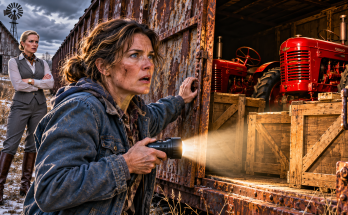
I kept returning to the photograph Laurel had sent Mom.
There was something about seeing Dad standing beside Harold that made it difficult to think of their relationship merely as a loan that hadn't been repaid.
They had known each other long before either of them had children.
They had watched each other's families grow.
Somewhere along the way, they had become involved in financial arrangements that I had never understood.
I wondered what Dad knew.
I wondered what Mom knew.
And I wondered why Harold had felt it necessary to write that particular message shortly before Dad died.
With Mom's permission, Mr. Ellison contacted Laurel.
About a week later, she came to see us.
She arrived carrying a cardboard box.
I hadn't seen her in years.
She was in her early fifties now, with strands of silver beginning to appear near her temples.
Yet I recognized something familiar in her expression as soon as I opened the door.
She greeted me warmly.
Then she looked past me and saw Mom.
Her face softened.
She put the box down and went toward her.
Mom held out her arms.
Laurel embraced her carefully, mindful of the difficulties she still experienced because of her hip.
They remained together for a little while.
When Laurel finally stepped back, her eyes were damp.
"I've thought about coming to see you so many times."
Mom smiled.
"Look at you. All grown up."
Laurel laughed.
"I was already nearly forty the last time we saw each other."
"You'll always be one of the children to me."
I understood that.
There were people my parents had known for so long that age seemed almost irrelevant to the way they remembered them.
Laurel was somebody's daughter before she was anything else.
Just as I remained somebody's daughter, even though I had five children of my own.
We gathered around the kitchen table.
Laurel placed the cardboard box beside her chair.
She took out several groups of papers.
There was also a notebook.
She explained that sorting through her father's belongings after his death had been a difficult experience.
There were documents relating to his business.
There were old financial records.
There were personal things he had kept.
Among those papers, she had found material concerning the money Dad lent him.
She wanted to make sure it was dealt with appropriately.
I appreciated that.
Laurel hadn't been responsible for the original arrangement.
She hadn't borrowed the money herself.
Yet she had taken the trouble to contact Mom rather than allowing the matter to remain buried among her father's belongings.
I showed her the photograph.
"Could you explain what your father meant by this?"
She looked at it.
Then she nodded.
She began telling us about the history between her father and mine.
Apparently, they had assisted each other on several occasions over the years.
Sometimes the assistance had been practical.
Sometimes it had involved money.
Their friendship extended through different stages of their lives and the various difficulties they experienced while supporting their families.
When Harold's transport business encountered serious problems, Dad had agreed to lend him money.
I already understood that part.
What I hadn't understood was what happened when our farm became threatened with foreclosure.
Laurel opened the notebook.
Her father had known how serious our circumstances were.
He also knew Dad wanted to help us.
Unfortunately, much of the money Dad and Mom had available was already committed elsewhere.
Some of it was the money Harold owed them.
Laurel explained that her father had made an effort to return part of the loan earlier than he otherwise would have been able to.
That repayment helped Dad and Mom gather the forty-eight thousand dollars they provided to Stig and me.
I looked toward Mom.
She nodded.
I remembered the two signatures on the authorization from their savings account.
Those signatures still told the truth.
Our parents had chosen to use their money to help us.
But Harold had played a role in making some of that money available when they needed it.
I turned back to Laurel.
"Did he give Dad something extra?"
"No."
She pointed toward the records.
"It was part of what he already owed."
I felt relieved to understand that distinction.
There hadn't been another entirely separate gift we knew nothing about.
Harold had managed to return part of an existing loan at a time when doing so was particularly helpful to our parents.
Laurel explained that he had made a considerable effort to arrange it.
His own business hadn't been in particularly strong financial condition.
But he understood that Dad needed the money.
I looked at Mom.
She was holding the photograph again.
"Your father never forgot what mine had done for him," Laurel said.
Mom nodded.
"They looked out for each other."
I thought about the timing.
Our farm had been approaching the point where we might have lost it.
Dad was dealing with his own illness.
Mom was trying to prepare for a future without him.
And Harold was trying to keep his own business functioning.
None of them had been in an especially comfortable position.
Yet money had moved between them because one household needed something another household could provide.
It wasn't a simple story about wealthy people helping those less fortunate.
It was a story about people who were struggling themselves.
People who had reasons to hold on to every available dollar.
People who had nevertheless decided to help.
I felt grateful.
I also felt concerned about the long-term consequences of those decisions.
Mom's financial position was evidence that even generous choices could leave difficult problems behind.
Both things could be true.
I was beginning to understand that I didn't have to choose between admiring our parents and wishing they had protected themselves a little better.
Laurel went through some additional information concerning the outstanding debt.
She explained what she knew about the estate's financial circumstances.
There were other obligations that still needed to be addressed.
She couldn't tell us precisely how much might eventually become available to Mom.
But she believed there was a reasonable possibility that a meaningful payment could be made.
Mr. Ellison would deal with the necessary legal details.
Laurel wanted the matter handled properly.
Mom seemed satisfied with that.
She reached across the table.
"Your father meant a great deal to us."
Laurel took her hand.
"He felt the same about you and your husband."
Her voice became unsteady.
For a moment, nobody spoke.
Then Mom began remembering things about Harold that had nothing to do with money.
Laurel listened.
Sometimes she added details she remembered hearing from her father.
Sometimes Mom corrected something.
They laughed.
They grew quiet.
They told each other how much things had changed.
I sat nearby, occasionally looking at the photograph of the two men beside the green tractor.
I found myself wishing Dad could be there to participate.
He would probably have been embarrassed by all the attention.
He had never liked being praised excessively.
Neither had Mom.
Perhaps that was partly why they had kept so much of their assistance private.
Laurel remained with us for another hour or so.
By the time she prepared to leave, the financial documents were only one part of the reason her visit had mattered.
She and Mom had reestablished a connection that had been allowed to fade over the years.
I was glad they had been able to do that.
After we said goodbye, I returned to the kitchen.
Mom was still looking through some of the papers.
I sat beside her.
"Do you think Dad realized how many people he helped?"
She smiled.
"I doubt he ever added them all up."
I thought about the amounts in the blue folder.
Forty-eight thousand dollars for our farm.
Seventy-two thousand connected to Kurtis's shop.
The thirty-five-thousand-dollar loan to Harold.
The smaller expenses that had helped our families during difficult periods.
I wasn't surprised that Dad hadn't thought much about being repaid in gratitude.
He had never approached his relationships that way.
But the ledger had shown us the consequences of not keeping enough for themselves.
"Maybe he should've done a little more adding up," I said.
Mom laughed.
"There's probably some truth in that."
Then her expression became thoughtful.
She turned the photograph over again.
"I wouldn't change the fact that we helped people."
I nodded.
"I know."
"But I'd do some things differently now."
She looked at me.
"It's possible to care for somebody without giving them every part of yourself."
I thought about the guest room.
The proposed trial stay.
The conditions she had attached to it.
She was trying to make sure none of us approached her care the way she and Dad had approached some of their financial decisions.
She wanted us to help.
She didn't want us to exhaust ourselves.
And she wasn't willing to accept assistance that would eventually leave somebody else in need of rescuing.
I understood that more clearly after Laurel's visit.
The following weeks were filled with practical arrangements.
Kurtis began organizing his working hours so he could attend some of Mom's appointments.
Whenever he was able to be there, he listened carefully.
Sometimes he asked questions I hadn't thought to ask.
I was glad he was developing an understanding of her needs that didn't depend entirely on what I told him.
Britt and I began coordinating our visits.
We discussed which days were suitable for each of us.
If something changed, we told each other.
Neither of us assumed the other person would automatically fill every available gap.
That seemed like an obvious way of arranging things.
Yet it was considerably different from the way I had been managing responsibilities before Christmas.
Stig began obtaining estimates for making the farmhouse entrance more accessible.
He took the practical recommendations seriously.
We didn't want to spend money on modifications that wouldn't actually address Mom's needs.
Nor did we want to overlook something important because it appeared inconvenient.
The arrangements moved forward gradually.
Meanwhile, Mom continued working on her rehabilitation.
Not every day was encouraging.
Some days she felt she had made progress.
On others, she struggled with something she had previously managed.
I could see how frustrating that was for her.
She had lived for approximately eighty years without needing somebody to help her with many of the most ordinary activities.
Now she sometimes had to concentrate on movements she had once performed without thinking.
One day, during a visit, she became visibly irritated with herself.
I sat nearby while she recovered from the effort she had been making.
"I should be able to do more than this," she said.
I looked at her.
"You've already done quite a lot."
She shook her head.
"You know what I mean."
I did.
She remembered how capable she had been before the fall.
She was comparing herself with that earlier version of herself.
It was an unfair comparison, but I understood why she made it.
I had done something similar when the farm was struggling.
Kurtis had done it after losing his business.
We all seemed capable of making ourselves miserable by expecting the present to resemble the past.
"You don't have to prove anything to us," I told her.
She gave me a skeptical look.
Then she smiled.
"I suppose you're right."
We talked about something else.
I was learning that every visit didn't have to revolve around her recovery.
Sometimes she wanted to discuss the children.
Sometimes she wanted to hear about the farm.
Sometimes she simply wanted somebody sitting nearby while she rested.
The blue circles on her calendar had made me reconsider what I was offering her.
I still helped with practical matters.
But I tried to leave enough time for ordinary companionship too.
By February, Mom's care team had gathered enough information to consider a carefully organized trial stay at our farmhouse.
I was delighted when we heard that the arrangement could move forward.
But I didn't begin packing her belongings immediately.
There were still preparations to complete.
We needed to have the necessary equipment available.
We needed professional assistance arranged.
We needed a clear understanding of her medication schedule and follow-up appointments.
The plan would have to be reviewed as her needs changed.
Mom wanted to be involved in those arrangements.
Whenever somebody discussed something affecting her, she expected to know what was being proposed.
I appreciated that.
This wasn't a decision we were making about an empty guest room.
It was a decision about where and how she would spend her days.
During one discussion, Paloma was standing nearby with her clipboard.
Mom listened to the various arrangements being explained.
Then she looked at all of us.
"Remember, I'm changing my address. I'm not giving up the right to run my life."
Paloma burst out laughing.
So did I.
Mom looked quite pleased with herself.
There was something wonderful about seeing her personality emerge so strongly after months of uncertainty.
She was still the woman who had raised Kurtis and me.
She still had opinions.
She still wanted to understand what was happening around her.
And she still expected people to listen when she spoke.
We finished making the arrangements.
A date was established for the beginning of her trial stay.
When I returned home, I went into the downstairs guest room.
I looked at the space we had prepared.
Then I opened the curtains.
The equipment shed stood beyond the window.
I remembered Mom sitting there in January, quietly considering whether she might be happy living with us.
Soon, she would have a chance to find out.