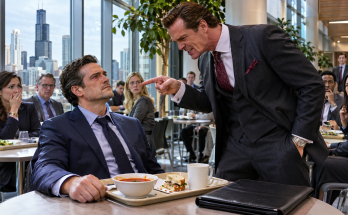
Gail glanced at the information I had placed in front of her.
She barely looked at the first paragraph.
"What is this supposed to prove?"
"It's the policy governing voluntary living donation."
She pushed the paper away slightly.
"I don't see why we need another discussion."
I drew it back toward the center of the table.
"Because a potential donor has the right to decide whether to participate."
She sighed.
"Annie, we're talking about your sister."
"I know exactly who we're talking about."
I explained that a donor could not be pressured into surgery.
There could be no threats, no conditions imposed by relatives, and no obligation based on a family relationship.
The assessment had to establish that the decision was informed and freely made.
Gail looked toward the hospital attorney.
Then she looked at me.
"You people certainly know how to make a simple thing complicated."
I stared at her.
There was nothing simple about the operation we were discussing.
There were risks.
There would be pain, recovery, and medical consequences I would have to consider for the rest of my life.
I understood those realities better than most people sitting at that table.
And understanding them didn't make my body any less valuable than somebody else's.
"It's not a minor favor you're asking for, Gail."
She noticed that I had stopped calling her Mom.
Her eyes narrowed.
"I'm trying to keep my daughter alive."
Before I could answer, Victoria spoke.
"Could you please stop?"
Gail turned toward her.
"What is it?"
"The way you're talking to her."
Gail looked irritated.
"Victoria, let me handle this."
"No."
The word was quiet, but it carried across the room.
I turned toward my sister.
She straightened herself in the wheelchair.
Her face was pale.
Her eyes were still wet from crying.
But she appeared determined to finish what she had started.
"You've just found out who she is, and you haven't asked her one thing about her life."
Gail frowned.
"We've got more urgent matters to worry about."
"She's your daughter, too."
Gail became very still.
Victoria swallowed.
"I've spent years thinking Annie didn't want anything to do with us."
I watched her pull her sweater sleeves away from her fingers.
"Now I know why she wasn't there. And you're acting like the only important thing is whether she can give me an organ."
"That's because you're ill!"
"I know I'm ill."
Her voice trembled.
"I'm the one who has to go through dialysis."
Gail looked toward Vince.
He didn't say anything.
Victoria continued.
"I don't want you speaking to Annie like she exists to fix me."
For the first time since the meeting began, Gail appeared to have no easy response.
I looked at my sister.
She was exhausted.
She had spent years living with an illness that had gradually taken away her independence.
She knew what a transplant could mean for her.
Yet she was defending my right to refuse one.
I hadn't known what kind of woman she had become.
Now I was beginning to find out.
Gail reached for her handbag.
"This conversation is getting us nowhere."
She stood.
Then she looked directly at me.
"I need a moment alone with you."
I shook my head.
"We can discuss the relevant matters here."
"Not everything is hospital business."
"No. But there isn't anything I need to discuss with you in private right now."
She stepped closer to the table.
"You're still my daughter."
I looked at the surrender document.
"You were my mother when you put your name on that page."
Her expression changed.
For a moment, I thought she might sit down again.
Instead, she pulled her handbag against her side.
She looked at Victoria.
Then she turned toward the door.
Vince stood immediately and followed her.
Neither of them said goodbye.
The door closed behind them.
I remained seated.
There was a strange feeling in the room after they left.
Nobody seemed quite sure whether to speak.
I looked toward Dr. Vance.
He gave me a moment.
The other people at the table respected the silence.
I appreciated that.
Victoria was the first person to break it.
"I'm embarrassed."
I turned toward her.
"About what?"
"Everything she said."
"You don't need to carry that."
She shook her head.
"She had no business treating you like that."
I looked down at the surrender form.
I could have told Victoria that the conversation had sounded painfully familiar.
That our mother had been placing her needs ahead of mine since the day I was taken to Saint Jude's.
Instead, I reached for my sister's hand.
"You're not responsible for how she behaves."
Victoria nodded slowly.
Then she remembered something.
"Oh. I nearly forgot."
She reached into the pocket of her gray sweater.
The effort seemed to tire her.
She removed a small folded piece of paper and placed it beside my folder.
"I wanted to bring this in case the doctor had found my sister."
I unfolded it.
It was another old photograph.
I immediately recognized the little girl sitting on the floor.
She had dark hair and was holding a stuffed bear.
Beside her was a much smaller child wrapped in a white blanket.
I looked at Victoria.
"That's us."
She nodded.
I turned the photograph over.
Four words had been written on the back in faded blue ink.
Our names.
Annie and Tory Bear.
I ran my thumb carefully along the edge of the photograph.
I hadn't known it still existed.
Gail had told me that Vince had thrown away most of the childhood pictures when they moved.
She had handed me the photograph of myself wearing the knitted hat as though it were the last surviving piece of my childhood.
But Victoria had this one.
"Where did you find it?"
"In a box at home."
She smiled sadly.
"Apparently, nobody thought it was important enough to throw away."
I looked at the bear again.
I remembered holding it.
I remembered how important it had once seemed.
There was something almost unbearable about seeing the photograph after so many years.
The little girl on the floor had no idea that she would soon be separated from the child beside her.
Neither of us understood what was coming.
We simply sat together.
Victoria brushed a tear away.
"I used to take that picture out when I was younger."
I looked up.
"Did you?"
"Sometimes I imagined that you were somewhere thinking about me."
I swallowed.
"You weren't wrong."
She stared at me.
"Really?"
"Of course I thought about you."
I couldn't tell her how many times.
I couldn't count the occasions when a little girl's laughter had reminded me of her or when somebody had mentioned a childhood memory that made me wonder about hers.
There had been entire years when I tried not to think about what I had lost.
But Victoria had never completely disappeared from my thoughts.
She looked at the photograph again.
Then she asked something Gail hadn't thought to ask.
"Were things all right for you afterward?"
I knew what she meant.
She wanted to know about the years following Saint Jude's.
She wanted to know whether I had been safe.
I nodded.
"I was very fortunate."
Her face softened.
"Tell me about them."
"Michael and Olivia?"
"Yes."
I looked at the photograph of Dad in my mind.
I remembered their kitchen island.
The first Christmas I spent with them was one of the memories I especially treasured.
They had asked what I wanted to eat for Christmas dinner.
I hadn't understood the question at first.
I thought they were asking what I would be willing to eat.
Instead, they were giving me an actual choice.
They wanted my opinion because I was part of the family.
That had been new to me.
I told Victoria about Olivia teaching me to bake.
How ordinary afternoons spent in the kitchen had gradually become some of the safest moments of my childhood.
I told her how Dad brought home medical textbooks when I was twelve.
He sometimes behaved as though he couldn't possibly understand something without my assistance.
I had believed him often enough to become interested in what was inside those books.
Victoria laughed.
"He sounds wonderful."
"He is."
I told her how that interest developed into a determination to study medicine.
I described the long training, the exhaustion, and the satisfaction of finally being able to help patients myself.
I talked about assisting with my first transplant operation.
I remembered how seriously I had taken every responsibility and how proud I had felt afterward.
Then I told her about becoming chief.
She listened carefully.
She wasn't waiting for me to finish so she could ask about the transplant schedule.
She genuinely wanted to know.
There was something healing about telling my sister those stories.
For so long, she had existed somewhere outside the life I had built.
Now I was able to invite her into it through ordinary memories.
When I finished, she looked at me with a small smile.
"I'm so relieved you ended up with people who cared about you."
I reached toward her.
"They did."
She looked down.
"I used to worry about where you were."
"I know."
"I thought maybe you had nobody."
I squeezed her fingers.
"I had a family, Tori."
She nodded.
Tears appeared in her eyes again.
I wondered how long she had carried that fear.
Even while believing I had run away, she had apparently worried about whether I had found somebody to look after me.
I wanted her to understand that she didn't need to feel guilty about the childhood I eventually received.
Michael and Olivia had given me a good life.
Their love wasn't something Gail could take away by returning.
After a while, Victoria looked toward the medical documents.
Her expression became serious.
"Can I ask about the kidney?"
"Certainly."
She hesitated.
"Do you actually want to do this?"
I appreciated the way she asked.
She didn't assume.
She didn't point toward the preliminary results as though they represented a promise.
She simply wanted to know what I was thinking.
"I'm willing to explore it properly."
She waited.
"I need the independent team to examine me. They need to establish whether donation would be safe enough to consider."
Victoria nodded.
"And we need to make sure you're medically ready, too."
She looked worried.
"What happens if they say there are risks?"
"There are risks with every operation."
Her fingers tightened around mine.
"Then I don't want you agreeing because of me."
I looked at her.
"You're the reason I'm considering it."
"That's not what I mean."
She took a breath.
"I don't want you feeling like you have to keep me alive because you're my big sister."
I couldn't answer immediately.
That was exactly the difference between Victoria and Gail.
Gail saw our relationship as proof that I had an obligation.
Victoria saw it as a reason to protect me.
"I understand," I told her.
She shook her head.
"Annie, I've only just found you."
Her voice became unsteady.
"I couldn't bear it if something happened to you because I needed treatment."
I felt my eyes fill.
"I don't want us to be separated again," she whispered.
I moved closer.
"We're going to know each other regardless of what the doctors decide."
She looked at me.
"You promise?"
"I promise that being your sister doesn't depend on whether I'm your donor."
She nodded.
Then she reached for me again.
I held her.
There was no television audience.
Nobody was telling us what we owed each other.
We were two women trying to understand how to be sisters after missing most of each other's lives.
And for the first time, I believed we might actually get that opportunity.
Three days later, Gail contacted the hospital administration.
The complaint concerned me personally.
She claimed I had allowed unresolved family resentment to interfere with Victoria's transplant.
She suggested that I was deliberately slowing the process.
She also questioned whether I had obtained the adoption documents through improper use of my hospital position.
When the hospital attorney requested a meeting, I wasn't surprised.
I brought the necessary information.
The records belonged to my own adoption history or had been obtained through legitimate procedures.
I hadn't used my role as chief to gain unauthorized access to them.
I was prepared to establish that clearly.
What worried me more was the accusation that Victoria's treatment was being deliberately delayed.
She was already frightened enough about her health.
She didn't need to start wondering whether her sister was withholding medical care to settle an old argument.
That afternoon, the transplant coordinator telephoned me.
Her voice was unusually serious.
"Dr. Kingsley, I think you should know what's happening."
I put down my pen.
"Has something happened with Victoria?"
"No. It's regarding your mother."
I leaned back.
The coordinator explained that Gail had approached two local television news stations.
Apparently, the story she was telling had changed again.
Now I was a surgeon refusing to help her sister until my mother admitted that she had abandoned me.
I closed my eyes.
We had spent an entire meeting explaining the need for independent assessment.
We had discussed voluntary consent.
Victoria herself had spoken against the pressure being placed on me.
None of that seemed to matter to Gail.
She had found a version of events that made my medical decisions sound like punishment.
"Does Victoria know about this?" I asked.
"Not that I'm aware of."
"Please don't expose her to those reports unnecessarily. She has enough to manage."
The coordinator understood.
After the conversation ended, I remained in my office.
The photograph Victoria had brought was lying beside my folder.
I turned it over and looked at the faded writing.
I thought about the child holding the bear.
I had spent years becoming someone capable of making difficult decisions.
Yet Gail still seemed convinced that my choices belonged to her.
When I agreed with her, she called me a good daughter.
When I insisted on having a choice, she accused me of letting my sister suffer.
I put the photograph down.
I needed to get away from the hospital for a few hours.
More importantly, I needed to hear myself think without Gail's demands influencing every question.
That evening, I went to Dad's brownstone.