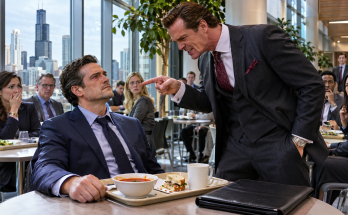
"Before I go, would you mind answering something?"
Richard looked impatient.
"What?"
"Why should somebody's position determine whether they're allowed to sit in this room?"
He looked around the cafeteria as though the answer ought to have been obvious to everybody present.
"We conduct business here."
I looked at the employees sitting nearby.
Most of them were looking at their trays.
"What kind of business?"
"Important discussions. Client relationships. Management matters."
He spoke with the certainty of somebody explaining something to a particularly slow child.
"We can't have staff members sitting around us while we're dealing with those things."
I thought about the people I had watched eating together when I arrived.
There hadn't been a single conversation that appeared to require executive confidentiality.
"Don't the other employees have responsibilities too?"
"That's not the point."
"What is the point?"
His expression hardened.
"People need to recognize the structure of the organization. Otherwise, nothing works properly."
There it was.
He hadn't bothered to refer to a written policy.
He hadn't explained a genuine business requirement.
He believed there were people who belonged in certain rooms and people who didn't.
And he believed he was entitled to make that distinction.
I looked toward the cafeteria manager.
The poor man was still standing near the counter.
Richard hadn't given him an instruction he could comfortably follow.
He had given him an instruction that forced him to choose between doing his job properly and pleasing a powerful executive.
I didn't want to make that choice any more difficult for him.
I stood.
Richard took a small step backward.
For the first time since approaching me, he seemed reasonably pleased.
"Finally."
I gathered my things.
The black leather folder went under my arm.
I lifted the plastic tray with both hands.
I had decided against revealing my identity there.
It wasn't because I enjoyed the idea of surprising Richard later.
I wanted to understand what I had just witnessed without transforming it into an argument about who possessed greater authority.
If I announced that I was the CEO, every expression in the cafeteria would change.
Richard would probably apologize.
The cafeteria manager would relax.
The employees would discover that the man being mistreated happened to be somebody capable of protecting himself.
But that wouldn't tell me anything about what happened when he wasn't.
I had moved only slightly away from the table when a young man's voice came from beside me.
"Excuse me, sir."
Richard turned.
The young man was sitting at the neighboring table.
He looked uncomfortable.
His hands were near his tray, and he seemed to be making a considerable effort to keep his voice steady.
"He hasn't done anything to anyone."
I stopped.
Richard studied him.
"What did you just say?"
The young man hesitated.
Then he answered.
"I just meant he's been sitting here eating. That's all."
It wasn't a particularly bold statement.
He hadn't accused Richard of anything.
He hadn't called him a bully.
He had simply described what everybody in the cafeteria had witnessed.
Richard reacted as though the young man had challenged his right to manage the entire company.
"Tell me your name."
The young man's expression changed.
"Michael."
"Michael what?"
"Michael Torres, sir."
Richard nodded slowly.
"And where do you work?"
"Customer support."
I watched Michael's shoulders draw inward.
He seemed to understand where the conversation was going.
Richard smiled.
It wasn't a friendly smile.
"Perhaps you should spend a little more time dealing with your customers and a little less time involving yourself in management decisions."
Michael looked down.
Richard continued staring at him for another moment.
Then he turned his attention back to me.
I wanted to say something.
Every instinct I had developed over fifteen years of management told me that Michael needed somebody to stand beside him.
But the incident had already shown me something important.
Richard was capable of treating a reasonable observation as an act of insubordination.
If I challenged him further without explaining my position, he might direct even more anger toward Michael.
And if I announced my position, Richard's immediate behavior would no longer reflect what happened under ordinary circumstances.
I had to make sure that Michael didn't suffer because of what he had done.
That responsibility was mine now.
I looked at him.
He didn't look back.
He was staring at his food.
The sight stayed with me.
A few seconds earlier, he had been an employee eating lunch.
Now he had been reminded that expressing an opinion could put his employment at risk.
I felt angry.
More than I had when Richard pointed at me.
There was an important difference between the two of us.
I could afford to remain standing there.
Michael couldn't necessarily afford to say another word.
I carried my tray toward the return counter.
The conversations around me hadn't properly resumed.
People were trying to look occupied.
Some moved their food around.
Others reached for drinks they didn't appear interested in drinking.
Richard walked a short distance alongside me.
"Next time, I'd suggest finding out how things are done here before helping yourself to a seat."
I stopped.
He looked at me.
"I appreciate the explanation, Mr. Whitmore."
For a moment, he appeared confused.
Then his eyes narrowed.
"Have we met?"
"No."
"Then how do you know my name?"
I shifted the folder beneath my arm.
"I make an effort to know the people around me."
He didn't answer.
I continued toward the counter and returned my tray.
The tomato soup was still unfinished.
So was the sandwich.
I remembered placing the coffee cup beside the bowl before walking away.
It seemed ridiculous that such a small, ordinary detail would become one of my clearest memories of that afternoon.
But it did.
As I left the cafeteria, the noise gradually returned behind me.
A conversation began.
Then another.
People were going back to their lunches.
Richard had gotten what he wanted.
He had removed somebody he considered unworthy of sharing his space.
He probably considered the matter settled.
I didn't.
By the time I reached my temporary office, I was no longer thinking primarily about how he had spoken to me.
I was thinking about the cafeteria manager.
The employees who hadn't looked up.
Michael Torres.
I placed the black leather folder on my desk.
There were still financial reports waiting for my attention.
I moved them aside.
Then I asked my executive assistant to come in.
Olivia Bennett arrived carrying a notebook.
She had been helping me find my way through Sterling's complicated management structure since my appointment.
She was efficient.
Careful.
And, I was beginning to suspect, accustomed to working around things that nobody had successfully addressed.
"Do you have a moment, Olivia?"
"Certainly, Mr. Carter."
She opened her notebook.
I asked her to sit down.
"I need some information about Richard Whitmore."
Her pen remained above the page.
She didn't write immediately.
"What kind of information?"
"Personnel complaints, to begin with."
She looked at me.
"How far back?"
"Three years."
She wrote that down.
"I'd also like the staff departure figures for the sales division over the same period."
Another note.
"And I want to know which clients have canceled agreements or reduced their business with us during the previous eighteen months."
Olivia finished writing.
Then she looked up.
"Is there a particular issue you're investigating?"
"I'm trying to establish how Mr. Whitmore manages his people."
She looked down at the notebook again.
There was a hesitation in her manner that hadn't been there when we had discussed ordinary administrative matters.
I waited.
Eventually, she spoke.
"There have been some difficulties in that department."
"What sort of difficulties?"
"Management complaints."
"Concerning Richard personally?"
"Some of them, yes."
She looked toward the door.
It was closed.
I hadn't realized how much that small gesture would bother me until I saw it.
We were sitting inside the office of the company's chief executive.
Yet Olivia still seemed concerned about discussing its sales director.
"Go on," I said.
"Employees have complained about the way he speaks to people."
"Privately?"
"Sometimes in front of other employees."
I thought about Michael.
"What else?"
"Targets that some people believe are unreasonable. Pressure concerning reported sales performance."
"What kind of pressure?"
She chose her words carefully.
"There have been allegations that employees were expected to present figures in a way that wasn't entirely accurate."
I leaned forward.
"Allegations of misrepresentation?"
"Yes."
"And these matters were investigated?"
"Human Resources dealt with them."
"What was the outcome?"
She hesitated again.
"Management discussions took place. The cases were generally closed afterward."
"Who authorized that?"
She knew the answer.
I could see that immediately.
But she seemed reluctant to say it.
"The former chief operating officer. Mr. Whitmore reported to him."
I looked at the notes she had made.
I had encountered this arrangement before.
Employees complained about a powerful manager.
The complaints traveled through a process that appeared independent on paper.
Eventually, the responsibility for deciding what happened returned to someone who benefited from keeping that manager in place.
The employee received some kind of acknowledgment.
A file was closed.
And the manager continued working as before.
I wasn't prepared to assume that had happened here.
But I needed to find out.
"Please arrange for me to receive the complete files," I told her.
"Would you like a briefing document?"
"No. I need to see the complaints as they were submitted, along with the responses and decisions."
She nodded.
"I'll request those."
"And whatever records exist regarding the departures."
"Certainly."
She started to stand.
Then stopped.
"There's something else you might want to know."
I waited.
"It's about what happened downstairs today."
I wasn't surprised that news of the confrontation had reached her.
A room full of employees had witnessed it.
"What have you heard?"
"People have been talking about the employee who spoke up."
"Michael Torres."
"Yes. I believe that's his name."
She lowered her notebook slightly.
"There's a suggestion that Mr. Whitmore intends to pursue disciplinary action against him."
I looked at her.
"For what?"
"I haven't seen anything official."
"Has Richard submitted a request?"
"I don't know."
I appreciated that she didn't pretend to possess information she hadn't verified.
"Please find out whether anything has been initiated."
She nodded.
"There's also supposed to be a recording of what happened."
I thought about the employees who had been holding their phones.
It was entirely possible.
"Do we know who has it?"
"Not yet."
"Find out whether it actually exists."
"Would you like me to obtain a copy?"
"If somebody is willing to provide it through an appropriate process, yes. But nobody should feel compelled to hand anything over."
She wrote another note.
"And don't tell anyone what the outcome of this will be," I added.
"I haven't reached a conclusion."
"Of course."
She left.
I remained at my desk.
Outside the window, Chicago continued with its afternoon.
Vehicles moved through intersections.
People walked between buildings.
Everything looked orderly from where I was sitting.
That was one of the problems with being high above the street.
Distance made complicated things appear simple.
I turned back toward the door Olivia had closed.
What concerned me wasn't merely that Richard had apparently mistreated employees.
It was that complaints had already been made.
People had already tried to explain that something was wrong.
The organization had received those warnings.
And Richard Whitmore was still confident enough to threaten a stranger in a crowded cafeteria.
I thought again about the young man at the neighboring table.
Michael had taken a risk I hadn't needed to take.
He didn't know that I was the CEO when he defended me.
He had spoken because he believed I was being treated unfairly.
Nothing in that choice suggested that he expected anything in return.
Richard, meanwhile, had apparently considered that act of basic decency a disciplinary matter.
I opened the black folder.
Then I began making space on my desk for the records Olivia was arranging to send me.
For the first time since accepting the position at Sterling Global, I felt that I knew where my work needed to begin.