I thought I could earn my father's love.
For eighteen years, I treated it like something I hadn't worked hard enough to deserve.
Better grades.
Fewer complaints.
Another reason for him to look at me the way he looked at my brother.
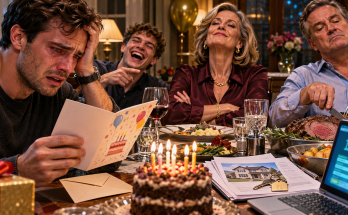
On my eighteenth birthday, I brought an envelope to the dinner table that I believed might finally make a difference.
My father brought his checkbook.
Neither of us knew how much those two things would change our family.
My name was Quinton Fairbanks.
I grew up in Oakbrook, Illinois, among houses with enormous windows, carefully maintained lawns, and garages big enough to hold more cars than most families needed.
From the street, our house looked like a wonderful place to grow up.
I understood why people thought that.
They saw my father leaving for work in an expensive suit. They saw my mother smiling politely when neighbors stopped to speak to her.
They saw my older brother Nolan driving a beautiful BMW before he was old enough to understand what earning one meant.
What they didn't see was me standing beside a public bus stop in clothes that had once belonged to him.
My father, Dwight Fairbanks, was a chief financial officer.
He was good with numbers and particularly proud of his ability to recognize what he considered a worthwhile investment.
Unfortunately, he applied the same thinking to his children.
Nolan was the investment with promising returns.
I was the expense he resented.
Dad wore a diamond-covered Patek Philippe watch on his left wrist.
I remembered that watch better than I remembered some of the things he said to me.
Whenever I approached him with a question, he would sometimes glance down at it before answering.
It was a small gesture.
But it made me feel that whatever I needed was taking something valuable away from him.
My brother never seemed to have that problem.
Nolan knew how to make Dad laugh.
He knew when to ask for something and how to make the request sound like a compliment.
He could talk about his future with such confidence that people forgot to ask what he was doing in the present to prepare for it.
Dad loved that confidence.
My brother struggled academically, but those struggles were treated as problems that could be solved with enough money.
There were private tutors.
There were arrangements made around his schedule.
There were conversations about his enormous potential whenever his actual performance fell short.
I watched adults gather around him whenever he needed something.
When I needed something, I was generally told to find a solution myself.
The distance between our experiences became particularly obvious during winter.
Nolan had his BMW.
I had a two-mile walk before I could even board the bus.
The wind would find its way through the sleeves of a coat that didn't fit me properly.
Snow collected around my shoes.
Sometimes I reached the bus stop with fingers so cold that bending them hurt.
Our house was warm when I left.
I could have stayed warm in a car, too.
There was no financial reason I couldn't.
That was the part I found hardest to understand.
My parents weren't struggling to afford transportation for two children.
Dad had simply decided that one child's comfort mattered more.
I didn't expect a BMW.
I would have been grateful for practically anything that shortened that walk.
But asking for equal treatment usually resulted in a conversation about why I hadn't earned it.
My mother, Vivien, rarely participated in those conversations.
She listened.
She looked uncomfortable.
Then she found something else to occupy her attention.
As a boy, I mistook her discomfort for evidence that she was on my side.
I believed she would eventually say something when Dad went too far.
She never did.
For years, that possibility was enough to keep me hoping.
I became very good at studying without expecting anyone to notice.
School offered something that our house didn't.
There were questions with answers that could be checked.
A correct answer didn't become incorrect because Nolan had given a different one.
A teacher could evaluate my work without considering which of us Dad preferred.
I liked that certainty.
I liked being able to open a book and improve my understanding of something without needing permission.
Medicine became the direction I wanted to pursue.
I understood that getting there would take years.
I understood there would be examinations, difficult courses, and expenses that I couldn't yet calculate accurately.
What I didn't understand was how completely my parents had already decided what I was capable of doing.
I still imagined that an admission committee might persuade them to reconsider.
On my eighteenth birthday, I received an acceptance into an undergraduate program with a strong premedical track.
There was a partial academic scholarship included.
I read the scholarship information carefully.
Then I went through the remaining expenses.
Tuition.
A place to live.
Food and ordinary necessities.
The amount I needed to find came to approximately fifteen thousand dollars each year.
It wasn't a small sum.
I knew that.
But I also knew what my father spent on Nolan without hesitation.
I didn't intend to ask Dad to finance every part of my education.
I had already earned some assistance.
I wanted him to help me cover the difference while I built the foundation for a medical career.
I thought that showing him the official letter would make the discussion easier.
It wasn't just an ambitious idea coming from his younger son anymore.
A university had reviewed my academic record and offered me a place.
Someone outside our household believed I had a reasonable chance.
That mattered enormously to me.
I carried the envelope downstairs that evening.
The dining room was familiar enough that I could have walked through it with my eyes closed.
The polished furniture.
The expensive porcelain.
The carefully arranged place settings.
My mother had always been particular about how things looked at that table.
Everything belonged in its proper position.
Including, apparently, me.
Nolan was there when I arrived.
Dad was in a particularly good mood.
I remember feeling relieved about that because approaching him on a good evening seemed like a sensible advantage.
I didn't understand that his good mood had nothing to do with my birthday.
It had everything to do with Nolan.
Dad produced his checkbook.
I kept my acceptance envelope close while he began talking about the future of our family.
He spoke about medicine as an achievement that would add something important to the Fairbanks reputation.
He sounded pleased with himself.
Nolan listened with the comfortable expression of someone who already knew how a conversation would end.
Then Dad wrote out the check.
Two hundred and fifty thousand dollars.
I looked at the number.
I had spent part of that afternoon calculating how much money I would need for basic living expenses.
Now I was watching my father commit an amount that made those calculations look almost insignificant.
He signed the check without any visible hesitation.
The expensive watch shifted against his wrist.
He slid the money toward Nolan.
“This should take care of your medical education.”
Nolan accepted it.
Dad continued talking about the importance of making something of the Fairbanks name.
He wasn't merely paying tuition.
In his mind, he was purchasing another reason for people to admire him.
I waited until there was room to speak.
Then I placed my envelope where he could see it.
I explained that I had received my college admission decision that afternoon.
I told him about the premedical program and the scholarship.
I said I had gone through the costs and worked out what remained.
Fifteen thousand dollars a year.
I tried to make my voice sound confident.
I didn't want to appear ungrateful or demanding.
I wanted Dad to understand that I had already done part of the work.
He didn't pick up the letter.
I watched his eyes move briefly toward it.
That was all.
I explained that I wanted to study medicine, too.
For a moment, I wondered whether he might be pleasantly surprised.
Perhaps the thought of two sons becoming doctors would appeal to him.
Perhaps he would open the envelope and ask about my grades.
Instead, he looked directly at me.
“You aren't suited for that kind of career, Quinton.”
I didn't understand how he could say it so quickly.
He hadn't read anything.
He didn't know the scholarship amount or the details of the program.
He hadn't asked a single question about my plans.
I tried to explain that the admission was genuine.
That I had worked hard for it.
He stopped me.
“You've never amounted to much. Find yourself a job cooking hamburgers.”
There wasn't any anger in his delivery.
That made it worse.
He sounded like someone stating an established fact that didn't require further discussion.
I looked at Nolan.
He was folding the check.
There was a little smile on his face as he put it away.
I looked at my mother.
She had her knife in her hand.
She was cutting her dinner into pieces so small that there seemed to be no practical reason to continue.
She didn't raise her eyes.
I waited for her to say that Dad should at least read my letter.
I would have accepted that much.
She could have asked him to reconsider.
She could have reminded him that it was my birthday.
She could have simply looked at me.
Nothing.
The room remained comfortable and warm.
The table was beautifully set.
My brother had a quarter of a million dollars in his pocket.
And I was sitting there trying not to let anyone see how badly I wanted to cry.
Looking back, I wasn't ashamed of needing financial help.
I was ashamed of how desperately I wanted these particular people to give it to me.
The money represented something I had been missing long before college became a consideration.
I wanted to know that my future mattered.
That was what I had brought to the table with my acceptance letter.
Dad had refused to look at either one.
I thought about the years Nolan had received tutors because his grades weren't good enough.
I thought about the car.
The clothes.
The mornings standing in the snow.
All those little differences that I had tried to explain away suddenly seemed connected.
My father had never been waiting for me to demonstrate that I deserved support.
He had already assigned me a position in his family.
My achievements threatened that arrangement more than they improved it.
I sat there for another moment.
Then I stood.
I didn't argue with Nolan.
I didn't ask my mother why she wouldn't defend me.
I left the letter on the table because I couldn't bear to pick it up in front of them.
Upstairs, I found a duffel bag.
There wasn't much I needed to pack.
Many of my clothes had belonged to Nolan anyway, and I wasn't particularly attached to them.
I gathered what I could carry.
I remember the sound of the zipper closing.
It was an ordinary sound, but it marked the first decision I had made without imagining how Dad might react.
I was frightened.
I had an acceptance into a university and a substantial financial problem.
I didn't have a comfortable place waiting for me where everything would immediately become easier.
Leaving wasn't a solution to every difficulty.
It was a decision about which difficulties I was willing to face.
Outside, rain was falling.
The air was bitterly cold.
I carried my bag out of the house without making a speech.
There was no satisfying confrontation.
No sudden apology from my father.
No moment when my mother realized how serious the situation had become and persuaded me to stay.
I stepped away from the place where I had spent my childhood.
My clothes began getting wet.
The bag grew uncomfortable against my shoulder.
For the first time, I had no reason to pretend that getting home would make me feel better.
I had left my acceptance letter behind, but the opportunity it represented was still mine.
Dad's refusal hadn't canceled it.
His opinion hadn't changed my grades.
The university hadn't withdrawn its offer simply because he didn't believe I deserved one.
Those were small facts, but I held onto them.
I couldn't afford to think about the entire future at once.
I needed to find money.
I needed somewhere to live.
I needed to begin my education.
And I needed to stop expecting the people who had made my life smaller to give me permission to make it bigger.
That night, I walked through the rain with a single bag.
I was eighteen years old.
I was afraid of nearly everything ahead of me.
But I had finally stopped waiting for my father to open the envelope.