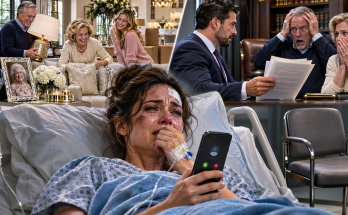
I asked Elena whether Dad was angry.
It was the first thing that came into my mind after she told me the police had contacted him.
Even from a hospital bed, I was worrying about his reaction.
I should have been thinking about my recovery.
Instead, I was imagining how much worse things might become when he discovered that I had been speaking to my mother.
Elena looked at me carefully.
"I don't know what he's thinking right now."
I stared at the blanket.
"He's going to be upset with me."
She shook her head.
"The important thing is making sure you have somewhere safe to stay."
I didn't know what that meant.
I was fifteen.
As far as I understood, Dad was the person who decided where I lived.
If he came to the hospital and told me to get dressed and follow him, I didn't know whether anyone could stop him.
I wondered whether I would have to return to the farmhouse with Colleen and Brin.
The thought made my stomach tighten.
But I also felt guilty for being frightened of going home.
That house contained nearly everything familiar to me.
My room.
My school belongings.
The place where Dad had once helped me learn how to manage my diabetes.
I wasn't prepared to think of it as somewhere I might not be safe.
Elena seemed to understand that I was confused.
She didn't promise me things she couldn't yet know.
She simply made it clear that nobody should expect me to return to dangerous circumstances.
A knock interrupted our conversation.
Officer Brangan entered the room.
I recognized him.
Seeing his face brought back the light beside the highway.
I knew I hadn't thanked him properly before.
"Thank you for helping me."
He pulled a chair nearer to the bed.
"I'm pleased you're doing better."
He didn't behave as though I had inconvenienced him.
He didn't ask why I had been foolish enough to leave the farmhouse.
He didn't suggest that a fifteen-year-old should have been able to deal with the situation alone.
Instead, he asked whether I felt able to answer some questions.
I said I did.
He began with what had happened at home.
I told him about the missing money.
I told him about Colleen and the cash box.
I told him that Brin had pointed toward my backpack.
There was something uncomfortable about explaining ordinary family things to someone outside the family.
I wasn't accustomed to doing that.
At home, disagreements generally stayed at home.
I had learned to avoid talking about things that might make Dad look bad.
Now I was describing an argument to a police officer.
I told him that Dad had searched my belongings.
I explained why I carried granola bars.
I explained that I had already taken my insulin and had been waiting to eat dinner.
Officer Brangan listened without interrupting.
When I described being told to leave, he asked me to explain exactly what had happened.
I remembered Dad standing at the door.
I remembered the rain.
I remembered the terrible feeling of realizing he actually expected me to go outside.
"He said he couldn't put up with me anymore."
The officer wrote something down.
"Were you dressed for that weather?"
"No."
"Did you have your diabetes supplies?"
"No. They were in my bag."
"Did your father know that?"
I nodded.
The questions were simple.
Answering them made the situation sound more serious than I had allowed myself to admit.
He asked whether Dad knew that I had already taken my mealtime insulin.
I didn't have to think about that answer.
"He knew. He was there when I took it."
Officer Brangan glanced at Elena.
She remained quiet.
I continued explaining that Dad understood I needed to eat afterward.
There hadn't been some secret medical issue I had forgotten to tell him about.
He had helped manage my condition when I was younger.
He knew what insulin was.
He knew what could happen when my blood sugar dropped.
That was part of what made the evening so difficult for me to understand.
Officer Brangan turned another page in his notebook.
"Has your father made you leave the house like this before?"
I shook my head.
Then I wondered whether I should say anything else.
The safest answer, emotionally, seemed to be no.
If I said no, perhaps I could protect Dad from further questions.
Perhaps everyone could treat the evening as a terrible accident.
But there had been other things.
There were times when Dad had taken my phone.
There were comments he had made about the difficulties of raising a child with diabetes.
There were moments when I had felt ashamed of asking him for things I genuinely needed.
I remembered those moments while looking at the officer.
And then I told him.
Not everything that had ever happened.
Just what I could explain.
"He gets frustrated about my diabetes sometimes."
The officer waited.
"And he takes my phone away."
He wrote down my answer.
I felt nervous watching his pen move.
It was one thing to say something out loud.
It was another to see somebody record it.
He explained that he needed to document the circumstances that had led to my being found beside the highway.
He also told me that the appropriate child welfare authorities would become involved.
I looked at Elena.
She reached for my hand.
I felt as though I had done something terrible.
"I don't want my dad to have problems because of me."
She leaned closer.
"You're answering questions about something that happened to you."
I looked down.
"But he's still my dad."
"Of course he is."
She didn't disagree with that.
She didn't tell me that I should stop caring about him.
She only reminded me that I hadn't chosen to be outside in the freezing rain.
I hadn't chosen to become diabetic.
And I hadn't chosen to be accused of taking money.
I could hear the sense in what she was saying.
Believing it was harder.
Officer Brangan waited until I had settled a little.
Then he returned to the subject of the missing cash.
He told me Dad had reported that three hundred and forty dollars were missing.
Dad had identified me as the person he believed responsible.
I felt the same sick sensation I had experienced at the kitchen table.
"I didn't take it."
The officer nodded.
"I'm aware that's what you've told us."
I wanted to explain again that he could search everything I owned.
My room.
My backpack.
My clothes.
There was nothing to find.
But Officer Brangan had something else to tell me.
Another officer had gone to the farmhouse before I was brought into the hospital.
He had spoken with people there.
Including Brin.
I looked up immediately.
"What did she tell him?"
Officer Brangan explained that my sister's account had changed.
She was no longer claiming she knew I had taken the money.
I stared at him.
The first thing I felt was relief.
Then I became angry.
Then I felt relieved again.
It was difficult to separate the emotions.
"She knows I never touched it."
Elena squeezed my hand.
The officer told me Brin had mentioned seeing someone with the cash box earlier in the day.
When she had been asked to identify that person, she had become upset.
She wouldn't say who it was.
I couldn't understand why she was still protecting someone.
Didn't she know where I had ended up?
Didn't she understand what Dad had done because of what she had said?
I wanted to believe she was finally going to make things right.
She was my sister.
We had shared a bedroom when we were younger.
I had helped her with schoolwork.
I had once protected her from getting in trouble over a broken kitchen vase.
Those memories made her behavior difficult to accept.
I knew children sometimes lied when they were frightened.
But her lie hadn't ended when Dad began searching my bag.
It hadn't ended when the granola bars became part of the argument.
It hadn't ended when he opened the front door.
She had watched me leave.
And now I was learning that she knew more than she had admitted.
Officer Brangan told me one further detail.
According to Brin, someone had told her not to discuss what she had seen.
"Who told her that?"
He explained that she hadn't identified the person.
I stared toward the foot of my bed.
It seemed that the missing money wasn't the simple misunderstanding I had wanted it to be.
There were things happening inside our farmhouse that I didn't understand.
I had been punished before anyone had bothered to establish the facts.
Now my sister was giving different answers to the police.
I didn't know whether that made me feel safer or more frightened.
The officer eventually finished asking his questions.
I was grateful when I no longer needed to explain myself.
Around nine that evening, a woman named Patricia Hall came to see me.
She worked as a hospital social worker.
She introduced herself calmly and explained why she was there.
The circumstances surrounding my hospitalization meant that adults needed to discuss how I could be kept safe.
She wanted to understand the situation at home.
She also wanted to understand Elena's relationship with me.
Elena explained that she and Dad had been separated for years.
She told Patricia that she had repeatedly tried to maintain contact with me.
I listened carefully.
I had heard pieces of this before, but never in a conversation with someone whose responsibility was to understand my family situation.
Patricia asked why I hadn't been living with Elena.
My mother looked down briefly.
"Richard told me she didn't want contact with me."
I turned toward her.
"What did you say?"
She looked back at me.
"He said seeing me would upset you."
I couldn't understand it.
There had been years when I would have given almost anything to know her.
Years when I had wanted a birthday phone call.
Years when I had wondered whether she might come to visit.
And apparently, Dad had told her I wanted her to stay away.
"Did you believe him?"
Elena's expression became painful.
She explained that she had tried to visit and communicate despite the difficulties between them.
There had been legal disagreements.
Arguments.
Things she wished she had managed differently.
She hadn't wanted me placed in the middle of an ongoing fight between my parents.
But her efforts hadn't brought her back into my daily life.
I thought about my childhood.
I remembered asking Dad why my mother never telephoned on my birthday.
He had made it sound as though she had more important things to do.
I remembered asking whether I might visit her someday.
He had told me, in one way or another, that she wouldn't welcome the visit.
There had also been a photograph.
A woman holding a baby.
I remembered Dad taking it away when he discovered me looking at it.
He had been irritated that I was going through old belongings.
I had stopped asking questions afterward.
Now I looked at Elena and wondered how many of those moments had meant something entirely different from what I had understood.
"Did you decide you didn't want me anymore?"
Her eyes filled.
"No, Myra. I never made that decision."
I looked at her handbag when she reached inside.
She removed a worn envelope.
The edges showed signs of having been handled over time.
There were birthday cards inside.
She brought them out carefully.
I recognized the handwriting before I had finished looking at the envelopes.
It was the same handwriting I had seen on the card in the glove compartment.
My name.
Written again and again.
Cards for birthdays I had celebrated without her.
I touched one of the envelopes.
"You wrote these for me?"
"Every year."
I asked why she still had them.
She explained that Dad had returned some of the letters she had attempted to send.
After that, she had begun keeping the cards.
She hoped there would eventually be an opportunity to place them directly in my hands.
I didn't know how to respond.
There was no amount of money involved in those envelopes.
No elaborate gift.
Just cards.
But they represented years of my childhood.
Years during which I had believed my mother couldn't be bothered to remember me.
She had remembered.
She had written my name.
And she had kept the evidence of that love even when she couldn't give it to me.
Patricia allowed us some privacy.
Elena sat close to the bed.
I looked at the collection of cards and began understanding something that frightened me.
I had spent years accepting my father's version of why my mother wasn't there.
Now I had heard hers.
For the first time, I realized I might have been grieving the absence of someone who had never wanted to be absent.