I had been nervous when I first wrote to Elena.
Even before the night of the storm, contacting her had felt like breaking a rule nobody had ever needed to say aloud.
At our farmhouse, my biological mother wasn't someone we discussed freely.
There were questions Dad didn't like.
There were memories he didn't want brought up.
And there were things I had learned to leave alone if I wanted the evening to remain peaceful.
Elena belonged to all three categories.
For years, I accepted what he told me.
I believed she was occupied with her own life.
I believed she wasn't particularly interested in mine.
I believed there was something about me that hadn't been enough to make her stay.
That last belief was never something Dad needed to explain directly.
It was simply what a child could conclude after hearing that her mother didn't want to see her.
I had wondered what I would say if I ever met her.
Sometimes I imagined asking why she had left.
Sometimes I imagined pretending I didn't care.
In reality, I couldn't even bring myself to ask Dad about her without watching his expression first.
Then I discovered the birthday card in the glove compartment.
The handwriting caught my attention.
It was my name.
Not someone else's.
Mine.
I kept thinking about the fact that somebody had taken the time to write it.
I remembered wondering why a woman who supposedly had no interest in me would bother with a birthday card.
It didn't prove everything I wanted to know.
But it gave me a reason to ask.
When I eventually sent Elena an email, I didn't write much.
I introduced myself.
I explained that I had found a card with her name on it.
And I asked whether she remembered who I was.
It was an uncomfortable question to ask your own mother.
I wasn't sure what kind of response I would receive.
I wasn't even certain that receiving a response would make me feel better.
There was always the possibility that Dad had told me the truth.
She might confirm that she preferred her life without me in it.
I thought about that while waiting.
Her answer arrived within minutes.
She told me that there hadn't been a day when I had disappeared from her thoughts.
I read her words more than once.
I was so accustomed to hearing about her through Dad that it felt strange to hear directly from her.
There was nobody interpreting her answer.
Nobody explaining what she supposedly meant.
Just her words.
Written to me.
Our conversations developed gradually.
She didn't demand that I call her anything special.
She didn't act as though I owed her affection because we were related.
She asked ordinary questions.
What I liked reading.
How things were going at school.
Whether I had been keeping up with my diabetes care.
I found those questions surprisingly comforting.
She told me about her job and her apartment.
She mentioned the plants she kept near her kitchen.
Small details that helped me picture a woman I had spent years trying not to think about.
I wanted to know more.
But I was also cautious.
I didn't understand everything that had happened between her and Dad.
I worried that becoming close to her would somehow mean betraying him.
That was the position I had placed myself in.
I thought I had to choose which parent I was allowed to love.
Elena never asked me to make that choice.
When we met at the library, she had a folder containing documents and correspondence.
I didn't fully understand their importance at the time.
I was more interested in being able to sit near her.
Seeing her face when I spoke.
Finding out what it felt like to have a conversation with my mother without someone becoming angry about it.
There was so much I wanted to ask.
But those conversations were still new, and I hadn't yet learned how much of my childhood had been shaped by things nobody had explained.
I wasn't ready to accuse Dad of lying about everything.
He was still my father.
I still remembered him as the man who had helped me learn to ride a bicycle.
I remembered sitting on his shoulders at the county fair.
I remembered him staying awake when I was first diagnosed with diabetes.
Those memories were real.
I didn't want to lose them simply because I was getting to know Elena.
And I certainly didn't imagine that one day I would depend on her because Dad had put me outside during dangerous weather.
But that was where I found myself.
I had sent her my location.
Afterward, everything became harder to follow.
I was cold enough that concentrating on anything besides the cold took effort.
My blood sugar was dropping.
I had no way to check it properly because my usual supplies were in the backpack Dad had kept inside.
I knew something was seriously wrong.
I couldn't seem to make my body cooperate with what my mind wanted it to do.
I wanted to reach the gas station.
I wanted somewhere dry.
I wanted someone to give me something to eat.
But the rain and the cold weren't the only things affecting me anymore.
My thoughts had become confused.
I remember struggling with the phone.
I remember trying to keep moving.
I remember being frightened by how difficult it had become to do things that ordinarily required no thought at all.
I couldn't rely on my hands.
I couldn't rely on my judgment.
And I couldn't know whether Elena had received the information I had sent her.
There was no guarantee that I would make it to the place I had been trying to reach.
I thought about Dad.
Even then, I wanted him to appear.
I wanted to see him looking for me.
I wanted proof that the anger in the kitchen hadn't been stronger than his concern for my safety.
But I didn't see him.
What I remembered instead was the light.
A flashlight.
The presence of someone near the highway.
His name, I later learned, was Officer Vern Brangan.
He was the police officer who found me.
I didn't know everything that happened immediately afterward.
There were gaps in my memory that I couldn't fill simply by trying harder to remember.
I had been found in a serious medical emergency.
The situation had gone far beyond being an unhappy teenager caught in the rain.
My body needed urgent treatment.
I learned later that my blood glucose had reached twenty-eight.
At the time, I couldn't have explained that number to anyone.
I couldn't have argued about the missing money.
I couldn't have persuaded Dad that I was telling the truth.
I couldn't even get myself somewhere safe.
The emergency team took care of what I was no longer capable of managing alone.
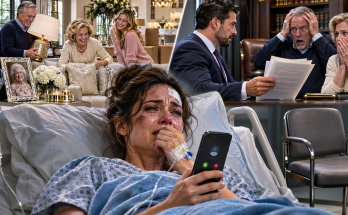
When I began to understand my surroundings again, I was in a hospital.
There was a blanket over me.
Medical equipment nearby.
A different kind of light from the one I remembered beside the highway.
I wasn't standing outside anymore.
I wasn't walking toward the gas station.
And there was someone beside me.
Elena.
I looked at her and tried to make sense of how she could be there.
For years, I had barely been able to ask questions about her.
Now she was sitting close enough for me to reach her hand.
Her eyes were wet.
I could see that she had been crying.
I wanted to ask several questions at once, but the first thing I needed to understand was how she had known where to find me.
"How did you get here?"
She wiped her face.
"Your message reached me while I was on the road."
I stared at her.
She explained that she had already been coming toward me when I sent my location.
When I stopped responding, she became worried enough to contact the police.
They eventually told her that an officer had found me and that I had been taken to the hospital.
She hadn't waited at home for me to send another message.
She hadn't assumed that everything would eventually work itself out.
She had come.
I looked at the blanket covering me.
"I was trying to reach the gas station."
"I know."
"I didn't have my things."
Her face changed slightly.
"Your diabetes supplies?"
I nodded.
"My backpack was still in the house."
She asked whether I had been able to eat anything.
I shook my head.
The question made me think of the kitchen table.
The food had been so close.
I could remember the pot roast.
I could remember sitting there while everyone talked about the money.
And I could remember trying to explain why the granola bars were in my backpack.
"I'd already taken my insulin."
Elena looked at me.
I could see that she understood what that meant.
I tried explaining that I had only wanted to have dinner.
The words came out badly.
I began crying before I had finished saying them.
I had been holding so much inside myself that evening.
The accusation.
The humiliation of Dad searching my belongings.
The way Brin had pointed toward my bag.
The door closing.
And the terrible feeling of realizing I might not reach the gas station.
Now somebody was sitting beside me who didn't seem interested in deciding whether I had been sufficiently respectful.
She wanted to know whether I had eaten.
She wanted to know whether I had been able to take care of myself.
And she seemed upset that nobody had made sure I could.
"I was so hungry."
She leaned over and kissed my forehead.
"A child shouldn't have to argue for her dinner."
I cried harder.
I wasn't used to hearing an adult say something like that without adding a condition.
There was no reminder about being grateful.
No explanation about how expensive my diabetes was.
No suggestion that I had brought the entire evening upon myself by being difficult.
She stayed beside me.
I could feel the warmth of her hand.
It was strange how something so small could make me realize how frightened I had been.
I had spent part of the evening wondering whether anyone would come looking for me.
Now someone had.
I still wanted my father.
That was the part I found difficult to admit.
Elena's presence didn't immediately remove the years I had spent believing Dad would protect me.
I wanted him to know I was in the hospital.
I wanted him to realize that what had happened was serious.
I wanted him to understand that there was never any money in my backpack.
Somewhere inside me, I still believed he would fix everything if he finally heard the truth.
A nurse came into the room.
She greeted me kindly.
She seemed pleased to see that I was awake.
When she asked how I felt, I struggled to find an answer that described it properly.
"I don't really understand what's happening."
She explained that my blood sugar had fallen dangerously low.
The emergency staff had treated me, but they still needed to monitor my condition.
Because I had taken my mealtime insulin without having the meal it was intended for, they were being careful about my recovery.
Elena listened.
She asked questions.
She wanted to know what the medical team planned to do and what I would need afterward.
I watched her write things down.
There was something about seeing her do that which affected me more than I expected.
Dad had often spoken about my medical needs as though they were problems he wished would disappear.
Elena was treating them as things she needed to understand.
She wasn't asking how much trouble my care would cause her.
She was asking how to help.
When the nurse finished explaining everything, Elena wanted to know whether I could have something to eat.
The nurse assured her that the team would arrange appropriate food when it was safe for me.
Elena thanked her.
Then she returned her attention to me.
For a little while, I watched the medical equipment and tried to accept the fact that I was safe enough to stop thinking about the road.
My fingers were no longer fighting against the phone.
My backpack wasn't beside me, but there were medical professionals taking responsibility for what I needed.
I didn't have to persuade anyone that my condition mattered.
Elena moved her chair closer.
"There is something you should know."
I turned toward her.
"The officers have been in touch with your father."
Immediately, I felt nervous.
I had wanted him to know where I was.
But hearing that he had been contacted made me think about the fact that Elena was beside my bed.
Dad didn't know about our secret conversations.
He didn't know about the library.
He didn't know how much I had learned from her.
I had always imagined telling him about our renewed relationship under circumstances I could control.
Instead, the truth was waiting for him in a hospital room.
I looked at Elena.
"Does he know you're with me?"
"Yes."
I swallowed.
"Is he coming here?"
She told me she couldn't say for certain.
I looked toward the door.
I wasn't sure whether I wanted it to open.