Christmas morning at our townhouse was quiet.
There was no reason to examine my phone before Sophie came downstairs.
I wasn't expecting an urgent demand from my father.
There were no payments I needed to restore before noon.
Nobody was waiting for me to explain why a supplementary card wasn't working.
Our morning belonged to us.
That was something I had learned to appreciate during the previous year.
The opportunity to wake up without immediately becoming responsible for another adult's unhappiness.
There were presents beneath our tree.
I was looking forward to watching Sophie open them.
Then she came downstairs carrying a small envelope.
Something about it seemed familiar.
She approached me and held it out.
“Mommy, look.”
I took it from her.
The envelope wasn't new.
When I opened it, I immediately recognized what was inside.
The Christmas card she had made for my father the previous year.
I hadn't seen it for some time.
I remembered her carrying it into my parents' house.
I remembered the drawing of Grandpa beside a Christmas tree, holding her hand.
She had made it because he had helped her build a birdhouse.
That afternoon in his garage had mattered enormously to her.
She had wanted to thank him.
And she had hoped he might put the card on his refrigerator.
I looked at the paper in my hands.
The corners were still bent.
A crease ran across the drawing.
I could tell where she had gripped it tightly.
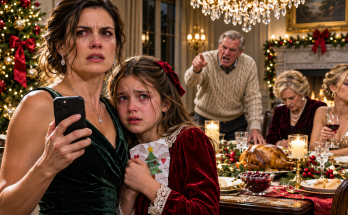
Seeing those marks brought back the dining room with an unpleasant clarity.
I remembered my father approaching me.
I remembered hearing Sophie scream.
I remembered her clutching the card against her red velvet dress.
She had been trying to understand what was happening to the grandfather she loved and the mother she depended on.
I hadn't realized she had kept the card all this time.
Apparently, it had remained in a drawer.
She stood beside me while I looked at the drawing.
“I put something else in it.”
I opened the card.
Her original message was still there.
She had thanked Grandpa for teaching her how to make things.
Beneath that message was another sentence.
The handwriting was careful.
I could imagine her taking her time over each word.
She had written that she hoped Grandpa would learn to be kind again.
I read the sentence twice.
There was no accusation in it.
No complicated explanation of what had happened.
She hadn't written that she hated him.
She hadn't told him he could never see her again.
She had expressed a wish.
A small, understandable wish that someone she remembered loving would become someone she could feel comfortable loving again.
I felt my throat tighten.
For months, I had been trying to explain the conditions under which a relationship with Dad might become possible.
I had written him a letter.
I had asked him to acknowledge the assault.
I had explained why an apology without excuses mattered.
I had told him that changes in his behavior would need to accompany whatever he said.
Those were important things.
But Sophie had expressed the heart of the matter in one simple sentence.
She wanted her grandfather to remember how to be kind.
I looked at her.
“Would you like to give this to him?”
She shook her head.
“Not right now.”
“All right.”
She looked at the card.
“Maybe I just want to keep it.”
“That's fine too.”
She seemed relieved.
I handed it back to her.
It was her card.
She had made it.
She had carried it home.
She had decided to add something to it.
I wasn't going to take control of the next decision simply because I was her mother.
She didn't owe Grandpa the card.
She didn't owe him forgiveness because it was Christmas morning.
She didn't have to decide whether she would ever want to send it.
That could remain her choice.
She took the envelope upstairs.
I watched her go.
Then I sat for a moment and thought about the difference between the card she had made a year earlier and the one she had shown me that morning.
The picture hadn't changed.
Grandpa was still holding her hand beside the tree.
The original words were still underneath it.
She hadn't crossed them out.
She hadn't decided that enjoying an afternoon building a birdhouse had been a mistake.
She had simply added something.
That seemed important.
Perhaps she was beginning to understand that a good memory didn't require her to ignore a bad one.
Perhaps she could remember loving her grandfather while also recognizing that what he had done was unacceptable.
I hoped so.
It was something I had struggled to learn myself.
I thought about the photograph in my own drawer.
The little girl sitting on Dad's shoulders during the Fourth of July parade.
I hadn't thrown that photograph away either.
I still remembered the ice cream he bought me afterward.
I remembered the way he had carried me above the crowd.
And I remembered Christmas Eve.
Those memories could exist together.
I didn't need to choose one version of my father and pretend the other had never existed.
What mattered was how I allowed him to behave toward us now.
I had made my conditions clear.
He hadn't met them.
That was where things stood.
I didn't have to become angry about it every morning.
I didn't have to spend holidays imagining what might persuade him to change his mind.
I could acknowledge the sadness of the situation and still enjoy my life.
Sophie returned downstairs a few minutes later.
She had another envelope.
She held it differently from the first one.
“This is yours.”
I smiled.
“Another card?”
She nodded.
I took the envelope and opened it.
Inside was a picture of our townhouse.
I recognized the Christmas tree she had drawn.
There were two figures standing near the front door.
One was supposed to be me.
The other was Sophie.
I looked at the drawing carefully.
Our house wasn't particularly large.
It didn't have the expensive kitchen Madison had once been so proud of.
It didn't have an enormous television or a new leather recliner.
It wasn't the kind of property anybody in my family would have used as evidence of professional success.
But it was ours.
Sophie had drawn it as somewhere worth celebrating.
I opened the card.
She had written a short message.
She thanked me for making sure the two of us were safe.
I stopped.
For a moment, I couldn't speak.
I read her words again.
There was nothing about the presents beneath our tree.
Nothing about the education fund I had established for her.
Nothing about the money I could now afford to put aside.
She wasn't thanking me for taking her to Michigan or buying her the stuffed fox she had wanted.
She was thanking me for protecting her.
I pressed my lips together.
Then I reached toward her.
“Come here, sweetheart.”
She moved into my arms.
I held her tightly.
For years, I had worried about whether I was doing enough for my parents.
I had wondered whether I was sufficiently generous to Madison.
I had examined my bank account before making decisions about their lives.
I had kept saying yes because I believed those decisions reflected the kind of daughter and sister I wanted to be.
All that time, the person whose opinion mattered most had been watching me.
She had watched me work on Saturdays.
She had listened while I discussed other people's bills.
She had seen me tolerate comments I didn't appreciate.
And eventually, she had seen me stand up beside a dining table and tell my father not to speak to her cruelly.
I hadn't handled everything perfectly.
There were things I wished I had done earlier.
I wished I had confronted Madison the first time she criticized Sophie's dress.
I wished I had established clear financial limits when my parents initially asked for assistance.
I wished I had recognized how much responsibility I was accepting for choices I hadn't made.
But I couldn't change those decisions.
I could only learn from them.
And I could make sure Sophie never believed that my mistakes were hers to correct.
I looked at the card again.
Her drawing showed the two of us outside our home.
There was no complicated message about family obligations.
Just our house.
Our tree.
The two people who lived there.
I understood why she had chosen that picture.
Home was where she wanted to feel secure.
It was where she wanted to be able to break a glass without wondering whether someone would hurt her.
Where she could ask a question without worrying about her tone.
Where she could wear something she liked without having to defend its price.
Those were modest expectations.
It saddened me that they had become things she felt grateful enough to write about.
But I was glad she could experience them.
I held her for a little longer.
Then I looked at her face.
“Thank you for making this for me.”
She smiled.
“Do you like the house?”
“I love the house.”
She looked at the drawing again.
I smiled too.
I thought about the enormous amount of money that had left my account during the previous six years.
More than four hundred and fifty thousand dollars.
For a long time, I had believed that amount demonstrated how much I loved my family.
Perhaps some of it did.
I had genuinely wanted to make their lives easier.
But money hadn't prevented my father from hurting me.
It hadn't persuaded Madison to intervene.
It hadn't encouraged my mother to ask whether Sophie was all right after we left.
I couldn't purchase those responses.
And I shouldn't have needed to.
I had spent years treating affection as something I needed to protect through financial assistance.
Whenever I considered saying no, I worried about what the decision might do to my relationships.
Eventually, I discovered what those relationships looked like when the money stopped.
Some things became painfully clear.
Some things began to improve.
Madison had found employment that allowed her to maintain her own household.
She had exchanged an expensive SUV for a used sedan.
She had apologized to me and offered money she had earned herself.
Those were changes she had made.
They belonged to her.
My parents still had their house.
They still had income and resources available to them.
They also had a repayment arrangement concerning money they had borrowed from me.
Nobody had taken away their ability to make choices.
I had simply stopped taking responsibility for those choices.
That was an important distinction.
I hadn't set out to destroy my family.
I hadn't tried to recover every gift I had ever given them.
I hadn't demanded that Madison return four years of mortgage assistance.
I had asked my parents to honor one documented agreement.
I had stopped future voluntary payments.
And I had protected my daughter from a situation that had already frightened her enough.
There was nothing unreasonable about those decisions.
It had taken me a long time to become comfortable saying that without adding an apology.
Dad had wanted me to remember my position in our family.
He had made that clear on Christmas Eve.
I wasn't supposed to challenge him.
I wasn't supposed to mention the financial arrangements when Madison criticized me.
I was supposed to accept his authority because he was my father.
When I refused, he had tried to force me back into that familiar position.
Five blows.
I would never forget them.
But I didn't want those moments to determine how I lived the remainder of my life.
I didn't want them determining Sophie's life either.
I wanted the things we did afterward to matter more.
Leaving the house.
Canceling the unnecessary transfers.
Making the call to my bank.
Speaking with Rebecca.
Reporting what had happened.
Taking Sophie to counseling.
Learning how to say no without spending the following week feeling responsible for everybody else's reaction.
Those decisions hadn't been dramatic victories.
They had been individual steps.
Some were uncomfortable.
Some made me feel guilty.
Some required more courage than I had expected.
But together, they had allowed Sophie and me to establish the home she had drawn on her card.
A place where she didn't need to earn affection.
A place where I didn't need to provide financial assistance before I could expect basic respect.
A place where somebody could be disappointed without another person being punished for it.
I went into the kitchen and placed Sophie's card on the refrigerator.
I made sure it was positioned where I could see the drawing easily.
For a moment, I thought about the card she had made for Grandpa.
She had once hoped he would display it in exactly the same way.
Perhaps someday she would decide to give it to him.
Perhaps she wouldn't.
I didn't need to know that morning.
I was happy to let her keep it for as long as she wanted.
The new card remained on the refrigerator.
I stood looking at it before returning to the living room.
Sophie had received a dollhouse that morning.
There were pieces that needed to be assembled.
She was examining everything beneath the Christmas tree.
“Mommy, can you help?”
“Of course.”
I sat down beside her.
We began sorting the pieces.
She concentrated on figuring out where everything belonged.
I helped her arrange the parts and follow the instructions.
It reminded me of the afternoon she had spent building a birdhouse with Grandpa.
There was something special about making things together.
Children remembered those moments.
Not necessarily because the finished object was impressive.
Because somebody had taken the time to sit beside them.
I was glad I could be that person for her.
My phone was still on the kitchen counter.
I could have reached for it.
I could have checked my messages or reviewed my banking application.
For years, that would have been almost automatic.
But there was nothing there more important than what I was doing.
My parents' expenses were their responsibility.
Madison's bills belonged to Madison.
The person who genuinely needed my attention was sitting on the living room floor, trying to work out how the pieces of her dollhouse fit together.
I moved closer and helped her.
We took our time.
There was no payment I needed to arrange before we finished.
No telephone call I needed to return because somebody had made another decision they couldn't afford.
No reason to leave my daughter waiting while I made someone else's life more comfortable.
Sophie held up a piece of the dollhouse.
“Does this go here?”
I looked at it.
“Yes. I think that's right.”
She fitted it into place.
Then she smiled at me.
I smiled back.
The refrigerator held the best Christmas message I could have received.
The old Honda was outside.
Our tree stood in the corner.
Everything we needed was right there.
And my phone stayed where I had left it.
The End
Read more original stories on lastestdrama.com.