Mom called before coming to my townhouse one Saturday in April.
That alone made me appreciate the visit more than I otherwise might have.
She hadn't simply appeared at the door and expected me to rearrange whatever Sophie and I were doing.
She asked whether I was available.
Sophie was attending a friend's birthday party that afternoon.
I agreed to see Mom while we had the house to ourselves.
When she arrived, she was carrying a container of homemade banana bread.
I recognized the familiar loaf as soon as she placed it on the kitchen counter.
“I made some yesterday. I thought you might want it.”
“Thank you, Mom.”
I did like her banana bread.
I had eaten it countless times growing up.
Sometimes she made it when the bananas in our kitchen became too ripe.
Other times, she prepared it because she knew somebody particularly enjoyed it.
Seeing the container brought back a collection of ordinary memories.
Mom standing beside the oven.
The smell of something baking.
Slices of bread waiting on the counter.
There had been kindness in our family.
That was one reason everything that happened afterward had been so difficult to understand.
I couldn't simply look at my parents and pretend they had never done anything good for me.
They had.
But the existence of those good things didn't settle what happened at Christmas.
I invited Mom to sit at the kitchen table.
For a few minutes, we talked about subjects that required very little from either of us.
She mentioned the weather.
She asked how work was going.
She told me about a neighbor who had moved away.
I answered politely.
There were pauses between subjects.
I could tell she hadn't come simply to deliver banana bread.
Eventually, she placed her hands together on the table.
“Your dad's been thinking about Sophie.”
I looked at her.
“He really misses having her around.”
I waited before answering.
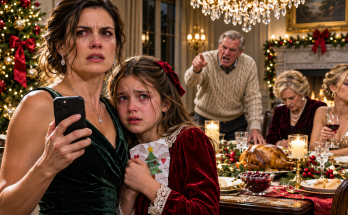
I remembered Sophie holding her Christmas card against her dress.
I remembered her little voice asking whether we could go home.
And I remembered the question she asked me the following morning.
Was I going to allow Grandpa to hurt me again?
“Dad can write something to her if he wants.”
Mom looked disappointed.
“He'd rather spend some time with her.”
“Has he admitted that what happened at dinner was wrong?”
She sighed.
“He understands things got out of hand.”
I studied her expression.
“Is that what he told you?”
“Well, you know how your father is.”
I did.
That was exactly why I was asking.
“Has he actually said he shouldn't have hit me?”
Mom looked toward the counter.
“He's not very good at talking about certain things.”
“Has he apologized?”
She looked down at her hands.
“Natalie, he's always been a proud person.”
I waited.
She continued.
“He finds this whole situation extremely difficult.”
I thought about the conference room in Rebecca's office.
Dad sitting in his navy blazer.
The loan agreement in front of him.
His inability to answer whether he had originally intended to return the money.
Apparently, he was experiencing another situation in which admitting something uncomfortable seemed more difficult than expecting me to overlook it.
“I understand that it's difficult for him, Mom.”
“Then can't we start putting this behind us?”
“What would that involve?”
She looked hopeful.
“Perhaps you could bring Sophie over sometime.”
I shook my head.
“That's not happening.”
Her expression fell.
“You can't keep holding onto things forever.”
“I'm not discussing forever. I'm discussing what needs to happen before anything changes.”
She looked confused.
I explained that I wasn't interested in returning Sophie to an environment where Dad could behave however he wanted without acknowledging what he had done.
Mom listened.
Then she asked whether I could forgive him.
There was something familiar about the question.
It placed the next important decision entirely with me.
Dad had struck me.
Dad hadn't apologized.
Dad wanted to see my daughter.
And somehow, the solution Mom was proposing involved me becoming more forgiving.
“Whether I forgive Dad doesn't determine whether it's appropriate for Sophie to spend time with him.”
Mom's eyes became moist.
“He's her grandfather.”
“I know.”
“She means a great deal to him.”
“I hope she does.”
“We're not getting any younger, Natalie.”
I looked toward the window.
I had always been particularly vulnerable to that argument.
The reminder that my parents were growing older could make almost any disagreement feel petty.
What if something happened to one of them?
What if I regretted refusing a visit?
What if there wasn't another opportunity to make things right?
Those questions had influenced many of my decisions over the years.
But I couldn't allow them to become Sophie's responsibility.
“Mom, being older doesn't excuse what Dad did.”
She wiped beneath one eye.
“We don't know how much time any of us have.”
“That's true.”
“Then why waste it like this?”
I leaned forward.
“I'm not the person refusing to apologize.”
She became quiet.
For several minutes, I tried to explain that I wasn't preventing Dad from taking steps toward repairing our relationship.
There were things he could do.
He could acknowledge his actions.
He could express regret.
He could demonstrate that he understood why I wasn't willing to expose Sophie to another situation like the one she had experienced.
None of those things required me to resume paying his bills.
None required Sophie to visit him.
They required him to take responsibility.
Mom pressed her lips together.
I could see how uncomfortable the conversation was making her.
For most of her married life, she had dealt with Dad's anger by encouraging the people around him to make allowances.
Sometimes those allowances were small.
Sometimes they involved pretending an unpleasant comment hadn't been made.
Other times, they involved entire conversations being redirected because Dad was becoming upset.
I had participated in that arrangement for years.
Now I was asking Mom to consider the possibility that Dad himself needed to change something.
She wasn't accustomed to that.
“He would never hurt Sophie,” she finally said.
I looked directly at her.
“Mom, he hurt me while Sophie was standing there asking him to stop.”
Her face changed.
“He didn't touch her.”
“He frightened her.”
Mom looked away.
“She spent Christmas worrying about whether he would do it again.”
I could feel myself becoming emotional.
I tried to keep my voice steady.
“She thought it happened because she wore the wrong dress.”
Mom's eyes filled.
I didn't want to cause her unnecessary pain.
But I wanted her to understand that Sophie hadn't simply witnessed an unpleasant argument between adults.
She had watched someone she trusted deliberately hurt her mother.
Then she had watched the other adults remain where they were.
That experience had followed her home.
It had appeared in grocery stores.
In spilled milk.
In a broken drinking glass on my kitchen floor.
I couldn't dismiss it simply because Grandpa missed her.
Mom began crying.
I reached for a tissue and handed it to her.
She took it.
For a little while, neither of us spoke.
Then I decided to ask the question I had been avoiding.
“Why didn't you help me that night?”
Mom looked startled.
I waited.
She glanced toward the window.
“I didn't know what to do.”
I remembered her standing near the table after Dad had already struck me.
She had called his name.
But she hadn't moved toward me.
She hadn't put herself between us.
“What were you feeling?”
She swallowed.
“I just couldn't move.”
I nodded slowly.
I could understand that somebody might freeze during a frightening situation.
I hadn't expected my father to behave that way either.
Everything had happened quickly.
But there was another part of the evening and the days afterward that I struggled to understand.
“What about after we left?”
Mom looked at me.
“What do you mean?”
“You had opportunities to call me after Christmas Eve.”
She lowered the tissue.
“You sent messages about Dad being under pressure. You asked me to put the payments back.”
Her eyes moved toward the table.
“Why didn't you ask whether Sophie and I were all right?”
She began crying harder.
I waited for her to compose herself.
“I was frightened, Natalie.”
“Frightened of Dad?”
She shook her head slightly.
“Of what was going to happen to us.”
I looked at her.
“What did you think was going to happen?”
“I thought we might lose everything.”
She spoke so quietly that I almost didn't hear her.
I sat back.
For a moment, I didn't know what to say.
Her answer explained something I had spent months trying to understand.
She had been terrified about the financial consequences.
She had considered the mortgage.
The household expenses.
The life she and Dad had grown accustomed to maintaining.
Her attention had gone there before it went to her injured daughter and frightened granddaughter.
I could sympathize with her fear.
I understood how uncomfortable financial uncertainty could be.
But I also understood what her response had cost us.
I looked toward the banana bread on the counter.
I remembered Mom caring for Sophie during my divorce.
There had been a time when she had provided exactly the kind of support I needed.
At Christmas, I had needed something from her again.
Not money.
Not a place to stay.
I had needed my mother to recognize that what Dad was doing was wrong.
And afterward, I had needed her to care about how Sophie and I were managing.
Instead, she had worried about what would happen to her household if I stopped paying.
“I was frightened that night too, Mom.”
She looked at me.
For a moment, she seemed to understand.
She reached across the table and touched my hand.
“I'm sorry, Natalie.”
I waited.
Usually, an apology from Mom arrived with an explanation about something I had done.
She would express regret and then remind me that Dad was sensitive about his business failing.
Or that Madison had been upset.
Or that I could have chosen a different moment to speak.
This time, she didn't immediately add anything.
She simply sat there holding my hand.
I didn't mistake that moment for a complete resolution.
She still seemed uncomfortable acknowledging the full seriousness of what had happened.
She still wanted me to help repair Dad's relationship with Sophie before he had done anything himself.
But something had shifted.
For the first time, Mom had offered an apology without immediately asking me to accept part of the blame.
I appreciated that.
I told her so.
Then we discussed what future contact with Sophie might look like.
I was willing to consider allowing Mom to rebuild that relationship gradually.
But there would be conditions.
She couldn't use time with Sophie to encourage her to visit Grandpa.
She couldn't tell her that I was responsible for the separation.
She couldn't suggest that Sophie needed to make her grandfather feel better.
And she couldn't treat our decisions as temporary obstacles that would disappear once I became less upset.
Mom listened.
“She misses us, doesn't she?”
I considered how to answer.
“Sophie has good memories of you.”
Mom nodded.
“I don't want her losing those.”
“Neither do I.”
I meant that.
I wanted Sophie to be able to remember the people she loved without feeling required to excuse everything those people had done.
If Mom could respect the limits I established, perhaps they could gradually have a comfortable relationship again.
But I wasn't going to promise that before seeing how she behaved.
Mom agreed to the conditions.
I accepted her agreement cautiously.
Words were important.
I had learned, however, that words needed to be followed by choices.
After she left, the banana bread remained on my kitchen counter.
I looked at it for a while.
Then I put the container away.
It was possible to appreciate the fact that my mother remembered something I liked.
It was also possible to insist that she respect my decisions about Sophie.
I didn't need to choose between those two things.
Dad took a different approach.
An envelope arrived containing an old photograph.
I recognized myself almost immediately.
I was seven years old, sitting on his shoulders during a Fourth of July parade.
My little arms rested near his head.
Dad looked younger than I remembered him being.
Both of us were smiling.
I turned the photograph over.
He had written a message reminding me that he had supported and loved me long before I earned the money I now had.
I sat down.
For a little while, I was seven years old again.
I remembered the heat that day.
The sound of the marching bands.
The crowd standing along the street.
Dad had lifted me high enough to see everything.
Afterward, he bought me ice cream.
I remembered feeling completely secure on his shoulders.
There had been other experiences like that.
He had taught me to ride a bicycle.
He helped move my belongings into my first apartment.
Once, when my car wouldn't start during a snowstorm, he drove out with jumper cables.
I had been grateful for him.
I had loved being his daughter.
And I believed he had loved me too.
Those memories belonged to me.
I wasn't willing to throw them away simply because our relationship had become something painful.
But I wasn't willing to let Dad use them as a substitute for acknowledging Christmas Eve.
I placed the photograph in a drawer.
Then I sat down and began writing him a letter.
I explained that I remembered the things he had done for me.
I thanked him for helping Sophie and me during the divorce.
I told him I wished our relationship hadn't reached this point.
Then I explained my decisions.
The financial support wasn't going to resume.
Sophie wouldn't be spending time alone with him.
If he wanted to rebuild our relationship, he would need to recognize that hitting me had been wrong.
He would need to apologize without explaining why I supposedly deserved it.
And his behavior would need to demonstrate that we could trust him again.
I kept the letter focused on those matters.
I didn't mention Madison's mortgage.
I didn't criticize his spending.
I didn't bring up the seventy-eight-thousand-dollar settlement.
Those things had already been addressed.
This letter was about something money couldn't resolve.
I wanted a relationship with my father that didn't require me to tolerate being frightened of him.
I wanted Sophie to understand that she could love somebody without allowing that person to behave cruelly toward her.
I read the letter carefully.
There were no threats in it.
No insults.
No demands that Dad become somebody completely different overnight.
I was asking him to take responsibility for what he had done and show that it wouldn't happen again.
I sent it.
Then I continued with my life.
Days passed.
There was no answer.
More weeks passed.
Still nothing.
I had once believed that silence from my father meant I should try harder to repair whatever had gone wrong between us.
This time, I didn't send another letter.
I didn't ask Mom to persuade him to respond.
I didn't offer money as a way of making the situation easier.
I had told him what I needed.
He was free to decide whether he was willing to provide it.
And I was finally free to stop making that decision for him.