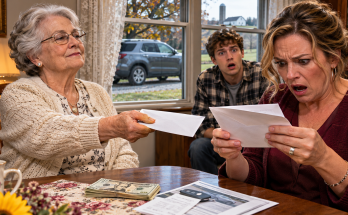
I never thought my own child would make me feel like a burden.
Especially not on the day I buried his father.
It was a Tuesday in Yellville, and the sky was the color of an old dishcloth.
We had gathered behind the First Baptist Church to say goodbye to my husband, Harlis.
I was seventy-three years old.
For fifty-one of those years, I had been somebody's wife.
I was still getting used to the idea that I wasn't anymore.
Harlis had died in the recliner in our living room.
The television had been on.
The weatherman was talking when my husband's heart stopped, and nothing about that evening had warned me that I was about to become a widow.
There wasn't any grand farewell.
There wasn't time to ask him where he kept something or what he wanted me to do after he was gone.
One minute, he was the man I expected to see in his chair every evening.
Then he wasn't.
I kept thinking about that chair while I stood beside his grave.
People spoke to me.
I thanked them.
Some took my hands between theirs, and others put an arm around my shoulders.
I recognized nearly every face.
I'd worked behind the pharmacy register at the drugstore on the square for twenty-six years.
In a town like ours, that was long enough to see young mothers become grandmothers.
I remembered people by their faces, their habits, and sometimes by the prescriptions they picked up every month.
What they told me across that counter stayed there.
Harlis was much the same way.
He had delivered propane around those hills for forty years.
He wasn't a man who needed everybody knowing what he'd done for somebody.
If a kindness could be kept between two people, that's generally how he preferred it.
I had always admired that about him.
It never occurred to me that one of his quiet kindnesses would leave me standing in a church parking lot wondering what sort of man our son had become.
The graveside service ended.
People began making their way toward their vehicles.
I watched them go, holding my purse in front of me with both hands.
I wasn't ready to return to our house.
There would be Harlis's chair, his things, and the familiar noises that had never seemed important when he was alive.
I knew what waited for me there.
Nothing had prepared me for how empty an ordinary afternoon could suddenly become.
My son Brandon came up beside me.
He was forty-four, but I still saw the little boy in him whenever he turned his head a certain way.
He had inherited Harlis's chin.
Sometimes that resemblance caught me so suddenly that I forgot how many years had passed.
He walked along with me toward my car.
Courtney, his wife, was beside him.
She was wearing a black dress and holding her phone.
I thought Brandon had noticed how slowly I was walking.
I expected him to offer me his arm.
Instead, he reached inside his jacket.
He brought out a check.
It took me a moment to understand why he was holding it toward me.
I recognized the amount before I properly looked at anything else.
Nine hundred dollars.
It was the same amount he had been giving me every month for six years.
I hadn't expected him to bring it to his father's funeral.
Money was about the furthest thing from my mind.
I held out my hand because he was waiting for me to take it.
He didn't let go immediately.
“Mom, we're not going to be doing this anymore.”
I looked at him.
“Doing what?”
“The monthly checks.”
I glanced down at the piece of paper between us.
I thought perhaps he meant there would be some change in when he brought them.
I wasn't thinking very clearly that day.
I'd spent the morning trying to remember how to breathe without feeling something hard pressing against my chest.
Brandon took another breath.
“Courtney and I have done our share. You're going to need to manage with the Social Security Dad left you.”
I understood him then.
There wasn't anything complicated about what he had said.
He was telling me that my husband's death marked the end of his obligation to me.
And he was telling me beside my car, with the church behind us and Harlis barely in the ground.
I looked at Courtney.
She was looking at her phone.
There was a small movement at the corner of her mouth.
A smile.
Not the sort of smile somebody gives a grieving woman because they don't know what else to do.
At least, that wasn't how it looked to me.
She raised her eyes briefly.
“Kaden's baseball expenses aren't getting any cheaper, Jeanie. We've got to think about that.”
Kaden played travel ball.
I knew that cost money.
I wasn't unfamiliar with the expenses involved in raising children, and I had never expected Brandon to put his mother ahead of his own family in everything.
But I couldn't understand why this particular conversation couldn't have waited.
I wanted to ask them that.
I wanted to know whether they'd discussed it before leaving for the funeral.
Had they decided in their kitchen that morning that this was the right time to tell me?
Had Brandon put the check inside his jacket knowing exactly what he planned to say when the service was over?
I didn't ask.
Some questions are too painful when you're not certain you want to hear the answer.
I looked at Brandon again.
I kept noticing his chin.
That was the thing that nearly undid me.
Harlis would have been standing beside him if the circumstances had been different.
He would have heard those words.
For one foolish second, I wanted to turn around and find my husband so he could straighten everything out.
Instead, I was standing there alone.
Brandon seemed to be waiting for some kind of response.
I could have reminded him about the brick house on Highway 62.
I could have asked him how much he believed it cost to keep a roof over his family's heads.
I could have explained something his father and I had spent six years carefully avoiding.
But I didn't.
I folded my fingers around the check.
“That's fine, sweetheart.”
Courtney returned her attention to her phone.
I opened my purse and put the check inside.
It was a small thing to do.
A perfectly ordinary movement.
I'd taken checks from Brandon plenty of times before.
Never had one felt so heavy.
I didn't make a scene.
I didn't cry in front of them.
I didn't ask my son to reconsider.
I got into my car and prepared to drive home.
By then, I had begun wondering whether staying quiet had become too much of a habit with me.
I'd been doing it for years.
Not because I lacked opinions.
Anybody who'd known me at the drugstore knew I could speak up when something needed saying.
But family was different.
With family, I often considered how something might sound before I considered whether it needed to be said.
Would Brandon feel embarrassed?
Would Harlis think I was interfering?
Would Courtney take offense?
I had asked myself some version of those questions so often that I hardly noticed anymore.
In the parking lot that afternoon, I did it again.
I spared my son's feelings.
Mine could apparently wait.
I drove away from the church with my purse beside me.
Inside it was the last check my son intended to give me.
Inside it was also something he didn't understand.
That money had never meant quite what he believed it meant.
The arrangement had started in 2019.
Brandon had owned a flooring business then.
He'd worked hard at it, and he'd been proud of what he'd built.
When things went wrong, they went wrong badly enough that hard work wasn't sufficient to put everything right.
His business failed.
The bank took the house he and Courtney had been living in over in Mountain View.
I remembered the change in him during that period.
He seemed uncomfortable talking about anything that involved money.
He was a grown man with a wife and children, and suddenly he couldn't provide them with the home he had expected to provide.
Harlis understood how much that hurt him.
My husband wasn't one to carry on about another man's embarrassment.
He had a way of helping without making a person stand there and explain why he needed it.
We happened to own a rental property that could solve Brandon's immediate problem.
It was a modest brick house out along the highway.
Three bedrooms.
A carport.
Nothing fancy, but it was solid and comfortable.
Harlis and I had purchased it in 2003.
It represented years of putting something aside whenever we could.
Neither of us had earned the sort of money that made buying property an easy decision.
He drove his truck.
I worked my register.
We saved.
By 2011, the rental house was completely paid for.
I had felt a particular kind of relief when we reached that point.
We had something that belonged to us.
Something that might help provide for us when we were older and no longer working.
Then Brandon needed somewhere to live.
Harlis didn't hesitate about what we ought to do.
“We can put them in the brick house.”
I agreed.
There wasn't much to discuss as far as I was concerned.
Our son needed help, and we had a way to give it.
What worried Harlis wasn't the house.
It was Brandon.
“He's not going to like feeling beholden to us,” he told me.
I knew he was right.
Even when Brandon had very little left, he kept talking about paying his way.
He couldn't stand the thought of being looked after by his parents at his age.
There was no shame in what had happened to him.
Businesses failed.
People lost houses.
Good, hardworking people sometimes found themselves starting all over again.
But knowing that didn't make Brandon feel any better about his own circumstances.
Harlis wanted to help him without taking away what little confidence he had left.
He came up with a way to do it.
I trusted my husband's judgment.
That was one of the reasons the conversation at the funeral was so difficult for me to understand.
Brandon had been given something valuable when he needed it most.
Yet somehow, six years later, he had come to believe that we were the ones who had depended on him.
I couldn't pretend that misunderstanding had appeared all by itself.
His father and I had helped create it.
We had done so because we loved him.
That didn't make it any less of a mistake.
When I arrived home from the funeral, I carried my purse inside.
The rooms looked much as they always had.
There was no visible sign that my entire life had changed.
Harlis's things were still there.
I could see the desk where he'd kept track of our household affairs.
His caps were stacked on top.
I looked at that desk for a while.
Then I looked at the purse containing Brandon's check.
I wasn't interested in punishing my son.
I wasn't thinking about putting him and his family out on the highway.
I was tired, lonely, and hurt in a way I hadn't expected to be hurt that day.
I'd lost my husband.
I had also heard my only son describe the help he'd given me as something he could no longer tolerate.
And beneath both those things was a fact that remained unchanged.
The house Brandon had lived in since 2019 belonged to Harlis and me.
With Harlis gone, it belonged to me.
Not Brandon.
Not Courtney.
Me.
I hadn't needed to remind anyone of that while my husband was alive.
For the first time, I understood that I might have to.