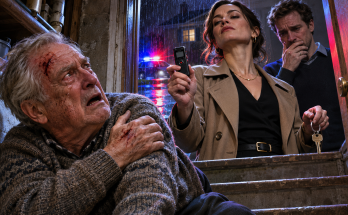
The moment my son realized I had discovered the truth, he looked at me as though I were holding a gun instead of a blue credit card.
“Mom,” Julian whispered, his face draining of color, “you need to put that down.”
I stood in the middle of my kitchen, staring at the little piece of plastic between my fingers.
It was the same credit card I had given him three years earlier for emergencies.
The same card he had casually used to pay for takeout the previous evening.
And apparently, the same card he had been using to finance something far more disturbing than dinner.
“Why?”
I asked.
“What exactly are you afraid I’m going to find?”
My daughter-in-law, Brooke, stepped forward.
“Eleanor, this is ridiculous.
We’re having a family disagreement, and you’re acting like someone committed a crime.”
I looked at her.
“Then you won’t mind explaining why my credit card was used to pay a Charleston law firm almost seven thousand dollars.”
The kitchen fell silent.
Julian closed his eyes.
Brooke stopped moving.
And from the hallway, my seven-year-old granddaughter, Lily, called out, “Grandma?
Why is Daddy crying?”
I didn’t turn around.
Because I was staring at something even more frightening on my banking app.
A transaction labeled WHITAKER PROPERTY TRANSFER.
For eleven years, I had lived peacefully in the home my husband and I spent thirty-one years paying for.
Now my own son was standing in my kitchen, surrounded by moving boxes, trying to explain why he had paid a lawyer to transfer property I had never agreed to sell.
“Julian,” I said slowly, “what have you done to my house?”
He looked toward Brooke.
She shook her head almost imperceptibly.
Then he said the words that would unravel everything I believed about my family.
“Mom, there’s something you need to know about Dad’s will.”
I felt the blood drain from my face.
My husband had been dead for eleven years.
His will had been settled.
His debts had been paid.
And as far as I knew, there was nothing left to discuss.
But Julian was looking at me with a combination of fear and determination.
“You’re not going to like what Dad wanted,” he said.
And that was when I understood something terrible.
My son hadn’t come to my house looking for shelter.
He had come looking for ownership.
My name is Eleanor Whitaker.
I’m sixty-eight years old, and until that Tuesday evening, I believed the worst thing that had ever happened to me was losing my husband.
Thomas Whitaker was the love of my life.
We met when I was twenty-two, working at a little bookstore in downtown Charleston, South Carolina.
He walked in one rainy afternoon looking for a repair manual for an antique woodworking machine.
I told him we didn’t carry anything that specialized.
He smiled and said, “Then I suppose I’ll have to come back tomorrow.”
He came back the next day.
And the day after that.
By the end of the week, I realized he wasn’t particularly interested in repair manuals.
Six months later, he proposed beside the harbor.
We were married for thirty-eight years.
Thomas was a cabinetmaker, a patient man with rough hands, a gentle voice, and an extraordinary ability to make broken things useful again.
He believed that anything worth having was worth caring for.
Our marriage wasn’t perfect.
We argued about bills, parenting, work, and whether the kitchen should be painted yellow.
But we never went to bed wondering whether we were loved.
When we bought our brick house outside Charleston, we had barely enough money for the down payment.
The roof needed repairs.
The plumbing groaned.
The backyard was mostly weeds.
Thomas looked around the empty living room and said, “Give me thirty years, Ellie.
I’ll make this place beautiful.”
He kept his promise.
For thirty-one years, we paid that mortgage.
Every Christmas bonus, every extra commission, every dollar we managed to save went toward building our future.
When we made the final payment, Thomas brought home a bottle of champagne and two ridiculous plastic crowns.
He placed one on my head.
“Your Majesty,” he said, bowing dramatically, “we are officially the owners of this castle.”
I laughed so hard I cried.
Three years later, he was diagnosed with cancer.
Two years after that, I buried him.
The silence that followed almost destroyed me.
For months, I couldn’t sleep in our bedroom.
I ate dinner standing beside the kitchen counter because sitting alone at our dining table was unbearable.
Sometimes I would catch myself calling his name.
And for half a second, before reality returned, I would expect him to answer.
Eventually, grief changed.
It never disappeared.
It simply became something I learned to carry.
I started gardening.
I joined a weekly book club.
I volunteered at the library.
I traveled with my oldest friend, June, and discovered that life could still contain beautiful moments.
By sixty-eight, I had finally found peace.
I woke up when I wanted.
I drank coffee on my porch.
I spent Sunday afternoons reading beneath the oak tree Thomas had planted when Julian was born.
And I had absolutely no intention of surrendering that life.
Unfortunately, my son had other plans.
Julian had always been a complicated child.
Bright, charming, ambitious.
He could walk into a room full of strangers and leave twenty minutes later knowing everyone’s name.
As a little boy, he was affectionate and imaginative.
He loved helping Thomas in the workshop.
At eight, he built me a crooked wooden birdhouse that still hangs beside my garden.
At twelve, he announced he would become a millionaire.
At sixteen, he discovered that people were often willing to give him things if he told them the right story.
Thomas noticed it before I did.
One evening, after Julian convinced a neighbor to pay him for lawn work he hadn’t finished, Thomas sat him down.
“Son, there’s a difference between being clever and being dishonest.”
Julian shrugged.
“I was going to finish eventually.”
“Then you should have waited to get paid.”
Julian rolled his eyes.
Thomas didn’t raise his voice.
”
The world doesn’t owe you something just because you want it.
”
For years, I wondered whether that lesson had stayed with him.
Julian grew up, went to college, and married Brooke.
They had two beautiful children.
Lily was thoughtful, gentle, and curious.
Mason was a cheerful little boy who believed dinosaurs could solve nearly every problem.
I adored them.
I loved Julian, too.
But love had gradually become complicated.
After Thomas died, Julian became increasingly interested in money.
He asked about my retirement savings.
He wanted to know whether the house had appreciated.
Once, during Thanksgiving dinner, he casually suggested that I sell the property and move into a smaller apartment.
“Think about how much equity you’re sitting on, Mom.”
I told him I wasn’t interested.
He laughed.
“You’re sentimental about everything.”
Perhaps I was.
But sentimentality had nothing to do with wanting to remain in the home where I’d spent most of my adult life.
Three years earlier, when Julian’s family experienced a medical emergency, I gave him access to a credit card attached to one of my accounts.
It was meant for emergencies only.
I assumed he understood that.
I never imagined he would interpret my generosity as permanent permission.
Then came that Tuesday evening.
His SUV appeared outside my house, packed with luggage and cardboard boxes.
Julian claimed their home purchase had been delayed.
Brooke said their short-term rental had fallen through.
Before I could properly question either explanation, my grandchildren were hugging me.
“Grandma, we’re having a sleepover!”
Lily announced.
I couldn’t bring myself to disappoint them.
So I allowed the family to stay one night.
That was my first mistake.
Within twenty minutes, Brooke was rearranging my guest bedroom.
She removed photographs of Thomas from the dresser to make space for cosmetics.
She asked for my Wi-Fi password without greeting me.
She told Julian where to place the kitchen boxes.
By bedtime, my home looked like a moving company had exploded inside it.
The following morning, Brooke knocked on my bedroom door at precisely 6:42.
“Lily needs her special milk, Mason wants pancakes, and Julian has a meeting.”
I stared at her.
“Good morning, Brooke.”
She continued as though I hadn’t spoken.
“I thought you could handle breakfast.”
I reminded her that the children had two parents.
She looked at my robe.
“But Eleanor, you’re retired.”
As though retirement meant I was now available for unpaid domestic labor.
At eight o’clock, I found a handwritten chore list beside my coffee mug.
Groceries.
Laundry.
Clean guest bathroom.
Pick up toys.
Prepare dinner at six.
I carried the list into the kitchen.
Julian was drinking coffee.
“What is this?”
He glanced at the paper.
“Brooke’s just trying to keep everyone organized.”
“Everyone?
Or me?”
“Mom, don’t start.”
I put the list down.
”
You moved into my house without permission.
You do not get to assign me chores.
”
His expression hardened.
“We’re family.”
“That doesn’t mean you own me.”
He sighed dramatically.
Then came the argument that exposed the first lie.
I asked when their house closing was scheduled.
Julian couldn’t provide a date.
I asked for the address.
He couldn’t provide one.
Finally, he admitted they had surrendered their rental two weeks earlier.
The move had been planned long before they appeared at my door.
When I asked how long they intended to stay, Brooke calmly answered, “Six months would make the most sense.”
I turned to Julian.
He said nothing.
And when I mentioned the blue credit card, I saw fear flash across his face.
That was the moment everything began to unravel.
“Show me the will,” I said.
Julian stood beside my kitchen island, gripping his coffee mug.
“Mom, you’re upset.”
“Show me.”
Brooke folded her arms.
“Maybe everyone should calm down.”
“I am calm.”
My voice sounded strange even to me.
Almost unnaturally steady.
“Julian, you’ve just suggested that your dead father left instructions concerning my home.
I want to see them.”
He hesitated.
Then he reached into his briefcase.
He removed a thick folder and placed it on the counter.
The front page carried the name of a Charleston law firm.
Bell & Cartwright, LLP.
I recognized it immediately.
Graham Bell had handled Thomas’s estate.
He had been a family friend for almost twenty-five years.
He attended Thomas’s funeral.
He brought food to my house during the first terrible weeks after the burial.
For years afterward, he sent Christmas cards and occasionally called to ask whether I needed anything.
I trusted Graham.
Or at least, I had.
Julian opened the folder.
Inside was a document titled:
WHITAKER FAMILY RESTORATION TRUST — SUPPLEMENTAL DIRECTIVE.
Beneath it was Thomas’s name.
My throat tightened.
“What is this?”
Julian cleared his throat.
“Dad apparently made some changes before he died.”
“Changes to what?”
“His estate plan.”
I stared at him.
“His estate was settled eleven years ago.”
“Not completely.”
“Julian.”
He spoke faster.
“Graham found an additional directive.
Dad wanted the property to eventually pass to me.
He was concerned about what would happen when you got older.”
I felt something cold settle in my stomach.
“Older?”
Julian glanced at Brooke.
Then he continued.
“He wanted me to take responsibility when you turned sixty-eight.”
I actually laughed.
Not because anything was funny.
Because the absurdity was overwhelming.
“How convenient.”
“Mom, please.”
“Your father died when I was fifty-seven.
You’re telling me he secretly decided that on my sixty-eighth birthday, I would become incapable of owning my own house?”
“Nobody said incapable.”
“Then what are you saying?”
Brooke stepped forward.
“That sometimes older people don’t recognize when they need help.”
I turned toward her.
“Are you suggesting I’m incompetent?”
She smiled tightly.
“I’m suggesting that independence can become dangerous when someone refuses to accept support.”
There it was.
The word I’d been waiting for.
Dangerous.
Suddenly, their arrival made more sense.
The chore list.
The pressure to babysit.
The suggestion that I was selfish for maintaining my own schedule.
They weren’t simply trying to move into my home.
They were establishing a story.
A story in which I was elderly, stubborn, unreasonable, and increasingly unable to manage my affairs.
Julian pushed the document toward me.
“Mom, Dad wanted us to take care of you.”
I looked down at Thomas’s alleged signature.
It was elegant.
Familiar.
Almost perfect.
And yet something about it bothered me.
Thomas had developed a tremor during the final months of his illness.
By the time the document was supposedly signed, he could barely hold a pen.
But this signature was smooth.
Strong.
Confident.
I touched the paper.
“Where did this come from?”
“Graham.”
“Why didn’t Graham contact me?”
“He thought it would be easier coming from family.”
That answer was so rehearsed that it frightened me.
I looked at Julian.
“Did you know about this before you moved in?”
He hesitated.
“Not all of it.”
“That’s not an answer.”
“Mom, Dad would have wanted—”
“Stop.”
He blinked.
“Do not tell me what your father wanted.”
Julian’s face darkened.
Then he said it.
The sentence that would remain with me for the rest of my life.
“Dad would be ashamed of you.”
The room seemed to tilt.
For a moment, I wasn’t standing in my kitchen.
I was back in a hospital room eleven years earlier, holding Thomas’s hand as the machines recorded his final breaths.
I remembered pressing my forehead against his.
I remembered whispering that I would be all right, even though I knew I was lying.
And now our son was using that man’s memory as a weapon.
I looked Julian directly in the eyes.
“Your father loved me for thirty-eight years.”
My voice trembled.
“He would never have asked me to surrender my home to prove I loved my family.”
Julian looked away.
I closed the folder.
“Everyone out of my kitchen.”
Brooke opened her mouth.
“Now.”
Something in my voice made her stop.
When they left, I sat at the table and stared at the blue credit card.
Then I picked up my phone.
I had no idea how much worse things were about to become.
The first person I called was my bank.
A representative named Nina Price answered after I explained that I suspected unauthorized activity.
She asked me to verify my identity.
Then she began reviewing the transactions.
The silence on her end grew longer.
“Mrs.
Whitaker,” she finally said, “are you aware of several substantial charges made during the past four months?”
“How substantial?”
She hesitated.
“Twenty-eight thousand, four hundred seventeen dollars and sixty-one cents.”
I gripped the edge of the table.
For several seconds, I couldn’t speak.
Nina carefully repeated the amount.
I whispered, “That can’t be right.”
She explained that some charges were still pending, but the total activity was alarming.
Restaurants.
Hotels.
Furniture stores.
Electronics.
A luxury resort in Hilton Head.
And the payment to Bell & Cartwright.
Six thousand nine hundred dollars.
“What was that payment for?”
I asked.
“The merchant description is Whitaker Property Transfer.”
I felt sick.
“Can you freeze the account?”
“Yes, ma’am.”
“Do it.”
She asked whether Julian was an authorized user.
I explained that he had been given access for emergencies.
She told me the distinction could complicate reimbursement because authorized-user activity was not always treated the same as a stolen card.
But she could immediately prevent additional charges and open an investigation.
I agreed.
Then I requested copies of the statements.
When the call ended, I sat motionless.
Twenty-eight thousand dollars.
That represented more than a year’s worth of my ordinary living expenses.
It was money I had saved carefully.
Money intended for home repairs, medical expenses, and whatever unpredictable difficulties old age might bring.
And my son had spent it.
Or allowed someone else to spend it.
I looked toward the hallway.
I could hear Lily laughing.
Mason was roaring like a dinosaur.
Brooke was talking on the phone.
Julian was upstairs.
For the first time in my life, my own house felt unsafe.
I called my oldest friend, June Mercer.
June was seventy-one, a retired nurse with silver-framed glasses and the practical temperament of someone who had spent forty years dealing with emergencies.
She listened without interrupting.
When I finished, she said, “Eleanor, you need a lawyer who isn’t Graham Bell.”
I swallowed.
“I know.”
“And you need to stop discussing the paperwork with Julian until you understand what it means.”
“I know.”
“Eleanor?”
“Yes?”
“Lock up your personal documents.”
My eyes moved toward the small desk in the living room.
Thomas’s death certificate.
Our marriage certificate.
Old tax returns.
Copies of the deed.
Insurance statements.
Everything was stored in a filing cabinet that Julian had helped me organize three years earlier.
My stomach tightened.
June heard my silence.
“He has access to those things, doesn’t he?”
I didn’t answer.
She sighed.
“I’m coming over.”
Thirty minutes later, June arrived carrying two coffees and a yellow legal pad.
She didn’t hug me immediately.
Instead, she placed both coffees on the table and said, “Tell me everything from the beginning.”
That was June.
Affection later.
Practicality first.
Together, we reviewed the bank statements.
Several charges had been made while Julian and Brooke were supposedly living in their rental home.
The furniture purchases alone exceeded nine thousand dollars.
There were hotel stays I knew nothing about.
A series of transfers to a company called Palmetto Residential Services.
And an electronic payment to Bell & Cartwright.
June circled that one.
“Why does a property transfer require a charge on your personal credit card?”
“I don’t know.”
“Then that’s where we start.”
She picked up her phone.
“My niece used a good attorney after her divorce.
Rebecca Sloan.
She handles property disputes and estate matters.”
I nodded.
“Call her.”
June smiled grimly.
“Already doing it.”
Rebecca Sloan’s office occupied the second floor of a renovated brick building near downtown Charleston.
She was in her early fifties, with dark hair pinned neatly at the back of her head and the kind of direct gaze that made dishonesty seem inconvenient.
June accompanied me.
Rebecca listened to the story, examined the documents, and asked careful questions.
When she reached the supplemental directive, her expression changed.
“Where did this come from?”
“My son says Graham Bell found it.”
She looked at the signature.
Then the date.
“Mrs.
Whitaker, did you sign anything transferring your property after your husband died?”
“No.”
“Did you give Julian power of attorney?”
“Never.”
“Have you authorized anyone to create or change a trust involving your home?”
“No.”
Rebecca leaned back.
“Then we need to determine whether these documents have any legal effect and whether someone has attempted to record anything against your property.”
I felt a flicker of hope.
“So they can’t just take my house?”
“Not merely because they possess a piece of paper claiming your husband wanted them to.”
She explained that Thomas’s will had been probated years earlier.
The public estate records showed that his interest in our marital property had passed to me.
The deed was in my name.
A newly produced document would not automatically override that.
But there was a complication.
Someone had recently submitted paperwork connected to my property.
Rebecca had already checked the county records.
She slid a printed page across the desk.
A document titled:
DURABLE POWER OF ATTORNEY — ELEANOR M.
WHITAKER.
I stared at it.
My signature appeared at the bottom.
So did a notary seal.
The document purported to authorize Julian to act for me in financial and real estate matters.
It had been dated six weeks earlier.
“That’s not mine,” I whispered.
Rebecca looked at me.
“You’re certain?”
“Absolutely.”
She turned the page.
Beneath the signature were the names of two witnesses.
One was unfamiliar.
The other made my chest tighten.
Graham Bell.
I felt as though someone had struck me.
“Graham witnessed this?”
“According to the document.”
“But I haven’t seen Graham in months.”
Rebecca was silent.
Then she asked something that frightened me more than anything else that morning.
“Mrs.
Whitaker, has anyone recently suggested you might be unable to handle your own affairs?”
I thought of Brooke’s voice.
Sometimes older people don’t recognize when they need help.
I thought of Julian’s expression when I demanded to know when they were leaving.
I thought of the handwritten chore list, the unannounced move, the constant insistence that retirement made me available.
“Yes,” I said.
Rebecca’s expression hardened.
“Then we’re going to treat this very seriously.”
She explained the immediate steps.
We would notify the appropriate financial institutions.
We would challenge the purported authorization.
We would seek to prevent any property transfer.
We would preserve evidence.
And we would report the suspected forgery.
I looked down at the page.
My signature was there.
Except it wasn’t.
Someone had copied the way I formed the E.
The way I looped the W.
Even the little flourish beneath my last name.
It looked like me.
But there was one detail they had missed.
For almost forty years, I had signed official documents using my full middle name.
Eleanor June Whitaker.
Not Eleanor M.
Whitaker.
I had never used that middle initial.
Rebecca noticed my expression.
“What is it?”
I pointed.
“That’s not my name.”
She leaned forward.
“Explain.”
“My middle name is June.
After my grandmother.”
Rebecca studied the document again.
Then she looked up.
“Mrs.
Whitaker, that may be very important.”
I should have felt relieved.
Instead, a more frightening question entered my mind.
If someone could forge my signature this carefully, what else had they forged?
When I returned home that afternoon, Julian was waiting in the living room.
Brooke sat beside him.
The children were upstairs.
I could tell immediately that something had happened.
Julian held his phone.
“Did you freeze the credit card?”
“Yes.”
He stared at me.
“Mom, what the hell?”
June, standing behind me, stiffened.
I raised one hand.
“It’s all right.”
Then I looked at my son.
“You spent nearly twenty-nine thousand dollars without asking.”
“We were going to pay it back.”
“When?”
He didn’t answer.
Brooke spoke.
“Some of those purchases were for the family.”
“Your family,” I replied.
“Not mine.”
She frowned.
“We’re your family, too.”
“And I have helped you for years.
But you don’t get to decide what I can afford to give.”
Julian stood.
“You’re making everything harder.”
I almost laughed.
“Harder for whom?”
He ran a hand through his hair.
“Mom, you don’t understand what’s happening.”
“Then explain it.”
He looked toward June.
“This is private.”
June didn’t move.
“Anything you need to say to your mother can be said in front of me.”
Julian’s jaw tightened.
I sat down across from him.
“Start with the credit card.”
He looked at Brooke.
Then at the floor.
“Our business has been struggling.”
I frowned.
Julian worked in commercial property management.
At least, that was what he’d told me.
Brooke worked part-time for a real estate brokerage.
“What business?”
He hesitated.
“An investment company.
We started it last year.”
I felt a new wave of dread.
“What investment company?”
“Lowcountry Equity Partners.”
I had never heard the name.
Julian began explaining.
They had invested in several residential redevelopment projects.
They borrowed money.
They expected quick sales.
Interest rates changed.
Buyers withdrew.
One project collapsed.
Another required additional financing.
Suddenly, the money they expected wasn’t coming.
“We just needed breathing room,” he said.
“And my credit card provided that?”
“We were desperate.”
I looked at Brooke.
She was staring at the carpet.
“Why didn’t you tell me?”
Julian looked up sharply.
“Because you always judge me.”
The accusation surprised me.
“Julian, I have helped you every time you’ve asked.”
“Exactly.”
I stared at him.
He continued.
“You help, but you make me feel like a failure.”
For a moment, I genuinely didn’t know what to say.
I thought about the money we’d given them over the years.
The car repair bills.
The children’s expenses.
The emergency medical costs.
The groceries delivered when their finances were tight.
I had never asked to be repaid.
I had never demanded gratitude.
But apparently, my assistance had become evidence against me.
“Son,” I said quietly, “I cannot control how you feel about needing help.
I can only control what help I choose to give.”
He looked away.
Then I asked about the property documents.
“Who told you your father wanted you to have this house?”
“Graham.”
“When?”
“Three months ago.”
“Why?”
Julian hesitated.
“Because he said there was a trust.”
“What trust?”
“A family trust Dad established before he died.”
Brooke finally looked up.
“Graham said the house was supposed to be transferred once Eleanor turned sixty-eight.”
I stared at her.
“Did you see the original documents?”
She nodded.
“Copies.”
“Did you ask why I knew nothing about them?”
Brooke’s mouth opened.
Then closed.
Julian answered for her.
“Graham said Dad wanted to protect you from difficult financial decisions.”
Something inside me broke.
Not from fear.
From disappointment.
“My husband trusted me with everything.”
Julian scoffed.
“Mom, Dad didn’t tell you everything.”
The words landed like a slap.
I looked at him.
“What does that mean?”
He swallowed.
Then said, “He left more than you think.”
I felt the room grow cold.
“What else did he leave?”
Julian stared at me.
And for one terrible moment, I thought I saw guilt.
Not anger.
Not resentment.
Guilt.
But before he could answer, Brooke interrupted.
“Julian, don’t.”
He turned toward her.
“She needs to know.”
Brooke’s eyes widened.
“No.
Not like this.”
I leaned forward.
“Know what?”
Julian stood abruptly.
“This conversation is over.”
And he walked upstairs.
I watched him go.
For the first time, I understood that the house might not be the only thing at stake.
That night, I couldn’t sleep.
I sat in Thomas’s old workshop behind the garage.
The room still smelled faintly of cedar and machine oil.
His tools hung neatly along the walls.
A half-finished rocking chair stood near the window.
He had been working on it when he became too sick to continue.
I never had the heart to finish it.
Sometimes, when I missed him terribly, I sat on the old wooden stool and imagined hearing his voice.
That night, I wanted his advice.
I wanted him to tell me that everything was a misunderstanding.
That Julian had made mistakes but wasn’t capable of deliberately stealing from me.
Instead, I remembered something Thomas said shortly before his death.
We had been talking about Julian’s latest business plan.
He wanted us to invest twenty thousand dollars.
Thomas refused.
Julian was furious.
After our son left, I asked why Thomas had been so firm.
He looked at me sadly.
“Ellie, Julian doesn’t understand the difference between opportunity and entitlement.”
I defended our son.
“He’s young.”
Thomas shook his head.
“He’s thirty.
At some point, we have to stop calling selfishness immaturity.”
I remembered being angry with him.
I remembered accusing him of being too harsh.
He had taken my hand.
”
Loving our son doesn’t mean protecting him from every consequence.
”
I sat in the workshop, staring at the unfinished chair.
Had Thomas seen something I refused to acknowledge?
Had I spent eleven years mistaking guilt for love?
I heard the door creak.
Lily stood in the doorway wearing pink pajamas.
Her stuffed rabbit hung from one hand.
“Grandma?”
I smiled.
“Sweetheart, what are you doing awake?”
She walked toward me.
“Mommy and Daddy are fighting.”
My heart tightened.
“I’m sorry, honey.”
She climbed onto the stool beside me.
“Are we going to have to leave?”
I looked at her.
“Your mommy and daddy will make sure you have somewhere safe to live.”
She considered that.
Then whispered, “Daddy says this is going to be our house.”
I felt something twist inside my chest.
“Did he?”
She nodded.
“He said Grandpa Thomas wanted us to have it.”
I stared at her.
Lily had never met Thomas.
She knew him only through stories and photographs.
“What else did Daddy say?”
She hugged her rabbit.
“He said Grandma doesn’t understand grown-up things anymore.”
For several seconds, I couldn’t breathe.
Then Lily looked at me with enormous brown eyes.
“But you understand lots of things.”
I pulled her into my arms.
“Thank you, sweetheart.”
She rested her head against my shoulder.
After a moment, she whispered, “Grandma, are you sick?”
“No.”
“Because Daddy told Mommy people can get confused when they’re old.”
I closed my eyes.
I understood then that the story Julian and Brooke were creating had already reached my grandchildren.
And something hardened inside me.
I could forgive financial mistakes.
I could forgive desperation.
But I would not allow my own grandchildren to be taught that I was helpless simply because I was aging.
I kissed Lily’s hair.
“Listen to me, sweetheart.
Getting older doesn’t mean you stop knowing who you are.”
She nodded solemnly.
Then she pointed toward Thomas’s workbench.
“What’s in that box?”
I followed her gaze.
A narrow cedar box sat beneath a folded canvas cloth.
I hadn’t opened it in years.
Thomas had made it during his final winter.
I remembered him telling me it contained some old business papers.
At the time, I was too overwhelmed by hospital appointments and medications to pay attention.
I lifted the lid.
Inside were several folders, a pocket notebook, and a sealed envelope.
The envelope had my name written across the front.
Ellie.
My heart stopped.
It was Thomas’s handwriting.
Not the smooth, perfect signature on Julian’s document.
This writing was shaky.
Uneven.
Real.
I sat down.
Lily watched quietly as I turned the envelope over.
A date was written beneath the flap.
April 14, 2015.
Six weeks before Thomas died.
My fingers trembled.
I wanted desperately to open it.
But something stopped me.
Perhaps fear.
Perhaps the feeling that once I read whatever Thomas had left, I would never again be able to pretend my family was unchanged.
I slipped the envelope into my purse.
Then I took Lily back to bed.
The following morning, I brought the box to Rebecca Sloan.
Rebecca examined the contents carefully.
The pocket notebook contained ordinary business records.
Customer names.
Woodworking orders.
Amounts owed.
But several pages near the back were different.
They contained references to a trust.
And repeated entries bearing Graham Bell’s initials.
Rebecca leaned forward.
“Mrs.
Whitaker, did your husband ever mention establishing a separate trust?”
“Not that I remember.”
She turned another page.
There was a handwritten note.
G.B. — funds protected for future grandchildren.
Confirm independent trustee.
My pulse quickened.
“Grandchildren?”
Rebecca looked up.
“Did Thomas have a life insurance policy?”
“Yes.
One through his business and another personal policy.”
“Do you remember the beneficiaries?”
“I received the personal policy.”
“And the business policy?”
I frowned.
“I thought it was used to settle business obligations.”
Rebecca became very still.
“Who told you that?”
I thought back.
After Thomas died, Graham handled so much paperwork.
He explained that the business policy was connected to outstanding obligations.
There had been forms.
Calls.
Documents requiring signatures.
I had barely been functioning.
“Graham,” I whispered.
Rebecca exchanged a glance with June.
Then she carefully opened the sealed envelope.
I had asked her to do it because my hands wouldn’t stop shaking.
Inside was a handwritten letter.
The ink had faded slightly.
The writing was unmistakably Thomas’s.
Rebecca asked whether I wanted privacy.
I shook my head.
“Please stay.”
Then I began reading.
My Ellie,
If you’re reading this, then I hope you have found your way back to the garden.
My eyes filled immediately.
Thomas knew how much I loved my roses.
He had always said the garden would keep me busy when he was gone.
I don’t know how much time I have left, and there are things I should have explained sooner.
I have arranged a separate trust intended to help our future grandchildren.
It is funded through the business life insurance policy.
I wanted there to be something for the children who come after us, something that cannot be lost because of their parents’ mistakes.
Graham helped prepare the paperwork, but I’ve grown concerned about the way he has handled certain accounts.
I have asked for an independent review.
I stopped reading.
My heart was pounding.
Rebecca leaned forward.
“Keep going.”
I swallowed.
I don’t want you burdened with this while I’m sick.
The trust is separate from our home and your retirement.
It should never require you to surrender anything.
Our house belongs with you, Ellie.
I want you to grow old there.
I want you to sit beneath the oak tree and remember that you gave me the happiest years of my life.
Tears blurred the page.
Then came the sentence that made Rebecca sit upright.
If Graham tells you I changed my mind about the house, ask for the original documents.
And if Julian ever comes to you demanding what he believes he deserves, remember this: love is not a debt you owe him.
I covered my mouth.
Rebecca was staring at the letter.
June reached for my hand.
I continued reading.
I hope I’m worrying about nothing.
I hope our son grows into the man we tried to raise.
But if he doesn’t, please don’t sacrifice yourself trying to save him.
I love you beyond this life.
Thomas.
I couldn’t speak.
For eleven years, I had wondered whether Thomas would be disappointed in the life I’d built after him.
Whether he would understand my need for solitude.
Whether he would approve of the boundaries I had finally learned to set.
And there, in his own handwriting, was the answer.
He had wanted me to keep living.
Not surrender.
Rebecca gently took the letter.
“This changes things.”
I wiped my face.
“How?”
She pointed to the reference to the trust.
“We need to find out whether it was established, what assets it held, and who controlled them.”
I looked at Thomas’s notebook.
“Graham.”
Rebecca nodded.
“And if he mishandled those funds, it may explain why he’s suddenly interested in your property.”
I stared at her.
“Do you think he stole money from my grandchildren?”
She didn’t answer immediately.
Then she said, “I think we need to prepare ourselves for that possibility.”
Over the next several days, my life became a series of phone calls, meetings, and discoveries.
Rebecca requested records connected to Thomas’s business insurance policy.
June helped me organize bank statements.
I changed passwords.
I moved important documents into a locked cabinet.
And I told Julian and Brooke they had until Sunday evening to arrange somewhere else to stay.
Julian exploded.
“You can’t throw your grandchildren onto the street!”
“I am not throwing anyone onto the street.”
“That’s exactly what you’re doing!”
“You are responsible for your children’s housing, Julian.”
Brooke stood beside him.
“And what if we can’t find anything by Sunday?”
“Then you’ll need to speak with a rental agency, a hotel, or someone else willing to accommodate you.”
Julian laughed bitterly.
“You have five bedrooms.”
“I have three bedrooms, and two of them are mine to use however I choose.”
“Mom, that’s unbelievably selfish.”
I looked at him.
“Then I’ll have to live with your disappointment.”
He stared at me as though he’d never heard those words before.
Perhaps he hadn’t.
For years, I had rushed to soften every disagreement.
I apologized when he became upset.
I offered money when he complained.
I changed plans when he needed something.
Now, for the first time, I wasn’t negotiating.
I was setting a boundary.
And Julian didn’t know what to do with it.
That evening, I received a call from Graham Bell.
His voice was warm and familiar.
“Eleanor, my dear.
Julian tells me there’s been some confusion.”
My stomach tightened.
“Hello, Graham.”
“I understand you’re worried about the property documents.”
“Yes.”
“Well, these things can look alarming when you’re unfamiliar with legal terminology.”
I stared at the wall.
The condescension was subtle.
Almost affectionate.
But unmistakable.
“I’m familiar with the fact that my signature appears on a document I never signed.”
A pause.
Then Graham chuckled.
“Memory can be unreliable, Eleanor.
Especially when documents were signed during stressful periods.”
“I wasn’t under stress six weeks ago.”
“Of course.”
“Where was I supposed to have signed it?”
“At my office.”
“I haven’t been to your office in over a year.”
Silence.
Then his voice changed.
Not dramatically.
Just enough.
“Eleanor, perhaps we should discuss this privately.”
“I’ve retained another attorney.”
Another pause.
“Really?”
“Rebecca Sloan.”
He exhaled.
“That was unnecessary.”
“She disagrees.”
“Eleanor, I’ve known your family for decades.”
“Then you should understand why this matters.”
His tone sharpened.
“Sometimes people outside a family don’t appreciate its history.”
I looked at Thomas’s photograph on my desk.
“You’re right, Graham.”
He seemed relieved.
“Good.”
“That’s why I’ve asked Rebecca to examine every document you’ve handled since my husband died.”
For several seconds, he said nothing.
Then he spoke very carefully.
“I would advise against turning a family misunderstanding into a legal dispute.”
I felt my hands grow cold.
“Is that a warning?”
“Of course not.”
“Then I think we’re finished.”
I hung up.
A minute later, my phone rang again.
Julian.
I let it go to voicemail.
His message was short.
“Mom, what did you say to Graham?
He just called me.
You need to stop this before you ruin everything.”
I listened twice.
Then I saved it.
My son wasn’t worried that someone had forged my signature.
He was worried that I was asking questions.
The next breakthrough came from someone I hadn’t expected.
Brooke.
It was Friday evening.
The children were watching a movie upstairs.
Julian had gone out, supposedly to meet an investor.
I was washing a coffee cup when Brooke entered the kitchen.
She stood silently for a moment.
Then said, “Eleanor, can we talk?”
I turned off the faucet.
“Of course.”
She looked exhausted.
There were dark circles beneath her eyes.
For the first time since arriving, she seemed less like a woman trying to control my household and more like someone barely holding herself together.
“I owe you an apology,” she said.
I waited.
“The chore list was rude.
Moving in without asking was wrong.
I know that.”
I said nothing.
She looked at her hands.
“Julian told me you already knew we were coming.”
I frowned.
“He told me you’d agreed.”
“Why would he tell you that?”
“I don’t know anymore.”
She looked up.
Her eyes were wet.
“Eleanor, I don’t know what’s true.”
I pulled out a chair.
“Sit down.”
She did.
Then she began talking.
Julian had told her that Thomas left a trust.
He said Graham had discovered documents proving that Julian was entitled to control the family property.
He said I had known about the arrangement for years but refused to acknowledge it.
Brooke believed him.
At first.
Then the bills started arriving.
Credit cards.
Loans.
Overdue notices.
She discovered that their investment company was in far worse condition than Julian admitted.
He had personally guaranteed several debts.
They had lost money on projects Brooke didn’t even know existed.
“How much?”
I asked.
She swallowed.
“More than four hundred thousand dollars.”
I stared at her.
“Four hundred thousand?”
She nodded.
“And that was before the lawsuits.”
I felt dizzy.
“What lawsuits?”
Brooke looked toward the hallway.
“Two investors say Julian misrepresented how their money was being used.”
I gripped the table.
“Does he owe them money?”
“Yes.”
“How much?”
She hesitated.
“Almost six hundred thousand.”
I closed my eyes.
Nearly a million dollars in trouble.
And somehow, Julian believed my home was the answer.
Brooke began crying.
“I didn’t know about most of it.
I thought the investments were legitimate.
I thought he was just having a difficult year.”
I handed her a tissue.
Then asked, “Why didn’t you tell me?”
She laughed bitterly.
“Because Julian said you were the reason everything was happening.”
I stared at her.
“What?”
“He said your refusal to cooperate was preventing him from accessing money his father left.”
The words were so familiar that I almost felt numb.
Julian had always found someone else to blame.
Teachers.
Employers.
Business partners.
Now me.
Brooke wiped her eyes.
Then said, “There’s something else.”
I waited.
“Three months ago, Graham came to our house.”
My pulse quickened.
“He brought documents.
Julian signed several things.”
“What things?”
“I don’t know.”
“Brooke.”
She looked frightened.
“I saw one page.”
“What did it say?”
She swallowed.
“It mentioned a trust for Lily and Mason.”
My heart began pounding.
“Did Julian tell you what it was?”
Brooke shook her head.
“He said his father had left money for future grandchildren.”
I felt the room tilt.
“Did he say how much?”
She hesitated.
Then whispered, “One point eight million dollars.”
For several seconds, I couldn’t hear anything except the refrigerator humming.
One point eight million.
Money Thomas had intended for children he would never meet.
Money I knew nothing about.
I stared at Brooke.
“Where is it?”
She began crying harder.
“Eleanor, I don’t know.”
Then she added the words that frightened me most.
”
I don’t think Julian knows where it is anymore, either.
”
On Monday morning, Rebecca called.
Her voice was unusually serious.
“Eleanor, I need you to come to my office.”
“What’s happened?”
“I’ve located documents related to the trust.”
I felt my stomach tighten.
“Is it real?”
“Yes.”
That single word changed everything.
The trust existed.
Thomas had created it approximately eleven years earlier.
It was funded by a business life insurance benefit.
Its stated purpose was to provide for future descendants of our family.
The original amount was approximately
one million, two hundred thousand dollars
.
Over time, properly invested, it could reasonably have grown.
The beneficiaries included future grandchildren.
Lily and Mason qualified.
But there was a problem.
A very serious problem.
Rebecca spread several documents across her conference table.
“The trust was supposed to have an independent trustee.”
“Who?”
“Graham Bell.”
I stared at her.
She continued.
“The agreement included restrictions on distributions and required proper accounting.”
I nodded slowly.
“So what happened?”
Rebecca pointed to a series of records.
“For several years, the trust appears to have remained intact.
But beginning approximately four years ago, large amounts were transferred into investment entities.”
“What entities?”
She looked at me.
“Lowcountry Equity Partners.”
I recognized the name immediately.
Julian’s company.
My mouth went dry.
“How much?”
Rebecca took a breath.
“Based on the records we’ve obtained so far, at least one million dollars moved into accounts connected to Julian’s business activities.”
I stared at the documents.
“No.”
Rebecca said nothing.
“No, Thomas left that money for the children.”
“Yes.”
“Julian wouldn’t…”
I stopped.
Because I no longer knew what Julian would or wouldn’t do.
Rebecca continued carefully.
“We don’t yet know whether every transfer was authorized, who approved them, or how much remains.
But there are serious discrepancies.”
I looked at the dates.
Some transfers had occurred before Lily was born.
Others after.
One particularly large transfer took place six months earlier.
Nearly three hundred thousand dollars.
“Where did it go?”
Rebecca pointed to another page.
“A real estate development account.”
“Julian’s?”
“Yes.”
I felt sick.
“Did Graham allow this?”
“Apparently.”
“Why?”
“That’s what we’re trying to determine.”
I looked down at Thomas’s handwritten letter.
He had wanted to protect our grandchildren from their parents’ mistakes.
Instead, the very people entrusted with protecting the money appeared to have placed it directly into those mistakes.
My eyes filled.
“Thomas knew.”
Rebecca looked at me.
“He suspected Graham wasn’t handling things properly.”
“Then why didn’t he stop it?”
“He was very ill, Eleanor.”
I stared at the letter.
I remembered Thomas struggling to hold a glass of water.
The pain medication.
The endless hospital visits.
The way his hands shook.
He had been trying to protect us while dying.
And Graham had been sitting beside his hospital bed, promising to take care of everything.
I felt a fury unlike anything I’d ever experienced.
“Rebecca,” I said, “I want every dollar accounted for.”
She nodded.
“And I want my home protected.”
“Of course.”
“And if my son helped take money from his own children…”
My voice broke.
Rebecca waited.
I wiped my eyes.
“Then I want the truth, even if it destroys him.”
The confrontation happened that evening.
I asked Julian to meet me in the living room.
June stayed.
Rebecca joined by phone, with Julian’s knowledge, to make sure no one misunderstood the conversation.
Brooke sat beside the fireplace.
The children were at a neighbor’s house for dinner.
Julian arrived ten minutes late.
He looked irritated.
“Can we get this over with?
I’ve had a terrible day.”
I looked at him.
“Sit down.”
He laughed.
“Mom, seriously?”
“Sit.”
Something in my voice made him obey.
I placed the trust records on the coffee table.
His expression changed immediately.
“Where did you get those?”
“Rebecca found them.”
He reached for the papers.
I moved them away.
“How much money did you take from the trust your father created for Lily and Mason?”
The room went silent.
Julian stared at me.
Then he laughed.
“That’s absurd.”
“Answer me.”
“Those were investment funds.”
“Belonging to whom?”
He looked toward Brooke.
She was crying quietly.
“Brooke?”
She shook her head.
“I told her what I knew.”
Julian’s face turned red.
“You had no right.”
She stared at him.
“No right?
Julian, you told me your mother was hiding money from us!”
He stood.
“You’re twisting everything!”
I raised my voice.
”
Sit down, Julian!
”
He froze.
I had rarely shouted at him.
Even as a child.
But something inside me had reached its limit.
“You have lied to your wife.
You have lied to me.
You have used my credit card.
You have moved into my house without permission.
And now I find out that money your father left for your children has been transferred into your failing businesses.”
He stared at me.
Then said, “You don’t understand the trust.”
“Then explain it.”
“Graham approved the investments.”
“Did you know the money belonged to your children?”
Silence.
“Julian.”
His eyes filled.
“Yes.”
The word barely reached me.
I felt my heart crack.
“How long have you known?”
He swallowed.
“Since Lily was born.”
Seven years.
For seven years, my son had known.
I stared at him.
“And you never told me?”
“Graham said it wasn’t necessary.”
“Did he also tell you to use the money?”
Julian rubbed his face.
“Mom, the investments were supposed to make everyone wealthy.”
“Everyone?”
“Yes.”
“Did Lily approve them?”
He looked at me as though I were insane.
“She’s seven.”
“Exactly.”
My voice shook.
“She is seven years old.
And you were willing to gamble money meant for her future.”
Julian stood.
“You’re acting like I stole it!”
“Did you?”
He stared at me.
Then looked away.
Brooke began sobbing.
I sat back.
The answer was right there.
In his silence.
In his refusal to meet my eyes.
In the desperate anger that had followed every question.
I whispered, “How much is left?”
Julian closed his eyes.
“Mom…”
“How much?”
He shook his head.
I felt my throat tighten.
“Julian, please.”
He looked at me.
And finally said, “Not enough.”
The room seemed to disappear.
I could see only my son.
The baby I’d held in my arms.
The little boy who built me a birdhouse.
The teenager Thomas had tried so hard to guide.
And now the man who had apparently helped destroy the future his father wanted to give his children.
I stood.
“You need to leave my house.”
Julian stared at me.
“Mom, please.”
“Tonight.”
“We have nowhere to go.”
“Then call Graham.”
His eyes widened.
I continued.
“Since Graham has been helping you make these decisions, perhaps he can help you live with the consequences.”
Julian looked suddenly terrified.
“You don’t understand.”
I shook my head.
“Then help me.”
He opened his mouth.
Closed it.
Then whispered, “Graham won’t help us.”
“Why not?”
Julian’s voice cracked.
“Because he’s the one who told me to transfer the house.”
For several seconds, nobody spoke.
I stared at my son.
“What do you mean?”
Julian sat down heavily.
“Graham said the trust was being audited.”
Rebecca’s voice came through the phone.
“Audited by whom?”
Julian swallowed.
“An independent accounting firm.”
“And?”
“He said there were problems with the investment records.”
I looked at him.
“Problems?”
Julian laughed bitterly.
“He said if the money couldn’t be restored, there could be lawsuits.
Criminal charges.
Everything.”
Brooke covered her mouth.
Julian continued.
“Graham told me the only way to fix it was to use the house as collateral.
He said we could borrow against it, put the money back, and repay the loan after our development projects sold.”
I stared at him.
“My house?”
He nodded.
“And when I refused?”
He looked away.
“Graham said the supplemental directive gave me authority.”
Rebecca interrupted.
“Julian, did Graham tell you that document allowed you to transfer your mother’s property without her consent?”
“Yes.”
“Did he prepare the power of attorney?”
Julian froze.
Rebecca repeated the question.
“Did Graham prepare the document that bears your mother’s forged signature?”
Julian said nothing.
My heart pounded.
“Julian,” I whispered, “did you sign my name?”
He looked up.
Tears were running down his face.
“No.”
I almost believed him.
Then he added, “Graham said it was already handled.”
I stared at him.
“What does that mean?”
“He said you had signed something years ago that allowed it.”
Rebecca spoke sharply.
“The document was dated six weeks ago.”
Julian closed his eyes.
“I know.”
I felt a wave of horror.
“You knew?”
He nodded.
“You knew I hadn’t signed anything six weeks ago?”
“Mom, I thought Graham could make it legal.”
I stepped backward.
The room seemed to spin.
My son had known the document wasn’t legitimate.
He had known I wasn’t consenting.
And he’d gone along with it.
“Why?”
I whispered.
Julian looked at me helplessly.
“Because I was scared.”
I stared at him.
“Scared enough to steal my home?”
He began crying.
“I thought I could fix everything before you found out.”
I felt something inside me go completely still.
There was no more anger.
No shouting.
Only a terrible clarity.
“You weren’t trying to fix anything, Julian.”
He looked up.
”
You were trying to make your mistakes my responsibility.
”
He covered his face.
And for the first time in my life, I didn’t rush forward to comfort him.
The next morning, Detective Mara Collins arrived at Rebecca’s office.
She worked with investigators handling financial crimes.
Rebecca had already helped me file a report and preserve the relevant documents.
Detective Collins was a woman in her forties with a steady voice and a habit of listening longer than most people expected.
She asked detailed questions.
Who had access to my documents?
Who had used my credit card?
Who prepared the power of attorney?
Had I ever met with Graham regarding property transfers?
Had anyone suggested I was incapable of handling my finances?
I answered everything.
Then she asked about the trust.
Rebecca provided copies of the documents we had lawfully obtained.
Detective Collins examined them carefully.
“Mrs.
Whitaker, I want you to understand something.
We cannot assume every questionable transaction is criminal merely because money was lost.
But forged documents, misrepresentations, and unauthorized transfers can change the picture significantly.”
I nodded.
“I understand.”
She looked at me.
“Have you spoken to Graham Bell recently?”
“Yes.”
“What did he say?”
I handed her notes from our conversation.
She read them.
Then asked whether I would cooperate if investigators needed additional records or interviews.
“Absolutely.”
Her expression softened.
“This is difficult when family members are involved.”
I looked at the table.
“My husband spent his life trying to leave us something good.”
She waited.
“And now I don’t know whether the people he trusted used his death to take it away.”
Detective Collins didn’t offer easy reassurance.
She simply said, “Then we’ll follow the evidence.”
Over the following week, Rebecca moved quickly to challenge the questionable documents and protect my title.
A court hearing was scheduled.
The bank investigation continued.
Additional records were requested.
Julian and Brooke moved into a furnished apartment paid for temporarily by Brooke’s mother.
The children cried when they left.
Lily held my waist so tightly I could barely breathe.
“Grandma, are you mad at us?”
I knelt in front of her.
“Never.”
“Are you mad at Daddy?”
I hesitated.
“Your daddy and I are having a grown-up disagreement.”
She looked frightened.
“Will you still be our grandma?”
My eyes filled.
“Sweetheart, nothing could ever change that.”
I hugged both children.
Then I watched their car disappear down the street.
The house became quiet again.
But it wasn’t peaceful.
Not yet.
There were boxes of evidence on my dining table.
Copies of signatures.
Bank records.
Trust statements.
Photographs.
Letters.
And somewhere in those papers was the answer to a question I couldn’t stop asking.
Had Graham Bell manipulated my son into destroying his family?
Or had Julian willingly participated from the beginning?
I was about to discover that the truth was even worse than either possibility.
Two weeks later, Rebecca called me with new information.
“Eleanor, we’ve obtained additional records connected to Palmetto Residential Services.”
I sat down.
“What’s that?”
“The company receiving payments from your credit account.”
I remembered the name from the statements.
“Who owns it?”
Rebecca hesitated.
“That’s complicated.
It appears connected to a larger network of companies.”
“Connected to Graham?”
“Yes.”
My stomach tightened.
“And Julian?”
“Possibly.”
I waited.
Rebecca continued.
“We also found a proposed purchase agreement involving your property.”
I felt cold.
“A purchase agreement?”
“Yes.”
“Who was buying it?”
“Palmetto Restoration Holdings.”
I stared at the wall.
“How much?”
She hesitated.
“Four hundred and eighty thousand dollars.”
I nearly dropped the phone.
My house was worth substantially more than that.
A recent appraisal had placed it near nine hundred thousand.
“That’s almost half its value.”
“I know.”
“Why would anyone agree to that?”
Rebecca paused.
“Because the proposed transaction wasn’t structured as an ordinary sale.”
I swallowed.
“Explain.”
“It appears the buyer intended to acquire the property quickly, then arrange a leaseback.”
“A leaseback?”
“You would supposedly remain in the house as a tenant.”
I stared at the photograph of Thomas on my mantel.
“A tenant?”
“In your own home.”
The words made me physically sick.
Thirty-one years of mortgage payments.
Decades of memories.
And someone intended to turn me into a renter beneath my own roof.
Rebecca continued.
“There’s another concern.”
I gripped the phone.
“What?”
“Palmetto Restoration Holdings is indirectly connected to Graham Bell.”
I closed my eyes.
Of course.
Of course it was.
Graham wasn’t simply trying to help Julian secure financing.
He was positioning himself to acquire my property at a fraction of its value.
“Why?”
I whispered.
Rebecca was silent for a moment.
“That’s what we’re trying to establish.”
Then she added something I didn’t expect.
“Eleanor, have you heard about the proposed medical research campus outside Charleston?”
I frowned.
“No.”
“A private development group has been negotiating for land in your area.”
My heart began pounding.
“What does that have to do with me?”
“Several properties near yours may be affected by a proposed access-road expansion.”
I looked toward the living room window.
Beyond the oak tree lay the quiet road where Thomas and I had lived for decades.
“What does that mean?”
“It may mean certain parcels have become much more valuable than their current residential appraisals suggest.”
I stared at her.
“How much more valuable?”
Rebecca took a breath.
“We don’t know yet.
But I think we need an independent land valuation.”
I hung up and stood beside the window.
For years, I had thought of my house as a home.
To Graham, it might have been something entirely different.
An investment.
A hidden opportunity.
And a property he could acquire by exploiting a grieving widow and her desperate son.
But that was only the beginning.
The meeting with the independent appraiser happened three days later.
His name was Michael Avery.
He was a quiet man with wire-rimmed glasses and a folder full of maps.
He examined the property, reviewed planning documents, and asked about the surrounding land.
Then he sat across from Rebecca and me.
“Mrs.
Whitaker, your home is unusual.”
I frowned.
“How?”
“The lot is larger than most surrounding residential parcels.
More importantly, it has direct access to a road corridor that could become significant.”
I listened.
He explained that preliminary development proposals had made certain properties attractive to investors.
Nothing was guaranteed.
No purchase offer was assured.
But there was genuine commercial interest.
“An ordinary residential appraisal doesn’t necessarily capture what a buyer might pay for strategic access,” he said.
Rebecca nodded.
“So what range are we discussing?”
Michael hesitated.
“Depending on approvals, negotiations, and the final project design, the value could be substantially higher than nine hundred thousand.”
“How substantially?”
He looked at me.
“Potentially several million dollars.”
I felt my breath catch.
“Several million?”
He nodded cautiously.
“That’s a possibility, not a guaranteed valuation.”
I stared at the table.
Thomas had purchased the house because he loved the oak trees.
Because the porch faced the morning sun.
Because there was enough room for a workshop and a garden.
He had never imagined the land itself might become valuable to a major development project.
I thought of Graham.
He had represented developers for years.
He knew the area.
He knew the property.
He knew my husband’s estate.
And he knew I had no intention of selling.
Unless he could make me believe I no longer controlled the decision.
Suddenly, his plan made horrible sense.
He could acquire my house cheaply.
Sell it later at a substantial profit.
Use part of the proceeds to restore missing trust funds.
Keep the rest.
And perhaps persuade Julian that everything had been resolved.
I looked at Rebecca.
“Do you think Graham knew?”
She nodded slowly.
“I think it’s increasingly likely.”
I leaned back.
“And Julian?”
She said nothing.
That silence was answer enough.
The court hearing concerning the challenged documents was scheduled for the following Thursday.
I arrived wearing a navy dress and Thomas’s pearl earrings.
June sat beside me.
Rebecca carried two folders.
Julian arrived with Brooke.
Graham was there, too.
He wore a gray suit and the polished expression of a man accustomed to being believed.
When he saw me, he smiled.
“Eleanor.”
I looked at him.
“Graham.”
He stepped closer.
“This has all gotten terribly out of hand.”
I said nothing.
He lowered his voice.
“Thomas would hate seeing his family divided like this.”
For one moment, anger nearly overwhelmed me.
Then I remembered the letter.
Thomas’s shaky handwriting.
His warning.
His final wish that I remain in my home.
I looked Graham directly in the eyes.
“Don’t speak for my husband.”
His smile disappeared.
Rebecca gently touched my elbow.
We entered the courtroom.
The hearing concerned whether the questionable power-of-attorney document and related attempted property actions should be restrained while the dispute was examined.
Rebecca presented evidence that I had not executed the document.
She described inconsistencies in the identifying information.
She showed records placing me elsewhere on the supposed signing date.
And she introduced the fact that the purported authorization had been used in connection with a proposed transfer I had never approved.
Graham’s attorney argued that there had been misunderstandings.
That the family had discussed estate planning.
That the documents needed further review.
The judge listened carefully.
Then asked one question.
“Mrs.
Whitaker, did you authorize your son to sell or transfer this property?”
I stood.
“No, Your Honor.”
“Did you sign the document presented as your power of attorney?”
“No.”
“Are you currently asking the court to protect your ability to remain in and control your home while these matters are resolved?”
“Yes.”
The judge nodded.
Temporary restrictions were ordered to prevent the disputed documents from being used to transfer the property pending further proceedings.
I felt my shoulders sag.
It wasn’t the end.
The legal process would continue.
But my house was protected for the moment.
Outside the courtroom, Julian approached me.
He looked pale.
“Mom, can we talk?”
I glanced toward Rebecca.
She nodded but remained nearby.
Julian lowered his voice.
“Graham isn’t telling you everything.”
My pulse quickened.
“Then tell me.”
He looked toward the hallway.
“Graham said if the house transfer didn’t go through, everything would fall apart.”
“What would fall apart?”
He swallowed.
“The trust.”
I stared at him.
“Julian, the trust is already in trouble.”
“No.”
He shook his head.
“You don’t understand.”
I felt my stomach tighten.
“What don’t I understand?”
He looked at me with frightened eyes.
”
The money didn’t just disappear.
Someone has been moving it for years.
”
I froze.
“Who?”
Julian opened his mouth.
Then stopped.
Behind him, Graham emerged from the courtroom.
Their eyes met.
Julian went completely silent.
And in that moment, I realized my son was afraid of him.
Not simply worried.
Afraid.
That evening, Brooke called me.
Her voice was shaking.
“Eleanor, I need to tell you something.”
I sat down.
“What happened?”
“Julian found some old files.”
“What files?”
“From Graham’s office.
He’d copied them months ago.”
My heart began pounding.
“What do they show?”
Brooke began crying.
“I don’t understand all of it, but there are transfers going back years.
Long before Julian started his investment company.”
I stared at the wall.
“How far back?”
“Almost eleven years.”
I felt cold.
Almost eleven years.
Back to Thomas’s death.
Brooke continued.
“Julian says Graham told him the trust had been depleted by management costs and bad investments.”
I frowned.
“But the money was supposed to be invested conservatively.”
“I know.”
“Did Julian question him?”
“He did.
Graham told him there was a way to restore the money.”
“The investments?”
“Yes.”
I closed my eyes.
Brooke’s voice broke.
“Julian thought he could turn a few hundred thousand into enough to replace everything.”
I stared at the ceiling.
“And when he lost it?”
“Graham said the house would solve the problem.”
I felt sick.
“Brooke, listen to me.
Are you safe?”
There was a long silence.
Then she whispered, “I don’t know.”
I sat upright.
“What do you mean?”
“Julian and Graham had a terrible argument tonight.”
“About what?”
“The files.”
I gripped the phone.
“Where is Julian?”
“I don’t know.
He left an hour ago.”
“Did he take the files?”
“Some of them.”
“Brooke, call Rebecca immediately.
Tell her everything.”
She hesitated.
“Eleanor?”
“Yes?”
“I’m sorry.”
Her voice cracked.
“I’m sorry I treated you like you were the problem.”
I closed my eyes.
“Brooke, right now I need you to protect yourself and the children.”
She began crying.
“I don’t know what I’ve done.”
I thought of the chore list.
The photographs.
The way she’d marched into my home and treated me like a servant.
Part of me still resented her.
But another part understood something important.
Brooke had been arrogant.
Entitled.
Willing to accept a story that made her life easier.
Yet she might also have been lied to.
And unlike Julian, she was finally choosing to question those lies.
“Tell the truth,” I said.
“Even if it hurts?”
“Especially then.”
The following morning, Julian disappeared.
His phone went straight to voicemail.
Brooke hadn’t heard from him.
Graham’s office claimed he was unavailable.
By afternoon, Rebecca had spoken with Detective Collins.
I sat at my kitchen table, watching the clock.
Every minute seemed longer than the last.
At six thirty, someone knocked on my door.
I opened it.
Julian stood on the porch.
He looked terrible.
His shirt was wrinkled.
His eyes were bloodshot.
There was a small cut near his eyebrow.
“Mom,” he whispered, “I need your help.”
For one terrible moment, instinct took over.
I wanted to pull him inside.
Make him tea.
Ask who had hurt him.
But I remembered the forged document.
The trust.
The credit card.
Everything.
“Come in,” I said.
He walked into the living room and sat heavily on the couch.
I remained standing.
“What happened?”
He rubbed his face.
“Graham threatened me.”
“How?”
“He said if I didn’t keep quiet, he’d tell everyone I stole the trust money.”
I stared at him.
“Did you?”
Julian looked up.
“Not all of it.”
The answer chilled me.
“How much?”
He swallowed.
“I don’t know exactly.”
“Julian.”
He began crying.
“Mom, I swear I didn’t understand what was happening at first.”
I sat across from him.
“Then explain it from the beginning.”
He stared at the floor.
And finally, after weeks of lies, my son began telling the truth.
Or at least, part of it.
When Lily was born, Graham had informed Julian about the trust.
He explained that Thomas had created it for future grandchildren.
Julian was thrilled.
He imagined the children attending excellent schools.
Buying homes someday.
Having financial security.
Then Graham offered him an opportunity.
A small investment from the trust into a residential development project.
He claimed the trust permitted certain investments.
He said the returns would be excellent.
Julian agreed.
The first project made money.
Then came another.
And another.
Eventually, Julian began using the trust as a source of financing for his own deals.
Some projects succeeded.
Others failed.
The losses grew.
Graham kept approving transactions.
Julian kept believing he could recover the money.
Then the developments collapsed.
“How much was lost?”
I asked.
Julian covered his face.
“More than a million.”
I felt as though the air had vanished from the room.
A million dollars.
Money that belonged to my grandchildren.
Money their grandfather had intended to protect.
I stared at Julian.
“Why didn’t you stop?”
He whispered, “Because I thought I could make it back.”
I shook my head.
“At what point did you realize you were gambling with their future?”
He began sobbing.
“I know, Mom.”
“No.
I don’t think you do.”
He looked at me.
I leaned forward.
“Your father worked his entire life to give the next generation something better.
He trusted people to protect that gift.”
My voice broke.
“And you treated it like a business opportunity.”
Julian stared at his hands.
Then said, “Graham took money before I ever touched it.”
I froze.
“What?”
He looked up.
“That’s what the files show.”
I felt my pulse quicken.
“Explain.”
“Graham had been withdrawing money for years.
Management fees.
Consulting fees.
Loans.
Things that didn’t make sense.”
I stared at him.
“Before Lily was born?”
He nodded.
“Yes.”
My stomach turned.
If Julian was telling the truth, Graham had begun draining the trust long before my son became involved.
And when the missing money became dangerous, he had used Julian’s ambition to cover it.
I looked at my son.
“Do you have proof?”
He reached into his jacket.
Then placed a small USB drive on the table.
“I copied everything I could.”
I stared at it.
Julian’s hands were trembling.
“Mom, Graham knows I have this.”
I looked toward the dark windows.
“Then we need to call Rebecca.”
Julian grabbed my wrist.
“No.”
I pulled away.
“Julian.”
He looked terrified.
“If you give that to the police, I’m going to prison.”
I stared at him.
And there, in his eyes, was the same desperate plea I’d seen so many times before.
Save me.
Fix it.
Make the consequences disappear.
For most of his life, I had tried.
But I couldn’t anymore.
I gently picked up the USB drive.
“Then you need a lawyer.”
He began crying.
“Mom, please.”
I looked at him.
”
I love you, Julian.
But I will not become your accomplice to prove it.
”
The files changed everything.
Rebecca arranged for the materials to be preserved and reviewed through the appropriate legal and investigative channels.
Detective Collins contacted specialists experienced in financial fraud.
The trust records were far more extensive than we expected.
There were spreadsheets.
Bank statements.
Internal memoranda.
Emails.
Loan agreements.
And years of accounting entries.
Some transactions were legitimate.
Others were questionable.
Several were deeply suspicious.
The records suggested that Graham had directed substantial trust funds toward companies in which he had undisclosed interests.
Some payments were labeled consulting fees.
Others were disguised as investment expenses.
There were loans to companies that appeared to have little actual business activity.
And when the balances became dangerously low, new transactions were created to conceal earlier losses.
Julian’s investments had made the situation worse.
But they hadn’t started it.
Graham had.
Rebecca explained it carefully.
“Think of it as a series of overlapping transactions.
Money goes out under one explanation.
Another transaction appears to replace it.
Then a third hides the shortage.
Eventually, the accounting becomes so complicated that people stop asking where the original money went.”
I stared at her.
“And Graham was doing this with my husband’s trust?”
“That’s what the evidence suggests.”
I felt physically ill.
Eleven years.
For eleven years, Graham had smiled at me during church fundraisers.
Sent Christmas cards.
Asked after my health.
And quietly handled documents connected to my husband’s final wishes.
All while apparently exploiting the trust Thomas had created.
I thought of the day Thomas died.
Graham stood beside me at the funeral.
He placed one hand on my shoulder.
“Don’t worry about the paperwork, Eleanor,” he said.
“I’ll take care of everything.”
At the time, I was grateful.
Now the memory made my skin crawl.
Rebecca had another discovery.
Several of the questionable transfers predated Julian’s involvement.
One particularly large payment had been made shortly after Thomas died.
It went to a company called
Harborbridge Financial Consulting
.
Rebecca showed me the ownership records.
The company was connected to Graham’s wife.
I stared at the page.
“So he was moving money to his own family.”
“It appears that way.”
“How much?”
“Over several years, hundreds of thousands of dollars.”
I felt anger rising.
“And then he convinced Julian to gamble with what was left.”
Rebecca nodded.
“That may have provided him with a convenient explanation for the missing funds.”
I sat very still.
“So when Julian’s investments failed, Graham could blame him.”
“Potentially.”
“And when the trust needed money restored, Graham wanted my house.”
“Yes.”
I stared at Thomas’s photograph.
The pieces were finally connecting.
But one question remained.
Why now?
Why had Graham suddenly become desperate enough to forge documents?
The answer arrived two days later.
An accounting review had been requested.
The trust beneficiaries were approaching an age at which their mother could reasonably begin asking questions about education planning.
And changes in the law firm’s internal management had triggered a closer examination of certain client accounts.
Rebecca explained that Graham’s firm had taken on a new partner.
A woman named Allison Pierce.
She had insisted on reviewing older trust files.
That review uncovered inconsistencies.
Graham needed money.
Quickly.
And he needed to make the records look whole before anyone understood the scale of the problem.
Julian’s failed investment company offered an explanation.
My house offered a possible source of funds.
And the proposed development project offered a chance for Graham to profit.
It was a cruelly efficient plan.
Acquire my property at a discount.
Use financing or a resale to generate cash.
Restore some missing trust money.
Blame Julian for the remaining losses.
And keep me confused enough to accept the arrangement.
But something didn’t fit.
I kept thinking about the supplemental directive.
The forged signature.
The way Graham claimed Thomas wanted my home transferred when I turned sixty-eight.
Why that particular age?
Why create a document that could be so easily questioned?
Then Rebecca showed me another file.
It was an internal memo.
The heading read:
CAPACITY CONCERNS — ELEANOR WHITAKER.
My stomach tightened.
The document described me as increasingly forgetful.
Emotionally unstable.
Unwilling to accept family assistance.
It mentioned my supposed inability to maintain household routines.
My resistance to financial guidance.
My insistence on living alone.
I stared at the words.
“Who wrote this?”
Rebecca looked grim.
“It appears to have been prepared using information from Julian.”
I couldn’t breathe.
The chore list.
The breakfast arguments.
The pressure to babysit.
The accusations that I was selfish.
Suddenly, I understood why those moments had felt so strange.
They weren’t simply family disagreements.
They had been transformed into evidence.
According to the memo, I had failed to cooperate with basic household responsibilities.
I had reacted angrily to reasonable requests.
I had rejected assistance from family members.
I had displayed unusual suspicion toward financial arrangements.
Each sentence took an ordinary boundary and twisted it into a symptom.
I looked up at Rebecca.
“They were trying to make me look incompetent.”
She nodded.
“That appears to have been part of the strategy.”
I felt tears burn my eyes.
“My own son?”
Rebecca’s voice softened.
“Julian may not have understood every legal implication.”
I shook my head.
“He understood enough.”
I thought of Lily asking whether I was sick.
I thought of Brooke telling me older people didn’t always recognize when they needed help.
I thought of Julian saying Thomas would be ashamed of me.
And I finally saw the full shape of the trap.
If I agreed to leave, they would take the house.
If I refused, they would use my refusal to argue that I needed someone else making decisions for me.
It was a situation designed to make every choice dangerous.
Except one.
I could fight.
The investigation continued for several months.
During that time, my relationship with Julian changed in ways I never imagined.
He retained an attorney.
He began cooperating with investigators.
He admitted authorizing investments involving trust funds.
He acknowledged using my credit card beyond its intended purpose.
And he admitted knowing that the purported power of attorney did not reflect any recent consent from me.
But he also provided evidence of Graham’s earlier misconduct.
The situation was complicated.
Julian wasn’t innocent.
He had made deliberate choices.
He had ignored obvious warning signs.
He had helped pressure me.
And he had tried to use my home to escape consequences.
But Graham had also exploited him.
Both things could be true.
That was one of the hardest lessons I learned.
Someone can be manipulated and still be responsible for the harm they cause.
Brooke began attending counseling.
She found full-time work.
She moved into a smaller apartment with the children.
She and Julian separated.
I didn’t celebrate.
Whatever mistakes Brooke had made, I knew my grandchildren were suffering.
Lily grew quieter.
Mason began asking whether Daddy was coming home.
Sometimes they stayed with me on weekends.
We baked cookies.
Read books.
Worked in the garden.
I kept their routines as normal as possible.
One Saturday, Lily found me sitting beneath the oak tree.
“Grandma?”
“Yes, sweetheart?”
“Is Daddy a bad person?”
The question hurt more than I expected.
I thought carefully.
“Your daddy has made some very bad choices.”
She looked down.
“Does that mean he’s bad forever?”
I pulled her close.
“People can change, Lily.
But changing means telling the truth and taking responsibility.”
She considered that.
“Like when I broke Mommy’s vase and told her Mason did it?”
I smiled sadly.
“Exactly.”
She nodded.
“Mommy said telling the truth doesn’t make the vase unbroken.”
I kissed her forehead.
“Your mommy was right.”
Lily leaned against me.
“Will Daddy fix everything?”
I looked toward the house.
The brick walls.
The garden.
The workshop.
All the things Thomas and I had built.
“I don’t know, sweetheart.”
Then I added, “But you don’t have to fix it for him.”
She smiled faintly.
And for the first time in weeks, I felt something resembling hope.
The most important development came on a rainy Thursday morning.
Rebecca called.
“Eleanor, we need to meet.”
I had learned to recognize that tone.
“What happened?”
“Investigators found something in Graham’s archived files.”
I felt my stomach tighten.
“What?”
“A document involving Thomas.”
I drove to Rebecca’s office with June.
Detective Collins was waiting.
So was Allison Pierce, the new partner whose accounting review had helped uncover the discrepancies.
On the conference table lay a file marked:
WHITAKER — PRIVATE CORRESPONDENCE.
Rebecca looked at me.
“Eleanor, before we begin, I want you to understand that some of what we’re about to discuss may be painful.”
I nodded.
“Tell me.”
Allison opened the folder.
Inside were copies of letters between Thomas and Graham.
They were dated during the final months of Thomas’s illness.
The first was polite.
Thomas requested confirmation of the trust’s funding and management arrangements.
The second was firmer.
He asked why Graham had failed to provide an independent trustee confirmation.
The third made my hands tremble.
Thomas wrote:
Graham, I have reviewed the figures you sent.
They do not reconcile with the policy proceeds or the expenses you described.
I want a complete accounting.
Until that accounting is provided, no additional discretionary movement of funds should occur.
I stared at the page.
Thomas had been investigating.
Even while dying.
Even while struggling to breathe.
He had noticed something wrong.
The next letter was from Graham.
It reassured Thomas that everything was in order.
It described the discrepancies as temporary administrative issues.
It promised a full accounting.
But there was no evidence Thomas ever received one.
Instead, the next document was a handwritten note from Thomas.
Contact independent counsel.
Do not rely solely on G.B.
I covered my mouth.
Rebecca gently touched my shoulder.
Then Allison showed me the final document.
A letter drafted by Thomas but never sent.
It was addressed to me.
My name appeared at the top.
Ellie,
If the records are not resolved before I’m gone, please ask someone independent to review Graham’s handling of the trust.
I don’t want to frighten you while you’re already carrying so much.
But something is wrong.
I began crying.
For years, I had imagined Thomas’s final months as a period in which he was focused only on surviving.
I remembered the pain.
The hospital beds.
The medication.
The exhausted silence.
I hadn’t known that beneath all of it, he was still trying to protect our family.
I looked at the investigators.
“Why didn’t he tell me?”
Allison answered gently.
“Perhaps he hoped to resolve it without adding to your burden.”
I stared at the letter.
I knew Thomas.
He hated worrying me.
When the roof leaked, he climbed into the attic before telling me.
When business slowed, he worked longer hours rather than allow me to panic.
It was one of the things I loved about him.
And sometimes, one of the things that frustrated me.
He had carried too much alone.
I wiped my face.
Then Detective Collins said something unexpected.
“Mrs.
Whitaker, there’s one more thing.”
I looked up.
She opened another folder.
“These files suggest Graham was not acting alone in the later stages.”
My stomach tightened.
“Julian?”
She nodded.
“But there’s additional evidence concerning when Julian first became aware of the earlier missing funds.”
I stared at her.
“What evidence?”
She placed an email on the table.
The sender was Julian.
The recipient was Graham.
The date was almost two years earlier.
The subject line read:
TRUST SHORTFALL — PROPERTY SOLUTION.
I felt my heart stop.
Almost two years.
Long before Julian claimed Graham pressured him.
Long before the moving boxes appeared.
Long before my sixty-eighth birthday.
I began reading.
The message proposed using my home’s equity to replace missing trust funds.
It described me as emotionally attached to the property and unlikely to agree voluntarily.
Then came the sentence that changed everything.
“If we can establish that Mom needs help managing her affairs, there may be a way to move the property without a direct sale request.”
I stared at the page.
Julian had written it.
My own son.
Not Graham.
Not Brooke.
Julian.
I looked up at Detective Collins.
“Are you sure this is authentic?”
She answered carefully.
“The email was recovered from records that investigators are still validating, but the available evidence strongly supports that it came from his account.”
I looked down again.
There was more.
Julian had attached notes about my routines.
My book club schedule.
My medical appointments.
My reluctance to relocate.
My attachment to Thomas’s belongings.
My tendency to avoid conflict.
He had turned years of knowing me into a plan.
And then he had pretended Graham invented the idea.
I couldn’t speak.
Rebecca placed a glass of water beside me.
I stared at the words until they blurred.
Julian hadn’t merely been manipulated into targeting my home.
He had helped design the trap.
When I finally confronted Julian with the evidence, he didn’t deny it.
Not immediately.
We met in Rebecca’s conference room.
His attorney sat beside him.
I had requested the conversation because there was something I needed to hear from my son before the legal process moved further.
Julian looked older.
His face had lost its easy confidence.
His hands trembled when he lifted his coffee cup.
I placed a copy of the email on the table.
He stared at it.
Then closed his eyes.
“Mom…”
“Did you write this?”
He said nothing.
“Julian.”
His attorney leaned toward him.
Julian shook his head.
“It’s okay.”
Then he looked at me.
“Yes.”
I felt something break inside my chest.
“Why?”
He stared at his hands.
“I was desperate.”
“Two years ago?”
He swallowed.
“Yes.”
“Before the largest losses?”
He nodded.
I stared at him.
“You were already planning to take my home.”
He began crying.
“I didn’t want to hurt you.”
The words made me almost angry enough to stand.
“Then why did you study my routines?
Why did you make notes about my attachment to your father?
Why did you suggest making me look incapable?”
Julian covered his face.
“I thought if we could get the money back into the trust, nobody would ever know.”
I shook my head.
“That’s not an answer.”
He lowered his hands.
His eyes were red.
“Because I thought the house should have been mine.”
There it was.
Not fear.
Not confusion.
Not Graham’s manipulation.
The truth.
Julian continued.
“Dad built that house.
He worked for it.
And I thought eventually it would come to me.”
I stared at him.
“Your father and I built that house.”
“I know.”
“No, Julian.
You don’t.”
My voice began shaking.
“I worked at the bookstore when we bought it.
I took extra shifts.
I went without new clothes.
I refinanced the mortgage when your father needed equipment for his business.
I paid bills when he was sick.”
Julian looked down.
“Mom…”
“That house isn’t something your father forgot to give you.”
I leaned forward.
”
It is the life we built together.
And I am still living it.
”
Julian began sobbing.
For a moment, I remembered him at eight years old.
Standing in the kitchen after breaking a window.
Crying because he feared his father would be angry.
Thomas had knelt beside him and said, “Tell me the truth, son.
We can fix broken glass.”
I wondered when Julian stopped believing that truth mattered.
I wondered whether I had helped teach him that enough tears could erase consequences.
I wondered whether Thomas and I had made mistakes we would never fully understand.
Then Julian whispered, “Are you going to disown me?”
I looked at him.
“No.”
His eyes lifted hopefully.
I continued.
“You’re my son.
That will never change.”
He began crying harder.
“But being my son does not give you permission to destroy me.”
I stood.
“I will not lie for you.
I will not surrender my home.
And I will not protect you from the legal consequences of what you’ve done.”
He stared at me.
I took a breath.
“If you want a relationship with me someday, it has to begin with honesty.”
Then I turned toward the door.
Before leaving, I looked back.
“And Julian?”
He raised his head.
“Your father would not be ashamed of me.”
My voice broke.
”
He would be heartbroken by what you’ve become.
”
The months that followed were exhausting.
The investigation expanded.
Additional financial records were obtained.
Several former clients of Graham’s firm came forward with concerns about trust management.
The apparent scheme was larger than my family.
Investigators uncovered questionable transactions involving other accounts.
Graham eventually faced serious criminal allegations connected to misappropriation and fraud.
Julian faced his own legal consequences for his participation.
The exact proceedings took time.
There were hearings.
Negotiations.
Documents.
Financial experts.
And painful conversations about responsibility.
Some funds were recovered.
Other losses required continued efforts.
The process was neither quick nor simple.
But the central facts became impossible to ignore.
Thomas’s trust had been misused.
My credit account had been abused.
Documents had been prepared and used without my genuine authorization.
And my property had been targeted as part of an effort to cover financial wrongdoing.
Graham’s professional reputation collapsed.
The man who had once comforted me at my husband’s funeral now faced the consequences of exploiting the trust placed in him.
Julian eventually accepted responsibility for his role.
His attorney negotiated with prosecutors.
He agreed to cooperate.
He admitted that he had knowingly participated in conduct intended to obtain control of my property.
He also acknowledged misusing funds intended for the children.
I won’t pretend I felt satisfaction watching my son enter a courtroom.
I didn’t.
I felt grief.
A strange second grief.
The first time, I lost Thomas to death.
The second time, I lost the version of Julian I had spent years believing still existed.
But there was also relief.
For the first time, the lies were ending.
Brooke filed for divorce.
She worked hard to rebuild stability for Lily and Mason.
We slowly developed a more respectful relationship.
It wasn’t easy.
I hadn’t forgotten her behavior in my house.
She hadn’t forgotten my anger.
But we both loved the children.
And sometimes, love requires people to stop defending their pride long enough to do what matters.
Lily continued visiting every Saturday.
Mason helped me water the roses.
June still came over for coffee.
And eventually, the cardboard boxes disappeared from my dining room.
The house began feeling like mine again.
One evening, I stood in Thomas’s workshop holding the unfinished rocking chair.
For eleven years, I had left it untouched.
It had become a monument to everything we never finished.
I ran my fingers along the smooth wooden arm.
Then I picked up a piece of sandpaper.
And began working.
It took several weeks.
I made mistakes.
I asked a local craftsman for help with the difficult joints.
But eventually, the chair was finished.
I placed it on the back porch.
The first evening I sat in it, the sun was setting behind the oak tree.
For a moment, I could almost hear Thomas laughing.
“About time, Ellie.”
I closed my eyes.
And smiled.
I thought that was the end of the story.
I was wrong.
Because six months after the legal proceedings began moving toward resolution, Rebecca called with one final discovery.
It came from the original trust documents.
Documents that had been stored separately from the financial records Graham controlled.
A second attorney had retained copies of Thomas’s instructions.
Rebecca asked me to come to her office.
I arrived expecting another accounting update.
Instead, she handed me a sealed envelope.
It bore Thomas’s handwriting.
And beneath my name were four words.
For Ellie, when necessary.
I stared at it.
My hands began shaking.
“Where did this come from?”
Rebecca explained that Thomas had arranged for independent copies of certain documents to be held outside Graham’s firm.
The attorney who retained them had recently located the file during the investigation.
There was a letter.
And a separate instruction.
I opened it carefully.
Thomas’s handwriting filled the page.
My darling Ellie,
If this letter ever reaches you, I hope it means someone finally asked the right questions.
I stopped breathing.
I have spent my life believing that family should be built on love, not obligation.
But I have also learned that money can reveal things people work very hard to hide.
The trust for our future grandchildren is important to me because I want them to have choices.
I don’t want them to feel trapped by debt, fear, or the mistakes of people who came before them.
If anything happens to the trust, I have arranged an additional safeguard.
I looked up at Rebecca.
“What safeguard?”
She pointed toward the second document.
“Keep reading.”
My hands trembled.
I have placed a separate portion of my business interests into an independent arrangement.
It is not meant to replace the trust.
It is meant to ensure that even if someone mishandles the money, our grandchildren won’t be left with nothing.
You are the person I trust to decide when and how that protection should be used.
I stared at the page.
For years, I had believed Thomas left me our home, a modest retirement, and a lifetime of memories.
But apparently, he had arranged something else.
Rebecca opened the attached documents.
The independent arrangement involved a minority interest Thomas had retained in a regional building-supply business.
At the time of his death, the interest wasn’t particularly valuable.
It paid small distributions.
The documents allowed those distributions to accumulate.
And over eleven years, the business had expanded.
It acquired competitors.
Opened new warehouses.
Entered commercial supply agreements.
Its value increased dramatically.
I stared at the figures.
Rebecca watched my face.
“Eleanor?”
I whispered, “How much?”
She turned a page.
“The latest independent valuation places the interest at approximately four million dollars.”
I couldn’t speak.
Four million.
I looked at the letter again.
Thomas had created the arrangement to protect the next generation.
Not to enrich himself.
Not to control anyone.
Not even to guarantee that Julian inherited something.
He had wanted the children to have choices.
Rebecca continued.
“The structure is separate from the trust Graham managed.
We’ve found no indication that he controlled these assets.”
I felt tears filling my eyes.
“So he couldn’t take it?”
“Not through the authority he had over the other trust.”
I stared at Thomas’s handwriting.
Then I noticed one final paragraph.
Ellie, I hope this never becomes necessary.
I hope Julian grows into a man who understands that the best things in life are not things he can claim from someone else.
But if he doesn’t, I want our grandchildren to know that their future was never supposed to depend on his choices.
I covered my mouth.
Rebecca gently pushed the final page toward me.
It contained the most important instruction of all.
The funds were to remain protected for future generations, with Eleanor responsible for directing their use under the independent arrangement.
Julian had spent years believing he needed my house to secure his children’s future.
He had risked everything trying to acquire money he thought he deserved.
He had lied.
Forged.
Manipulated.
Betrayed.
And all the while, his father had already arranged an independent source of protection for the children.
One Julian couldn’t simply take.
One Graham couldn’t easily reach.
One that had nothing to do with stealing my home.
I began crying so hard I couldn’t read.
Rebecca handed me a tissue.
I looked down at Thomas’s letter.
And suddenly, I understood.
The greatest gift my husband left wasn’t money.
It wasn’t the house.
It wasn’t even the trust.
It was the choice to protect our grandchildren without rewarding the people who had betrayed us.
A year later, the house outside Charleston looked much as it always had.
The roses bloomed beside the fence.
The oak tree spread its branches across the yard.
Thomas’s rocking chair stood on the porch.
I still drank coffee there every morning.
But I was different.
Not because I had become harder.
Because I had finally learned that kindness without boundaries can become an invitation to exploitation.
The original trust losses remained subject to recovery efforts.
The independent assets Thomas had arranged were preserved for the children’s benefit.
With legal guidance, I helped establish plans for education, healthcare, and future support.
Not enormous allowances.
Not unchecked access.
Carefully structured support intended to give Lily and Mason opportunities without teaching them entitlement.
Brooke continued rebuilding her life.
Julian faced the consequences of his actions.
Our relationship remained complicated.
Some days, I missed him so much it physically hurt.
Other days, I remembered the email describing how my own habits could be used against me.
I don’t know whether I’ll ever fully trust him again.
Perhaps forgiveness will come.
Perhaps reconciliation will take years.
Perhaps some things will never be the same.
But I no longer confuse forgiveness with surrender.
One Sunday afternoon, Lily and Mason came over to help me plant flowers.
Lily was digging a small hole beside the porch when she looked up.
“Grandma, was Grandpa Thomas nice?”
I smiled.
“He was the kindest man I ever knew.”
Mason held up a muddy shovel.
“Was he rich?”
I laughed softly.
“Not in the way most people mean.”
Lily frowned.
“What does that mean?”
I looked toward the rocking chair.
Then toward the house Thomas and I had worked so hard to keep.
“It means your grandfather understood something very important.”
“What?”
I knelt beside them.
“Having money is useful.
Having a home is wonderful.
But neither matters much if you forget how to treat people.”
Lily considered that.
Then she smiled.
“Like being kind?”
“Yes.”
Mason held out a handful of dirt.
“And not stealing?”
I laughed through sudden tears.
“Especially that.”
We finished planting the flowers.
Then the children ran across the lawn, laughing beneath the oak tree.
I stood on the porch and watched them.
For a moment, I imagined Thomas standing beside me.
His hand resting on my shoulder.
His gentle voice saying, “You did good, Ellie.”
I closed my eyes.
And for the first time in a very long time, I believed it.
But there was one last moment I will never forget.
It happened several weeks later, when Julian sent me a handwritten letter.
I almost didn’t open it.
But eventually, I sat in Thomas’s rocking chair and unfolded the paper.
There were no excuses.
No demands.
No references to what he deserved.
Only an apology.
He wrote about the choices he’d made.
About his children.
About the shame he felt.
And about a conversation he remembered having with Thomas when he was sixteen.
The same conversation about the neighbor’s unfinished lawn.
Julian wrote:
Dad told me that being clever wasn’t the same as being honest.
I spent most of my life thinking I was smarter than everyone else.
Now I understand that I was only finding more complicated ways to avoid responsibility.
I wiped my eyes.
Then I reached the final paragraph.
Mom, I told you Dad would be ashamed of you.
I said it because I knew it would hurt you.
I wanted you to feel guilty enough to give me what I wanted.
But I’ve been thinking about what Dad would really say if he could see us.
And I finally understand something.
He wouldn’t be ashamed of you.
He would be ashamed of me.
I sat motionless for a long time.
Then I folded the letter.
I wasn’t ready to forgive everything.
I wasn’t ready to pretend our family could return to what it had been.
But I recognized something I hadn’t heard from my son in years.
Accountability.
And for the first time, I allowed myself to hope that perhaps, someday, he might become the man Thomas had wanted him to be.
I placed Julian’s letter beside Thomas’s photograph.
Then I walked into the garden.
The afternoon sun was warm.
The roses smelled sweet.
The house stood behind me, solid and familiar.
My son had tried to take my home.
A trusted family friend had tried to steal my husband’s legacy.
And the people who believed I was too old and too weak to defend myself had learned how wrong they were.
But the greatest surprise wasn’t the money Thomas had protected.
It wasn’t the exposure of Graham’s fraud.
It wasn’t even discovering that my own son had helped plan the betrayal.
It was realizing that, after everything I’d survived, I still had the power to choose the life I wanted.
And I chose peace.
I chose dignity.
I chose my grandchildren’s future.
Most importantly,
I chose myself.
Because the house Thomas and I spent thirty-one years paying for was never merely an inheritance waiting for someone else to claim.
It was my home.
My life.
My future.
And as long as I drew breath, nobody would ever convince me that growing older meant I had to surrender any of those things.
THE END.