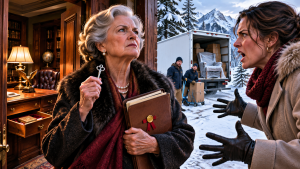
The study door opened three inches and stopped.
No hand appeared around the edge. No face looked through the gap. The door simply moved as if someone on the other side had released it, then settled against something hidden in the frame.
Melissa took one step backward.
Mike moved in front of me.
“Stay behind me, Mrs. Harland.”
“I am not hiding behind anyone,” I said, though my voice came out quieter than I intended.
The cabin had been silent a moment before. Now every sound seemed magnified: the low hum of the heating system, the ticking clock above the fireplace, the soft scrape of snow against the windows.
Melissa stared at the opening.
“You said no one knew about that room,” she whispered.
“I said no one knew about the drawer.”
Her eyes flicked toward me. That was the first mistake she made that morning. She had come prepared for an old woman who would be frightened by official paper, a moving truck, and a confident voice. She had not expected me to know exactly what she was looking for.
Mike drew his phone from his pocket but did not lower his gaze from Melissa.
“Do not touch anything,” he said.
She gave a brittle laugh. “You are both being dramatic. There is a mechanical latch in that door. Old houses make noises.”
“Then you will not mind waiting for the sheriff,” I replied.
Her expression changed again. The fear disappeared, replaced by irritation.
“You cannot hold me here.”
“No one is holding you,” Mike said. “You are standing on private property after being instructed not to enter it.”
“I have a legal right to be here.”
“Then you can explain that right to the deputy.”
She looked at the moving crew through the open front door. The three men stood in the cold, their breath clouding around their faces. The oldest one, a broad man with a gray mustache, had set down a cardboard box marked KITCHEN. He was watching Melissa now, not me.
She noticed.
“Get the rest of the boxes,” she ordered.
No one moved.
“Did you hear me?”
The gray-mustached mover rubbed his gloved hands together. “Ma’am, we were told this was a legal move. We were not told we were breaking into somebody’s house.”
“You are not breaking in.”
“You tried to make us go upstairs while the owner was inside.”
Melissa’s mouth tightened. “She is not the owner.”
I held out the visitor log.
“Before we discuss ownership, sign your name.”
She stared at the book.
“Why?”
“Because you have arrived with a truck, three men, and a document claiming to transfer my property. I would like an accurate record of the visit.”
“I am not signing that.”
“Then you are refusing to identify yourself on security footage. That will also be noted.”
Mike stepped aside just enough to reveal the camera mounted above the entryway.
The red indicator light blinked steadily.
Melissa looked at it, then at the silver key in her hand.
She had forgotten she was still holding it.
“Where did you get that?” I asked.
“It was given to me.”
“By whom?”
“You know by whom.”
“My husband has been dead for eleven months.”
“I am aware of that.”
“Then tell me who gave you the key.”
She slid it back into her coat pocket. “This is pointless. The drawer contains personal papers that belonged to your husband. He wanted me to have them.”
“Did he tell you that?”
“Yes.”
“When?”
She hesitated.
“Before he died.”
“Where?”
“At the house in Denver.”
“My husband was in hospice at the time.”
“He was still capable of making decisions.”
“Who else was present?”
Melissa’s face became perfectly still.
That was when I knew she had not expected questions. She had memorized answers, but not the questions themselves.
Mike’s phone vibrated. He glanced down.
“The deputy is on the way,” he said.
Melissa took a sharp breath. “You called the police?”
“I called the county office first. They transferred me to law enforcement when I explained the forged document.”
“You have no proof that it is forged.”
“Your document lists me as a witness,” Mike said. “I was in Arizona on the date written there. My employer has the travel records, and I have the hotel receipt.”
Melissa shook her head. “That does not prove anything. Someone could have used your name.”
“Exactly.”
She turned to me. “You are doing this because you hate me.”
“No,” I said. “I am doing this because you came to remove me from my home.”
“You have always resented me.”
“I barely knew you.”
“You resented that your son chose me.”
The words struck harder than they should have. My son, Daniel, had been dead for four years. A winter accident on a mountain road had taken him before he reached thirty-five. Melissa had been his wife for less than three years, and after his death she had disappeared from my life except for occasional messages about money, paperwork, or family property.
There had never been time for the hatred she claimed.
Only distance.
“You left before the funeral flowers were gone,” I said.
Her face hardened. “You made it clear I was not welcome.”
“I offered you the apartment in Denver.”
“You offered me a place to live as if I were a charity case.”
“You refused it.”
“Because you wanted me out of the family.”
“Melissa, you were already gone.”
For a moment, something unguarded crossed her face. Not grief. Not shame.
Resentment, old and polished.
Then the study door moved another inch.
The faint metallic click came again.
Mike’s eyes narrowed. “There is someone in there.”
“No,” Melissa said too quickly.
I turned to her.
She had gone pale.
“Who is in my study?”
“No one.”
“Then why are you frightened?”
“I am not frightened.”
“Your hand is shaking.”
She looked down at the gloved hand holding the folder. It was trembling badly enough that the pages inside made a dry, rapid sound.
The deputy arrived six minutes later in a white county SUV. He was young, perhaps thirty, with snow on the shoulders of his brown uniform. Behind him came a woman from the county assessor’s office, carrying a black case and wearing a long green coat.
Mike met them at the porch and spoke quietly. The deputy looked toward Melissa, then at the movers, then at the document in her hand.
“Mrs. Harland?” he asked.
“Yes.”
“I am Deputy Collins. This is Ms. Avery from the assessor’s office. She asked to come when we heard there might be a disputed transfer.”
Melissa stepped forward. “This is a private family matter.”
Ms. Avery removed her gloves. “The moment a deed is presented as a basis for taking possession of real property, it becomes a county matter.”
Melissa opened her mouth, but Ms. Avery continued.
“And if a public notary seal has been used improperly, it becomes a matter for the state.”
The color drained from Melissa’s face.
I noticed that.
So did Mike.
Deputy Collins extended his hand. “I need the folder.”
Melissa kept it against her chest.
“I have not been charged with anything.”
“No one said you had been. I am asking for the document so it can be examined.”
“My attorney told me not to surrender it.”
“Then your attorney can explain why you refused.”
She looked toward the driveway. The moving truck’s engine was still running, its exhaust drifting through the trees.
For the first time since she had arrived, she seemed to understand that the scene no longer belonged to her.
She handed over the folder.
Deputy Collins opened it on the porch railing. Ms. Avery leaned beside him. I remained in the doorway, while Mike stood at my shoulder.
The first page was the supposed transfer instrument. The second listed the land and the cabin. The third contained a notary acknowledgment.
Ms. Avery’s expression changed as she read.
“This notary seal is registered to Elaine Porter,” she said.
Melissa swallowed. “Yes.”
“Elaine Porter stopped practicing two years ago.”
“That is impossible.”
Ms. Avery pointed to the seal. “The commission number is no longer active. The stamp design is also wrong.”
Melissa looked at me. “You did this.”
I almost laughed.
“I was asleep when you arrived.”
“You knew I was coming.”
“I knew you would eventually try something.”
“That is not the same thing.”
“No,” I said. “It is not.”
Deputy Collins turned to Mike. “You said your name appears as a witness?”
Mike nodded.
“Can you prove where you were on the stated date?”
“I can show you.”
“Do it.”
Mike opened his phone and brought up a travel record. He had been in Phoenix for a security conference, then in Tucson the following morning. The timestamps were clear. The hotel receipt showed his name, the room number, and the date Melissa’s document claimed he had witnessed my signature in Colorado.
Ms. Avery examined the screen.
“Mr. Mike, did you sign any document for Mrs. Harland?”
“No.”
“Have you ever been a notary?”
“No.”
Melissa folded her arms. “He could be lying.”
Deputy Collins looked at her. “So could you. That is why we collect evidence.”
The gray-mustached mover let out a low breath.
One of the younger men murmured, “We should leave.”
“You will stay,” Deputy Collins said. “I may need your statements.”
Melissa spun on him. “They have nothing to do with this.”
“They were hired to remove property from a residence under disputed circumstances. They have plenty to do with it.”
She looked at the cabin again.
The door to the study remained partly open.
“Mrs. Harland,” she said, much more softly, “you do not understand what is in that drawer.”
“Then help me understand.”
“You are making a terrible mistake.”
“Which mistake?”
“Opening it.”
The sentence hung between us.
I looked at Mike.
He had been calm through the forged signature, the false witness line, and the illegal attempt to remove me. But now his jaw was tight.
“Mrs. Harland,” he said, “perhaps we should wait until the deputy searches the room.”
“No.”
He turned to me. “You do not know what she has arranged.”
“I know she has a key.”
“And I know that key should not exist outside your desk.”
That was true. My husband had given me the key eight years earlier, the month we bought the cabin. He had placed it in my palm while we stood in the empty study, before the furniture arrived and before the floors were refinished.
“There is a drawer behind the lower panel,” he had told me. “It is not for ordinary papers.”
“What does it hold?”
“Something I want you to have if I am no longer here.”
I had smiled at him then. “You are making a very dramatic promise.”
“I am making a practical one.”
He had kissed my forehead and told me never to use the key unless someone else found out about the drawer.
I had forgotten the exact words until that moment.
Someone else had found out.
Melissa had found the key.
I stepped into the study.
“Mrs. Harland,” Mike said.
“I am not going alone.”
He followed me. Deputy Collins came behind him, with Ms. Avery after that. Melissa remained on the porch until Deputy Collins told her to stay where he could see her.
The study smelled of cedar and cold ashes. My husband’s books filled the shelves, their leather spines faded by sunlight. His old brass lamp stood on the desk. The blue folder Melissa had brought lay open beside it, its pages disturbed by the morning wind.
The lower panel was beneath the desk, hidden behind a row of carved trim. I had never found it by accident. The seam was so fine it looked like part of the wood.
I knelt and ran my fingers along it.
There.
A shallow indentation.
Mike crouched beside me. “The key.”
I removed the silver key from my pocket. Melissa had dropped it when Deputy Collins took the folder. I had picked it up without thinking.
When I put it into the lock, it turned easily.
The panel swung outward.
Inside was a narrow drawer lined with dark green felt.
It was not empty.
There was a leather-bound notebook, a sealed envelope, a small black recording device, and a folded document tied with white thread.
For a moment, no one spoke.
Deputy Collins reached toward the drawer.
“May I?”
I nodded.
He removed the recording device first. It was old, the kind my husband had used for dictation. A strip of masking tape was fixed across it, and on the tape my husband’s handwriting appeared in blue ink.
FOR MARTHA. PLAY ONLY IF THE KEY IS FOUND BY SOMEONE ELSE.
My name was Martha Harland. Melissa had always called me Mrs. Harland, even in private. Daniel had called me Mom. My husband had called me Martha when he wanted me to listen.
The room seemed to tilt.
“You knew,” I whispered.
Not to anyone in the room. To the man who was no longer there.
Mike looked at the recorder. “Do you want to play it?”
I pressed the button.
Static crackled. Then my husband’s voice filled the room.
Older than I remembered. Tired, but steady.
“Martha, if you are hearing this, someone has found the key without your permission. Do not assume that person has found this drawer by accident.”
I gripped the edge of the desk.
His voice continued.
“I am recording this on November third. My health is failing faster than the doctors admit, and I may not have the time to explain everything in person. The cabin is yours, regardless of what anyone tells you. It was purchased with money from your inheritance, and I placed it in your name through the Harland Family Trust. I did not tell you because I wanted to give you one place that no one could take from you.”
My breath caught.
I had inherited money from my parents, but I had never known the precise amount. My husband had handled most of our investments because I trusted him. I had never questioned the papers he brought home. We had been married forty-two years.
Deputy Collins glanced at me, then at the folded document.
The recording continued.
“Daniel knows about the trust. Melissa does not. If she says she has a right to the cabin, ask her why she knows about the hidden drawer. If she claims I gave her the key, ask her to tell you when. The truth is that I never gave it to her.”
Melissa shouted from the porch.
“Turn that off!”
Everyone in the study froze.
Her voice came again, sharper. “You have no right to listen to that.”
I turned toward the open door.
“How do you know what he is saying?”
She did not answer.
Deputy Collins moved into the hallway. “Stay on the porch, ma’am.”
“He was not in his right mind when he made that recording.”
The recorder continued in my husband’s voice.
“There is more. The trust contains a protection clause. If anyone attempts to remove Martha from the cabin by means of a false transfer, the property is to be placed immediately under the control of the Harland Foundation, with Martha retaining lifetime use. The foundation will then pursue every person involved.”
Mike looked at me.
“What foundation?”
I had heard the name before. My husband had created charitable accounts after Daniel died, but he had never explained the full structure.
The recording answered him.
“The foundation is not a charity in the ordinary sense. It is the legal successor to the trust. Martha, if you are listening, you are the sole beneficiary of both. No family member can sell the cabin, mortgage it, or remove you from it. Not while you are alive.”
The words should have brought relief.
Instead, I felt a deep, aching sadness.
My husband had known I might someday need protection from the people closest to me. He had known enough to build walls around me without telling me they were there.
The recording clicked off.
Outside, Melissa began to cry.
Not softly.
She cried with the loud, furious grief of someone who had lost an argument rather than a person.
“You are twisting his words,” she called. “He promised me the property.”
I walked into the hallway.
“What did he promise you?”
She wiped her face with one gloved hand. “He said he would make sure I was taken care of.”
“He may have meant financially.”
“He said I deserved a fresh start.”
“Did he say you would own the cabin?”
She looked away.
“Melissa.”
“He said he would leave it to me.”
“Did he put that in writing?”
“He was going to.”
“But he did not.”
“He would have if you had not poisoned him against me.”
The accusation landed in the hall like a thrown stone.
I stepped closer to the door.
“You did not need me to poison him. You stopped visiting him six months before he died.”
“You refused to let me see him.”
“Because you came asking him for money while he was on oxygen.”
“I was his daughter-in-law.”
“You were his son’s widow.”
“And that meant nothing to you?”
“It meant I opened the door every time you called.”
Her mouth trembled.
For one second, I saw the woman she might once have been: young, exhausted, and angry at a life that had not turned out as promised. Then the expression vanished beneath calculation.
“You think a recording saves you?” she asked. “It does not. My attorney has a signed agreement from your husband.”
“What kind of agreement?”
“The cabin was collateral.”
“For what?”
She gave a small, victorious smile.
“For the money he borrowed.”
The room went still.
Mike looked at me. “Did your husband have debts?”
“No.”
Melissa laughed without humor. “You never knew him as well as you thought.”
Deputy Collins glanced toward Ms. Avery. “Is that claim in the folder?”
“No,” Ms. Avery said. “Only the transfer papers.”
Melissa’s smile faded.
“Then where is this agreement?” I asked.
She said nothing.
“Who was the lender?”
Still nothing.
“Who is your attorney?”
Her eyes moved toward the moving truck.
The youngest mover stood beside the driver’s door, listening. The gray-mustached man had stepped away from him, as if he wanted no part of the conversation.
Deputy Collins took out his notebook.
“Mrs. Melissa, I need the name of the attorney who prepared these documents.”
“You cannot demand privileged information.”
“I can ask who prepared a document used to claim possession of a home.”
“My attorney is handling this.”
“Then call him.”
She pulled out her phone and tapped the screen. No one answered. She tried again.
The second time, the call went directly to voicemail.
That detail did not escape her.
She lowered the phone.
I looked down at the folded document from the drawer.
“May I open that?” I asked Deputy Collins.
He examined the seal. “It is addressed to you.”
There was a date written on the outside. November third, the same day my husband had recorded the message.
I untied the thread.
The document was a trust amendment, notarized and signed by my husband, with the names of two attorneys beneath his signature. It stated plainly that the cabin had been purchased with my inherited funds and was to remain my separate property. The original deed was attached.
At the bottom, beneath the legal language, my husband had written one sentence in his own hand:
Martha must never be made to feel grateful for being allowed to stay in her own home.
I pressed my fingers to my lips.
Mike looked away, giving me the privacy of his silence.
Melissa read my face.
“What does it say?”
I did not answer.
She moved toward the hallway.
Deputy Collins blocked her.
“Do not come inside.”
“You cannot keep that from me.”
“It is addressed to Mrs. Harland.”
“Her husband was my family.”
“He was not your husband.”
The words came from me.
Melissa stared.
Then she laughed again, but this time the sound broke in the middle.
“You always thought you were better than me.”
“No. I thought you were better than this.”
That angered her more than any accusation.
She reached into her coat and pulled out her phone.
“I have messages,” she said. “I have proof he promised me the cabin. I have voice notes. I have photographs. I have everything.”
“Then show them,” I said.
She held the phone against her chest.
“I will show them in court.”
“You should have shown them before ordering strangers to remove my belongings.”
Deputy Collins nodded toward the document in his hand. “There is another issue.”
“What?”
“The signature on this transfer is not simply inconsistent with Mrs. Harland’s known signature. The date on the notary acknowledgment is impossible.”
Ms. Avery stepped closer. “The county record shows the cabin was already protected by a trust before that date. Even if Mrs. Harland had signed a transfer, the document would not be valid without authorization from the trustee.”
“Who is the trustee?” Melissa asked.
I looked at the trust amendment.
There were two names.
One was a law firm in Denver.
The other was Mike.
He went completely still.
“What?” I said.
His eyes moved over the page. “I did not know.”
The document named him as successor trustee, effective upon my husband’s death, unless he declined in writing.
Melissa’s face changed.
“You knew,” she whispered.
Mike looked at her. “I did not.”
“You were in the house when he signed it.”
“I was not.”
“You were his security guard.”
“I guarded the property. I was not part of his legal affairs.”
She pointed at the document. “Your name is there.”
Mike looked at me, stunned. “Mrs. Harland, I swear to you, I have never seen this.”
I believed him.
My husband had hired Mike after Daniel’s death, when Melissa began appearing at the Denver house without calling first. Mike had been the one who installed the cameras at the cabin. He had been patient with my questions and careful with my privacy. He had never once hinted that my husband had named him in a trust.
Melissa’s shock was different.
She had expected Mike to be compromised by the false witness line. She had not expected him to be part of the document that defeated her.
“Why would he choose you?” she demanded.
Mike shook his head. “I do not know.”
The black recorder lay on the desk.
I pressed its button again.
There was one more message.
My husband’s voice returned.
“Mike, if you are present when Martha hears this, I have chosen you because you understand the difference between protecting a person and controlling one. I know you will not let anyone use the trust to frighten her. If you do not want the responsibility, the Denver firm can replace you. But I hope you will accept.”
Mike closed his eyes.
The room grew quiet except for the recorder.
My husband’s voice softened.
“Martha, you will be angry that I kept this from you. You will say I should have trusted you with the truth. You will be right. But I also know you. You would have tried to solve everyone’s problems before considering your own. This cabin is not an inheritance from me. It is something you built with your own life. Please do not let anyone convince you otherwise.”
The recording ended.
For several seconds, even Melissa said nothing.
Then she whispered, “He hated me.”
“No,” I said. “He feared what you would do when you did not get what you wanted.”
Her eyes flashed.
“You think this is over?”
“No.”
She smiled.
It was a smaller smile than before, but it carried a new threat.
“You still do not know what happened to Daniel’s insurance money.”
The words struck the room with such force that I could almost hear something crack.
Mike turned toward her. “What are you talking about?”
Melissa looked at me.
“Ask your husband where the money went.”
“My son had a life insurance policy,” I said. “It paid for the funeral, the legal expenses, and the apartment you refused.”
“You are lying.”
“I handled the account.”
“Did you?”
My hand tightened around the trust amendment.
Melissa continued. “Daniel changed the beneficiary before he died.”
I could not breathe.
The insurance policy had been one of the few matters I had never personally handled. My husband had told me the payment was processed, and I had accepted that. After Daniel’s funeral, there had been so many forms, so many accounts to close, so much grief that numbers became meaningless.
Melissa watched me carefully.
“Daniel named me,” she said. “Your husband took the money.”
“That is not possible.”
“He told me it was being held for me until I was stable.”
“Where is the policy?”
“In the drawer.”
“Which drawer?”
She pointed toward the hidden compartment.
“The one beneath the trust papers.”
Deputy Collins immediately said, “Do not touch anything else.”
But the drawer was already open. The notebook remained inside.
I lifted it.
The cover was soft leather, worn at the corners. My husband’s initials were pressed into it. I opened the first page.
The entries were dated over several months after Daniel’s death.
The first line read:
Melissa is asking about the policy again. She says Daniel promised it to her. I told her I would look into it.
The second:
There is no policy in her name. Daniel left the money to Martha, as he always intended.
The third:
Melissa showed me a letter with Daniel’s signature. It may be genuine, but the beneficiary change was filed after Daniel’s death date. I am sending it to the insurer for review.
My eyes blurred.
“Keep reading,” Melissa said.
Her voice had lost its certainty.
I turned the page.
The letter is fraudulent. The signature was copied from Daniel’s driver’s license application. The person who prepared it had access to his files. I have not told Martha. She is grieving, and I do not yet know who helped Melissa obtain the records.
I looked up.
Melissa had gone utterly pale.
The notebook continued.
I believe Melissa found the old insurance forms in the Denver house. She has been asking about the cabin because she thinks the trust contains the rest of Daniel’s money. She is wrong. There is no hidden fortune. The cabin is Martha’s.
I turned another page.
If Melissa attempts to take the cabin, show her the insurance report. Do not allow her to make Martha feel guilty for surviving her son.
A paper slipped from between the pages.
Deputy Collins caught it before it reached the floor.
It was a letter from the insurance company, dated ten months earlier. The claim for the altered beneficiary form had been denied. The company had referred the matter to the district attorney because the signature had been forged.
Beneath that was a photocopy of a payment record.
The insurance money had not gone to Melissa.
It had not gone to my husband.
It had been placed into a college fund for Daniel’s young daughter, whose name I knew but had not heard spoken that morning because Melissa had not brought her.
That was the second major truth to surface. The cabin was not the only thing Melissa had tried to take. She had tried to take the money Daniel had meant for his child.
I looked at Melissa.
“Where is Daniel’s daughter?”
Her lips parted.
“You were supposed to bring her,” I said. “You said you were taking her to a new home.”
“She is with a friend.”
“Which friend?”
“She is safe.”
“Give me the address.”
Melissa looked toward the window.
Deputy Collins took a step forward. “Mrs. Melissa, answer her.”
“She is not in danger.”
“That was not the question.”
“She is with someone I trust.”
“Name.”
Melissa’s face crumpled.
The gray-mustached mover spoke from the porch.
“Her daughter is at a motel in town.”
Everyone turned.
Melissa stared at him.
He lifted both hands. “You told us to load the child’s furniture too. One of the boys saw a car seat in the truck and asked where the child was. You said she was waiting at the motel.”
“Be quiet,” Melissa snapped.
Deputy Collins’ expression changed from suspicion to alarm.
“How old is the child?”
“Eight,” the mover said.
“Where is the motel?”
Melissa turned toward the driveway.
Mike moved first, grabbing the keys from the moving truck’s ignition before the younger mover could start it.
Deputy Collins spoke into his radio. “I need a welfare check at the local motels. Female child, eight years old. Possible guardian attempting unauthorized relocation.”
Melissa backed away.
“No. You cannot take her from me.”
“No one is taking her,” I said. “We are making sure she is safe.”
“You will use her against me.”
“She is not a weapon.”
“She is all I have.”
The sentence came out broken.
For the first time, Melissa looked less like an enemy and more like a person who had built her entire life around refusing to admit how frightened she was.
I felt pity.
I hated that I felt it.
“You should have come to me,” I said.
“You would have called the police.”
“If you had asked for help, I would have helped.”
“You never help without making people feel small.”
“I gave you a home.”
“You gave me a home I could never afford to keep.”
“That was not a trap.”
“It was a reminder that I had nothing.”
I looked at the folder, the forged transfer, the key, and the moving truck.
“You could have asked for a permanent arrangement. You could have asked for money. You could have asked me to help with your daughter. Instead, you tried to make me homeless.”
Her eyes filled.
“I was tired of asking.”
“Then you should have stopped pretending this was an inheritance.”
The deputy’s radio sounded.
He listened, then said, “The child is located. She is unharmed.”
A breath passed through the room.
Melissa closed her eyes.
“She is at the Pine Ridge Motel,” Deputy Collins continued. “A deputy is with her now.”
Melissa sank onto the porch step.
Snow blew through the open doorway and melted on the dark floorboards.
The moving crew stood in a line near the truck, silent and uncomfortable. The gray-mustached man removed his cap.
“Ma’am,” he said to me, “we are sorry. We thought this was legal.”
“I know.”
He looked at Melissa. “We will unload anything that belongs to the child.”
She shook her head.
“No.”
“Those things are hers,” I said.
“I said no.”
“Why?”
“Because if she comes here, you will take her.”
I walked onto the porch and sat beside her, leaving a careful space between us.
“Where would you like her to go?”
She stared at the snow.
“I do not know.”
“Then begin by letting her come somewhere warm.”
“You mean the cabin?”
“I mean a safe place.”
“Your safe place.”
“Until we decide what happens next.”
She looked at me with exhausted suspicion.
“Why would you do that?”
“Because she is Daniel’s daughter.”
“You never wanted her.”
“That is not true.”
“You barely saw her.”
“You kept moving. You changed phone numbers. You told me she was too young to understand who I was.”
“You would have turned her against me.”
“I never needed to. You did that yourself.”
She flinched.
Deputy Collins returned to the porch.
“The child is safe,” he said. “She is being brought here with a female deputy. Mrs. Melissa, I need you to come with me to give a statement.”
“I am not under arrest.”
“Not at this moment.”
She looked at me.
“What happens to me?”
“That depends on the documents and the investigation.”
“You are going to press charges.”
I thought of the forged signature. The false witness line. The obsolete notary seal. The insurance letter. The child waiting in a motel because her mother had spent the night planning to seize a house.
“Yes,” I said. “I will cooperate fully with the investigation.”
Her shoulders sagged.
“Even after everything?”
“Especially after everything.”
She looked down at her hands.
Then she said, “Your husband knew.”
“Yes.”
“He knew I was struggling.”
“Yes.”
“He could have helped me.”
“He did help you.”
“He gave me nothing.”
“He gave Daniel’s daughter a future.”
Melissa lifted her head.
The cabin seemed to hold its breath.
“You knew about the fund?”
“I know now.”
“That was supposed to be mine.”
“No. It was supposed to be hers.”
“She is my daughter.”
“She is also Daniel’s child.”
Melissa turned toward the road.
The deputy’s vehicle was approaching, followed by another. Behind them, through the snow, I could see a small figure in a purple coat sitting in the back seat of the second car.
My granddaughter.
I had seen her only six times.
She had Daniel’s dark hair and his habit of pressing her lips together when she was trying not to cry.
Melissa saw her too.
She stood quickly, but Deputy Collins raised a hand.
“Stay here until the deputy brings her inside.”
“I am her mother.”
“No one is disputing that.”
“She will be afraid.”
“She will be less afraid if the adults stop shouting.”
Melissa looked at me.
“Will you tell her I did not leave her?”
“I will tell her the truth.”
“What truth?”
“That you were trying to find a place for both of you.”
Her eyes filled again.
“And that I failed.”
I did not answer.
The female deputy brought the child inside. She was carrying a pink backpack and a stuffed rabbit with one ear missing. She looked around the cabin with wide eyes, taking in the strangers, the moving boxes, the open study door, and her mother sitting on the porch.
“Mom?”
Melissa crossed the threshold before anyone could stop her.
The girl ran into her arms.
For a moment, all the legal papers and accusations disappeared. Melissa held the child so tightly that the little girl’s face pressed into her coat.
“I am here,” Melissa whispered. “I am here.”
The child looked over her mother’s shoulder at me.
I did not move toward her.
I had learned, over the years, that frightened children should not be forced to accept comfort from strangers simply because adults had decided they were family.
So I smiled instead.
“Hello.”
She stared at me.
“Are you Mrs. Harland?”
“Yes.”
“Mom said this was your house.”
“It is.”
“Are we in trouble?”
“No,” I said. “You are safe.”
Her fingers tightened around the stuffed rabbit.
“Can I have my room?”
Melissa looked at me sharply.
The question hung there.
The moving truck was full of the child’s furniture: a white bed frame, two plastic bins of books, a small desk, and a box of winter clothes. Melissa had brought those things to the cabin under the pretense of taking everything that belonged to her.
Now the same boxes stood in the driveway, waiting to be carried inside.
I looked at the movers.
“Put the child’s things in the room at the end of the hall,” I said.
Melissa stiffened. “No.”
The child looked between us.
I turned to Melissa. “You can decide where you sleep. She should not have to.”
Melissa’s face twisted with confusion.
“You are letting us stay?”
“For tonight.”
“And tomorrow?”
“Tomorrow we speak to the attorney.”
“You said you would cooperate with the investigation.”
“I will.”
“You will let the police take me, then let my daughter sleep in your house?”
“She is not responsible for what you did.”
“You will use her to prove you are the better person.”
“No,” I said. “I am doing the decent thing because she is a child.”
The child stepped away from her mother and walked toward the hallway.
“Which room?”
I pointed.
“The one with the window.”
She looked at Melissa.
“Can I?”
Melissa covered her mouth.
“Go,” she whispered.
The movers carried the boxes inside. The gray-mustached man placed the small desk beneath the window. The younger men assembled the bed while the girl watched, clutching her rabbit. Mike found a stack of clean sheets in the linen closet and helped make the bed.
The cabin changed in less than an hour.
A room that had been empty since my husband’s death filled with the smell of cardboard, wool, and a child’s shampoo. Books appeared on the shelves. A purple blanket was spread across the mattress. The girl placed her rabbit on the pillow and stepped back to inspect the room.
“It is nice,” she said.
“It needs pictures,” I told her.
“I have some.”
“Then we will find tape.”
She looked at me carefully.
“Are you really my grandmother?”
“Yes.”
“Why did Mom say you did not want us?”
I glanced toward the hall.
Melissa stood there with Deputy Collins beside her.
This was the moment I had feared for years. Not the forged papers. Not the legal fight. A child asking for an answer that could shape her memory of everyone she loved.
“I wanted to know you,” I said. “Your mother was worried that would make things difficult.”
“Did she say you were mean?”
“Sometimes.”
“Are you?”
“Sometimes.”
The girl’s eyes widened.
I smiled. “Everyone is sometimes.”
She considered that.
“Mom is mean sometimes.”
Melissa looked down.
“But she makes pancakes,” the girl added.
“Then she must be good at something.”
“She burns the first one.”
“So do I.”
That made the child smile.
It was small, but it changed the room.
Deputy Collins waited until the girl returned to her boxes before speaking to Melissa.
“We need to go.”
Melissa nodded.
She turned to me.
“Do not let her think I abandoned her.”
“I will not.”
“Do not tell her I forged anything.”
“I will tell her the truth when she is old enough to understand it.”
“And if I go to jail?”
The question was barely audible.
I looked at the woman who had arrived before dawn in a cream coat, holding a folder full of lies. I looked at the daughter of my dead son, who had inherited none of her mother’s bitterness yet.
“Then I will make sure your daughter knows you loved her,” I said. “But I will not teach her that love excuses cruelty.”
Melissa nodded once.
Deputy Collins led her down the steps.
At the bottom, she stopped.
“What will happen to the cabin?”
“It remains mine.”
“And the trust?”
“I have not decided whether to keep Mike as trustee.”
Mike glanced at me.
“You should,” Melissa said.
We both looked at her.
She gave a tired, humorless smile.
“He was the only person your husband trusted who did not want anything.”
Then she walked toward the county vehicle.
The truck remained parked at the edge of the driveway. The fraudulent folder sat in an evidence bag on Deputy Collins’ seat. The silver key was on the desk beside the recording device.
I stood by the window until the vehicles disappeared beyond the pines.
Only then did I return to the study.
Mike was examining the trust amendment.
“You really did not know?” I asked.
“No.”
“Why did he choose you?”
“He once asked me to watch the property if he became ill. I thought he meant security.”
“He meant more.”
Mike ran a finger along the edge of the paper.
“I do not know if I am qualified to manage a trust.”
“You protected this cabin for months without knowing you were doing it.”
“I installed cameras.”
“You also called me before Melissa reached the door.”
“That is my job.”
“No,” I said. “That is what he saw in you.”
Mike looked at the recorder.
“Do you want me to contact the Denver firm?”
“Tomorrow.”
“And tonight?”
“Tonight, I have a child’s room to finish.”
He smiled faintly.
I picked up the silver key.
It felt warm from my hand.
On the desk, beneath the key, I noticed a small fold in the masking tape that had covered the recorder. I peeled it back.
There was writing underneath.
Not my husband’s handwriting.
The words were tiny, nearly hidden:
The first recording is for Martha. The second is for Melissa.
I froze.
Mike saw my expression.
“What is it?”
I turned the recorder over. A second button was set into the underside, almost invisible beneath the battery cover.
My hand hovered over it.
The room seemed to grow colder.
“Mrs. Harland,” Mike said carefully, “you do not have to play it.”
“Yes, I do.”
I pressed the button.
Static crackled again.
Then my husband’s voice spoke, but this time it was directed at Melissa.
“Melissa, if you are hearing this, you have already found the key or have been given a copy of it. You have also probably told Martha that the cabin belongs to you. I hope you are listening before you do something that cannot be undone.”
I sat down.
The recording continued.
“I know about the insurance form. I know you copied Daniel’s signature. I know you took the key from the desk in Denver while Martha was visiting him in hospice.”
My hand went cold.
Mike’s eyes lifted to mine.
My husband continued.
“You told me Daniel promised you the insurance money. He did not. You told me he wanted you to have the cabin. He did not. You told me Martha hated you. She does not. She is disappointed, frightened, and tired. You mistook those things for hatred because hatred was easier for you to bear.”
A soft sound came from the hallway.
Melissa had not left.
She stood just inside the study door, her face drained of color.
Deputy Collins was behind her, one hand raised as if he had tried to stop her.
The recording played on.
“You have spent four years trying to make Martha pay for Daniel’s death. But she did not cause the accident. She did not hide money from you. She did not take your future. You lost Daniel, and instead of grieving, you decided someone had to be guilty.”
Melissa covered her mouth.
My husband’s voice softened.
“If you are still willing to change, ask Martha for help plainly. She will not give you the cabin, because it is hers. She will not give you Daniel’s child’s money, because it is the child’s. But she may help you build a life that does not depend on taking from other people.”
The recording paused.
Then he said the words that made the entire morning rearrange itself in my mind.
“There is one final thing you should know. I did not leave the cabin to Martha because she was my wife. I left it to her because she bought it.”
I stared at the recorder.
My husband continued.
“She paid for the land with her inheritance. She chose the architect, the timber, the stone, and the view. I only helped her believe that building a place for herself was not selfish. The deed is in her name because it always belonged in her name.”
My throat tightened.
I remembered the first winter here. I had stood on the unfinished porch while workers framed the roof. My husband had brought me coffee and teased me for choosing so many windows.
“You wanted to see the mountains,” he had said.
“I wanted to see the sky.”
“Then we will build the whole house around it.”
At the time, I had believed we had built it together.
The truth was not smaller.
It was larger.
I had built it.
My husband had simply known me well enough to remind me.
The recording ended with one final sentence.
“Martha, if Melissa comes to the cabin with a truck, let her enter. Let her believe she has won long enough for the truth to become impossible to hide. Then open the drawer.”
The study went silent.
I looked at the cameras mounted beyond the window, at the recording device, at the trust amendment, and at the woman standing in the doorway.
My husband had not merely prepared for Melissa’s betrayal.
He had predicted the exact shape it would take.
He had known that Melissa would arrive with a false deed, a borrowed key, and enough confidence to frighten everyone into surrender. He had known that I would hesitate to fight because I had spent my life avoiding conflict.
So he had left me a trail.
Not to revenge.
To certainty.
Melissa stepped into the room.
“You knew,” she whispered.
“No,” I said. “He knew.”
“You set me up.”
“I did not know you were coming this morning.”
“But he did.”
“He knew what you were capable of.”
Her eyes filled with tears.
“Did he ever love me?”
I wanted to say no.
It would have been easier.
Instead, I answered honestly.
“He loved Daniel. He cared about you because you were part of Daniel’s life. But love does not mean handing someone whatever they demand.”
She looked at the recorder.
“Why did he not give me the money?”
“Because it belonged to your daughter.”
“Why did he not tell me about the trust?”
“Because you would have tried to take the cabin.”
She flinched.
“Yes,” she said. “I would have.”
The admission was the first honest thing she had said all morning.
Deputy Collins stepped forward.
“We need to go now.”
Melissa nodded, but she kept looking at me.
“Will you let me call her tonight?”
“Yes.”
“Will you tell her I am coming back?”
“I will tell her you are trying.”
Her face crumpled.
“That sounds like something people say when they do not believe you.”
“It is something people say when they do not know what will happen.”
She accepted that.
At the doorway, she stopped once more.
“Mrs. Harland?”
“Yes?”
“Your husband was right about one thing.”
“Which thing?”
“You do help people even when they do not deserve it.”
I looked toward the little girl’s room.
“No,” I said. “I help people when children are depending on them.”
Melissa lowered her eyes and left with the deputy.
The cabin became quiet again.
Not empty.
Quiet.
Mike closed the study door and began gathering the papers into clear folders. The moving crew finished placing the child’s boxes upstairs, then left without taking payment. Before the gray-mustached man climbed into his truck, he came to the porch.
“I am sorry for believing her,” he said.
“You believed the paperwork.”
“Still.”
“You did the right thing when you stopped.”
He nodded, then looked up at the cameras.
“Those things record everything?”
“Almost everything.”
He shook his head. “Good thing.”
When the truck finally disappeared down the mountain, the snow began to fall harder.
I made tea for myself and hot chocolate for my granddaughter. She sat at the kitchen table with her stuffed rabbit in her lap, staring at the steam rising from the cup.
“Is Mom coming back today?” she asked.
“Not today.”
“Is she in trouble?”
“Yes.”
“Big trouble?”
“Probably.”
She thought about this.
“Will she be mad at me?”
“No.”
“Will she be mad at you?”
“Probably.”
“Are you scared?”
I placed a marshmallow in her cup.
“Yes.”
She looked surprised.
“Adults can be scared too?”
“Of course.”
“What do you do?”
I wrapped both hands around my tea.
“You tell the truth. Then you wait.”
She nodded as if that were a rule she could remember.
After she finished her drink, we went upstairs. I helped her arrange her books and tape photographs to the wall. One showed Daniel as a boy, standing beside a river with a fish almost as large as his arm. Another showed him at seventeen, grinning through a missing front tooth.
She studied them.
“That is my dad?”
“Yes.”
“He looks silly.”
“He was.”
“Did he like pancakes?”
“He burned them.”
She smiled.
The room smelled of fresh tape and pinewood. Outside, the mountain disappeared behind a veil of snow.
At the foot of the bed, I found a small envelope tucked inside one of the moving boxes. It had my name on it.
For one irrational moment, I thought there might be another secret.
Another document.
Another hidden warning.
I almost left it unopened.
Then I remembered my husband’s voice: Do not let anyone convince you otherwise.
I opened the envelope.
Inside was a photograph of the cabin under construction. I was standing on the porch, younger by a decade, holding a rolled-up blueprint. My husband stood behind me with both hands on my shoulders.
On the back, he had written:
The first place Martha ever chose for herself.
There was no legal language. No hidden clause. No threat.
Only the truth.
I sat on the edge of the child’s bed and held the photograph in my lap.
For years, I had thought of the cabin as the last gift my husband had given me. That morning, I understood the final twist of his careful plan.
He had not been protecting the cabin from Melissa. He had been protecting me from the belief that I needed his permission to keep it.
The deed, the trust, the recording, and the hidden drawer had all been arranged around one fact I had forgotten:
The property was mine before anyone else tried to claim it.
My granddaughter climbed onto the bed beside me.
“Who is that?” she asked, pointing at the photograph.
“Me.”
“You look different.”
“I was.”
“Were you happy?”
I looked through the window at the snow-covered pines, the pale ridges, and the long driveway where Melissa’s truck had arrived like a declaration of war.
Then I looked at the room that now belonged to a child who had spent too long being carried from one uncertainty to another.
“Yes,” I said. “I was happy.”
“Are you happy now?”
The answer took longer.
But it came.
“Yes.”
Downstairs, the security system chimed. A message appeared on the monitor: Visitor log updated. Deputy Collins departed. Melissa Harland in custody for questioning.
I looked at the screen, then closed the notification.
The day had begun with someone trying to throw me out of my own home.
It ended with my granddaughter asleep beneath a purple blanket, Mike securing the doors, and the cabin standing exactly where it had always stood, rooted in the mountain.
Before turning off the light, I placed the silver key on the windowsill.
I no longer needed to hide it.
And when the first evening star appeared above the pines, I understood why my husband had left the drawer waiting all those years.
Not because he expected me to lose everything.
Because he knew that one day, someone would try to convince me I had never owned anything at all.
He wanted me to have proof.
He wanted me to have the truth.
And most of all, he wanted me to remember that the woman Melissa came to remove was not helpless, not confused, and not standing in anyone’s way.
She was Martha Harland.
She was home.