Alden stood in my kitchen doorway with his duffel bag hanging from one hand and a look on his face like somebody had slapped him with a wet dishcloth.
“What?”
“You heard me.”
He looked past me at the stove. No pots bubbling. No chicken and dumplings. No cornbread cooling on the counter. Just my little blue teakettle and a vase of yellow wildflowers Miriam Yoder’s youngest daughter had picked along the fence line.
“Joanne, I been driving eleven hours.”
“And I’ve been doing things myself for forty-five years. Guess we’re both tired.”
He dropped his duffel bag beside the refrigerator.
“Don’t start getting smart with me. I asked you to fix supper.”
“I remember.”
“Then where is it?”
I folded the dish towel I’d been holding and laid it neatly beside the sink.
“Same place my pension went, I reckon. Somewhere you decided I didn’t need to know about.”
His face changed.
Not much. Just a little tightening around the mouth.
But I had been married to that man since Jimmy Carter was running for president. I knew every twitch on his face.
He’d expected an argument about the bank account eventually.
He hadn’t expected me to bring it up while he was hungry.
“Good Lord, woman. You’re still carrying on about that?”
“No, Alden. I finished carrying on about it two weeks ago.”
He pushed past me toward the refrigerator, jerked it open, and stared.
There was milk, butter, a carton of eggs, half a watermelon, and a covered bowl of potato salad I’d made for myself.
He reached for the bowl.
I took it from his hand.
“That belongs to me.”
He blinked.
“Have you lost your mind?”
“Possibly. I’ve been married to you so long, it wouldn’t surprise me.”
Across the road, Miriam Yoder laughed.
Alden turned toward the window.
And that’s when he saw them.
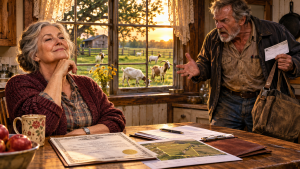
Six goats stood in the front pasture, their white bodies glowing in the last of the evening light.
Beyond them, a dozen more moved along the fence.
One brown goat had climbed onto the little hill where Alden liked to park his zero-turn mower and was looking toward the farmhouse as if she owned the whole county.
Alden’s mouth fell open.
“What in God’s name are those doing there?”
“Eating grass.”
“Whose goats are those?”
“Miriam’s.”
He stared at me.
Then he pointed at the window.
“Get them off my property.”
I reached into the drawer beside the stove and took out the folded sheet of paper I’d been keeping there all afternoon.
I smoothed it against the kitchen table.
“That’s what I wanted to show you.”
He snatched it up.
I watched him read.
Once.
Twice.
Then he turned the paper over, looking for something on the back.
There wasn’t anything.
The front was enough.
It was a signed pasture lease.
Twenty-four months.
Forty acres described by parcel number, with the front grazing area and access lane specifically identified.
The tenant was Miriam Yoder.
The property owner was Joanne Kittle.
The monthly payment was six hundred dollars.
And one sentence, printed in plain English, stated that the tenant had permission to install temporary fencing and use the designated pasture for goats, subject to the terms of the agreement.
Alden jabbed his finger at my name.
“You can’t do this without asking me.”
I looked at him.
“That’s funny. I said the same thing about my pension.”
He crumpled the paper.
“I’m your husband!”
“Yes, you are.”
“That land belongs to this family!”
“It belonged to my daddy. Then it belonged to me.”
“We’ve been married forty-five years!”
“And the courthouse records still have my name on the deed.”
His jaw moved without making any sound.
For the first time in our marriage, Alden Kittle had discovered that shouting didn’t change what was written on paper.
Then his eyes narrowed.
“You think a piece of paper means you can disrespect me in my own house?”
I reached back into the drawer.
“No,” I said. “But I brought you another one, just in case.”
This time I handed him a certified copy of the deed.
He stared at the raised seal.
His face went the color of yesterday’s biscuit dough.
“You went to the courthouse?”
“Sure did.”
“Behind my back?”
“While you were in Texas.”
“Joanne!”
“And then I went to the bank.”
He froze.
I told him I’d contacted the pension office, reported the unauthorized change to my direct deposit, opened a new account, and requested records showing where my money had gone.
He lowered himself into a chair.
Not because I invited him.
Because his legs seemed to have made the decision without consulting the rest of him.
“You had no right.”
There it was.
Four words that explained forty-five years.
I sat across from him.
“Alden, I’ve been thinking about rights a whole lot lately.”
He glared at me.
I continued.
“Remember when the water heater broke in January?”
“What’s that got to do with anything?”
“You told me we couldn’t afford another one.”
“Money was tight.”
“You bought yourself a twelve-thousand-eight-hundred-dollar mower.”
“That’s equipment!”
“Equipment for cutting grass on land you don’t own.”
His ears turned red.
I almost felt sorry for him.
Almost.
Then I remembered standing over the stove in January, heating water in my biggest stockpot, carrying it down the hall in a heavy metal bucket because my husband had decided hot water wasn’t worth spending money on.
At sixty-seven years old, I’d been bathing like a woman in 1885 while a brand-new mower sat under a tarp in the barn.
I wasn’t feeling sorry anymore.
“Did you know,” I said, “that Miriam’s boys found a broken post along the south fence?”
He blinked.
“What?”
“Fixed it yesterday. Didn’t cost me a dime. That’s part of the lease.”
He shoved the papers toward me.
“You get those animals out of there by morning.”
“No.”
His eyes widened.
It was such a small word.
One syllable.
I should have practiced using it years earlier.
He stood so fast his chair scraped across the floor.
“Then I’ll do it myself.”
He headed for the back door.
I didn’t move.
He made it halfway across the porch before a voice floated across the road.
“Evening, Alden!”
Miriam Yoder stood on her porch, still holding her glass of sweet tea.
She was seventy-one, strong as an ox, and had delivered nine children without ever developing the habit of being intimidated by a man.
Alden pointed toward the pasture.
“Get those goats off my land!”
Miriam took a slow sip.
“Can’t, Alden. Got a lease.”
“I never signed any lease!”
“Didn’t ask you to.”
He stopped.
Miriam leaned against the porch rail.
“Joanne signed it. Her daddy’s place, remember?”
I could see Alden’s shoulders rising and falling.
Then Miriam added something that nearly made me choke on my own laughter.
“And thank you kindly for buying that nice mower. My grandson says it’ll sure come in handy keeping the fence lanes clear.”
Alden turned around so sharply I thought he’d wrench his neck.
“What mower?”
I opened the screen door.
“Oh, honey. I was just getting to that.”
He came back inside.
I poured myself a glass of iced tea.
“Your mower’s still yours,” I told him. “But Miriam asked if she could hire you to mow along the fence line. I told her she’d have to negotiate with the man who brings home the paycheck.”
He looked like he might explode.
“You think this is funny?”
“No,” I said quietly. “I think it’s forty-five years overdue.”
That should have been the end of the argument.
It wasn’t.
Alden had two sisters.
And when Alden couldn’t win an argument by himself, he called reinforcements.
Before nine o’clock, my phone rang.
His older sister, Darlene, didn’t bother saying hello.
“Joanne, what in the world have you done?”
I was sitting in Daddy’s old rocking chair, the one Alden had always called ugly and wanted thrown out.
“Good evening to you too, Darlene.”
“Alden says you’ve rented out his land to the Amish.”
“Miriam’s family isn’t Amish. They’re Mennonite.”
“That’s not the point!”
“It’s not Alden’s land either.”
There was a long silence.
Then Darlene said, “You’ve embarrassed your husband.”
I looked around my living room.
The wallpaper was faded.
The carpet had been installed in 1998.
The curtains were ones I’d sewn myself.
I’d saved every year for something better, and every year Alden had found another expense that mattered more.
“I think he embarrassed himself,” I said.
“You need to remember who takes care of you.”
That one made me laugh.
I couldn’t help it.
“Darlene, I carried mail for thirty-one years. I worked through ice storms, muddy roads, heat waves, and dogs big enough to eat the bumper off my Jeep. I earned my retirement. Alden didn’t buy it for me.”
“He’s always been a good provider!”
“Then perhaps he’ll provide his own supper.”
I hung up.
My hands shook afterward.
Not because I regretted what I’d said.
Because I’d never said anything like it before.
Ten minutes later his younger sister, Brenda, called.
I let it ring.
Then she sent a text.
Marriage is about compromise, Joanne. You’re behaving like a selfish old woman.
I read it twice.
Old habit.
Then I typed back:
I’ve compromised for forty-five years. It’s his turn.
I put the phone down and went to bed.
The next morning, I woke to the sound of Alden banging around in the kitchen.
By the time I reached the doorway, he’d burned two pieces of toast and broken an egg onto the floor.
He looked at me with murder in his eyes.
“Where do you keep the frying pans?”
“Same cabinet they’ve been in since 1994.”
He yanked open the wrong door.
I didn’t help him.
Instead, I put on my shoes and drove into Yellville.
There was a second reason I’d gone to the courthouse two weeks earlier.
And unlike the pasture lease, Alden didn’t know anything about it yet.
I’d met with an attorney named Ruth Callahan.
Ruth was fifty-eight, wore bright red reading glasses, and had the kind of calm voice that made people pay attention.
She’d grown up outside Flippin, and her mother had been on my mail route.
When I’d first sat in her office, I’d brought a grocery sack full of papers.
Bank statements.
Pension letters.
Property tax receipts.
Our marriage certificate.
Alden’s old trucking pay stubs.
And the note I’d written after he’d waved that paycheck in my face.
Ruth had spread everything across her desk.
“Joanne,” she’d asked, “what do you want?”
I’d opened my mouth.
Nothing came out.
I knew what Alden wanted.
I knew what his sisters wanted.
I knew when he liked his supper and how he wanted his socks folded.
But nobody had asked me that question in so long I couldn’t remember how to answer it.
Finally, I said, “I want to stop being afraid to spend my own money.”
Ruth took off her glasses.
“Then we start there.”
She explained that the deed was important, but forty-five years of marriage could complicate property questions if we divorced. A premarital inheritance didn’t automatically settle every question about improvements, marital contributions, or ownership claims.
I appreciated that she didn’t promise me the moon.
She told me the truth.
We worked through the banking problem first.
Then she helped me request records, secure my pension information, and document the transfers.
She advised me not to make assumptions about what money was legally mine until we could trace it.
And when I told her about Alden’s demand to control every dollar, she asked whether I felt safe at home.
I said yes.
Then I thought about how he shouted.
How he’d once punched a hole through the pantry door when I bought a new sewing machine without asking.
How I’d learned to wait until he was gone before buying groceries he considered unnecessary.
Ruth noticed my hesitation.
She gave me information about local support services and a safety plan.
“Financial control is still control,” she said.
I carried those words home.
They felt heavier than the grocery sack full of papers.
Now, two weeks later, I was returning to her office.
And this time I knew exactly what I wanted.
“I’d like to file for divorce,” I told her.
Ruth looked at me carefully.
“Are you certain?”
I thought of Alden sitting at our kitchen table.
I thought of how he’d spent the previous night calling me ungrateful.
I thought of the empty bank account, the cold bathwater, the forty-five years of asking whether I could spend money I’d earned.
“Yes,” I said.
Then I added something that surprised even me.
“And I want to keep my daddy’s rocking chair.”
Ruth smiled.
“We’ll make sure your belongings are addressed.”
The filing didn’t magically dissolve my marriage.
There would be paperwork, financial disclosures, negotiations, and decisions a judge might have to make.
Ruth made that clear.
But when I signed my name on the petition, I felt something loosen inside my chest.
For the first time since 1981, I could imagine my future without Alden standing in the middle of it.
I drove home slowly.
I stopped at the hardware store.
Bought a new water heater.
Paid for installation with money from my own account.
Then I went to the grocery store and bought a strawberry shortcake.
Not for Alden.
For myself.
When I got home, he was standing beside his mower in the barn, arguing with somebody on the phone.
He hung up when he saw me.
“Darlene says you need to apologize.”
I took the grocery bag out of my truck.
“Darlene can apologize to herself for getting involved.”
“You’ve turned into somebody I don’t recognize.”
I looked at him.
“You’re right.”
He followed me toward the house.
“And where’ve you been?”
“Town.”
“Doing what?”
“Buying a water heater.”
He stopped dead.
“You did what?”
“The plumber’s coming Monday.”
“We haven’t discussed that!”
“We discussed it in January. You said no.”
“And now?”
“Now I said yes.”
He shook his head.
“You’re spending money like you’ve lost your senses.”
“No, Alden. I’m spending money like I’ve finally found them.”
He didn’t speak to me for the rest of the afternoon.
That evening, he came into the kitchen carrying an envelope.
He laid it on the table.
Inside were three hundred dollars.
“Here,” he said. “For groceries.”
I looked at the bills.
Then at him.
He stood a little straighter.
I knew what he expected.
Gratitude.
Maybe tears.
Possibly an apology.
Instead, I said, “What’s this for?”
“For the house.”
“Which house?”
His eyebrows pulled together.
“Our house, Joanne.”
“Then why’d you take my name off the account we used to pay for it?”
He sighed like I was a child refusing to understand arithmetic.
“Because you kept questioning me.”
“I asked where my pension went.”
“You make everything difficult.”
I pushed the envelope back.
“You’ll need that money for groceries. You’re welcome to buy your own.”
He stared at me for a long time.
Then, to my surprise, his eyes filled.
Not much.
Just enough to make me remember the twenty-four-year-old man I’d married.
The man who’d stood beside me at Daddy’s funeral and promised he’d always take care of me.
The man who used to bring home wildflowers from roadside ditches.
For a moment, I almost reached for his hand.
Then he said, “You’re really going to make me beg?”
And the moment passed.
“No,” I answered. “I’m asking you to take responsibility for yourself.”
He took the envelope and walked out.
That night I heard his truck start.
He drove away without telling me where he was going.
I slept better than I had in years.
On Monday morning, the plumber arrived.
His name was Junior Pruitt, and I’d delivered his draft registration notice back when he was eighteen.
He carried the new water heater into the utility room, looked at the old one, and whistled.
“Miss Joanne, this thing should’ve been replaced a long time ago.”
“I know.”
“Why’d you wait?”
I looked at the old water heater.
Rust streaked down its sides.
The shutoff valve was stiff.
There were mineral deposits around the fittings.
For six weeks I’d heated water on the stove because my husband said we couldn’t afford something necessary.
Then I’d spent months accepting lukewarm showers because I was afraid to bring it up again.
“Guess I was waiting for permission,” I said.
Junior looked at me.
Then he shook his head.
“Ma’am, you don’t need anybody’s permission to have hot water.”
I went into the kitchen and cried.
Not loudly.
Just a few tears while the coffee brewed.
By noon, hot water was running from every faucet.
I stood at the sink and let it flow across my hands.
Warm.
Clean.
Ordinary.
It was the most beautiful thing I’d felt in years.
That afternoon, Miriam came over with a peach pie.
She sat at my kitchen table while I told her about the divorce filing.
She didn’t laugh this time.
She reached across and squeezed my hand.
“You sure?”
“Yes.”
“You know folks are going to talk.”
“They’ve been talking since I was twenty-three.”
“His sisters are going to carry on.”
“They already are.”
Miriam nodded.
Then she said, “Well, if they’re hungry, they can carry on while making their own supper.”
We laughed so hard the peach pie nearly slid off the table.
But the laughter stopped when I showed her the bank records.
Ruth had helped me obtain transaction histories from the accounts we could access, and the pension office was investigating the unauthorized deposit change.
Over several months, money from my retirement had been directed into an account Alden controlled.
There were transfers to his trucking expenses.
Payments toward the mower.
Cash withdrawals.
And several large payments I didn’t recognize.
One was for four thousand eight hundred dollars.
Another was for six thousand two hundred.
Both had gone to the same business.
Ozark Ridge Properties.
Miriam leaned closer.
“What’s that?”
“I don’t know.”
“Maybe a hunting lease?”
“Maybe.”
But something bothered me.
Alden had been telling me money was tight for nearly a year.
Yet those payments had been made while he was refusing to replace our water heater.
Miriam studied the dates.
Then she asked a question I hadn’t thought to ask.
“Joanne, where’s he been staying when he’s not on the road?”
I looked up.
“What do you mean?”
“His rig’s been coming home fewer weekends than it used to.”
“He’s been taking longer routes.”
Miriam said nothing.
That was worse than if she’d spoken.
Because for years I’d accepted whatever Alden told me about his trucking schedule.
Two weeks out.
Three days home.
Sometimes longer.
Sometimes shorter.
It had become the rhythm of our marriage.
I didn’t want to imagine that rhythm had been hiding something else.
The next morning, I called Ruth.
She told me not to confront Alden about unexplained transactions without more information and advised me to keep records of anything relevant.
She would request the appropriate financial disclosures through the divorce proceedings.
Then she said, “Joanne, sometimes the most useful thing you can do is stop guessing and let the documents tell you what happened.”
That sounded like advice from a woman who’d never spent forty-five years loving a man she no longer understood.
But I followed it.
Three days later, Alden came home early.
I was hanging sheets on the clothesline when his pickup turned into the drive.
Not the big rig.
His personal truck.
He stepped out wearing a clean shirt and carrying a plastic bag from the bakery in Harrison.
“Brought you something,” he said.
Inside was a pecan pie.
My favorite.
For a second, I felt twenty-three again.
Then I remembered that the last time he’d brought me a pecan pie was when he’d convinced me to sign a loan application for his first truck.
“What do you want, Alden?”
He looked hurt.
“Can’t a man bring his wife a pie?”
“Of course.”
He followed me to the porch.
“I’ve been thinking.”
I waited.
“Maybe I handled that bank business wrong.”
I folded my arms.
“Maybe?”
He sighed.
“Fine. I handled it wrong.”
It was the first time I’d heard him admit fault without adding an explanation.
I almost smiled.
Then he continued.
“But you went too far with those goats.”
And there it was.
The little hook hidden inside the apology.
“I didn’t go too far,” I said.
“You made me a laughingstock.”
“You did that when you waved your paycheck in my face.”
He glanced toward the Yoder farm.
“Miriam’s husband asked me yesterday if I needed a job mowing fences.”
I couldn’t help smiling.
Alden’s face hardened.
“You think this is all a joke?”
“No.”
“Then fix it.”
“What do you want me to fix?”
“Cancel the lease. Put your pension back where it belongs. And tell my sisters you overreacted.”
I looked at him for a long time.
He stood there holding the pecan pie as if it were a peace offering.
Maybe he believed it was.
Maybe he thought marriage meant I would eventually return to the place he’d assigned me.
I took the pie.
Set it on the porch table.
Then I said, “I filed for divorce, Alden.”
He didn’t move.
The wind rustled the sheets behind us.
A tractor hummed somewhere down the road.
He blinked.
“You what?”
“Filed for divorce.”
He gave a short, disbelieving laugh.
“Over a bank account?”
“No.”
“Over some goats?”
“No.”
“Then what?”
I looked at the man I’d loved for most of my adult life.
And I told him the truth.
“Because I don’t want to spend whatever years I have left being afraid of you.”
His expression changed.
Not to sadness.
To anger.
“Afraid of me? I’ve never laid a hand on you!”
“No,” I said. “You just made sure I was scared to do anything without asking.”
He shook his head.
“You’re being dramatic.”
“Maybe. But I’m still getting divorced.”
He stepped closer.
“You’ll lose everything.”
That old familiar fear stirred in my stomach.
The one that had kept me quiet through a thousand small humiliations.
I held his gaze.
“Then we’ll let the judge decide what belongs to whom.”
He stared at me as though I’d started speaking another language.
Then he turned and walked away.
He left the pie.
I watched him drive down the gravel road.
And for the first time, I didn’t run after him.
The divorce took months.
Not two weeks.
Not one dramatic afternoon at the courthouse.
Months of paperwork, lawyers, financial records, and difficult conversations.
Alden argued that he’d helped maintain the farm.
Ruth acknowledged that his contributions had to be considered, along with the legal status of the inherited property and everything we’d accumulated during the marriage.
There were disagreements over the vehicles, savings, debts, and equipment.
And there was the matter of the missing pension money.
The financial records eventually explained the mysterious payments.
Ozark Ridge Properties was a small company that managed vacation cabins near Bull Shoals Lake.
Alden had been making installment payments toward a cabin purchase agreement.
He hadn’t told me.
He hadn’t asked me.
He’d simply used money he controlled, including funds traced to my pension deposits.
When Ruth showed me the documents, I sat very still.
The cabin wasn’t some secret luxury mansion.
It was a two-bedroom place with a little deck, a gravel driveway, and a view of the trees.
But the secret hurt more than the price.
For years, I’d wanted us to take a vacation.
Just once.
I’d clipped pictures of little cabins from magazines.
I’d suggested Branson.
Eureka Springs.
A weekend somewhere we could sit on a porch and drink coffee without worrying about the yard.
Alden always said we couldn’t afford it.
Now I knew he’d been putting money toward a cabin without telling me.
When I asked him why, during one of our meetings with the attorneys, he shrugged.
“I was going to surprise you.”
I wanted to believe him.
I truly did.
Then Ruth asked why the purchase paperwork listed only his name and why the related correspondence went to a post office box I hadn’t known existed.
Alden looked down.
He didn’t answer.
Later, through the financial disclosures, we learned he’d intended to use the cabin as a rental investment.
It wasn’t a romantic surprise.
It was another decision he’d made for himself while telling me our household couldn’t afford hot water.
That discovery hurt.
But it also helped me understand something.
I hadn’t been foolish because I’d trusted my husband.
I’d simply trusted him long after he’d stopped earning that trust.
The settlement took careful negotiation.
I kept the farmhouse and the inherited acreage, with the financial agreement addressing the marital claims and assets.
Alden kept his truck and certain equipment, including the mower.
The disputed pension transfers were accounted for in the financial settlement.
It wasn’t perfect.
I paid legal fees.
I gave up claims to some property I might have fought harder over.
There were days when I wondered whether I’d made a terrible mistake.
But every morning I woke up in my own bed, made my own coffee, and didn’t have to wonder what mood my husband would be in when he came through the door.
That was worth more than I’d expected.
One afternoon, about six months after Alden first waved that paycheck in my face, Miriam came over carrying a little cardboard box.
Inside were four jars of homemade goat-milk caramel.
The labels were written in her youngest granddaughter’s crooked handwriting.
“First batch from the girls grazing your pasture,” she said.
I held one jar up to the light.
The caramel glowed golden brown.
“Looks wonderful.”
Miriam smiled.
“Thought you ought to taste what your land’s been producing.”
I opened the jar.
Dipped in a spoon.
And nearly closed my eyes with happiness.
It tasted like butter, brown sugar, and every good thing I remembered from childhood.
Miriam laughed.
“Careful. You’ll eat the whole jar.”
“I just might.”
We sat on the porch while the goats grazed beyond the fence.
The pasture looked healthier than it had in years.
Miriam’s family had repaired the old posts, cleared brush, and kept the fence lanes neat.
The grass was growing back thick and green.
Daddy would have liked that.
He’d always believed land was meant to be cared for, not merely claimed.
As the sun lowered behind the ridge, a pickup came slowly down the road.
Alden’s.
He’d been living in a small rental outside Harrison.
The divorce was final.
I hadn’t seen him in three weeks.
He pulled into the driveway and stepped out.
Miriam glanced at me.
“You want me to stay?”
I shook my head.
“I’ll be all right.”
She squeezed my shoulder and crossed the road.
Alden walked up the porch steps.
He looked older.
Not dramatically.
Just tired around the eyes.
He held an envelope.
“I found something you might want.”
Inside was a photograph.
Our wedding day.
June 1981.
I was wearing a simple white dress my mother had sewn.
Alden stood beside me in a brown suit with lapels wide enough to land an airplane.
We were both smiling.
Behind us stood Daddy’s farmhouse.
The same farmhouse we were standing in front of now.
For a long moment, neither of us said anything.
Then Alden cleared his throat.
“I was wrong, Joanne.”
I looked up.
He wasn’t shouting.
Wasn’t waving a paycheck.
Wasn’t asking me to cancel a lease.
He was just standing on the porch with his hands empty.
“I know,” I said.
He nodded.
“I guess I figured if I controlled the money, I could control everything else.”
I looked at him carefully.
“Why?”
He stared toward the pasture.
“My daddy always said a man wasn’t much of a man if he couldn’t keep his house in order.”
I thought of Alden’s father.
A stern man who rarely smiled and spoke to his wife as though she were a hired hand.
I’d forgotten how much Alden had wanted his approval.
“That explains where you learned it,” I said. “It doesn’t make it right.”
“No.”
He swallowed.
“I know that now.”
We stood quietly.
Then he gave a tired little smile.
“Darlene says I’ve made the biggest fool of myself in Marion County.”
I raised an eyebrow.
“Darlene finally got something right.”
He laughed.
A real laugh.
The kind I hadn’t heard from him in years.
Then he looked toward the pasture.
“Those goats still eating everything in sight?”
“Pretty much.”
“The brown one still climbing on things?”
“Every chance she gets.”
He nodded.
“She’s a menace.”
“Her name’s Queenie.”
“Figures.”
He lingered another moment.
Then he stepped down from the porch.
“Take care of yourself, Joanne.”
“I intend to.”
He walked toward his truck.
Just before climbing in, he turned.
“You ever regret it?”
I knew what he meant.
Forty-five years of marriage.
The farm.
The paperwork.
The loneliness.
The embarrassment.
The memories that didn’t stop being good just because the ending had been bad.
I thought carefully before answering.
“I regret that we couldn’t find a way to respect each other while we still had time.”
He looked down.
Then he nodded and drove away.
I watched his taillights disappear beyond the bend.
I didn’t cry.
Not that time.
That fall, I turned sixty-eight.
Miriam and her family threw me a birthday supper in their barn.
There were folding tables, homemade rolls, fried chicken, green beans, and enough pies to feed half of Arkansas.
Junior Pruitt came with his wife.
Ruth Callahan stopped by after work.
Even Vonda from the courthouse showed up carrying a bouquet of sunflowers.
Miriam stood up during dessert and tapped her spoon against a glass.
“Joanne, we got something for you.”
Her youngest grandson carried in a wooden sign.
The lettering was crooked, but the paint was beautiful.
It read:
KITTLE FARM — EST. 1981
Underneath, in smaller letters:
OWNER: JOANNE KITTLE
Everybody clapped.
I covered my mouth.
For a moment, I couldn’t speak.
Then Miriam hugged me.
“Your daddy would be proud.”
That’s when I cried.
Not because of Alden.
Not because of the money.
Because for forty-five years, I’d lived on land my father left me and somehow forgotten I was allowed to call it mine.
The next morning, Miriam’s boys mounted that sign beside the gate.
I stood in the driveway with my coffee and watched them work.
The goats bleated in the pasture.
The kitchen windows caught the morning sun.
Inside the house, the new water heater hummed quietly.
And my phone buzzed with a message from Darlene.
Are you really going to keep that embarrassing sign up?
I looked at the sign.
Then I looked at the message.
For once, I didn’t read it twice.
I typed three words.
You bet I am.
Then I blocked her number.
By winter, the pasture rent had paid for the new water heater and helped cover the cost of repairing my front porch.
I’d opened a small savings account for emergencies.
My pension arrived on schedule.
I took a weekend trip to Eureka Springs with Miriam.
We stayed in a little inn with flowered curtains, ate breakfast at a café, and spent an entire afternoon walking through antique stores.
I bought myself a blue ceramic pitcher.
Thirty-eight dollars.
Not because I needed it.
Because I liked it.
And nobody asked me to explain the purchase.
One evening in December, I sat beside the fireplace with Daddy’s old rocking chair pulled close to the warmth.
Snow drifted past the windows.
Across the road, the Yoders’ barn lights glowed yellow in the darkness.
I had a bowl of chicken and dumplings on my lap.
Made from scratch.
Exactly the way Alden had always liked them.
Only this time, I made them because I wanted them.
Not because somebody ordered me to.
I thought back to that night when Alden waved his paycheck in my face and said, “Whoever brings this home calls the shots.”
For years, I’d believed marriage meant one person steering and the other keeping quiet.
But I’d learned something at sixty-seven that I wished I’d understood at twenty-three.
A paycheck isn’t a crown.
A wedding ring isn’t a deed.
And taking care of someone doesn’t give you the right to control them.
I set down my bowl and looked toward the front pasture.
Queenie was standing near the fence, stubborn as ever, watching the house.
I smiled.
“Goodnight, Queenie.”
She bleated once.
And I laughed.
Because after forty-five years of being told what I could and couldn’t do, I finally understood the sweetest thing about owning my own life.
I didn’t need anybody’s permission to be happy.
And if Alden Kittle ever came knocking again, demanding to know what was for supper, I already knew exactly what I’d tell him.
“Whatever you brought home, honey.”
The END