She Connected Her Cabin, Barn, and Forge—Then Heated All 80 Feet With One Fire
PART 1 — THE WOMAN WHO BOUGHT THE WRONG WINTER
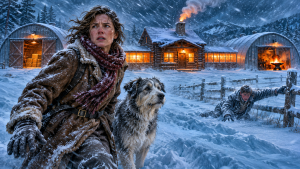
The morning the county road disappeared, Nora Whitcomb stood in the snow with her old sheepdog and watched smoke lift from a single chimney above the middle of her homestead.
On either side of her cabin rose two enormous corrugated-metal arches, silver as fish scales beneath the dull Montana sky. The left arch sheltered her small barn. The right held a forge and a workshop. From the air, the three buildings looked like a strange bird spread across the white prairie: two curved wings and a timber heart. From the ground, they looked like a mistake waiting to be buried.
The wind found the gap between Nora’s scarf and collar. Her dog, Moss, leaned against her boots, his rough gray-and-tan fur collecting snow.
Nora put her gloved hand on his head and listened for a familiar sound beneath the wind: the quiet tick of hot metal expanding behind the central cabin wall.
Eighty feet. That was the distance from the north end of the barn, through the cabin, to the far wall of the forge. Three distinct spaces, two insulated connecting passages, and one carefully controlled fire in a masonry heater at the center. Nobody in the county believed it could work when she began. A few people had called it ingenious. Most had called it suicide by stubbornness.
Now the temperature had fallen to forty below, the power lines were down, and there was no place in the whole valley to buy another stick of firewood.
A fresh curl of smoke slipped from the chimney.
Nora whispered, “Keep going.”
Moss lifted his nose toward the western snowfield and growled.
A dark shape was moving beside the fence, where there should have been nothing alive.
Three months earlier, Nora had never intended to live here at all.
She had been thirty-four when she stood in the fluorescent light of a hospital corridor in Great Falls, holding a paper cup of coffee that had gone cold before she took the first sip. Her mother had died in September after an illness that left Nora with medical bills, a vacant apartment, and the terrible feeling that the last useful thing she had done was promise a dying woman that she would be all right.
She had not been all right. She lost her job two weeks after the funeral when the building-products company where she worked eliminated its small field-testing division. A decade of inspecting insulation, building mock-ups, and finding leaks in other people’s systems had ended in a brief meeting and a cardboard box.
The severance payment barely paid the debts she had inherited and the rent she was still trying to carry.
Nora could have moved to Billings, found another job, and begun again among parking lots and fluorescent lights. Instead, she drove north after seeing an auction listing for a foreclosed homestead outside a shrinking town called Dry Creek.
The listing described ‘residence and outbuildings, as is.’ It did not mention that the residence was a drafty two-room log cabin or that the outbuildings were aging agricultural Quonset huts whose frames stood in snow so deep their lower walls had vanished. It also did not mention that the access road flooded every spring or that the nearest year-round neighbor lived almost four miles away.
The property had been owned by a blacksmith named Walter Thorne. He had built the cabin in the seventies and added the curved structures as his family grew.
His daughter sold after his death, and by the time the bank offered it again, the house had sat empty for six winters. The roof was sound; almost everything else needed help.
Nora paid twelve thousand eight hundred dollars, almost everything she had left. She signed the papers on a rainy Thursday and slept on her mother’s old quilt on the cabin floor that night.
When the first cold front rattled the loose panes, she understood why the bank had accepted her offer so quickly.
‘You bought a tin can with a chimney,’ said the first visitor, Earl Baines, a retired rancher with a face the color of sun-dried leather. He brought a thermos and walked her through the hazards: the shallow well, the windbreak in need of repair, the old fuel tank, and the cracks in the forge’s concrete floor. ‘Nobody lives out here through February anymore.
Not alone.’
‘I’ll manage,’ Nora said.
Earl studied her blueprints spread across the kitchen table. ‘What’s that line?’
‘A thermal passage. Two passages, really. One to the barn and one to the forge.’
‘You thinking of heating the whole place with that little stove?’
‘Not the little stove. A new masonry core. The stove is coming out.’
He looked from the sketch to her and then back again. ‘Well. You’re either ahead of the rest of us, or your mother raised a determined fool.’
Nora did not tell him that her mother had raised both.
The idea was born the second week, when she walked between the buildings in a sleet storm carrying a bucket of water for the two half-starved goats she had acquired from a farmer leaving the county. She reached the barn shaking and found one goat crouched beside the other, their drinking pail already filming over with ice.
Later, returning to the cabin, she stepped into a drift so deep she lost one boot.
She sat on the floor beside her tiny wood stove and made a decision. She could not run three separate heaters, maintain three separate fires, and carry fuel through snowdrifts every morning. She could not afford it and, more importantly, she might not survive it. She had to make the structures behave like one shelter without allowing an accidental fire or a cloud of carbon monoxide to travel through all three.
Her first pencil drawing was crude: a central thermal mass, isolated ducted water loops, insulated service corridors, and doors that sealed each zone. The barn would not need the warmth of a living room, only a frost-safe area for water and young animals. The forge could stay cool when nobody worked there, with reserve heat directed to a small insulated work bay.
The cabin would receive the most warmth and act as the system’s heart. ‘One fire’ would mean one combustion source, not one magical blaze; pumps and controls had to fail safe, and there would be gravity circulation and stored heat if electricity vanished.
Nora had worked around enough failed installations to respect what she did not know. She called a licensed local heating contractor, Rosa Alvarez, whose shop was seventy miles away. Rosa listened in silence and then asked for the layout and load calculations.
‘Send me the drawings,’ Rosa said. ‘If you’re talking about piping flue gas into the barn, I won’t touch it.’
‘I’m not,’ Nora replied. ‘Closed hydronic loops, properly vented combustion, heat exchangers. And I’d like you to tell me where the plan is stupid.’
‘Good. That’s the first smart thing you’ve said.’
Their first meeting lasted four hours.
Rosa crossed out half the design and explained that barn dust, forge sparks, frozen pipes, pressure relief, and combustion air could each turn a good idea into a lethal one. Nora bought code-rated components instead of scavenged pipe where safety mattered, arranged inspections, and revised the plan so the buildings shared warmth without sharing smoke or hazardous air. The pathways between them would be weatherproof walking corridors with insulated doors, not open ducts. The source would be a high-efficiency masonry heater with a certified water-heating module, a thermal storage tank, relief equipment, and monitored temperatures. A separate emergency stove remained available in the cabin if the water loop failed.
The first obstacle was money. After paying Rosa for the engineering and required work, Nora had barely three thousand dollars to finish the site. She took temporary jobs repairing farm buildings.
She traded weeks of labor for two pallet loads of surplus insulation and rebuilt an abandoned grain trailer into a sled to move materials. She sold her mother’s jewelry except for a plain silver ring, and the day she packed the velvet boxes she felt as though she were surrendering her last evidence that there had once been a life before this one.
Then she met the dog.
Moss had belonged to a woman who moved south after a stroke. His temporary caretaker was ready to send him to a distant shelter. He was seven years old, with one ear permanently folded, and he climbed into Nora’s truck as though he had already chosen a new home. He did not bother to introduce himself. He simply settled beside the heater vent and sighed.
When Nora slept, Moss slept across the door. When she worked on the forge roof, he watched from a drift.
When she cried on the evening of her mother’s birthday, he pushed his wet nose under her hand until she stopped hiding her face.
In October, Nora drove to Dry Creek for a meeting about road maintenance. The town was little more than a feed store, gas pumps, schoolhouse, diner, and church, but everyone seemed to know exactly how she intended to freeze. The county commissioner, Clark Dempsey, announced that plowing her private spur road would not be a priority.
‘I don’t expect it to be,’ Nora said. ‘I only want to know what the county will do if the main highway closes.’
‘We get the highway open when we can,’ he said. ‘People out your way ought to make winter plans.’
‘I am making winter plans.’
‘With one stove for three buildings?’ a voice from the back asked.
People laughed.
Nora turned and found her nearest rival in the room: Silas Granger, owner of the commercial fuel depot and a large neighboring ranch. Silas was forty-eight, handsome in the blunt way of men who expected rooms to part before them. He had tried to buy Walter Thorne’s land at auction but refused to bid past eight thousand. Since Nora won it, he had made a habit of describing her project as a danger to the rest of the valley.
‘Your plan doesn’t concern me,’ Nora said.
‘It does when emergency volunteers have to dig you out,’ Silas replied.
‘I hope they don’t.’
He smiled. ‘So do I.’
At the diner, the waitress gave Nora an extra slice of pie. ‘Don’t take it too hard. Silas thinks winter belongs to him because he sells the fuel.’
The waitress was named June McCall, a widow with tired eyes and a silver braid.
‘My brother worked for old Walter,’ she said. ‘He’d like what you’re doing. But watch Silas. There’s a dispute about a spring running under that back pasture, and he hasn’t forgiven anyone for being on the other side of it.’
Nora knew about the spring only as a faded note on her property survey. It fed a small well near the forge in summer. In winter the ground above it looked exactly like everything else: white and impossible to read.
By November, the corridors were enclosed and the buildings were beginning to fit together. The cabin’s rough timber facade remained unchanged. The Quonset arches still curved outward like giant metal ribs. But behind the walls Nora had installed layers of insulation, sealed doors, radiant tubing in protected sections, and accessible mechanical chases.
She had also mounted a smoke detector and carbon monoxide alarm in each occupied zone, plus temperature sensors that would tell her where heat was going.
Some days she loved the work. Other days she could barely move her fingers at the end of it. A hammer slipped and split her thumbnail. A shipment of fittings went to the wrong town. Snow blew through an unfinished seam and buried the tools she had laid out in a careful row. She discovered a rotten sill beneath the west arch and spent an entire week repairing something nobody would ever admire.
Rosa returned to commission the central heater and test the loop. She inspected the draft, controls, expansion tank, isolation valves, and temperature limits, and would not let Nora fire the system until the checks passed. When a valve failed a test, they replaced it. When air trapped in the barn loop stopped circulation, they corrected the layout.
When Nora asked whether the barn would stay warm during a full outage, Rosa pointed at her calculations and said, ‘Warm enough for the animals if your insulation holds. Not a miracle. This is engineering, and engineering has limits.’
On the first firing day, Nora knelt beside the heater’s glass door with a notebook. She had gathered dry split wood and stacked it under a tarp weeks earlier. The flames took slowly. The heavy masonry absorbed heat and the storage tank climbed in temperature while the weather outside dropped below freezing. Hours later, an insulated pipe along the barn wall was warm to the touch, the drinking station stood above freezing, and condensation no longer crusted the workbench in the forge.
Nora walked through the enclosed passage from the cabin into the barn without a coat. The goats looked at her with complete indifference.
The room smelled of hay and animals, not chimney smoke. She touched the side of the water trough, then hurried back to the central monitor. Every reading was within Rosa’s planned range.
For the first time since her mother’s death, Nora laughed without having to remember how.
Earl Baines came by the next morning and made a show of removing his hat inside the passage.
‘Well, I’ll be,’ he said. ‘You built yourself an eighty-foot pocket.’
‘It doesn’t make the whole barn cozy,’ Nora said. ‘It keeps the critical parts safe.’
‘That’s what cozy means to a goat.’
He brought her a pair of wool mittens and a box of iron hinges from Walter’s old shop.
Then he sat at her kitchen table and, between sips of coffee, told her stories about a winter when the town ran out of propane and people burned furniture to stay alive.
‘Bad weather shows you what people built their lives on,’ he said. ‘Sometimes that’s wood. Sometimes it’s neighbors.’
In early December, Silas drove down her private road without calling. He parked by the forge, looking at the roof and chimney and the stack of dry wood. Nora met him outside with Moss beside her.
‘Pretty setup,’ Silas said. ‘Unsafe, but pretty.’
‘It’s been inspected.’
‘Inspectors don’t live through our blizzards.’
‘Neither do fuel invoices.’
His smile flattened. ‘I’ll offer you twenty thousand cash. You can leave before winter gets serious.’
‘Not for sale.’
‘That’s a mistake.’
‘It’s mine to make.’
He stood there so long Moss began a low, vibrating growl.
Silas looked past Nora toward the chimney, then at the old well cap beyond the forge. Something about the well caught his attention. His gaze lingered there before he got back into his truck.
That night Nora found tire tracks on the service path behind the forge, a route Silas had not used while she watched him. Beside the well cap, one of the survey stakes had been pulled from the frozen ground and laid flat. She photographed it. The theft of a wooden stake was too petty for a sheriff’s report, but the message was plain enough.
You may own this land on paper. Someone else believes it still belongs to him.
Two days before Christmas, a storm warning appeared on the county radio. The forecast first mentioned twelve inches of snow, then eighteen, then whiteout winds and wind chills below minus sixty.
The meteorologist said the system could stall over north-central Montana for several days. Nora reviewed her firewood inventory, stored feed, tested the backup alarms, filled emergency water containers, and called Rosa one last time about safe shutdown procedures.
Rosa said, ‘You have a good setup, Nora. But don’t treat good equipment like a reason to take chances. If you smell smoke, hear an alarm, or see a pressure problem, shut it down and use the backup. Understand?’
‘I understand.’
‘I mean it.’
Nora looked at Moss, who was trying to steal a glove from her lap. ‘I mean it too.’
By the second morning, the storm erased the boundary between field and sky. Nora could not see the fence from the kitchen window. The cabin remained comfortable, the barn loop stayed above its minimum temperature, and the forge’s protected bay held enough warmth to keep tools and water from freezing solid.
The masonry core consumed less wood than three separate stoves would have, but Nora still monitored it like a living thing.
At dawn on the third day, a noise woke Moss before it woke Nora. He barked once and ran to the passage door. Nora pulled on her boots and stepped out into the central yard. The sky was a gray lid; the two arches gathered drifts around their bases; warm smoke lifted against the wind from the cabin chimney.
That’s when she saw the moving shape along the western fence.
At first she thought it was a loose calf. Then the figure stumbled upright and waved a bare hand.
Nora ran toward it through thigh-deep snow. A teenage boy staggered against the fence, his jacket crusted white, his lips an unnatural gray.
He had a dark bruise across one cheek and was carrying a backpack with a broken strap.
‘Please,’ he whispered. ‘My grandpa’s truck went into the ditch.’
‘Where?’
‘By the culvert. I walked. I thought I saw your smoke.’
Nora caught him before his knees collapsed. With Moss circling them she dragged him toward the cabin, pulling his weight through snow that seemed determined to keep him. Inside, she peeled off his soaked outer clothes, wrapped him in dry blankets, and called emergency services on the weak satellite connection she kept for storms. The dispatcher was overwhelmed; several roads were closed and crews could not immediately reach the culvert.
The boy’s name was Owen Baines. Earl’s grandson.
‘Earl was driving?’ she asked.
Owen nodded, shivering so hard his words broke apart. ‘We were taking medicine to the Kellers. He saw the road marker too late.
The truck went sideways. Grandpa told me to follow the fence to your place.’
‘How long ago?’
‘Hours. I don’t know.’
Nora reached for the county radio. A voice crackled through static, reporting another downed power line and a stalled plow. She asked for help, but the operator could offer no clear arrival time.
Owen caught her sleeve. ‘He couldn’t get out. His leg was trapped. And he said not to tell anyone—’
‘Tell anyone what?’
The boy stared at the orange glow inside the masonry heater. His expression was a mixture of pain and fear.
‘Grandpa said the road isn’t why we crashed. He saw someone at your well last night. A truck, with no lights. He recognized it. And before we slid into the ditch, he said they had cut the wire to the road marker.’
Nora heard the heater ticking in the wall.
Outside, the wind pushed snow hard against the windows.
Owen swallowed. ‘He made me promise that if he didn’t make it back, I’d give you what he found under your forge.’
From his broken backpack, he pulled a small oilcloth packet tied with blue cord.
Across its front, in the shaky handwriting of a man who had been freezing, were five words:
FOR NORA—BEFORE SILAS FINDS IT.
And then the lights went out.
PART 2 — WHAT THE SNOW WAS HIDING
The sudden darkness made Owen gasp. Nora heard the refrigerator stop, then the soft fading whine of the circulation pump. For a heartbeat the cabin seemed to hold its breath. Only the flame inside the masonry heater remained, small and orange behind the glass.
Nora took a flashlight from the peg beside the kitchen door. The battery-powered alarm panel came alive with a quiet green blink. Her thermal storage tank still carried heat. The pumps had gone down with the electricity, but the gravity-capable emergency loop and thermal mass would buy time. She had rehearsed this with Rosa. The house would not freeze in minutes. The barn did not become a death trap the instant the grid failed.
But she needed to know what had interrupted the line, how long it would last, and whether anyone was still alive inside Earl’s truck.
She helped Owen into a chair near the stove, not too close to the heat, and checked him for signs of injury. His feet were numb and his hands shook. She kept him wrapped in dry blankets and gave the dispatcher his condition, following the advice she could receive through the patchy satellite connection. The boy was alert enough to answer questions, but the concern in his eyes returned every time he thought about his grandfather.
‘How far is the culvert?’ Nora asked.
‘About a mile and a half. Maybe two. We couldn’t see the road.’
A mile and a half in summer was nothing. In this weather it might as well have been another state.
Nora had a compact tracked utility sled in the forge, bought at auction and repaired over the fall. It was not a vehicle for a highway and she had never trusted it in a blizzard, but it could haul feed and supplies across her own fields. She looked at the shovel leaning beside the door, then at Owen.
‘You stay here. I’ll ask the volunteers to coordinate a rescue. I’m not going to leave you alone and disappear into a whiteout.’
‘He’ll die.’
‘Not if we can help it.’
The next call went to June McCall, who was part of the volunteer emergency network. June answered on the third ring. Her diner had become a warming station for stranded travelers, and the background sounded like an argument inside a crowded school bus.
‘Earl’s trapped near the old culvert,’ Nora told her. ‘Owen reached me.
Can you get a crew moving?’
‘Our rescue truck is at the highway pileup. I’ll radio the sheriff and the ranchers with tracked rigs. Nora, don’t go walking out there blind.’
‘I won’t.’
‘Are you safe?’
‘For now. Power’s out. The heater is still operating within its safe limits. I’ve got a backup stove and stored water.’
June hesitated. ‘People at the diner are saying the power line was brought down near your property.’
Nora looked toward the window. All she saw was white. ‘The line?’
‘Could be weather. Could be a pole. I don’t know. Keep your doors shut and your alarms on.’
After the call, Nora put the oilcloth packet on the table. She did not open it immediately. Owen’s eyes followed her hand.
‘Grandpa said it belonged to Walter,’ he told her. ‘The old blacksmith.
He found it behind a board when we were checking your forge last month. He wanted to make sure it was real before he said anything.’
‘Why was he checking the forge?’
‘Because he thought your property line had been moved.’
Nora remembered the pulled survey stake. She unwound the blue cord carefully and folded back the oilcloth. Inside was a yellowing notebook, a metal key, and a small map drawn in thick pencil. The notebook smelled of oil and woodsmoke. Walter Thorne had written dates along the margins. Several pages described the spring running under the back pasture, and the map showed an old stone-lined intake on the homestead side of the fence.
At the bottom of a page from seventeen years earlier, Walter had written: Granger asked again for the spring. I refused. Told him the water is for this land and whoever comes after me.
He said paper can be made to say anything.
Nora turned the page. There were copies of handwritten correspondence, the name of a surveyor who had retired, and an envelope marked DRAINAGE EASEMENT—NOT EXECUTED. Most importantly, there was a photocopy of a signed 1978 agreement granting the neighboring ranch a limited right to cross the homestead for livestock access, not any right to own or divert the spring. Somebody had scribbled a warning in the margin: Original recorded at courthouse, Book 44, page 219.
Nora did not know whether the document still had legal force or whether the record said what Walter believed it said. She did know why Silas Granger had stared at the old well cap.
Outside, a low thud rolled through the wind.
Moss jumped to his feet and barked at the passage. Nora listened, then heard it again: something metallic striking metal, twice, from the direction of the forge.
A branch might have hit the roof. A sheet panel might be loose. But the rhythm felt almost deliberate.
She could not investigate while Owen needed care. Instead she moved him into her warmest interior room, kept her emergency supplies beside him, and checked the monitor again. The barn’s water station temperature had begun to decline. It remained above freezing, but it could not stay so indefinitely. The thermal storage tank was cooling by slow degrees.
Nora thought of all the mock-ups she had examined in former jobs. The difference between a home that lasted through a power outage and one that failed often came down to details nobody noticed on a sunny day: air sealing at a doorway, an insulated line around a corner, the thermal capacity of a wall, a backup that did not depend on the failed equipment. She had not built the homestead for the apocalypse.
She had built it for the ordinary cruelty of Montana weather, and now weather was testing every choice she had made.
An hour later, a voice broke through the radio: Deputy Hannah Pierce, who had taken command of the search from the west side. She had arranged for a tracked tractor and two volunteers to approach the culvert using a ranch access trail. They wanted a landmark near the fence, and Nora could provide one.
‘I can leave the forge floodlight on the backup battery for thirty minutes,’ Nora said. ‘It’s at the end of the eastern arch. You’ll see the roofline if you get within a few hundred yards.’
‘Good. Keep your door locked. We have a report of somebody tampering with the county marker at the fork.’
Nora looked at Owen. ‘I may have information about that too.’
‘Hold it until we’re there,’ Hannah said.
‘First we get the man out.’
Nora hooked up her portable battery to the low-wattage beacon, checked that it would not compromise the safety monitors, and lit the forge end with a pale amber glow. The Quonset arch shone dimly through wind-driven snow like the back of a whale beneath ice.
She returned to the cabin and warmed soup on her backup stove. Owen managed a few spoonfuls. His hands were getting steadier, but his voice remained thin.
‘Grandpa said Silas was mad because you wouldn’t sell.’
‘He told me the same thing.’
‘He didn’t want me to be afraid.’
‘Neither do I.’
‘Are you afraid?’
Nora considered lying. She could hear the wind in the ceiling and the complaint of an old timber settling under temperature change. She could picture Earl pinned behind his steering wheel. She was very much afraid.
‘Yes,’ she said.
‘But fear doesn’t get to make every decision.’
Owen nodded as though this was a useful thing to know.
At half past noon, the radio crackled with news that the search crew had reached Earl’s truck. It was lodged against a snowbank near the drainage ditch. Earl was conscious but badly cold, and the volunteers were working to free his leg. Nora held the radio with both hands. Owen closed his eyes and let out a breath that sounded almost like a sob.
‘Bring him here if you can’t get him to town,’ Nora said. ‘We have shelter, stored heat, water, and space.’
The deputy answered, ‘We may need exactly that.’
The rescue tractor arrived after another forty minutes, its engine snarling beneath a crust of ice. Four people emerged from the storm. Two volunteers carried Earl on an improvised stretcher, with a medic walking beside them.
Nora opened the corridor doors in sequence to conserve warmth and guided the group into the cabin. She cleared the table and set out blankets while the medic assessed Earl.
Earl’s face was pale beneath the bruises. When he saw Owen alive, he reached weakly for the boy’s hand.
‘You listened,’ Earl whispered.
‘I saw the smoke,’ Owen said.
The elderly rancher turned his eyes toward Nora. ‘You listened too.’
‘Not the time to talk about that,’ she told him. ‘Save your strength.’
He gave a small, stubborn movement of his head. ‘Silas. I know the truck.’
Hannah Pierce stepped forward. ‘We can take a statement when you’re stable.’
‘He was behind the old marker at dusk. I went out to see why. He had a cable hooked to the post. The wire had been pulled down.
I saw the plate on the back of his truck.’
Hannah wrote it down. She was a lean woman with black hair tucked under her cap, and she did not give any hint of what she believed.
‘Sir, are you certain you saw him?’
‘Certain of the truck. Certain he was there. Can’t swear what he did with the cable.’
Nora admired the distinction. Earl was not going to exaggerate, even now.
The medic announced that Earl needed a hospital, but the road beyond the homestead remained impassable. He and Owen were both at risk from cold exposure and would need continuing medical attention. For the present, the warm cabin was safer than another hour in the storm. Hannah contacted dispatch and arranged a priority evacuation as soon as a route could be cleared.
The volunteers filled the small room with wet coats and frightened voices.
Nora realized that in the place everybody had dismissed as a winter deathtrap, seven people were now warming themselves by the same fire.
A woman named Beth Keller was among them. She had ridden with the tractor to help the rescuers navigate the access trail. Her husband had pneumonia, she explained, and Earl had been trying to deliver medicine and supplies when the storm caught him. She lived on a ranch with a failing generator. At home, two calves were penned in an unheated shed and she had no way to thaw the frozen water line.
Nora glanced toward the barn. ‘Bring the calves here when the weather eases enough to move them safely. There’s room in the insulated section.’
Beth blinked. ‘You already have animals.’
‘Two goats, three hens, and a very opinionated dog. We’ll manage.’
‘And your heating?’
‘One source, separate zones. The barn is cooler than this room.
That’s fine for healthy livestock, but we’ll have to monitor the young ones carefully.’
The expression on Beth’s face changed from disbelief to hope.
Then the alarm panel chirped.
Nora went to the monitor. The temperature at the far end of the forge loop was falling more quickly than the model predicted. Not disastrously, but enough to demand attention. A second reading showed an unexpected pressure change in the secondary loop. She checked the valves and thermal storage display. The system was still safe, but something was wrong. She would not gamble on an undiagnosed pressure issue. She shut down the affected circulation circuit according to Rosa’s instructions and isolated the forge zone.
‘Nobody goes into the forge until I check it,’ she told the room.
The deputy looked toward the window. ‘What do you think happened?’
‘I don’t know yet.’
She put on her coat, safety glasses, and insulated gloves, then went through the corridor with Moss trailing her.
The forge was colder than the cabin, smelling of iron filings and dry wood. Pale daylight filtered through the seam at the high end of the arched roof. The outer door was secured. She checked the accessible portion of the heating run and found a small puddle already crystallizing under the service manifold.
A flexible protective cover had been opened. Beneath it, a coupling had been disturbed and the pipe was leaking.
Nora crouched to examine the damage. No single feature proved sabotage, but the wrench marks on the coupling were fresh. A tool she kept on a nail beside the bench lay on the floor. She photographed the assembly without touching it, then shut the isolation valve and went back to the cabin.
‘Hannah,’ she said, ‘I need you to see something.’
The deputy followed, inspected the scene, and took photographs of her own.
‘Could vibration have loosened it?’
‘Possibly. But the guard was open and the wrench wasn’t where I left it. I don’t want to claim more than the evidence shows.’
‘Good,’ Hannah said. ‘Most people do.’
When they came back, Silas Granger was standing in the cabin doorway.
He was coated with snow, holding a shortwave radio and a folded length of tow strap. Two of the volunteers had let him inside after he arrived by snowmobile from the east trail. He wore the expression of a man who expected gratitude before he had done anything.
‘Heard you had a rescue going,’ he said. ‘Figured I’d check.’
Hannah moved between him and the table. ‘Mr. Granger, there’s an investigation underway. I’ll need to ask you where you were last night.’
Silas laughed. ‘Are you serious?
Half the county’s out here trying to keep people alive.’
‘Where were you?’
‘At my ranch.’
‘Anyone with you?’
‘My hands.’
Nora saw him glance toward the oilcloth packet beside her notebook. His gaze returned to her face too quickly.
‘You need something?’ she asked.
‘Only wondering why old Walter’s maps are on your table.’
The room went silent.
Nora had not told him about the maps.
Hannah’s eyes narrowed. ‘How do you know what those are?’
Silas opened his mouth, then shut it. He looked at Earl, who was resting beneath a blanket. Something hard passed between the two men.
‘Everybody knew Walter drew maps,’ Silas said finally.
‘Not that the packet was here,’ Nora replied.
Silas turned to leave. Hannah asked him to remain while she recorded his statement, and for a moment he seemed ready to push past her. Then he realized there were too many witnesses.
He sat down heavily in the chair near the door.
By late afternoon, the storm had worsened again. The rescue tractor’s tracks vanished within minutes of being laid. Dispatch reported that the county generator at the school warming center had failed. Thirty people were in a building cooling toward freezing, several of them elderly. The remaining volunteer teams could not move them across the blocked highway, and the nearest reliable shelter had been opened more than twenty miles away.
Nora looked through her cabin window at the two enormous silver arches. The barn could shelter animals, and the forge, though partly isolated, had a work bay that could be warmed with stored heat if the leak could be repaired under safe conditions. Her homestead was not designed to hold thirty people. But it had room, warmth, and a route the tracked tractor could reach.
‘How many can you bring?’
Hannah asked quietly.
‘Enough to keep the worst cases warm. Maybe more if we reorganize. We would need supplies and a supervised heating plan. I won’t overload the heater or compromise the ventilation.’
Hannah nodded. ‘I’ll coordinate it with dispatch.’
Silas, still in the chair, let out an ugly laugh. ‘You think your little experiment can save a town?’
Nora said, ‘I think we should try to save our neighbors.’
For the first time, his confidence wavered. He leaned forward and spoke so softly only she could hear.
‘If you open that forge again, you’ll find something you wish you hadn’t.’
Nora kept her expression still. ‘What would that be?’
He looked at the oilcloth. ‘Ask Walter what happened to his daughter.’
Walter Thorne was dead. His daughter had sold the property years ago.
Nora knew nothing about her beyond a name on the closing documents.
Before she could answer, the radio crackled: the schoolhouse roof had started to leak, and a school bus was being loaded with stranded families to meet the tractor at the south junction.
Hannah stood. ‘We move now.’
Nora watched Silas as the deputy led him outside for a recorded interview. He had threatened her, named a dead man’s daughter, and somehow knew about a packet he had never seen being opened.
But the greatest problem was still in front of her: she had one safe source of heat, a winter storm that would not let up, and a valley full of people beginning to run out of time.
As she reached for the firewood ledger, Moss began scratching at the inner wall of the forge passage. He scratched twice, then whined.
Nora crouched beside him and noticed a narrow line of frost at the baseboard, on a section she had sealed in October. The floor there felt hollow under her knuckles.
Hidden beneath the passage was an old service hatch.
The brass key from Walter’s packet fit its lock.
Nora raised the lid and shone her flashlight into the dark.
Far below the floor, where she had expected earth and a few forgotten tools, a narrow stone stairway descended toward the sound of running water.
PART 3 — THE FIRE THAT WOULD NOT QUIT
Nora stared down the staircase with the hatch open in her hands. She had lived in the cabin for almost four months. She had crawled beneath floors, replaced rotten boards, studied old plans, and convinced herself she knew every empty space on the property. Yet below the forge passage, cool air breathed out of a stone-lined shaft no bigger than a pantry.
The sound was unmistakable: water moving over rock.
Moss wagged his tail once and stepped away. Even he seemed to recognize that this was no place to explore during a rescue emergency.
Nora closed the hatch, photographed the key and lock, and marked the spot with tape. The hidden space could wait. People could not.
She radioed Hannah and explained the limit of her warming capacity.
The cabin’s main room could safely hold a small group; the enclosed passages offered temporary staging space; the barn’s animal area would remain separate to protect hygiene, and the forge work bay could be used only after the leaking loop was inspected and repaired. Hannah coordinated the incoming evacuees with the county dispatcher, ranking them by urgent need and arranging medical oversight. It was not a romantic scene of an entire town streaming into a magic house. It was hard arithmetic: floor area, ventilation, blankets, water, sanitary facilities, and how many hours the roads might stay closed.
Nora remembered her mother’s voice, weary but firm, from the last weeks of illness: When everything is too much, honey, do the next necessary thing.
The next necessary thing was to call Rosa Alvarez.
The satellite call dropped twice before Rosa picked up.
Nora told her about the pressure change, the opened guard, and the leaking coupling. Rosa asked detailed questions, then instructed Nora to keep the forge loop isolated until a qualified repair could be performed and tested. They discussed whether the thermal storage and gravity-supported circuit could continue serving the cabin and barn without the affected branch. Nora read off every relevant pressure and temperature measurement.
‘You’re inside the designed limits,’ Rosa said. ‘Don’t open any more valves. Don’t let people crowd the heater or block the combustion air. The moment an alarm indicates danger, you evacuate or switch to the emergency plan. Your wood pile isn’t worth a life.’
Nora repeated the instructions until Rosa was satisfied. She would not risk seven people and two goats because the story sounded better if a heroine ignored safety rules.
The first group arrived near dusk.
A tracked tractor pulled a sled loaded with five people, blankets, medicines, and cases of water. Mrs. Ada Lyle, the retired school librarian, had become confused in the cold and needed assessment by the volunteer medic. A father named Calvin brought his nine-year-old daughter, Wren, who had asthma and had been frightened by the failing generator. Two older sisters followed, both wearing ski coats over bathrobes because they had been evacuated from their homes in a hurry.
Nora brought them into the cabin and arranged the warmest places. The medic checked everyone and continued monitoring those at risk. Wren sat beside Moss and stroked the fold in his ear. When she asked whether the dog was always so serious, Nora replied, ‘Only when he hasn’t eaten his second breakfast.’
It earned the first small laugh anyone had managed that evening.
More people came in waves.
Some were transported onward by another crew as roads briefly opened; others stayed. The rooms became crowded but orderly. June arrived with soup from the diner and a crate of bread. She took over food distribution without asking for permission. Beth returned with two chilled but alert calves, which were placed in a prepared, ventilated section of the barn after the animal-health volunteer checked them. The goats objected loudly to the new arrangement, then settled when Nora brought hay.
The central fire became the heart of a tiny improvised settlement. Nora kept a strict firing and monitoring schedule, recording temperatures and fuel use. A volunteer watched the carbon monoxide alarms and made sure no one stacked sleeping bags against a heated surface. The masonry held warmth long after visible flames subsided.
Every time the main door opened, cold rushed in, but the insulated passages reduced the direct loss from the living area.
‘How can one fire do this?’ Calvin asked, standing near the corridor.
‘It isn’t heating eighty feet of air to living-room temperature,’ Nora explained. ‘It’s storing heat in mass and water and sending only the amount each zone needs. The cabin gets priority. The barn gets freeze protection and a warmer small pen. The forge is mostly cold right now because that loop is shut off. One fuel source doesn’t mean equal heat everywhere.’
‘But it keeps them alive.’
‘It helps. So does the insulation. So do the doors staying closed. And so does everybody taking turns instead of opening the exits every five minutes.’
He smiled and began guarding the door like a soldier.
Near midnight, Hannah came to speak with her.
The deputy had helped Silas back to his ranch by snowmobile after taking his statement. She had photographed the damaged road marker but could not yet establish whether the damage was intentional. The sheriff had contacted a state investigator about the documents from Walter’s packet, and the county records clerk had confirmed that a deed book matching Nora’s citation existed.
‘One more thing,’ Hannah said. ‘There was a civil dispute over that spring seventeen years ago. Walter accused Granger of diverting water. It never reached trial because somebody paid the filing fee to withdraw the case.’
‘Who paid?’
‘That’s what we intend to find out.’
Nora looked toward the closed forge hatch. ‘I found a staircase under the service passage. It’s locked and leads down toward water.’
Hannah’s expression sharpened. ‘Don’t go in there by yourself.’
‘I wasn’t planning to.’
‘Good.
I want the county building inspector here before anyone disturbs an unknown underground space. Confined areas can be dangerous.’
Nora nodded. She had already decided the same thing.
At three in the morning, another crisis arrived on the radio. A feed truck carrying emergency supplies had become stranded near the old rail crossing. Its driver, seventeen-year-old Hannah Bell, had called dispatch before losing contact. Her father was trying to reach her in a pickup, and the sheriff feared he would become a second victim. The track crew could not spare a vehicle immediately, because the road to the hospital was finally opening and Earl and Owen had to be evacuated.
Nora listened as the medic prepared Earl for transport. The old rancher caught her hand.
‘You know what to do,’ he whispered.
‘With what?’
‘The forge. Walter built more than a blacksmith shop.
He was trying to protect his daughter.’
His eyes drifted closed before she could ask more.
The deputy explained that an abandoned rail service lane crossed Nora’s northern field and joined the road near the stranded feed truck. Nora knew the lane from the survey. In summer she had walked it with Moss. In winter it was invisible under the drifts. But she also knew where the fence line ran, and her tracked utility sled could travel along the inside of her property without crossing the worst culvert.
‘We might be able to guide the rescue team from my northern gate,’ she said. ‘Not alone. With a trained driver and radio contact.’
Hannah considered the route on the map. She said she would take it to incident command.
Within an hour a volunteer with rescue experience, Jonah Ellis, arrived to inspect the tracked sled.
He was a school bus mechanic who had spent years working with winter equipment. He checked its fuel, lights, tracks, and towing capacity, then shook his head at its thin windscreen.
‘It’s no rescue ambulance,’ he said. ‘But it can carry a marker and a radio. If the tractor follows, we can use it to find the gate.’
Nora offered to guide them to the departure point, using the homestead as a landmark, and stayed behind once the trained crew began the traverse. Her contribution was knowledge of the land, not recklessness. As the sled lights vanished beyond the fence, she went back inside and kept the shelter running.
At dawn they returned with Hannah Bell alive. The feed truck had been buried nose-first against a drift. The driver had kept herself wrapped in an emergency blanket and stayed in the cab. She was cold and frightened but conscious.
Jonah brought her to the cabin for assessment before transport. Her father followed later, crying openly in front of half the county.
With the truck came flour, oats, animal feed, and twenty additional bags of wood pellets meant for another facility. Nora could not burn the pellets in her masonry heater; it was not designed for them. She set them aside for the appropriate stove at the warming center when service resumed. What she could use was a shipment of split hardwood intended for a school camp, and the dispatcher approved its diversion as emergency fuel.
The wood arrived with a note from a stranger: USE WHAT YOU NEED. RETURN WHAT YOU CAN.
Nora read it three times. She tucked it into her notebook beside the daily firing log.
On the fifth morning, the storm eased just enough for the western sky to show as a faint pearl stripe.
The cabin windows were glazed with frost. Nora stood outside for five minutes, checking the roofs and vents from a safe distance. The main chimney was clear and drafting normally. Snow had banked against the lower portions of both curved structures, providing some wind shelter but requiring attention around marked ventilation openings. The thermal corridors remained enclosed. Behind her, Moss sniffed the tracks of a fox and sneezed.
A line of figures approached from the road. Silas Granger led them.
He had brought two ranch hands and a battered snowmobile. He stopped where the lane opened into the yard. Even from a distance, Nora could see the anger under his strained politeness.
‘Word is you’re running an unauthorized shelter,’ he shouted.
‘We’re coordinating with the county,’ Nora replied.
‘And using water that’s legally mine.’
Nora felt the world narrow.
‘I haven’t drawn a drop from your ranch.’
‘The spring beneath your forge supplies the west well. My family has rights to that water.’
‘Bring the deed and we’ll discuss it with the county.’
‘You think you can hide behind paperwork?’
‘It’s usually what you ask people to sign.’
One of his ranch hands looked away.
Hannah stepped from the cabin with the sheriff’s radio at her hip. ‘Mr. Granger, this is an emergency shelter operating with county coordination. You need to leave the access lane clear.’
Silas pointed toward the arched forge. ‘She has something down there that doesn’t belong to her. A hidden pumping chamber. Walter stole my family’s water and everybody let him.’
‘Then you can show me your documentation at the courthouse when it opens,’ Hannah said. ‘You don’t get to trespass during a declared emergency.’
For a moment Silas seemed ready to challenge her.
Then he noticed the people gathering at the cabin doorway: Beth, June, Calvin, the two sisters, and Wren with Moss beside her. Their faces were tired, unshaven, and unafraid of him. They were not a crowd looking for entertainment. They were witnesses.
Silas’s voice dropped. ‘You all think she’s some kind of hero. Ask what happened when Walter’s daughter went down into that chamber.’
‘What happened?’ Nora asked.
He glanced at his men. ‘She never came out the same.’
Then he turned the snowmobile and left.
June came beside Nora. ‘I’ve heard that story,’ she said reluctantly. ‘Walter’s daughter, Lydia, was hurt in an accident on the property. She moved away and wouldn’t speak about it. People said the old man blamed Silas.’
‘Was she killed?’
‘No. She was still alive when she sold you the place. I think she lives in Oregon.’
‘Why would a man use her injury to threaten me?’
June’s face hardened. ‘Because he’s never had to answer the question out loud.’
Nora could not open the hatch yet. The medical evacuees still needed transport and the county inspector had not arrived. But she could call Lydia. She found the forwarding address from the sale documents and reached a property agent who agreed to pass along an urgent message. By evening, a woman with a careful, steady voice called her back.
‘My name is Lydia Thorne,’ the woman said. ‘I hear you’re living in my father’s cabin.’
‘Yes. I found a chamber under the forge passage.’
There was a long silence.
‘Is it flooded?’
‘I haven’t entered.’
‘Good. Don’t. My father built a stone cistern there when he was trying to keep the well usable during droughts. We used it for years, but it wasn’t professionally designed.
I fell through a rotten cover when I was nineteen. Broke my hip. I was lucky to be pulled out.’
‘Was Silas Granger involved?’
‘He wasn’t at the accident. But he’d been arguing with Daddy for months about the spring. The night before I fell, someone had removed a safety brace from the cover. We never proved who. Daddy blamed Silas, and Silas accused us of making it up. I just wanted to leave.’
Nora looked at the ceiling. ‘I’m sorry.’
‘You didn’t do it.’ Lydia paused. ‘Did you find a blue notebook?’
‘Yes.’
‘Then my father wanted you to have it. He was afraid the spring would go to Granger when the property sold. He told me once that he had hidden the original survey under the forge, in a dry box above the cistern. I thought it was another of his stories.’
‘Would you be willing to speak with the sheriff?’
‘Yes. And Nora?’
‘Yes?’
‘Don’t let people call him crazy. He built that place because our family couldn’t afford three fuels, and when he was young he tried connecting the buildings with heat pipes. Never got it right. Maybe you can finish what he started.’
Nora sat down slowly. In the darkness she had been carrying the property like an accident, a broken thing she alone had chosen. Suddenly the cabin felt less lonely. Somebody else had once stood in this place and imagined the same impossible protection against winter.
The next afternoon the inspector arrived with a confined-space specialist, a structural engineer, and two deputies. They examined the hatch and found the stairs unsafe for casual entry. The cavity was treated as a hazardous space, with ventilation, atmospheric testing, and entry procedures handled by trained personnel.
Nora watched from the passage as they recovered a sealed metal box from an elevated niche beside the stone-lined water chamber. They left the old cistern undisturbed pending further assessment.
Inside the box was the original 1978 survey, a recorded water-use agreement, photographs of the old spring intake, and a bundle of letters between Walter and an attorney. The survey clearly placed the intake and the relevant source on the homestead parcel, though experts would still need to review the applicable water rights and later filings. One letter alleged that a Granger employee had tried to alter a marker. Another included a receipt for a replacement survey pin.
Hannah spread copies across Nora’s kitchen table while the specialist documented the originals. The deputies had also received a report from a utility worker who saw a dark pickup near the damaged county marker before the storm.
The description matched Earl’s account of Silas’s vehicle, but that did not yet prove who damaged anything. The investigation was growing, not closing.
‘You might finally have what you need to establish the property history,’ Hannah said.
Nora looked at the documents. ‘I want the truth, not a story that makes me win.’
‘Sometimes those are the same thing.’
Before nightfall the last shelter guests were scheduled for transport toward town. Wren hugged Moss so fiercely he gave a long, theatrical sigh. Beth brought Nora a jar of preserved peaches from her emergency pantry. June promised to return with a box of proper groceries. Earl and Owen had reached the hospital safely. The system had sustained the shelter, with the forge loop isolated and the remaining zones operating within their limits, but everyone knew the homestead had been close to its maximum capacity.
Nora walked the nearly empty cabin as snow fell lightly outside.
The silence seemed louder than the crowd had been. She had spent so many months thinking of survival as a private achievement: enough wood, enough food, enough knowledge to avoid becoming somebody else’s problem. Now she could not imagine the walls without the people who had filled them.
At ten o’clock, just as she began to sweep the floor, Moss barked from the front door. Beyond the window, a pair of headlights glowed through the snowfall. A pickup stood near the fence, and a figure was walking toward the cabin carrying a heavy can.
Nora turned off the porch light and reached for her radio. Through the glass she saw the figure stop at the wood shed. The person set down the can, crouched, and moved a hand toward the stacked timber.
She smelled gasoline through the door seam.
Then she heard the scrape of a match.
PART 4 — A PLACE FOR EVERYONE WHO WAS COLD
Nora did not throw open the door.
She switched on her emergency radio and gave dispatch her address, then moved away from the windows. Moss stood in the hall with his hackles lifted, a warning rumble in his throat. Outside, the dark figure worked beside the wood shed, half-hidden by the curve of the western arch.
Nora could see a brief flare in the person’s hands. The flame went out in the wind. Whoever it was crouched to try again.
There were still two volunteers asleep in the cabin, waiting for daylight transport. Nora woke them quietly and moved everyone to the designated safer exit away from the fuel storage. She kept the fire doors closed and did not go out to confront the intruder.
One volunteer was Calvin, who had stayed to help clean; he had been an emergency medical technician years earlier and immediately understood her instructions.
‘Call Hannah again,’ Nora said. ‘Tell her possible attempted arson, wood shed side. Stay clear of the windows.’
The second flare lasted longer. Then the wood shed glowed orange.
For a terrible instant Nora thought all the work of the last four months would burn: the cabin, the barn, the forge, the goats, the tools, the notebooks, and every remaining scrap of the life she had built after her mother died. She could not force herself to look away.
But the shed was detached and positioned to reduce the risk of flames reaching the main buildings. The firebreak she had cleared in November now mattered more than any of her clever drawings. She had also kept only a limited amount of fuel near the building; the rest was stacked in separate, safer locations.
Snow covered the ground between the structures. The wind, cruel as it was, blew the first flames away from the house rather than toward it.
The intruder ran for the pickup. Its tires spun in the snowy rut, found purchase, and threw a dirty fan of slush. For one moment the rear license plate flashed in Nora’s battery-powered yard camera, which had been operating on local storage. Then the truck disappeared behind the fence.
She remained inside until deputies and the volunteer fire crew arrived. The responders dealt with the burning shed and checked the surrounding walls for heat damage. Nora handed over her recording device and wrote down exactly what she had seen. She was too shaken to do anything else for several minutes.
Hannah arrived with her breath steaming in the moonlight. ‘Everyone all right?’
‘Yes. Two volunteers, me, Moss. The animals are contained.’
‘Good.’
‘It looked like Silas’s pickup.’
‘You don’t know that yet.’
‘No. I don’t.’
‘And we will find out.’
The deputy’s calm was infuriating and comforting at the same time.
By dawn the fire was out. The outer wall of the forge had black marks, but the building itself remained standing. The loss was mostly wood, tools, and the small shed that had held them. The fire crew confirmed that the primary shelter buildings had not suffered structural fire damage, though the wiring and adjacent materials required checks before normal work resumed. Nora’s central heater remained contained and safe after inspection; she maintained the existing operating limits and kept all damaged equipment isolated.
What she could not inspect so easily was herself. She had dreamed of burning rafters and woke with her heart hammering. Her hands shook when she tried to make coffee.
Moss stayed close enough that she tripped over him twice.
‘You can come stay with us,’ June offered on the telephone. ‘The diner has heat again. There’s an upstairs room.’
Nora looked through the window at the cabin between its silver wings. Smoke from the single chimney rose straight into the calm morning air.
‘I might take you up on it for a night,’ she said. ‘But I’m not giving up the place.’
‘Nobody asked you to.’
The investigation moved faster after the fire. A clear segment from Nora’s yard camera revealed a partial plate number and a distinctive damaged tailgate. The vehicle was registered to a small repair company that maintained equipment for several ranches, including Granger’s. A mechanic identified the driver as one of Silas’s hired men, a young worker named Tyler Fenn, but the sheriff did not treat that alone as proof of who ordered the fire.
Tyler was brought in for questioning and, after consulting counsel, agreed to give a formal statement.
He admitted setting the shed alight. He said he had been told to frighten Nora into leaving and that Silas had promised to cover his debts. Investigators secured records and messages to test the allegation. Some supported Tyler’s account; others remained disputed. The county prosecutor filed charges based on the evidence gathered, while reminding everyone that guilt would be determined through the legal process.
Dry Creek was too small to hold a secret like that. By noon people were calling Nora from as far away as Havre, each offering a mixture of outrage, gossip, and help. One offered a replacement shed. Another promised a load of firewood. The hardware store offered to donate smoke detectors for the school and church.
The high school shop teacher volunteered his students to help repair the damaged fence when conditions were safe.
At first Nora resented the calls. She had not bought the homestead to become the valley’s mascot. She wanted quiet, her work, her dog, and a winter that asked nothing more of her than what she could reasonably provide. But the voices on the telephone sounded sincere. They were the same people whose eyes had once slid away when she mentioned her building plan, unsure whether to admire her or worry about her.
Now they had seen the place work.
Earl called from the hospital with his grandson in the room. His leg was broken, but the doctors expected him to recover. Owen had been treated for cold exposure and was already arguing about whether he could return to school after the roads reopened.
‘Your place saved my boy,’ Earl said.
‘He walked there. He saved himself.’
‘And you opened the door.’
Nora had no reply for that.
The following week, Rosa Alvarez arrived in a truck carrying replacement parts, test instruments, and two thermoses of coffee. She examined the damaged coupling in the forge and found that the mechanical guard had indeed been opened and the connection loosened. After documenting the condition for the investigators, she replaced and tested the affected components. She checked the expansion system, safety devices, combustion venting, backup arrangements, and each isolated branch before authorizing the forge zone’s return to service.
It was not a quick twist of a wrench. It took most of a day. Nora appreciated the seriousness of the process; she had been terrified that something invisible might have become unsafe while she was occupied with everyone else’s problems.
When Rosa finally nodded at the test results, Nora felt her shoulders loosen for the first time in days.
‘Your work was good,’ Rosa said. ‘The safety margins did exactly what they were supposed to do. You isolated the problem, used the reserve heat, and didn’t pretend the damaged zone was fine.’
‘I was lucky.’
‘Some luck. Mostly preparation.’
They walked together through the buildings. In the cabin, the masonry heater sat solid and quiet between the living room and kitchen. Its firebox held a controlled fire, and the thermal tank registered a reserve appropriate to the weather. In the barn, the goats snorted through their hay and the recovered calves stood on steady legs. In the forge, warmth returned gradually to the designated work area without heating the entire unoccupied volume.
Rosa stopped where the old service hatch lay beneath the passage. The inspector’s team had fitted a temporary secure cover.
‘You know,’ she said, ‘old Walter was trying to do something similar with iron pipe and a basement boiler.
I heard about him when I was an apprentice. It didn’t work very well.’
‘His daughter told me.’
‘Every useful system begins as somebody’s question. The next person gets to answer it better.’
Nora smiled. ‘And the next person will find all the mistakes I made.’
‘Let’s hope they do. That’s progress.’
The spring dispute took longer. The survey recovered from the chamber was valuable, but paper could not replace a proper title examination. A water-rights attorney volunteered a reduced fee after hearing about the rescue. An independent surveyor confirmed that the older documents were consistent with the physical boundaries and recorded monuments. The county reviewed later easements. The state water office examined historical filings. After weeks of work, Nora learned that Walter’s parcel retained the rights she had believed she was buying, subject to the normal regulations and limitations governing use.
Granger’s ranch had a separate recorded access easement for livestock travel, but no documented right to take the spring itself through the route he had claimed.
The finding did not grant Nora a magical underground river or unlimited water. It protected a modest, lawful source on the homestead, valuable because the existing well was shallow and drought had become an annual worry. She arranged for professional assessment of the spring intake, testing and any approvals needed before making changes. The unsafe cistern stayed locked until specialists designed a safe closure and access plan.
Lydia Thorne visited in early March, after the main road finally remained passable. She arrived in a blue rental car and stepped into the yard with a cane. She was in her fifties now, small and dark-haired, with a face weathered by years of ocean air.
Nora recognized something of Walter in the determined way she examined the property before greeting anyone.
‘The arches are still standing,’ Lydia said.
‘Barely, some days.’
‘He loved them.’
They walked to the cabin and stood together in front of the old timber wall. The windows glowed with late afternoon light. Smoke rose from the chimney in a pale straight ribbon.
‘I’ve thought about selling this place a thousand times,’ Lydia said. ‘When Daddy died, I finally did. I was tired of the arguments. Tired of imagining that hole beneath the floor. It felt like the land had swallowed the best part of my youth.’
‘I’m sorry it hurt you.’
‘I was afraid of it. That’s different.’
Inside, Nora showed her the repaired heater, the monitoring board, and the drawings that explained the separated zones.
Lydia looked at the insulated doors in the passage and touched a section of the old cabin wall that Nora had preserved instead of replacing.
‘Daddy always said the whole property ought to work together,’ she murmured. ‘I thought he meant the work. The animals, the shop, the house. Maybe he meant the warmth too.’
‘He started the idea.’
‘And you finished it.’
‘With help.’
Lydia nodded. ‘That’s the part he never learned easily.’
They laughed then, and for a few minutes the years between Walter’s life and Nora’s seemed to fold together. Lydia brought a photograph she had found while sorting old family records. It showed Walter beside the original cabin, smiling awkwardly in a thick winter coat. The two arch frames rose behind him, unfinished. Across the back someone had written: We will keep each other warm.
Nora placed the photograph on the mantel beneath her mother’s silver ring.
The criminal investigation continued through spring. Tyler Fenn entered a guilty plea on the arson charge and received a sentence that included restitution and supervision under the court’s terms. The evidence concerning Silas was reviewed separately. He faced charges relating to alleged conspiracy and property interference and contested them. As the case proceeded, the town divided into people eager to condemn him and people who insisted he had done nothing wrong. Nora stayed out of the public shouting. She cooperated with investigators, provided records, and refused invitations to turn her pain into entertainment.
One evening in April, Silas came to the edge of her property with a lawyer and a deputy. The visit was authorized so that a civil boundary notice could be served without confrontation. He looked older than he had in October.
His face had gone gray around the mouth and his expensive coat hung loosely on his shoulders.
‘You could have sold,’ he said from the lane.
Nora stood beside the fence with Moss at her knee. ‘You could have accepted no.’
‘Spring’s not worth all this.’
‘Then why didn’t you leave it alone?’
He looked away. Whatever answer existed stayed inside him.
‘I didn’t want anyone hurt,’ he said.
Nora did not know whether he meant the fire, the road, Lydia’s injury, or the slow grinding years of threats and resentment. She was too tired to guess.
‘Intentions don’t undo damage,’ she replied. ‘The courts will decide what you did. I hope you decide what kind of man you want to be after that.’
He did not answer. The deputy escorted him back to the road.
Nora watched the truck go and felt neither triumph nor the relief she had imagined revenge would bring.
She felt only that the boundary had been spoken aloud, clearly enough that she could finally stop rehearsing it.
The spring thaw revealed how much the winter had changed the valley. The school had replaced its generator and started an emergency shelter committee. Beth organized a shared system for checking on isolated neighbors during storms. June’s diner kept a list of residents who might need rides or medicine. Earl volunteered to teach young people basic winter vehicle safety as soon as his leg healed, and Owen insisted that the first lesson should be ‘never trust a drift just because it looks flat.’
Nora was asked to speak at a county meeting about building resilience. The very thought made her stomach tighten. She did not like microphones or applause. She liked measuring systems, rebuilding things, and quietly proving that a problem could be solved.
She went anyway.
The meeting room was full.
A diagram of her homestead was projected on the wall: central cabin, left barn arch, right forge arch, eighty feet end to end. In the photograph, the structures rose from a white field under a gray sunset, a woman and a dog standing in front of the timber walls. Nora recognized the picture from the day before the worst storm. Someone had taken it from a local volunteer’s drone camera and printed it for the emergency preparedness presentation.
Standing beside the image, she felt strangely exposed. The little figure in the snow looked brave from a distance. Nora remembered that she had been cold, anxious, and worried about a stuck latch. Photographs had a way of erasing the ordinary fears that made courage necessary.
‘People have been calling this a one-fire miracle,’ she began. ‘It wasn’t a miracle. It was insulation, careful zoning, safe design, inspections, heat storage, and the willingness to correct mistakes.
The barn was never as warm as the living room, and the forge was isolated when it had a leak. We couldn’t have heated the whole county. We didn’t even try. We made a small place useful in a hard moment.’
She showed the energy readings from the storm. She explained how storing heat reduced the frequency of firing and how the corridors prevented unnecessary exposure when tending livestock. She spoke about the limitations: maintenance, fuel planning, safe clearances, ventilation, professional installation, and the danger of adapting the idea without proper design. Nobody in the room needed an inspirational lie. They needed to know what might work for their own homes.
Then she put down the pointer.
‘I couldn’t have done what we did without people who knew the roads, carried medicine, drove the tractors, checked on patients, and sent supplies. My system kept the buildings warm.
Other people kept the community alive.’
There was a moment of silence. Then someone at the back began to clap. Others joined in, not because a woman had built something clever, but because they recognized the shape of a truth they had lived together.
Afterward, a teenage girl named Sophie approached with her father. She said she loved welding and had been thinking of leaving town because nobody believed a girl could make a living doing practical work.
‘Who told you that?’ Nora asked.
‘Everybody who asks what I’ll do with the skill besides fix my own car.’
Nora smiled. ‘Come see the forge on Saturday. I’ll show you a dozen things you can build besides a car part. And if you still want to leave town afterward, that’s your right too.’
Sophie laughed. Her father looked relieved.
By May, Nora had enough work to begin a modest local business.
She called it Three Wings Workshop, though there were technically only two curved wings and the cabin between them. The name came from Lydia’s photograph and Walter’s note. Nora repaired farm gates, taught safe weatherization workshops with licensed tradespeople, and helped neighbors document their heating and insulation problems before hiring professionals. She did not claim to be a licensed heating contractor or offer improvised installation instructions. Her strength was diagnosing waste and designing sensible improvements with the right team.
Rosa became a frequent collaborator. Together they developed a small demonstration space in the forge showing how different materials lost heat, why doors and drafts mattered, and why every heating system needed a safe, tested plan. When visitors asked if they could build an identical setup, Rosa would answer, ‘You can learn from the principles. Your own building needs its own engineering.’
The work paid the taxes, bought hay, and slowly filled the savings account Nora had thought she would never rebuild.
It did not make her rich. It made her less afraid of opening the mail.
In June, Earl and Owen came to repair the pasture gate. Earl walked with a slight limp but refused to let anyone carry his toolbox. Owen had grown two inches and talked incessantly about restoring the little tracked sled. Moss followed them from post to post, supervising everything.
At lunch they sat under the shade of the cabin roof and ate sandwiches. Earl looked toward the forge, where a young woman in safety glasses was learning to weld under Nora’s supervision.
‘So,’ he said, ‘you still think you bought the wrong winter?’
Nora leaned back in her chair. ‘I bought the right place at a difficult time.’
‘That’s one way to say it.’
‘What’s yours?’
Earl rested his cane against the table. ‘You thought you came here because you had nowhere to go.
Turns out this place had been waiting for someone to stay.’
Nora looked at Moss stretched in the sunlight, then at Owen laughing with Sophie beside the forge. She remembered arriving with an empty truck bed and an old quilt, imagining that the world had narrowed to a patch of frozen dirt. Perhaps Earl was right. Perhaps the place had never been as empty as it looked.
Summer brought a drought, then a sudden hailstorm that broke the kitchen garden’s new growth. Nora replanted. A water trough developed a leak and had to be repaired. The goat with the torn ear learned to open a latch and ate half a sack of grain before anyone caught her. There were still hard days. A useful homestead was not a fairy tale, and a single winter survived did not exempt anyone from the next.
But Nora was no longer alone in the work.
By late October, as the first flakes settled on the grass, the emergency shelter committee held a drill. Neighbors checked radios, road maps, transport lists, and backup power. The school installed a second heating option, and isolated residents received practical guides to storing supplies. Nobody expected Nora’s cabin to shoulder the valley’s emergencies again. That, she insisted, would miss the lesson entirely.
When the first real snow arrived in November, Nora stood in the yard where the photograph had been taken a year before. The sky had the same dark, low ceiling. The cabin still sat between the two silver arches. The wood siding had weathered another shade, the stove pipe breathed a clean plume into the cold, and the barn and forge remained linked by their enclosed passages.
Moss pressed his shoulder against her leg. Nora looked across the flat white fields and felt the enormous quiet settle around them.
She had prepared the fuel, cleaned the passages, arranged inspections, and checked the alarms. Beyond the fence, neighbors had done their own work. She did not know what winter would demand, only that they had learned to answer together.
A truck appeared on the access road. Its horn sounded twice. June climbed down with a basket of pies, followed by Earl, Owen, Lydia, Rosa, Sophie, Beth, Calvin, and Wren, who ran straight to Moss. More vehicles appeared behind them.
Nora stared. ‘What’s all this?’
June put the basket in her arms. ‘One-year anniversary of the day you moved in. We figured you might let us celebrate before the next blizzard.’
‘You all drove out here for that?’
‘For dinner,’ Earl said. ‘You’ve got that one good fire, haven’t you?’
Nora laughed, and the sound escaped into the cold air like something she no longer needed to hold back.
They crowded the cabin, hung coats in the passage, and carried dishes through the door. In the barn, the goats settled into clean straw and the water line held safely above freezing. In the forge, Sophie laid a new iron sign on the workbench. She had shaped it herself, with the words WALTER’S THREE WINGS cut beneath a small rising sun.
‘He never got to see it finished,’ she said to Nora. ‘I thought he should still have a place here.’
Nora touched the cool edge of the metal. ‘He does.’
At dinner they told the stories people tell after surviving something they once feared they would not survive: the terrible coffee at the school shelter, the tractor that refused to start until three people shouted at it, Owen’s stubborn walk, and the way Moss had appointed himself guardian of every arriving child.
Nobody spoke much about the flames by the wood shed. Nora appreciated that too. The fire belonged to the past, to the investigators and courts. This night belonged to the living.
After the plates were cleared, Nora stepped outside for a moment. She wanted to see the place the way it looked when everyone was inside. Warm yellow squares shone from the cabin windows. The corrugated arches caught a little moonlight and stretched away from the central timber walls. Above the roof, a single line of smoke rose into the dark.
Eighty feet from one end to the other.
One carefully tended fire at the center.
Inside the buildings, there were animals breathing peacefully, tools waiting for tomorrow, and friends washing dishes at the kitchen sink. There was no grand mansion, no great fortune buried beneath the floor, no machine that defied the laws of winter.
There was only a home built by someone who had learned that surviving alone and living well were not the same thing.
Nora slipped her mother’s silver ring from her finger and held it against the glow of the window. She remembered the hospital corridor, the cardboard box, the promise she had made when there was nothing left to promise with.
I’ll be all right, Mom.
She had thought the words meant that she would never need anybody. She understood them differently now.
The cabin door opened. Wren called, ‘Nora! We’re cutting the pie!’
Moss barked once, as if to remind her that he had an equal claim on dessert.
Nora put the ring back on, turned from the snowfield, and went inside.
Behind her the little homestead stood warm beneath the Montana sky: a cabin, a barn, and a forge joined not by some impossible trick, but by patient work, careful hands, and one fire at their heart.
And that winter, when the next storm came, the valley knew how to keep each other warm.