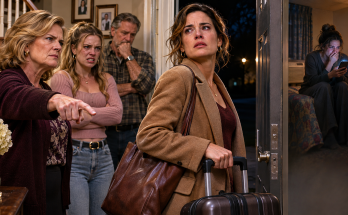
The door opened.
Standing there was Marianne, my father’s former attorney and the woman who had helped me uncover the truth about my family.
She carried a leather briefcase.
My mother, Sylvia, immediately lost her smile.
“What are you doing here?” she demanded.
Marianne calmly stepped inside.
“I was invited.”
My mother looked at me.
“You invited her?”
“Yes,” I answered.
Addison lowered her phone. For the first time that evening, she seemed unsure whether she should continue recording.
Marianne placed her briefcase on the kitchen table and opened it.
Inside were bank statements, property documents, old correspondence, tax records, and several documents bearing my father’s signature.
My mother stared at them.
“Where did you get those?”
Marianne ignored the question.
“These are your husband’s estate records, Sylvia.”
My father had died eleven years earlier. According to my mother, he had left behind almost nothing. She had always claimed that his medical expenses, mortgage, and outstanding debts had consumed everything.
I had believed her.
But the truth was completely different.
Marianne removed a property deed and placed it in front of me.
The house on Maple Drive had been transferred into a family trust eighteen months before my father’s death.
And there were three beneficiaries.
My mother.
My sister.
And me.
We were supposed to receive equal shares.
I looked at my mother.
“Why did you tell me there was nothing?”
She immediately became defensive.
“Your father was sick. He didn’t understand what he was signing.”
Marianne shook her head.
“That’s not true. He had a medical evaluation confirming that he was mentally competent when he signed the documents.”
My hands began trembling.
My father had deliberately included me.
Even after all those years, he hadn’t forgotten me.
But then I asked the question that changed everything.
“What happened to my share?”
Marianne looked toward Ruth, the elderly neighbor who had lived across the street from my family for decades.
Ruth stepped forward.
Her eyes were already filled with tears.
“Ren, I should have told you a long time ago.”
She explained that on the night my father died, Sylvia had approached her with a disturbing request.
My mother had wanted Ruth to confirm that I had voluntarily abandoned my family and had agreed to surrender my inheritance to Addison.
But Ruth knew that wasn’t true.
I had never signed anything.
I had never agreed to give up my share.
My mother had simply decided that I didn’t deserve it.
Then Ruth revealed something even more painful.
She had witnessed my mother repeatedly telling people that I was selfish, ungrateful, and uninterested in the family.
Those lies had helped convince relatives that Addison deserved everything.
Ruth reached into her purse and produced a small envelope.
Inside was a handwritten note from my father.
Marianne unfolded it and read:
“Ren, if you’re reading this, something happened that I hoped never would. Whatever anyone tells you, you were never less loved. The house is meant to protect all three of you. Don’t surrender your share because someone makes you feel guilty for wanting what is yours.”
I couldn’t hold back my tears.
For eleven years, I had believed my father had died thinking I was an ungrateful daughter.
But he had known what was happening.
He had tried to protect me.
Then Addison finally spoke.
“Wait. You’re telling me the house belongs to all three of us?”
Marianne nodded.
“Legally, yes.”
Addison turned toward our mother.
“You told me Ren signed away her share!”
My mother said nothing.
Addison admitted that she had discovered the truth the previous year. She had seen documents proving that I had never signed a waiver.
Yet she had remained silent.
She had allowed our mother to continue pretending that everything belonged to her.
I looked at my sister.
“You knew?”
Addison began crying.
“I found out last year. I didn’t know what to do.”
For the first time, I understood that my mother had manipulated both of us, although in very different ways.
But I wasn’t there to repair everything.
I had brought something of my own.
I reached into my coat and removed the sealed envelope.
Inside were eight pages documenting fifteen years of financial transfers I had made to my parents.
Every payment.
Every emergency.
Every request for help.
Every time I had been told that Addison needed money.
I had records of the bank transfers, receipts, emails, and property documents.
My mother stared at the pages.
“You’ve been investigating us?”
“No,” I answered. “I’ve been investigating the truth.”
Then the doorbell rang again.
Denny opened the door.
Two men stood outside: a county assessor and a process server.
They had legal documents addressed to Sylvia and Addison.
My mother turned toward me.
“What did you do?”
“Nothing tonight.”
Marianne explained that the legal proceedings concerning the trust and the disputed property were beginning.
My mother had spent years believing that nobody would ever challenge her version of events.
Now the documents were finally speaking for themselves.
But something unexpected happened.
I looked around the house.
The staircase where Addison and I had played as children.
The kitchen where my father used to make pancakes on Sunday mornings.
The dining room where my mother had repeatedly reminded me that being the responsible daughter was my duty.
And suddenly, I realized I didn’t want the house.
I had never wanted the house.
I had wanted the truth.
I wanted my father’s wishes respected.
Most importantly, I wanted to stop believing that I had to sacrifice everything to deserve a place in my family.
I looked at my mother.
“You can keep the house if that’s what you want.”
She looked confused.
“Then why did you come here?”
I answered quietly.
“Because I wanted to know whether my family was capable of telling me the truth.”
Nobody responded.
I picked up my coat.
As I reached the doorway, Addison called my name.
“Ren, I deleted the video.”
I turned around.
“Okay.”
“I’m sorry. I shouldn’t have recorded you.”
For the first time that evening, her apology sounded genuine.
I nodded.
Then my mother whispered:
“Are you really leaving?”
I looked at her.
“Yes.”
“After everything?”
I took a breath.
“I’m leaving because being your daughter doesn’t mean I have to keep volunteering to be your victim.”
And I walked out.
Three weeks later: My father’s final secret
I thought Christmas Eve had finally given me the answers I needed.
But three weeks later, Marianne called.
“Ren, your father’s original trust documents have been discovered.”
I frowned.
“We already have the trust documents.”
“No. We had copies. Your father left an additional amendment that was never disclosed to your mother.”
I immediately drove to Virginia.
When I arrived at Marianne’s office, she placed a thick brown folder on the desk.
“Your father knew your mother had a habit of controlling people by making them feel guilty,” she explained. “He knew Addison was favored, and he knew you were always the one expected to surrender.”
She showed me an amendment signed four months before his death.
It contained a financial protection clause.
If either daughter was pressured, deceived, or forced into surrendering her inheritance, that daughter’s portion would be redirected into an independent trust for her protection.
My father had anticipated exactly what my mother might do.
He had protected my inheritance even after his death.
But there was another paragraph.
Marianne pointed to it.
It was a personal message addressed specifically to me.
I began reading.
“Ren, you were never the difficult child.
You were never the selfish child.
You were the child who noticed things.
You asked questions.
You saw when someone was hurting.
You recognized when something wasn’t fair.
And because you saw things I wanted to ignore, you were often treated as though you were the problem.
You were not.”
I covered my mouth.
Then I reached the final handwritten sentence.
“Ren, I am sorry I taught you that peace was worth more than truth.”
I began crying.
For eleven years, I had wondered whether my father had been disappointed in me.
Now I finally understood.
He had seen everything.
He had known I was hurting.
He had simply failed to protect me while he was alive.
Marianne then handed me another envelope.
It contained a personal letter from my father.
He wrote about my childhood, my school achievements, my first job, and the day I left for college.
He explained that he had given Addison more financial support because he worried she wouldn’t survive without it.
He had given me less because he believed I was strong enough to manage independently.
It was a terrible mistake.
He finally admitted it.
“You shouldn’t have had to be strong just because you were capable of being strong.”
Then came the words that stayed with me forever:
“Never confuse being needed with being loved.”
I read that sentence repeatedly.
And for the first time, I stopped blaming myself for everything that had happened.
The final decision
Three months later, the house on Maple Drive was sold.
My mother fought the decision.
She hired an attorney, challenged the trust, and accused Marianne of misconduct.
She even accused me of being greedy.
But the original documents, medical evaluations, and legal records proved my father’s intentions.
The court recognized the trust.
The property was divided according to his instructions.
My mother received her portion.
Addison received hers.
And I received mine.
I could finally have taken the money and walked away without another word.
But I had a different idea.
I used my inheritance to establish a scholarship fund in my father’s name.
I called it the Daniel Bennett Independence Scholarship.
It was designed for students who worked while attending college, young people caring for sick relatives, and students who had been forced to become independent before they were ready.
The first recipient was a nineteen-year-old girl named Elena.
She worked nights at a grocery store and attended community college during the day.
When I called to tell her she had received the scholarship, she asked:
“Why me?”
I smiled.
“Because you kept going.”
She cried.
And I cried too.
For the first time, my strength wasn’t something my family used against me.
It had become something I could use to help someone else.
My sister finally apologized
Addison called me several times after the house was sold.
Initially, I didn’t answer.
But one afternoon, I finally picked up.
“Hi, Ren.”
“Hi.”
“I’ve been thinking about Christmas.”
“So have I.”
She was silent for a moment.
Then she said:
“I was horrible to you.”
I didn’t argue.
She continued.
“I always thought Mom loved me more. I thought I was the daughter who mattered. But now I think she just loved being able to use me.”
That was the first honest thing my sister had ever said about our family.
We talked for almost two hours.
We discussed our childhood, our father, and the roles our mother had forced us to play.
Addison apologized.
I eventually forgave her.
But forgiveness didn’t mean pretending nothing had happened.
We didn’t suddenly become inseparable sisters.
We simply began building a more honest relationship.
Sometimes she called.
Sometimes I called.
We met for lunch twice that summer.
During our second meeting, she brought me a small box.
Inside was the old Christmas video.
She admitted that she had kept a copy.
Then she handed me her phone.
“I deleted it. Every copy.”
I nodded.
“Thank you.”
She looked at me.
“Do you think Dad would have wanted us to fix this?”
I thought for a moment.
“I think he would have wanted us to stop lying first.”
She laughed softly.
And for the first time in years, we smiled together without competing for our mother’s approval.
My mother never apologized
There was one person who never changed.
Sylvia.
She eventually sent me a three-page letter.
I opened it expecting an apology.
Instead, most of it was about how difficult her life had been, how abandoned she had felt, and how much Addison had needed her.
She blamed circumstances.
She blamed my independence.
She blamed the years of silence.
At the very end, she wrote:
“I suppose we all made mistakes.”
I read that sentence twice.
Then I placed the letter in a drawer.
I didn’t respond.
Because I finally understood something.
Sometimes closure doesn’t come from hearing someone admit they hurt you.
Sometimes closure comes from no longer needing them to admit it.
One year later: Christmas finally felt different
A year after that terrible Christmas Eve, I returned to Virginia.
I didn’t go to Maple Drive.
The house had been sold, and a new family lived there.
There was a swing set in the backyard and a blue bicycle leaning against the garage.
Someone had planted flowers along the walkway.
I parked across the street and took my father’s letter from my purse.
I read the final sentence again.
“Never confuse being needed with being loved.”
My phone rang.
It was Addison.
“Where are you?”
“Virginia.”
“You didn’t tell me.”
“I wanted to see something.”
“What?”
I looked at the house.
“Home.”
There was a brief silence.
Then she asked:
“Do you want me to come?”
I smiled.
“No. I’m okay.”
“All right. I’m glad you went.”
“Me too.”
After we hung up, I looked at the house one last time.
For years, I had believed home was somewhere people recognized you.
Somewhere your childhood bedroom waited.
Somewhere your mother called you downstairs.
Somewhere your father’s chair remained empty after he died.
But I finally understood that home wasn’t a building.
It wasn’t my mother’s approval.
It wasn’t Addison’s acceptance.
And it certainly wasn’t an inheritance.
Home was the life I had built after I stopped begging people to make room for me.
My mother had invited me back to Christmas because she wanted to prove that I would always come running.
She had been right about one thing.
I did come.
But she was wrong about why.
I hadn’t come because I needed her.
I had come because the little girl inside me still wanted answers.
And once I finally received them, I was free.
I started my car.
Before driving away, I whispered:
“Merry Christmas, Dad.”
For the first time since his death, I didn’t feel like I was saying goodbye.
I felt like I was saying thank you.
Because the greatest gift he had left me wasn’t the house.
It wasn’t the money.
It wasn’t even the inheritance.
It was the truth.
I had spent years believing I wasn’t enough.
But my father had spent his final years trying to make sure I would eventually understand that I always had been.
And that was the Christmas gift I had been searching for all my life.
I finally stopped running toward people who had spent years standing still, waiting for me to prove that I loved them.
And this time, I drove home.
THE END.