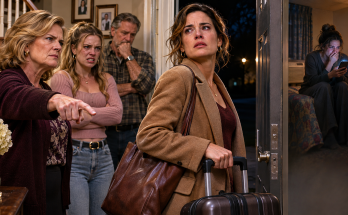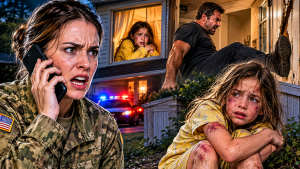
My 9-year-old daughter called 911 as her uncle kicked in her bedroom door. She whispered her address four times. The dispatcher said, “Go back to bed, kid,” and hung up. The dispatcher was my sister-in-law. At dawn, my daughter was found in the backyard, covered in bruises, barely able to stand. When I returned from deployment, I called 911 from my sister-in-law’s house. She answered, “What’s your emergency?” “I’m standing in your kitchen,” I said. “Say goodbye to your husband.” Tonight is his last night of freedom…”
“Go back to bed, kid,” the dispatcher said.
Then the line went dead.
My nine-year-old daughter was hiding behind her bedroom door while her uncle kicked it open.
Her name is Maisie. She was nine years old, barefoot, and wearing the yellow pajamas I’d bought her before my deployment. She had whispered our home address four times.
Nobody came.
By sunrise, my little girl was lying behind our backyard shed, covered in bruises, too weak to stand.
And the woman who had refused to send help was her own aunt.
I didn’t know any of that when it happened. I was thousands of miles from North Carolina, wearing an Army uniform and believing my daughter was safe with family.
My name is Tessa Holloway.
In October 2025, I was thirty-nine years old, a staff sergeant in the United States Army, and a mother who had made one terrible assumption.
I thought the people who shared our last name would protect my child.
Our house sat on a quiet street outside Fayetteville, about twenty minutes from Fort Liberty. It was a single-story brick ranch with a narrow front porch, two maple trees, and a backyard Caleb always complained was too big to mow.
Caleb was my husband.
We’d been married twelve years before his accident. He worked as an electrician, fixed practically everything around the house, and made terrible pancakes every Sunday.
Then, in January, he fell from a ladder at a construction site.
The spinal injury changed everything. He could move his arms, but his legs weren’t reliable enough for him to walk independently. Rehabilitation helped, though some days were harder than others.
When I received deployment orders that spring, we arranged professional home assistance and help from relatives.
His older sister, Blythe, volunteered immediately.
“Don’t worry about a thing,” she told me. “I’ll take care of my brother and that sweet girl.”
Her husband, Darren, promised to handle transportation and household repairs.
I remember standing in our kitchen, looking at the refrigerator covered with Maisie’s drawings, feeling grateful.
That memory bothers me now because I shook Darren’s hand.
I thanked him.
And I left.
On Thursday, October 9, Maisie came home from school around 3:30. She finished her homework at the kitchen table, ate leftover spaghetti, and watched a nature documentary about sea turtles.
Caleb was resting in his bedroom after a difficult physical therapy session.
Darren arrived shortly after seven. He told Maisie he needed to check something on the family computer.
She was supposed to be in bed by 8:30, but she’d left her library book downstairs.
When she came back into the living room, Darren was standing beside the computer, looking through a drawer. He had a small black flash drive in his hand.
Maisie recognized it.
Earlier that afternoon, she’d seen a document on the computer with her father’s name and a dollar amount she didn’t understand.
$38,000.
She’d asked Darren about it.
He’d snapped at her to mind her own business.
Now he wanted to know whether she’d touched his files.
Maisie said no.
He didn’t believe her.
What happened next would take investigators weeks to piece together, but my daughter remembered every sound.
Darren followed her down the hallway, demanding to know where she’d put the flash drive.
She ran into her bedroom and locked the door.
He struck it with his fist.
Then he kicked it.
Maisie grabbed her old cell phone from the nightstand. It didn’t have an active service plan, but it could still place an emergency call.
At 11:46 p.m., she dialed 911.
She kept her voice low.
“Please send somebody. He’s trying to get in.”
The dispatcher asked for her location.
Maisie gave the street address.
Then she repeated it.
And repeated it again.
Outside her bedroom, Darren shouted her name.
The dispatcher went quiet.
Maisie heard a breath, followed by an irritated sigh.
“Go back to bed, kid.”
The call ended.
Maisie stared at the screen.
She tried calling again, but Darren kicked the door hard enough to split the frame.
She dropped the phone.
Her bedroom window was only a few feet above the flower bed. Caleb had installed a safety latch years earlier so she could open it during an emergency.
She pushed the window up, climbed onto the sill, and jumped.
She landed badly. Her knees struck the wooden border around the flower bed, and one shoulder scraped against the bricks.
She ran anyway.
Darren came through the bedroom door moments later.
By then, she was crawling behind the storage shed.
Inside the house, Caleb heard the crashing and called for his daughter.
His wheelchair had been moved away from the bed after therapy. His phone was charging in the kitchen.
He tried pulling himself toward the edge of the mattress, but pain shot through his back.
“Maisie!”
Nobody answered.
He shouted for Darren.
Darren eventually appeared and claimed Maisie had run outside after an argument.
Caleb demanded that he find her.
Darren searched briefly, then returned, saying she’d probably gone to a neighbor’s house.
He refused to call the police.
Caleb spent the remaining hours awake, calling his daughter’s name whenever he heard movement outside.
At 6:12 the next morning, Odessa Pike stepped into her backyard carrying a bag of birdseed.
Odessa was sixty-three, retired from the county school system, and knew every child on our street.
She noticed something yellow behind our shed.
At first, she thought it was a discarded blanket.
Then it moved.
Maisie was curled against the wooden fence, shivering. Her legs were bruised. Her arms were scratched. One ankle had swollen inside her sock.
Odessa knelt beside her.
“Sweetheart, can you hear me?”
Maisie opened her eyes.
“Please don’t tell Uncle Darren.”
Odessa didn’t ask another question.
She called 911, stayed beside Maisie, and covered her with her cardigan until the ambulance arrived.
At Cape Fear Valley Medical Center, the doctors examined her injuries while a social worker contacted the appropriate authorities.
Caleb was brought to the hospital with assistance.
Darren told investigators that Maisie had wandered outside and fallen.
Blythe supported his account.
But Odessa had already told the responding deputy what Maisie said when she found her.
And somewhere in the emergency communications system, a recording still existed.
A recording Blythe believed nobody would question.
That afternoon, my first sergeant found me after a briefing.
His expression changed before he spoke.
“Tessa, we need to talk privately.”
I followed him into a small office.
He handed me a telephone.
The woman on the other end explained that my daughter was hospitalized and that an investigation had begun.
I asked whether Maisie was alive.
“Yes, Sergeant Holloway. She’s alive.”
I sat down.
For several seconds, I couldn’t make my mouth work.
Then I asked the question that would follow me all the way home.
“Where was my husband?”
The first thing I noticed when I walked into my daughter’s hospital room was that she wasn’t watching cartoons.
Maisie loved cartoons, even when she had the flu. She’d insist on watching something silly, usually with a bowl of crackers balanced on her stomach.
But that afternoon, she was staring at the door.
Every time someone passed in the hallway, her eyes followed the movement.
I stood there holding my Army duffel bag, still wearing the uniform I’d traveled home in.
“Hey, Peanut,” I said.
She looked at me for one second.
She didn’t move.
Then her bottom lip started trembling.
“Mom.”
I dropped my bag and crossed the room.
She reached for me, then pulled back when I leaned too close.
That stopped me cold.
“It’s okay,” I whispered. “I’m right here.”
She looked down at her bruised arms.
“Can you close the door?”
I closed it halfway, leaving enough space for the nurses to see inside.
Then I sat beside her and waited.
A minute later, she reached for my hand.
I held it until she fell asleep.
I’d spent nearly twenty years in the Army. I’d worked through exhausting field exercises, difficult deployments, and emergencies where every decision mattered.
But sitting beside that hospital bed, I couldn’t think of a single thing to do except hold my daughter’s hand.
A nurse named Patricia came in around four.
She explained that Maisie had bruising on her arms and legs, several abrasions, and a sprained ankle.
Fortunately, the X-rays showed no fractures.
The doctors wanted to monitor her hydration and make sure she could walk safely before discharge.
A hospital social worker had already spoken with Maisie, and a specialist would conduct a more formal interview later.
I was grateful nobody expected her to repeat everything immediately.
“She’s been through enough,” Patricia said.
I nodded.
Then I asked where Caleb was.
“Your husband is waiting in the family room.”
I found him sitting near a vending machine, his wheelchair angled toward the window.
He looked older than he had when I left. His beard had grown unevenly, and the gray around his temples seemed more noticeable.
When he saw me, his shoulders dropped.
“Tessa.”
I stood in front of him.
“What happened to our daughter?”
He opened his mouth, but nothing came out.
“Caleb!”
“I heard her screaming.”
My stomach tightened.
“Then why didn’t you help her?”
His hands gripped the wheels of his chair.
“Darren moved my chair away from the bed. My phone was in the kitchen. I couldn’t get to either one.”
“Why was Darren in our house at midnight?”
“He said he was checking paperwork.”
“Paperwork?”
Caleb looked away.
I sat across from him.
“Start at the beginning.”
He rubbed his forehead.
After his accident in January, we’d hired a home aide for weekday mornings.
Caleb attended physical therapy twice a week, and Maisie stayed with Odessa when appointments ran late.
Blythe and Darren had offered to cover evenings and transportation.
At first, the arrangement worked.
Blythe brought casseroles and helped with groceries. Darren drove Caleb to appointments and fixed a leaking faucet.
Then Darren began handling more of our finances.
He said Caleb shouldn’t worry about bills while recovering.
Caleb agreed to let him help organize paperwork.
Somewhere along the way, helping became controlling.
Darren started opening mail before Caleb saw it. He questioned purchases, criticized the home schedule, and complained about the cost of rehabilitation.
“Blythe backed him up,” Caleb admitted. “She kept saying I was lucky they were helping.”
“Did you tell them to stop?”
“I tried.”
He stared at his hands.
“Darren said if they stopped coming, somebody might decide Maisie wasn’t safe living with me.”
I leaned back.
“Who would decide that?”
“He said social services.”
“Caleb, that’s not how it works.”
“I know that now.”
But I could see he hadn’t known it then.
He’d been frightened, isolated, and ashamed of needing assistance.
None of that excused what happened.
Still, looking at him, I understood how Darren had found an opening.
Before his accident, Caleb was the man who carried groceries in one trip because he refused to admit two trips made more sense.
Now he needed help getting into the shower, and Darren had turned that dependence into leverage.
“Why didn’t you call me?” I asked.
Caleb swallowed.
“You were overseas. I didn’t want you worrying about things you couldn’t fix.”
I looked toward the hallway.
“Our daughter nearly paid for that decision.”
He nodded without defending himself.
That made me angrier somehow.
Later, I returned to Maisie’s room.
She was awake, picking at the corner of her blanket.
“Did Daddy tell you?” she asked.
“He told me some things.”
“Is he in trouble?”
I pulled my chair closer.
“Daddy and I have things to work out. You don’t need to worry about that.”
She studied my face.
“Uncle Darren said nobody would believe me.”
I felt my jaw tighten.
I wanted to ask what he’d done, what he’d said, whether he’d touched her.
Instead, I remembered the hospital social worker’s advice.
I kept my voice steady.
“You did the right thing asking for help.”
Her eyes filled.
“But nobody came.”
I reached for a tissue.
“I know, sweetheart.”
She wiped her nose.
“Are you going away again?”
That question hurt worse than anything Caleb had said.
“I have some things to work out with the Army,” I answered. “But I’m here now, and we’re going to make sure you’re safe.”
She nodded, though I could tell she wasn’t completely convinced.
Neither was I.
That evening, Darren appeared outside the hospital room carrying a stuffed bear from Walmart.
He smiled when he saw me.
“Well, look who’s home.”
I stood.
He tried stepping around me.
“Thought I’d check on my favorite niece.”
“She’s resting.”
“Come on, Tessa. Don’t make this ugly.”
He moved closer, reaching toward the door.
I shifted into his path.
Years of training had taught me to watch shoulders and hands before listening to threats.
“Step back, Darren.”
He laughed.
“Still playing soldier.”
“No. Right now, I’m being her mother.”
When he tried pushing past, I kept my footing and called for hospital security.
He left before the officers reached us, but not before looking through the doorway at Maisie.
She pulled the blanket over her head.
That night, Odessa came to the hospital.
She brought homemade banana bread wrapped in aluminum foil.
“I know hospital food hasn’t improved since my gallbladder surgery,” she said.
For the first time all day, I almost smiled.
Then she reached into her purse.
“I found something under Maisie’s window.”
She placed a small plastic keychain on the table.
Inside was a black flash drive.
Maisie saw it and sat straight up.
“Mom,” she whispered.
I turned toward her.
“That’s what Uncle Darren wanted.”
I stared at the flash drive in Odessa’s hand, wondering how something so small could have frightened a grown man enough to chase a child through her own house.
Maisie was watching me carefully.
“Am I in trouble?” she asked.
“No, sweetheart.”
“Uncle Darren said I stole it.”
I pulled my chair closer to her bed.
“Did you?”
She shook her head.
“He left it in the computer. I took it because he got mad when I saw Daddy’s name.”
I wanted to ask a hundred questions.
Instead, I looked at Odessa.
“Where exactly did you find it?”
“In the flower bed underneath her window. I was picking up some broken branches when I saw the keychain.”
I thanked her, then called Detective Lorna Sykes, whose number the hospital social worker had given me.
She arrived forty minutes later carrying a notebook and a paper evidence bag.
Lorna was a compact woman in her late forties with short brown hair and the tired expression of somebody who had spent too many years listening to people lie.
I explained what Odessa had found.
Lorna asked us to describe how the drive had been handled.
She documented our answers, photographed it, and sealed it in the evidence bag.
“Please don’t plug this into anything,” she said.
“I wasn’t planning to.”
“Good. You’d be surprised.”
Afterward, she arranged for Maisie’s formal interview through the local child advocacy center.
I appreciated that.
My daughter needed someone trained to ask difficult questions without making her feel responsible for what happened.
By Saturday afternoon, Maisie had been discharged.
She walked slowly with a supportive ankle brace, holding my hand all the way to the car.
When we reached our driveway, she stopped.
“Do we have to go inside?”
I looked at our front door.
The damaged bedroom frame was still visible through the hallway.
“No,” I said. “Not today.”
We stayed at a hotel near Skibo Road instead.
Caleb came with us.
Odessa brought Maisie’s schoolbooks and the stuffed rabbit she’d slept with since kindergarten.
That night, I sat at the little hotel desk while Caleb helped Maisie settle into bed.
He rolled back into the room looking exhausted.
“She asked if Darren has a key.”
“He won’t be getting near her.”
Caleb nodded.
Then he said something I wasn’t expecting.
“I think he took money from us.”
I turned around.
“How much?”
“I don’t know exactly.”
Caleb looked down.
“Maybe thirty thousand. Maybe more.”
I stared at him.
Our savings weren’t enormous.
We had a mortgage, medical expenses, and a daughter who would eventually need braces, a car, and hopefully some help with college.
Thirty thousand dollars wasn’t pocket change.
“Why didn’t you tell me?”
“I kept thinking I could fix it before you came home.”
I looked at the hotel curtains, trying to find a response that wouldn’t turn into shouting.
Finally, I said, “Tomorrow. We’re calling the bank.”
We spent Sunday morning reviewing statements on Caleb’s laptop.
Several transfers had gone to a business called Ror Property Services.
Darren owned it.
Some payments were labeled home repairs. Others were marked consulting or equipment.
Caleb recognized two legitimate expenses.
The rest made no sense.
One transfer alone was for $9,800.
“Did you approve this?” I asked.
“No.”
“Did you sign anything?”
“A form letting Darren help with one payment while I was recovering.”
“Do you still have it?”
“I think Blythe kept the copy.”
I closed the laptop.
That was when I understood how carefully Darren had arranged things.
He hadn’t simply borrowed money.
He’d made himself useful, gained access, and slowly convinced Caleb that questioning him would endanger the family.
On Monday, we visited our bank.
A manager named Evelyn listened while Caleb explained the unauthorized transactions.
She didn’t promise to return the money.
Instead, she helped him report the disputed activity, secure his online access, and begin the bank’s investigation.
She also recommended speaking with an attorney about the documents Darren had obtained.
By the time we left, my head hurt.
I’d expected the truth to be simple.
Find the money. Find the thief. Make him answer.
Instead, we had forms, account histories, questions about signatures, and no immediate guarantee of recovering a dime.
That afternoon, I met Marisol Vega at a diner near Fort Liberty.
Marisol and I had served together for years. She was the kind of soldier who could organize a chaotic supply operation without raising her voice.
She ordered coffee and looked at me.
“You look terrible.”
“Thanks.”
“I could lie. But you’d know.”
I told her about the hospital, Darren, and the bank.
She listened without interrupting.
When I finished, she stirred her coffee.
“What are you thinking about doing?”
I looked out the window.
“Something stupid.”
She waited.
“I keep picturing him standing outside Maisie’s door. I keep thinking about what I would have done if I’d been home.”
Marisol put down her spoon.
“Tessa, you know how to protect people. Don’t confuse that with needing to punish somebody yourself.”
“I know.”
Knowing and doing aren’t always the same thing.
She wasn’t lecturing me.
She’d seen me under pressure. She knew exactly how close anger could sit beside discipline.
Before leaving, she reminded me that my command could help me navigate the family emergency and available support services.
“You don’t have to carry this alone.”
I nodded, though accepting help had never been my strongest skill.
Tuesday morning, Detective Sykes called.
Investigators had begun examining the financial records, but the flash drive contained files that would require authentication and comparison with bank documents.
There was no instant answer.
Then her voice changed.
“Tessa, there’s something else.”
I stepped into the hotel hallway.
“What?”
“We’ve reviewed the initial emergency communications records from Thursday night.”
I leaned against the wall.
“Maisie’s call?”
“Yes.”
“Did somebody hear her?”
There was a pause.
“The call was answered by Blythe Ror.”
I closed my eyes.
I’d suspected it, but hearing confirmation was different.
Lorna continued.
“The electronic record shows that Blythe entered a disposition indicating no emergency response was necessary. The recording and related system logs have been preserved.”
“She knew it was Maisie.”
“We’re investigating what she knew and when.”
I looked through the open hotel doorway.
Maisie was sitting on the bed, helping Caleb sort a deck of cards.
My daughter had begged for help.
Her aunt had been the person listening.
“Does Blythe know you found this?” I asked.
“Not yet. The communications agency has been notified, and the matter is being handled through the appropriate investigative channels.”
I swallowed.
“What happens now?”
“We keep gathering evidence. And I need you not to confront her about the call.”
I wanted to argue.
Instead, I said, “All right.”
After hanging up, I stayed in the hallway for several minutes.
I’d spent years training soldiers to check facts before acting, even when emotions were running high.
Now I had to follow my own advice.
Inside the room, Maisie laughed at something Caleb said.
It was a small sound, but I hadn’t heard it since coming home.
I put my phone away and went back to them.
For that afternoon, at least, I could give my daughter something Darren and Blythe hadn’t managed to take.
A few ordinary hours with her parents.
The morning Caleb finally told me everything, I found him sitting at our kitchen table, staring at a photograph from before his accident.
In the picture, he was standing on a ladder hanging Christmas lights while Maisie watched from the porch.
He looked happy.
A little ridiculous, too, because he’d insisted on wearing his old Dallas Cowboys sweatshirt in freezing weather.
I set two mugs of coffee on the table.
“Remember that day?” I asked.
He smiled faintly.
“You told me the lights looked crooked.”
“They were crooked.”
“You made me climb down and start over.”
I sat across from him.
For a moment, we were just a married couple remembering an ordinary December afternoon.
Then Caleb turned the photograph face down.
“There’s something I haven’t told you.”
I waited.
He rubbed his thumb along the edge of his coffee mug.
“Darren started threatening me in June.”
I didn’t speak.
“He said if I didn’t let him handle the bills, he’d tell social services I wasn’t capable of taking care of Maisie.”
“Because of your wheelchair?”
“Because I couldn’t always get out of bed without help. Because I needed somebody to drive me to appointments.”
I shook my head.
“Needing help doesn’t make you an unfit father.”
“I know that now.”
He looked toward the hallway.
“But back then, every day felt like somebody had taken another piece of my life.”
I understood more than he realized.
I’d watched soldiers struggle after injuries. Men and women who’d once carried heavy equipment across rough terrain suddenly needed assistance with ordinary tasks.
The physical recovery was difficult.
Accepting help could be harder.
Caleb continued.
“Blythe kept telling me you couldn’t afford trouble with your command. She said an investigation would make you look irresponsible.”
“That wasn’t true.”
“I know.”
“Then why didn’t you ask somebody?”
He looked directly at me.
“Because I was embarrassed.”
There it was.
Not a complicated conspiracy. Not some clever excuse.
Shame.
He’d been afraid of looking weak in front of the woman he’d married.
And Darren had used that fear against him.
I pushed my coffee aside.
“Caleb, I need you to understand something. Your injury wasn’t your choice. What Darren did wasn’t your fault. But keeping secrets from me, letting him keep coming around after you knew something was wrong…”
My voice caught.
“That was a choice.”
He nodded.
“I know.”
“Maisie could have died out there.”
His eyes filled.
“I know.”
I stood and walked to the sink.
Outside, a school bus stopped at the corner. Two children climbed aboard while their mother waved from the sidewalk.
I watched until the bus disappeared.
Then I said, “I don’t know how to forgive you yet.”
Caleb didn’t ask me to.
That afternoon, I drove him to rehabilitation.
His therapist, a cheerful woman named Renee, had him practice transferring between his wheelchair and a padded bench.
He struggled with the final movement.
“Come on, Caleb,” she encouraged. “One more.”
He grunted.
“I used to complain about mowing the lawn.”
Renee laughed.
“Well, congratulations. You found something harder.”
Even Caleb smiled.
I watched him try again.
His arms trembled. Sweat gathered along his forehead, but he completed the transfer.
Nobody clapped.
Renee simply nodded and said, “Good work.”
That quiet acknowledgment stayed with me.
Strength didn’t always look like a soldier carrying another soldier across a field.
Sometimes it looked like a man moving twelve inches without giving up.
After therapy, Caleb asked me to stop at the bank.
He wanted to speak with Evelyn himself.
I offered to come inside.
“No,” he said. “I need to do this.”
I waited in the car.
Forty minutes later, he returned carrying a folder.
He’d requested copies of the disputed transactions, updated his account access, and arranged for future statements to come directly to him.
He also scheduled a meeting with an attorney.
It wasn’t dramatic, but it was the first time I’d seen him take control of something since coming home.
Two days later, we met Karen Bellamy, a civil attorney in downtown Fayetteville.
Her office smelled faintly of coffee and old paper.
Karen listened while Caleb explained how Darren had gained access to his financial information.
She asked careful questions about signatures, authorizations, and who had been present during certain transactions.
When Caleb hesitated, she waited.
She never looked at me to answer for him.
I appreciated that.
By the end of the meeting, she’d explained several possible steps for protecting our accounts and challenging unauthorized activity.
She also warned us that recovering money could take time.
“Even when the facts seem obvious,” she said, “the paperwork still matters.”
I nearly laughed.
The Army had taught me the same lesson.
Back home, Maisie was sitting with Odessa at the kitchen table, working on a school project about North Carolina wildlife.
She’d drawn a red fox that looked suspiciously like a large orange cat.
“That’s excellent,” I told her.
“It’s supposed to be a fox.”
“I knew that.”
She gave me a look.
“Mom.”
I smiled.
For a few minutes, everything felt normal.
Then a truck pulled into our driveway.
Darren.
I recognized the engine before I saw him.
He climbed out carrying a manila envelope.
Caleb rolled toward the living room.
“Don’t let him in,” he said.
“I won’t.”
I stepped onto the porch and closed the door behind me.
Darren smiled.
“Thought we could settle this like adults.”
“Leave the envelope on the porch.”
“I need Caleb’s signature.”
“He has an attorney now.”
His smile disappeared.
“You’ve been home five minutes and already turned everybody against me.”
I folded my arms.
“Get off our property.”
He stepped closer.
“You don’t scare me, Tessa.”
“I’m not trying to.”
He grabbed the screen door handle and pulled.
I moved between him and the doorway.
“Let go.”
He leaned toward me.
“Move.”
When he reached for my arm, I stepped sideways, broke his grip, and put distance between us.
It was a simple defensive movement, practiced hundreds of times during training.
Nothing flashy.
Just enough to keep him from controlling where I stood.
I didn’t strike him.
I didn’t chase him.
I kept the door closed and told him the police had been called.
He backed toward his truck, breathing hard.
Then he pointed through the window at Caleb.
“You think your wife knows everything?”
Caleb didn’t answer.
Darren laughed bitterly.
“Ask her what your sister did before that little girl ever called 911.”
He climbed into his truck and drove away.
I stood on the porch until his taillights disappeared.
Then I went inside.
Caleb was staring at the floor.
“What was he talking about?” I asked.
My husband looked up slowly.
And the expression on his face told me Darren hadn’t been bluffing.
Caleb didn’t answer right away.
He sat beside the living room window, watching Darren’s truck disappear down our street.
Finally, he said, “Blythe knew about the money before Darren ever touched our accounts.”
I pulled a chair across from him.
“How much did she know?”
“More than I wanted to believe.”
He reached for the glass of water beside his wheelchair.
“In June, she brought me papers Darren said were for the insurance company. She told me signing them would make it easier to pay the medical bills.”
“Did you read them?”
“Some. Not all.”
I closed my eyes.
Caleb continued.
“A week later, I noticed money missing. Blythe said it was temporary. Darren had a contracting job coming through, and he’d pay everything back.”
“Thirty-eight thousand dollars?”
“I didn’t know it was that much.”
He looked miserable.
“She promised she’d fix it before you got home.”
I stood and walked toward the kitchen.
Our refrigerator still held Maisie’s school calendar.
Someone had circled her October field trip in purple marker.
I wondered how many ordinary mornings my daughter had spent eating cereal while Darren and Blythe discussed stealing from us.
“Why didn’t you tell Detective Sykes?”
“I was going to.”
“Caleb.”
He lowered his head.
“I was afraid they’d think I helped them.”
I leaned against the counter.
“Then tell them exactly what happened. Every part, even the embarrassing parts.”
He nodded.
The following morning, Caleb contacted Detective Sykes and arranged another interview.
I drove him there but waited outside.
He needed to speak for himself.
While I sat in the parking lot, my phone rang.
It was Marisol.
“How’s my favorite troublemaker? Considering a career in goat farming?”
“Goats are meaner than soldiers.”
“At least they don’t forge signatures.”
She stopped joking.
“What happened?”
I told her about Caleb’s confession.
Marisol listened, then asked whether I’d eaten breakfast.
“Coffee counts.”
“No, it doesn’t.”
“Since when?”
“Since you started making decisions on an empty stomach.”
She made me promise to get something to eat.
I bought a biscuit from a drive-thru and sat in my car, watching people enter the sheriff’s office.
Some carried folders. Others held children by the hand.
Everyone had a reason for being there.
For the first time, I understood how exhausting it was to wait for someone else to investigate a danger you could already see.
Two days later, Detective Sykes called me.
The Emergency Communications Agency had opened an administrative investigation into Blythe’s handling of Maisie’s call.
The preserved recording matched my daughter’s account.
Blythe had recognized the address, dismissed the request for help, and entered an inaccurate disposition.
The investigators were also examining messages between Blythe and Darren.
Lorna couldn’t tell me everything, but she confirmed something that made my stomach turn.
Blythe had known Darren intended to retrieve the flash drive that night.
“She claims she didn’t expect him to become violent,” Lorna said.
I stared at the wall.
“Then why didn’t she send help when Maisie called?”
“That question is central to the investigation.”
After we hung up, I went outside.
The October air was cool enough to make me wish I’d brought a jacket.
I stood beside my truck, trying to slow my breathing.
I could picture Blythe sitting behind her headset while Maisie whispered our address four times.
I imagined my daughter waiting for sirens that never came.
Then I got into the truck and drove.
I didn’t realize where I was going until I reached the parking lot near Blythe’s workplace.
I stopped beneath a tree and turned off the engine.
For several minutes, I watched employees walk through the entrance.
I wanted Blythe to look me in the eye.
I wanted her to explain how she’d listened to a frightened child and decided that protecting Darren mattered more.
My hand was already on the door handle when I remembered something from a training exercise years earlier.
Our team had been working through a simulated emergency.
Everyone was tired, and the situation seemed straightforward.
I’d been ready to move.
My platoon sergeant stopped me.
“What’s the one thing you haven’t checked?”
I’d been so focused on acting that I’d missed a second person inside the building.
Nobody was hurt.
It was training.
But I never forgot the lesson.
Acting quickly wasn’t the same as acting correctly.
I took my hand off the door.
Then I called Marisol.
“Talk to me,” I said.
“Where are you?”
“Somewhere I shouldn’t be.”
She didn’t ask for details immediately.
“Are you safe?”
“Yes.”
“Can you drive home?”
I looked at the building.
“Yeah.”
“Then do that. I’ll stay on the phone.”
We talked about ordinary things during the drive.
Her son’s broken washing machine. The terrible coffee at our old unit. Whether I’d remembered to renew my truck registration.
By the time I reached home, my hands had stopped shaking.
That evening, Maisie was sitting on the couch with a blanket around her shoulders.
She’d started counseling earlier that week.
Her counselor had suggested keeping familiar routines and letting Maisie decide when she wanted to discuss what happened.
So we ate dinner together.
Caleb made grilled cheese sandwiches using the electric griddle on the kitchen counter.
He burned the first one.
Maisie examined it.
“Daddy, that’s not toasted. That’s a crime.”
Caleb laughed.
“Your mother married me for my cooking.”
“That’s definitely not true,” I said.
Maisie smiled.
It was small, but it was real.
Later, while I helped her get ready for bed, she asked whether soldiers ever got scared.
“All the time,” I said.
“Even you?”
“Especially me, sometimes.”
She thought about that.
“What do you do?”
“I try to remember what I know, ask for help when I need it, and do the next right thing.”
She looked toward her bedroom door.
“Can you leave the hallway light on?”
“Of course.”
After she fell asleep, I sat beside Caleb at the kitchen table.
He’d written down everything he remembered about Darren’s visits, the financial paperwork, and Blythe’s threats.
There were six pages.
His handwriting was shaky, but the details were clear.
“I should have done this months ago,” he said.
“Yes,” I answered.
He nodded.
I didn’t soften the truth, but I placed my hand over his.
The next afternoon, Caleb’s bank called.
Someone had attempted another transfer from an account that was now restricted.
The transaction had been flagged and stopped.
The caller couldn’t establish who had initiated it, but the bank had preserved the relevant records for review.
Caleb contacted Detective Sykes.
An hour later, she called me.
“Tessa, Darren may be preparing to leave the area. We’re following up on information about his movements.”
“Is he being arrested?”
“I can’t discuss operational decisions.”
I understood.
I didn’t like it, but I understood.
After the call, I stood at the kitchen window, watching Maisie and Odessa hang a bird feeder near the porch.
For the first time since coming home, I wasn’t thinking about what I wanted to do to Darren.
I was thinking about what needed to happen so he could never frighten my daughter again.
Then my phone vibrated.
A message from an unfamiliar number appeared.
Tell your husband to stop talking. You have no idea what happens next.
The message stayed on my phone screen for almost a minute.
Tell your husband to stop talking. You have no idea what happens next.
There was no name attached, just a number I didn’t recognize.
I took a screenshot and called Detective Sykes.
“Don’t respond,” she told me. “Forward the message to me and keep the original.”
“Do you think it’s Darren?”
“We’ll look into it.”
That was becoming my least favorite answer.
I wanted somebody to tell me Darren was finished.
Instead, every day brought another question, another document, another reason to wait.
By the following Monday, Caleb had hired Karen Bellamy to handle the remaining financial matters.
She sent Darren and Blythe a written request to return our original household documents.
Blythe called that afternoon.
Her voice was sweet enough to make my teeth hurt.
“Tessa, I think we should talk privately.”
“About what?”
“About putting this family back together.”
I looked at Caleb, who was sitting beside the kitchen table.
“Return the documents first.”
She sighed.
“Come by tomorrow evening. I’ll have everything ready.”
I didn’t trust her.
Neither did Caleb.
But Karen advised that if we chose to collect the papers ourselves, we should keep the visit brief and leave immediately if the situation became uncomfortable.
Detective Sykes was informed of the arrangement.
She made no promise that officers would be present.
Tuesday evening, I drove to Blythe’s house on the north side of Fayetteville.
I parked facing the street, an old habit from the Army. I preferred being able to leave without backing into traffic.
Blythe opened the door wearing a blue cardigan and the same pearl earrings she’d worn to our wedding.
“Well,” she said. “Come inside.”
Her kitchen smelled like lemon cleaner.
A pot of artificial flowers sat on the table.
For years, I’d celebrated Thanksgiving in that room.
Now I could barely stand looking at it.
Blythe pointed toward a manila envelope.
“Everything’s there.”
I opened it.
Bank statements. Insurance letters. Caleb’s identification documents.
But several original papers were missing.
“Where’s the authorization Darren had Caleb sign?”
Blythe folded her arms.
“I don’t know what you’re talking about.”
“Yes, you do.”
She looked toward the hallway.
“Tessa, this has gotten completely out of hand.”
“My daughter called 911, Blythe.”
Her expression changed.
I kept my voice level.
“She asked for help. You recognized our address, and you disconnected the call.”
Blythe gripped the counter.
“You don’t understand what happened.”
“Then explain it.”
“Darren told me Maisie was acting up. He said she was making trouble over some paperwork.”
“She was nine years old.”
“I thought he had everything under control.”
I stared at her.
“Did you hear her say he was breaking down her door?”
Blythe looked away.
That was my answer.
Then a man’s voice came from the hallway.
“You shouldn’t have come here.”
Darren stepped into the kitchen.
He was wearing jeans and a gray work shirt. His truck keys hung from one finger.
I hadn’t seen his vehicle outside.
He must have parked behind the house.
I moved closer to the doorway.
“I’m leaving.”
Darren stepped in front of it.
“Not until we settle something.”
“Move.”
He looked at the envelope in my hand.
“Those papers belong to me.”
“They belong to Caleb.”
He reached for them.
I pulled the envelope back.
“Don’t.”
Darren laughed.
“You think you can come into my house and threaten my wife?”
“I haven’t threatened anybody.”
He moved closer.
I kept my hands visible and shifted sideways, making sure I wasn’t trapped between the counter and the refrigerator.
Darren reached for my arm.
I turned out of his grip and stepped back.
He stumbled against a kitchen chair.
Nothing dramatic.
No punches. No broken furniture.
Just enough space to keep him from holding me.
“Stay away from me,” I said.
Blythe started crying.
“Darren, stop.”
But he was angry now.
He grabbed the envelope and threw it onto the floor.
Papers scattered across the tiles.
Then he moved between me and the front door again.
I took out my phone.
“I’m calling the police.”
He pointed at me.
“Go ahead. Tell them you’re an Army sergeant who came here looking for a fight.”
I dialed 911.
A dispatcher answered.
I gave Blythe’s address, explained that a man was preventing me from leaving, and requested officers.
The dispatcher asked whether anyone was injured.
“No, but he’s behaving aggressively, and I need assistance.”
I stayed on the line while moving toward the living room.
Darren followed.
Blythe picked up her phone and began dialing.
A moment later, mine vibrated with an incoming call from her.
I didn’t answer until the emergency dispatcher confirmed officers had been sent and told me I could disconnect if I was safely separated.
By then, Darren had backed away from the doorway.
I answered Blythe’s call.
“What’s your emergency?” she snapped.
The words hit me harder than I expected.
For a second, I was back in Maisie’s hospital room, watching my daughter stare at the door.
“I’m standing in your kitchen,” I said.
Blythe went silent.
Then I added, “Tell your husband to step away from the door. The police are coming.”
She lowered her phone.
Darren stared at me.
“You called them.”
“Yes.”
He looked toward the front window.
Then he did something almost funny.
He started straightening the kitchen chairs as though a tidy room would explain everything.
Blythe whispered, “Darren, just sit down.”
He ignored her.
When the first patrol car arrived, I was standing near the front entrance with my hands visible.
Two officers approached.
I explained why I’d come, showed them the messages on my phone, and described what happened.
They separated us and spoke with everyone individually.
Darren claimed I’d attacked him.
I told the officers exactly how I’d moved when he grabbed my arm.
I didn’t exaggerate.
I didn’t need to.
The officers documented the incident and contacted Detective Sykes because of the existing investigation.
After reviewing the immediate circumstances, they allowed me to leave.
I drove home without the missing documents.
That felt like losing.
But the following morning, Detective Sykes called.
Investigators had obtained additional financial records and evidence supporting the charges they were preparing.
The threatening message was also being examined.
Darren was arrested later that week under warrants issued in connection with the assault and financial investigation.
I wasn’t there when it happened.
I didn’t need to be.
The first court appearance was held at the Cumberland County Courthouse.
Caleb attended with me.
Blythe sat across the room looking exhausted.
Darren stood before the judge while the prosecutor outlined the allegations.
There was no dramatic confession.
No applause.
Just the ordinary machinery of a courtroom finally beginning to move.
Outside, Blythe approached us.
“You’ve destroyed this family,” she said.
Caleb straightened in his wheelchair.
“No,” he answered. “You helped Darren destroy our trust.”
She looked at me.
I held her gaze.
“I didn’t make either of you do those things, Blythe. I just stopped keeping quiet about them.”
She turned away.
As Caleb and I reached the parking lot, he touched my arm.
“Do you think this is over?”
I looked back at the courthouse.
“No,” I said. “But it’s finally started.”
The first morning Maisie slept until seven without waking up frightened, I almost missed it.
I was standing in our kitchen, waiting for the coffee to finish brewing, when I noticed the hallway light was off.
For months, we’d left it burning every night.
I walked to her bedroom and found her curled beneath her quilt, one arm wrapped around her stuffed rabbit.
She was sleeping peacefully.
I didn’t wake her.
I just stood there for a moment, then went back to the kitchen.
That was in June 2026, eight months after the night Darren broke down her bedroom door.
By then, our lives looked different.
Not perfect.
Different.
Darren’s criminal case had moved slowly through the Cumberland County courts.
There had been interviews, hearings, financial reviews, and enough paperwork to fill a filing cabinet.
Detective Sykes kept us informed about the major developments, but she never promised a particular outcome.
I learned to appreciate that.
Promises were easy.
Evidence took work.
The financial investigation established that Darren had obtained unauthorized access to our accounts and diverted approximately $38,600 through his contracting business.
The case also included the assault on Maisie and his attempts to intimidate our family afterward.
Eventually, Darren accepted a negotiated plea agreement.
The judge imposed a prison sentence and ordered restitution as part of the judgment.
When Karen explained the restitution order, Caleb asked whether that meant we’d get our savings back immediately.
She shook her head.
“An order to repay money isn’t the same thing as having money available to repay it.”
Caleb sighed.
“Well, there goes my dream of buying a fishing boat.”
Karen smiled.
“Let’s get your emergency fund rebuilt first.”
It wasn’t the satisfying financial ending I’d once imagined.
We still had bills.
Some of the money might take years to recover, if we recovered it at all.
But Darren could no longer walk into our house and decide how we lived.
That mattered more.
Blythe’s case followed a separate path.
The Emergency Communications Agency completed its administrative investigation and terminated her employment.
The preserved recording, electronic call records, and other evidence were reviewed by prosecutors.
Her misconduct also led to criminal proceedings, though the consequences were different from Darren’s.
I attended one hearing.
Blythe sat beside her attorney, wearing a plain gray jacket.
She looked smaller than I remembered.
For years, she’d been the person who organized family dinners, corrected everyone’s manners, and reminded us how much she did for other people.
Now she barely looked up.
I waited for the satisfaction I’d expected to feel.
It didn’t come.
All I could think about was Maisie whispering our address into a phone.
When the hearing ended, I walked outside and sat in my truck.
I didn’t cry.
I didn’t celebrate.
I just wanted to go home.
Caleb’s recovery was slower than either of us had hoped.
He continued physical therapy and learned new ways to manage daily tasks independently.
We installed better grab bars in the bathroom and adjusted the kitchen so he could reach the cabinets without asking for help.
He also started counseling.
One evening, he told me he’d spent months feeling like half a husband and half a father.
I put down the dish towel I was holding.
“Caleb, I never needed you to be the man you were before the accident.”
He looked at me.
“I needed you to trust me enough to tell me the truth.”
He nodded.
“I know.”
We didn’t fix our marriage with one conversation.
There were difficult evenings.
Sometimes I remembered how long he’d hidden the financial problems, and my anger returned.
Sometimes he became defensive before catching himself and apologizing.
But he stopped making promises he couldn’t keep.
Instead, he did things.
He handled Maisie’s school paperwork, attended his appointments, and kept track of our household expenses.
When he needed assistance, he asked for it.
That was progress.
Maisie made progress, too.
Her bruises disappeared long before her fear did.
She continued seeing her counselor and gradually returned to the activities she’d enjoyed before the attack.
She went to school, played with friends, and started complaining about homework again.
I never thought I’d be grateful to hear a child complain about multiplication, but I was.
One Saturday, Odessa came over carrying a homemade peach cobbler.
Maisie opened the door and announced that she’d earned a perfect score on her spelling test.
Odessa pretended to be shocked.
“Well, somebody better notify the governor.”
Maisie laughed.
Then she helped Odessa carry the cobbler into the kitchen.
Watching them together reminded me how much one decent neighbor had changed our lives.
Odessa hadn’t needed special training.
She’d simply noticed a child who needed help and refused to walk away.
I thanked her again that afternoon.
She waved me off.
“Honey, that’s what neighbors are supposed to do.”
By June, Maisie had turned ten.
For her birthday, she wanted a small party, chocolate cake, and a trip for ice cream.
No expensive presents.
No crowded restaurant.
Just us.
Afterward, we sat outside while Caleb watered the flowers from his wheelchair.
Maisie leaned against my shoulder.
“Mom?”
“Yeah, sweetheart?”
“Do you think Aunt Blythe and Uncle Darren are still mad at us?”
I considered my answer.
“Maybe they are.”
“Did we do something wrong?”
I turned toward her.
“No. You asked for help when you were scared. That was exactly the right thing to do.”
She looked down at her sneakers.
“Sometimes I still get scared.”
“I know.”
“Does that ever stop?”
“I think it gets easier. And when it doesn’t, we ask for help.”
She nodded.
Then she asked whether we could get another scoop of ice cream.
I laughed.
“Nice try.”
Later that month, I attended a small recognition ceremony with my Army unit.
Standing among people I’d served beside for years, I thought about everything military life had taught me.
How to stay calm.
How to make difficult decisions.
How to protect others without letting fear take control.
But the hardest part of coming home hadn’t been confronting Darren.
It had been learning to live with what happened afterward.
Helping Maisie feel safe.
Allowing Caleb to rebuild my trust.
And accepting that justice didn’t erase the past.
That evening, I returned home to find my husband and daughter making pancakes for dinner.
Caleb had burned one.
Maisie held it up.
“Mom, we need adult supervision.”
I looked at my husband.
“I thought you were the adult.”
He shrugged.
“Apparently, that’s still under review.”
And standing there, listening to them laugh, I realized something.
Darren and Blythe had taken money, trust, and months of peace from our family.
But they hadn’t taken our future.
I’d once believed revenge meant making the people who hurt us suffer as much as we had.
Now I understood that the better victory was seeing my daughter feel safe in her own home again.
If you’ve ever had to stand up for someone you love, I hope you know how much that matters.
The END