
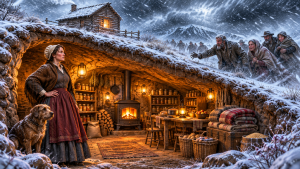
PART 1 — THE WOMAN WHO DUG INTO THE EARTH
The first time Miriam Bell carried her iron stove down into the hillside, three men stood beside the road and laughed as though she had dragged a coffin to her own funeral.
It was October of 1886, and the high Wyoming country had already begun to turn white. Snow powdered the sagebrush beyond Dry Creek, sealed the ruts left by wagon wheels, and lay in the folds of the distant mountains like flour in a baker’s apron. A small log cabin stood on Miriam’s claim above the creek, its single window casting a warm yellow square into the early dusk. Directly below it, she had cut a doorway into the face of a low hill.
Inside that opening waited a stone-vaulted room, its ceiling arched under six feet of packed earth and its walls lined with rock she had hauled herself.
Miriam was thirty-two years old, a widow, and the owner of precisely forty acres of ground that every sensible rancher considered nearly worthless. Her possessions consisted of the cabin, a stubborn brown dog named Bracken, a handcart, a few blankets, a stack of preserved fruit, and an iron stove whose weight seemed determined to break every bone in her back. She had traded her last good saddle for that stove at an auction in Laramie. Its legs were short, its door was scarred, and its chimney collar sat crooked from a careless fall. But it held heat longer than any stove she had ever owned, and heat was the one thing she could not afford to waste.
The men beside the road were town merchant Orrin Vale, ranch foreman Silas Cobb, and Deputy Frederick Pruitt.
They had come to collect a payment for winter feed Miriam had purchased in September. When they found her pushing the stove toward the dugout entrance, they forgot about the bill.
‘Planning to live like a badger, Mrs. Bell?’ Silas called.
‘Badgers have better sense than most men,’ Miriam answered, bracing her shoulder beneath the stove’s iron edge.
Orrin grinned. ‘That hole will turn into a grave when the thaw comes.’
‘Then I’ll build it not to.’
Pruitt stamped his boots and inspected the stone retaining wall beside the entrance. ‘Everybody’s talking about this project. A stove belongs in a house, not a hole in the ground.’
Miriam set down her burden and rubbed her aching hands. ‘You came for your money. I’ll have the balance after the first trapping run.’
‘Your account’s due before winter.’ Orrin’s grin disappeared.
‘I can be patient, but I’m not a charity.’
‘Neither am I.’
She gave them two silver coins and a handwritten tally. Pruitt read it with exaggerated care. He seemed disappointed to find every figure correct. The three men left laughing, and Miriam waited until their horses vanished behind the sage before trying to move the stove again.
Bracken padded close to her, his heavy fur dusted white. He gave a soft, questioning whine.
‘Yes,’ she told him, ‘I heard them. We have work to do anyway.’
The stove had belonged to a family whose children died of fever the previous spring. Miriam thought of that every time she touched the cold iron. She was not afraid of ghosts, but she was afraid of wasted chances. A woman could die in a perfectly respectable house if she believed the boards over her head were enough to protect her.
She had learned that in the winter that took her husband.
Thomas Bell had been a quiet carpenter, more skilled with a measuring line than with a compliment. Four years earlier, he had built their cabin on the ridge and said it would be plenty for two people. By February, a blizzard had ripped away half the roof. Thomas climbed up to secure the loose rafters while Miriam kept the fire alive below. A gust threw him against the chimney. His leg broke. He came down breathing hard and insisting that he would be fine by morning. The following week, infection took him, and Miriam was left alone with a house that leaked wind through the joints.
She had not forgotten his last clear words: ‘Don’t let my stubbornness become yours.’
For two winters afterward she did just that, staying inside the cabin because it had been theirs and because the neighbors called it sound.
She stuffed rags into cracks, burned precious wood through nights longer than she believed possible, and woke to frost inside her blankets. When the third winter ended, she decided loyalty to Thomas did not require repeating his mistakes.
She began to study how the land kept itself alive. Snow fell onto rabbit burrows without filling them. The ground beneath a deep drift stayed softer than the exposed ridge. A spring tucked into a bank kept moving long after the creek surface froze. One afternoon she knelt in the shadow of a cutbank and pressed her palm to the earth. It was cold, but not as cold as the air. She remembered something her father had told her when she was a girl in Ohio: the earth was a slow keeper of warmth, never generous, never entirely empty.
Her father, Samuel Quinn, had been a railroad mason.
He built culverts and stone cellars, and sometimes took his daughter along to carry tools. Miriam remembered his rule for arches: ‘The stones must lean on one another. Never ask a single stone to do the work of a wall.’ She remembered his other rule, too: keep the ground water out before you think about keeping the weather out.
The idea of a sheltered room grew from those memories. She would not simply excavate a cave and trust that it remained standing. She would cut a trench below the hill, make a thick stone vault with timber centering, cover it in packed earth, and leave a downhill drain where meltwater could escape. She would keep a little air moving near the floor and a chimney clear above the snowline. If the work succeeded, the earth itself would blunt the worst extremes of winter.
If she made a mistake, the hill would remind her without mercy.
For six months she worked at dawn and after her sewing jobs in town. She dug with a short spade because the long shovel kept striking the bank. She moved soil with baskets, fitted fieldstones with a hammer, and set the arch on a temporary timber form she had salvaged from Thomas’s woodpile. A traveler named Ezra Pike, once a miner, showed her how to build a safe chimney thimble where the pipe passed near timber. In payment, Miriam mended his winter coat and fed his tired horse.
She did not pretend she had invented underground houses. Travelers, Indigenous communities, homesteaders, and miners had used earth-sheltered structures in different ways for generations. Her own design borrowed from old root cellars and the stonework she had seen as a child. The achievement was not novelty.
It was fitting old knowledge to one hard patch of Wyoming ground.
By October, the main room stood completed. From outside it looked like a lamp-lit opening beneath a snow-dusted bluff. Inside, the stone walls shone amber under lantern light. A small wooden table stood near the stove position, shelves held brown jars and yellow pickles, and thick quilts rested on a chest beside a neatly made cot. Firewood filled a dry niche to the right. The old cabin remained above as a workshop and weather lookout, but she intended to sleep down below once the first serious storm arrived.
Her work had attracted every opinion in Dry Creek except curiosity. Some said she was mad with grief. Others said she was secretly hunting gold. Children who dared one another to peek through her doorway came away insisting that she lived like a queen beneath the hill.
Miriam did not mind the children. They were at least trying to see what was there.
At sundown, a wagon rattled up the track carrying fourteen-year-old Nora Whitlock and her younger brother, Caleb. Their mother had sent a basket of potatoes and asked whether Miriam needed another pair of hands. The Whitlocks rented a small place downstream. Their father had died the previous winter, and Nora understood more than most grown people about the distance between needing help and accepting it.
‘We heard your stove won’t fit,’ Nora said.
‘It’ll fit,’ Miriam replied. ‘I haven’t convinced it yet.’
Caleb, nine years old and all elbows, inspected the handcart. ‘Could use planks as a ramp.’
‘I have planks. I need someone to keep them from walking out under the wheels.’
They worked together in the fading light, bracing the boards with stones, easing the stove forward a finger’s breadth at a time.
When its feet finally touched the prepared flagstones, Miriam let out a laugh so sudden that Caleb laughed too. Nora wiped her face on her sleeve and asked if the stove truly would make the room warm.
‘It’ll make it warm if I feed it,’ Miriam said. ‘The hill will help keep it that way.’
‘Is that why the ceiling is round?’
‘Yes. The arch carries the weight into the sides. A flat roof would need more timber than I can afford.’
Nora stepped inside and studied the carefully mortared stones. ‘My mother says people think you are hiding from the world.’
‘The world has a way of finding people, even when they are hidden.’ Miriam shook soot from the pipe. ‘But there’s a difference between hiding and preparing.’
She sent the children home with bread, then lit the first small fire in the iron stove.
A curl of smoke drifted through the pipe and out above the slope. She checked every joint with a lantern, then stepped outside to see the chimney drawing cleanly. The cabin on the crest stood dark and wind-struck; the underground room glowed like a small promise.
For the first time since Thomas died, Miriam sat down without feeling she needed to keep moving to stay alive.
That peace lasted until the following morning.
She woke to Bracken growling at the doorway. A folded notice had been pinned to the rough gate by a nail, and the horse tracks leading away were unmistakable. On the page, county surveyor Daniel Rusk declared that Miriam’s excavated room constituted an unlawful alteration to the drainage corridor serving Vale Creek Ranch. She had ten days to remove the structure or face a hearing that could put her claim in jeopardy.
Miriam read it twice.
A drainage corridor? There was no surface channel through the hillside. It was one of the reasons she had chosen it. She turned the page and found a small map with a blue line drawn straight through the room she’d just finished.
At the bottom stood an initial: O. V.
Orrin Vale, the merchant who owned the only big feed store in town, had also begun buying land along the creek. Miriam knew he wanted a route from his pasture to the new road. What she did not know was why he had decided he needed her hill to secure it.
She folded the paper, placed it in her apron pocket, and looked toward the log cabin above. Thomas had left her a locked tin box under the floorboards.
He had told her it contained their land papers, and she’d never opened it because the memory of his trembling hands made her turn away.
Now she climbed to the cabin and lifted the loose board by the hearth.
The box was still there. So was the key, tied on a string beneath it. Inside she found the original homestead filing, Thomas’s survey notes, and a letter bearing a seal from a man named Henry Aldridge. The letter was dated four months before Thomas died. Its first sentence was ordinary enough: ‘Mr. Bell, I have reviewed the old county plat you sent me.’
Its last sentence was not.
‘Tell Mrs. Bell that the hillside is more important than anyone in Dry Creek understands, and she must never let Orrin Vale persuade her otherwise.’
Miriam sat beside the cold cabin hearth as snow blew against the door.
She had spent half a year building the safest room she knew how to build. Without realizing it, she had chosen the one place in the valley that someone else had been waiting to take.
She took the letter and went to see the surveyor.
Daniel Rusk lived behind the land office in a narrow house with more books than furniture. He was forty, near-sighted, and chronically short of coal. He looked unhappy when Miriam laid the notice on his desk.
‘You signed this,’ she said.
‘I did.’
‘Did you walk the site?’
‘Not yet.’
‘Then how do you know the drainage line runs through it?’
Rusk cleared his throat. ‘Mr. Vale brought a copy of a road survey.’
‘And you accepted his copy?’
‘It bears the county seal.’
Miriam placed Thomas’s old plat beside it. The maps disagreed.
A seasonal drainage channel on Thomas’s paper curved well south of the hill, following the low ground to a shallow gulch. On Vale’s copy, the channel was drawn uphill, improbably crossing a rocky rise, then returning downhill on the opposite side.
‘Water can be stubborn,’ Miriam said, ‘but I’ve never seen it run uphill because a merchant wanted it to.’
Rusk studied both documents for a long moment. ‘I’ll come tomorrow.’
‘Please bring someone who isn’t paid by Orrin Vale.’
‘I’m paid by the county.’
‘That is what worries me.’
He flushed, then nodded. The remark had landed exactly where she intended.
Outside, the sky flattened to a pale iron color. At the blacksmith shop, men were discussing the winter forecast. A freight driver from Fort Laramie claimed a storm had shut down travel farther north. A rancher said a wild autumn meant nothing.
Orrin Vale leaned against the doorway and watched Miriam cross the street.
‘I’ve heard your hole is under investigation,’ he called.
‘I’ve heard your map doesn’t know which way water flows.’
The blacksmith snorted into his sleeve. Orrin’s face tightened. ‘A widow can’t fight the county forever.’
‘Perhaps not. But she can ask the county to read.’
Miriam walked on before he could reply. She wanted the last word, but she wanted something else more: information. Henry Aldridge had been an engineer who worked on the old territorial road. She would need to find out whether he was alive, and why his warning had been buried with her husband’s unfinished plans.
On her way out of town, she stopped at the Whitlocks’. Mrs. Whitlock, a thin woman named Ada with flour on her sleeves, invited her in for tea. The little house felt colder than the weather outside.
Its stove smoked, the roof had a soft patch above the pantry, and Nora had rolled old newspapers against the door.
Ada listened while Miriam described the notice. ‘Orrin is buying everything he can,’ she said. ‘He offered to take our lease, too. Said we could rent the house from him afterward.’
‘Was that supposed to be a kindness?’
‘He made it sound like one.’
Miriam watched Caleb blow warmth into his hands. She knew the Whitlocks had barely enough fuel to last December. She also knew her own stores were measured for one person, not four. The thought made her stomach tighten.
‘If the cold gets worse,’ she said, ‘come up to my hill.’
Ada shook her head. ‘We couldn’t impose.’
‘I’m not asking you to move in tomorrow. I’m asking you not to wait until someone gets frostbite.’
Ada looked at the children’s red hands.
‘I’ll remember.’
As Miriam headed home, a flock of geese passed overhead, lower than she’d ever seen them travel. Bracken, riding in the back of her cart, lifted his head and watched until they disappeared.
By nightfall the temperature had fallen another twelve degrees. Miriam kept a modest fire burning, checked the chimney draft, and set a shallow basin near the drain trench to make sure no water was seeping in. The earth around her remained still. Her lantern flame scarcely trembled.
She lay beneath a wool quilt and thought about the letter. Thomas had known something about the hill and had kept it secret, perhaps to protect her, perhaps because he had run out of time. She wanted to be angry with him. Instead she found herself whispering into the darkness, ‘I could have used a little more honesty, Tom.’
Bracken laid his heavy head against her boot.
Far away, wind gathered in the mountains. It had a low sound, like a freight train beyond the curve of the earth.
The next morning Rusk arrived with a measuring chain, a notebook, and Sheriff Alice Monroe, who wore a long wool coat and possessed a reputation for taking neither bribes nor unnecessary foolishness. Alice was fifty-one, formerly a ranch hand and a widow herself. She walked the slope once, then crouched beside the stone drain Miriam had built.
‘Where does this go?’
‘To the gulch south of the cottonwoods,’ Miriam replied. ‘Downhill all the way.’
Rusk followed the channel with his eyes. ‘The line on Vale’s map is wrong,’ he said finally.
‘Wrong like a mistake?’ Alice asked. ‘Or wrong like a lie?’
‘I can’t say yet.’
Alice turned to Miriam. ‘You have until the hearing. Nobody is touching this place before then.’
‘And after the hearing?’
‘Bring your papers and speak plainly.’
Miriam almost laughed. Speaking plainly had never been the part she struggled with.
Before leaving, Alice took a long look inside the stone chamber. She tested the heavy door, checked the stove pipe, and felt the temperature difference against her cheek.
‘You built this on your own?’
‘With a little help.’
‘It’s sounder than half the sheds in town.’
‘Tell them that when they start laughing.’
Alice’s mouth twitched. ‘They might stop laughing on their own.’
By evening, the first serious blizzard warning reached Dry Creek. The telegraph operator had received word of exceptional cold across the northern plains, a train delayed by drifts, and livestock already dying in exposed pastures. Nobody knew how long the weather would last.
The forecast made the coming storm sound like a single event; in the mountains, every rancher knew a storm could become a season.
Miriam took a lantern and walked the perimeter of her shelter. She packed fresh straw behind the entrance door, tied wire around the chimney cap, and checked the raised vent. She had built for cold, not certainty. She understood that a vent could ice shut, a drain could clog, and an underground room could become dangerous if its stove smoked or the air failed to move. The best protection was never a clever building alone. It was the habit of checking the things that could kill you quietly.
When she returned inside, someone was waiting by the gate: Nora Whitlock, cheeks pink with wind, clutching a parcel wrapped in cloth.
‘Mother made extra bread,’ she said. ‘And she wants to know something.’
‘What is it?’
Nora hesitated.
‘If the creek freezes clear to the bed and the roads disappear, would you really let us stay?’
Miriam looked at the girl, then at the warm arch beyond her shoulder. ‘I didn’t build all this room just to hear my own footsteps.’
Nora smiled, but her eyes filled unexpectedly.
‘And Nora,’ Miriam added, ‘bring your mother’s kettle if you come. Mine isn’t big enough for all of us.’
The girl laughed, pulled her shawl tight, and ran back down the path.
That night the wind struck the ridge with a strength Miriam had never heard in October. The cabin above creaked and took the blows. Below the earth, the stone room held quiet. She fed one short length of wood into the stove and watched it settle into embers.
The people of Dry Creek could call her frightened, foolish, or a mole in a hole. The cold had no opinions. It would test only what she had made.
And on a hillside outside town, beneath a roof of earth and rock, Miriam Bell waited for the test.
PART 2 — WHAT THE WINTER TOOK
The blizzard announced itself by stealing the view.
By dawn the distant hills had disappeared behind a white wall, and the little log cabin above Miriam’s underground room looked as though someone were rubbing it away with a rough cloth. Wind drove powder beneath the eaves. It piled snow against the front door, then scraped the ridge bare, then piled it again. Miriam pulled on her coat and crossed to the shed with Bracken at her heel, carrying a shovel, a coil of rope, and a lantern whose flame struggled in its glass.
She did not intend to prove courage by staying outside. She intended to secure the things she would need when she could no longer go outside at all. She tied the outdoor wood rack to its posts, moved the remaining dry kindling into the sheltered alcove, and cleared the chimney outlet.
Inside the cabin she closed the shutters and wrapped a piece of old blanket around the water pitcher so it would not burst when the room froze. She took Thomas’s papers down to the vault, wrapped them in oilcloth, and placed them above floor level on the shelf nearest her cot.
By noon the stove’s small flame had warmed the room enough that she could work without her coat. The ceiling held steady. The vent admitted a thread of fresh air. No dampness appeared at the drain. She set three small stones on the table as reminders: chimney, water, doorway. Each time she rose, she checked one of them. It was an odd game for a grown woman to invent, but grief had taught her the difference between worrying in circles and doing something useful.
At two o’clock, Bracken barked so fiercely that Miriam reached for the fire poker.
Someone knocked at the outer door, three quick blows followed by a desperate scraping sound. She lifted the latch and found Nora Whitlock pushing her mother through the entrance. Caleb stumbled behind with a flour sack of clothes slung over one shoulder.
Ada’s lips were blue. Snow clung to the scarf wrapped over her mouth. ‘We tried to stay,’ she whispered. ‘The stove pipe fell. The smoke came back into the room.’
Miriam helped her toward the chair. ‘Coats off slowly. Not too close to the stove.’
Nora’s eyebrows had turned white with frost. Caleb stared at the glowing iron as though it belonged to another world. Miriam warmed water, made weak tea, and found spare dry socks. She resisted the urge to crowd them against the heat; she remembered what her father said about warming frozen hands gently and never rubbing skin that had lost feeling.
Once they could speak clearly, Ada described their final hour at home.
The wind had shoved snow through a gap beside the stove pipe, and when they tried to repair it, the brittle bracket tore free. Smoke filled the kitchen. A neighbor’s roof sailed through the air and landed in their garden. They tied themselves together with a clothesline, followed the fence posts, and climbed to Miriam’s hill in a white darkness that made the familiar path feel like a wilderness.
‘What if you’d said no?’ Caleb asked.
‘Then I’d have had to answer to Bracken,’ Miriam said, and the boy managed a thin smile.
She gave them soup thickened with barley. They ate in silence until the trembling stopped. Ada touched the stone wall with one hand. ‘I understand now,’ she murmured.
‘What?’
‘Why you kept digging after everybody laughed.’
Miriam set down her spoon. ‘I was afraid, Ada. I won’t pretend otherwise.
I didn’t want another winter to surprise me.’
Ada looked at the children sleeping beneath one quilt. ‘You were afraid of the right things.’
That evening the door shook under a new series of blows. Sheriff Alice Monroe arrived bent nearly double beneath the wind, carrying a canvas satchel. Her mustache of frozen breath melted as she stepped inside. ‘Three families in the low quarter have lost roofs,’ she said. ‘Rusk’s office is abandoned. The county telegraph is dead.’
‘Is anybody missing?’
‘Two freight hands. Maybe more. Vale says his storehouse is solid, but he’s charging double for coal already.’
‘Of course he is.’
Alice pulled off her gloves and looked at the Whitlocks. ‘I thought you might come here. I’m glad you did.’
‘Is the hearing canceled?’ Miriam asked.
‘Everything’s canceled except getting through tonight.’
Alice took a little tea, then rose to leave.
Miriam caught her sleeve. ‘You cannot go out into that without a rope.’
‘I know the track.’
‘You knew it before the snow erased it.’
The sheriff stared at the door. At last she let Miriam tie a bright strip of cloth to her lantern and take a length of braided line from the wall. Miriam secured one end to an iron eye she had mortared beside the entrance. Alice agreed to follow it back in a straight line before taking the lower path where the fence posts began. It was not safe, but it was safer than guessing.
‘You’ll need more wood,’ Alice observed.
‘I have some in the dry niche and more under tarps. I planned for one, not four.’
‘We’ll bring what we can when the wind drops.’
She had almost reached the door when she turned. ‘Orrin was asking about your land papers this morning.
Strange thing to worry about when men are freezing.’
‘Not strange if a man thinks the storm will do his work for him.’
Alice’s expression darkened. ‘Keep the papers dry. And keep the door barred.’
For two days the storm gave them little rest. Miriam kept careful notes in a ledger: one basket of wood each day, then less; half a pail of water melted from clean snow, then another; three meals from stores, measured in handfuls rather than wishes. Nora helped prepare food. Caleb learned to brush ice from the vent opening without blocking it. Ada sewed a second draft curtain from old sacks and worried over the seam until Miriam assured her that the uneven stitches mattered less than the extra cloth.
At night Miriam read to the children by lamplight. She owned a battered edition of The Swiss Family Robinson and a slim book of poems once given to Thomas.
Caleb wanted stories about storms and wolves; Nora wanted to know how the people survived afterward. Miriam read both kinds, stopping whenever the wind sounded too close.
On the third morning the weather briefly cleared. Dry Creek lay almost unrecognizable below, its roads transformed into slopes and troughs of snow. Smoke rose from only a few chimneys. Miriam stood beside the hill and listened. The silence was what frightened her most. There were no horses, no wagon wheels, no barking dogs from town. The world seemed to have learned how to hold its breath.
Alice came at noon with Dr. Elias Reed, a stooped physician whose beard had frozen into points. They brought two men from the freight road, both alive, one with a badly injured ankle.
Miriam gave them the sheltered floor nearest the stove, though she knew that made six adults and two children sharing a room intended for far fewer.
The injured man was Franklin Moss, a driver of thirty who had been stranded with his partner when the wagon overturned. Franklin could still joke, but his partner, Jasper Leach, spoke little and watched the door as though it might vanish. Dr. Reed splinted the ankle with narrow pieces of wood and urged rest. He examined everyone for signs of frostbite, then praised the space for being warm and dry while warning that overcrowding made ventilation still more important.
‘You’ve thought of smoke?’ he asked Miriam.
‘Every hour.’
‘Good. The roof may be stone, but the stove can still kill you if the pipe stops drawing.’
She had learned that lesson from Ada’s house.
It was one of the reasons she refused to seal the room entirely, no matter how cold the fresh air felt near the floor.
The doctor stayed only long enough to eat. He was needed at the schoolhouse, where refugees slept on desks and benches. Miriam gave him a small jar of honey and sent Bracken to walk with him as far as the old gate. The dog returned half an hour later, shaking snow from his coat as though furious at the entire season.
The next clear interval brought another visitor. Daniel Rusk arrived with his hat tied under his chin and a parcel of papers held against his chest. He had been searching the county records before the storm, he explained, and had found something that made him doubt the drainage notice even more.
The old territorial survey showed not just the creek’s natural course but also an easement that allowed residents to use a path along the ridge to reach a sheltered spring in the southern gulch.
‘An easement?’ Miriam asked.
‘A right of passage. The territory recorded it when the first homesteads were laid out. It was meant to keep the upper farms from being cut off during floods.’
‘And Vale’s proposed road?’
‘Would cross the path and redirect runoff toward your claim. He needs your hillside because the land below is unstable.’
Miriam spread Thomas’s map beside Rusk’s. The marks lined up. She saw the old path through a gap in the cottonwoods, then the land Vale wanted to cut into a wagon grade. His survey moved the drainage line to make Miriam appear responsible for an obstruction that didn’t exist.
It also erased the public right of passage.
‘Who owns the original?’ she asked.
‘The territorial archive in Cheyenne, if it survived the move. I have a copy in the county book, but Vale’s lawyer will say the copy isn’t complete.’
‘Henry Aldridge knew,’ Miriam said.
Rusk frowned. ‘Aldridge? The engineer?’
‘Thomas wrote to him. He warned us about the hill.’
Rusk hesitated before speaking again. ‘There was a rumor Aldridge had measurements of a spring that never froze. The cattle companies wanted it. Nobody could agree where it emerged.’
The thought struck Miriam. The sheltered spring she had observed years earlier flowed even when Dry Creek froze. Could Vale be seeking more than a road? Her property sat between the ridge route and a buried seam of water. A man with a herd and little mercy could turn that knowledge into power.
She asked Rusk to leave copies of everything.
He did, then surprised her by admitting he had originally approved the notice because Orrin promised to repair the land office chimney. He had not taken cash, he said, but a favor could bend judgment as surely as money.
‘I was wrong,’ Rusk said. ‘I want to make it right.’
Miriam studied him. ‘Then don’t apologize to me until you’ve corrected the record.’
‘I will.’
‘And take a meal before you go. A righteous man can still freeze.’
Rusk looked relieved enough to laugh.
As the storm returned, they heard distant gunshots. Three sharp reports, separated by long pauses, came from the direction of Vale’s ranch. Alice had told townspeople to fire a signal if someone needed help. Miriam stood at the entrance, listening hard. Another report sounded. Then nothing.
Franklin Moss tried to rise despite his injured ankle. ‘Somebody ought to go.’
‘You ought to stay put,’ Miriam told him.
‘I can still carry a rope.’
‘You can carry it when you can walk.’
She went outside with Rusk, Bracken, and a narrow sled loaded with blankets and rope. They kept to the sheltered hollows, moving in short stages, marking each turn with strips of cloth tied to brush. In a drainage cut halfway to Vale’s ranch they found a woman and a boy huddled behind an overturned wagon. The woman was Rebecca Finch, cook at Vale’s place. The child, seven-year-old Owen Vale, was Orrin’s grandson.
Owen’s boots were full of snow. Rebecca had wrapped her own coat around him and could barely move her fingers. Their driver had gone for help hours earlier and not returned. Miriam crouched beside them and spoke slowly, keeping her voice level. She gave Owen the dry mittens she’d brought, tucked the blanket tight, and helped Rebecca stand between herself and Rusk.
Bracken nosed the boy’s knee until he gave a faint laugh.
The return took twice as long. Owen cried once, then grew quiet. Miriam was more frightened of his silence than of his tears. She stopped beneath a cliff, checked his face and hands, and made him answer silly questions about the dog’s name. When at last they reached the hill, Nora opened the door before Miriam knocked.
Heat moved over them like a physical thing. The boy stood in the entrance and stared at the lanterns, shelves, and stove. ‘Is this a cave?’
‘Partly,’ Miriam answered. ‘Mostly it’s a room that doesn’t let the wind vote.’
Ada laughed with relief as she pulled dry stockings from the chest. Dr. Reed returned that evening and examined Rebecca and Owen. Their condition was serious enough that he stayed with them through the night.
The underground room was now crowded beyond comfort, but nobody suggested sending anyone back into the storm.
The following afternoon Orrin Vale arrived, accompanied by Deputy Pruitt and two ranch hands. He burst into the entrance with his face drawn by worry. When Owen saw him, he leaped from the cot and ran into his arms. Orrin held the boy so tightly that for a moment Miriam saw no merchant, no adversary, only a grandfather terrified by the thought of loss.
Then he looked around the room, counted the refugees, and recovered his old manner.
‘You’ve collected half the town down here,’ he said.
‘More than I planned,’ Miriam replied.
Owen tugged his sleeve. ‘Mrs. Bell found me. She gave me her mittens.’
Orrin’s jaw tightened. ‘I am grateful, of course.’
‘You can help by bringing food and coal,’ Miriam said.
‘The shelter has room for bodies, but the pantry was not built for nine.’
Orrin glanced toward the shelves. ‘I don’t run my business by handing out stock.’
‘Your grandson ate the last of my oatcakes.’
Owen looked down, mortified. Miriam gently touched his shoulder. ‘You did right to eat them.’
The room fell silent. Alice, who had arrived moments before, stood by the door with snow melting from her hat. She heard enough.
‘Orrin,’ she said, ‘if your storehouse can spare supplies for a winter sale, it can spare a wagon for people who saved your family.’
‘You cannot order that.’
‘I am not ordering it. I’m asking you to decide how you wish your neighbors to remember this storm.’
Orrin opened his mouth, closed it, and looked down at Owen. ‘I’ll send what I can.’
He left shortly afterward with the boy, and his ranch hands carried Rebecca to a sheltered wagon.
By twilight, a mule team arrived bearing sacks of flour, two tins of lard, a crate of dried beans, and a small load of fuel. The donation was not generous by Orrin’s standards. It was enough to keep the stove fed for another week.
That night Miriam discovered a note folded between the sacks. It was written in a cramped hand she recognized from the original notice.
Your husband’s map will not save you. The spring belongs to the man who can hold it. Sell now, before the next storm buries your evidence.
There was no signature. Miriam did not need one.
She showed the note to Alice, who read it twice and tucked it into her coat. ‘Now we have a threat in writing.’
‘He won’t stop,’ Miriam said.
‘Neither will I.’
Alice examined the door, then the chimney.
‘He may not be foolish enough to come here with a gun, but desperate men find other ways to hurt people.’
Miriam checked the chimney cap again. ‘Then we keep watching.’
Near midnight Bracken began to growl. The sound came from the darkest corner beside the door, where he lay with his ears flat. Miriam rose quietly, felt the wall for her lantern, and heard footsteps crunch outside. A scraping sound came from above the entrance. Someone was touching the chimney support.
She shouted, ‘Who’s there?’
The footsteps ran. She opened the door in time to glimpse a lantern bobbing away toward the sagebrush. On the roof above the vent lay a coil of wet canvas, held down by two stones. Had it been pulled farther across, it could have blocked the exhaust and filled the chamber with deadly fumes.
Miriam dragged it aside while Alice and Rusk came running from the room.
They found bootprints leading toward the road, one heel missing a nail. Deputy Pruitt’s boots had been repaired last month at the blacksmith shop. Miriam had noticed the broken nail when he first mocked her stove.
She stared at the prints, feeling cold in a way the wind could not explain. Someone had tried to turn her sanctuary into a trap.
Alice knelt beside the canvas. ‘I know these boots,’ she said quietly.
Below them, in the warm chamber, children slept beside a stove that might have killed them all if Bracken had not heard the scraping.
The storm had not finished testing Miriam Bell. The men who wanted her hill had only begun.
PART 3 — THE ROAD BENEATH THE SNOW
Alice Monroe did not arrest Frederick Pruitt the next morning. The deputy had already vanished.
His horse was gone from the livery, his room behind the jail stood empty, and the stable boy said he had ridden south before dawn. Alice took the wet canvas, the threat, and a careful drawing of the bootprints as evidence. She sent a rider toward the next settlement as soon as the road cleared enough for a horse, but she did not fool herself. A man who knew every gully in the district could disappear for weeks among the ranch outbuildings.
Miriam watched her pack the evidence. ‘Do you think Orrin ordered it?’
‘I think Pruitt has been doing Orrin’s bidding for years. Whether the merchant asked him to poison a roomful of people is a question I intend to put to him.’
‘And if he’s out of reach?’
‘Then we start with the truth we can prove.’
Rusk spent the following hours comparing Thomas’s survey with the county’s oldest boundary records. He discovered a reference to a stone marker near the spring, placed there during the territorial road survey nearly twenty years before. If the marker remained, it would establish the correct position of the public passage and contradict Vale’s map. But it lay beyond the southern gulch, where snow had hidden the ground and the frost could split stone from stone.
Miriam remembered a line in Henry Aldridge’s letter: ‘The four stones above the water remember what the ink forgets.’ She had dismissed it as a mason’s flourish. Now she understood it might be a direction.
She went up to the cabin and searched the tin box again. Beneath Thomas’s account book was a smaller folded page she had overlooked.
It contained his drawing of the hillside, the spring, and four flat stones set in a crooked diamond. Beside them he had written: KEEP THE PASSAGE OPEN. At the bottom was an arrow pointing toward an old mine adit, long sealed by rockfall.
The drawing unsettled her. Why had Thomas taken such care with a place they rarely visited? She remembered him leaving the cabin with his tools during the summer before he died. He said he was helping a neighbor repair a retaining wall. Had the work been something else? Had he been trying to protect a public route from a powerful rancher who already wanted it closed?
Rusk recognized the mine. ‘The Silver Lantern prospect. Nobody found much there. The entrance collapsed after a flood.’
‘Was Aldridge involved?’
‘He surveyed it for the territorial office. That was before Vale bought the lower pastures.’
Miriam traced the four stones with a finger.
‘The marker may be above the mine, not beside the spring.’
Alice studied the weather through the doorway. The wind was easing, but the temperature remained brutal. ‘We’re not sending people on a treasure hunt for a boundary stone while there are families without fuel.’
‘It’s not treasure,’ Miriam replied. ‘It’s the path the families need to reach water if the creek freezes or the ranch fences them out.’
‘Which makes it important enough to find alive.’
Miriam conceded the point. She helped Nora inventory the supplies while Alice organized a daylight expedition to bring fuel from abandoned sheds and distribute food to houses the storm had spared. The work was slow and unglamorous. One person led the mule. Another broke a path. Someone carried a shovel for doors packed shut.
They marked safe routes with cloth and poles and kept count of who left and who returned.
A crisis did not become less serious because it was made of ordinary chores. By the fourth day of the effort, Miriam had heard of three barns collapsed, dozens of cattle lost, and the death of a man who had tried to walk home from the saloon after the first blizzard. His name was Peter Lansing. Miriam knew him only as a distant voice at church, but she wrote his name in her ledger because a season should not swallow people anonymously.
At night the Whitlocks shared the stone chamber while other refugees slept at the schoolhouse, the doctor’s surgery, and the church. Miriam made the room available by rotation. Families with damaged houses stayed until they were stable, then made space for the next.
Nobody could rely on the stove alone; they used blankets, hot meals, dry clothing, and the simple comfort of being seen. The chamber became a place for meals and planning as much as shelter.
One evening a young ranch hand named Isaac Ward came with a strange request. His employer, Orrin Vale, wanted to purchase Miriam’s entire claim immediately. The offer was six hundred dollars in cash, more than she had earned in several seasons. Isaac carried the paper in his glove as if it were hot.
‘He says he’ll also clear what you owe at the feed store,’ Isaac added.
‘Why is he suddenly offering so much?’
‘He says it’s for the road.’
‘And what do you think?’
Isaac stared into the stove. ‘I think nobody pays six hundred dollars for a road that can’t hold a wagon.’
Miriam took the paper without signing it.
‘Tell Orrin I need time to think.’
Isaac looked surprised. ‘You aren’t going to refuse outright?’
‘I’m going to make him wonder what I know.’
After he left, Alice read the terms. Hidden near the bottom was a clause assigning to Vale any mineral and water rights Miriam possessed, whether known or undiscovered. She pointed it out to Rusk. He nodded grimly.
‘There’s your answer,’ he said. ‘He isn’t buying dirt. He’s buying control.’
Miriam remembered the little spring that had stayed open through cold weather. A water source close to the new freight road could be worth more than ordinary pasture, especially if neighboring ranches depended on it. But she did not want the water for herself alone. Thomas had gone to trouble to preserve the old public path; she would not sell his effort to the man trying to erase it.
The next morning Isaac returned without a horse.
He stood beneath the arch rubbing his hands, his face pale under a crust of snow. Vale had dismissed him for carrying the offer too slowly and accusing the ranch of wasting supplies. The young man had nowhere else to go. Miriam gave him coffee and a stool.
‘He keeps a locked room below the grain loft,’ Isaac said, speaking so quietly that Nora had to lean forward to hear. ‘I’ve seen documents carried in and out. Mr. Pruitt went there after the storm started. He left with a sack and a lantern.’
‘Is Pruitt hiding there now?’ Alice asked.
‘I haven’t seen him, but there are tracks by the rear door after every snowfall.’
Alice rose at once. ‘I’ll take two people and visit the ranch.’
Miriam caught her arm.
‘Don’t go alone into a house whose owner thinks the law is another thing he can buy.’
The sheriff gave a tired smile. ‘That’s why I’m taking people.’
By afternoon Alice returned with a sealed tin case and a face like thunder. Orrin had claimed the case was his property, but inside were copies of old surveys, account ledgers, and a contract for a private pipeline from the spring to his cattle troughs. The line on the forged drainage map matched the proposed pipeline route. More damning still, Rusk found a letter instructing Pruitt to ‘discourage the widow’s excavation before she discovers the stone headwall.’ It was signed with Orrin’s full name.
Alice had not been able to arrest the merchant immediately. The evidence required review, and she refused to use the same loose methods he had used against Miriam.
But she posted an order preventing construction along the disputed path until a district hearing could be held, and she kept guards on the ranch office to ensure no one destroyed its contents.
The effect in Dry Creek was immediate. People who had once praised Vale for extending store credit began comparing the price of his coal with their own empty pockets. Some defended him, saying a merchant had a right to profit. Others remembered when the public spring was open to everyone and asked why a fence had appeared near it. By Sunday, the conflict was no longer a private quarrel over a widow’s hillside. It had become a question of who would control the valley’s water when the thaw came.
Miriam had little interest in being the heroine of a town dispute. She was exhausted.
Her back ached from hauling stone, her hands were cracked, and the crowded shelter held too many conversations for her to think. She missed the quiet mornings of the life she had tried to build, and she sometimes felt guilty for missing them. When she said so to Ada, her friend replied, ‘You may be grateful they’re alive and still wish they talked less.’
They laughed so hard Nora came over to ask what had happened.
‘Your mother has discovered wisdom,’ Miriam said.
‘About what?’
‘Keeping one’s mouth shut.’
Nora rolled her eyes. ‘Then she’s years too late.’
For several hours they almost forgot the winter.
On January 12, the temperature plunged again. A new storm moved down from the mountains with a dry violence that made exposed skin sting in seconds. Its arrival coincided with a shortage of fuel at the schoolhouse. The church had given away most of its coal.
Vale’s storehouse was still partly stocked, but wagons could not pass the western drift. Families began walking toward Miriam’s claim in small groups, guided by the tall chimney and the orange light from the doorway.
Miriam understood that her room could not hold them all. There was no dignity in inviting thirty people into a chamber that might run out of air. She and Alice decided to use the underground room as a warming station and the sturdy log cabin above as a supply depot. They opened the tool shed for dry storage. Men and women carried bundles of firewood from nearby stands of dead timber, taking only what they could move without exhausting themselves. Dr. Reed supervised those suffering from cold, and Ada organized food on the table by need rather than by who had brought it.
Then the schoolhouse roof collapsed.
The sound traveled across the frozen valley like a distant cannon.
A runner arrived breathless, reporting that twelve people had been inside when a beam gave way. Alice set out with every able volunteer. Miriam went too, despite Ada’s protest. They traveled with ropes and shovels, moving slowly because the wind hid the drop-offs beside the road.
They found the schoolhouse roof folded inward above the front room. A teacher named Agnes Porter had kept the children near the rear wall, away from the failure. Most escaped through a window, but two older residents and one child remained trapped beneath fallen planks. Miriam remembered the way Thomas had taught her to lift weight: never pull blindly; brace what can move before taking away what seems to hold it.
She and Isaac Ward built a temporary support from two fence posts and a broad plank. Alice crawled into the space and guided the trapped people toward the opening.
It took an hour. The youngest, a little girl named Rose, came out crying for a wool doll that had disappeared under the debris. Miriam promised they would look for it when it was safe. Rose nodded, still crying, and wrapped herself around Dr. Reed’s neck.
They brought the injured to the underground room in shifts. Its warmth steadied them while the doctor examined bruises and broken bones. One elderly man had a fractured wrist. The other had a cut above his eye. None died, though Miriam knew survival had depended on minutes and on a dozen small choices made without panic.
After dark, Rose found Miriam by the stove. ‘You promised my doll.’
‘I did.’
‘Will you forget?’
Miriam crouched so their eyes met. ‘Not if you remind me tomorrow.’
Rose considered this. ‘You’re a grown-up. Grown-ups forget.’
‘You’re right.
Let me write it down.’
Miriam took the ledger and wrote, in large letters, FIND ROSE’S DOLL. The girl examined the page solemnly, then went to sleep beneath Ada’s spare quilt.
The following day brought the coldest air anyone in Dry Creek remembered. The doctor’s outdoor thermometer, protected from direct wind, fell far below the numbers most residents expected to see. People talked of forty degrees below zero and worse, though Miriam knew the instruments were imperfect and the wind made every reading feel like an insult. Her own room remained above freezing without constant roaring fire, an advantage of its insulated roof and thick stone walls. It was not miraculous; it still required fuel, airflow, and care. But one moderate fire could maintain conditions that exposed cabins struggled to reach with twice the wood.
Rusk, shivering over his notes, said the hill was doing the work of another stove.
‘No,’ Miriam corrected. ‘It slows the work the stove has already done.’
‘Perhaps that is a better way to put it.’
‘It also means we can’t open the door every thirty seconds,’ Ada called from the table.
The room laughed. They had developed a habit of laughing at the things they could control.
A few hours before sunset, Bracken went to the entrance and whined. Miriam followed him outside into a brief break in the wind. Near the path stood an exhausted horse without a rider, its reins trailing in the snow. The animal wore Orrin Vale’s distinctive brass harness fittings.
Alice arrived and examined the tracks. They led toward the southern gulch, where the old public path crossed above the spring. In the fresh snow she saw a second set of hoofprints and the marks of a sled.
Someone had gone toward the spring during the coldest day of the winter.
Miriam looked at Thomas’s drawing. Four stones above the water. A disused mine. A hidden marker. It all lay in the same direction.
‘It’s Orrin,’ Isaac said. ‘He has been talking for weeks about securing the headwall before anyone else finds it.’
‘He’ll die out there,’ Ada said.
Miriam watched the empty horse breathe, its sides shuddering. Orrin had threatened her home. He may have sent the man who tried to block her chimney. He had profited from frightened families and denied the town a fair share of supplies. Yet the fact that he deserved consequences did not mean she wanted him frozen beside a spring he hoped to steal.
‘I know the way,’ she told Alice.
‘And I know the danger,’ Alice replied.
‘We go with ropes, two sleds, and people who can turn back.’
The sheriff hesitated, then nodded. ‘At dawn, if the wind lets us.’
They did not wait until dawn. Just after midnight a light flashed from the southern gulch, three times, then twice more. Someone was signaling for help.
Miriam stood in the entrance with the rope over her shoulder while Bracken paced beside her. Behind her, the underground room glowed gold. Ahead, the wind drove snow across a valley that had swallowed roads, fences, and almost every trace of human certainty.
‘You can stay,’ Alice told her. ‘Nobody would blame you.’
Miriam thought of Thomas on the cabin roof, insisting he could repair everything alone. She thought of the words he’d spoken before he died. Then she took Isaac’s offered hand and stepped onto the marked trail.
‘That isn’t the question,’ she said. ‘The question is whether we can bring him back.’
PART 2 — WHAT THE WINTER TOOK
The blizzard announced itself by stealing the view.
By dawn the distant hills had disappeared behind a white wall, and the little log cabin above Miriam’s underground room looked as though someone were rubbing it away with a rough cloth. Wind drove powder beneath the eaves. It piled snow against the front door, then scraped the ridge bare, then piled it again. Miriam pulled on her coat and crossed to the shed with Bracken at her heel, carrying a shovel, a coil of rope, and a lantern whose flame struggled in its glass.
She did not intend to prove courage by staying outside. She intended to secure the things she would need when she could no longer go outside at all. She tied the outdoor wood rack to its posts, moved the remaining dry kindling into the sheltered alcove, and cleared the chimney outlet.
Inside the cabin she closed the shutters and wrapped a piece of old blanket around the water pitcher so it would not burst when the room froze. She took Thomas’s papers down to the vault, wrapped them in oilcloth, and placed them above floor level on the shelf nearest her cot.
By noon the stove’s small flame had warmed the room enough that she could work without her coat. The ceiling held steady. The vent admitted a thread of fresh air. No dampness appeared at the drain. She set three small stones on the table as reminders: chimney, water, doorway. Each time she rose, she checked one of them. It was an odd game for a grown woman to invent, but grief had taught her the difference between worrying in circles and doing something useful.
At two o’clock, Bracken barked so fiercely that Miriam reached for the fire poker.
Someone knocked at the outer door, three quick blows followed by a desperate scraping sound. She lifted the latch and found Nora Whitlock pushing her mother through the entrance. Caleb stumbled behind with a flour sack of clothes slung over one shoulder.
Ada’s lips were blue. Snow clung to the scarf wrapped over her mouth. ‘We tried to stay,’ she whispered. ‘The stove pipe fell. The smoke came back into the room.’
Miriam helped her toward the chair. ‘Coats off slowly. Not too close to the stove.’
Nora’s eyebrows had turned white with frost. Caleb stared at the glowing iron as though it belonged to another world. Miriam warmed water, made weak tea, and found spare dry socks. She resisted the urge to crowd them against the heat; she remembered what her father said about warming frozen hands gently and never rubbing skin that had lost feeling.
Once they could speak clearly, Ada described their final hour at home.
The wind had shoved snow through a gap beside the stove pipe, and when they tried to repair it, the brittle bracket tore free. Smoke filled the kitchen. A neighbor’s roof sailed through the air and landed in their garden. They tied themselves together with a clothesline, followed the fence posts, and climbed to Miriam’s hill in a white darkness that made the familiar path feel like a wilderness.
‘What if you’d said no?’ Caleb asked.
‘Then I’d have had to answer to Bracken,’ Miriam said, and the boy managed a thin smile.
She gave them soup thickened with barley. They ate in silence until the trembling stopped. Ada touched the stone wall with one hand. ‘I understand now,’ she murmured.
‘What?’
‘Why you kept digging after everybody laughed.’
Miriam set down her spoon. ‘I was afraid, Ada. I won’t pretend otherwise.
I didn’t want another winter to surprise me.’
Ada looked at the children sleeping beneath one quilt. ‘You were afraid of the right things.’
That evening the door shook under a new series of blows. Sheriff Alice Monroe arrived bent nearly double beneath the wind, carrying a canvas satchel. Her mustache of frozen breath melted as she stepped inside. ‘Three families in the low quarter have lost roofs,’ she said. ‘Rusk’s office is abandoned. The county telegraph is dead.’
‘Is anybody missing?’
‘Two freight hands. Maybe more. Vale says his storehouse is solid, but he’s charging double for coal already.’
‘Of course he is.’
Alice pulled off her gloves and looked at the Whitlocks. ‘I thought you might come here. I’m glad you did.’
‘Is the hearing canceled?’ Miriam asked.
‘Everything’s canceled except getting through tonight.’
Alice took a little tea, then rose to leave.
Miriam caught her sleeve. ‘You cannot go out into that without a rope.’
‘I know the track.’
‘You knew it before the snow erased it.’
The sheriff stared at the door. At last she let Miriam tie a bright strip of cloth to her lantern and take a length of braided line from the wall. Miriam secured one end to an iron eye she had mortared beside the entrance. Alice agreed to follow it back in a straight line before taking the lower path where the fence posts began. It was not safe, but it was safer than guessing.
‘You’ll need more wood,’ Alice observed.
‘I have some in the dry niche and more under tarps. I planned for one, not four.’
‘We’ll bring what we can when the wind drops.’
She had almost reached the door when she turned. ‘Orrin was asking about your land papers this morning.
Strange thing to worry about when men are freezing.’
‘Not strange if a man thinks the storm will do his work for him.’
Alice’s expression darkened. ‘Keep the papers dry. And keep the door barred.’
For two days the storm gave them little rest. Miriam kept careful notes in a ledger: one basket of wood each day, then less; half a pail of water melted from clean snow, then another; three meals from stores, measured in handfuls rather than wishes. Nora helped prepare food. Caleb learned to brush ice from the vent opening without blocking it. Ada sewed a second draft curtain from old sacks and worried over the seam until Miriam assured her that the uneven stitches mattered less than the extra cloth.
At night Miriam read to the children by lamplight. She owned a battered edition of The Swiss Family Robinson and a slim book of poems once given to Thomas.
Caleb wanted stories about storms and wolves; Nora wanted to know how the people survived afterward. Miriam read both kinds, stopping whenever the wind sounded too close.
On the third morning the weather briefly cleared. Dry Creek lay almost unrecognizable below, its roads transformed into slopes and troughs of snow. Smoke rose from only a few chimneys. Miriam stood beside the hill and listened. The silence was what frightened her most. There were no horses, no wagon wheels, no barking dogs from town. The world seemed to have learned how to hold its breath.
Alice came at noon with Dr. Elias Reed, a stooped physician whose beard had frozen into points. They brought two men from the freight road, both alive, one with a badly injured ankle.
Miriam gave them the sheltered floor nearest the stove, though she knew that made six adults and two children sharing a room intended for far fewer.
The injured man was Franklin Moss, a driver of thirty who had been stranded with his partner when the wagon overturned. Franklin could still joke, but his partner, Jasper Leach, spoke little and watched the door as though it might vanish. Dr. Reed splinted the ankle with narrow pieces of wood and urged rest. He examined everyone for signs of frostbite, then praised the space for being warm and dry while warning that overcrowding made ventilation still more important.
‘You’ve thought of smoke?’ he asked Miriam.
‘Every hour.’
‘Good. The roof may be stone, but the stove can still kill you if the pipe stops drawing.’
She had learned that lesson from Ada’s house.
It was one of the reasons she refused to seal the room entirely, no matter how cold the fresh air felt near the floor.
The doctor stayed only long enough to eat. He was needed at the schoolhouse, where refugees slept on desks and benches. Miriam gave him a small jar of honey and sent Bracken to walk with him as far as the old gate. The dog returned half an hour later, shaking snow from his coat as though furious at the entire season.
The next clear interval brought another visitor. Daniel Rusk arrived with his hat tied under his chin and a parcel of papers held against his chest. He had been searching the county records before the storm, he explained, and had found something that made him doubt the drainage notice even more.
The old territorial survey showed not just the creek’s natural course but also an easement that allowed residents to use a path along the ridge to reach a sheltered spring in the southern gulch.
‘An easement?’ Miriam asked.
‘A right of passage. The territory recorded it when the first homesteads were laid out. It was meant to keep the upper farms from being cut off during floods.’
‘And Vale’s proposed road?’
‘Would cross the path and redirect runoff toward your claim. He needs your hillside because the land below is unstable.’
Miriam spread Thomas’s map beside Rusk’s. The marks lined up. She saw the old path through a gap in the cottonwoods, then the land Vale wanted to cut into a wagon grade. His survey moved the drainage line to make Miriam appear responsible for an obstruction that didn’t exist.
It also erased the public right of passage.
‘Who owns the original?’ she asked.
‘The territorial archive in Cheyenne, if it survived the move. I have a copy in the county book, but Vale’s lawyer will say the copy isn’t complete.’
‘Henry Aldridge knew,’ Miriam said.
Rusk frowned. ‘Aldridge? The engineer?’
‘Thomas wrote to him. He warned us about the hill.’
Rusk hesitated before speaking again. ‘There was a rumor Aldridge had measurements of a spring that never froze. The cattle companies wanted it. Nobody could agree where it emerged.’
The thought struck Miriam. The sheltered spring she had observed years earlier flowed even when Dry Creek froze. Could Vale be seeking more than a road? Her property sat between the ridge route and a buried seam of water. A man with a herd and little mercy could turn that knowledge into power.
She asked Rusk to leave copies of everything.
He did, then surprised her by admitting he had originally approved the notice because Orrin promised to repair the land office chimney. He had not taken cash, he said, but a favor could bend judgment as surely as money.
‘I was wrong,’ Rusk said. ‘I want to make it right.’
Miriam studied him. ‘Then don’t apologize to me until you’ve corrected the record.’
‘I will.’
‘And take a meal before you go. A righteous man can still freeze.’
Rusk looked relieved enough to laugh.
As the storm returned, they heard distant gunshots. Three sharp reports, separated by long pauses, came from the direction of Vale’s ranch. Alice had told townspeople to fire a signal if someone needed help. Miriam stood at the entrance, listening hard. Another report sounded. Then nothing.
Franklin Moss tried to rise despite his injured ankle. ‘Somebody ought to go.’
‘You ought to stay put,’ Miriam told him.
‘I can still carry a rope.’
‘You can carry it when you can walk.’
She went outside with Rusk, Bracken, and a narrow sled loaded with blankets and rope. They kept to the sheltered hollows, moving in short stages, marking each turn with strips of cloth tied to brush. In a drainage cut halfway to Vale’s ranch they found a woman and a boy huddled behind an overturned wagon. The woman was Rebecca Finch, cook at Vale’s place. The child, seven-year-old Owen Vale, was Orrin’s grandson.
Owen’s boots were full of snow. Rebecca had wrapped her own coat around him and could barely move her fingers. Their driver had gone for help hours earlier and not returned. Miriam crouched beside them and spoke slowly, keeping her voice level. She gave Owen the dry mittens she’d brought, tucked the blanket tight, and helped Rebecca stand between herself and Rusk.
Bracken nosed the boy’s knee until he gave a faint laugh.
The return took twice as long. Owen cried once, then grew quiet. Miriam was more frightened of his silence than of his tears. She stopped beneath a cliff, checked his face and hands, and made him answer silly questions about the dog’s name. When at last they reached the hill, Nora opened the door before Miriam knocked.
Heat moved over them like a physical thing. The boy stood in the entrance and stared at the lanterns, shelves, and stove. ‘Is this a cave?’
‘Partly,’ Miriam answered. ‘Mostly it’s a room that doesn’t let the wind vote.’
Ada laughed with relief as she pulled dry stockings from the chest. Dr. Reed returned that evening and examined Rebecca and Owen. Their condition was serious enough that he stayed with them through the night.
The underground room was now crowded beyond comfort, but nobody suggested sending anyone back into the storm.
The following afternoon Orrin Vale arrived, accompanied by Deputy Pruitt and two ranch hands. He burst into the entrance with his face drawn by worry. When Owen saw him, he leaped from the cot and ran into his arms. Orrin held the boy so tightly that for a moment Miriam saw no merchant, no adversary, only a grandfather terrified by the thought of loss.
Then he looked around the room, counted the refugees, and recovered his old manner.
‘You’ve collected half the town down here,’ he said.
‘More than I planned,’ Miriam replied.
Owen tugged his sleeve. ‘Mrs. Bell found me. She gave me her mittens.’
Orrin’s jaw tightened. ‘I am grateful, of course.’
‘You can help by bringing food and coal,’ Miriam said.
‘The shelter has room for bodies, but the pantry was not built for nine.’
Orrin glanced toward the shelves. ‘I don’t run my business by handing out stock.’
‘Your grandson ate the last of my oatcakes.’
Owen looked down, mortified. Miriam gently touched his shoulder. ‘You did right to eat them.’
The room fell silent. Alice, who had arrived moments before, stood by the door with snow melting from her hat. She heard enough.
‘Orrin,’ she said, ‘if your storehouse can spare supplies for a winter sale, it can spare a wagon for people who saved your family.’
‘You cannot order that.’
‘I am not ordering it. I’m asking you to decide how you wish your neighbors to remember this storm.’
Orrin opened his mouth, closed it, and looked down at Owen. ‘I’ll send what I can.’
He left shortly afterward with the boy, and his ranch hands carried Rebecca to a sheltered wagon.
By twilight, a mule team arrived bearing sacks of flour, two tins of lard, a crate of dried beans, and a small load of fuel. The donation was not generous by Orrin’s standards. It was enough to keep the stove fed for another week.
That night Miriam discovered a note folded between the sacks. It was written in a cramped hand she recognized from the original notice.
Your husband’s map will not save you. The spring belongs to the man who can hold it. Sell now, before the next storm buries your evidence.
There was no signature. Miriam did not need one.
She showed the note to Alice, who read it twice and tucked it into her coat. ‘Now we have a threat in writing.’
‘He won’t stop,’ Miriam said.
‘Neither will I.’
Alice examined the door, then the chimney.
‘He may not be foolish enough to come here with a gun, but desperate men find other ways to hurt people.’
Miriam checked the chimney cap again. ‘Then we keep watching.’
Near midnight Bracken began to growl. The sound came from the darkest corner beside the door, where he lay with his ears flat. Miriam rose quietly, felt the wall for her lantern, and heard footsteps crunch outside. A scraping sound came from above the entrance. Someone was touching the chimney support.
She shouted, ‘Who’s there?’
The footsteps ran. She opened the door in time to glimpse a lantern bobbing away toward the sagebrush. On the roof above the vent lay a coil of wet canvas, held down by two stones. Had it been pulled farther across, it could have blocked the exhaust and filled the chamber with deadly fumes.
Miriam dragged it aside while Alice and Rusk came running from the room.
They found bootprints leading toward the road, one heel missing a nail. Deputy Pruitt’s boots had been repaired last month at the blacksmith shop. Miriam had noticed the broken nail when he first mocked her stove.
She stared at the prints, feeling cold in a way the wind could not explain. Someone had tried to turn her sanctuary into a trap.
Alice knelt beside the canvas. ‘I know these boots,’ she said quietly.
Below them, in the warm chamber, children slept beside a stove that might have killed them all if Bracken had not heard the scraping.
The storm had not finished testing Miriam Bell. The men who wanted her hill had only begun.
PART 4 — THE HILL THAT HELD
They found the broken sled first.
It lay on its side near the edge of the southern gulch, one runner snapped against a rock hidden under the snow. The harness rope led into a drift where the second horse had struggled free. Alice raised her lantern and saw bootprints staggering toward the old mine adit. The wind erased them almost as fast as they formed.
Miriam called Orrin Vale’s name. Nothing answered except the river of air pouring through the gulch. They followed the rock wall to a patch of stone where the snow had been swept away. There, between four flat slabs half buried in ice, she saw a dark shape crouched against the cliff.
Orrin had one arm wrapped around a bundle of papers, as though they might keep him warm. His hat was gone. His cheeks were waxy, and his left boot had come loose.
Beside him lay Frederick Pruitt, eyes open and hands tucked uselessly under his coat. The deputy was alive, but barely conscious.
Alice knelt beside them while Miriam wrapped a blanket around Orrin. He blinked at her face without recognition.
‘The stone,’ he whispered. ‘I found the stone.’
‘You need to stand,’ she told him. ‘Can you help us?’
He tried, failed, and cursed weakly. Isaac brought the first sled close. They shifted Orrin onto it, sheltered him from the wind, then lifted Pruitt to the second. Bracken paced ahead, sniffing at the ground where the route turned. They took the same slow, marked path home, stopping whenever someone faltered. Each stop cost warmth; moving too fast cost strength. Miriam could not stop counting the footsteps.
Halfway back, the wind rose again. Snow turned the lantern light into a glowing wall. Alice shouted for them to halt beneath a protected rock face.
Miriam held a blanket over Pruitt while Isaac lashed the sleds together so they could not drift apart. Nobody spoke for several minutes. The cold seemed to penetrate the sound of their voices.
Then Orrin stirred and caught Miriam’s sleeve. ‘Why?’ he asked.
‘Why what?’
‘Why did you come?’
She had imagined being asked this question before, but the answer she found was smaller than she expected. ‘Because you’re here.’
His grip loosened. He did not speak again until they reached her hill.
The room below the earth had never seemed so crowded or so necessary. Ada and Nora helped remove wet clothing and distribute warm blankets. Dr. Reed was waiting with his bag. He took charge immediately, checking pulse and breathing, examining extremities, and ordering gentle warming. Orrin complained that everyone was fussing over him.
The doctor informed him that if he had enough breath to complain, he could spend some of it following instructions.
Pruitt did not wake properly until morning. When he did, Alice sat beside him with a notebook. She did not question him immediately. She gave him water and waited until the doctor said he could speak.
The deputy watched the stove for a long time. ‘I put the canvas on the pipe,’ he said at last.
Alice wrote down his words. ‘Who sent you?’
Pruitt glanced at Orrin, sleeping on the other cot. ‘He told me to frighten her. He said if she left, the claim would come cheap. He never said to kill anyone.’
‘But you knew the canvas could block the pipe.’
‘I knew it might smoke them out.’
‘There were children inside.’
His face changed. He turned away. ‘I didn’t look.’
‘Not looking doesn’t make children disappear,’ Alice said.
She took his statement in full, with Dr. Reed present to confirm he was clear-headed. Pruitt admitted altering a survey copy, posting the drainage notice, and tampering with the chimney. He named Orrin as the man who ordered the intimidation and financed the forged paperwork. Whether every part of his account would hold under questioning remained uncertain, but the written admission joined the documents seized from the ranch. It was enough for Alice to place him under guard.
Orrin recovered slowly. A few days later, when he could stand unaided, Alice questioned him in the presence of Rusk and Isaac Ward. He admitted seeking control of the spring and offering to buy Miriam’s claim in order to lay a private line. He denied instructing Pruitt to endanger anyone. He claimed the deputy acted on his own. Alice recorded the answer without argument.
The courts would decide the difference between a frightened subordinate’s confession and a merchant’s practiced denial.
Miriam expected the discovery at the gulch to settle everything. Instead, the real work began. Rusk examined the four flat stones and found the territorial benchmark they surrounded. Beneath a skin of ice, an iron pin had been driven into the rock. Nearby, the old headwall had crumbled but still guided a thread of moving water through a natural notch. On the largest stone, almost hidden by lichen, were the initials H.A. and a date from the old survey.
It was Henry Aldridge’s marker. Thomas had drawn it accurately. The position matched the original plat, not Vale’s altered version. Rusk made measurements, copied the old inscription, and prepared a sworn report for the district court. He also found evidence of a second, older retaining wall, likely built when the public route was first opened.
The stones bore chisel marks of a style Miriam recognized from her father’s masonry work.
They located Aldridge himself by letter a month later. He lived in a modest house in Cheyenne and had been nearly blind for three years. His daughter read Miriam’s inquiry to him. He dictated a reply: Thomas Bell had once helped repair the old spring headwall after a ranch crew attempted to divert its flow. Aldridge had warned him that powerful interests might seek the water rights. Thomas promised to keep his notes safe and to protect the public access recorded by the territory.
The last lines of Aldridge’s reply made Miriam cry.
‘Thomas was proud of your judgment,’ he wrote. ‘He said you would know what to do when the time came. I regret that the warning reached you so late.
A good man should not have carried the whole burden alone.’
She read the letter beside the iron stove and felt four winters of anger soften. She had spent years thinking Thomas’s final act was a foolish attempt to save their roof. Perhaps it had been, but it had not defined the whole man. Before that last storm, he had tried to leave her something besides the cabin: a record, a warning, the means to defend her place. She wished he had told her more. She also understood that they had both been proud, and that pride had cost them precious time.
One evening she walked to the log cabin above the hill, now patched and free of snow. She lit the lamp by the window and opened Thomas’s tool chest. The worn measuring line still lay inside.
She held it for a moment, remembering his patient hands fitting stones that seemed too irregular to belong together.
‘You were right about the arches,’ she whispered. ‘And wrong about doing everything by yourself.’
She carried the measuring line below and hung it beside the door.
By March the worst cold had eased, though winter remained stubborn in the shadowed gullies. The underground room had weathered repeated freezes, violent wind, and the burden of too many frightened visitors. Its stonework held. The drainage trench needed clearing twice, and one section of the entrance wall had to be repointed after a thaw. The chimney cap required daily attention in heavy snow. Miriam was proud of the room, but she never called it perfect. That would have been another form of the pride Thomas had warned against.
She kept a record of what had worked and what had not: the thick earth reduced heat loss; the heavy door needed a better inner latch; the low air vent had to remain open; the wood niche was too small for a large family; a second exit would be wise if she ever enlarged the chamber.
Rusk said she ought to publish the observations. Miriam said she might, if he promised to correct her spelling without changing her meaning.
The district hearing took place in April, when the roads had opened enough for witnesses to travel. Miriam dressed in her cleanest blue-gray gown, tied her bonnet beneath her chin, and arrived with Alice, Rusk, Ada, Nora, and Isaac. She had never liked courtrooms. They smelled of damp coats and men trying to look certain. But when she took the witness chair, she looked toward the judge and spoke as plainly as she had spoken to Orrin at her gate.
She described the hillside, her drainage work, the notice, and the maps. She explained why water flowed toward the gulch rather than across the ridge. Rusk confirmed the measurements. Aldridge’s sworn statement supported the original plat. Pruitt’s confession and the seized correspondence demonstrated a coordinated effort to pressure Miriam into selling.
The judge accepted the territorial records and issued an order recognizing the public passage to the spring, subject to proper maintenance and safety provisions. He also referred the forged documents and threats for prosecution.
Orrin sat in the rear with his lawyer. His eyes met Miriam’s only once. There was no apology in them, but there was something she had not seen before: the realization that money had failed to settle the matter.
Afterward, Isaac asked whether she felt victorious. She considered the word as they stepped into the bright spring air. The law had protected her home, at least for now. Orrin still owned land and had allies. Pruitt would face consequences, but no court could restore the anxiety he had caused. The people who lost homes in the storms still had roofs to rebuild, and Peter Lansing was still dead.
‘I feel tired,’ she said. ‘And relieved.
I expect victory feels better in books.’
Isaac laughed. ‘Maybe it takes a few days to arrive.’
‘If it does, tell it to bring nails.’
The following week, Dry Creek held a meeting at the church to discuss the spring and the storm damage. Someone proposed that the town use the newly confirmed passage to construct a shared water point protected from careless grazing. Another wanted a proper store of emergency fuel. The blacksmith offered scrap iron for stove repairs, and Agnes Porter suggested a fund to repair roofs before the next winter instead of waiting for disaster.
Miriam listened as neighbors argued over costs and responsibilities. The meeting was loud, untidy, and occasionally bitter. It was also different from the old gatherings where the loudest landowner spoke and everyone else waited. Nora Whitlock stood at the back with her school slate and took notes. Ada volunteered to organize a supply register.
Isaac proposed a team that could help elderly residents clear snow from doorways. Alice insisted that any emergency plan include a way to account for missing people.
Then the church steward asked Miriam to stand.
‘You built a place we laughed at,’ he said. ‘And it helped keep our neighbors alive. We’d like to thank you.’
She did not know where to put her hands. People looked toward her, some smiling, some ashamed. She remembered the first day she moved the stove, the laughter beside the road, and the feeling of iron pressing into her palms.
‘You don’t have to thank me for wanting to stay warm,’ she said.
‘We do,’ said a woman whose children had slept beneath Miriam’s blankets. ‘Because you made room when you didn’t have to.’
Miriam looked at the faces in the church. ‘Then remember what it cost to wait until the storm.
Repair roofs in summer. Store fuel before the first snow. Check your neighbors. And don’t make a person feel foolish for preparing differently than you do.’
A murmur moved through the room. The blacksmith nodded. Even men who disliked being told what to do could recognize the sense in that.
‘And another thing,’ Miriam added. ‘A buried room is not magic. Mine needed stonework, drainage, ventilation, and constant attention. Don’t dig a hole and sleep under an unsupported roof because you heard my story.’
This drew laughter, but she waited until everyone was quiet again.
‘If you build, build carefully. If you need help, ask before it’s too late.’
That was the speech people remembered. Not because it sounded grand, but because each listener could think of something they had failed to ask or offer during the winter.
By May, the Whitlocks had moved back into their repaired house.
The roof no longer leaked, and their stove pipe had been replaced with sound metal and a proper brace. Caleb visited Miriam most afternoons to help fit new shelves in the upper cabin. Nora came to borrow books and sometimes stayed to copy measurements from Miriam’s notebook. She had decided she wanted to become a teacher, but she also wanted to understand how buildings carried weight.
‘Those seem like different interests,’ Miriam told her.
‘Both keep people from falling,’ Nora replied.
Miriam laughed. ‘That’s better than anything I could have said.’
The dog remained the hill’s unquestioned master. Bracken grew fat on scraps from visitors and slept across the doorway whenever the weather was fine. He still barked at Pruitt’s former deputy badge, which Alice had kept as evidence before removing it from service. Miriam said the dog had better judgment than most officials.
Alice admitted, with a straight face, that she had considered hiring him.
Summer came late to the high ground. As the snow receded, small blue flowers appeared around the stones of the entrance, and the creek filled with cold running water. Miriam planted potatoes in the patch of earth south of the hill and laid new gravel along the drain so the spring thaw would not wash mud into the doorway. She bought a lighter pot for the stove, repaired the wooden shelves, and installed an inner shutter that could close against drifting snow without blocking the air supply.
She also opened the old log cabin again. It was still useful, and she wanted it to be more than a monument to failure. In its front room she set up Thomas’s workbench and began teaching Nora and Caleb how to measure, saw, and join simple timbers.
She took care to tell them what she did not know, so they would learn to seek guidance before trusting a roof or wall to guesswork.
One clear morning an unfamiliar wagon climbed the hill. At the reins sat Henry Aldridge’s daughter, Margaret, with her elderly father beside her. He could barely see the cabin, but he recognized the sound of the stone stair beneath his boots and asked Miriam to guide his hand along the arch.
‘Good work,’ he said after a long silence. ‘The spring stones were Thomas’s idea. He feared they’d be moved.’
‘He didn’t tell me,’ Miriam replied.
‘We think silence protects those we love. Usually it only leaves them with questions.’
She swallowed. ‘He was proud of me, you wrote.’
‘Very. He showed me a sketch you made of a small stone root cellar, years ago.
He said you saw solutions before you could explain them.’
Miriam had forgotten that drawing. She had made it while Thomas was cutting firewood, and he had teased her for thinking like an engineer. To know he had shown it to Aldridge changed the memory into something gentler.
They spent the afternoon at the table, drinking tea while Henry described old road surveys, lost bridges, and the men and women who had built homes with little more than perseverance and borrowed tools. Before leaving, Margaret placed a small parcel in Miriam’s hands. It contained a polished brass compass that had once belonged to Henry’s survey crew.
‘Father says the person who kept the path open ought to have it.’
Miriam protested, but Henry waved the objection away. ‘Keep it for the next young person who asks how to find the way.’
In September, the town organized its first winter-preparation day.
They repaired the bridge railing, stored wood in a communal shed, marked the safest routes between outlying farms, and inspected chimneys before the cold returned. Miriam gave a demonstration of her stone chamber. More than fifty people came. Some simply wanted to see the room they had mocked. Others asked serious questions about smoke, drainage, water, and bedding. She answered what she could and sent the rest to the people who knew more.
Orrin Vale did not attend. He had sold much of his ranch to meet debts and legal expenses. The court case continued toward its conclusion, and the town had stopped treating his money as a substitute for judgment. His grandson Owen, however, came with Rebecca Finch. The boy brought a small carved dog he had made from a scrap of pine.
‘For Bracken,’ he said shyly.
Bracken sniffed the gift, then tried to chew its ears.
Owen laughed so hard he had to sit on the steps. Miriam set the carving high on the shelf where it could survive its intended recipient.
‘You saved me,’ Owen said as they walked toward the wagon.
‘We saved each other in a way,’ she answered. ‘Your grandfather brought supplies after you came here.’
Owen frowned. ‘He says people took advantage of him.’
Miriam considered how much truth belonged to a child. ‘People can tell themselves stories that make their choices easier. You’ll have to decide what kind of story you want to tell.’
Owen looked at the hill, the chimney, and the warm doorway. ‘I want to tell the one where you found us.’
‘That’s a good beginning,’ she said.
The first snow of the new winter fell in early November. It was gentle, almost apologetic, settling over the cabin roof and the dead grass beside the path.
Miriam stood at the threshold of the underground room in her blue-gray dress and dark burgundy apron, Bracken close against her boots. The lamp behind her lit the stacked jars and the stone arch. Above, the old log cabin’s window burned gold against the white hillside. The contrast would have pleased Thomas, who had always loved the look of a house at dusk.
She listened for the wind and heard only the quiet movement of snow against dry brush. There would be other storms. She did not imagine one brave winter had taught her everything. The drain could clog; the roof would need inspection; the spring path required care. The valley would sometimes forget its promises, and she would sometimes need help keeping hers.
But the town had changed in small, reliable ways. Fuel was stacked before it was needed. The emergency routes were marked.
People knocked on one another’s doors before snow rose to the windows. Nora was studying at the schoolhouse with a teacher who encouraged her questions, and Caleb had become the proud keeper of the communal tool inventory. Ada no longer apologized when she asked for help.
Most important, Miriam no longer believed that safety meant being alone. Her underground room had been built because she feared losing another home. It became a home in the fullest sense only when she opened its door to people who needed warmth.
She took one last look across the snowy slope, then went inside and closed the heavy door. The stove held a steady fire. The stone walls breathed back the warmth they had gathered through the day. On the table lay her notebook, a loaf of bread, and an invitation to spend Christmas with the Whitlocks.
Bracken settled onto his familiar rug and sighed.
‘Yes,’ Miriam said, kneeling to scratch behind his ears. ‘I think we can face another winter.’
She added one final line to the ledger that had carried so many careful measurements and names:
A strong shelter keeps out the cold. A good home makes room for others.
And as Wyoming’s long night wrapped around the hill, the little stove burned quietly beneath the earth, warming a woman who had finally learned that preparation was not the opposite of hope. It was one of the ways hope learned to last.
THE END

