
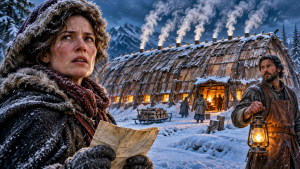
PART 1 — THE HOUSE THAT SHOULD NOT HAVE STOOD
The first time I saw smoke rising from six holes in the roof of a house made almost entirely of bark, I thought I had found a village trying to hide inside a single fallen tree.
It was January 1892, in the northern mountains of Montana Territory’s newly admitted state, and the thermometer tied to my saddle had stopped pretending to be useful. The little glass column had fallen below its last marked line. My horse, Juniper, trembled through her blanket. The eyelashes of the man leading us had frozen into white spikes. Everywhere I looked, the forest stood perfectly still beneath a blue sky so clear it seemed cruel.
Then, between the firs, appeared the enormous curved roof. Brown slabs of bark overlapped from ridge to ground like scales on some sleeping animal.
White smoke lifted from a row of vents, not one chimney but six, each drifting upward in the windless air. Fire glowed through narrow windows near the snowline. Around the building, people moved in heavy coats, hauling wood on sledges, chopping at a stump, and carrying steaming buckets between doors. It was not a ruin. It was alive.
My brother Owen had written about it three months before he disappeared.
If winter closes the road, he had said, find the longhouse beyond Three-Fork Creek. Don’t trust the men who say it can’t keep people warm. What they call old-fashioned may be the only thing that saves us.
I was thirty-four years old, a widowed schoolteacher from Helena, and I had traveled two hundred miles to learn whether my younger brother had died of the cold or of something far less innocent.
By the time I reached the longhouse, I was beginning to suspect the answer was both.
The guide stopped so abruptly that Juniper nearly collided with him. His name was Daniel Crowell, a former army mule handler who had agreed to bring me as far as the creek and no farther. He looked from the house to a set of tracks crossing the snow.
“That’s where I leave you, Mrs. Bell.”
“You said you would deliver me to the door.”
“And the door’s right there.”
“Two hundred yards through snow up to my knees.”
“I’ll lead your horse. But after that, I go.”
He watched the dark pines beyond the house instead of my face. I followed his gaze and found nothing except the quiet that always follows heavy snowfall. Yet the man had seen something.
I had learned to recognize fear when it was being disguised as haste.
We crossed a clearing marked by dragged timber and footprints. The longhouse grew more extraordinary up close. Thick timber ribs supported its arch, and layers of birch and cedar bark covered them in overlapping strips held by wooden pegs and weighted battens. Banks of packed snow rose along the outside walls, stopping below the small shuttered windows. A ladder stood against one end. A child in a brown coat carried kindling through a low entrance while another swept drifting snow from the threshold.
A gray-haired woman emerged before we arrived. Her face was brown and deeply lined. She wore mittens sewn from deerhide and a blue wool scarf wound around her head.
“You took the east trail,” she said to Crowell. “The west trail’s safer.”
“Didn’t have a choice.”
“You always have a choice, Daniel.
Some simply cost more.”
His expression tightened. He passed me Juniper’s reins, accepted his money, and left without taking the tea she offered him. She watched him vanish among the trees.
“I’m Nora Bell,” I said. “I’m looking for Owen Bell.”
The woman let out a slow breath. “I’m Ada Whitcomb. We wondered whether you’d come.”
“Is he here?”
“Come inside first. Your lips have turned blue.”
“Please. I need to know.”
She took the reins from my stiff fingers. “Then you need to stay alive long enough to hear it.”
Inside, the air smelled of wood smoke, dried apples, wet wool, and broth. I expected one cavernous room, drafty and dark. Instead, the interior opened into a long central passage flanked by low sleeping platforms, storage alcoves, benches, and partitions made from woven willow and stretched canvas.
The ceiling arched high over a series of stone-lined hearths, each with a hood of clay and sheet metal leading toward its roof vent. There was no roaring furnace, no steam pipe, no miracle machine. The warmth came from slow fires, insulated walls, and people who knew exactly how to manage both.
A young woman kneaded bread beside a wooden table. Two boys mended snowshoes. An elderly man cleaned the wick of a lantern. Near a hearth, a little girl slept under a patchwork quilt, her boots warming a safe distance from the fire. People looked up as we passed, some curious, some guarded.
Ada brought me to a bench and set a mug between my hands. The drink tasted of hot water, honey, and the last raspberries of summer. Feeling returned to my fingers in painful needles.
“We have twenty-three people living here,” she said.
“Sometimes thirty if the weather traps travelers. We had seventeen when Owen came.”
My throat tightened. “When did he leave?”
She looked toward a man working beneath the far roof beam. Broad-shouldered and dark-haired, he wore a leather apron and held a wooden mallet. He was repairing a joint with patient taps. A scar crossed the back of his left hand.
“Elias,” Ada called. “Nora’s here.”
The man stood so quickly that he struck his shoulder against the beam. He crossed the room with the expression of someone approaching a door he had dreaded opening.
“I’m Elias Ward,” he said. “Your brother was my friend.”
Was. That single word did what the winter cold had failed to do. It left me without breath.
“Where is he?”
“We don’t know.”
“You just said was.”
“Because no one has seen him since November nineteenth.”
“His letter was dated November twenty-second.”
Elias went still.
I took the folded paper from the inner pocket of my coat, where it had rested against my heart throughout the journey. Elias read the postmark, and the color left his face.
“That isn’t possible,” he murmured.
I had not come to Montana to be protected by impossible explanations. “Tell me everything. From the beginning.”
He drew up a stool. Around us, the longhouse continued its quiet labor. A pot lid rattled. Someone laughed softly at the far hearth. A little boy trailed a string through a crack in a wooden toy horse. Life went on even as mine stopped.
Owen had arrived the previous spring with survey papers and a battered transit instrument. He had been hired by Blackstone Timber and Mineral Company to map a proposed mountain rail spur. The company claimed to be bringing steady work and a new road into a valley where isolated farms struggled to reach a market.
Its manager, Victor Rusk, wore expensive suits and spoke about progress with the certainty of a preacher.
But Owen discovered that Blackstone’s map did not match the county records. The proposed line crossed homesteads that had never been sold, followed a creek that had been omitted from the company’s application, and passed within a few hundred feet of the longhouse. When he questioned the discrepancies, Rusk told him the original surveys were unreliable.
“Your brother didn’t believe him,” Elias said. “He had a habit of believing measurements.”
“He had a habit of believing people until they gave him reason not to.”
“That, too.”
Owen spent the summer helping Elias repair the longhouse while quietly checking old land markers. On November nineteenth, he went down to the settlement of Frost Bend to meet a clerk who claimed to have a copy of the original grant. He did not return.
Two days later, his surveying horse came back without him, its bridle cut.
“We searched for six days,” Elias said. “The sheriff said Owen had gone south.”
“Would Owen leave his instrument behind?”
“Never.”
“Would he leave without writing me?”
Elias shook his head.
“Then why did the sheriff decide he had gone south?”
Elias glanced at Ada. She answered for him. “Because Blackstone pays the sheriff’s debts.”
For a moment, the room seemed colder. I looked at the letter in my hands. Owen’s writing slanted sharply to the right, just as it had when we were children and shared one school desk. The date was clear. He had described the house’s unusual roof, the way smoke traveled through clay collars, and the importance of the community’s winter stores.
At the bottom he had added a line I had read a hundred times: The house is older than the claim anyone has made against it, and I have begun to understand why that matters.
“Where was the letter mailed?” Elias asked.
“Frost Bend. December third.”
“Two weeks after he vanished.”
We sat looking at each other. That was my first true discovery in the longhouse: someone had kept a letter and sent it after its author disappeared.
Ada insisted that I eat before we spoke further. I had barely tasted the stew when the outer door burst inward and a boy staggered through carrying a bucket. Water had frozen over his sleeves and collar. He was perhaps thirteen, with dark eyebrows and a stubborn jaw.
“The trough’s ice again,” he announced. “And Miss Lena says the north vent’s drawing wrong.”
Elias stood. “Caleb, tell Jonas to open the lower baffle halfway.
Not the upper one.”
“He already did.”
“Then shut it and find me.”
The boy eyed me. “Is that Owen’s sister?”
“Yes,” I said.
“He told me girls could be surveyors.”
“He told me boys could learn to ask permission before interrupting,” I replied.
The boy grinned despite himself. “He was wrong about some things.”
Elias followed him toward the hearths, and Ada led me into a small chamber separated by heavy curtains. She placed my travel bag beside a narrow bed covered in woven blankets.
“You can stay here,” she said. “For as long as you need.”
“I don’t want to take anyone’s place.”
“You’re not. Owen used that bed.”
I looked at the folded blanket, the smooth wooden shelf, the nail driven into the wall for a coat. In the corner lay an old pencil shortened almost to its metal tip.
I picked it up and recognized the knife marks on the wood. Owen had been impatient with pencil sharpeners, even as a child.
Ada waited without speaking. Only after I had sat on the bed did she say, “There’s something I should tell you.”
I looked up.
“Your brother didn’t simply study the longhouse. He helped us save it last summer. The timber company wanted it burned.”
“Why?”
“Because a house filled with people is harder to erase from a map.”
That night I lay listening to the strange breathing of the building. The fires hissed and settled; the wind passed over its curved roof rather than battering flat against it. Far away, someone coughed. A child whispered for water, and a woman answered. The place seemed to hold its inhabitants gently, as a pair of hands holds an injured bird.
I had come expecting a shelter.
I had found a community built around a question nobody had answered.
Before dawn, I woke to the sound of a bell.
Not a church bell. Three rapid blows struck against iron. Footsteps thudded through the passage. Voices shouted that the eastern vent had gone dark. I dressed and hurried out to find smoke gathering beneath the arched ceiling. One of the hoods was blocked, and the fire beneath it had begun to smolder. Elias and two others carried wet cloths across their mouths while they loosened the vent collar. Ada opened a low shutter, directing a thin stream of cold air into the passage.
“Get the children away from the smoke,” she ordered.
I had taught emergency drills in schoolhouses with one stove and no proper exits. I knew enough to move people calmly and quickly.
I led five children and an older couple through the far door to a sheltered work shed where a banked ember stove kept tools from freezing. We wrapped ourselves in blankets and counted heads. Caleb insisted on returning to help until I put him in charge of tending the youngest.
Half an hour later, Elias appeared, black soot across his forehead. “All clear. Nobody hurt.”
“What blocked it?” I asked.
He opened his gloved hand. Inside lay a piece of oiled canvas wrapped tight around a wooden slat.
“Not a bird’s nest,” he said.
Ada examined it. “That roof vent was checked yesterday.”
Elias looked toward the dark timber line where the early morning light had begun to appear.
“Somebody climbed onto the house last night.”
The thought followed us through breakfast. Had someone entered the compound while the workers slept? Had Blackstone sent men to frighten the residents?
Or was the intruder one of the twenty-three people inside? Those questions mattered, but what frightened me more was the ease with which one small strip of canvas had turned a warm home into a chamber of poisonous smoke.
Elias later showed me the roof from the ground. “The design works because air moves where we tell it to move. Fresh air enters low; warm air draws upward through the hoods. Too much draft takes our heat. Too little makes smoke and danger. Nothing’s automatic. Someone watches each hearth every hour.”
“And if someone stops a vent?”
“Then it stops working. No old house is a miracle. It survives because people keep it alive.”
I asked to learn how every part functioned.
Not because I intended to stay forever, I told myself, but because understanding the building might help me understand why Owen had risked his life for it.
The longhouse had stood in some form for more than forty years. Its first frame had been raised by a mixed band of homesteading families after a series of winter storms destroyed their scattered cabins. An Abenaki carpenter named Samuel Pike, whose family had moved west through years of seasonal work, had helped them rethink the walls and roof using techniques he had learned from his father. Ada was careful to explain that the shape was a local adaptation, not an ancient design belonging to one tribe or one century. The name had stuck because it was long enough to house an entire little settlement.
Samuel had understood bark as a material: its direction, its flexibility, its weaknesses at seams.
He knew how to overlap the pieces to shed water, how to leave breathing space beneath layers, and how to repair damage with pegs rather than nails that would split the wood. His wife had taught the group to dry food without wasting fuel. Other families brought skills in masonry, woodworking, and making cloth insulation. No one alone had invented the longhouse. It had been built out of what people knew and what the winter forced them to learn.
The ribs were heavy fir, braced with crosspieces and anchored to rock footings. Between inner lath and the outer bark, the builders packed dry moss, straw, and shredded cedar bark in removable sections. The mass of the hearth stones stored some warmth after flames diminished. Thick curtains prevented gusts from racing the full length of the passage. Sleeping platforms stood above the coldest air near the floor. Firewood dried under a covered lean-to.
Ash was sifted, coals were guarded, and every bucket of water represented labor.
“It’s impressive,” I said.
“It’s inconvenient,” Elias corrected. “And it takes twenty people to do properly. But twenty people can do more together than twenty people freezing in separate huts.”
By noon, I had seen their stores: racks of smoked meat, sacks of beans, root vegetables packed in sand, jars of preserves, barrels of hardtack, and bundles of dried herbs. Nothing suggested abundance. Every shelf had a chalk mark recording what remained. Ada showed me a ledger where she calculated daily portions through March.
“We won’t starve if the road stays closed,” she said. “Not if nobody wastes anything.”
“What if more people arrive?”
She glanced at the door. “That is why the ledger has margins.”
The next morning I joined a group cutting kindling beneath a bright sky.
Caleb taught me how to split thin dry pieces with a smaller blade, handling the task as solemnly as if he were instructing the governor. Lena Ortiz, a quiet young woman whose father had died in a logging accident, brought fresh strips of bark to mend a seam near the east wall. She had dark hair twisted beneath a cap and hands reddened by soap and cold.
“Owen spent most evenings drawing this place,” she said. “He was always measuring.”
“Where did he keep the drawings?”
“In a green book.”
“Did he take it when he left?”
Lena hesitated. “I thought Elias kept it.”
Elias, working nearby, shook his head. “Owen took it to Frost Bend.”
Their answers should have matched. They did not. I made a note in my own book that evening, under the date January twelfth: Find the green survey book. Ask why Owen’s letter was mailed late.
Learn who can climb onto the roof without being noticed.
The next day brought the cold that would change everything. The sky turned white before breakfast, not with snowfall but with a strange veil that blotted out the mountains. Birds disappeared from the trees. The wind stopped. Elias checked the outdoor thermometer with a cloth over his nose and returned silent.
“Forty below,” he said at last. “Celsius. Near enough the same as Fahrenheit at that point.”
Someone gave a low whistle. Ada did not. She opened the ration ledger and began issuing orders. All outside work except water and fuel was suspended. The hearths would be fed in rotation rather than stoked together. The youngest and oldest would sleep toward the central bays. Every outer door had to be cleared of snow every few hours, and no one was to go more than a hundred yards alone.
I thought of Daniel Crowell, who had refused to remain an extra night.
I thought of the empty road and the little settlements beyond the timber. At that temperature, any person stranded outside without adequate clothing could lose the use of their hands before they reached shelter.
Yet inside the longhouse, as the women poured hot broth and the children held bowls between their palms, the temperature stayed tolerable. Breath did not fog in front of our faces. The windows frosted at the corners, and the edges of the outer partitions felt cool, but the central passage held warmth.
People spoke quietly, as if afraid to disturb the balance.
Then, shortly after sunset, three knocks sounded at the west entrance.
Nobody was expected.
Elias lifted the latch while Ada stood ready with blankets. On the threshold stood a little girl whose coat had been tied around her with rope. Snow crusted her hair. Her lips moved, but no sound came.
Behind her, almost lost in the dark, lay a man sprawled beside a broken hand sled.
The girl lifted one stiff hand and pointed into the trees.
“Mama,” she whispered.
And I understood, with a dread deeper than any I had felt so far, that the longhouse’s hardest winter was only beginning.
We carried the man through the door feet first, his coat stiff as a plank. Caleb ran ahead to clear a sleeping platform, and Ada ordered us not to put his frozen hands against the fire. I had never seen a person so close to death while still breathing. His cheeks were white and waxy; his eyelashes were rimmed with ice. When we peeled away his mittens, the skin on two fingers was discolored.
“Warm him slowly,” Ada said. “Dry blankets. No rubbing. Lena, fetch the medical chest.”
The child stood near the stove, too frightened to let anyone remove her coat.
I knelt in front of her. “I’m Nora. What’s your name?”
“Elsie.”
“How old are you, Elsie?”
“Nine.”
“Where did you come from?”
“The mill cottages. Papa said the road would take us to a house that smoked through its roof.”
I looked at Elias. He knew the place. The mill cottages stood near Blackstone’s abandoned sawmill, six miles down the creek. Men had been laid off there in November. Elsie said the house had become too cold after a stove pipe collapsed and the roof caught fire. Her father had loaded their remaining food and blankets onto the sled. Halfway through the woods, her mother had fallen and hurt her ankle. They left her sheltered beside a rock with the family’s second quilt and continued toward help.
“How long ago?” Elias asked.
Elsie searched the ceiling as if the answer might be written on a beam.
“Before it got dark.”
The room went quiet. At forty below, dusk was not something a stranded adult could afford. Elias reached for his coat. Ada caught his arm.
“You can’t see the trail now.”
“The girl walked it.”
“The girl may have drifted off it.”
“Then we follow the sled marks while they’re still there.”
I heard myself speak before I had decided to. “I’m coming.”
Elias stared. “No.”
“I can read a compass and keep track of distance. Owen taught me.”
“You nearly froze getting here.”
“And I’ve warmed up since. We need a second person.”
Ada watched us with the expression of someone assessing supplies. “You both go, and neither goes without a rope between you. Jonas can stand by the west door with a lantern. Take two fur blankets and the little rescue sledge. We will keep the entrance lit.”
She fitted my face with a wool wrap and made me put an extra pair of mittens beneath my overmitts.
Elias took a lantern, a hatchet, and a roll of rope, then knotted it loosely between our belts so we could separate to move around trees without losing each other in darkness. No heroic speech preceded our departure. Ada simply said, “Come home.”
The cold struck like an invisible wall. I had expected wind, but there was none. The air seemed to steal moisture from my throat with every breath. Snow squealed beneath our snowshoes. Our lantern made a small circle of yellow, and beyond it the trees looked black and infinite.
We followed the shallow marks of the broken sled until they became confused with deer tracks. Elias stopped often, lifted the lantern, and scanned the ground. I counted steps under my breath, using Owen’s old method of remembering distance. At two hundred paces, we passed a split cedar. At four hundred, a fallen fir.
We found the rock where Elsie said her mother had waited, but there was no woman beside it.
I felt despair rising in my chest. Elias found the first new mark: a smear where someone had dragged one leg. We followed it south into a narrow stand of saplings. There, beneath an overhanging trunk, we saw a dark bundle.
Her name was Martha Finch. Her eyes were open, though she did not seem to recognize us. She had wrapped Elsie’s spare scarf around her ankle and tucked both hands into her coat. Her breathing was shallow.
“Your daughter is safe,” I said, bending near her ear. “She made it.”
A tear formed at the edge of one eye and froze there. Together we slid blankets beneath her, carefully lifted her onto the sledge, and wrapped her without exposing her skin to the air longer than necessary.
The trip back seemed impossibly long. Twice I stumbled; twice Elias steadied the rope. Once he stopped and placed his ear near Martha’s mouth. When he straightened, he pulled harder.
At the door, I nearly collapsed into Ada’s arms. She helped us unload Martha as if she had been doing nothing but rescuing winter travelers all her life. She had prepared a bed away from the fiercest heat, a basin of lukewarm water, clean cloths, and a small stove. It was not a hospital, but it was the best care within fifty miles.
Elsie climbed beside her mother’s blankets and waited, watching every movement of the adults. Her father regained enough consciousness to ask her name. That night neither of them died. By morning, Martha could swallow broth.
Her ankle was badly sprained, not broken, and though the father would later lose the tip of one frostbitten finger, he lived to see spring.
I should have slept after the rescue, but I found Elias at the far end of the passage patching a split section of bark. The mallet rested unused beside him.
“You were right to go,” he said.
“Ada decided we should.”
“You were right to insist.”
I sat on a bench. “You sound surprised.”
“I’m surprised you still trust this place after what happened to Owen.”
“I don’t know if I trust the place. I trust people who went into the cold for a stranger.”
He looked at his scarred hand. “That’s not always the same thing.”
I wanted to ask what had happened to his hand, and why he spoke as if kindness were a debt he might never repay.
Instead I asked whether he had known my brother well.
“He taught Caleb to write measurements in a straight column. He told Lena she could learn drafting. He sat with my father the night he died, even though my father had spent three months calling him a foolish city boy.” Elias smiled faintly. “Yes. I knew him.”
“Then you’ll help me find out what happened.”
His smile vanished. “I have been trying.”
“Try with me.”
For a long time, he said nothing. At last he reached beneath his bench and drew out a narrow wooden box. Its lid was held shut with twisted wire.
“Owen left this in my keeping,” he said. “He told me not to open it until somebody came who knew the words to an old song your mother used to sing.”
I stared at the box.
Owen had been clever with little puzzles when we were children, but the memory felt painfully out of place. Our mother had sung us to sleep with a nonsense verse about a silver river and a green door. I repeated it softly. Elias tested the words against a scrap of paper he had hidden in his vest.
When I reached the final line, he cut the wire and lifted the lid.
Inside lay a brass key, a strip of blue cloth, and a note folded into a square small enough to hide in a shoe.
My brother’s handwriting covered both sides. At the top was one sentence, underlined twice:
IF I DISAPPEAR, DO NOT LET RUSK DIG BENEATH THE NORTH HEARTH.
I read it again, certain that my tired eyes had rearranged the words. A hearth was a place for warmth.
What could anyone want to dig beneath it?
Elias saw the question on my face. “I don’t know,” he said. “Owen wouldn’t tell me.”
On the reverse Owen had drawn a rough plan of the longhouse. Beside the north hearth, beneath the sleeping platform, he marked a narrow rectangle. And on the edge of the paper, where someone might mistake it for an accidental flourish, he wrote three numbers.
The first matched the county survey marker east of the creek. The second I recognized as the latitude of the settlement. The third number was wrong by nearly a mile.
“That’s a bearing,” I whispered.
“To what?”
I folded the note. “I think Owen left us a way to find out.”
A bell sounded again from the far entrance. It was not the emergency signal this time but the regular three strokes used when someone approached.
Through the shuttered window I saw two riders bundled against the cold. One carried a black leather document case. Both wore coats too expensive for men who spent winter on logging roads.
Ada came to stand behind us. She had seen the case too.
“That,” she said, “is Victor Rusk’s lawyer.”
The riders dismounted. The taller man held up a sheet of paper stamped with the county seal.
“By order of the court,” he called through the door, “this property is to be vacated in seven days.”
All along the central passage, conversations stopped. The warmth of the longhouse, which had seemed so secure only an hour earlier, suddenly felt like something we were holding in our hands while another man reached to take it away.
I looked at Owen’s hidden note. A house that could withstand forty degrees below zero could still be destroyed by a piece of paper.
And we had only seven days to learn why.
PART 2 — WHAT THE EARTH REMEMBERED
The man with the court order introduced himself as Mr. Horace Venn, counsel to Blackstone Timber and Mineral Company. He held the paper above the snow as if proximity to the ground might diminish its authority. Behind him stood a deputy with a rifle across his saddle.
Elias would not let either man enter until they removed their boots and agreed to leave the rifle outside. Venn protested that he was acting in an official capacity. Ada said the floors had just been cleaned and made it plain she cared more about mud than his official capacity. Eventually Venn complied. The deputy remained beside the horses, stamping his feet in the bitter cold.
Inside, Venn announced that Blackstone had acquired title to the surrounding land through a chain of lawful purchases, and the longhouse occupants were trespassers.
The court had ordered them to leave within seven days and surrender all improvements to the rightful owner. He spoke slowly, savoring the sound of phrases such as final judgment and immediate possession.
Ada placed a mug of tea in front of him. “Your legal paper won’t keep your horses alive. Put them under the shed.”
“We will not be staying.”
“Then they’d better be moving.”
Venn glanced toward the windows, where the cold had traced delicate ferns of frost. He drank the tea.
“The company is prepared to help you relocate,” he said. “Mr. Rusk has arranged temporary quarters in Frost Bend for the elderly and young children. Wagons will collect your goods at the end of the week.”
“There are thirty people here now,” I said. “The road’s blocked.”
He looked at me for the first time. “And you are?”
“Nora Bell.”
His hand tightened on the mug.
It was a tiny movement, but he did not conceal it quickly enough.
“Owen Bell’s sister?”
“Yes.”
“Then you should know your brother was dismissed for misconduct.”
“What misconduct?”
“Unauthorized copies of proprietary surveys. He disappeared before the company could pursue charges.”
“He disappeared after discovering falsified boundary lines.”
“You have no evidence of that.”
“Then you won’t mind if I examine the records.”
Venn rose. “My duty is to deliver the notice, not argue with visitors.”
“Then your duty is done,” Ada said. “Take the warm route back. The north crossing’s drifting shut.”
As he approached the door, he stopped beside the northernmost hearth. Its low stone surround was cracked, repaired with dark clay, and partially hidden behind a sleeping platform. He looked at the floor beneath it for an instant too long.
I felt the brass key in my pocket. Owen had known exactly which hearth interested Blackstone.
Now I knew someone at the company was aware of the same secret.
After Venn left, the longhouse divided into frightened knots of conversation. People wondered where they could take their livestock, how they could move the infirm, and whether the county would really force families into the wilderness at forty below. Ada quieted them with the back of a spoon struck against a pot.
“Nobody leaves today,” she said. “We have seven days to contest the order. Anyone who wants to pack may pack, but first we do the work needed to make supper.”
Her practicality steadied the room more than any speech about justice could have done. I found Lena examining the court notice near the table. The paper was stamped with a seal, signed by Judge Martin Vale, and dated three weeks before the winter road closed.
Under a paragraph about title, the order referred to a recorded deed from 1871.
“Ada told me the original house was built in the 1840s,” I said.
“The first house was,” Lena replied. “Then the flood came in fifty-eight. They rebuilt higher up the slope, keeping the old frame pieces that survived. My grandmother remembered both.”
“Do you know who owned the ground?”
“Everyone and no one, depending on who was collecting taxes.”
A few minutes later Elias took me to the north hearth. The stones were warm, and a pot of beans hung above a small, steady fire. A shelf behind it held folded blankets. He asked me to describe Owen’s drawing without showing the paper to anyone else. I pointed to the rectangle beneath the platform.
“Could there be a cavity?” I asked.
“There’s a service trench for air to reach the fire,” he said.
“And old footings from the earlier hearth.”
“Could it contain something?”
“Certainly. Dust, mice, old nails. Maybe a copper penny if we’re fortunate.”
He knelt and tapped the floor. Some boards rang hollow. One section had been laid across a seam and held down by pegs rather than nails. The brass key was too small for a door and too large for a watch. It might belong to a chest.
“We can’t open this while the hearth’s burning,” he said. “We’d lose our draft, and the cold’s getting worse.”
“Then wait until we can move the fire safely.”
“You say that like weather takes instructions.”
“I was a teacher. I tried giving instructions to worse things.”
He smiled, then returned his attention to the floor. “We can inspect the air trench from the side. If we seal it after, the draft should remain safe.
But I want Jonas with us. He’s the only man alive who remembers how his grandfather built this bay.”
Jonas Pike was seventy-two, thin and stooped, with a face like a weathered map. He had watched Ada run the stores, repaired roof seams with Elias, and never offered an opinion until he was sure someone would listen. When we showed him the drawing, he shook his head.
“That mark isn’t under the hearth,” he said. “It’s beneath the old hearth.”
“Where was the old one?” I asked.
He pointed two feet toward the wall. “Before we rebuilt the roof, the smoke rose through an opening farther north. My father moved the fire in sixty-four because the wind kept driving smoke back inside. We laid the new hearth on a stone shelf and packed the old one with gravel.”
“Why would Owen mark it?”
Jonas hesitated.
“His transit kept pointing him there. He said our foundations weren’t straight with the rest of the walls.”
“Were they supposed to be?”
“Not at first. The first builders worked around a spring seep and a slab of solid rock. They put the longhouse where the ground was firmest. Later we forgot why certain timbers bent instead of running straight.”
He led us outside to the northern wall. Frost glittered along the bark seams. Near the ground, behind a ridge of packed snow, lay three narrow drainage channels capped with loose stones. Jonas cleared one with a wooden paddle and showed us a line of flat rock descending toward the creek.
“The old drainage,” he said. “Keeps the thaw from washing under the hearth.”
I knelt. There was something deliberate about the stones, a pattern too consistent to be accidental.
Their placement might be the clue to Owen’s altered bearing.
We did not get a chance to investigate further. By afternoon, a second emergency demanded all our attention.
The well chain snapped.
The well was a covered shaft near the wood shed, its water kept from freezing by depth and a thick insulated cap. We used it for drinking and cooking; snow could be melted in an emergency, but doing so consumed fuel we could not spare. When Caleb lowered the bucket, the chain parted at a corroded link and disappeared into the dark. The bucket struck water with a distant splash.
“We have the reserve barrels,” Ada said, “but they’ll last only three days at full rations.”
Elias inspected the broken link and cursed under his breath. The chain was old but had been checked the previous week. Someone had filed it nearly through.
Its bright metal was visible beneath a thin smear of grease.
“Another accident?” I asked.
“It wasn’t an accident,” he said.
At night we gathered around the central table and discussed guards. Some wanted to question everyone in the house. Others suggested walking to Frost Bend to confront Blackstone. Ada refused both schemes. “Suspicion won’t fix the well,” she said. “And a man freezing on the road doesn’t help us.”
Elias fashioned a retrieval hook from a bent iron rod. Lena helped him knot new rope. At dawn they recovered the bucket, and Jonas replaced the broken chain with a double braided line that could be checked by hand. While the work proceeded, I stood near the shed with Elsie, who had begun following me whenever I went outdoors.
“Someone keeps breaking things,” she said. “Is it the same person who burned our roof?”
I looked at her.
“What burned your roof?”
“Papa said the stove pipe fell.”
“Did you see it?”
She nodded. “I saw a man running away before the smoke came. He wore a coat with silver buttons. Papa said I shouldn’t tell strangers because we’d get into trouble.”
I crouched so we could speak face to face. “Did you see his face?”
“No. He had a scarf. But his boots made a funny sound, like one heel was loose.”
That evening I shared her words with Elias. He listened without interrupting. When I finished, he said, “The deputy with Venn has a silver-buttoned coat. He limps on his right leg.”
“You think he set the fire?”
“I think a man paid to empty land might begin by emptying houses.”
“Then we need a witness who can identify him.”
“She’s nine, Nora.
She should be allowed to sleep without thinking about what she saw.”
“I agree. But her father may know more.”
Martha and her husband, Thomas, had regained enough strength to sit beside the hearth. Thomas was a sawyer, forty years old, with dark circles beneath his eyes and a bandaged hand. When I asked about the fire, his expression changed. He admitted that Blackstone had ordered the mill cottages vacated in December, claiming the housing was unsafe. The men who remained were offered one month’s pay to move south. Thomas refused because his wages had been withheld for nearly four months. A week later, the stove pipe in his cottage collapsed during the night.
“Was anyone working on it?” I asked.
“The deputy came through earlier that day,” he said. “Said he had to inspect the chimney for the county. I didn’t argue.
What good would it do?”
“Did he wear silver buttons?”
Thomas stared at me. “How did you know?”
I gave him a brief account of Elsie’s memory. He sat for a long time, rubbing his forehead with his uninjured hand.
“I made her promise not to tell anybody,” he said. “Thought it would keep her safe.”
“It still might,” I said. “We won’t ask her to speak to anyone until she’s ready.”
The more we learned, the clearer the pattern became. Blackstone did not need to kill thirty people outright. It only needed to make shelter impossible, let winter accomplish the rest, and call the result misfortune.
I copied the court order into my notebook and began listing questions. Which clerk had recorded the disputed deed? Where was the original? Could an attorney in Helena seek a stay by telegraph? Why had the sheriff accepted Owen’s disappearance without inquiry?
And what, precisely, lay beneath the old hearth?
A line of answers led me toward Frost Bend. Unfortunately, so did the road Blackstone controlled.
Elias proposed a plan. We would travel with the delivery team that brought weekly mail and small supplies from the settlement when weather permitted. Jonas could run the hearths during his absence; Lena would supervise roof checks; Ada would manage stores and every other problem the rest of us failed to anticipate. Caleb wanted to join us and was refused so emphatically that he spent the afternoon sulking on a chopping block.
“You promised Owen I’d learn surveying,” he accused Elias.
“And you will,” Elias replied. “Starting with the distance between that woodpile and the shed. Measure it three ways and tell me why your numbers differ.”
Caleb glared at the snow, then fetched a line and began measuring.
A minute later he was so absorbed in his task that he forgot to be angry.
We left before dawn two days after Venn’s visit, traveling on snowshoes and pulling a small sledge with food and blankets. The temperature had risen to a comparatively merciful twenty-five below. At a fork where the trail descended beside a frozen creek, Elias stopped and pointed at a stump marked with three notches.
“Owen used these to mark the route,” he said. “If the drifts cover the old trail, follow the notches.”
“He was preparing for winter.”
“He was preparing for people to get lost.”
We walked in silence for a while. At a ridge, I saw the longhouse below us like a brown vessel anchored in a white sea. Six lines of smoke rose from its roof. The sight had comforted me on the day I arrived.
Now I understood what an extraordinary responsibility those threads of smoke represented. They meant that people were alive, and that someone had fed the fires all night, and that a building nobody considered valuable enough to protect had become the last safe place in the valley.
Halfway down, we found fresh horse tracks crossing the trail. Elias bent to study them.
“Two riders,” he said. “One horse is missing a front shoe nail.”
“How can you tell?”
“Look at the mark. There’s a little notch where the nail should be.”
I followed his finger and saw it. Owen would have loved such certainty drawn from a detail. I wished suddenly that he could step from behind a fir and laugh at my fear. The ache of missing him nearly stopped me.
In Frost Bend, smoke drifted from a dozen chimneys, and the main street lay rutted with frozen sleigh tracks.
The settlement had a general store, a small church, a boarded hotel, and a county office occupying the upper floor of the mercantile. Blackstone’s sign hung above the largest brick building. Its windows were brightly lit; the houses of men who worked for it looked considerably less prosperous.
The county clerk, Arthur Pike, was no relation to Jonas but had learned to resent the surname anyway. He sat behind a tall desk surrounded by ledgers and declared that all records pertaining to the Blackstone purchase were unavailable.
“Unavailable because they’re lost,” I asked, “or because you’re forbidden to show them?”
“Madam, I don’t take orders from you.”
“No. You take them from the county. I am requesting copies of public records.”
“And I’m telling you the office is closed.”
I pointed to the clock above his head.
“It is half past ten in the morning.”
“There’s an audit.”
“Who is conducting it?”
He stopped answering. Elias leaned against the doorframe, silent but visibly refusing to go away. I wrote down the clerk’s name, the date, the time, and the exact reasons he had offered. The sound of my pencil seemed to irritate him more than any argument could have done.
Outside, we met the town’s physician, Dr. Miriam Shaw, an unmarried woman in her late forties who carried more authority in her medical bag than most men carried in their official titles. She had treated Owen for a broken wrist the previous summer. When I introduced myself, she gripped my hands warmly, then looked over her shoulder.
“Not here,” she said. “Come to the surgery.”
Her office occupied a two-room house at the edge of town.
She locked the door, took a thick envelope from a cabinet, and handed it to me.
“Your brother left these with me,” she said. “He was worried that people would search his boarding room. I should have sent them to you sooner, but I didn’t know who to trust.”
Inside were copies of payroll records, witness statements from displaced families, and sketches of creek crossings. A map showed the disputed land divided into narrow strips. Blackstone’s proposed rail spur followed an old mineral vein, but a different notation caught my eye: a pale blue line running under the site of the longhouse.
“What is that?” I asked.
“An underground watercourse, according to Owen. He was testing whether it fed the spring used by three settlements.”
“Why would Blackstone want it?”
“A rail spur needs water. A mine needs more. But that isn’t the only reason.”
She unfolded a second page: a draft petition asking the state to investigate contamination of the creek below a Blackstone ore-processing site.
Owen had collected samples after cattle became sick and families reported a metallic taste in their water. The company denied any problem.
“He believed they’d buried waste near the north ridge,” Miriam said. “He asked me to document the illnesses. Then he vanished.”
“Do you think they killed him?”
She did not look away. “I think they wanted him quiet. I do not know whether he is dead.”
For the first time since arriving, I could hear a distinction between those two statements without pretending one meant the other.
Miriam knew the judge who had signed the eviction order. Vale had been ill when the hearing took place and was traveling east to see a specialist. His deputy had approved several procedural steps in his absence. More importantly, the order was based on an affidavit claiming the longhouse had been abandoned.
“Abandoned?” I repeated.
“There are thirty people living there.”
“According to the affidavit,” she said, “no residents were found during inspection.”
“When?”
She showed me the date. November nineteenth. The day Owen disappeared.
The significance took a moment to settle. Someone had recorded an inspection of a home occupied by seventeen people, on the same day a surveyor who questioned the land claim vanished. That false statement had become the foundation of a court order.
“Who signed the affidavit?”
“Deputy Sheriff Silas Brent.”
Silver buttons. A damaged heel. A black lie in a public record.
I stood. “We need a telegraph.”
Miriam led us to the railroad station, where the operator agreed to send a request for emergency legal assistance to an attorney in Helena whom I knew from my teaching work. I paid for the message with money I had reserved for my journey home.
The clerk promised to transmit it by afternoon.
Before leaving, we visited the boardinghouse where Owen had lodged. Its owner, a widow named Josephine Bellamy, greeted me with a look of recognition before I had spoken.
“You have his eyes,” she said.
She had kept a few of Owen’s things in a locked drawer: a broken ruler, a small compass, a winter scarf, and a photograph of us as children standing beside our father’s orchard. She swore she had not seen him after the nineteenth. But she remembered one strange visitor.
“A man came that night,” she said. “Knocked at the back door. Had a bandage around his head. He wanted to know whether Owen had left a packet for a woman from Helena.”
“Did you see his face?”
“Only one side. He had a burn scar along his neck.”
I felt the room tilt.
Elias had a scar on his hand, not his neck. A stranger injured on the night Owen vanished could mean almost anything. Josephine gave me one more detail: the man had spoken with an accent she could not place and had carried a brass lantern engraved with a pine tree.
We were leaving when a boy ran up the street, shouting that a horse had bolted near the mill crossing. Through the confusion, I saw Deputy Brent enter the station and speak briefly to the telegraph operator. The operator’s face changed. When I returned to ask about my message, he claimed the line was down.
I looked at the machine. Its key had just stopped clicking. The wire through the wall was intact.
“Try again,” I said.
“No use. Storm on the line.”
Brent appeared behind me.
His coat had polished silver buttons, and one heel clicked oddly against the wooden floor.
“Mrs. Bell, isn’t it?” he said. “Far from home for a schoolteacher.”
“Not as far as you might think, Deputy.”
“Winter roads are dangerous. Folks disappear on them.”
Elias stepped beside me. “We know.”
Brent smiled at him without warmth. “You should be more careful where you walk, Ward. Some trails lead straight over a cliff.”
We left the station without another word. I knew then that the telegraph would not rescue us, at least not from Frost Bend. The people who controlled the road also controlled the message leaving it.
On our way out of town, Elias bought lamp oil, fresh needles, and two lengths of iron chain. I bought a small slate and chalk for Caleb, though I had no idea whether there would still be a place to teach him when we returned.
At the last row of houses, someone slipped a note into my mitten while pretending to ask directions.
The person was a teenage girl with a basket of laundry. She walked away before I could speak. The note read: The inspection was never made. Ask what they buried at the old quarry. Beware the man who carries the pine lantern.
There was no signature. I showed Elias. He read it twice and tucked it inside his coat.
“I know that lantern,” he said.
“Who carries it?”
“A man named Nathan Voss. He worked for Blackstone, then left after an explosion. Haven’t seen him since autumn.”
“Could he have hurt Owen?”
“He could have. Or he could be the only reason Owen is still alive.”
We traveled back as daylight faded. The cold intensified, and the snow caught the blue of the evening sky.
I thought of the people waiting for us, measuring the hours until the court order took effect. I thought of the family huddled in their burned cottage and the watercourse running invisibly beneath the longhouse floor. One man might have vanished for trying to protect both.
When the roof appeared through the pines, we saw that only four smoke plumes rose where six should have been.
Elias broke into a run.
We found Jonas on a stool near the north hearth, holding a wet cloth against his forehead. One section of the inner wall had sagged, and Lena was directing people to move bedding away from a smoking seam. A fire had spread through dry insulation behind the bark. They had caught it early, but two sleeping bays were now open to the winter air.
“How did it start?” Elias demanded.
Lena handed him a small bottle blackened with soot.
“Kerosene. We found it behind the outer panel.”
Someone had not simply damaged the longhouse. Someone was trying to burn it while its people slept.
Ada had already gathered the residents around the central hearth, giving them tasks and refusing panic. Elias went outside with Jonas to remove the damaged bark. I helped Lena carry blankets to the warmer bays. For a moment the hall sounded like a disturbed beehive: children crying, people calling names, pots clattering, boots thudding across planks.
Then Ada raised her voice. “Count with me.”
She led the children in a familiar counting song while adults passed boards, water, and tools in a steady line. A little girl whose hands had been shaking began to count too. Within minutes the noise had become rhythm instead of fear. The old house might have been damaged, but the people inside were still capable of working together.
By midnight we had sealed the opening with spare canvas, timber, and two layers of dry bark.
We moved everyone out of the exposed bay and reduced the hearth there to embers until its hood could be checked. Exhausted, I went to find Ada.
She stood at the north hearth, looking at the stones. “This can’t continue,” she said. “Someone comes after us every time we make progress.”
“We found a witness. We found evidence the order is false.”
“And we have five days.”
I remembered Owen’s note. “We need to open the old hearth.”
Ada looked toward the ceiling. “Tonight?”
“Before whoever wants it reaches it first.”
She closed her eyes for a moment. When she opened them, they were very clear. “Then do it with care. Don’t sacrifice the house to save the house.”
Near dawn, as the central hearth took over the warmth of the sleeping bay, Elias, Jonas, Lena, and I lifted the platform by the north wall.
The boards beneath were ancient, their pegs brittle with age. Jonas demonstrated how to loosen the old joints without splitting them. We drew out a flat slab of stone and exposed a small cavity lined with river rock.
The brass key fit a box wrapped in stiff leather.
Inside were a rolled parchment, an oilcloth envelope, and a narrow tin cylinder. The parchment crackled when I touched it. Elias held a lantern steady while I read the faded words.
It was a land covenant, signed in 1851 by eleven founding households and witnessed by the county’s first magistrate. The document designated the longhouse ground, its well, and the upper spring approach as a shared refuge that could not be sold by any single household. It carried marks from families who could not write and signatures from those who could.
A second paper recorded later recognition of the agreement in county archives.
The oilcloth envelope contained survey measurements and a series of names. Among them was Owen’s. Another name had been scratched out with such force that the paper was almost torn.
The tin cylinder held a spool of fine copper wire, a tiny glass vial, and one photograph. The picture showed Owen standing beside a man whose neck was wrapped in a bandage. Both men appeared exhausted. On the back, Owen had written:
Nathan knows where the missing survey went. If he reaches you, listen before you judge him.
Elias lowered the lantern. “My God.”
The room seemed to breathe around us. We had proof that the land belonged to a refuge, not to one absent owner. But the covenant was not the strongest evidence in the box.
At the bottom lay a recent deed, dated September 1891, carrying a signature I recognized from the eviction order: Judge Martin Vale.
It transferred the same land to Blackstone for one dollar.
Beside the signature, stamped in blue, was a date on which Vale had been recovering from surgery in Boston.
Someone had forged a judge’s name to take the longhouse, and Owen had found the original document that could expose the crime.
We heard a soft thump at the door.
Caleb stood there in his nightshirt, staring at the papers. He had not come to interrupt us. He was holding a lantern, its brass body decorated with an engraved pine tree.
“A man left this by the wood shed,” he whispered. “He said to tell Nora Bell her brother’s still alive.”
PART 3 — THE FIRE BENEATH THE SNOW
Caleb held the lantern with both hands, as though a man might climb out of it if he shook it hard enough. Its brass was dented along one edge, and soot blackened the glass. A small pine tree had been engraved near the handle. I had never wanted to believe a stranger’s message more desperately in my life, and that frightened me almost as much as the news itself.
“Where is he?” I asked.
“By the wood shed. Or he was. He said he’d wait five minutes and no longer.”
Elias seized his coat. “Jonas, stay here.”
“I’m coming,” I said.
He started to object, looked at my face, and thought better of it. We went into the cold together, carrying the lantern as a signal. The longhouse was nearly silent behind us.
Frost shone on the sled runners, and the trees beyond the wood shed stood thick and black.
A man stepped from the shelter of a fir. He was lean, had a ragged beard, and kept one side of his neck covered with a scarf. He held no weapon that I could see. His first words were directed at Elias.
“I didn’t come for a fight.”
“You worked for Rusk,” Elias said.
“Not anymore.”
“Where’s Owen?” I demanded.
Nathan Voss examined my face. “You are his sister. He said you’d be stubborn.”
“Is he alive?”
“He was yesterday morning.”
I nearly stumbled toward him. Elias caught my sleeve, not to restrain me, but to keep me steady on the ice.
Nathan explained in quick, guarded sentences. On the night Owen vanished, he had gone to the abandoned quarry to meet a former Blackstone bookkeeper.
The woman was prepared to hand over a ledger documenting unlawful disposal of mine waste and falsified land payments. Deputy Brent and two hired men arrived before the exchange could be completed. There was a struggle. Owen was knocked unconscious, and the bookkeeper fled into the woods. Nathan, who had been hiding nearby to help guide them back, dragged Owen into a drainage tunnel beneath the quarry.
“Why didn’t you bring him home?” Elias asked.
“Because the deputy followed us. Because Owen had a skull injury and couldn’t walk. Because the only road out was watched. Choose whichever answer makes you least angry.”
“You let us believe he was dead.”
“I wanted you to believe he was gone. That’s what kept them from searching the house every night.”
“They did search it,” I said. “They tried to burn it.”
Nathan’s jaw tightened.
“Then they’re closer than I thought.”
He had sheltered Owen in an old blasting-store tunnel. For six weeks, he and the missing bookkeeper had carried food, boiled water, and kept a small stove alive beneath a hidden vent. Owen’s head injury had improved, but an infection in his leg had recently worsened. He was now too weak to move unaided. Nathan had come for medicine and help because he no longer believed he could keep Owen alive until spring.
“How far?” I asked.
“Eight miles, if the upper pass is open. More if it isn’t.”
“Then we leave at first light.”
Nathan looked past me at the house. “Not in daylight. Brent patrols the pass. We go tonight or not at all.”
I wanted to rush forward immediately, but Ada would have been right to call that reckless.
We needed medical supplies, food, ropes, and a reliable method of bringing an injured man home in deep cold. Dr. Shaw was in Frost Bend, beyond the reach of a single night trip. Yet Ada had nursed miners through winter illnesses and kept a small chest of antiseptic, dressings, and simple medicines. Nathan said Owen could survive another day if the fever did not rise. We decided to leave at dusk, once preparations were complete.
Before the man disappeared into the trees, I showed him the tin cylinder and the photograph. His eyes filled when he saw the picture.
“He thought those would protect you,” he whispered.
“From whom?”
“He didn’t know who had signed the false deed. He only knew Rusk had bought someone’s loyalty at the courthouse.”
“We found the deed.”
Nathan looked at me sharply. “Then keep it away from a fire.
Rusk’s people will burn the whole valley to erase it.”
When the sky began to pale, he left by a narrow trail that avoided the road. I watched his tracks until the snow swallowed them. Behind me the longhouse was waking. The first smoke plume rose from the eastern vent. It was astonishing that such an ordinary sight could carry both comfort and warning.
I told Ada everything. She sat for a long time with Owen’s photograph before returning it.
“Bring him back if you can,” she said. “But not at the cost of every person going after him.”
We made our preparations quietly. Elias rebuilt an old rescue sled using flexible ash runners and a canvas litter supported by springs from a worn wagon seat. Lena sewed a wind cover and padded the sides with dry wool.
Jonas packed a small brazier designed to warm hands during stops, but warned us never to use it inside the closed canvas. Carbon monoxide had killed more than one winter traveler who confused warmth with safety.
Ada measured enough broth concentrate and dried food for four people. She packed spare socks, a bandage roll, boiled cloth, and a sealed jar of pine resin for equipment repairs. Thomas Finch, still weak from the cold, insisted on mending a broken runner. He worked with his bandaged hand resting on his knee and gave instructions to his wife, who tightened the lashings.
“You saved our daughter,” Martha said. “Let us help save your brother.”
The willingness of the Finches unsettled me. They had barely survived their own misfortune, yet here they were preparing a sled for someone they had never met.
I asked Martha why she had followed Elsie into the cold when she could scarcely walk.
“She needed her mother,” Martha said. “And my husband needed us both. What else was I going to do?”
I carried that question with me for the rest of the day. What else were we going to do? It sounded simple until the cost became clear.
At midday we held a meeting near the central hearth. Elias explained the journey without revealing Owen’s location. The residents needed to know why two capable workers would be absent while Blackstone’s deadline approached. Some agreed that we should rescue Owen. Others feared the entire plan was a trap meant to draw us from the house.
“If Brent knows where the tunnel is, he might be waiting,” Lena said.
“And if we do nothing, Owen may die,” I answered.
An older farmer named Everett Moss asked what would happen if the court order arrived while Elias was away.
Ada told him she had the documents, the support of Dr. Shaw, and a list of witnesses willing to attest to continuous occupancy. Jonas said he would keep the hearths safe. Lena promised to supervise the roof. The Finches would help with water and food distribution. Nobody pretended the risks were small, but people volunteered until every essential task had a name beside it.
Only Caleb remained silent. When the meeting ended, he came to me carrying the slate I had bought him.
“Owen said a survey is a way of telling the truth about where things stand,” he said. “Is that right?”
“It is, when the surveyor tells the truth.”
“Then tell him I’ve been practicing.”
He showed me three measurements of the distance between the woodpile and the shed. They differed by several inches, and beside each he had written an explanation: loose snow, stretched line, crooked starting point.
His handwriting was clumsy, but the reasoning was careful.
“He’s going to be proud of you,” I told him.
Caleb’s face brightened, then clouded. “Don’t say that unless you know he’ll come home.”
He was right. Adults lied to children most often when they thought they were being kind. I handed back the slate.
“I don’t know whether we’ll bring him home,” I said. “But I know we’ll try as hard as we can.”
He nodded, accepting a difficult truth with more grace than some grown men had managed.
At dusk, Elias, Nathan, and I left the longhouse. Nathan moved ahead as silently as a fox, choosing ground sheltered by the trees. Elias pulled the empty rescue sled, and I followed with a pack. Our clothes made us bulky and slow, but every layer mattered. We crossed a narrow frozen stream on foot, testing each step with poles.
Once we heard wolves calling far down the valley, their voices carrying through the cold air. Elias lifted his head, listened, and said they were following elk, not us.
The journey took five hours. We stopped only to drink from insulated flasks and check each other’s faces for white patches of frostbite. Near the quarry, Nathan extinguished our lantern and guided us by moonlight across a ridge of broken stone. Below lay the old workings, black openings in a white hillside. One had collapsed. Another was blocked by timber. Nathan led us to a fissure beneath a fallen cedar and tapped three times on a metal plate concealed in the snow.
A woman’s voice answered, “Who comes?”
“Nathan. With help.”
The plate lifted. A narrow shaft descended into darkness, and a lantern appeared below. I climbed down a rough ladder into air that smelled of wet stone, smoke, and boiled leather.
At the bottom stood a thin woman in a patched coat, her black hair braided tightly against her head.
“Cora Webb,” she said. “I was the bookkeeper.”
She looked from my face to the lantern behind me and understood who I was without another word.
“He’s through there.”
Owen lay on a cot beside a small clay-lined stove. His hair was longer than I remembered. His cheeks had hollowed, and a dark bandage wrapped his left leg. For one terrible instant I saw no movement. Then his eyes opened.
“Nora?”
I had imagined shouting, demanding answers, perhaps striking his shoulder for frightening me. Instead I knelt and pressed my forehead to his hand. It was warm. I could not stop touching it, as if he might vanish again if I let go.
“You took your time,” he whispered.
I laughed and cried at once.
“The roads are dreadful.”
“I wrote you.”
“I know.”
“Did you find the longhouse?”
“Yes. And the papers.”
His grip tightened. “Then don’t let them take it.”
For a moment I almost hated him for thinking of the building before himself. But the look in his eyes was not obsession. It was fear for thirty living people who trusted him.
I told him we had come to bring him home. He shook his head, then winced. The infection in his leg had begun after a wound reopened in the damp tunnel. He feared he would slow us too much. Elias examined the bandage and found inflammation spreading upward. He spoke quietly to Cora, asking how long the fever had persisted and what medicines she had used. We cleaned the wound with the supplies Ada had sent, but none of us pretended that our improvised care could replace a physician.
He needed Dr. Shaw.
As we worked, Owen told me what had happened. The company had altered maps to conceal a dumping ground where processing chemicals and mining waste had been buried above a stream that supplied several farms. Blackstone had also purchased or forged deeds covering the route of a proposed rail spur. The longhouse property stood over an old spring channel that the company wanted to divert for industrial use. Once they controlled the land, they could draw water away from families downstream while claiming the refuge was abandoned.
“Why would they risk exposure?” I asked.
“Because the mine’s running out of easy ore,” Owen said. “They need the rail line to bring in heavier machinery. And they need the spring to run the works. Without those, their investors start asking where the money went.”
Cora produced the ledger she had nearly surrendered on the night Owen vanished.
Its pages listed company accounts, illegal payments, and reimbursements for ‘winter clearance.’ Several entries carried Deputy Brent’s initials. Others bore the name of Horace Venn. A large payment to a bank in Helena had been recorded the week Judge Vale supposedly signed the false deed.
“That payment was to a man posing as the judge’s agent,” Cora said. “I copied the signature from the real court file before they removed it. I was ordered to alter the book. I refused.”
“Can you testify?” I asked.
She stared at me as though I had asked whether she could walk across the moon. “They have a warrant calling me a thief. They said I stole company money.”
“Did you?”
“No. But they can prove I was the person who opened the accounts. They made sure of that.”
“Then we’ll show the whole ledger, not just the pages they choose.”
Owen reached under his pillow and took out a leather folio. Inside were the original field notes that matched the land covenant, samples of stained creek sediment sealed in glass, and a notarized statement from a man who had witnessed the dumping. The man had since left the state. Owen had hidden the evidence because it was all he had left to show that the contamination was deliberate.
We spent two hours preparing him for the journey. Cora helped us secure the folio beneath the sled lining. Nathan carried the ledger inside his coat. Elias reinforced the canvas cover so cold air could not sweep directly across Owen’s face, while leaving openings for ventilation. I wrapped his hands and feet in warm dry cloth and checked them twice.
Before we left, Cora opened an iron box and showed me a final document: an unsigned contract offering Nathan a thousand dollars to reveal Owen’s hiding place.
The payment would be doubled if Owen were delivered alive.
“Why didn’t you take it?” I asked Nathan.
He looked away. “Because once I did enough harm for Rusk to pay me. I didn’t want to finish my life that way.”
Elias glanced at him sharply. “What harm?”
Nathan swallowed. “I set the charge that collapsed the quarry passage last autumn. I thought I was sealing an abandoned tunnel. I didn’t know two men were still inside. One died. I found out afterward.”
The silence that followed was heavier than the stone around us. Nathan’s bandaged neck had come from trying to reach the trapped men. He had been paid to hide what happened. Owen learned the truth and persuaded him to testify.
“You could have told the families,” Elias said.
“I should have.”
“You should still.”
“If I survive the next two days, I will.”
We could not solve his past in that tunnel. We had a wounded man, an approaching eviction, and a dangerous night journey ahead. Yet I saw that the longhouse’s struggle was not divided neatly into innocent people and villains. Fear had made some people complicit; shame had made others brave. Nathan had done wrong, and he had also kept my brother alive. Both facts would have to be faced.
We began climbing out shortly before midnight. The moon had slipped behind clouds, and a pale haze spread through the trees. Nathan went ahead to scout the pass. Elias and I pulled the sled with a rope across our shoulders, resting every few hundred paces to check Owen’s breathing. He spoke occasionally, telling us where the trail bent or warning us about hidden stones, but mostly he lay silent beneath the canvas.
At the narrowest part of the ridge, Nathan raised his hand.
We stopped. Ahead, between the trees, a lantern swung. Then another. Voices carried up from the quarry road.
“We know you’re there,” a man called. “Leave the surveyor and come out.”
Deputy Brent.
Elias drew the sled behind a boulder. Nathan crouched beside us, his face pale. There were three men below, perhaps four. We had no firearms. Our best weapon was the darkness and the fact that they did not know the upper trail as well as Nathan did.
“There’s a drainage cut to the east,” Nathan whispered. “Steep, but it joins the creek lower down.”
“Can the sled pass?” Elias asked.
“If we lower it with rope.”
We worked without speaking. Elias anchored the line around a thick fir, and Nathan led the sled toward the cut. I held the spare rope while Owen listened beneath the cover. The first ten feet were manageable.
The next twenty descended sharply between rocks coated with ice. One runner caught, twisting the sled sideways. Elias braced himself, and I heard the rope strain.
Below us, Brent shouted again. A shot cracked into the darkness. Snow fell from a branch near my head. The sound made me flinch, but Elias did not release the line.
“Keep moving,” he ordered.
Nathan scrambled beneath the sled and freed the runner. We lowered Owen another yard, then another. When the runners reached the bottom, I slid down after them, using the rope to control my descent. My knees struck stone. Pain flared, but I got up. Elias came last, pulling the rope free as another shot struck the tree above him.
We followed the drainage cut until it joined a frozen creek. The new route added miles, but it placed a ridge between us and Brent’s men.
For several hours, we dragged the sled through deep, powdery snow. My shoulders burned. Every time we stopped, I wanted to lie down. Elias watched me closely, but he did not offer empty reassurance.
“You can do the next hundred paces,” he said once. “We’ll count them together.”
We counted. Then we counted another hundred.
Near dawn, a wind began to rise. At first it merely stirred the snow around the trunks. Then it came in sudden gusts that threatened to erase our tracks behind us. Nathan found the notched cedar route again and announced we were less than two miles from the longhouse. The news should have lifted me. Instead it frightened me. Two miles had become an impossible distance.
Owen spoke from the sled. “Nora.”
I bent beside him. “I’m here.”
“Don’t let them burn the papers.”
“I won’t.”
“Promise me you’ll look at the water samples.
The blue stain. It isn’t natural.”
I wanted to tell him to stop worrying about maps and springs. I wanted him to think about his own life. But he was asking me to protect the truth he had nearly died to find. I touched his forehead through the opening in the canvas.
“I promise.”
We reached the clearing at sunrise. Smoke rose from all six roof vents again, and someone had cleared a path wide enough for the sled. Ada stood in the entrance with Jonas and Lena. Behind them were the Finches and Caleb, wrapped in a coat two sizes too large.
Caleb ran toward us, then stopped when he saw Owen lying still. For one dreadful moment he looked as though the child inside him had broken.
Owen opened his eyes. “Is that my assistant surveyor?”
Caleb made a sound halfway between a laugh and a sob.
He climbed onto the sled’s side, touched Owen’s mitten, and said, “I measured the shed three ways.”
“Good,” Owen whispered. “We’ll compare them when I’m better.”
Inside, Ada prepared a heated space for him near the center of the building. She changed his dressings and gave him water in slow sips. Dr. Shaw was sent for at once, but the roads were still blocked, and there was no telling how soon she could arrive. We watched his fever through the day. As his breathing grew less strained, I allowed myself the smallest possible hope.
That afternoon, an unexpected visitor entered the longhouse carrying a leather case and a parcel wrapped in brown paper. He was a middle-aged man with round glasses, a stiff collar, and snow in his eyebrows.
“Mrs. Bell?” he asked. “I’m Samuel Hartley, attorney at law.
Your message reached my office in Helena.”
I stared at him. “But the telegraph operator said the line was down.”
“It was. I received only the first half, and it took considerable effort to discover where you were. Dr. Shaw’s letter supplied the rest.”
He took out an official envelope bearing the seal of a district court. Inside was a temporary stay of eviction pending review of title. The paper had been issued that morning, and he had ridden from the nearest rail station with a team of two drivers who changed horses twice in the cold.
The room filled with a sound I had not heard since arriving: pure relief. Some people hugged. One elderly man sat down abruptly and began to cry. Ada accepted the order, read it twice, and placed it beneath a glass paperweight on the central table.
“How long does it protect us?”
she asked.
“Until the court can examine the underlying ownership,” Hartley said. “Not indefinitely. But no sheriff has legal authority to clear this property while the stay stands.”
I showed him the covenant, the forged deed, and the ledger. His expression grew more serious with every page. After half an hour, he looked up.
“This is not merely an eviction matter,” he said. “These documents suggest a conspiracy involving fraud, coercion, and misuse of public authority.”
“Can you stop them?” Elias asked.
“I can put evidence before a court. Stopping them will require witnesses who do not run and papers that do not disappear.”
As if summoned by the warning, a rifle shot sounded outside. People ducked instinctively. Elias rushed to the door and opened it a crack. The wood shed had caught fire.
Black smoke rolled from beneath its roof, and bright flames climbed over a stack of dry logs.
Two men on horseback galloped away toward the creek. In the nearest window, I saw the sheriff’s deputy turn in his saddle, his silver buttons flashing.
No one hesitated. Jonas took command of a line from the well to the shed. Elias and Nathan began pulling unburned fuel away from the flames. Ada moved the children into the far bay and ordered every exit cleared. Hartley carried the evidence case to the stone cellar. I helped Lena soak blankets and drape them over the adjoining wall to prevent the flames from spreading.
The danger was immediate. The wood shed stood close enough that embers could reach the longhouse’s bark roof if the wind turned. We had survived the cold, but fire could destroy everything in an hour. A gust sent sparks toward the eastern end. Elias climbed a ladder with a wet cloth and beat out the first glowing flecks.
Jonas shouted for more water, and the chain on the new well line creaked under the load.
Thomas Finch, whose frostbitten hand was still bandaged, braced the ladder’s base. Martha carried buckets. Elsie stood beside Caleb counting how many empty pails came down the line. Even the wounded helped in small ways, moving supplies and clearing snow away from the paths. The longhouse had taught them an old lesson: survival was not reserved for the strong. It belonged to everyone willing to do what they could.
After forty minutes, the shed’s roof collapsed. It sent a column of sparks skyward, but we had cleared enough space to prevent the fire from reaching the house. By noon the flames were reduced to smoking rubble. A third of our winter fuel had been destroyed.
Elias stood in the snow staring at the ruin.
His face was black with soot, and his hands shook as he removed his gloves. He had worked for years to store that wood. Now it was gone because another man wanted a deed nobody had a right to sign.
“How much remains?” Ada asked.
He made a quick calculation. “Three weeks if the cold holds. Maybe four if we bank everything carefully.”
“And the roads?”
“Still blocked to the north. The south road’s passable on horseback, but wagons can’t reach us.”
Ada said nothing. Her silence was worse than alarm. We had won time in court and lost time in the woodpile. The law might protect us from a sheriff, but it could not create firewood out of snow.
That night, Hartley gathered everyone around the central table. He explained the stay in terms even the children could understand. Blackstone could not legally take the house until the court heard evidence.
He also warned that people willing to set fires might not respect judicial orders. We needed to organize watches, preserve documents, and make a clear record of every attack.
Cora Webb agreed to give sworn testimony. Nathan promised to disclose his own part in the quarry accident. Thomas Finch would describe the inspection and the fire at the mill cottages. Jonas could explain the longhouse’s continuous occupancy and the history of the covenant. Dr. Shaw, if she arrived, could confirm the illnesses and review the creek water evidence.
I agreed to organize the statements. I had spent years teaching students to separate observation from assumption, and it seemed suddenly that my schoolroom work had prepared me for this exact task. I asked each witness to describe what they had seen, what they had heard from others, and what they believed. We made those categories distinct.
Truth becomes less useful when it is tangled carelessly with rumor.
After the meeting, Elias and I sat beside the north hearth. The building was still warm, but the fire beneath us was smaller than usual. He stared at its coals as though they were numbers in a ledger that would not balance.
“I’m afraid,” he said.
I had never heard him say it so plainly.
“Of Rusk?”
“Of choosing wrong. If I burn too little wood, a child freezes. If I burn too much, everyone freezes later. If I send people into the forest for fuel, they may not return. If I don’t, we run out.”
“That’s too much for one person to carry.”
“I’ve carried it for years.”
“Then perhaps that’s the problem.”
He looked at me. I told him what I had seen since arriving: Ada calculating food, Lena repairing walls, Jonas remembering forgotten joints, Caleb measuring distances, the Finches helping strangers.
The longhouse had never stood because Elias alone was strong enough to keep it standing. It stood because its people had divided labor, passed on knowledge, and admitted when they needed help.
“You can’t make every decision for everyone,” I said. “You can help us make them together.”
He let out a long breath. “Owen said something like that.”
“He was often right. Irritatingly often.”
A faint smile crossed Elias’s face. Then he took my hand, carefully, as if it were something he had been offered rather than something he had earned.
“I’m glad you came,” he said.
“So am I.”
Beyond the bark walls, the winter deepened. We had saved Owen, but we still faced weeks of cold, a damaged supply of fuel, and a company that had shown it would rather burn a refuge than lose its claim.
The next morning I began our first collective lesson.
I spread Owen’s survey map across the central table and asked every resident who knew the valley to mark where dry deadfall could be collected safely. They named sheltered hollows, stands of windthrown pine, old logging piles, and narrow trails that sleds could use without crossing unstable ice. We found enough possible fuel sources to make a plan.
Then Caleb pointed to a line on the map. “What about the old quarry road?”
“It’s too far,” Elias began.
“Not if you follow the creek from the lower bend,” Caleb said. “I measured it when Owen showed me the map. The road’s almost level.”
He was right. The abandoned timber piles beside the quarry could supply weeks of fuel if we could haul them back. The road passed Blackstone’s property, but the stay protected our right of access along the public trail.
Hartley believed we could defend that right if necessary.
Elias studied the boy’s measurements, then nodded. “We’ll send a team tomorrow.”
Caleb stood a little straighter. There, in the middle of a crisis, an ordinary piece of learning had changed what was possible.
Our optimism lasted until evening, when a man arrived at the door carrying a telegram forwarded from Helena. It was addressed to Hartley and stamped urgent. The lawyer read it, then asked Ada to sit down.
“Judge Vale has died,” he said. “His signature cannot be verified by testimony. And Blackstone’s owners have petitioned to dissolve the stay by claiming the original covenant is a forgery.”
He looked around the room, at the faces of people who had survived every threat winter could offer.
“The hearing has been set for three days from now.
If we lose, the sheriff may return with authority to evict.”
I looked toward the north hearth. Its stones still held the warmth of the fire. Under them, the old covenant had waited forty years for someone to find it. Now a dead judge’s missing voice threatened to bury the truth again.
For the first time, I wondered whether saving the longhouse might require something harder than surviving the winter: persuading strangers who had never felt that cold to believe the people who had.
PART 4 — A FIRE KEPT FOR EVERYONE
Three days is a short time to prepare for a court hearing and a long time to watch a fever rise. Owen lay between those two measurements, neither recovering quickly enough to testify nor declining so sharply that we dared abandon hope. Ada changed his dressings at sunrise and sunset. Dr. Shaw arrived late on the first day, her hands trembling from the ride, and immediately ordered clean water, fresh cloths, and a quieter room. She examined the wound, removed damaged tissue as carefully as she could, and began the treatment available to her. Through that first night, I sat with a basin beside his bed and counted the minutes between his breaths.
“You have to go,” he said when he woke near midnight.
“I’m not leaving you alone.”
“You aren’t. There are thirty people here.”
“Thirty-one, counting a lawyer who seems to think sleep is a moral failure.”
He gave a weak smile. “Then let him make himself useful. Nora, if the hearing goes wrong, that house is gone. You know it.”
I looked at the blankets pulled beneath his chin. We had come into these mountains as children with an orchard, an ordinary home, and parents who believed books could take us anywhere. Now the place that mattered most to my brother was a bark-roofed building full of people I had only just met. I understood why. Their future lay in the court’s hands, but their trust lay in ours.
“I’ll go,” I said. “If you promise to rest.”
He closed his eyes. “I promise to be an unusually obedient patient.”
“You never were.”
“No,” he admitted. “But there’s a first time for everything.”
Hartley prepared our case on the long central table while Lena copied witness statements and Cora checked figures against the ledger.
I had taught penmanship for years, and my handwriting became an unexpectedly valuable resource. With the last good ink in Ada’s store, I made three copies of the key documents. One set would travel with us. One would remain locked in the stone cellar. The third would go by a different route to Dr. Shaw’s office, where her medical records could help corroborate the contamination claims.
Hartley examined the forged deed under a magnifying glass. He noted inconsistencies in the seal impression and the paper’s watermark. The paper had been manufactured recently, while the deed purported to be an older copy. More strikingly, the signature’s ink had bled through an erased line that could still be seen when held against a lantern.
“Someone altered a different document,” he said. “Possibly a routine county notice. They reused the official paper and added the land transfer.”
“Can you prove it?”
I asked.
“We can show evidence of alteration. For a final determination, we need records from the county archives and someone who handled the original.”
Cora looked up. “Arthur Pike handled it. He was the clerk who filed the deed.”
“He refuses to show us anything,” I said.
“Then the court can require him to produce it,” Hartley replied. “Provided the court chooses to do its job.”
There was a bitterness in his last words I had not expected. He later told me his first legal appointment involved a family driven from land by a forged tax notice. He had won compensation three years afterward, long after their house was demolished. The law could acknowledge injustice without restoring what people had lost. Perhaps that was why he had crossed a frozen mountain to help a community most attorneys would never have heard of.
Meanwhile, the fight for fuel began.
Elias sent two teams to collect deadfall from sheltered hollows and another to the abandoned timber piles near the quarry. They traveled with ropes, hand sleds, and a strict rule that no worker was to leave a partner’s sight. The first team returned with little more than a week’s fuel, much of it wet. The second brought heavy logs that took hours to split. The third found the quarry road blocked by a chain and an armed Blackstone watchman.
“He said we were stealing,” Lena reported when she returned. Her cheeks were bright with cold, and her eyes were furious. “That timber’s been rotting for years.”
“And we can’t spend a day arguing while the house cools,” Elias answered.
He adjusted the hearth plan instead. Rather than keeping all six fires at an even burn, they concentrated heat in four central bays and closed two end sections with heavy partitions.
The roof vents in the unused areas were left appropriately ventilated and monitored so trapped moisture and smoke would not create new hazards. Families moved bedding closer together. The youngest children shared blankets, and adults took turns checking temperatures and coals during the night.
It was not a comfortable arrangement. People lost privacy. A woman who snored woke her neighbors. A toddler spilled broth on a sleeping mat. Old Everett Moss complained that three children whispered constantly beneath his platform. Ada listened to every grievance and somehow found a small solution for each: a curtain, a change in sleeping order, a quieter task at bedtime. The longhouse was a refuge, not a paradise. Its strength came from people agreeing, day after day, to bear the ordinary inconveniences of living together.
I helped Lena weigh the food stores. We estimated how long the dried beans, smoked meat, flour, and roots would last under reduced rations.
The Finches had brought almost nothing when they arrived, yet they were useful in ways no ledger could capture. Martha repaired torn mittens. Thomas designed a device to pull heavy logs without lifting them by hand. Elsie taught the younger children a game in which the floorboards became a map of rivers and mountains. Each new resident added needs, but also hands and knowledge.
On the second night, the temperature fell again. A hard, bright moon hung over the longhouse. Outside, the thermometer reached the bottom of its marked range, near forty below Celsius. Inside, I walked through the sleeping bays with Ada, checking for drafts. In the central passage the air felt warmer than our hands had any right to expect. We listened for the sound of proper airflow through the hoods and felt along the seams where smoke or cold might escape. There were no hidden machines keeping us safe.
Only timber, bark, packed insulation, measured fires, and human attention.
“It’s a strange thing,” I said. “The town calls this building backward, but every part seems to have been considered.”
Ada touched a patch near the west wall. “This one leaked for ten years. Jonas finally figured out how the wind was getting beneath the bark. We didn’t build something perfect. We built something we could keep correcting.”
“Do you remember Samuel Pike?”
“I was very young when he died. He’d say the house wasn’t a lesson in the past. It was a lesson in paying attention. Learn what the trees give. Learn what the ground does. Learn from every person who knows something you don’t.”
She paused beside a sleeping child. “A good idea doesn’t become worthless because it’s old.
And it doesn’t become safe just because someone calls it ancient.”
I wrote her words in my notebook after the watch. They seemed more important than many speeches I had heard from men whose offices were warmer than their consciences.
The hearing was held in Frost Bend’s largest room, the same hall used for winter dances and public meetings. We traveled at first light with Hartley, Cora, Jonas, Nathan, Thomas Finch, and three other witnesses. Elias remained to supervise the house and care for Owen. I disliked leaving him, but he had no one else familiar enough with the structure to oversee the fuel changes. When we said goodbye, he pressed a small wooden token into my palm. It was a piece of cedar carved into the shape of the longhouse.
“So you remember what you’re arguing for,” he said.
“I don’t need reminding.”
“Then keep it for when things go badly.”
I looked at his tired face. We had survived cold, fire, and fear together, but I had not asked him what would happen after winter. It felt foolish to think about such things while the house stood in danger.
“Don’t let the roof burn while I’m gone,” I said.
“Don’t let the courthouse fall down while you’re there.”
We smiled, and then we had to leave.
The hall was crowded when we arrived. Blackstone employees filled one side, their boots polished and their faces set in identical expressions of seriousness. On the other side sat farmers, mill workers, and families from downstream settlements. Word of the fire and Owen’s return had traveled faster than the official notices. Some had come to support the longhouse; others wanted to know whether the creek that watered their cattle had been poisoned.
Victor Rusk entered wearing a charcoal coat and gloves lined with fur.
He was younger than I expected, with a smooth face and the calm bearing of a man who assumed other people would eventually grow tired of resisting him. Horace Venn followed, carrying two leather cases. Deputy Brent stood near the door, his silver buttons gleaming.
The presiding judge was not the man who had signed the original order. Judge Eleanor Brooks had been assigned from a neighboring district after Vale’s death. She sat straight-backed, examined the attorneys without affection, and opened the hearing by stating that its immediate purpose was limited: to decide whether the temporary stay should continue while title and related allegations were investigated.
Venn spoke first. He argued that Blackstone held valid title, that the longhouse was an unlawful encampment, and that the covenant we presented was an unrecorded document of uncertain origin. He described the occupants as transient families rather than lawful residents.
He suggested the court should not be manipulated by emotional appeals to winter hardship.
Hartley rose when his turn came. He did not begin with the cold. He began with the records. He presented the covenant, Jonas’s testimony about continuous occupancy, tax receipts paid by founding households, and the ledger showing payments tied to the allegedly abandoned property. He then submitted the questioned deed and demonstrated the visible alteration to its date and signature line.
“The company asks the court to believe thirty people vanished from a building on the very day its surveyor disappeared,” Hartley said. “It asks the court to accept a deed that appears to have been altered, and an affidavit signed by a deputy whose own employer paid him for winter clearance. We do not request a final finding today.
We request that no family be forced into lethal weather on the strength of such records.”
Venn objected that the payment entries were irrelevant. Judge Brooks overruled him for the limited purpose of assessing the stay. When Hartley called Cora, the room shifted with unease.
Cora walked to the witness stand with trembling hands. I could see she wanted to run. Rusk stared at her as she took the oath. She described her work as bookkeeper, the instructions to transfer funds into concealed accounts, and the orders to falsify records. She admitted that she had copied figures in documents she knew were misleading before she finally refused to continue.
Venn pressed her about those admissions. He asked whether she had stolen company property and whether she hoped to escape prosecution by accusing her former employer.
She answered that she had taken copies of records because the originals were being destroyed, and that she was prepared to face scrutiny of her own actions.
“I should have spoken sooner,” she said. “I was afraid of losing my job. Then I was afraid of losing my freedom. I made choices I regret. But the figures are real, and the people they harmed are real.”
There was no dramatic applause. The room remained quiet. Her courage mattered precisely because she did not pretend to have been fearless.
Next came Nathan. When he admitted setting the quarry charge that had killed a worker, a woman in the back row stood abruptly. Her husband had been the man trapped inside. Nathan looked directly at her and apologized, without asking for forgiveness. He described the company’s pressure to conceal the incident and his later effort to protect Owen.
He produced the unsigned contract offering money for Owen’s surrender.
Rusk’s expression changed for the first time. He leaned toward Venn and whispered rapidly. The attorney asked for a recess. Judge Brooks refused until the current witness finished.
Thomas Finch then described the fire at his cottage, the deputy’s inspection, and his family’s flight through extreme cold. He did not call the deputy a murderer. He said exactly what he knew: the date of the inspection, the condition of the stove pipe before and after, and Elsie’s account of seeing a man with silver buttons run away. Hartley did not put Elsie on the stand. Dr. Shaw supplied medical records showing the family’s injuries after the rescue.
At last Jonas spoke about the house itself. He told the court how the roof had been rebuilt after the flood, how families had used it through every winter since, and how the covenant had been passed between the households.
Venn asked why there were no modern heating pipes, why the structure was covered with bark, and whether the people living there understood the danger of carbon monoxide and fire.
Jonas answered carefully. “We know those dangers because we live beside them. We check our hoods, keep our vents clear, and teach the young ones how to notice a bad draft. A man with a fine stove can still die if he neglects it. The shape of the building doesn’t excuse carelessness.”
“Wouldn’t a modern house be safer?” Venn asked.
“Maybe,” Jonas replied. “If the company wishes to build thirty modern houses and give them to us before sunset, I’ll be delighted to discuss it. Until then, this is the house that stands.”
A murmur passed through the room. Judge Brooks struck her gavel once, though I thought I saw her suppress a smile.
After lunch, Hartley called Arthur Pike, the county clerk.
He had been compelled to attend with the records under subpoena. His face was gray, and he kept looking toward Venn. When asked about the supposed inspection, he claimed the affidavit had been filed in proper form. When asked whether he had seen Judge Vale sign the disputed deed, he hesitated.
“I handled the file,” he said.
“Did you witness the signature?”
“I don’t recall.”
“Was the judge in this county on the date stated?”
“I don’t know.”
Hartley produced a certified hospital record showing Vale had been under treatment hundreds of miles away. He then showed the original county notice, recovered that morning from an archive drawer on the judge’s order. Its serial number matched the altered deed. Under magnification, the erased wording showed through: an ordinary notice regarding road maintenance, not a transfer of land.
“Mr.
Pike,” Hartley asked, “who instructed you to replace this notice with a deed?”
The clerk’s lips moved without sound. He looked toward Deputy Brent. Brent shifted his weight and moved one hand toward his coat.
Judge Brooks noticed. “Deputy, keep your hands where the court can see them.”
Brent stopped. A state marshal, assigned to the hearing after Hartley raised concerns about local interference, stepped beside the door. For a moment nobody breathed.
Pike swallowed. “Mr. Rusk told me the judge had already approved the transfer. Mr. Venn brought the document. I was told to enter it in the book.”
Venn objected furiously, claiming the clerk had misunderstood. Judge Brooks warned him to sit down. Pike began to cry, then seemed ashamed of the tears.
“I was behind on my debts,” he said. “They paid them. I thought the land was empty.
When I learned people lived there, it was too late to undo what I’d done.”
I thought of the Finches in the snow, Owen under the quarry, the burned wood shed, and the winter children sleeping beneath bark. It had not been too late when Pike first learned the truth. He had simply been afraid of the cost of admitting it. Now others had paid that cost for him.
Judge Brooks recessed the hearing. Hartley warned us not to celebrate until she returned. Cora sat with her hands clenched together. Thomas kept his gaze on the floor. Nathan approached the widow of the miner who had died in the quarry, but she held up a hand and told him she was not ready to speak. He nodded and stepped away. Accountability, I saw, was not a single moment of confession.
It was a road that might take years and never end in forgiveness.
When the judge resumed, she extended the stay and ordered an independent review of the disputed title. She directed the marshal to preserve the original records and instructed state authorities to investigate the allegations of fraud, arson, and unlawful dumping. Blackstone’s purported deed would not be recognized as a basis for eviction pending the investigation. She also ordered protective measures for witnesses after hearing evidence of intimidation.
The ruling was not the final victory that people in the hall wanted. It did not restore the lost fuel or cure Owen’s fever. It did not undo the harm to the Finch family or return the miner who had died. But it stopped the immediate eviction.
More important, it required the law to look at the evidence rather than merely the wealth of the man presenting it.
Outside the courthouse, farmers gathered around us. Several offered to haul supplies to the longhouse once the road improved. A carpenter promised spare boards. A woman from a downstream settlement said she had kept records of sick cattle and would share them with Dr. Shaw. A mill worker, hearing about the burned fuel, asked whether he could organize a timber team.
I thanked him, but he shook his head. “Don’t thank me yet. Let me bring the wood.”
That afternoon, the state marshal detained Brent for questioning in connection with the threatened witnesses and the suspicious fire. Rusk remained free pending further investigation. Venn left the courthouse without speaking to anyone.
I had expected some grand moment in which the guilty would be led away in chains, but real consequences came in pieces: a warrant here, a sworn statement there, a ledger carried to Helena under guard. Justice was slower than the stories I once read to my students. It was also more demanding.
We returned to the longhouse after dark. Elias met us at the door, looking from our faces to Hartley’s. I held up the continued stay. He let out a breath that seemed to empty his whole body.
“We can keep the house?”
“For now,” I said. “And we have a real chance to keep it for good.”
The children cheered when they heard. Ada did not cheer; she took the paper, put it beneath its glass weight, and ordered everyone to wash their hands for supper. Yet when she thought no one watched, she touched Jonas’s shoulder and leaned briefly against him.
In all the weeks I had known her, it was the first time she allowed herself to look tired.
The following morning we received the news I had feared most. Owen’s fever had risen sharply during the night. Dr. Shaw had stayed with him, but he was weak and disoriented. She needed better medicines and equipment than the longhouse could provide. We made plans to move him toward the nearest hospital as soon as the road opened.
I sat by his bed while the daylight moved across the floor. He opened his eyes and whispered that he had dreamed of our father’s orchard. I told him the trees still bloomed every spring, even after a winter so hard that branches cracked. He asked whether the old apple tree near the gate had survived.
I said it had, though the story of its survival belonged more to my memory than to current fact.
“You always were terrible at lying,” he murmured.
“And you always liked pointing it out.”
He smiled weakly. I told him about the hearing, the judge, and the testimony. When I reached the ruling, his eyes filled.
“Then the house has a chance.”
“Yes.”
“Good.”
He closed his eyes and slept. I stayed until his breathing steadied. I did not know whether he would recover, and I was too tired to bargain with the future. I had learned that hope was not certainty. It was the willingness to keep doing what mattered while certainty remained out of reach.
By February, reinforcements reached us from Frost Bend. The first supply sled carried beans, flour, medicine, and three heavy wool blankets. The second brought dry wood and a skilled carpenter.
The third arrived with an unexpected cargo: books donated by a school in Helena. Someone had told my former colleagues that children in the mountains were learning their lessons beside a hearth, and they had emptied a cupboard of primers, copybooks, atlases, and arithmetic texts.
I cried when I opened the parcel. Its wrapping bore a familiar hand: Miss Ruth Ellison, who had taught next door to my classroom for fifteen years. She included a note saying that if I intended to build a school in the woods, I might as well begin with decent spelling books.
The longhouse became a schoolroom every afternoon. We moved a table near the western hearth, hung a slate from two pegs, and arranged benches for children of all ages. Caleb studied surveying and arithmetic with renewed determination. Elsie learned to read complete paragraphs without tracing each word with her finger.
Two smaller children, whose parents had never attended school, practiced writing their names. Adults sometimes joined us after supper, pretending they only wanted to warm their hands while listening to the lessons.
At first I thought teaching there was a temporary occupation until I could return to Helena. Then I began to imagine it lasting longer. These children knew how to repair a snowshoe and identify safe drinking water. They could judge weather from clouds, chop kindling, and share a meal without being told. They deserved books and mathematics too, not as replacements for what their families taught them but as additional tools.
One afternoon, I asked Caleb what he wanted to become. He said a surveyor, then considered and added, “Or a teacher of surveyors. So nobody else can draw a false map and fool a whole town.”
I told him that sounded like a worthy profession.
He grinned and bent back over his figures.
The fuel crisis eased as more volunteers brought timber, but we never returned to careless burning. Elias recorded how much wood each hearth consumed and compared it against the temperature outside. Lena measured which curtains reduced drafts without blocking ventilation. Jonas taught the younger carpenters to inspect bark seams in a way that prevented water from entering during thaw. Ada revised her food ledger as supplies arrived, carefully distinguishing donations from obligations. Every improvement became a lesson that could be passed on.
Owen recovered slowly. A wagon with padded bedding carried him to a hospital in March, where more extensive treatment saved his leg. He spent several weeks there and returned in April with a cane, a thinner face, and a determination to record the longhouse’s history before anyone could alter it again. His first request was for Caleb’s notebook.
The boy presented its crooked columns, and Owen sat studying them as solemnly as a professor examining a thesis.
“Your measurements disagree,” he said at last.
Caleb looked crushed. “I know.”
“And you’ve explained why. That’s the beginning of good work.”
The boy’s face lit up. I watched them for a moment, remembering the promise I had been afraid to make beside the rescue sled. Not every promise of reunion is fulfilled. This one, against the odds, had been.
The independent inquiry continued through spring. Investigators confirmed that Blackstone had altered deeds and improperly influenced local officials. Evidence of the dumping prompted an environmental and public-health investigation by authorities of the era, limited in scope but serious enough to halt the company’s planned expansion. The longhouse residents secured legal recognition of the shared refuge covenant through a new recorded agreement, signed by the households and properly filed with the county.
The upper watercourse was placed under a protective easement designed to preserve access for neighboring farms and the refuge, subject to the laws then in force.
These changes did not erase the waste buried near the quarry. Crews had to remove and isolate contaminated material, and downstream families continued monitoring their wells with help from Dr. Shaw and state officials. Some people moved away. Others returned. The valley could not be restored by a judge’s sentence alone.
Rusk eventually faced criminal charges related to fraudulent records and intimidation, and the proceedings took more than a year. Venn lost his professional standing after evidence showed his involvement in preparing altered documents. Deputy Brent was convicted of several offenses tied to arson and witness coercion. Nathan gave testimony about the quarry blast and accepted responsibility for his part in it. He spent time in custody before returning to work as a mechanic far from the mountains.
The widow whose husband had died never forgave him, and he did not ask her to. Instead, he sent a portion of his wages to a fund for the children of injured miners. His payments could not buy absolution, but they were a form of responsibility he could keep fulfilling.
As the snow receded, the longhouse looked different. The bark roof that had seemed nearly buried in January now stood high above damp grass. Water ran along the drainage channels, carrying melt toward the creek without undermining the floor. The wood shed was rebuilt farther from the main structure, separated by a safer stretch of cleared ground. New supports reinforced the roof where the fire had damaged the timber. We repaired the clay collars around the vents and checked every hearth for cracks.
The builders were careful not to romanticize what had happened.
The winter had revealed serious weaknesses: a vent that could be blocked, a fuel supply stored too close to the house, a vulnerable well chain, and too much knowledge kept in the heads of only two or three people. We recorded procedures on paper, trained backups for every essential task, and established alarms that children understood. We improved ventilation and firebreaks without sacrificing the low-tech design that made the house repairable with local materials.
One warm afternoon, Ada called the residents together beneath the dripping roof. She announced that the common storehouse would be expanded and that a small schoolroom would be built beside the western entrance. Then she looked at me.
“We need someone to teach,” she said.
I had received an invitation from my old school in Helena the previous week. The position was secure, the salary respectable, and the classroom had glass windows instead of bark shutters.
I could return to the life I had understood before Owen vanished. I had been turning the letter over in my hands for days.
“I don’t know,” I said.
Ada nodded as though uncertainty were an answer worthy of respect. “Then take your time.”
That evening Elias and I walked to the edge of the clearing. The forest smelled of thawing earth. Patches of snow clung to the roots of shaded trees, but birds had returned, and a small stream sang beneath its thinning cover of ice. We stood where I had first seen the longhouse with its six plumes of smoke.
“You’ll leave?” Elias asked.
“I might.”
He nodded. I was grateful that he did not ask me to stay for him. After years in which grief had made every decision feel like a duty, I wanted at least one choice to be mine alone.
“If you go,” he said, “the children will miss you.”
“And you?”
He gave me a look of such naked surprise that I laughed.
“Especially me,” he said.
We stayed there until the last light faded from the mountains. Then he told me about the years after his father’s death, when he had mistaken responsibility for solitude. He had kept the roof standing and the fires burning, but he had rarely allowed anyone to see how frightened he was of failing. I told him about my husband’s illness, the years I spent caring for him, and the silence that followed his death. I had believed there was dignity in asking for nothing. The longhouse had shown me another kind of courage: allowing others to help.
Elias reached for my hand. This time neither of us hesitated.
I wrote to Helena the next morning. I thanked the headmaster for his generous offer and explained that I had found a different classroom.
It was colder in winter, louder at supper, and full of students whose boots were always damp. It was also the place I wanted to be.
In May, we planted a garden behind the longhouse. The children argued about which seeds belonged in which rows, and Jonas settled disputes by making them measure the sunlight. Owen walked with his cane from bed to bed, suggesting improvements to the water channels. Ada supervised the planting of beans as fiercely as she had supervised the winter rations. Martha Finch planted a row of medicinal herbs for Dr. Shaw, and Thomas built a bench from salvaged quarry timber. Elsie carved the word WELCOME into a board, then asked me how to spell it correctly before she painted the letters.
When the board was hung beside the west entrance, I remembered the night she arrived half frozen, pointing into the trees for her mother.
The same child now stood in sunlight, laughing as she tried to keep paint from running down her sleeve.
The years that followed did not make the longhouse famous. Travelers sometimes came to stare at its curved roof and ask how people survived forty below without modern machinery. They seemed disappointed when we spoke of smoke hoods, insulated bark, food stores, constant repairs, and the hard work of tending fires. Some wanted a secret invention or an ancient miracle. We had neither. We had only carefully gathered knowledge and a community willing to practice it.
Owen made a drawing for every visitor who asked. He showed the arched timber ribs, overlapping bark, dry insulation, drainage trenches, sleeping platforms, and ventilated hearths. He also wrote warnings about fire, smoke, moisture, and the limits of such a structure. A poorly built or neglected longhouse could be dangerous.
Ours endured because people watched it, repaired it, and changed what failed.
As for the word ancient, I came to think of it differently. The building was old, but not ancient in the way travelers meant. Its materials and some of its ideas came from much older traditions, adapted by families from different backgrounds to the conditions of that valley. To call the house ancient was to tell only half its story. The better half was that knowledge survived by moving from hand to hand, year to year, winter to winter.
Two winters later, after another severe storm, I found myself standing at the doorway beside Elias while snow climbed the banks along the walls. Inside, the children were gathered over arithmetic, and Ada was arguing with Jonas about whether the beans needed another hour.
Caleb, taller now, had been appointed to check the outdoor temperature and record the result at sunrise.
He came in with frost on his scarf and a look of exaggerated solemnity.
“Forty below,” he announced.
The younger children gasped. Someone reached instinctively for another log. Ada stopped him.
“Check the hearth schedule first,” she said. “We don’t burn wood because a number frightens us. We burn what we need, when we need it, and keep the house safe.”
Caleb grinned and went to the ledger. Elias checked the western vent. I closed a curtain against a small draft, then returned to the table where a little girl was struggling over a word in her primer. Outside, the pines stood white and motionless. Inside, six hearths glowed, and the work of staying alive went on.
That evening Owen asked me whether I still missed the city.
I said I missed its libraries, its easy roads, and the convenience of sending a letter without wondering whether snow would swallow the messenger. I missed fresh oranges in winter and the sound of many voices in a crowded street. But I did not miss being lonely in rooms full of people.
He nodded toward the roof above us. “You know, I thought the great discovery here would be a hidden watercourse. Then a legal document. Then evidence of a crime.”
“Weren’t those discoveries enough?”
“They mattered. But none of them explains why the house survived.”
“What does?”
He looked around the passage. Caleb was helping Elsie with a map. Thomas was repairing a chair. Ada’s voice rose above the bubbling stew as she told someone to move their wet boots away from the fire. Lena checked a seam with a lamp.
Elias came toward us carrying the evening fuel record, and when he caught my eye, he smiled.
“All of them,” Owen said. “That’s the answer.”
I thought back to the first day, when I had arrived half frozen, searching for my brother and expecting to find a mystery buried in bark and snow. There had been mysteries. There had been crimes, fears, failures, and losses that no amount of warmth could undo. But the strongest thing in the valley had never been a forged deed, a hidden spring, or a company rich enough to buy silence.
It was the decision made every morning by ordinary people to feed the fire for someone who had not yet woken, to open the door for someone who had nowhere else to go, and to teach the next person how to keep the place standing.
Long after the court records faded and the names of those who tried to steal the land were forgotten, the longhouse remained in use as a refuge and meeting place.
Some families eventually built separate homes nearby. Others stayed through every season. In summer the doors stood open to the smell of pine and rain. In winter the curtains were drawn, the fuel was counted, and the smoke rose steadily through the roof.
Whenever a newcomer asked how that old house had survived forty degrees below zero without modern technology, I showed them the overlapping bark, the stone hearths, the drainage channels, and the stores carefully prepared before the first snow. Then I brought them inside and introduced them to the people who kept those things working.
The longhouse did not defeat winter. No house ever truly does.
It simply gave us a place to face winter together.
And that, I learned, was a far greater kind of warmth.

