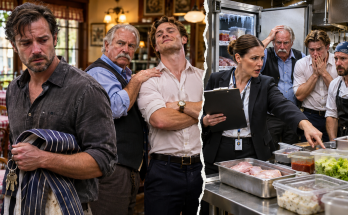
I arrived before sunrise.
The street was quiet.
The restaurant windows were dark until I turned on the lights.
For a moment, I stood just inside the entrance.
I was early.
That was nothing new.
For eighteen years, I'd usually been one of the first people at Callaway's Table.
I knew what it felt like to enter a restaurant before customers arrived.
The silence.
The clean tables.
The kitchen waiting to be used.
The feeling that an entire day depended on what happened in the next few hours.
But this morning felt different.
I wasn't walking into my father's restaurant.
I wasn't wondering what problem Dad would need me to solve.
And I wasn't preparing to do work that somebody else might eventually decide belonged to my brother.
I was opening Second Table.
A business I'd planned with Patrice and Emmett.
A place where the agreements were clear.
A place where we all knew what we were responsible for.
That knowledge changed the way I felt standing in the doorway.
I looked down at the apron in my hands.
It was new.
The fabric was stiff.
The strings hadn't been worn soft by years of use.
I held it for a moment.
Then I remembered the apron I'd folded at Callaway's Table.
The one I'd left beside the register when Dad handed Colton the business.
I hadn't planned to make a dramatic statement that night.
I had simply reached a point where I couldn't keep working under the arrangement my family had chosen.
I'd folded the apron.
Set down my three keys.
And walked away.
At the time, the gesture had felt final.
I thought I was leaving restaurant work behind.
Now I was standing in another kitchen with a new apron.
And I realized the work had never been the problem.
The problem had been what I believed I had to accept in order to keep doing it.
I looked toward the kitchen.
Emmett was already there.
He was checking the refrigeration temperatures.
I watched him move from one unit to another.
He took the readings seriously.
There was no performance in it.
No attempt to impress anybody.
He was simply doing what needed to be done.
I remembered his call on the morning Rhonda inspected Callaway's Table.
The walk-in had been at fifty-one degrees.
Colton had dismissed the thermometer.
Emmett had checked with another probe.
And when he realized the problem was real, he'd told the inspector what he knew.
That decision had cost him his job.
Now he was a partner in a restaurant where doing the right thing was part of his responsibility.
I was proud of that.
I didn't say anything.
I just watched for a moment.
Then I turned toward the dining room.
Patrice was arranging coffee cups.
She moved carefully, making sure everything was ready.
She had spent years taking care of guests.
Now she had a clear role in shaping how our own restaurant would welcome them.
She looked up when she noticed me standing there.
“You doing okay?”
I nodded.
I wanted to say yes immediately.
But my hands were still holding the apron.
She looked at it.
Then back at me.
“Need a hand?”
I smiled.
“No. I can manage.”
I put the apron around my waist.
Then I tied it.
It was such a small thing.
Two pieces of fabric pulled together.
A simple knot.
But I stood there for a moment after finishing.
At Callaway's Table, putting on an apron had become automatic.
It meant another day of responsibility.
Another day of keeping the business moving.
Another day of proving I could handle whatever happened.
This morning, it meant something else.
I wanted to be there.
I had helped plan the place.
I had agreed to the responsibilities.
And I could return home at the end of the day without feeling I had to carry every problem alone.
I wasn't sure I would always remember that.
Old habits are difficult to break.
But I was determined to try.
Emmett called from the kitchen.
He had another temperature reading to record.
Patrice finished arranging the cups.
And I moved into the day's work.
The hours before opening passed quickly.
We checked what needed checking.
We prepared the kitchen.
We made sure the dining room was ready.
I moved between the two areas, noticing small details.
A chair needed to be adjusted.
A work surface needed to be cleared.
A few things could be placed more conveniently.
Nothing serious.
Just the ordinary work of preparing to serve people.
I found myself enjoying it.
There was something comforting about having practical problems to solve.
Problems that weren't connected to a family argument.
Problems that didn't require me to ignore a forged signature.
Problems that could be addressed with attention and care.
By the time seven o'clock approached, I felt ready.
Not completely calm.
But ready.
We unlocked the door.
I stood near the front.
For a moment, I wondered who would come in first.
We'd spent a month preparing the business.
We'd reviewed the costs and agreements.
We'd worked through the practical requirements.
But none of those things could guarantee customers would walk through the door.
I knew that.
A restaurant needed people who wanted to eat there.
And I was about to find out whether anyone wanted to visit ours.
Then the first customer arrived.
Mrs. Whitaker.
I recognized her immediately.
For twenty-two years, she'd eaten Friday catfish at Callaway's Table.
She was one of those customers who became part of the ordinary rhythm of the restaurant.
I knew when to expect her.
I knew what she liked.
And I knew she'd notice if something changed.
She stepped inside carrying yellow flowers.
I stared at the bouquet.
Then at her face.
She smiled.
“I was told somebody around here still knows how to make biscuits.”
Emmett laughed from the kitchen.
I took the flowers.
“Good morning, Mrs. Whitaker.”
She looked around the dining room.
I watched her take in the windows.
The tables.
The space we'd spent weeks preparing.
Then she looked back at me.
She reached for my hand.
“Your mother would've been proud to see this.”
I couldn't answer.
Not immediately.
Her words reached a place I'd been trying to keep quiet for months.
My mother.
The old restaurant.
The photograph from 1996.
The little blue stool.
For years, I'd thought that leaving Callaway's Table meant leaving behind the place where my mother had once stood.
But here was someone who had known our family for decades, standing inside Second Table and speaking about her as though she belonged here too.
I looked at the flowers.
Then at Mrs. Whitaker.
I managed to thank her.
She patted my arm.
Then she walked toward a table near the window.
I watched her sit down.
It was a simple moment.
No applause.
No grand announcement.
Just an old customer choosing to come back and eat food we'd prepared.
But it meant more to me than I could explain.
I placed the flowers where they could be seen.
Then the morning began moving.
Customers arrived.
Patrice greeted them.
Emmett and the kitchen handled the food.
I moved through the restaurant, helping where needed.
The dining room grew busy.
I heard conversation.
Coffee cups.
Chairs moving.
The ordinary sounds I'd missed without realizing how much I missed them.
But there was something different about the noise.
I didn't feel trapped by it.
I felt part of it.
By eight o'clock, every seat was taken.
I looked around the room.
Thirty-eight seats.
Possibly forty with the arrangement we'd chosen.
Every one of them mattered.
I remembered standing with Patrice when we'd first viewed the empty space.
She'd counted the capacity.
I'd suggested moving things around.
Emmett had laughed because I'd already started planning the room.
Now customers were sitting in the places we'd imagined.
That felt almost unreal.
By nine, people were waiting outside.
I saw them through the windows.
I felt a familiar rush of concern.
Were we moving quickly enough?
Could the kitchen keep up?
Was everyone comfortable?
Did we have enough food prepared?
Those questions were natural.
I knew a busy restaurant required attention.
But this time, I didn't automatically assume I had to solve everything myself.
Patrice managed the dining room.
Emmett handled the kitchen.
I did my part.
And we communicated.
Nobody needed to pretend they knew something they didn't.
Nobody was afraid to say when they needed help.
I moved through the morning watching the team work.
It was the kind of operation I'd wanted for years.
Not perfect.
Not effortless.
But honest.
People were doing their jobs.
And the work was moving forward.
By noon, we'd sold every biscuit we'd prepared.
I looked at the empty supply.
Then I laughed.
I couldn't remember the last time selling out had made me feel that happy.
At Callaway's Table, a shortage could become another reason to feel I'd failed.
I would worry that we hadn't planned properly.
I would immediately start thinking about how to prevent it from happening again.
Those instincts were still there.
But today, selling out meant customers had wanted what we'd made.
It meant our first morning had gone better than I expected.
I knew we'd have to review the numbers and adjust.
That was part of running a restaurant.
But I allowed myself to enjoy the moment.
We had opened.
People had come.
And the food had been served.
I thought about the months after leaving Callaway's Table.
The quiet apartment.
The gray sweatshirt.
The folder of credit documents.
The calls with Rebecca.
The fear that a debt I hadn't authorized could follow me for years.
I thought about Dad's confession.
Colton's admission.
The closed restaurant.
All of those things were still part of my life.
The legal process wasn't over.
The family relationships weren't repaired.
And I didn't know what the future held for the old business.
But for the first time, those problems weren't the center of everything I did.
I had something new to care about.
Something that wasn't built on pretending the past had never happened.
Something that existed because I'd finally made different choices.
The rest of the day passed in a blur of ordinary restaurant work.
People ate.
We served them.
We cleaned tables.
We kept the kitchen moving.
And eventually, the last customer left.
I stood in the dining room.
The tables were empty again.
The chairs had been moved.
There was work to finish before going home.
I felt tired.
My feet hurt.
My shoulders were sore.
Those sensations were familiar.
But the exhaustion felt different.
I hadn't spent the day trying to prove I deserved to be there.
I'd spent it doing something I loved.
Patrice was nearby.
Emmett was finishing in the kitchen.
I looked at them both.
They looked tired too.
But there was satisfaction in the room.
We'd opened Second Table.
We'd completed our first day.
And none of us had needed to pretend the work belonged to someone else.
Later that evening, I went toward the register.
Something was lying beneath it.
An envelope.
My name was written across the front.
I recognized the handwriting immediately.
Dad.
I stood there holding it.
For a moment, the entire day seemed to become quiet.
My father hadn't been part of our opening.
He hadn't come in to take charge.
He hadn't asked me to let him help.
And I hadn't known he intended to send anything.
I turned the envelope over.
Then I opened it.
There was a photograph inside.
And a letter.
I took out the picture first.
It showed me at fourteen.
I was standing on the old blue wooden stool in the restaurant kitchen.
My mother had her arm around me.
Dad stood behind us.
All three of us were smiling.
I stared at it.
Then I turned it over.
On the back was my mother's handwriting.
Seven words.
Nathan always makes room for everyone.
I read them twice.
My hands started shaking.
I'd forgotten that photograph existed.
I'd forgotten anyone had ever written those words about me.
And now, after a day spent welcoming people into a restaurant I'd chosen to build, I was holding something my mother had written years before.
I sat down.
I couldn't look at the letter immediately.
For a while, I just held the photograph.
I remembered the blue stool.
Its crooked leg.
The name Mom had written underneath.
I remembered standing beside her.
Watching her work.
Feeling like I belonged.
I looked around Second Table.
The dining room was quiet.
The customers had gone home.
The first day was finished.
And for the first time in eighteen years, I was sitting inside a restaurant where I didn't have to wonder whether my place could be given away without asking me.
I turned back to the envelope.
Then I unfolded Dad's letter.
I wasn't expecting it to change what had happened.
Nothing could do that.
But I was finally ready to read what he'd chosen to say without asking me for something in return.