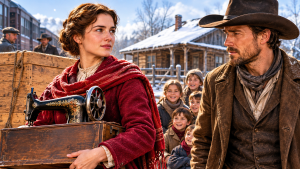
PART 1 — THE WOMAN WHO ARRIVED WITH A SEWING MACHINE…AND THE RED STRIPE THAT WOULD SAVE AN ENTIRE TOWN
He Ordered a Bride for His Struggling Ranch—But When She Stepped Off the Train With a Giant Wooden Crate,
He Almost Sent Her Back.
Months Later, That Crate Would Save 23 Children From Freezing to Death.
On October 2, 1887,
a lonely Nebraska rancher stood on a railroad platform waiting for the woman he had agreed to marry.
He expected a modest trunk, a nervous smile,
and perhaps a few personal belongings. Instead,
he got a woman who arrived with a wooden crate nearly the size of a coffin.
And what was inside that crate would change the fate of an entire town.
The stationmaster swore under his breath when he saw it.
Two porters and a freight boy struggled to unload the enormous pine box from the Union Pacific train at Plum Bluff,
Nebraska. Rope was wrapped around its sides,
and the name of a Chicago sewing machine company was stamped across the wood.
Standing at the far end of the platform was Halvor Ingram,
a 34-year-old rancher with tired eyes, a patched coat,
and a hat clutched nervously between his hands.
He had written an advertisement asking for a wife.
He hadn’t asked for a sewing business.
Then Odessa Brandt stepped down from the train.
She wasn’t dressed like a wealthy woman. Her trunk was small and worn,
her clothes were practical,
and her face carried the quiet determination of someone who had worked hard for everything she owned.
She walked straight toward him and offered her hand. “Mr.
Ingram. I am Odessa Brandt.”
Then, before he could ask about the enormous crate, she explained.
Inside was her Singer treadle sewing machine, complete with its cabinet,
spare needle bars, and bobbins.
And she had absolutely no intention of leaving it behind.
“It came before I did,” she told him.
“It paid for my ticket and it goes where I go.” Halvor stared at her.
Then he looked toward the crate. He had a two-room house,
a struggling ranch, and more debt than he cared to admit.
The previous winter had killed a third of his cattle.
He couldn’t afford luxuries.
And he certainly hadn’t expected his new bride to bring
something that required more space than most furniture.
Finally, he told her he had written for a wife, not a dressmaker’s shop.
Odessa didn’t raise her voice.
She simply answered that it was fortunate a sewing
machine didn’t need feeding at his table. Then she offered him a choice.
If he wanted to send her back east, she would go. She wouldn’t argue.
But she asked him for one day to prove she could be useful.
One day. That was all.
Halvor studied her for a long, uncomfortable moment.
Then he put on his hat, walked toward the freight wagon,
and helped arrange for the crate to be loaded.
“The machine will have to stay in the barn,” he told her.
Odessa nodded. “The barn will do very well.”
They were married that morning by the local justice of the peace,
with the stationmaster serving as witness.
And together they headed toward Halvor’s ranch, eleven miles north of town.
Neither of them understood that a few months later,
the people of Plum Bluff would owe their lives to the very machine Halvor almost refused to bring home.
But to understand why Odessa guarded that machine so fiercely,
you have to understand what her life had been before she arrived.
For eight years, Odessa had worked as a seamstress in Milwaukee.
She had sewn approximately 1,100 coats. Beautiful coats.
Expensive coats.
Coats for prosperous families who could afford warm wool
and careful tailoring. Yet not one of those coats belonged to her.
Every winter,
she had walked back to her cold boardinghouse wearing an old shawl she had repaired so many times it seemed to consist more of stitching than fabric.
Her father, a tailor, had died when she was seven.
Her mother had taught her to sew before she could read properly.
By twelve,
Odessa was earning four dollars a week and sending three dollars home.
When her mother died of lung fever,
Odessa was nineteen and left with funeral debt that took years to repay.
She understood hunger. She understood loneliness.
And she understood what it meant to work until your
hands ached while having almost nothing to show for it.
That sewing machine represented something different. Freedom.
She had paid five dollars a month toward it for three years,
sometimes skipping meals to make the installments.
When the final payment was made, she held the receipt against her chest.
For the first time, her work belonged to her.
But she still wanted a home. A place where she was needed.
A place where she could work for people whose faces she knew.
Then she saw Halvor’s advertisement in a Chicago newspaper.
He wanted a wife willing to share a hard life on a Nebraska ranch.
He promised to ask only for honesty and goodwill. Odessa wrote back.
Through the summer, their letters passed between them.
And eventually she boarded the train.
There was only one thing she hadn’t mentioned. The machine.
She feared he would reject her before they ever met.
So she decided to bring it and trust that he would give her a chance.
At the ranch, their beginning was awkward.
Halvor gave Odessa the bed and slept on a bench beside the stove.
He cleared a dry corner of the barn for her machine.
She began repairing everything in sight. Curtains. Furniture.
Shirts. Then one evening she noticed the coat worn by Colm Rooney,
the nineteen-year-old orphan who helped Halvor with the cattle.
The boy’s jacket was badly torn. Its lining was almost gone.
One sleeve had a hole large enough for Odessa to push her fist through.
She took it from him and repaired it that night. By then,
Halvor had carried her sewing machine into the kitchen because the barn was too cold for her fingers.
And for the first time in eleven years,
the Ingram house was filled with the steady sound of a sewing machine.
Something began to change. Not just in the house. In the district.
Whenever Odessa accompanied Halvor into Plum Bluff,
she noticed something troubling.
The children were poorly dressed for winter.
Many wore scarves instead of proper hats.
Women wrapped themselves in shawls when they needed thick coats.
Families were waiting for winter supplies that hadn’t arrived.
The local merchant, Ezra Pell,
had ordered ninety coats and two hundred blankets from Omaha.
But a damaged railroad bridge had stranded the shipment.
Nobody knew when it would arrive.
And the weather was turning dangerously cold. On November 19,
the temperature dropped so sharply that water froze solid in the ranch trough.
Odessa looked toward the pale Nebraska sky.
She knew the district was in trouble. Then Dagny Lindquist,
a sheep rancher’s wife from the neighboring valley,
arrived with a worn-out coat belonging to her eldest son.
The boy had outgrown it. The elbows were nearly threadbare.
Dagny hoped Odessa could somehow make it last another winter.
Odessa studied the fabric. Then she looked up. She had an idea.
And that idea began with something nobody else wanted.
In the storeroom of Pell’s Mercantile,
Odessa found 260 heavy gray army-surplus wool blankets.
Pell had purchased them at a government sale two years earlier.
They had sat unsold ever since.
They were too heavy, too dull, and too unattractive for most customers.
But Odessa saw something different. She saw warm winter coats.
Two hundred and sixty of them.
She offered to buy the blankets at Pell’s original cost,
then turn them into long, hooded coats lined with donated flannel.
When she explained her plan to Halvor, he wasn’t pleased.
He believed a husband should provide for his household
without sending his wife to work for the neighbors. Odessa listened.
Then she quietly explained that she wasn’t trying to
become the district’s hired seamstress.
She wanted to work alongside the community, in her own home,
with her own machine.
And more than anything, she wanted to make coats for people she actually knew.
Halvor said very little. But before sunrise the next morning,
Odessa discovered that he had moved the kitchen table into the barn loft.
He had brought up chairs and a lantern.
He had covered the window to stop the drafts. He had made room.
Odessa laughed.
It was the first time Halvor had heard her laugh so freely in his house.
Soon six local women were helping her. Then thirty.
The barn loft became a workshop filled with wool, thread,
lamplight, and the rhythmic sound of her Singer machine.
Some women cut fabric. Others stitched linings. Others assembled hoods.
Their first finished coat went to Colm Rooney.
It was long, heavy, warm, and made especially for him.
When he tried it on, the women cheered.
The young orphan stood there quietly before admitting it
was the first coat he’d ever owned that hadn’t belonged
to somebody else. And then Odessa made one small alteration that would
later prove more important than anyone imagined.
She stitched a broad red stripe down the back of every gray hood.
Five inches wide. From the crown to the collar. Why?
Because she had been thinking about winter storms.
Gray disappeared against snow. But red could be seen.
She wanted anyone wearing one of her coats to be easier to find.
By mid-December, 140 coats were finished.
Twenty-three smaller coats had been made for the
children of Plum Bluff School. The women continued working.
Even Ezra Pell offered supplies on credit. Then, on January 11,
1888, the sky over the Nebraska Sandhills turned a strange yellow.
The wind suddenly died. And by three o’clock that afternoon,
snow was blowing sideways across the open prairie.
Within hours, the roads disappeared. The fences disappeared.
Even the hills vanished behind walls of white.
Halvor and Colm were out moving cattle when the storm struck.
Somewhere in the blinding snow, the two men became separated.
Odessa waited at the ranch, lighting every lamp she owned.
Then terrible news reached the district.
The Plum Bluff schoolhouse was running out of coal.
Inside were twenty-three children and their teacher.
Outside was a blizzard so fierce that parents couldn’t
even see the buildings on their own property. A rescue party formed.
The men tied themselves together with rope and stepped into the storm.
Every one of them wore a gray hooded coat.
Every hood carried Odessa’s red stripe.
And out on the frozen prairie, Halvor was desperately searching for Colm.
The nineteen-year-old had fallen somewhere near the creek.
The drifting snow was already covering him.
Halvor searched almost blindly, fighting the wind,
knowing that every passing minute reduced the boy’s chance of survival.
Then, through the swirling white, he saw something. Not a face.
Not a hand. Not even the outline of a body. Just a tiny flash of red.
It was Colm’s hood. The boy was buried beneath the snow.
And Halvor had almost walked right past him.
That was the moment a five-inch strip of red flannel
became the difference between life and death.
But the storm was not over.
Twenty-three schoolchildren were still trapped.
The rescue party was fighting its way through the whiteout.
And Odessa had no way of knowing whether the husband who
had once told her there was no room for her sewing
machine would ever come home.
PART 2 — THE RED STRIPE IN THE SNOW: HOW ONE WOMAN’S SEWING MACHINE SAVED A TOWN AND CHANGED A RANCHER’S HEART FOREVER
The tiny flash of red was almost swallowed by the blowing snow.
For one terrible moment,
Halvor Ingram could barely believe what he was seeing.
The prairie around him had disappeared.
The creek was hidden beneath drifts. The fences were gone.
The familiar hills of his own ranch had vanished into a
white emptiness that gave him no sense of direction.
Somewhere out there was Colm Rooney. Nineteen years old.
An orphan.
A boy who had worked beside Halvor through seasons of drought,
bitter cold, and exhausting days in the cattle pastures.
And now he was missing in a storm that could kill a man
before anyone knew he was gone.
Halvor had been searching through the blizzard when that
small bit of red caught his eye. Twenty feet away,
almost buried beneath the snow,
was the broad red stripe Odessa had sewn onto Colm’s hood.
The same stripe she had insisted on adding to every coat.
At the time, it had seemed like a thoughtful little detail.
Something practical.
Something a careful seamstress might do because she knew
the importance of making things properly.
But now that strip of fabric was the only visible sign
of a human being beneath the snow. Halvor rushed toward it.
He fell to his knees and began digging with his bare hands.
The snow was packed around Colm’s body.
Wind continued sweeping across the ground,
threatening to cover the boy even as Halvor struggled to uncover him.
There was no time to look for a shovel.
No time to think about the cold biting into his fingers.
Halvor dug until he could reach Colm.
And when he pulled the boy free, he discovered that Colm was still alive.
Cold. Weak. Shivering. But alive.
The boy’s heavy wool coat had helped protect him from
the worst of the freezing wind. Its deep hood had covered his head,
and the red stripe had made him visible when almost everything else had disappeared into the white.
Halvor lifted Colm across his shoulder.
Then he began the long struggle home. A mile.
In ordinary weather, a mile across the ranch was hardly worth mentioning.
A man could walk that distance while thinking about the day’s work.
But in a Nebraska blizzard, a mile could become an almost impossible journey.
The snow blew across Halvor’s face. His beard filled with ice.
The wind pushed against him.
And across his shoulder was a young man whose life
depended on reaching shelter. Halvor kept going.
Behind that determination was something more than
responsibility for a ranch hand.
Colm had no family waiting for him in a warm house.
He was an orphan who had found his place working alongside Halvor.
The two men had endured the previous terrible winter together.
They had hauled hay through freezing weather and watched
cattle die despite their efforts. They understood each other’s silence.
They knew what it meant to keep working even when there
was little reason to believe their luck would change.
Halvor had lost sixty cattle the winter before.
He was not going to leave Colm in the snow if there was
any chance of bringing him home.
At the Ingram house, Odessa was waiting.
She had lit every lamp she owned and placed the lights
where they could be seen from outside.
Then she had sat at her sewing machine.
The machine’s steady rhythm filled the small kitchen
while the storm raged beyond the walls. Her hands needed work.
She could not search the hills herself.
She could not control the weather.
She could not know where Halvor and Colm were.
But she could keep the lamps burning.
And she could keep her hands occupied while she waited.
For Odessa, the fear of losing someone to winter was not new.
Years earlier, she had lost her mother to a lung fever.
She remembered the helplessness of watching someone she
loved slip beyond her reach. Now, in this unfamiliar country,
the man she had married only three months earlier was somewhere in a storm that had erased the world beyond the windows.
And with him was a boy she had already come to care for.
The boy whose torn jacket she had mended during her first weeks on the ranch.
The boy for whom she had sewn the very first of the new winter coats.
Outside, the storm continued.
Then, through the white, Halvor finally reached the house.
When the door opened,
he stood there with snow packed into his beard and Colm draped across his shoulder.
The boy was shivering. Halvor was exhausted. But both were alive.
Odessa did not greet them with a long speech.
She did not ask Halvor why he had taken so long.
She did not remind him that she had been the one who
thought to put the red stripe on the coats. She simply reached for Colm.
Then she wrapped her arms around both men.
For a moment, the three of them stood together in the warmth of the kitchen.
Water dripped from their clothes. Their breathing filled the silence.
And outside the door, the wind continued howling.
It was a small moment in a small house.
But for Odessa, Halvor, and Colm, it meant everything.
They had come through the storm alive.
And the little machine that had once seemed too large
for their home had helped make it possible.
## The Twenty-Three Children Waiting in the Cold While Odessa was welcoming Halvor and Colm home,
the rest of Plum Bluff was facing its own desperate struggle.
The schoolhouse had become a trap.
Twenty-three children and their teacher, Ottoline Fenwick, were inside.
The coal was running out.
The storm had arrived so suddenly and grown so violent
that parents could not safely reach the school.
The prairie between the schoolhouse and the surrounding
homes had become a maze without landmarks.
In that kind of weather, familiar distances meant nothing.
A person could become lost between two buildings.
A rancher who had crossed the same stretch of land
hundreds of times could lose his bearings within minutes.
The snow hid the roads,
and the wind made it impossible to see far enough ahead to recognize the way home.
For the families of Plum Bluff,
the knowledge that their children were trapped was almost unbearable.
The children had gone to school as they did on ordinary mornings.
Their parents had expected to see them again at the end of the day.
But now those parents were separated from their sons and
daughters by a storm that made ordinary travel deadly.
It was not enough to know where the schoolhouse stood.
The rescuers had to reach it.
And then they had to bring the children home.
The district men organized themselves into a line.
They used rope to stay connected while moving through the whiteout.
Each man wore one of the heavy gray coats made in the Ingram barn.
Each hood bore the same broad red stripe.
Odessa had chosen that stripe because she knew the color
of the coats would disappear against the snow.
She wanted people to be visible.
She wanted someone walking behind another person to have
something bright to follow. Now that simple choice became critical.
In the storm, visibility shrank to almost nothing.
The men could barely see ten feet ahead. The wind struck their faces,
and the blowing snow erased the difference between earth and sky.
But the man following behind could make out the red band
on the hood in front of him. A strip of red. Five inches wide.
That was enough to help keep the line together. And when the line broke,
the red markings helped the men locate one another again.
No elaborate equipment had been needed to create those markings.
No costly materials. Only donated flannel, a sharp needle,
a sewing machine,
and a woman’s understanding of what might happen when gray wool met white snow.
Every coat worn by those rescuers represented hours of work in the barn loft.
Every seam had been cut, fitted,
and stitched by women who knew the families of the district.
The coats had begun as unwanted army blankets stacked in
the back of a general store.
Now they were protecting men who had gone into a deadly
storm to save children.
There was something extraordinary about that transformation.
What had once been useless stock was now essential equipment.
What had once seemed like ordinary women’s work was
The sewing itself had not changed
The sewing itself had not changed.
But the meaning of the work had become impossible to overlook.
For three days the storm held the Sandhills in its grip.
The rescue effort continued through conditions that made
every movement dangerous.
And when the storm finally broke on the fourth morning,
the result was almost unbelievable.
All twenty-three schoolchildren had been brought safely home.
They had been transported by sled,
wrapped in the heavy blanket coats with the red stripes.
Every child survived.
Not one family in the district had lost a person to the cold.
The rescue had required courage, cooperation,
and determination from the men who went into the storm.
It had required the children and their teacher to endure
frightening hours in the freezing schoolhouse.
It had required families to hold on while they waited for news.
But it had also depended on the coats. Warm coats. Strong coats.
Coats made from material everyone had overlooked.
And coats marked with red stripes that helped rescuers
remain visible to one another.
A Creek Bottom rancher named Abner Voss would tell the
story for years afterward.
He had nearly lost his way toward the Elkhorn River.
In the blinding conditions, he might have continued in the wrong direction.
Then he saw a bit of red through the snow. He followed it.
And he found his way home. For Abner,
that little stripe was not merely an interesting feature of his winter coat.
It was the reason he had survived. The same was true for Colm Rooney,
whose hidden body Halvor had found because the red band remained visible above the drift.
And for the twenty-three schoolchildren,
the coats had helped make their journey out of danger possible.
By the time the storm passed,
Odessa’s work had touched lives far beyond the little house where she had first unpacked her belongings.
Yet Odessa herself had not been standing before the town
asking for recognition. She was at the ranch. Working. Waiting.
Doing what she had always done.
And she had no idea what was coming next.
## Forty Wagons Appeared at the Ranch On the first clear morning after the blizzard,
Odessa was standing beside the stove. There was flour on her sleeves.
The house was warm.
Outside, the Sandhills lay beneath a deep blanket of snow.
The storm that had filled the world with noise had
finally given way to stillness. Then people began arriving.
At first,
the sight of a wagon approaching the ranch might not have seemed unusual.
Neighbors visited one another. Families helped during emergencies.
But this was no ordinary visit. More wagons followed. Then sleds.
Then still more wagons.
They climbed toward the Ingram house in a long procession.
By the time everyone arrived, there were forty wagons and sleds in the yard.
Odessa could hardly understand what she was seeing.
The people of Plum Bluff had come to her home. Ezra Pell,
the merchant whose unsold blankets had become winter coats,
stood at the front of the gathering.
Beside him were Dagny Lindquist and Ottoline Fenwick.
Ottoline’s face still showed the strain of the terrible
days she had spent trapped in the schoolhouse with
twenty-three children. Abner Voss had come from Creek Bottom.
Other ranchers were there.
So were the old men who usually gathered near Pell’s store.
Mothers stood with children wearing little gray coats.
On every hood was the familiar red stripe. The sight alone told a story.
Here were the people Odessa had seen shivering through early winter.
Here were the families who had been waiting for a
shipment of coats that never arrived.
Here were children who might otherwise have faced the storm in thin jackets,
worn scarves, and inadequate clothing.
Now they had gathered in the Ingram yard.
Not because they needed another coat.
But because they wanted to thank the woman who had helped keep them alive.
The gathering moved into the house. People filled the kitchen.
They stood on the porch. They crowded the yard.
And one by one, they began placing gifts on Odessa’s table.
Someone brought eggs. Someone brought a ham.
There was a jar of preserves. A pair of knitted mittens.
A handkerchief knotted around eleven silver dollars.
And then there was a child’s drawing.
It showed a woman sitting at a sewing machine.
The child had drawn the sun coming out of her head.
To a stranger, it might have looked like a simple child’s picture.
But to Odessa, it represented something no expensive gift could have replaced.
The children of the district knew what she had done.
They had seen the coats. They had worn them.
They had come home wrapped in them.
And one child had found a way to express that gratitude with pencil and paper.
Odessa stood in the middle of the room with her hands over her mouth.
For a woman who had spent years working behind the scenes,
this kind of attention was almost impossible to comprehend.
In Milwaukee,
she had sewn coat after coat for customers who might never have known her name.
She had spent eight years making clothing for strangers.
Eleven hundred coats. She had counted them once in a private ledger.
Eleven hundred pieces of work. And not one of those coats had been hers.
Now she looked around her own kitchen and saw the people
who had worn the coats she had made. They were not anonymous customers.
They were neighbors. Friends. Children. Families.
People whose names she knew.
And they had come not simply to pay for garments.
They had come to tell her that her work mattered.
Ezra Pell stepped forward.
The merchant was not a man known for extravagant displays of emotion.
He was practical, cautious,
and accustomed to measuring business in stock, receipts,
and ledgers. But even he could not ignore what had happened.
He had brought an account of the coats distributed throughout the district.
At his store,
families who had received coats had recorded what they could contribute.
Some had money. Others could offer eggs or supplies.
Some could provide labor. Not everyone had the same resources,
but everyone understood that the work had value.
And when the contributions were counted,
the total amounted to more than six hundred dollars.
For Odessa, this was astonishing.
She had never imagined that an effort begun with unused
blankets and donated fabric would produce such a sum.
She tried to refuse.
Her work, she insisted, had mostly cost labor and flannel.
She had been happy to help.
She did not regard the coats as a debt the community owed her.
She had seen a need. She had known how to meet it.
And she had gathered the women of the district to make something useful.
That was how she understood what had happened.
But the people standing in her kitchen understood it differently.
They had seen their children return from the storm.
They had seen neighbors survive.
They had watched the difference between adequate
clothing and dangerous exposure become a matter of life and death.
They did not want Odessa to think of her work as
something that could be dismissed because it had come naturally to her.
Dagny Lindquist stepped forward and placed a large hand on Odessa’s shoulder.
Dagny was the woman who had first arrived at the ranch
with her eldest son’s worn-out coat.
She knew exactly where this story had begun.
She also knew what might have happened without Odessa’s idea.
And she made Odessa understand that the mothers in that
kitchen had children at home who might have died in the
storm without the coats. The work mattered. The time mattered.
The skill mattered. The lives protected by that work mattered.
Odessa could not simply wave away what the district had received.
But there was still something more. Something she had never expected.
Something that would change Halvor’s life as profoundly
as the storm had changed the town.
Ezra Pell placed a clean paper receipt on the table.
It came from the Plum Bluff Bank.
And it showed that a debt of four hundred and twelve
dollars had been paid in full. The Ingram ranch’s debt.
The note Halvor had inherited from his father.
The obligation that had hung over the property for eleven years.
Paid. In full.
## The Debt That Had Haunted Halvor for Eleven Years To understand what that receipt meant,
it is necessary to understand what Halvor had been carrying long before Odessa arrived.
He had inherited the Ingram ranch at twenty-three.
It was not an easy inheritance.
The property stood in a hollow among the Nebraska Sandhills,
eleven miles north of Plum Bluff.
There were eleven hundred acres of grassland. A small two-room house.
A barn that leaned toward the east.
And a bank note his father had signed to purchase breeding cattle.
Halvor had inherited the land and its possibilities.
But he had also inherited the debt. For eleven years,
he had tried to make the ranch profitable enough to settle that obligation.
Every season depended on things no rancher could fully control.
Rain. Grass. Cattle prices. And winter. A good year might offer hope.
A bad year could take away years of progress.
Then came the terrible winter before Odessa arrived.
The autumn had been dry. The freeze had begun in November.
And the bitter weather had not lifted until March.
Halvor and Colm had hauled hay to the cattle until their
hands cracked and bled. Still, they lost sixty head.
A third of the herd was gone.
For Halvor, that loss was not simply a matter of livestock numbers.
The cattle represented the ranch’s ability to recover.
They represented income that might have paid the debt.
They represented years of effort and the hope that the
land could eventually provide a secure home.
When the herd was reduced so drastically,
the possibility of losing everything became painfully real.
Then the bank sent its notice.
The four-hundred-and-twelve-dollar balance would be due in full on March 1,
1888. Halvor had stood at the kitchen table reading the letter.
Afterward, he folded it into a small square and placed it in the stove.
Burning the letter could not erase the debt.
But it was all he could do with his anger and helplessness at that moment.
The ranch was in trouble. And Halvor had no easy solution.
That was the man Odessa had met on the railroad platform in October.
A man who was not merely lonely.
A man who was exhausted by responsibility.
A man who had spent eleven years trying to hold together
what his father had left him.
A man who had promised his dying mother that he would
not let the place grow cold. He wanted a wife.
He wanted someone who might share the loneliness and the work.
But he had become so accustomed to scarcity that he
struggled to imagine anything new entering his life
without adding another burden.
When he saw Odessa’s enormous crate, his first thought was not of opportunity.
It was of space. Expense. Trouble.
Another thing to accommodate when he already felt he
could barely manage what he had. So he said there was no room.
And now, a little more than three months later,
the very machine he had nearly rejected had helped eliminate the debt threatening his ranch.
The irony was almost too much to comprehend.
For years, Halvor had depended on his cattle to rescue the property.
He had thought the solution, if there was one, must come from the land.
More livestock. Better weather. A stronger herd. A profitable season.
Instead,
the debt had been paid because a woman arrived with a sewing machine and recognized the value of old blankets.
The bank receipt proved it. Four hundred and twelve dollars.
Paid in full. The remaining account balance was recorded under both
Halvor’s and Odessa’s names.
The land was no longer under the same financial shadow.
The note was gone.
And the town had done it as a way of honoring Odessa’s work.
As Odessa stood in the crowded kitchen, she was overwhelmed.
She had never planned to save the ranch by sewing coats.
She had not expected the town to gather money on her behalf.
She had only wanted to be useful. To protect children from the cold.
To make warm garments for families who needed them.
Now she was being told that what she had done was worth
more than six hundred dollars in money and contributions.
And that the community had used part of that value to
free her husband’s ranch from debt.
After the gifts were delivered and the words of thanks were spoken,
the visitors began to leave.
One by one, they returned to their wagons and sleds.
The kitchen slowly emptied. The porch cleared.
The long line of vehicles made its way down the hollow.
Then the house was quiet again.
Odessa remained surrounded by the things the visitors had brought. Eggs.
Food. Mittens. Money. The child’s drawing. And the bank receipt.
The silence after so many voices was extraordinary.
But there was one person whose response she had not yet heard.
Halvor.
He had stood in the corner during the gathering with his arms folded.
He had listened. He had watched the people of Plum Bluff honor his wife.
And now, with the last visitors gone, he crossed the kitchen.
He picked up the receipt. He read it once. Then he read it again.
The note was paid. Eleven years of worry.
Eleven years of trying to make the ranch profitable
enough to satisfy the bank.
Eleven years of measuring the future against a debt he
could not seem to escape. Gone.
Halvor placed the paper carefully on the table.
Then he walked out to the barn. Odessa watched him through the window.
He stood near the barn door for a long time.
And his shoulders were shaking.
This was a man who had spent years enduring hardship quietly.
He had buried cattle beneath the snow.
He had lived alone in a two-room house.
He had watched debt and difficult seasons wear away his hope.
He had rarely known how to express what he felt.
But now, standing outside the barn, he could no longer hold everything inside.
Odessa did not need him to explain. She understood. The ranch was safe.
And the man who had almost sent her away because there was no room for her sewing machine was standing in the snow,
overcome by what that machine had helped accomplish.
## The Apology He Had Been Carrying Since October That evening,
after supper, Halvor asked Odessa to sit with him beside the stove.
The storm was over.
Outside, the snow lay deep and still beneath the stars.
The wind that had roared across the Sandhills now moved
in little more than a whisper. Inside, the lamp burned low.
Halvor sat holding his hat.
It was the same nervous habit Odessa had noticed on the
railroad platform when they first met.
He turned it in his hands while he searched for the words he needed.
For a while, he said nothing. Then he told her he owed her an apology.
Not an ordinary apology offered simply to end an argument.
He wanted to make amends for something he had said the day she arrived.
He remembered standing at the station and looking at her crate.
He remembered telling her there was no room for a sewing machine.
And he admitted that he had thought about those words every day since.
The problem, he finally understood, had never been the size of the house.
He had two rooms. A barn with six stalls. Eleven hundred acres of land.
There had been physical space enough to accommodate her machine.
What he lacked was the courage to hope.
Years of struggle had taught him to expect loss.
He had become afraid to believe that something good
might enter his life and remain.
When Odessa stepped off the train with her trunk and the enormous wooden crate,
he saw another problem arriving. He could not yet see the possibilities.
She had asked for one day. One chance to prove herself.
And he had agreed partly because he would have been ashamed to refuse.
Now he understood that giving her that chance had been
one of the most important decisions of his life. Odessa listened.
She remembered the railroad platform, too.
She remembered how carefully she had spoken while her
fingers tightened around the handle of her trunk.
She had been prepared to turn around and leave if he refused her.
The machine represented three years of installment payments,
missed meals, and hope. It was her livelihood. Her independence.
The one valuable possession she had earned entirely through her own work.
She could not abandon it.
But she had also wanted the chance to build a home with Halvor.
She had wanted him to understand that she wasn’t
bringing a useless luxury into his household.
She was bringing the means to contribute.
He had not understood that immediately.
But she had seen something important in him soon afterward.
The morning after she explained her coat-making plan,
Halvor had risen before sunrise.
He had carried a table and chairs into the barn loft.
He had placed a lantern there. He had covered the drafty window.
He had made a place where she could work.
Odessa reminded him of that morning.
His words had said there was no room.
But his actions had said something else.
A man who carried a table up a ladder at four in the
morning to help his wife had already begun changing his mind.
She had known which part of him would win.
Her eyes filled with tears as she smiled at him.
Then she told him why she had truly answered his advertisement.
It had not been for the ranch. Not for the land.
Not even for the chance to put her machine somewhere
beyond the narrow corner of a boardinghouse room.
She had come because he had written that he wanted a
wife willing to share a hard place.
And Odessa had wanted to share that difficult life with an honest man.
She believed she had found him.
For Halvor, those words meant more than he could easily say.
He had worried that his poverty and the ranch’s
hardships made him an inadequate husband.
He had worried that he had little to offer.
He had worried that bringing someone else into his
struggling household was another obligation he could not fulfill.
But Odessa had never required wealth. She had asked for honesty.
Goodwill. And the chance to build something together.
She had seen that in him even before he could see what
she might bring into his life. Then Halvor kissed her.
For the first time.
It was a slow, careful kiss beside the stove in the quiet kitchen.
Nothing dramatic needed to happen around them.
There was no cheering crowd. No great speech.
Only a man and a woman who had spent three months
learning how to trust one another.
And the understanding that they had finally become more
than two people sharing a roof. They had become partners.
When they drew apart,
Halvor admitted something that brought laughter through Odessa’s tears.
He had continued sleeping on the bench beside the stove
for three months because she had never asked him to do otherwise.
And he told her he would sleep there for a hundred more
if that was what she wanted. Odessa laughed against his shoulder.
She told him she was asking for something else entirely.
And that night, Halvor stayed.
It was a gentle ending to a difficult winter.
The town had survived the storm
The town had survived the storm. The children were home.
And Odessa and Halvor had finally found the closeness
they had both wanted when they began exchanging letters
the previous summer. Yet Odessa’s story was far from finished.
Because the work she began in the barn loft would
continue reaching people for generations.
## The Room He Built Just for Her When spring arrived in Nebraska,
Halvor began building. Not another barn. Not an addition for cattle.
Not a structure devoted to the business of the ranch.
He built Odessa a workroom. It stood on the south side of the house,
with a large window facing the morning light.
Inside was a long worktable. Shelves stretched from floor to ceiling,
providing space for bolts of cloth and sewing supplies.
And in one corner,
Halvor made a place designed to fit her Singer sewing machine cabinet exactly.
Every part of the room had been planned around the work Odessa loved.
It was not a makeshift arrangement.
Not a space she would have to surrender when something else was needed.
It was a room built for her. When Halvor brought Odessa to see it,
he covered her eyes until they reached the doorway.
Then he let her look. Odessa stood silently.
For most of her life, she had worked wherever there was space available.
As a child, she had learned her trade while helping her mother make ends meet.
As a young seamstress,
she had worked in a back room above a Milwaukee cutting house.
Later, she had used a corner of her boardinghouse room.
Every place had been borrowed from someone else’s needs.
Her sewing machine might have belonged to her,
but the spaces around it rarely had.
Then she came to Nebraska and found herself working first in a cold barn,
then in the kitchen, and finally in the loft that Halvor had prepared.
Now she was standing in a bright room built specifically for her.
The difference was enormous.
She crossed the floor and touched the oak cabinet of her machine.
Then she said quietly that no one had ever built a room for her before.
It was a simple statement.
But behind it lay a lifetime of work and sacrifice.
For years, Odessa had made beautiful things for other people.
She had helped create warm clothing, comfortable garments,
and useful possessions that belonged to families with more money than she had ever known.
Now someone had made something for her.
Not because she had purchased it.
Not because she had earned it through a contract.
But because her husband loved her and wanted her to have a place of her own.
Halvor told her that the room had been waiting eleven
years for her to arrive and fill it. In a sense, he was right.
The ranch had been waiting for more than another pair of hands.
The house had been waiting for a different kind of life.
A life in which work was shared.
A life in which one person’s skills could strengthen another person’s efforts.
A life in which the future could be more than a continuation of hardship.
Odessa had brought that possibility with her.
But Halvor had helped it grow by finally making room.
That workroom became a visible reminder of how much had
changed since the railroad platform.
The woman who had once been told her machine must stay
in the barn now had a room designed around it.
And the man who had feared an additional burden had
discovered the value of building a future together.
## The Ranch Began to Recover The years after the storm
brought new stability to the Ingram ranch. The bank debt was gone.
Halvor could devote his efforts to rebuilding the herd
without the same immediate threat of losing the property
to an overdue note. Colm Rooney remained part of the ranch’s work.
Over time, additional hired hands joined them.
The livestock operation recovered.
And the Ingram place became known as one of the steadier
ranches in that part of Nebraska.
This recovery mattered deeply to Halvor.
For eleven years after inheriting the property,
he had struggled to protect what his father had left him.
He had spent his young adulthood measuring every season
against the ranch’s debts and expenses.
The devastating winter before Odessa arrived had nearly broken his prospects.
But the storm of January 1888 had produced an unexpected turning point.
The payment organized by the people of Plum Bluff had
freed the ranch from the old note. Now Halvor could rebuild.
And rebuild he did. His work remained difficult.
Cattle ranching in the Sandhills did not suddenly become
easy because the debt disappeared.
The land still depended on the weather. Grass still had to grow.
Livestock still needed care. Winter still demanded preparation.
But the burden had changed.
Halvor was no longer struggling under the same financial
obligation that had shadowed his life for more than a decade.
And the household was no longer simply a place where one
man returned at the end of a difficult day. It had become a home.
Odessa’s work continued.
Colm’s presence remained part of the ranch’s story.
And the couple gradually built the stable life neither
could have guaranteed when they first met.
Yet something even more lasting was happening beyond the ranch.
Because the barn-loft sewing project had shown Odessa
what was possible when women worked together.
She had begun with six helpers.
By the third week, thirty women had joined the effort.
Some had known how to sew. Others had learned individual tasks.
Each woman had contributed according to her ability.
The finished coats were proof that the work of many
hands could accomplish what no one household could easily manage alone.
And Odessa did not forget that lesson.
## The Little Shop on Main Street In the spring of 1889,
Odessa opened a small sewing shop in Plum Bluff.
It was a bright, narrow room on Main Street.
Halvor painted the sign himself. The shop offered coats and mending.
It was a modest business,
but its importance extended far beyond the garments made inside it.
Odessa had finally established the kind of working life
she had wanted for years.
In Milwaukee, she had been paid to sew for customers she rarely knew.
The work was repetitive. The wages were small.
Much of what she earned disappeared into rent, food, and debts.
Even after purchasing her machine,
she had remained limited by the circumstances around her.
But in Plum Bluff, she owned her work in a different way.
She knew the families. She understood the climate.
She understood what children needed to wear in the winter.
She knew which materials would withstand heavy use and
which repairs would last.
Her skills were no longer serving only a distant employer’s business.
They were serving her community.
And the shop gave her a place to pass those skills to others.
Over the next twenty years,
Odessa trained more than sixty girls from the district in sewing. Sixty.
For a woman who had begun working at twelve and spent years earning a few dollars a week,
this was an extraordinary achievement.
She had learned early that a practical skill could mean
the difference between dependence and independence.
She understood what it meant to earn money with one’s hands.
She understood the dignity that came from being able to
produce something valuable.
And she understood why owning the means of one’s work mattered.
Her Singer machine had represented freedom when she was young.
Now she could help other girls develop the same possibility.
Each girl who learned the trade gained something she
could carry into adult life. A way to earn. A way to contribute.
A skill that could remain useful through changing circumstances.
The young women were not simply learning how to stitch fabric.
They were learning work that had sustained Odessa through poverty,
helped her cross the country,
and eventually changed the fortunes of her household.
She knew its value because she had lived it.
And she wanted them to have that value too.
The shop’s success was not measured only in the number
of coats repaired or sewn.
Its lasting significance lay in the people Odessa trained.
More than sixty girls.
More than sixty futures touched by the skill she had
once learned from her mother.
The same skill that her mother had used to provide for
her after her father’s death.
In that way, the work connected three generations.
A mother teaching her daughter out of necessity.
A daughter using the trade to build an independent life.
And that woman teaching many more young people so they
could make their own way.
The story of Odessa’s sewing machine had become much
larger than the machine itself.
## The Winter Coat That Became a County Tradition The
town’s gratitude did not end with the gathering of forty wagons.
During the first winter after the blizzard,
the county commissioners added money to the school budget for winter coats.
The provision was intended to help any child who needed one.
It was a practical recognition of what the district had
learned during the storm. Warm clothing was not an unnecessary luxury.
For children living in the Nebraska Sandhills,
it could be essential to survival.
The winter of 1888 had exposed the danger of depending
on uncertain freight deliveries and whatever worn
garments families could repair or hand down.
The arrival of severe weather could make those shortages deadly.
The coats sewn in Odessa’s barn had helped address the immediate crisis.
But the community now understood that children would
need proper winter clothing every year. Not only during an emergency.
Not only when a blizzard was already approaching. Every winter.
Odessa wrote the pattern for the county coats herself.
She already knew what worked.
The coats needed to be long enough to protect a child’s body.
The wool needed to be warm.
The hoods needed to shelter heads and ears from the wind.
The seams needed to hold through hard use.
And the familiar red stripe remained an important part of the design.
That stripe became something more than a safety marking.
Over time, it became a symbol of the region. For a generation,
a child wearing a gray hooded coat with a red band was recognized as belonging to the Sandhills community.
The coat represented warmth. But it also represented care.
Somebody had thought about that child’s safety.
Somebody had helped provide the clothing.
Somebody had decided that children should not face
winter without protection simply because their families
could not afford expensive coats.
The red stripe was a reminder of a winter when neighbors
had worked together to keep one another alive.
It connected the schoolchildren who wore it to the women
who had first gathered in the Ingram barn.
It connected them to the rescuers who had followed red
markings through the blizzard.
And it connected them to the belief that no child should
be invisible when danger came. The original idea had been simple.
Gray disappears against white. Red can be seen.
But the meaning grew with every year.
A strip of fabric that had once helped men find one
another in a storm now identified a community that had
learned the importance of watching out for its people.
Odessa could hardly have imagined that future when she
first sat alone in the barn loft cutting red flannel into strips.
She had not been trying to create a tradition.
She had been trying to keep people safe.
And because the idea worked, the community carried it forward.
## From Two Rooms to Seven The Ingram house changed over the years, too.
When Odessa arrived, it had only two rooms.
Halvor had been so worried about space that he initially
wanted her sewing machine kept in the barn.
He had slept on a bench by the stove.
The house had been quiet for years,
filled mostly with the sounds of wind and ranch work.
But life did not remain that way.
Odessa and Halvor eventually had four children. The house expanded.
Two rooms became seven. And the family developed its own traditions.
Every winter, when the first hard frost arrived,
the family climbed to the barn loft to inspect the coats.
That loft had once been a place for hay and storage.
Then it had become the busiest sewing room in the district.
Women had gathered there during the winter of 1887,
cutting old blankets and stitching warm clothing under the glow of lanterns.
The rafters had held rows of finished coats.
The sound of the treadle machine had filled the air.
And the first red stripes had been sewn there.
For Odessa and Halvor, the loft was part of the family’s history.
It represented the beginning of their partnership.
The first great work they had shared.
The winter that had tested their marriage and strengthened it.
And the astonishing way the community had responded.
The yearly inspection of coats connected their children to that history.
It kept the purpose of the work alive. Winter was still winter.
The Sandhills could still become dangerous when the weather turned.
Warm clothing still mattered.
And the family remembered the lesson Odessa had learned
long before she reached Nebraska.
Useful work was never something to be ashamed of.
It was one of the ways people cared for one another.
The growing house reflected the life the couple had built. Children.
Work. A recovering ranch. A sewing room.
A family gathered around the warmth of a home that had
once seemed too small for one additional possession.
The man who had said there was no room had eventually
made room for much more than a machine.
He had made room for Odessa’s work. For a partnership. For children.
For a future.
And for the kind of happiness he had nearly stopped believing was possible.
## The Brass Plate Above the Hearth There was one object
in the Ingram home that remained especially important to Odessa.
It was not a piece of expensive jewelry. Not a fine dress.
Not a luxury purchased after the ranch began to prosper.
It was a small brass plate.
Ezra Pell had commissioned it from a Chicago engraver in the spring of 1888.
The inscription was simple.
THE TOWN OWES YOU EVERYTHING And beneath those words,
in smaller lettering: WE KNOW WE CANNOT REPAY IT.
The message was direct.
It expressed what the people of Plum Bluff had felt when
they gathered at the Ingram ranch after the storm.
They had brought money and food. They had paid the bank note.
They had tried to compensate Odessa for her skill and labor.
But they knew that no payment could fully represent the value of a life saved.
A parent could replace a lost coat.
A rancher might replace a damaged wagon.
A family could rebuild a fence or repair a roof.
But the children brought home from the blizzard could not have been replaced.
Neither could the men who had found their way through
the storm by following the red markings.
No amount of money could equal the relief of seeing a loved one return alive.
That was what Pell’s inscription acknowledged.
The district had found a way to repay some of the
material value of Odessa’s work.
But its deeper gratitude went beyond accounting.
Odessa placed the brass plate on a shelf above the hearth.
She positioned it where her sewing machine could see it.
It was a curious choice. The machine could not read.
It could not understand the words.
Yet Odessa seemed to regard it as part of the history being honored.
After all, the machine had traveled with her from Milwaukee.
It had stood in her boardinghouse room.
It had represented years of sacrifice.
It had crossed the country in the enormous wooden crate.
It had been carried into the Ingram barn and then into the kitchen.
And it had stitched the coats that changed everything.
The plate belonged near it.
For sixty years, Odessa kept that little brass reminder.
She never entirely believed the town owed her everything.
That was not how she thought about her work.
She remembered the women who had helped her.
Dagny and her sisters-in-law. Ottoline Fenwick.
The widows from the creek bottom.
The many hands that had cut, basted, lined, and assembled the coats.
She remembered Ezra Pell,
who had supplied materials and organized the payments.
She remembered the men who had gone into the blizzard to rescue the children.
She knew she had not acted alone.
But the town understood something Odessa was reluctant to claim.
The effort had begun because she saw a possibility nobody else had recognized.
She saw coats where others saw unwanted blankets.
She saw a workshop where Halvor saw an old barn loft.
She saw practical value in bringing women together.
And she saw the importance of a red stripe in a country
where winter could erase the landscape.
Her skill had made the work possible.
Her determination had organized it.
And her attention to one apparently small detail had helped save lives.
The brass plate did not celebrate wealth or status.
It celebrated usefulness.
And that made it the most fitting tribute Odessa could have received.
## The Story She Told Her Granddaughters As the years passed,
the people who had survived the terrible winter of 1888 grew older.
Children became adults. Families changed. The ranch continued.
The little shop on Main Street became part of the district’s history.
And the red-striped coats remained familiar throughout the Sandhills.
But Odessa did not allow the story of that winter to disappear.
Whenever a granddaughter asked about the brass plate above the hearth,
she explained what it meant. She began with the railroad platform.
October 2, 1887. The great pine crate. The stationmaster.
The rancher standing with his hat in his hands.
And the uncomfortable moment when Halvor told her there
was no room for the machine. She remembered asking for a single day.
Just one chance. Then she told how the machine came to the ranch.
How it began mending worn clothing.
How she discovered the district’s shortage of winter coats.
How Dagny arrived with her son’s old garment.
How the heavy gray army blankets became something worth
far more than their purchase price.
She spoke of the women in the barn loft. The rows of coats.
The small garments made for the schoolchildren.
And the broad red stripes sewn down the backs of the hoods.
Then she told of the storm. The terrible wind. The missing ranch hand.
The children trapped in the schoolhouse.
The rescuers struggling through the whiteout.
And the little bit of red that helped Halvor find Colm
buried beneath the snow. For the younger generations,
these stories connected the family to a past they had not personally experienced.
It was difficult to imagine what the Ingram ranch had
been like when their grandparents first met. They knew a larger house.
A stable family. A history of work and community ties.
But the story of the crate reminded them that none of
those things had been guaranteed.
Their grandmother had arrived with very little.
Their grandfather had been burdened by debt.
The story also reminded them that great changes do…
The story also reminded them that great changes do not
always begin with grand gestures. Sometimes they begin with a repair.
A worn-out coat. An overlooked pile of blankets.
A woman who refuses to abandon her tools.
Or a man who makes space for someone else’s work.
Odessa taught her granddaughters the lesson she believed
was at the heart of it all. “Work is love made visible.”
Those were the words later associated with the poet Kahlil Gibran.
But Odessa had lived the meaning long before she knew the phrase.
For her, work had always been connected to care.
Her mother had worked to support her as a child.
Odessa had worked to repay the funeral debt after her mother’s death.
She had worked to purchase her machine and build an independent life.
And in Nebraska, she had worked to keep children and neighbors warm.
The same act—sewing—had taken on different meanings at
different times in her life. At first, it was survival.
Then independence. Then partnership. Then service.
And finally, a legacy passed from one generation to the next.
The little brass plate reminded her granddaughters that
the community had recognized what she had done.
But the story itself taught something deeper.
The most important work is not always the work that
receives the greatest attention.
And some of the most valuable things people create are
not measured by their selling price.
A coat might be worth only a certain number of dollars in a store.
But in the middle of a blizzard, that same coat might become priceless.
## What Halvor Learned From a Woman With a Wooden Crate Of all the people changed by Odessa’s arrival,
Halvor may have undergone the most personal transformation.
When he first stood at the Plum Bluff station,
he saw the heavy crate before he saw the woman approaching him.
That detail mattered.
He was so accustomed to thinking in terms of burdens
that his first reaction was to calculate what the box would require.
Space. Effort. Accommodation.
He could not immediately imagine what it might contribute.
Odessa, however, understood its value.
For three years, she had sacrificed to purchase the machine.
She knew what it could do.
She knew how much faster and stronger her work could be when she used it.
And she knew that giving it up would mean surrendering a
hard-won part of her independence.
That was why she refused to leave it at the station.
She wasn’t trying to embarrass Halvor.
She wasn’t trying to dominate his household.
She simply knew that her machine and her skill belonged together.
If he accepted her,
he would have to accept the work that was part of her life.
At first, Halvor struggled with that.
He had grown accustomed to the idea that a husband’s
responsibility was to provide.
When Odessa proposed making coats with the district women,
he worried that allowing his wife to work for neighbors meant admitting he could not support his own household.
His pride was wounded.
But Odessa offered him another understanding of marriage.
She was not asking him to stop contributing.
She wanted them to contribute together. Her work did not diminish his.
It strengthened their household.
And the morning he moved the table into the barn loft,
he took the first real step toward accepting that truth.
He did not need a grand declaration. He carried furniture.
He hung a blanket to block the wind. He made room for the work.
That practical act helped transform their marriage.
Later, when Odessa was working late on the red stripes, Halvor joined her.
He sat beside her and rolled the strips of flannel into neat spools.
They worked quietly together until the lantern grew dim.
There was no argument about who should be doing which task.
No need for either to prove that the other’s labor mattered less.
They simply worked side by side.
And somewhere in those quiet hours, Odessa realized she was happy.
That moment was as important to their marriage as the
later payment of the bank note.
The debt settlement brought financial relief.
The storm proved the value of her work.
But their partnership had begun growing before either of
those things happened. It grew through small acts of cooperation.
A table moved. A window covered.
A spool passed from one hand to another.
A husband willing to help with work he had once dismissed.
And a wife patient enough to recognize that his actions
were changing even when his words came slowly.
By the time he built Odessa her workroom,
Halvor no longer regarded her machine as an intrusion.
He understood that it was central to the life they were building.
He didn’t simply tolerate her work. He made a permanent place for it.
And in doing so,
he corrected the mistake he had made on the railroad platform.
There was room. There had always been room.
He had simply needed to learn what it meant to share it.
## The Real Meaning of the Red Stripe When people remembered the winter of 1888,
they remembered the red stripe.
They remembered the sight of red against the snow.
They remembered the rescue of Colm Rooney.
They remembered the twenty-three schoolchildren returning home.
They remembered the men who had followed the markings through the blizzard.
But the stripe represented more than clever sewing.
It represented Odessa’s ability to notice what others overlooked.
She looked at the gray blankets and saw coats.
She looked at a barn loft and saw a workshop.
She looked at the women of the district and saw a group
capable of producing hundreds of garments.
Then she looked at the winter landscape and saw a danger
hidden in the color of the coats themselves. Gray against white.
A person could disappear. Her solution was not complicated.
She needed only red flannel and the time to stitch it
securely onto every hood.
But simplicity did not make the idea unimportant.
In fact, that simplicity was part of its brilliance.
The stripe required no expensive new invention.
It did not depend on the railroad.
It did not require the district to purchase specialized equipment.
It could be added with materials already available.
And it could help keep people visible in the conditions they feared most.
The value of the idea became clear only when the storm arrived.
Had there been no blizzard that winter,
the stripes might have remained a distinctive feature of the local coats.
People might have admired them or found them unusual.
But when visibility collapsed and lives were at risk,
their practical purpose became undeniable.
That was why the story endured.
A five-inch band of cloth had helped reveal where people
were in a world of white.
The stripe was not enough by itself to rescue anyone.
Halvor still had to search for Colm.
He still had to dig the boy out and carry him home.
The rescue party still had to brave the storm.
The people of Plum Bluff still had to organize, cooperate, and act.
But the red markings helped make those acts possible.
And Odessa had provided them before anyone knew how
badly they would be needed.
That was the difference between waiting for an emergency
and preparing for one. She had imagined a danger in advance.
Then she had used the skill she possessed to reduce it.
It was a quiet form of foresight.
One that looked like ordinary needlework until the wind began to howl.
## The Woman Who Never Thought She Was Owed Anything
Odessa’s response to the town’s gratitude revealed as
much about her character as the work itself.
She had not begun sewing coats to become wealthy.
She had not organized the women because she wanted public praise.
Her original purpose was practical.
There were people who needed warm clothing. She knew how to make it.
And she believed the district had enough resources,
if those resources were used differently. That was all.
When the town arrived with its gifts and money, she struggled to accept them.
She thought of the coats in terms of fabric and labor.
The wool had been inexpensive surplus material.
Much of the flannel had been donated. Many women had contributed time.
To Odessa, the work had been an act of shared necessity.
But the recipients saw its value from another perspective.
They knew what their lives would have been like without it.
A mother whose child returned safely from the
schoolhouse did not measure the coat only by the price of wool.
A rancher who followed the red stripe home did not think
merely of the number of stitches it required. Halvor,
holding the bank receipt,
could not reduce Odessa’s work to the original cost of the blankets.
For him, it had become the means by which the ranch was freed from debt.
Value, Odessa learned, could be greater than the price of materials.
And receiving gratitude did not diminish the generosity of what she had done.
The people of Plum Bluff were not trying to turn her
kindness into a commercial transaction. They wanted to honor the work.
They wanted her to understand that her skill mattered.
And they wanted to give something back.
That exchange was one of the most beautiful parts of the story.
Odessa had given the community her time, expertise, and leadership.
The community responded by protecting her family’s future.
Neither side could fully calculate what the other had provided.
The coats had helped save lives. The payment had helped save the ranch.
And out of that shared gratitude came a bond that would
last far beyond the original winter. The town did not forget her.
And she did not forget the town.
## Sixty Years After the Train Arrived For sixty years,
Odessa kept the brass plate above the hearth.
The years changed the world around her.
The children she and Halvor raised grew up.
The ranch expanded from the difficult little operation
she had entered in 1887 into a stable family enterprise.
The two-room house became a seven-room home.
The girls she trained carried sewing skills into their own lives.
And generations of schoolchildren wore the familiar gray
coats with red stripes. But the memory of her arrival remained.
A wooden crate. A small trunk. A nervous rancher.
A woman who refused to apologize for the one valuable thing she owned.
And a request for a single day to prove herself.
When Odessa looked back,
the crate was no longer merely the awkward object that had nearly ruined her introduction to Halvor.
It represented everything that had brought her to Nebraska.
Her mother’s teaching. Her years of piecework.
The funeral debt she had struggled to pay.
The installments she had made on the machine.
The long hours in a Milwaukee boardinghouse.
The hope that somewhere there might be a home where her work was wanted.
She had carried that history with her.
And she had almost been turned away because the box was too large.
Halvor, too, had brought a lifetime of worry to that railroad platform.
His father’s debt. The struggling ranch.
The cattle lost during the previous winter.
The promise made to his mother.
The loneliness of a house that had remained quiet for eleven years.
He was afraid he had nothing to offer.
She was afraid he would not accept what she brought.
Neither of them knew that the answer to their fears was
already standing there between them. A crate. A machine.
And the possibility of working together.
Their marriage did not succeed because one rescued the
other while the other remained helpless.
It succeeded because they gradually learned to share their strengths.
Halvor provided the home and the determination to rebuild the ranch.
Odessa brought her skills, independence,
and remarkable ability to recognize opportunities.
Together they made space for each other’s work.
And when the community needed help,
Odessa’s skills reached far beyond the walls of their house.
What began as a personal effort to build a home became a legacy of protection,
livelihood, and cooperation.
The people of Plum Bluff had recognized it with a brass plate.
But the real memorial to Odessa’s work was larger.
It was in the children who came home from the storm.
In the red stripes that remained part of the county’s winter clothing.
In the girls who learned a trade. In the ranch that recovered.
And in the family that grew inside the house where
Halvor had once believed there was no room.
## The Promise Inside the Wooden Box There is something
deeply moving about the fact that Odessa never
considered herself a hero.
She had not crossed the country looking for an opportunity to save a town.
She had answered a marriage advertisement.
She had brought the only valuable possession she owned.
And she had hoped to make a useful life with a decent man.
Everything extraordinary that followed grew from those ordinary desires.
She wanted to repair Colm’s coat because it was torn.
She wanted to help Dagny’s son because the boy needed something warm.
She wanted to turn the old blankets into coats because
the district was dangerously unprepared for winter.
She added the red stripes because people might be
difficult to find in a snowstorm. Each decision made sense on its own.
Each was practical.
Each came from observing a problem and using the tools she had to address it.
But together, those decisions changed the lives of hundreds of people.
They gave the town a way to protect its children.
They gave the women of the district valuable work.
They helped the rescuers survive a deadly blizzard. They saved Colm.
They helped bring twenty-three schoolchildren home.
And they freed the Ingram ranch from a debt that had
burdened Halvor for eleven years.
All because Odessa had refused to leave her machine behind.
Imagine how different the story might have been if
Halvor had insisted the crate remain at the depot.
If Odessa had agreed to abandon it because she feared losing the marriage.
If the heavy gray blankets had remained stacked in Pell’s storeroom.
If nobody had thought to mark the hoods with red.
The source of the town’s safety had been present long
before the storm arrived.
But it required someone willing to recognize its value.
Odessa recognized the value of the blankets.
Halvor eventually recognized the value of Odessa’s work.
And the town recognized the value of both.
That is why the story is not simply about a sewing machine.
It is about the dangers of dismissing what we do not immediately understand.
Halvor almost saw his bride’s greatest strength as an inconvenience.
Pell had regarded the army blankets as unwanted stock.
The district had been waiting for supplies from elsewhere,
never realizing that the materials needed for its own protection were already sitting in a local store.
Odessa saw possibilities where others saw obstacles.
And once those possibilities were given room to grow,
they became powerful enough to change a community.
Her sewing machine had traveled from Milwaukee to Nebraska in a pine crate.
But what she really carried was a lifetime of knowledge, patience,
discipline, and hope.
Those things could not be measured by the crate’s dimensions.
They could not be weighed by the freight boys at the station.
They could not be understood from one glance across a railroad platform.
They could only be revealed through the work she did.
And Halvor had been wise enough, even in his fear,
to grant her the one day she requested. One day became a marriage.
A marriage became a partnership. A partnership helped sustain a ranch.
And a sewing project became a legacy that protected children for generations.
## The Ending Nobody on That Railroad Platform Could Have Imagined Years later,
when Odessa told her granddaughters about the winter of 1888,
she always returned to the same image. A little bit of red in the snow.
Not the bank receipt. Not the money the town collected.
Not even the brass plate that honored her. The red stripe.
Because it represented everything she had wanted her work to accomplish.
A person could be found. A child could be kept warm.
Someone who was lost could be brought home.
The first coat she had made from the army blankets had gone to Colm Rooney.
He had been so moved because it was the first coat he
owned that had not previously belonged to someone else. Then,
only weeks later,
that same coat’s red marking helped Halvor find him beneath a drift.
The boy who had once worn a jacket with a fist-sized
hole in its sleeve was alive because people had cared
enough to make him something better.
And the woman who made it had once been told there was
no room for her machine. That contrast contains the heart of the story.
Sometimes the thing a person brings into your life does not look like a gift.
It may look inconvenient. It may take up space.
It may require you to change your plans.
It may challenge the way you have always thought about work,
responsibility, or what a household should be.
But if you make room for the person behind it,
you may discover something you never knew your life needed.
Halvor had believed he was bringing a wife to his ranch.
In reality,
he was welcoming a partner whose courage and skill would help transform his future.
Odessa had believed she was traveling to a hard place
where she might finally be useful.
She found a home, a husband, a family, and a community that valued her work.
The town had believed it was waiting for ninety coats
and two hundred blankets from Omaha. Instead,
it discovered that a woman with a sewing machine and a group of determined neighbors could create the protection it desperately needed.
And the children who survived the blizzard would grow up
in a district where the red stripe remained a symbol of
belonging and care. That was Odessa’s true legacy.
Not simply the coats she sewed. Not simply the debt that was paid.
Not even the lives her work helped preserve.
It was the idea that care becomes powerful when people
turn it into useful action. And that the smallest practical choice,
made with thoughtfulness and skill,
can carry consequences far beyond what anyone expects. On October 2,
1887,
Odessa Brandt stepped off a train with a small trunk and an enormous wooden crate.
Halvor Ingram looked at the crate and saw a problem.
By the end of that winter,
he understood that it had brought an answer to problems he had spent eleven years trying to solve.
The town gave Odessa a brass plate declaring that it owed her everything.
She kept it for sixty years,
though she never completely believed she deserved such praise.
Perhaps that was because she remembered how many people
had shared in the work. The women who stitched beside her.
The merchant who provided supplies. The men who went into the storm.
The families who supported one another. And Halvor,
who eventually stopped saying there was no room and began making space for the future they would build.
The story began with a woman determined not to leave her
sewing machine behind.
It ended with an entire community remembering what that
machine had made possible. And through all the years that followed,
the clearest reminder remained a narrow strip of red fabric against the winter white.
Because sometimes love does not arrive with flowers, promises,
or grand speeches. Sometimes it arrives in a battered wooden crate,
carried by a woman who asks for nothing more than one chance to prove her worth.
And sometimes, when that chance is given,
the love she carries is enough to keep an entire town warm.
THE END.