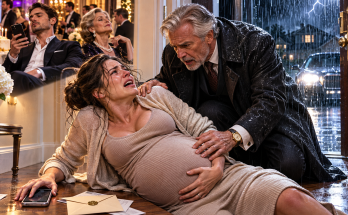
The ambulance doors opened before I felt ready.
I don't know what I had expected.
Perhaps a moment to understand what Warren had just told me.
Perhaps enough time to ask whether he was certain.
Whether he had proof.
Whether my biological father had truly been living in the same city while I spent my entire life believing he had abandoned me.
But there was no time.
The medical team had already begun moving.
Cold air reached my face.
Then bright hospital lights replaced the dark, rain-soaked driveway.
I heard wheels moving across the pavement.
Someone called out information about my pregnancy.
Thirty-nine weeks.
Ruptured membranes.
Severe contractions.
Reduced fetal movement.
I heard every word.
I wished I hadn't.
The words sounded different when spoken by medical professionals.
More serious.
Less like something I might somehow be imagining.
I turned my head toward Warren.
He was walking beside the stretcher.
His coat was still wet.
His silver hair had dried unevenly.
And his face was pale.
"You're still here," I whispered.
He looked at me immediately.
"Of course."
I wanted to ask him why.
Not because I wanted him to leave.
Because I had spent so many years accepting that people eventually did.
My biological father, according to Aunt Ruth, had disappeared before my birth.
My mother had died when I was eleven months old.
Aunt Ruth had raised me, then died when I was twenty-two.
And now Vance had refused to come home when I needed him.
I had become very familiar with people being absent.
Warren seemed to understand something of what I was thinking.
He touched my hand briefly.
"I'm not going anywhere."
I wanted to believe him.
Then the stretcher moved through the hospital entrance.
Everything became faster.
A nurse approached.
Another medical professional began asking questions.
The paramedic explained what had happened at home.
I heard my name repeated.
Natalie Brooks Mercer.
I had never felt so disconnected from my own name.
It sounded like someone else's emergency.
Someone else's life.
Someone else's frightened baby.
A doctor moved beside me.
She asked how long I had been experiencing the contractions.
I answered.
She asked whether I had noticed bleeding.
I told her what I could remember.
Then she asked about the baby.
"Have you felt any movement since the ambulance arrived?"
I pressed my lips together.
"No."
I hated that answer.
I wanted to change it.
I wanted to tell her that everything was normal.
That my son had kicked so hard I could feel him beneath my ribs.
But I couldn't.
The doctor nodded and gave instructions to the staff.
They moved me toward an area where they could assess the baby.
I glanced back.
Warren was following.
A nurse briefly stopped him.
He explained something quietly.
I couldn't hear the words.
Then the nurse looked toward me.
"Is he a family member?"
I stared at Warren.
Only minutes earlier, he had told me he believed I was his daughter.
I hadn't asked to see the documents.
I hadn't heard the full explanation.
I didn't know how he had spent thirty-two years without finding me.
But I knew how he had behaved when he found me on the floor.
I nodded.
"Yes."
The word surprised me.
It surprised him too.
I saw it in his face.
He didn't smile.
He only looked down for a moment, as though he needed to collect himself.
Then he followed us.
I was taken into a room filled with equipment.
A monitor was positioned nearby.
Someone adjusted the bed.
Someone else placed a blood pressure cuff around my arm.
I tried to follow every instruction.
I wanted to be useful.
I wanted to do something that would help my son.
But all I could really do was answer questions and wait.
The medical team began monitoring him.
I watched their faces.
That was a mistake.
Every small change in expression frightened me.
A nurse leaned closer to the screen.
The doctor examined the readings.
Then they exchanged a few words.
I couldn't understand all of them.
But I understood enough.
They were concerned.
"Is he all right?"
The doctor turned toward me.
She spoke calmly.
She explained that the findings suggested my baby might not be receiving enough oxygen.
The possibility of a placental complication was being considered.
They needed to act quickly.
I stared at her.
I had known something was wrong.
I had felt it at home.
But hearing a doctor confirm that my fear had a medical basis made my hands go cold.
"Can you help him?"
The doctor nodded.
"We're preparing for an emergency cesarean delivery."
I looked down at my abdomen.
For almost nine months, my son had been part of me.
I had felt him growing.
I had watched my stomach change.
I had talked to him when the house was quiet.
I had imagined the day he would finally be placed in my arms.
I never imagined being told he might not have enough oxygen.
"Please save him."
My voice barely worked.
"Please."
The doctor reassured me that the team was moving as quickly as possible.
Then she began explaining what would happen.
I tried to listen.
I knew the information mattered.
But my thoughts kept returning to the same question.
Was my son still alive?
No one had told me he wasn't.
But no one had given me the reassurance I desperately wanted.
I looked toward Warren.
He stood near the edge of the room.
His hands were clasped in front of him.
He looked as frightened as I felt.
That frightened me even more.
He was supposed to be powerful.
He was supposed to know how to solve impossible problems.
But he could only stand there while the medical team worked.
I held out my hand.
He moved immediately.
His fingers closed around mine.
"Don't let them stop," I whispered.
He shook his head.
"They won't."
I looked at him.
"I need him."
My voice broke.
"I haven't even held him yet."
Warren's eyes filled.
He leaned toward me.
"I know."
Then he said something I hadn't expected.
"I know, sweetheart."
It sounded natural coming from him.
Not practiced.
Not carefully chosen.
Like a father speaking to his frightened daughter.
I closed my eyes.
For a moment, I remembered Aunt Ruth sitting beside my bed when I was sick as a child.
She had called me sweetheart too.
She had brushed my hair away from my forehead.
She had stayed until I fell asleep.
The memory nearly broke me.
I had lost her years earlier.
And now, at the worst moment of my adult life, another person was holding my hand with the same quiet care.
The nurse approached with paperwork.
She explained that consent was needed for the emergency surgery.
I listened as she described what the doctors intended to do.
I knew I had to make the decision.
There was no question in my mind.
I wanted them to do whatever was medically necessary.
I signed where she indicated.
My handwriting was shaky.
The pen felt too heavy.
I looked at my signature afterward.
The capital N leaned awkwardly.
The final letters crowded together.
I remember feeling embarrassed by how untidy it looked.
Such a foolish thing to worry about.
But my mind was trying to focus on anything ordinary.
Anything other than the possibility of losing my son.
The nurse gathered the documents.
Then she asked whether my husband was available.
I froze.
Vance.
For several minutes, I had almost forgotten about him.
Not forgotten that I was married.
Not forgotten what he had done.
But forgotten that he was supposed to be the person standing beside me.
The nurse looked toward Warren.
Then back at me.
"Is your husband here?"
I shook my head.
"No."
She waited.
Perhaps she expected me to explain.
Perhaps she thought he was on his way.
I couldn't tell her the whole story.
I couldn't say that he had chosen to remain at his mother's birthday party.
I couldn't explain the music.
The champagne glasses.
Diane's accusation.
Dessert.
The word still made me feel sick.
So I said only what was true.
"He isn't here."
Warren's hand tightened around mine.
Not painfully.
Just enough to remind me that I wasn't alone.
The nurse nodded.
She didn't ask for details.
She returned to the medical preparations.
I was grateful.
I didn't have the strength to defend my marriage.
I didn't have the strength to explain why my husband had abandoned me.
I barely had the strength to remain calm.
Another contraction began.
I gripped the sheet.
The pain spread across my abdomen.
Someone spoke to me.
I tried to answer.
The room seemed to narrow.
The lights grew harsh.
I heard the doctor explaining that they needed to move.
Urgently.
Warren stepped back to make room.
For one terrible moment, I thought he was leaving.
I reached toward him.
He noticed.
"I'm right here."
I nodded.
Then he looked toward the medical team.
His expression changed.
The uncertainty remained, but his voice became steadier.
He told them he was my father.
The words filled the space between us.
"My father."
I had never heard a man say that about me before.
Not while I was old enough to remember.
A nurse glanced toward him.
Warren continued.
He asked them to provide every treatment my son and I required.
He said he would make sure financial arrangements were handled.
Money would not stand in the way.
I watched the nurse's expression.
She didn't seem impressed by his status.
She was focused on getting me the care I needed.
I found that comforting.
For once, Warren Sterling's money wasn't the most important thing in the room.
My son was.
The medical team was already working to help him.
Warren seemed to understand that.
He stopped speaking.
He stood aside.
And he let them do their jobs.
I looked at him again.
He had told a room full of strangers that I was his daughter.
He hadn't hesitated.
He hadn't qualified it.
He hadn't mentioned the investigator or the letters.
He had simply claimed me.
I wished I had time to understand what that meant.
Instead, the staff began moving my stretcher.
I was being taken toward surgery.
Warren followed as far as he was permitted.
The corridor lights passed above me.
One after another.
I tried counting them.
I lost track.
I heard wheels turning.
Medical staff speaking.
My own breathing.
Then I saw Warren walking beside me.
His face looked strained.
I wanted to tell him something.
I wasn't sure what.
Thank you.
Don't leave.
Tell me about my mother.
All three thoughts came at once.
I reached toward him.
He took my hand.
"There's so much I don't know," I whispered.
He leaned closer.
"About me?"
I nodded.
"About everything."
His eyes softened.
"We'll talk when you're better."
I wanted to argue.
I wanted him to tell me now.
I wanted to know why he had spent years believing I was gone.
But another wave of pain came.
I closed my eyes.
When it eased, I found myself looking at him again.
"Promise me something."
He waited.
"Don't leave before I wake up."
His face changed.
I saw how deeply the request affected him.
He nodded.
"I'll be here."
I held his gaze.
Then I said the one thing that mattered more.
"And please find out if my baby is okay."
His eyes filled again.
"I will."
The staff moved me through another doorway.
This time, Warren couldn't follow.
I watched him stop.
He stood in the corridor with his wet coat hanging heavily from his shoulders.
He raised his hand slightly.
I tried to raise mine.
Then the doors moved between us.
I was taken into the operating area.
The room was bright.
Too bright.
I heard equipment being prepared.
A medical professional explained the anesthesia.
Someone checked my identity again.
Someone confirmed the procedure.
I answered questions.
I tried to cooperate.
But I kept thinking about the hallway floor.
The ivory envelope.
Vance's voice.
Warren's hand.
How strange that all of those things belonged to the same evening.
I thought about our son.
I imagined his tiny hands.
I imagined the way his face might resemble mine.
Or Vance's.
Then I stopped myself.
I didn't want to think about Vance.
Not now.
I wanted to think about the baby.
Only the baby.
A nurse adjusted something near my head.
She spoke gently.
I asked whether she had children.
The question came out without warning.
She answered briefly.
I don't remember her exact words.
I remember her tone.
Kind.
Steady.
The sort of voice I had needed at home.
I looked toward the monitor.
The medical staff were watching it closely.
Someone moved quickly.
Another person spoke.
Then a warning sound began.
It cut through everything else.
I turned my head.
The doctor was looking at the monitoring equipment.
I heard her giving instructions.
The baby's heartbeat signal had become unreliable.
They were moving faster.
I wanted to ask what that meant.
I wanted to demand an answer.
But an oxygen mask was placed over my face.
Someone told me to breathe.
I tried.
I could hear the alarm.
I could hear the team working.
I could hear the doctor speaking.
Then the anesthesia began pulling me away from the room.
My last clear thought was not about Vance.
It wasn't about Warren's money.
It wasn't even about the letters.
It was about my son.
I had carried him for thirty-nine weeks.
I had learned the rhythm of his movements.
I had imagined his face without ever seeing it.
And I was terrified that I might never hear him cry.
I tried to hold onto that thought.
To stay awake.
To keep listening.
But the voices grew distant.
The lights blurred.
And I lost consciousness before anyone could tell me whether my little boy was safe.