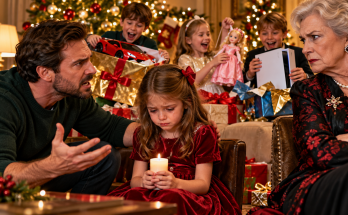
“My grandmother once gave me a candle for Christmas.”
Zia stood at the front of the funeral chapel with both hands resting against the lectern.
She was twenty-four now.
Not the seven-year-old in the gold dress.
Not the child turning a cream-colored gift tag between her fingers and trying to understand why the words on it hurt.
Still, for a second, I could see both versions at once.
Several relatives shifted in their seats.
Some remembered that Christmas.
Melissa did.
Aaron.
Travis.
Others knew only fragments.
Zia continued.
“It was vanilla.”
A few people smiled faintly.
“She gave my cousins tablets, cash, headphones, expensive stuff.”
She looked toward the first rows.
“I actually liked the candle.”
That surprised a soft laugh from the room.
“I still like vanilla.”
Then her expression changed.
“The problem wasn’t the price.”
Travis lowered his head.
“The problem was the label.”
Silence.
“It said Travis’s Girl.”
Zia let the words sit.
“She had been calling me things like that for years.”
No accusation in her tone.
No attempt to soften it either.
“Not granddaughter.”
“Not family in the same way.”
“She loved me.”
The sentence surprised people.
I saw it.
“She did.”
Zia nodded slightly.
“That’s part of why it hurt.”
There it was.
The truth Lorraine eventually learned.
Harm and love can occupy the same relationship.
One does not erase the other.
“The next morning, she put a place card at the family table.”
Zia paused.
“It said Guest.”
Some relatives looked down.
Aaron closed his eyes.
Melissa wiped at her face.
“I remember standing there and wondering why everybody else had a name.”
The sentence landed harder than any legal document ever had.
Zia continued.
“My dad had warned her before Christmas.”
She glanced at Travis.
“He had told her that if she kept treating me like I didn’t belong, things would change.”
Then the corner of her mouth lifted slightly.
“He also had a red velvet box.”
A few people who knew the story smiled through tears.
“My dad loves props.”
Travis whispered, “Unfair.”
The room laughed.
Even at a funeral.
Especially at a funeral.
Zia continued.
“Inside the box was a key.”
She explained only the emotional truth.
Not every mortgage statement.
Not every legal filing.
Not Grant’s spreadsheets.
Those details belonged elsewhere.
“The key meant Dad wasn’t going to keep paying for Grandma’s house while she treated his daughter like an outsider.”
She looked at Lorraine’s photograph.
“At the time, Grandma thought that was cruelty.”
A pause.
“Later, she understood it was a boundary.”
Zia’s voice remained calm.
“That Christmas started a lot of things.”
There were lawyers.
Money problems.
Old letters from Grandpa Frank.
Arguments about what family meant.
Daniel.
Trusts.
Property.
Apologies.
More lawyers.
She smiled faintly.
“Way too many lawyers.”
Maya, sitting near the back, laughed quietly.
Zia looked toward Daniel and Nina.
“My biological father had not been very reliable when I was little.”
Daniel nodded.
No shame performance.
No attempt to hide.
“He got better.”
Another simple sentence.
“It took time.”
She looked toward Travis.
“My dad was already my dad before any judge said so.”
Travis covered his mouth.
“And later a judge caught up.”
More soft laughter.
Then Zia returned to Lorraine.
“My grandmother changed too.”
She inhaled.
“That is the part I don’t want to tell wrong.”
The room became quieter.
“She did not hurt me so that she could become a better person.”
Important.
“She did not need to hurt me.”
Her eyes filled.
“I would rather she had just loved me without making it difficult.”
No redemption mythology.
No suffering turned into requirement.
“But after she hurt me, she had choices.”
Zia looked at Lorraine’s photograph.
“And eventually she started making better ones.”
She described the apology letter.
Not every word.
Only the part that mattered.
Lorraine apologized without demanding forgiveness.
She stopped using presents as compensation.
Stopped treating money as relationship.
Stopped contacting Daniel.
Stopped controlling the trust.
Accepted that Zia’s place in Frank’s family had never belonged to her to decide.
“She learned to let people say no.”
Zia smiled faintly.
“That took a while.”
The room laughed again.
“She learned not to make every feeling someone else’s job.”
Travis looked toward me.
We both heard the years inside that sentence.
“She made friends who weren’t related to her.”
“She got therapy.”
A louder laugh.
Zia glanced at Lorraine’s picture.
“She would hate that I said that at her funeral.”
Then, after a beat:
“Actually, current Grandma would think it was funny.”
That distinction mattered.
Current Grandma.
Not pretending the earlier version never existed.
Not trapping her there forever either.
Zia continued.
“When I was eighteen, I read the family records.”
The room shifted.
“I read things she wrote about me.”
Hard things.
Cruel things.
Things motivated by fear and inheritance and control.
“I asked her why loving me wasn’t enough to make her stop.”
My throat tightened.
Lorraine’s answer returned.
People can love someone and still choose themselves over them.
Zia repeated it.
Not accusing.
Remembering.
“That was probably the hardest thing she ever told me.”
She wiped one tear.
“Because it was the most honest.”
The chapel remained silent.
“She asked me years later whether I forgave her.”
Zia paused.
“I said I didn’t know.”
No one moved.
“I still don’t.”
The words were extraordinary inside a funeral.
Not cruel.
Free.
“And she died knowing that.”
Zia looked toward the casket.
“She also died knowing I loved her.”
Her voice broke.
“That was enough.”
Travis cried openly now.
So did Daniel.
So did I.
“She told me I didn’t owe her forgiveness before she died.”
Zia smiled through tears.
“That might have been the kindest thing she ever gave me.”
Not the cake.
Not books.
Not trust money.
Freedom from emotional debt.
“She finally understood that love is not something you prove by giving people the answer they want.”
Zia looked around the room.
“I think Grandpa Frank understood that earlier.”
“He wrote that family is the work people keep doing after the argument ends.”
She stopped.
Then corrected herself.
“Actually, he wrote something longer, but that’s the part I remember.”
Another quiet laugh.
“Grandma did the work.”
Not perfectly.
Not enough to erase anything.
Enough to become someone Zia chose to keep loving.
“When I was little, I wanted one thing.”
The funeral seemed to narrow around her.
“I wanted everybody to have names.”
She smiled.
“Because names felt safer than categories.”
Granddaughter.
Stepdaughter.
Biological.
Real.
Guest.
Beneficiary.
All the adult words used to organize a child.
“Now I think names are only safer if people use them honestly.”
She looked toward Travis.
“Dad.”
Then Daniel.
“Dad Daniel.”
A soft smile.
Then toward Lorraine’s photograph.
“Grandma.”
No qualifier.
That title had taken years to return.
She gave it now freely.
“Those names mean what we did with them.”
Zia stepped away from the lectern.
Then stopped.
“One more thing.”
She reached into her pocket.
The brass key.
Lorraine had given it to her near the end.
Zia held it up.
Most people in the room had no idea what it was.
Some did.
“This is the key that was inside the red box.”
Travis stared.
“I’ve been carrying it for three months because Grandma told me I could do whatever I wanted with it.”
She looked at the metal.
“It doesn’t open anything anymore.”
The old house belonged to someone else.
The locks had changed years ago.
“The first time I held it, I didn’t know what it meant.”
She had been seven.
Small hands.
Red velvet.
A consequence prepared by adults.
“Dad thought it meant a boundary.”
“Grandma thought it meant abandonment.”
“Later she thought it meant responsibility.”
Zia looked at the key again.
“I think it means something else.”
The room waited.
“It means you can stop carrying a job after the job is done.”
She closed her hand.
“The key opened the door to Grandma’s old house once.”
“It doesn’t now.”
“And I don’t think I need it to open the past either.”
Then she put it back in her pocket.
Not thrown away.
Not displayed.
No theatrical gesture.
A decision deferred to private life.
That felt right.
Zia stepped down.
The service ended shortly afterward.
Outside, people gathered in small groups.
Some relatives hugged Zia.
Others did not know what to say.
That was fine.
A funeral does not require everyone to produce a lesson.
Daniel approached her near the parking lot.
“You okay?”
“No.”
“Good.”
She laughed.
“You stole Mom’s answer.”
“I’ve learned from professionals.”
They hugged.
Nina joined.
Then Melissa.
Claire.
Aaron.
A family forming and reforming in small clusters.
No seating chart.
No categories.
After the burial, we returned to Lorraine’s apartment.
Her will was simple.
She had learned from Frank’s complexity.
Personal belongings divided mostly by request.
Small charitable gifts.
Remaining savings shared among her children.
Nothing to Zia directly except one item.
The mystery novel from her eighth birthday.
The one inscribed:
For Zia. Happy eighth birthday. Love, Grandma Lorraine.
Zia held it.
“You already owned this,” I said.
“No.”
She opened the cover.
Lorraine had added a second inscription beneath the first.
Years later.
Different ink.
Thank you for letting me become someone who could deserve the word Grandma sometimes. You never owed me the chance.
Zia stared at the sentence.
Then closed the book.
No one spoke.
The trust from Frank remained separate.
Lorraine had made no attempt to rebalance it through her own estate.
No compensating payment.
No symbolic “extra” for Zia.
That was deliberate.
Money did not need to apologize.
At home that night, Travis opened the red velvet box.
The key was gone.
Zia had it.
Inside remained Frank’s recovered note.
The trust recognition.
A copy of the adoption order.
Lorraine’s apology letter.
Years of records distilled into a handful of paper.
“What do you want to do with it?” I asked.
Travis looked at the box.
“Ask Zia.”
She was twenty-four.
No longer the child carrying it under instruction.
Her choice now.
She came downstairs.
“What?”
“Do you want this?”
“The box?”
“Yes.”
She stared at it.
Then sat.
For a while, she touched the velvet lid.
“You kept it all these years.”
“Yes.”
“Why?”
“I don’t know.”
She smiled.
“Yes you do.”
He thought.
“Because it was the moment I finally followed through.”
“That sounds right.”
She opened it.
Read Frank’s note again.
Do not let your mother convince you that choosing your child means abandoning her.
Then Lorraine’s apology.
Then the adoption order.
Her own history.
“What do you want?” I asked.
Zia closed the lid.
“I want the papers.”
“Not the box?”
“No.”
Travis looked surprised.
“Why?”
“Because the box belongs to the fight.”
That sounded exactly right.
“The papers belong to people.”
She removed the documents.
Placed them carefully in a plain archival folder.
Then pushed the empty red box toward Travis.
“What should I do with it?”
“Whatever.”
“Throw it away?”
“If you want.”
He looked almost offended.
She laughed.
“You’re attached.”
“No.”
“You are.”
“It cost forty dollars.”
“Dad.”
“I’m kidding.”
She took the box.
The next morning, it was gone.
I did not ask.
Weeks later, I learned what she had done.
She donated it.
Not ceremonially.
Not symbolically.
She dropped it at a charity resale shop with clothes and old kitchen items.
Some stranger probably bought it.
Maybe for jewelry.
Maybe for another gift.
Maybe because red velvet looked nice.
No history attached.
That felt strangely perfect.
The key remained with Zia.
For several months, anyway.
Then she made her own decision.
She returned to the former Bennett property.
Not the old house.
The development behind it.
Bennett Way curved past newly built homes.
Ortega Lane crossed near the preserved trees.
At the entrance stood the restored orchard sign.
BENNETT & ORTEGA ORCHARD.
A small plaque explained the land’s history.
Planting.
Partnership.
Dispute.
Restoration.
Nothing about the family trust.
Nothing about Lorraine.
Nothing about Zia.
History simplified for strangers.
She met Travis there.
Only him.
“Why did you want me to come?”
“You’ll see.”
They walked toward the preserved tree line.
Some of Frank’s old trees still stood.
Not apple trees.
Those were long gone.
But oaks and maples remained.
Near one, Zia stopped.
She took the brass key from her pocket.
Travis looked at it.
“You’re burying it?”
“That’s dramatic.”
“You brought me to Grandpa’s land with a symbolic key.”
“Fair.”
She had brought a small hand drill and a narrow wooden box.
Inside the box was no letter.
No money.
Just the key.
“What are you doing?”
“Time capsule.”
“For who?”
“No one.”
He frowned.
“That defeats the concept.”
“I know.”
She smiled.
“That’s why I like it.”
They dug a shallow hole near the tree.
Not on private residential property.
Within the approved memorial green space.
Zia placed the wooden box inside.
Then covered it.
“No marker?”
“No.”
“You’ll never find it.”
“Probably.”
“Then why?”
She stood.
Brushed soil from her hands.
“Because I don’t need it.”
The same conclusion Lorraine eventually reached.
But for a different reason.
Zia looked toward the development.
“Grandma spent years trying to keep proof.”
“Proof of what?”
“Who counted.”
She pointed toward the ground.
“That key used to be proof of a boundary.”
Then toward Bennett Way.
“The land used to be proof of ownership.”
Then toward the restored sign.
“Grandpa’s trust became proof I belonged.”
She shook her head.
“I’m tired of proof.”
Travis’s eyes filled.
“What do you want instead?”
She smiled.
“A normal life.”
He laughed.
“Good luck.”
“Thanks.”
They stood under the tree.
No ceremony.
No prayer.
No grand speech.
Then Zia said:
“Dad?”
“Yeah?”
“You know what’s funny?”
“What?”
“Grandma gave everybody else expensive presents that Christmas.”
He smiled.
“Yeah.”
“And I got the cheap candle.”
His face tightened slightly.
Even now.
“She spent years thinking that gift showed I mattered less.”
Zia looked toward him.
“But I don’t remember what tablets they got.”
Travis laughed.
“I don’t either.”
“I remember the candle.”
She paused.
“I remember you kneeling in front of me and saying nothing I did could make you stop being my dad.”
His expression broke.
“That’s what stayed.”
Not the price.
Not the trust.
Not the house.
Not the inheritance.
The choice.
Zia looked toward the tree.
“I think Grandma figured that out eventually.”
“Yes.”
“She was terrible at learning fast.”
“Yes.”
“She got there.”
“Mostly.”
Zia smiled.
“Mostly is enough for dead people.”
“Is it?”
“No idea.”
They started walking back.
At the entrance, they passed the plaque again.
Bennett & Ortega Orchard.
Two families once divided by land.
Now only names on a sign beside new houses.
Zia stopped.
“Dad?”
“Yeah?”
“Do you think Grandpa would be mad we sold the land?”
Travis considered.
“Yes.”
She laughed.
“Really?”
“For about twenty minutes.”
“And then?”
“He’d ask what the return was.”
“That sounds right.”
They continued.
Years later, Zia became a veterinarian.
Not immediately.
Training took time.
Debt.
Long nights.
Exhaustion.
Frank’s trust helped.
Scholarships helped.
We helped.
Daniel helped when he could.
Lorraine was gone before graduation.
Her photograph sat beside Frank’s at the ceremony.
Not equal because death made them equal.
Equal because both belonged to the story.
At graduation, Travis cried before Zia crossed the stage.
Daniel cried after.
I cried through most of it.
Nina handed out tissues.
Melissa claimed allergies.
Claire mocked everyone.
Normal family.
Afterward, Zia opened a small animal clinic with another veterinarian.
Not funded entirely by the trust.
Partly.
She insisted on taking a business loan too.
“I want the clinic to survive because it works.”
Frank would have liked that.
The clinic offered one low-cost treatment day each month.
In honor of no one publicly.
No plaque.
No donor wall.
Just service.
When I asked why, Zia said:
“Because helping should still work when nobody knows who did it.”
Lorraine would have understood that by the end.
Years passed.
Stories simplified.
Children in the family heard only fragments.
Grandpa Frank loved land and spreadsheets.
Grandma Lorraine made excellent cake and had once been extremely difficult.
Dad Daniel lived farther away but came to major holidays.
Dad Travis still loaded the dishwasher wrong.
Some details faded.
That was allowed.
Not every generation needs to inherit the complete archive of pain.
The documents remained.
If anyone ever needed them.
But they no longer governed relationships.
One Christmas, many years after the original candle, we gathered at Zia’s house.
She had children by then.
Two.
Both loud.
Both certain adults existed primarily to provide snacks.
Travis sat on the floor helping one assemble a toy animal clinic.
Daniel argued with the other about rules for a card game.
I stood in the kitchen.
Zia lit a candle.
Vanilla.
I noticed.
She caught me looking.
“What?”
“Nothing.”
She sniffed the candle.
“You’re thinking about it.”
“Yes.”
“I bought this because I like vanilla.”
“I know.”
She smiled.
No trauma attached to the object anymore.
Just scent.
On the dining table were handwritten place cards.
I stared.
Zia laughed.
“Relax.”
Each card had one thing.
A name.
Only a name.
No titles.
No categories.
No biological distinctions.
No guest.
Travis picked his up.
“Dad.”
He looked at Zia.
“You cheated.”
“What?”
“You said only names.”
“That is your name to me.”
He laughed.
Daniel’s card read:
Dad Daniel.
Mine read:
Mom.
The children had Grandma and Grandpa names of their own choosing.
No one argued.
Before dinner, Zia looked around the table.
Family by birth.
Marriage.
Adoption.
Choice.
Repair.
Time.
All of it.
Then she said:
“Everybody sit wherever your name is.”
Travis groaned.
“We’re back to assigned seating.”
“Yes.”
“What if I refuse?”
“You don’t eat.”
“Authoritarian.”
Zia laughed.
The table filled.
No one asked who counted.
No one needed to.
And if Frank had been right about one thing above all others, it was this:
Family was never secured by the house, the land, the trust, the bloodline, the labels, or the money people fought so hard to control.
It was secured in smaller ways.
Who stayed.
Who changed.
Who told the truth.
Who stopped asking children to carry adult fear.
Who learned that love without control could survive change.
Who understood that consequences were not abandonment.
Who accepted that apology could be sincere even without guaranteed forgiveness.
Who kept choosing the relationship after the argument ended.
Zia had spent years wondering whether Lorraine got to decide if she belonged.
In the end, the answer was simpler than every lawyer, trust document, financial statement, and family argument had made it.
Lorraine never had that power.
No one did.
Zia had belonged from the beginning.
The only question was how long the adults around her would take to understand it.
The End
Read more original stories on Feel Every Story.