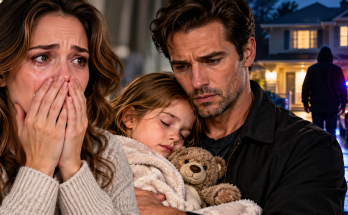
Zia fell asleep with her purse on the chair beside her bed.
The red velvet box remained inside it.
I knew because I checked twice.
Not because I intended to open it. Travis had made it clear the contents were meant for Lorraine, and something about the careful way he had prepared the moment made me unwilling to interfere.
But I needed to understand what my husband was doing.
Once Zia’s breathing settled into the slow rhythm of sleep, I followed him into the hallway and pulled the guest-room door almost closed behind us.
“What is inside that box?”
Travis leaned against the wall.
“It’s not dangerous.”
“That wasn’t my question.”
“I know.”
“Then answer me.”
For several seconds he listened to voices drifting from downstairs.
“Something Mom will recognize immediately.”
“That still isn’t an answer.”
“No.”
His expression softened.
“I’m sorry.”
I folded my arms.
“You’re asking our seven-year-old to hand your mother a mystery box after being humiliated. I think I’ve earned more than riddles.”
“You have.”
“Then?”
He exhaled.
“If I tell you now, you’ll spend the whole night thinking about what it means.”
“I’m already doing that.”
That almost made him smile.
Almost.
Then his attention shifted toward Zia’s door.
“I need tomorrow to be about her choice, not ours.”
“Her choice to do what?”
“To tell us when Mom crosses the line.”
My frustration sharpened.
“Lorraine already crossed it.”
“Yes.”
“Today.”
“Yes.”
“The tag was deliberate.”
“I know.”
His certainty stopped me.
“How do you know?”
He looked toward the stairs.
“Because she told me enough before Christmas that I stopped believing any of this was accidental.”
The house suddenly felt colder despite the heating vent humming near my feet.
“What did she tell you?”
“I’ll show you everything after we leave.”
“Why not now?”
“Because tonight Zia needs us calm.”
I hated that he was right.
If he showed me something worse than what I had already witnessed, I would not sleep. I might walk downstairs and confront Lorraine immediately. Whatever plan Travis had established would disappear beneath my anger.
Still, one question mattered.
“When you said this was her last chance, did Lorraine know that?”
“Yes.”
“Exactly?”
“Yes.”
“What did you tell her would happen?”
His face became unreadable.
“That our relationship would change.”
I glanced toward the room where our daughter slept.
“And the box is how?”
He nodded.
The simplicity of the gesture unsettled me.
Travis was not impulsive. He made spreadsheets before buying appliances. He researched restaurants before reservations. Even arguments with me tended to be approached as problems to understand rather than battles to win.
If he had packed a symbolic object before driving to his mother’s house, he had considered every possible outcome.
“Was the candle enough?” I asked.
He rubbed both hands over his face.
“For me? Yes.”
“But you didn’t use the box.”
“No.”
“Why?”
“Because I needed Zia to understand something first.”
“What?”
“That this isn’t retaliation.”
He looked directly at me.
“If Mom does something again, Zia needs to know she isn’t responsible for what follows. The consequence was already decided by me.”
That distinction mattered.
I sat on the narrow bench beneath the hallway window.
“You knew she might blame herself.”
“She already does.”
My stomach dropped.
“What do you mean?”
“You heard her.”
He lowered his voice further.
“She asked whether I’d still be her dad if she gave Mom the box. Somewhere in her head she’s learned that belonging can be taken away if she upsets the wrong adult.”
I thought of the gift tag turning in Zia’s fingers.
“She learned it here.”
Travis looked downstairs.
“Yes.”
The word carried no anger.
Only grief.
We returned to the room.
Zia had kicked away part of her blanket. Travis covered her again and carefully moved the purse farther from the edge of the chair so it would not fall.
I lay awake long after he fell asleep.
Every creak of Lorraine’s old house sounded unusually loud.
I kept thinking about the distinction between cruelty and ambiguity.
For years Lorraine had survived on ambiguity.
No single incident looked large enough from outside.
A photograph in the wrong place.
A slightly different introduction.
An awkward phrase.
A forgotten invitation.
One could be an accident.
Ten could be personality.
Twenty, stretched across birthdays and holidays, formed something else entirely.
A pattern.
And patterns teach children things whether adults name them or not.
At six fifteen the next morning, I woke to the smell of coffee and bacon.
Zia was already dressed.
She wore dark leggings and a soft blue sweater instead of the gold Christmas dress. Her hair stuck up slightly on one side.
“Morning,” I said.
“Morning.”
She was sitting on the carpet with her purse in her lap.
My eyes went immediately to it.
“Are you worried about the box?”
“A little.”
“You don’t have to give it to anyone.”
“I know.”
She opened the purse, looked inside, then closed it again.
“What if Grandma is nice today?”
“Then you have brunch.”
“And nothing happens?”
“Nothing happens.”
She considered that.
“What if she’s not?”
I sat beside her.
“Then your dad and I handle it.”
She frowned.
“But he said I give her the box.”
“Only if you want to.”
“Is that handling it?”
The seriousness of her question nearly made me smile.
“Partly.”
She nodded as if filing away a complicated rule.
Then she leaned against my shoulder.
“I wish everybody could just have names.”
The simplicity of it hurt more than any elaborate complaint.
“So do I.”
Downstairs, the house was already busy.
Lorraine loved brunch almost as much as Christmas dinner. The dining table had been extended with two extra leaves, white plates spaced evenly around it, folded napkins secured with silver rings.
Sunlight reflected from glassware.
Everything looked controlled.
Lorraine stood near the buffet arranging fruit.
“Good morning.”
Her voice was light.
No trace remained of yesterday’s tension.
“Morning,” Travis said.
Zia hovered beside him.
Lorraine glanced down.
“Sleep well?”
“Yes.”
“Good.”
For one hopeful second I thought perhaps she had reconsidered everything overnight.
Then I noticed the place cards.
Lorraine used them whenever the whole family ate together. She claimed they prevented children from arguing over seats, though I suspected she simply enjoyed deciding where everyone belonged.
Each card had been written by hand.
Melissa.
Aaron.
Travis.
My own name.
Every aunt.
Every uncle.
Every cousin.
Every grandchild.
I began searching for Zia.
Nothing.
Perhaps Lorraine had forgotten a card.
My eyes moved farther along the table.
Then I saw one positioned between two cousins’ names.
One word had been written across it.
Guest.
I stopped breathing.
No.
Not after yesterday.
Not after the conversations Travis said he had already had.
Not after watching Zia carry a candle upstairs and ask whether she was only someone’s girl.
My hand moved toward the card.
I intended to snatch it away, tear it in half, and tell Lorraine we were leaving.
Travis caught my wrist.
Gently.
I turned on him.
His face was pale.
But he was not looking at Lorraine.
He was looking past me.
At Zia.
My daughter stood at the entrance to the dining room.
She had seen the card.
For several seconds she did not move.
Nobody else seemed to understand yet. Chairs scraped. Coffee poured. A cousin complained that someone had taken his usual seat.
Zia looked at the place card marked Guest.
Then she looked at Travis.
He did not nod.
He did not instruct her.
He simply waited.
Her gaze shifted toward me.
I wanted to cross the room and carry her out of that house.
Instead I forced myself to stay still.
This was the choice Travis had meant.
Not whether Lorraine deserved consequences.
Whether Zia wanted to say, in the only way prepared for her, that she had had enough.
She reached into her purse.
Her small fingers closed around the red velvet box.
Across the dining room, Lorraine was still rearranging serving spoons.
Zia took one step.
Then another.
I heard Travis inhale beside me.
He had known this moment might come.
I had not believed Lorraine would be cruel enough to make sure it did.
Zia walked toward her grandmother carrying the box with both hands.
And Lorraine, still unaware that the consequence she had been warned about was approaching her across her own dining room, turned around smiling.