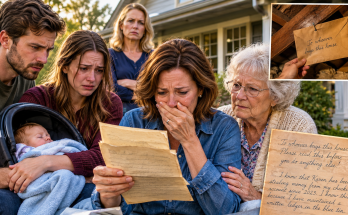
The letter arrived in March.
I recognized Michael's handwriting before I opened the envelope.
That surprised me.
I hadn't seen him write anything by hand in a long time.
For years, our conversations had mostly happened through telephone calls and messages.
Usually, he contacted me when something needed attention.
An expense.
A question.
A payment.
Sometimes he called simply to talk.
But those conversations had become less frequent.
And when they happened, money often entered them before long.
Now his handwriting was sitting in front of me.
I turned the envelope over.
My name was written carefully.
Margaret Morgan.
Not Mom.
Not Grandma.
My full name.
I stood in the kitchen holding it.
The green ledger was on the shelf nearby.
Linda's papers were arranged in a folder.
Rachel's graduation photograph was resting where I could see it.
The yellow tulips she had brought in February were gone now.
But I still remembered the way they had brightened the kitchen.
I looked at the envelope again.
Part of me wanted to open it immediately.
Another part wanted to put it away.
I was afraid of what Michael might say.
I was also afraid he would say nothing meaningful at all.
I had heard him apologize in my living room.
I remembered how small his voice had become.
But he had apologized only after I confronted him about the money and documents.
I didn't know whether he understood what he had done.
I didn't know whether his shame would last longer than the consequences.
And I didn't want to mistake a few emotional words for real change.
So I left the envelope on the kitchen table.
I told myself I would read it later.
That evening, I looked at it again.
I picked it up.
Then I put it down.
I made dinner.
I washed the dishes.
I checked a few business records.
The envelope remained where it was.
I could see it every time I walked through the kitchen.
The next morning, I made coffee.
I sat beside it.
I ran a finger along the edge.
Still, I didn't open it.
I felt foolish.
I was a grown woman.
I had handled complicated financial problems for decades.
I had raised two children after losing my husband.
I had built a business from very little.
And I was afraid of an envelope.
But that was the truth.
The letter came from someone I loved.
Someone who had hurt me.
And I knew that whatever he wrote might change how I saw him again.
I left it unopened for two days.
On the second evening, I finally sat at the table and reached for it.
The house was quiet.
Outside, the last of the winter snow had begun to disappear.
I could see the maple tree through the window.
Its branches were still bare.
I opened the envelope carefully.
Inside were handwritten pages.
Michael had taken his time.
The writing wasn't perfectly neat.
But it was familiar.
I remembered seeing that same handwriting on school assignments years earlier.
I remembered helping him practice spelling words.
I remembered signing forms for his teachers.
Now he was using that handwriting to tell me something he hadn't managed to say in person.
I began reading.
He didn't start by asking for money.
That was the first thing I noticed.
He didn't mention tuition.
He didn't mention Nicole's insurance.
He didn't ask me to reconsider the canceled transfers.
Instead, he wrote about himself.
About the pressure he had felt trying to appear successful.
About the house.
About the kind of life he had wanted people to think he could afford.
I read slowly.
Michael explained that Nicole's parents had more money than he did.
They moved in social circles he found intimidating.
They seemed comfortable with things he struggled to provide.
He wanted their approval.
He wanted to look like a man who could give his family everything it needed.
I stopped reading for a moment.
I hadn't known he felt that way.
I knew Nicole's parents were financially comfortable.
I knew they had different expectations about family gatherings.
Michael had mentioned that many times.
But I hadn't understood how deeply their opinions affected him.
I went back to the letter.
He wrote that he had become embarrassed by how much he depended on me.
That surprised me.
For years, he had accepted my help so easily that I assumed he no longer thought about it.
Apparently, he thought about it more than he admitted.
But he hadn't handled the feeling honestly.
He hadn't told me he was ashamed.
He hadn't asked me to help him make a plan for becoming independent.
Instead, he kept accepting the money.
And somewhere along the way, embarrassment had become resentment.
I read that part twice.
Resentment.
I had suspected it after Christmas.
But seeing Michael admit it was different.
He wrote that when I helped pay an expense, he sometimes felt grateful at first.
Then he felt uncomfortable.
He knew he should be managing his own household.
He knew he was relying on his mother more than he wanted to admit.
But instead of changing his behavior, he became angry with the person whose help reminded him of his dependence.
Me.
I placed the letter on the table.
I stared at the wall.
For a long time, I had wondered whether I had done something that made Nicole feel judged.
I had searched my memory for comments I might have made.
I had worried that my attempts to help had sounded controlling.
Maybe there were moments when I could have been more careful.
I was willing to admit that.
But Michael's letter explained something I hadn't understood.
My help had become a reminder of the responsibility he was avoiding.
He didn't want to confront that responsibility.
So he turned his discomfort toward me.
I felt hurt.
But I also felt a little less confused.
At least I could begin to understand how he had become the man who laughed about my money on Christmas night.
I picked up the letter again.
Michael wrote about the lifestyle he and Nicole had tried to maintain.
The house.
The expenses.
The pressure to look as though everything was going well.
He admitted that they had been living beyond what they could comfortably afford.
That was something I had suspected for years.
Every time another bill appeared, I wondered why they never seemed to get ahead.
I had believed the next promotion or financial improvement would help.
So had Michael.
But the improvement never seemed to be enough.
There was always another expense.
Another expectation.
Another reason to keep pretending they were doing better than they were.
He wrote that he had wanted to appear successful.
Not only to Nicole's parents.
To himself.
And to me.
I stopped at that sentence.
I thought about all the times I told him I was proud of him.
I thought about his childhood.
After Thomas died, Michael had tried to act older than he was.
Sometimes he wanted to help around the house.
Sometimes he asked whether I was tired.
Once, when he was little, he promised me that when he grew up, I wouldn't have to worry about anything anymore.
I remembered smiling.
I remembered hugging him.
I had never expected him to keep a child's promise exactly.
I simply wanted him to become a decent man.
A responsible one.
Someone who treated people kindly.
But perhaps Michael had carried that promise in a different way.
Perhaps he had come to believe that being successful meant having more money than he actually had.
I didn't know.
The letter couldn't answer every question.
But it showed me that he had been measuring himself against expectations I hadn't placed on him.
I went back to reading.
Michael acknowledged that he had taken my support for granted.
He admitted that he had allowed the financial arrangements to continue because they made his life easier.
He wrote about the failed investment.
He knew he should have told me.
He knew the money wasn't something he had permission to use for that purpose.
And he understood that hoping to replace it later didn't make the decision acceptable.
I felt my throat tighten.
Those were words I had needed to hear.
But they were difficult to read.
Because every admission brought back another memory.
The bank manager turning his computer screen toward me.
The transfers appearing one after another.
The figure at the bottom.
Twenty-seven thousand six hundred dollars.
The signature that wasn't mine.
The call from Linda.
The folder on my kitchen table.
I had spent weeks trying to understand those things.
Now Michael was acknowledging that his decisions had created real harm.
I didn't feel relieved.
Not exactly.
I felt sad that it had taken so much for him to say it.
He also wrote about Christmas.
I slowed down.
That was the part I had been waiting for.
He admitted that the way he spoke about me had been cruel.
He knew I had supported his family for years.
He knew I hadn't demanded an invitation because of the money.
He knew I wanted to spend time with Liam and Grace.
And he knew he had made me sound like an unreasonable mother because that was easier than admitting how dependent he had become.
I put the paper down again.
I remembered his laughter.
I remembered the people around him.
I remembered sitting alone afterward, trying to understand how my own son could speak about me that way.
I had replayed the moment so many times.
Sometimes I imagined confronting him differently.
Sometimes I wished I hadn't heard it at all.
But now I understood that not hearing the remark wouldn't have changed the problem.
The resentment would still have existed.
The money would still have been leaving my accounts.
The refinancing documents would still have needed investigation.
And Michael would still have been avoiding the truth.
Christmas hadn't created those problems.
It had forced me to stop ignoring them.
I returned to the letter.
The final part was written more carefully.
I could see that he had slowed down.
He wrote about Thomas.
About the day his father died.
About the years afterward.
He remembered me working late at the kitchen table.
He remembered seeing books and papers beside my coffee.
He remembered that I was often tired.
But he also remembered dinner being ready.
He remembered that I continued showing up for him and Rachel even when life was difficult.
I could barely see the page.
My eyes filled with tears.
Those evenings had been among the hardest years of my life.
I had tried to hide how frightened I was.
I worried about money.
I worried about keeping the house.
I worried about raising two children without Thomas.
I worried about whether they would be all right.
And I worked.
I studied.
I cooked.
I helped with homework.
I kept going.
I thought the children hadn't noticed how much effort it took.
But Michael had noticed.
He remembered.
That made the next part harder.
He wrote about the promise he had made as a boy.
He had told me that one day he would be the person making sure I was safe.
Now he understood that his decisions had forced me to protect myself from him.
I stopped reading.
I put my hand over my mouth.
Then I cried.
Not quietly.
Not with the careful control I had practiced for years.
I cried because I remembered the little boy.
I cried because I missed Thomas.
I cried because my son had finally admitted how far he had moved from the person he once wanted to become.
And I cried because I still loved him.
That was the hardest truth.
I could be angry with Michael.
I could refuse to pay his bills.
I could insist that the loan be repaid.
I could cooperate with the investigation.
And I could still love him so much that reading his letter hurt.
Those feelings didn't cancel one another.
I had spent weeks trying to make them fit into one simple answer.
Either I forgave him.
Or I didn't.
Either I trusted him.
Or I stopped loving him.
But life wasn't that simple.
I loved him.
I didn't trust him yet.
And I wasn't ready to pretend otherwise.
I wiped my eyes and read the final lines.
Michael said he didn't expect immediate forgiveness.
He knew he had damaged our relationship.
He wrote that he felt ashamed.
And he wanted me to understand that he recognized what he had done.
I sat with the pages in my hands.
For the first time since Christmas, Michael had communicated without asking me to solve anything.
He hadn't demanded reassurance.
He hadn't asked me to make the financial consequences disappear.
He had written about his own behavior.
And he had acknowledged that it was his responsibility.
I wanted to believe that meant he was changing.
But I knew a letter wasn't enough.
Words mattered.
They were a beginning.
But I needed to see what happened after them.
I folded the pages carefully.
Then I returned them to the envelope.
I sat at the kitchen table for a long time.
The green ledger was nearby.
I looked at it.
For years, that book had recorded the financial side of my relationship with Michael.
I could find the wedding contribution.
The house loan.
The recurring payments.
Every amount.
But there was no entry for the boy who remembered his mother studying at night.
No entry for the child who wanted to protect her.
No entry for the adult who had finally written a difficult letter.
I was grateful for that.
Some things shouldn't be reduced to numbers.
I placed the envelope beside Rachel's graduation photograph.
Then I made a cup of tea.
I thought about calling Michael.
I even picked up my phone.
But I wasn't ready.
I needed to decide what I wanted to say.
And I didn't want emotion to make promises I couldn't keep.
So I waited.
The following day, I sat at the same table and began writing a reply.
I didn't type it.
I wrote by hand.
It felt right.
Michael had taken the time to write honestly.
I wanted to answer with the same care.
I began by telling him I loved him.
That part was easy.
Then I told him forgiveness would require time.
I explained that I couldn't simply forget the financial documents, the transfers, or the hurt of Christmas.
Those things had happened.
They had consequences.
And rebuilding our relationship would mean facing them honestly.
I didn't threaten him.
I didn't list every dollar he owed.
Linda was already handling the financial arrangements.
I didn't want the letter to become another account statement.
I wanted it to be about us.
I wrote that if we were going to have a relationship again, it couldn't be built around money.
I needed him to tell me the truth.
Even when it was uncomfortable.
Especially then.
I needed him to respect the boundaries I had set.
And I needed to know that he wanted me in his life because I was his mother, not because I could pay for something.
Then I paused.
There was one more thing I wanted him to understand.
I thought about his embarrassment.
His desire to impress Nicole's parents.
His fear of looking unsuccessful.
I looked at Thomas's photograph.
Then I wrote that he had never needed to become wealthy to make me proud.
I didn't care whether his house was larger than someone else's.
I didn't care whether his car impressed anyone.
I didn't care whether Nicole's parents thought he was financially successful.
What mattered to me was the kind of man he became.
A man who told the truth.
A man who kept his promises.
A man who treated the people who loved him with respect.
I read that part again.
Then I signed the letter.
Mom.
Just Mom.
Not Margaret Morgan.
Not the woman whose name appeared on bank documents.
Not the person who had lent him ninety thousand dollars.
His mother.
I folded the paper and placed it in an envelope.
For a moment, I felt nervous.
I didn't know how he would respond.
I didn't know whether he would understand.
But I had finally said what mattered.
I wasn't asking him to become rich.
I was asking him to become responsible.
I wasn't asking him to prove his love with money.
I was asking him to show it through honesty.
And I wasn't offering to return to the arrangement that had hurt us both.
I put the letter aside to send.
Then I looked out at the maple tree.
Spring was approaching.
The branches were still bare.
But I knew they wouldn't remain that way forever.
I didn't know whether my relationship with Michael would recover.
I couldn't promise myself that.
Trust depended on more than hope.
Still, I had answered his letter.
I had left room for change.
And for the first time, I felt that the next step belonged to him.