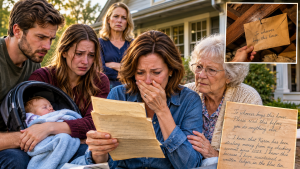
PART 1 — THE LETTER THAT WAS NEVER SUPPOSED TO BE FOUND
The morning after Tyler and Hannah Reed brought me the envelope, I sat in my kitchen with three pages of my mother’s handwriting spread across the table.
I had read the letter six times.
Every time, I discovered another sentence I couldn’t quite believe.
My mother, Dorothy Carlson, was eighty-four years old. She had lived in the same house for nearly fifty years. She had raised two daughters there, buried her husband there, and spent the last decade tending the flower garden my father had planted along the front porch.
And six days before my sister moved her into a care home, Mom had written a letter explaining that she was being forced out.
She had written that Karen was taking money from her checking account.
She had written that the house belonged to a trust established for my daughter, Emily.
And she had written that she feared she might never be allowed to return.
The final page was addressed directly to me.
I couldn’t bring myself to read it again.
Instead, I called Mr. Fenwick, the attorney whose name appeared in my mother’s letter.
He answered on the second ring.
“Fenwick Law.”
“Mr. Fenwick? My name is Beth Carlson. I’m Dorothy Carlson’s daughter.”
There was a pause.
“Beth.”
The way he said my name made my stomach tighten.
“Have you received something from your mother?”
“Yes. A letter. It says you have documents concerning her house.”
Another silence.
Then he said, “I was wondering when someone would call.”
I gripped the phone.
“What does that mean?”
“It means your mother came to see me in January. She was very concerned about several things. I asked her to bring her financial records and the trust documents. She came back a week later.”
“Was she mentally capable of understanding what she was doing?”
“Beth, your mother was very clear that day. She knew what she owned, who her daughters were, and what she wanted to happen to her property.”
My eyes filled with tears.
“She said Karen was taking her money.”
Mr. Fenwick sighed.
“She told me she suspected unauthorized withdrawals. I advised her to have the account reviewed. She also told me she was afraid Karen would sell the house.”
“Did you know Karen sold it?”
“I learned about it after the fact.”
“Why didn’t you call me?”
“I tried. The number I had for you was disconnected.”
I looked at my phone.
Karen had changed my mother’s contact information years ago.
“Mr. Fenwick, I need to see you.”
“Tomorrow morning. Nine o’clock.”
I looked at the blue tin Tyler had left on my kitchen table.
“Should I bring something?”
“Bring everything you have. Especially the letter.”
I hung up.
For a long time, I sat there staring at the kitchen wall.
Then I opened the last page of my mother’s letter.
And finally, I read what she had written to me.
PART 2 — WHAT MY MOTHER WANTED ME TO KNOW
My dear Beth,
If you are reading this, then I was not able to tell you these things myself.
I want you to know that I have not forgotten you.
I know you call every Sunday. I know you ask if I am eating properly, if I am sleeping, and whether I need anything.
I always tell you I am fine because I do not want you to worry.
But I have been frightened.
Your sister says I cannot be trusted to make decisions anymore. She says I am confused. Sometimes I am confused. I will not pretend otherwise.
But being confused about what day it is does not mean I have forgotten who I am.
I know that I am your mother.
I know that your father loved me.
I know that we bought this house together.
And I know that I promised your daughter Emily that someday, this house would be hers.
Karen says she is helping me. Perhaps she believes that. But she has taken money from me, and she has made decisions without asking me.
I do not know how much she has taken.
I do know that I have written down what I could.
Please find the blue tin.
Please speak to Mr. Fenwick.
And please, Beth, do not let your sister convince you that I wanted to leave my home.
I wanted to stay.
I wanted to sit on the porch in the afternoon and watch the birds.
I wanted to see Emily visit.
I wanted to sleep in my own bedroom, with your father’s photograph beside the bed.
I wanted to be old in the house where I had lived my life.
If I cannot have that, I want at least for the truth to be known.
I love you.
I am sorry I did not tell you sooner.
Mom.
I folded the letter.
Then I cried.
Not the quiet kind of crying that comes when you miss someone.
The kind that comes when you realize someone you love has been suffering right in front of you, and you were too far away to see it.
I had believed Karen.
I had believed her when she said Mom was getting forgetful.
I had believed her when she said the house needed to be sold.
I had believed her when she said the money would be used for Mom’s care.
I had believed her because she was my sister.
And because I wanted to believe someone was taking care of our mother.
PART 3 — THE BLUE TIN
The next morning, I drove to my mother’s old neighborhood.
Tyler had given me the address of the house, and I had called him the night before to ask whether he would let me look beneath the staircase.
He agreed immediately.
When I arrived, Hannah was waiting at the door.
“We’ve been thinking about your mother all night,” she said.
I thanked her.
Tyler led me inside.
The house looked different.
The living room had been repainted. The furniture was gone. A small toy lay beside the couch, and a baby blanket was draped over the armchair.
But the staircase was exactly as I remembered it.
My father had built it himself.
He used to joke that the third step was his secret storage place.
I knelt.
My fingers found the edge of the wooden tread.
It lifted.
Beneath it was a dark space.
And inside that space was a blue metal tin.
My hands began to shake.
I pulled it out.
The lid was rusted around the edges, but it opened.
Inside were several folded sheets of paper, an old bank statement, a small notebook, and a photograph of my mother and father standing in front of the house on the day they bought it.
On the first page of the notebook, my mother’s handwriting read:
Dorothy’s Personal Record — 2023
I opened it.
The entries were dated.
January 12: $800 withdrawn. Karen said it was for groceries and medicine.
February 3: $1,200 withdrawn. I did not ask for this.
March 17: $950 withdrawn. Karen said she needed to pay a bill.
April 8: $1,500 withdrawn. I asked what it was for. She said I was forgetting things.
The entries continued.
Some months had several withdrawals.
Others had notes beside them.
“Not my signature.”
“Did not approve.”
“Karen has the bank card.”
“Asked for statement. She said it was unnecessary.”
My heart pounded.
I turned to the bank statements.
The amounts were larger than the notebook suggested.
There were withdrawals, transfers, and payments to accounts I did not recognize.
I counted the pages.
Then I stopped.
I couldn’t do the math.
“Tyler,” I whispered.
He came over.
“Are you okay?”
I showed him the statements.
He looked at them, then back at me.
“Do you need me to call someone?”
“No.”
I took a breath.
“I need to find out how much.”
PART 4 — THE ATTORNEY’S OFFICE
At nine o’clock, I walked into Mr. Fenwick’s office with the blue tin under my arm.
He was an older man with silver hair and a quiet manner.
He stood when I entered.
“Beth. I’m sorry.”
I placed the tin on his desk.
“My mother said you have the trust documents.”
He nodded.
He opened a file cabinet and removed a thick folder.
Inside were documents dated 2019.
A trust agreement.
A property deed.
And a notarized declaration signed by my mother and father.
Mr. Fenwick placed the documents in front of me.
“Your parents transferred the house into a trust in 2019. Your daughter Emily was named the beneficiary.”
I stared at the pages.
“Why didn’t they tell me?”
“They wanted to surprise her when she became an adult. Your mother told me she hoped Emily would someday live there, or at least have the choice to keep the house in the family.”
“Was Karen aware of the trust?”
“She was not informed.”
I swallowed.
“Then how did she sell the house?”
Mr. Fenwick folded his hands.
“That is the question.”
He explained that Karen had been appointed as my mother’s power of attorney in 2022.
But a power of attorney did not automatically give her ownership of the house.
It did not mean she could disregard the trust.
And it did not mean she could use my mother’s money for her own purposes.
“Mr. Fenwick,” I asked, “could Karen have sold the house legally?”
“Not if the property was still held by the trust and she lacked the authority to transfer it. We need to examine the deed recorded at closing and the documents used to complete the sale.”
He looked at the letter.
“Your mother anticipated this possibility.”
He opened another folder.
Inside was a copy of the trust deed.
And beneath it was a handwritten note from my mother.
If Karen sells the house, please investigate.
I covered my mouth.
My mother had known.
She had known what might happen.
And she had tried to leave a trail for someone to follow.
PART 5 — THE NUMBER KAREN NEVER WANTED ME TO SEE
Mr. Fenwick arranged for a financial review.
Over the next several days, we examined the bank statements, withdrawal records, and the notebook.
The total amount of money that appeared to have been transferred without my mother’s authorization was $47,860.
Some transactions were small.
Others were thousands of dollars.
There were payments to a credit card in Karen’s name.
There were transfers to a personal account.
There were withdrawals made shortly after my mother had been hospitalized.
I stared at the number.
“Forty-seven thousand dollars?”
Mr. Fenwick nodded.
“That is the amount currently supported by the records we have. It may change as the review continues.”
I felt sick.
I thought about every Sunday call.
Every time I asked Karen if Mom needed anything.
Every time she said, “Don’t worry, Beth. I’ve got it.”
I remembered sending money for Mom’s birthday.
I remembered paying for a new television after Karen said the old one had stopped working.
I remembered asking whether Mom had enough money for her medication.
Karen always said yes.
I had trusted her.
Mr. Fenwick leaned forward.
“Beth, I need you to understand something. We are not going to make accusations based solely on the letter. We need evidence. We need the bank records. We need to establish what your mother authorized and what she did not.”
“I understand.”
“But if the evidence supports what your mother wrote, there may be serious legal consequences.”
I looked down at the notebook.
“Then we need to find out.”
PART 6 — THE CALL TO KAREN
I called my sister that afternoon.
She answered cheerfully.
“Beth! How are you?”
I almost laughed.
“Karen, I need to talk to you about Mom.”
“Of course. Is everything okay?”
“I found a letter.”
Silence.
“What letter?”
“A letter Mom wrote before you moved her into the care home.”
Karen sighed.
“Beth, you know Mom was confused around that time.”
“She wrote that she did not consent to the sale of the house.”
Another silence.
Then Karen said, “You cannot seriously believe that.”
“She wrote that the house belonged to Emily’s trust.”
“That is ridiculous.”
“She also wrote that you had been taking money from her account.”
Karen’s voice changed.
“Where did you get this?”
“From the house.”
“Who gave it to you?”
“That doesn’t matter.”
“Of course it matters! Someone has been going through private documents.”
I took a breath.
“Karen, I have the bank statements.”
She said nothing.
“I have the notebook.”
Still nothing.
“I have the trust documents.”
Then she laughed.
A short, sharp laugh.
“Beth, you have no idea what you’re talking about.”
“Then explain it.”
“Mom needed care. The house had to be sold.”
“Why didn’t you show me the settlement statement?”
“I told you I would.”
“You never sent it.”
“Because I was busy!”
I closed my eyes.
“Karen, how much did the house sell for?”
“Two hundred and ninety thousand dollars.”
“Where is the money?”
“It went to Mom’s care.”
“Then why does the care home say her account is nearly empty?”
The silence that followed was so long I checked whether the call had disconnected.
Finally, Karen said, “You need to stop this.”
“Stop what?”
“Making trouble.”
I looked at the letter.
“Mom asked me to find the truth.”
Karen’s voice dropped.
“Mom doesn’t know what she wants anymore.”
I felt something inside me break.
“She knew what she wanted when she wrote that letter.”
“Beth—”
“She wanted to stay in her house.”
I hung up.
PART 7 — THE CARE HOME
The next morning, I drove to the care home.
Mom was sitting beside a window in the common room.
She wore a pale blue cardigan and had her hands folded in her lap.
When she saw me, she smiled.
“Beth.”
I knelt beside her.
“Hi, Mom.”
She touched my cheek.
“You came.”
“I did.”
For a moment, she seemed perfectly clear.
Then she looked around.
“Where are we?”
I swallowed.
“You’re at the care home, Mom.”
She nodded slowly.
“Karen brought me here.”
“Yes.”
“She said I couldn’t stay in the house.”
I took her hand.
“Mom, I found your letter.”
Her eyes filled.
“You did?”
“Yes.”
She looked toward the window.
“I was afraid no one would.”
I held her hand tighter.
“Mom, why didn’t you tell me?”
She looked at me with a sadness I will never forget.
“I tried.”
I shook my head.
“I know.”
“No, Beth. I tried to call you.”
My heart stopped.
“What?”
She looked confused for a moment.
Then she continued.
“Karen said you were busy. She said you didn’t want to hear about my problems.”
I stared at her.
“Mom, I called you every Sunday.”
“I know.”
She squeezed my fingers.
“I know you did.”
A nurse came over to check on her.
Mom looked away.
When the nurse left, I leaned closer.
“Mom, did you want to move here?”
She shook her head.
“No.”
“Did you know Karen was selling the house?”
She nodded.
“She told me after she had already decided.”
“Did you sign anything?”
Mom looked uncertain.
“I signed papers.”
“Do you remember what they were?”
She shook her head.
“She said they were for my care.”
I felt tears rising.
“Mom, I’m going to help you.”
She looked at me.
“Don’t fight with your sister.”
I was stunned.
“Mom—”
“Please.”
Her voice was small.
“She is still your sister.”
I wanted to tell her that Karen had betrayed her.
That she had stolen money.
That she had sold the house.
But I couldn’t.
I just held her hand.
And I promised her that I would find out what had happened.
PART 8 — THE YOUNG COUPLE WHO CHOSE THE TRUTH
Tyler and Hannah had bought the house because they wanted a place to raise their baby.
They had spent their savings.
They had paid cash because they wanted to avoid a mortgage.
They had not known about the trust.
They had not known about the letter.
They had not known the house might have been sold without the proper authority.
When Mr. Fenwick contacted them, they agreed to cooperate.
Tyler brought the closing documents.
Hannah brought photographs of the attic.
They explained that they had found the envelope while insulating the roof.
They had initially thought it was an old family letter.
But after reading it, they realized it might be important.
“We didn’t want to get involved in a family fight,” Hannah told me.
“I understand.”
“But we also couldn’t pretend we hadn’t read it.”
Tyler nodded.
“We bought the house because we thought it was a clean sale. We want to protect our family, but we don’t want to keep something that doesn’t belong to us.”
I looked at them.
“You could have thrown the letter away.”
Hannah shook her head.
“Your mother wrote it for someone to find.”
That sentence stayed with me.
Your mother wrote it for someone to find.
And someone had.
PART 9 — THE CLOSING DOCUMENTS
Mr. Fenwick reviewed the sale documents.
The deed had been signed by Karen under her power of attorney.
The closing company had accepted the paperwork.
The buyers had paid $290,000.
The proceeds had been transferred to an account Karen controlled.
There was no clear accounting showing how the money had been used for my mother’s care.
Mr. Fenwick explained that the sale could be challenged.
But the process would not be simple.
The buyers had acted in good faith.
They had paid the agreed price.
They had no knowledge of the trust.
The legal questions would have to be resolved carefully.
I asked, “Can Emily get the house back?”
He replied, “Possibly. But I cannot promise that. We need to establish the trust’s rights, examine the transfer, and determine what remedies are available.”
I nodded.
“What about the money?”
“We can seek an accounting and, if appropriate, recovery of funds.”
I looked at the documents.
For the first time, the situation felt real.
This wasn’t just a family disagreement.
This was a legal matter.
And my mother’s letter was only the beginning.
PART 10 — KAREN ARRIVES
Three days later, Karen showed up at my house.
She didn’t call.
She simply knocked.
When I opened the door, she was standing there with a handbag over her shoulder and a look of fury on her face.
“Can we talk?”
I stepped aside.
She walked into the living room.
“How dare you?”
I closed the door.
“How dare I what?”
“Going behind my back.”
I stared at her.
“Behind your back?”
“You know what I’m talking about.”
“Karen, Mom wrote a letter. She asked me to find the truth.”
Karen laughed bitterly.
“Mom was confused.”
“She knew about the trust.”
“She didn’t understand it.”
“She knew about the money.”
Karen’s face hardened.
“You have no idea how difficult it was taking care of her.”
I looked at her.
“Then why didn’t you let me help?”
“Because you live two states away!”
“I offered to come.”
“You have a family.”
“So do you.”
She looked away.
For a moment, neither of us spoke.
Then she said, “I did everything for Mom.”
I wanted to believe her.
I wanted to believe that somewhere beneath all this, my sister had been trying to do the right thing.
But the records were on the table.
The letter was in my hands.
And my mother had been frightened.
“Karen,” I said quietly, “where is the money?”
She looked at me.
“I used it for Mom.”
“Then show me.”
She didn’t answer.
“Show me the records.”
Karen grabbed her handbag.
“This is unbelievable.”
She walked to the door.
Before leaving, she turned.
“You are destroying this family.”
I looked at her.
“No. I’m trying to find out what happened to our mother.”
She left.
And for the first time in my life, I did not chase after her.
PART 11 — THE COURTROOM
The legal proceedings began several weeks later.
Mr. Fenwick filed the necessary petitions.
The court reviewed the trust documents, the power of attorney, the property transfer, and the financial records.
Karen hired an attorney.
She argued that she had acted in my mother’s best interests.
She argued that Mom had been incapable of managing her affairs.
She argued that selling the house had been necessary to pay for care.
But the evidence raised questions.
The trust documents showed that the house had been placed in trust years before.
The bank statements showed transfers that did not clearly benefit my mother.
The care home’s records showed that the money from the sale had not been deposited into an account solely for her care.
The court ordered a full accounting.
Karen was required to provide records showing where the proceeds had gone.
For the first time, she had to answer questions she had avoided for months.
And my mother’s letter became part of the evidence.
PART 12 — THE ACCOUNTING
The accounting took months.
Every transaction was examined.
Every transfer was traced.
Every withdrawal was compared against my mother’s needs.
The final report showed that a significant portion of the money had gone toward Karen’s personal expenses.
Credit card payments.
A car loan.
Household bills.
Cash withdrawals.
Some expenses were legitimate caregiving costs.
Others were not.
The court found that Karen had failed to properly account for funds entrusted to her.
She was ordered to repay the unauthorized amounts.
The exact total was determined through the court process, but the evidence established that tens of thousands of dollars had been improperly taken from my mother.
The house sale was also challenged.
The court examined the trust’s rights and the circumstances surrounding the transfer.
The buyers, Tyler and Hannah, were recognized as people who had acted in good faith.
They had not participated in the wrongdoing.
They had not known about the trust.
They had paid their money and moved into the home.
The court’s decision protected their interests while addressing the trust’s claims.
The final resolution did not give my family everything we had hoped for.
But it established something important.
My mother’s wishes mattered.
Her property mattered.
And her money could not simply be taken because someone else had been appointed to help her.
PART 13 — THE LAST CONVERSATION
By the time the legal matter was resolved, Mom had become weaker.
Her lucid days were less frequent.
Sometimes she knew exactly who I was.
Sometimes she called me by my childhood nickname.
Sometimes she asked when Dad was coming home.
I visited her as often as I could.
One afternoon, I sat beside her bed.
She was looking at a photograph of the old house.
“Do you remember this?” I asked.
She nodded.
“Your father built the porch.”
“Yes.”
“He always wanted it to be perfect.”
I smiled.
“He was very proud of it.”
Mom looked at me.
“Did you find the letter?”
I swallowed.
“Yes.”
She closed her eyes.
“Good.”
I took her hand.
“Mom, I’m sorry.”
She opened her eyes.
“For what?”
“For not knowing.”
She looked at me for a long moment.
Then she said, “You called.”
I nodded.
“Every Sunday.”
“I know.”
She squeezed my hand.
“That was enough.”
I started to cry.
She looked toward the photograph.
“I wanted to go home.”
I leaned closer.
“I know.”
She turned back to me.
“But I am glad you came.”
Those were the last clear words she said to me.
PART 14 — THE HOUSE THAT REMEMBERED
Months later, Tyler and Hannah invited me to visit the house.
They had kept the old staircase.
They had repaired the attic.
They had planted flowers along the front porch.
Hannah showed me a small wooden box she had placed beside the staircase.
Inside was a copy of my mother’s letter.
Not the original.
The original was safely stored with Mr. Fenwick.
“We wanted to keep a reminder of what happened,” Hannah said.
I looked at the staircase.
My father had built it.
My mother had hidden the blue tin beneath it.
And Karen had never known.
I stood in the hallway and listened to the quiet sounds of the house.
A baby laughing.
A door opening.
Footsteps on the stairs.
Life continuing.
Tyler came over.
“We hope you don’t mind us staying here.”
I shook my head.
“No.”
I looked around.
“My mother wanted this house to be loved.”
Hannah smiled.
“We love it.”
I walked to the front porch.
The flowers were blooming.
For a moment, I imagined my mother sitting there.
Her cardigan folded over her lap.
Her hands resting on the armchair.
Her eyes watching the birds.
And I realized that although she had lost the house, she had not lost the truth.
The truth had survived.
It had survived the sale.
It had survived the silence.
It had survived the fear.
It had survived because my mother had written it down.
PART 15 — THE LETTER I KEEP
I keep a copy of my mother’s letter in my desk.
Sometimes I take it out.
Sometimes I read the final page.
Sometimes I stop at the words:
I know that I am your mother.
Those words remind me that a person’s memory can fade without their dignity disappearing.
That needing help does not mean losing the right to make decisions.
That being old does not mean being invisible.
And that family is not defined by who holds the power of attorney.
Family is defined by who shows up.
Who listens.
Who protects.
Who tells the truth when telling the truth is difficult.
My sister Karen and I no longer speak.
I don’t know whether we ever will.
I know she believed she was helping Mom in some ways.
I know caregiving is difficult.
I know the situation was complicated.
But I also know that my mother was frightened.
And I know she had asked for help.
She had asked for someone to find the letter.
Someone did.
Tyler and Hannah could have ignored it.
They could have thrown it away.
They could have decided it was none of their business.
Instead, they drove forty miles to find me.
They brought the letter.
They brought the blue tin.
They brought the truth.
And because they did, my mother’s wishes were finally heard.
The house may belong to a young family now.
The porch may have new flowers.
The attic may have new insulation.
But beneath the staircase, where my father once hid his lockbox, there is a place I will always remember.
A small space where my mother left her final message.
A message that began with:
To whoever buys this house.
And ended with the one thing she wanted most.
Please do not let them say I wanted to leave.
She didn’t.
She wanted to stay.
She wanted to grow old in the home she had built with my father.
She wanted to see her granddaughter come through the front door.
She wanted to sit on the porch.
She wanted to be heard.
And now, finally, she was.
THE END