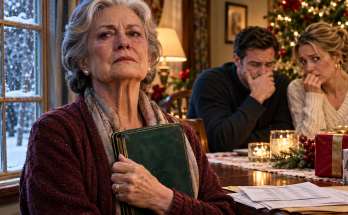
By February, I had learned that a quiet house could feel two very different ways.
Sometimes the silence was peaceful.
Other times, it reminded me of everything I had lost.
I still woke early.
I still made coffee in the same kitchen.
I still looked through the front window at the maple tree Thomas had planted.
But I no longer reached for my phone to check whether Michael needed another payment.
That habit had taken longer to break than I expected.
For years, I had built my mornings around other people's responsibilities.
There was always a bill to remember.
A payment to arrange.
A question about an expense.
Even when nobody called, part of my mind remained busy preparing for what they might need next.
Now those arrangements were ending.
The bank investigation had established where the money from the old joint account had gone.
The disputed authorization documents had been identified as not bearing my genuine signature.
Linda was helping me address the remaining financial matters properly.
And Michael had a repayment arrangement for the ninety-thousand-dollar loan.
On paper, things were becoming clearer.
At home, I still felt unsettled.
I had spent so long believing that helping my children was the center of my life that I didn't know what to do with the space left behind.
I wasn't without responsibilities.
Morgan Financial still needed my attention.
There were longtime clients who depended on me.
I had accounts to review and questions to answer.
But work had never been the only thing keeping me occupied.
Michael's household had filled whatever time remained.
I thought about that one morning while sitting at the kitchen table.
The green ledger lay beside my laptop.
For years, I opened it whenever I needed to remember what I had paid.
Now I sometimes opened it simply because I didn't know what else to do.
I would look at an old entry.
Remember why I had made the payment.
Then close the book again.
It was a habit that no longer served me.
I understood that.
But understanding a habit and changing it were different things.
There were moments when I wondered whether I had been too harsh.
Not about protecting my accounts.
I didn't regret that.
The documents had to be investigated.
The money had to be accounted for.
And the original loan had to be addressed.
But I wondered about Michael.
I pictured him sitting in my living room, struggling to explain the failed investment.
I remembered the shame in his voice.
Sometimes I wanted to call and ask how he was doing.
Then I remembered that he had been free to call me.
He knew my number.
He knew where I lived.
And he knew that my love for him hadn't disappeared.
What had changed was my willingness to solve every problem before he faced it himself.
That difference still felt unfamiliar.
I had to remind myself of it often.
Then February brought something I hadn't expected.
Rachel called to tell me she was coming to visit.
She sounded cheerful.
She said David and their little boy were doing well in Boston.
She wanted to spend some time with me.
I asked whether everything was all right.
She laughed softly.
"Mom, nothing is wrong."
I smiled.
"Then why are you coming?"
There was a pause.
"Because I want to see you."
I didn't know what to say.
It was such a simple answer.
My daughter wanted to visit because she missed me.
There was no expense to discuss.
No favor to arrange.
No financial problem waiting behind the conversation.
I felt embarrassed by how much that meant to me.
"Well," I said, "I'd like that very much."
She arrived on a Friday evening.
I heard the car outside and went to the front door.
Rachel was carrying grocery bags.
There was also a small bunch of yellow tulips tucked against her arm.
When she saw me, she smiled.
"Hi, Mom."
I opened my arms.
She hugged me so tightly that I nearly lost my balance.
For a moment, I forgot the flowers.
I forgot the groceries.
I simply held my daughter.
I hadn't realized how much I needed that.
"I missed you," she said.
I closed my eyes.
"I missed you too."
We stayed that way for another moment.
Then she stepped back and studied my face.
"Have you been looking after yourself?"
I almost laughed.
"Rachel, I'm perfectly capable of looking after myself."
She raised an eyebrow.
"That wasn't quite the question."
I smiled.
She knew me too well.
I took the tulips from her.
They were bright yellow.
Nothing expensive or elaborate.
Just flowers she had chosen because she thought I would like them.
I carried them into the kitchen.
Rachel followed with the groceries.
She looked at the table.
The green ledger was there.
So was a folder containing paperwork from Linda.
Rachel didn't comment immediately.
She put the groceries down and helped me find a vase.
I filled it with water.
Then I arranged the tulips near the window.
Their yellow petals looked almost startling against the pale winter light.
I stood back.
"They're beautiful."
Rachel smiled.
"I thought you needed something cheerful."
I turned toward her.
"Thank you."
She began unpacking the groceries.
I asked why she had brought so much.
She shrugged.
"I thought we could make dinner together."
"We could have used what I already had."
"I know."
She smiled again.
"I wanted to bring something."
That was Rachel.
She had never liked arriving empty-handed.
Even when she was younger, she tried to contribute.
Sometimes I told her she didn't need to.
Sometimes she listened.
Often she didn't.
I had always been proud of her independence.
But that evening, I appreciated something else.
She wasn't trying to prove anything.
She was simply sharing an ordinary evening with her mother.
We prepared dinner together.
I washed vegetables.
Rachel arranged things on the counter.
We moved around the kitchen without needing to explain where anything belonged.
She had grown up in that house.
She knew which drawer held the knives.
She knew where I kept the serving dishes.
She even remembered the cupboard that sometimes needed an extra push to close.
At one point, she laughed.
"You still haven't fixed that?"
I looked at the cupboard.
"It closes eventually."
"Mom."
"What?"
She shook her head, smiling.
For a few minutes, it felt like the years had folded together.
Rachel was an adult now.
A wife.
A mother.
She had her own home in Boston.
But there she was, standing beside me in the kitchen, teasing me about an old cupboard.
I hadn't needed to pay for that moment.
I hadn't needed to arrange anything special.
She was there because she wanted to be.
We ate at the kitchen table.
Rachel told me about David.
She talked about their son.
She told me little things about life in Boston.
Ordinary things.
The kind I had missed hearing.
I listened without looking at my phone.
I didn't check the ledger.
I didn't think about bank transfers.
For the first time in weeks, I felt like I was having dinner instead of waiting for the next difficult conversation.
After we finished, Rachel helped clear the dishes.
I told her to sit down.
She ignored me.
We washed and dried everything together.
Then we returned to the table.
The tulips stood near the window.
Rachel looked at them.
Then she looked at me.
"Mom, can I ask you something?"
I nodded.
"Of course."
"Are you still blaming yourself?"
I looked down.
I knew exactly what she meant.
I had told her about some of the financial problems.
She knew Linda was helping.
She knew that the bank had investigated the old account.
And she knew how much the entire situation had hurt me.
I considered denying it.
Instead, I told the truth.
"Sometimes."
Rachel nodded.
"What do you think you should have done differently?"
I looked toward the ledger.
"I should have asked more questions."
"Maybe."
"I should have made Michael repay the loan earlier."
"Maybe that would have helped."
"I should have noticed the transfers."
Rachel waited.
I swallowed.
"And I should have realized that helping him had become something he expected instead of appreciated."
My daughter sat quietly.
Then she said, "Mom, those are things you can learn from."
I looked at her.
"But you can't make yourself responsible for every choice Michael made."
I didn't answer.
She continued.
"He knew the money was supposed to be repaid."
I nodded.
"He knew you hadn't agreed to the investment."
"Yes."
"And he knew what he said at Christmas."
I closed my eyes.
That was still the hardest part.
The money had become a legal and financial problem.
But the Christmas call had become something personal.
I could look at the records and understand what happened.
I couldn't understand how my son had become comfortable laughing about his mother.
Rachel reached across the table.
"I know you miss him."
I looked at her.
"Of course I do."
"That doesn't mean you have to pretend everything is fine."
I squeezed her hand.
"I know."
But knowing hadn't made the missing easier.
I missed the son who used to sit beside me while I worked.
I missed the little boy who held my hand after Thomas died.
I missed the young man who had promised that he would look after me someday.
The adult Michael was still my son.
I loved him.
But I had to learn how to see him as he was, not only as the child I remembered.
That was painful.
Rachel seemed to understand.
She didn't tell me to forgive him immediately.
She didn't tell me to stay angry.
She simply sat with me.
After a while, she reached into her bag.
"I brought something else."
I smiled faintly.
"More groceries?"
"No."
She took out a small envelope.
It was plain.
Nothing fancy.
She placed it on the table.
I looked at it.
"What's this?"
"Something I've wanted you to have."
I opened it carefully.
Inside was a photograph.
I recognized it immediately.
Rachel's college graduation.
I was standing beside her.
She wore her graduation clothes.
I wore a blue dress.
My hair was shorter then.
There were dark circles beneath my eyes.
I remembered that day.
I had been exhausted.
Morgan Financial was still demanding long hours.
I had been trying to manage the business while making sure Rachel had everything she needed.
But I had been so proud of her.
In the photograph, I was smiling.
Not politely.
Not because someone told me to.
I looked genuinely happy.
I stared at the picture.
"I remember this."
Rachel leaned closer.
"I thought you might."
I ran my thumb along the edge.
"You were so excited."
She laughed softly.
"I was."
I turned the photograph over.
There was writing on the back.
Rachel had written a message to me.
I read it slowly.
She thanked me for working long hours after Thomas died.
She remembered the evenings I studied while trying to build a better future.
She wrote about how I had continued making dinner and looking after the family even when I was exhausted.
And she said she hoped she could someday give me even a portion of the love I had given her.
I read the message again.
My vision blurred.
I put the photograph down.
"Rachel."
She took my hand.
I tried to speak.
Nothing came out.
For years, I had worried that my children remembered only what I could provide.
Here was my daughter remembering something different.
She remembered the work.
The tired evenings.
The effort.
The love.
Not the amounts.
Not the checks.
Not the account transfers.
She remembered me.
I pressed my fingers against my eyes.
"I'm sorry."
Rachel looked surprised.
"For what?"
I shook my head.
"I don't know."
Then I laughed through my tears.
"I suppose I'm not very good at receiving things."
She smiled sadly.
"You've had plenty of practice giving."
I looked at the photograph.
The blue dress.
Rachel's graduation clothes.
My tired face.
And the smile I hadn't known someone would remember.
I felt something inside me ease.
Not because the problems with Michael were solved.
They weren't.
But because I could finally see that my years of work hadn't produced only dependence and resentment.
Rachel knew what I had given.
She also knew who I was.
That mattered more than I could explain.
She sat beside me.
"Mom, I don't want you thinking both your children feel the same way about you."
I shook my head.
"I don't."
"Good."
She looked at the photograph.
"Michael has things he needs to face."
I nodded.
"But I hope you two find a way to speak honestly again someday."
I looked toward the window.
The maple tree stood in the evening darkness.
"I hope so too."
I meant it.
I didn't want to spend the rest of my life angry with my son.
I didn't want every memory of him to end with Christmas.
But I couldn't rebuild trust simply because I missed him.
Something real had to change.
Rachel seemed to know that.
She didn't push.
Instead, she changed the subject.
"David has been asking me something."
I looked at her.
"What?"
"He wants you to teach him bookkeeping."
I blinked.
"David?"
She nodded.
"Yes."
"Why?"
Rachel smiled.
"He says anyone who keeps records as carefully as you do should be able to teach him how to make sure nothing slips past him."
I stared at her.
Then I laughed.
It surprised me.
The sound came out before I could stop it.
Rachel began laughing too.
For a moment, neither of us could speak.
It felt wonderful.
Not because the joke was particularly clever.
Because I hadn't laughed that freely in weeks.
I looked down at the green ledger.
For years, it had been a record of financial obligations.
Lately, it had become a reminder of painful discoveries.
Now David had managed to make it part of an ordinary family joke.
I shook my head.
"Tell him I'll teach him whatever he wants to know."
Rachel grinned.
"He'll be delighted."
We sat together a little longer.
The photograph remained between us.
I turned it over once more and read Rachel's message again.
Then I placed it carefully beside the tulips.
I wanted to remember that evening.
Not because someone had finally paid me back.
Not because a legal matter had been resolved.
But because my daughter had come home with groceries, flowers, and a photograph.
She had brought no request.
She had brought herself.
And after years of wondering whether my value depended on what I could provide, I had been reminded that love could arrive without asking for anything.
That night, before going to bed, I put the photograph somewhere safe.
I looked at the woman in the blue dress.
She was tired.
She had worked too much.
She had worried about her children.
But she was smiling because her daughter had reached an important moment in life.
I touched the edge of the picture.
I wished I could tell that younger woman what I was learning now.
That she didn't have to carry every burden forever.
That her children would eventually have to make their own choices.
And that some of the love she had given would return in ways she couldn't predict.
I turned off the light.
For the first time in a long while, I didn't feel quite so alone.