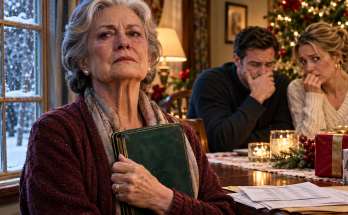
Six days after my husband’s funeral, I was clearing out his closet when I discovered a hidden door behind his hanging shirts. Just then, my son called from downstairs. “Mom, come down now. There are papers you need to sign.” He didn’t know I’d overheard his plan to sell my home. I asked for one more hour, then opened that hidden door…
Six days after we buried my husband, I found a door behind his work shirts.
I was holding his green flannel, the one with a missing cuff button, when I noticed that the back panel of his closet wasn’t quite flush with the shelf above it. There was a narrow gap near the floor. When I pressed my fingers into it, something clicked.
Downstairs, my younger son was waiting for me to sign papers.
Upstairs, behind a wall Raymond had built eighteen years earlier, an accordion folder sat beneath a desk lamp.
My name was written across the front.
I stood there with the flannel hanging from one hand. Then my phone began to ring.
Marcus.
For the first time since my husband died, I let my son’s call go unanswered.
My name is Loretta. I’m sixty-three, a retired schoolteacher, and until that March I had been married to Raymond for thirty-eight years.
He was sixty-seven when he collapsed in the back field, halfway between the house and the tool shed.
I saw him from the kitchen window.
At first, I thought he had dropped something. He was down on one knee, his hand against the ground. By the time I reached him, he wasn’t answering me.
The dispatcher stayed on the phone while I tried to help. The ambulance came up our gravel drive with its lights flashing against the bare trees.
At the hospital, a doctor told me they hadn’t been able to bring him back.
For days afterward, I kept remembering the ridiculous thing I had said when he left the kitchen that morning.
Bring your muddy boots in through the laundry room.
Those were my last words to him.
We lived on eight acres outside Greenville, South Carolina, in a farmhouse Raymond had built with help from his brothers and a few contractors whose work he inspected as though he were grading it.
We had raised two boys there. We had replaced the roof, buried three dogs, argued about the thermostat, and spent more summer evenings than I could count on the front porch.
Our older son, Derek, lived in Asheville. Marcus, the younger one, was thirty-one and worked for a commercial real estate development company in Charlotte.
Both came home when I called.
Derek brought groceries I couldn’t imagine eating. Marcus brought his laptop.
At the time, I thought that was simply how each of them handled grief.
We buried Raymond on Saturday.
Derek gave the eulogy. He spoke about fishing in the creek and the time his father drove eleven hours round trip to help him move into an apartment with no elevator.
Marcus sat beside me, holding a folded tissue he never used.
His girlfriend, Tanya, came down from Charlotte with him. She was polite, offered to carry flowers, and spent much of the reception answering messages on her phone.
I didn’t pay much attention. There were neighbors in my kitchen and casseroles filling my refrigerator. Raymond’s friend Dewey stood by the sink, crying into a paper napkin while trying to tell me a story about a lawn mower.
I was looking for more coffee filters when I remembered the unopened package upstairs.
That was why I went past Raymond’s study.
That was why I heard my son.
The study door was nearly closed.
Marcus was inside on the phone, speaking in the low, brisk voice he used for work.
“The buyer’s interested in the whole parcel,” he said. “Eight acres. Depending on access and rezoning, we’re talking one-four to one-eight.”
I stopped.
Our house stood on that parcel.
“The application isn’t filed yet,” he continued. “But planning staff didn’t shut it down. That corridor’s growing.”
A pause.
“Dad was the obstacle. Mom won’t want the hassle.”
I moved closer without meaning to. My hand touched the doorframe.
“No, she hasn’t agreed. She’s barely functioning right now.”
Someone downstairs laughed. A cabinet door closed.
Marcus lowered his voice further.
“I’ve got another route if she digs in. Leonard Pratt. He does assessments. We document that she can’t manage the finances, then petition for a conservator.”
I didn’t know the name. I knew the word.
A woman I had taught with had spent months helping arrange financial protection for her father after a serious illness. There had been lawyers, appointments, hearings.
Marcus spoke as though he were arranging an inspection.
“Three or four weeks if it stays uncontested,” he said. “Longer if somebody makes trouble. But she won’t even know what to ask.”
Then, after listening again, he said the words I would remember more clearly than anything spoken at the funeral.
“Don’t worry about her. She’s upstairs crying into his sweaters.”
I stepped back.
For a moment, I couldn’t feel my fingertips.
This was the boy who had climbed into our bed during thunderstorms. The boy whose baseball uniform I had washed at midnight because he had forgotten a game.
I wanted to open the door.
Instead, I went into the linen closet, found the coffee filters, and carried them downstairs.
Dewey was still beside the sink.
“You all right, Loretta?”
I put the package on the counter.
“Just tired.”
He nodded, accepting the answer because it was true.
The last visitors left around seven.
Derek drove back to Asheville after I insisted I didn’t need both boys sleeping in the house. Marcus and Tanya stayed in the downstairs guest room.
Marcus said he could work remotely for a few days.
“I’ll help you get organized,” he told me.
I thanked him.
That night, I lay on my side of the bed and watched the headlights of passing cars move across the ceiling.
Once I began looking backward, small things returned.
Marcus asking where we kept the deed.
Raymond ending phone calls with him sooner than he used to.
An argument in the driveway the previous fall. I had heard Marcus say, “You’re acting like I’m trying to rob you.”
When I asked Raymond about it, he said Marcus wanted money and he had refused.
That much hadn’t surprised me.
Our younger son earned well in good years, but there was always another commission coming, another expense that couldn’t wait.
What troubled me now was Raymond’s face after that argument. He had sat at the kitchen table without taking off his coat.
I had put a cup of coffee in front of him.
“Is it worse than he’s telling us?”
“Yes,” Raymond said.
Then he covered my hand with his.
“I’m getting advice.”
I had assumed he meant advice about helping Marcus.
Now I wasn’t sure.
Raymond had begun working with an attorney named Arthur Balden the previous October.
In November, I went with him to sign an updated estate plan.
Arthur explained that the house and land would be held in our living trust, that Raymond and I would manage it together, and that the survivor would continue as trustee.
I read the documents. I asked about taxes, maintenance money, and what would happen if both of us became unable to manage things.
I wasn’t careless.
But I hadn’t known I should ask whether our son was trying to turn my grief into a reason to take control.
Raymond had described the changes as overdue housekeeping.
At home afterward, he told me where the signed copies were kept in the study. He also mentioned an emergency folder upstairs.
“In the old eaves space behind my closet,” he said. “I put a release at the bottom of the panel. You remember that little storage bay?”
I remembered it filled with insulation and Christmas decorations during the renovation.
“Why back there?”
“Dry. Out of the way.”
I told him that was an inconvenient place to keep paperwork.
He smiled and said Arthur had copies of everything important.
Then Thanksgiving came. The dishwasher broke. We drove to Asheville for a birthday dinner. Life kept supplying ordinary reasons to postpone a serious conversation.
After Raymond died, Arthur’s office contacted me. We arranged to meet the following Monday, once the funeral was behind us.
Until I overheard Marcus, I had expected an unpleasant morning discussing death certificates.
By Sunday, I wanted that appointment sooner.
I left a message asking Arthur to call when he could speak privately.
Then I began looking through the study.
Marcus hovered.
He offered to sort the mail. He offered to call the bank. When I asked for the household bills, he said he had already stacked them in order.
There was nothing wrong with the order.
That made the rest harder to explain, even to myself.
On Monday, he asked whether I had been sleeping.
On Tuesday, he suggested that I shouldn’t make “big decisions” while I was upset.
On Wednesday, Tanya said a smaller place might be easier for me.
I was standing at the sink, rinsing a coffee cup.
“Easier how?”
“Less upkeep,” she said. “Somewhere with neighbors close by.”
“Our neighbors brought enough food to feed me until June.”
She gave a small laugh.
“I just meant somewhere more manageable.”
Marcus was watching me from the table.
I put the cup in the dishwasher.
“This place is manageable.”
That afternoon, Arthur returned my call while Marcus was taking a work meeting on the porch. I told him I had concerns about my son’s interest in the property.
Arthur asked whether I felt safe.
“Yes.”
“Have you signed anything since Raymond died?”
“No.”
“Keep it that way until we meet. If something is put in front of you, call me.”
I almost told him about the study conversation.
Then Marcus opened the screen door.
“I’ll explain in person,” I said.
Arthur offered an earlier appointment, but I couldn’t see how to leave without Marcus asking to come. We agreed to keep Monday, with the understanding that I could call sooner.
I spent the next two days observing my son as carefully as I had once watched a classroom during a test.
By Friday morning, I had stopped doubting what I had heard.
That was the morning I went into Raymond’s closet.
I told Marcus I wanted to sort some clothes.
Tanya offered to help.
“Thank you,” I said. “I need to do this myself.”
The bedroom was upstairs, over the older part of the house. During the renovation, Raymond had built a long closet beneath the sloping roof and enclosed the shallow storage bay beyond it.
For years, I had treated the painted rear panel as a wall.
With his shirts moved aside, I could see the faint seam.
I found the release near the baseboard, exactly where he had said it would be.
The panel opened inward.
Beyond it was a narrow space under the rafters, barely wide enough for a small work surface and a folding chair. The ceiling was high enough to stand near the entrance, then sloped sharply toward the outer edge of the house.
I remembered Raymond spending weekends in there with a drill and a shop vacuum.
I had forgotten the space could hold anything worth finding.
A desk lamp stood on a plywood shelf. I switched it on.
There was a steel document box, an old legal pad, and the accordion folder.
FOR LORETTA.
My phone rang.
I watched Marcus’s name disappear from the screen. A moment later, a message arrived.
Need you downstairs. Estate papers. Important.
I set the phone beside the lamp and opened the folder.
The first section contained bank statements.
The account was at a bank in Columbia, South Carolina. Our names were both on it.
I remembered opening it with Raymond the previous November. We had moved money out of a joint investment account because we wanted a larger cash reserve.
I had signed the forms myself.
What I hadn’t seen was the final balance after the transfers and the sale of several investments.
Two hundred forty thousand dollars.
A note in Raymond’s handwriting was clipped to the statement.
House reserve. Taxes, repairs, living expenses. No loans from this account. We agreed.
I remembered that conversation too.
Marcus had called three nights earlier, asking his father to guarantee a loan.
Raymond had refused.
I had said, “We can’t keep solving emergencies he helped create.”
At the time, I hadn’t understood how much Raymond feared the next emergency would involve us.
I turned the page.
There were copies of the trust documents, a recorded deed transferring the property into the trust, and Arthur’s explanatory letter.
A yellow tab marked the provisions for the surviving spouse.
Another marked the replacement trustee provisions.
Marcus’s name appeared among the people who might eventually benefit after both his parents were gone.
It did not appear as someone entitled to manage the house.
Then I found the investigative report.
Forty-three pages.
Reed Carpenter, a licensed private investigator based in Greenville.
Raymond had hired him in October.
I sat down.
The report didn’t contain secret access to every corner of Marcus’s life.
It contained enough.
There were copies of collection letters Marcus had brought Raymond while asking for help. Two court filings involving unpaid debts. A handwritten breakdown Marcus himself had prepared, listing roughly $160,000 owed to three creditors.
His anticipated commissions were written in the margin.
Most had never arrived.
There was also information about a civil enforcement case involving his employer’s marketing of another development. The case was public. The company disputed the allegations, but projects had stalled and financing had become uncertain.
Marcus’s paycheck hadn’t disappeared.
His expected windfalls had.
The land had become his solution.
Clipped behind the report were emails Raymond had received.
One came from a development representative thanking him for discussing a possible purchase.
Raymond’s reply was brief.
We have not discussed selling. My son is not authorized to negotiate on our behalf.
Another email, forwarded after Raymond asked what had prompted the inquiry, included something Marcus had written.
My father is resistant, but I expect to be handling the family’s property decisions soon.
The date was in October.
Raymond had still been splitting wood, fixing fence posts, and arguing with the television about the weather forecast.
Marcus had already been planning for the day his father stopped saying no.
I turned another page.
There were notes from Raymond’s conversation with Arthur. Questions about authority. About pressure to sign documents. About what a relative could and couldn’t do if he claimed an older person was no longer capable.
Raymond hadn’t known the name Leonard Pratt.
He had known enough to worry.
At the back of the folder was a sealed envelope.
I recognized my husband’s handwriting before I saw my name.
Loretta,
Arthur says we need to talk about this together. He’s right.
I keep putting it off because I’m ashamed of what I think our son may be doing, and because I still hope I’m wrong.
That is not a good reason to leave you without the facts.
I stopped reading.
For several seconds, all I could see was the first line.
Arthur says we need to talk about this together.
I loved Raymond. I could be angry with him too.
He had let me sit across from Marcus at Christmas dinner without knowing why he watched our son so carefully.
I wiped my face with the sleeve of his flannel and kept reading.
Marcus has approached people about the land. He told one of them he expected to be handling our decisions. When I confronted him, he said he was only exploring options.
I don’t believe that is the whole truth.
The plan we signed protects the survivor’s control of the house better than leaving things loose. It doesn’t mean nobody can challenge anything. Arthur was clear about that.
If there is pressure, call him. Don’t sign something because one of the boys says it’s routine.
The reserve account is ours, and yours to manage if I go first. Marcus has no authority over it.
I have put copies here because you should be able to see what I saw, including the things I wish I had been wrong about.
Then the handwriting changed slightly. The letters crowded closer together.
I remember you standing in the field in that yellow coat before we bought this place. I was explaining drainage. You were already deciding where the kitchen window should go.
You said, “Yes, this is the one.”
I’ve never regretted listening.
I should have trusted you with this sooner.
Love,
Raymond
I read the last sentence twice.
Then I folded the letter along its original creases.
For a few minutes, I sat with it against my chest.
I wanted my husband back so badly that the thought made me bend forward in the chair.
I wanted to tell him he had been foolish.
I wanted to thank him.
Downstairs, a chair scraped across the kitchen floor.
I put the letter back in its envelope.
I called Arthur.
His assistant put me through after I said I had documents in front of me and needed to speak privately.
“I found Raymond’s folder,” I told him.
“All right.”
“And I need to tell you what I heard at the reception.”
This time, I told him everything.
The buyer. The price. The assessment. Leonard Pratt.
Arthur let me finish.
Then he asked me to read Marcus’s message aloud.
“Do you have the papers he wants signed?”
“Not yet.”
“Don’t sign them. Ask to keep them so we can review them.”
“Can he do what he said?”
“Not simply because he says he can.”
Arthur explained that a claim about incapacity would have to be supported and addressed through legal procedures. I would have rights in that process, including legal representation.
A report arranged by my son wouldn’t make him my conservator.
And being appointed to a financial role would not turn my property into his inheritance.
“The trust matters,” Arthur said. “So does the deed. But neither is a force field. If Marcus takes action, we respond to the actual action. We don’t rely on reassuring language.”
I looked at Raymond’s note beside the statement.
“What do I do today?”
“Keep the originals safe. Keep your phone with you. If you feel threatened, leave or call for help. Otherwise, you can tell him plainly that no financial decisions will be made without your lawyer.”
“I want someone who handles this kind of dispute.”
“I can introduce you to Nora Gaines. She represents people facing financial exploitation and contested protective proceedings.”
“Please do.”
Before we ended the call, I asked whether he had sent Marcus any estate forms.
“No,” he said. “I have not.”
I took the folder, the legal pad, and the smaller envelopes out of the room in my canvas tote.
Then I washed my face.
I left Raymond’s flannel on our bed.
Marcus and Tanya were at the kitchen table.
Six pages lay between them, marked with yellow signature tabs. Tanya held an uncapped pen.
“There you are,” Marcus said. “I was starting to worry.”
“I was on the phone.”
“With who?”
“Arthur.”
Tanya put the pen down.
Marcus glanced at the papers.
“Good. Then he probably explained—”
“He explained that he didn’t send you anything to have me sign.”
My son’s hand stopped halfway toward the top page.
“There must be some confusion.”
“Where did these come from?”
“They’re standard forms.”
“That wasn’t my question.”
He sat back.
“I found them through a service. I was trying to save you a trip.”
I pulled out the chair across from him.
For thirty years, I had sat across from parents who insisted their child’s behavior had been misunderstood.
I had learned to wait after asking a question.
People often supplied more when you didn’t hurry to fill the silence.
Marcus pushed the pages toward me.
“It just lets me help.”
The title on the first page was a financial power of attorney.
I read the opening paragraphs. Then I turned to the section describing the authority being granted.
“This says I’m appointing you to act for me.”
“Temporarily.”
“Where does it say temporarily?”
He reached for the page.
I held it flat against the table.
“Show me.”
He didn’t.
Tanya leaned forward.
“Loretta, nobody’s trying to upset you. You’ve had a terrible week.”
“Ten days.”
She blinked.
“Since Raymond died. Ten days.”
Marcus rubbed his forehead.
“Mom, we know you’re upset.”
“I am. I’m also reading.”
I moved the papers away from the edge of the table and took the accordion folder from my tote.
Marcus looked at the handwriting on the front.
“Where did you get that?”
“Your father left it for me.”
I opened it to the printed email.
“You told someone you expected to handle our property decisions.”
“That was taken out of context.”
“What context makes it true?”
He looked toward Tanya.
She looked down.
I laid the bank statement aside without showing him the balance. Then I placed a copy of the trust summary in front of him.
“Your father and I signed our estate plan in November. I am the surviving trustee. I have an appointment with Arthur, and I’ll be making my own decisions.”
“Dad did all that because he was mad about a loan.”
“Did he?”
“He never understood how my business worked.”
“He understood that you owed money you couldn’t pay.”
Marcus’s face flushed.
“That’s private.”
“Yes,” I said. “It should have stayed between you and your creditors. You brought it into this house.”
He stood.
I stayed seated.
“Before you say anything else,” I told him, “I heard you in the study after the funeral.”
He stared at me.
I watched him understand which conversation I meant.
“Mom—”
“Leonard Pratt.”
Tanya drew her hand away from the pen.
Marcus lowered himself into the chair.
“You heard part of a conversation,” he said.
“I heard you say I was crying into your father’s sweaters.”
He looked at the tabletop.
“I shouldn’t have said that.”
“No.”
“I was under pressure.”
“What did you mean when you said you’d document that I couldn’t manage my finances?”
He breathed out through his nose.
“I was worried about you.”
“Then why were you discussing a buyer?”
There was no answer.
The refrigerator motor switched on. Somewhere outside, Dewey’s truck passed on the county road.
I could hear ordinary life continuing beyond our kitchen, and I wanted, absurdly, to step into it.
Instead, I asked my son another question.
“Have you arranged an appointment with this man?”
“Nothing’s scheduled.”
“Have you given him information about me?”
Marcus looked up.
“What kind of information?”
“That is what I’m asking you.”
He said he had made an inquiry. He said people discussed options all the time. He said I was making something ugly out of an attempt to help.
I let him finish.
Then I put my hand on the pages he had brought.
“I will keep these for my lawyer.”
“They’re mine.”
“You brought them for me to sign.”
“Mom, please.”
I had heard that word from him in so many kitchens, parking lots, and school hallways.
Please, just this once.
Please, don’t tell Dad.
Please, you don’t understand.
For years, I had treated the plea as the beginning of my responsibility.
That morning, I let it remain his.
Tanya stood and reached for her handbag.
“I think you two need some time.”
“You were holding the pen,” I said.
She stopped.
“I didn’t prepare the documents.”
“Did you read them?”
A pause.
“Some of them.”
“Then you knew they weren’t ordinary estate receipts.”
She put the pen beside the papers.
“I’m going outside.”
I didn’t stop her.
When the screen door closed, Marcus leaned toward me.
“The land’s worth more than you think.”
“I know what you think it’s worth.”
“It’s too much for one person. The taxes, the repairs—”
“I paid the property taxes last year.”
“Dad handled the investments.”
“We handled them together.”
“You could have a good life somewhere smaller.”
“I have a life here.”
He looked at me with an impatience I had seen before, usually when his father refused him something.
Then it was gone.
“I’m trying to get out of a bad situation.”
There it was.
The first thing he had said that sounded like the truth.
“How much did you expect to keep?” I asked.
He looked away.
I waited.
“A commission,” he said at last. “Possibly a consulting fee. It depended on the arrangement.”
“And what would I have received?”
“A place closer to us. Money put aside.”
“Under whose control?”
He didn’t answer.
I gathered the pages into a neat stack.
“You need to pack your things.”
His eyes filled.
For a second, he looked very young.
My hands wanted to move toward him. I put them in my lap.
“I made mistakes,” he said.
“You made plans.”
“I hadn’t done anything yet.”
“You brought me papers and lied about who sent them.”
He wiped his face with his palm.
“I can fix this.”
“Start by leaving the papers here.”
He looked toward the window, then back at me.
“What happens now?”
“I meet with my lawyers.”
“Are you going to report me?”
“I’m going to tell them the truth. They’ll advise me. I won’t make promises before I understand what happened.”
He sat there for another minute.
Then he pushed back his chair.
I asked him to leave his house key on the table.
He took it off the ring slowly, using his thumbnail to work it past the metal loop.
I watched the little brass key land beside the uncapped pen.
He and Tanya carried their bags out through the front door.
I stayed in the kitchen until I heard the car leave.
Then I went upstairs and put on Raymond’s flannel.
Derek came down from Asheville that evening.
I had called him after Marcus left.
Before he arrived, I made copies of the documents and put the originals in the steel box. I photographed the pages Marcus had brought, including the yellow tabs.
Derek found me at the table with a cup of cold tea.
He listened while I told him about the reception, the folder, and the conversation that morning.
Once, he started to interrupt.
Then he stopped himself.
When I finished, he asked to see the papers.
He read them without speaking.
“Did Dad tell you any of this?” I asked.
“He told me Marcus had asked for money. He said he’d handled it.”
Derek set the pages down.
“I should have asked more.”
“You didn’t know.”
“Neither did you.”
I looked toward the stairs.
“Your father should have told me.”
“Yes,” Derek said.
I was grateful he didn’t try to defend him.
A little later, he asked whether I wanted him to stay.
“For tonight.”
“All right.”
“And tomorrow, I need help changing the locks.”
He nodded.
We ate reheated chicken casserole from paper plates because I couldn’t bear another dish.
Before bed, he took the trash out without asking where the bags were kept.
On Monday, Arthur reviewed the trust, the deed, and the bank records with me.
There were practical tasks. Death certificates. Updating account records. Confirming my authority as surviving trustee.
Nobody stamped a document and declared me safe forever.
We made a list, and I worked through it.
Nora Gaines met with me that afternoon. I signed an engagement agreement, gave her copies of the folder, and described what I had overheard.
She asked careful questions.
What had Marcus actually said?
What had I seen?
Which statements came from Raymond’s records, and which were my conclusions?
She didn’t promise an arrest. She didn’t say grief made me an easy victim.
She said, “We’ll keep the evidence separate from what we suspect. That will help you.”
Her office sent Marcus a letter directing him to preserve relevant communications and stop presenting himself as authorized to act for me.
With my permission, they also contacted the development representative whose email was in Raymond’s folder.
He confirmed there was no signed purchase contract.
No rezoning application had been filed on my behalf.
His interest had depended on lawful authority, access, approvals, and a willing seller.
He had none of those from me.
The information about Leonard Pratt took longer.
Nora’s office checked the professional details associated with the service Marcus had named. The claimed South Carolina medical credentials could not be verified.
A consultation form later supplied during the inquiry referred to concerns reported by a family member.
There had been no examination of me.
There was no legitimate basis on that form for a conclusion about my capacity.
Nora helped me submit a factual report, with supporting documents, to local law enforcement. Information about the claimed credentials also went to the appropriate licensing authorities.
Marcus’s proposed conservatorship petition was never filed.
I learned that through his attorney.
The inquiry continued. I wasn’t entitled to decide its outcome, and I stopped asking Nora to guess.
What I needed immediately had already happened.
My son was no longer sitting in my kitchen telling me where to sign.
Over the next several months, Marcus’s employer lost financing on two projects and reduced its staff. He was among those let go.
Derek told me.
I asked whether Marcus had somewhere to live.
“He’s renting a room,” Derek said. “He found temporary work.”
Tanya had ended the relationship. I didn’t know exactly why, and I didn’t ask Derek to find out.
Marcus sent me a long email in May.
The first version contained a great deal about pressure, fear, and things getting out of hand.
I read it once and saved it.
Two weeks later, he sent a shorter one.
I lied about the papers. I talked about you as though you were an obstacle. I know you heard me.
There were other sentences.
Those were the ones I believed.
I wrote back that I had received his message. I said I wasn’t ready for a visit, and that any future relationship would require time and conduct I could trust.
I didn’t put a date on it.
I still loved him.
That was the part people sometimes expected me to explain.
I had raised him. Loving him had been the work of half my life.
It did not require me to hand him my keys again.
The space behind Raymond’s closet is still there.
I had an electrician check the lamp and the wiring. Derek added a proper handle inside the panel so it couldn’t close awkwardly behind me.
The documents are stored securely now. I don’t need to sit under the eaves to read bank statements.
Sometimes I go in anyway.
The folding chair creaks when I sit down. Raymond’s pencil is still tucked into the spiral of his legal pad.
I read his letter less often than I did at first.
When I do, I linger over the sentence where he admits he should have told me sooner.
It helps to have him imperfect on the page.
He was a good husband. He was stubborn. He could build a staircase to within an eighth of an inch and still believe an uncomfortable conversation might become easier next week.
I miss the whole man.
By April, the small kitchen garden beside the house needed clearing.
Derek came down one Saturday, and we extended it toward the south fence. Tomatoes, sweet corn, and a row of sunflowers where Raymond had once stretched string to show me his idea.
We had talked about doing it for years.
I planted until my knees hurt.
After Derek left, I carried a glass of iced tea onto the porch. The field was bright with new growth. Beyond the garden, the tool shed door needed paint.
I wrote that down.
Then I added porch steps, gutter over laundry room, and call about mower.
There was work to do here.
The farmhouse remained in the trust. I managed the reserve account. The land was still eight acres, and no part of it was for sale.
Near sunset, I went inside and found Marcus’s old house key in the small bowl where I had put it after the locks were changed.
I held it for a moment.
Then I opened the desk drawer, placed it beneath the copies of his papers, and closed the drawer.
Outside, the porch light came on.