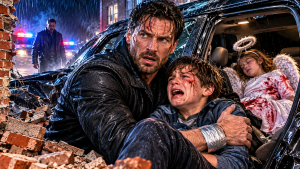
At 3 AM on Halloween, my ex-wife’s SUV crashed through my apartment wall. My 12-year-old son sat behind the wheel with his hands taped tightly in place. His little sister was unconscious in the back, wearing her bloodstained angel costume. “DADDY, HE LOCKED THE PEDALS… HE PROMISED WE WERE GOING TO RIDE THE ROLLER COASTER,” he cried. Their stepdad took them here.” He thought his police chief title would silence me. I was about to show him the side of me he had never imagined.
Chapter 1: The 3:00 AM Concussion
The drafting lamp cast a sterile cone of amber light over the vellum sheets spread across my oak worktable. Outside, the autumn rain came down in relentless, rhythmic sheets, washing over the cobblestones of Cape Haven, a historic maritime town whose salt-crusted brick facades kept secrets older than the republic itself. It was precisely three minutes past three on Halloween morning.
In the quiet corners of my ground-floor brownstone apartment, the only sound was the scratching of my mechanical pencil against the paper. I was redrafting the structural vulnerability assessment for a nineteenth-century municipal courthouse—a job that suited my carefully manufactured civilian life as an Architectural Risk Consultant. To the town council, to the neighbors who nodded to me at the corner bakery, I was David Vance: thirty-six years old, quiet, polite, a solitary craftsman nursing the lingering ache of a bitter divorce.
None of them knew that the blueprints on my desk were merely muscle memory for a mind trained to dismantle fortresses from the inside out. For twelve years, my real title had existed only on classified manifests within the Defense Intelligence Agency and Joint Special Operations Command. I had operated in dust and shadow across three continents as a Tier-One tactical intelligence specialist and interrogator. I had walked away from the black budget programs because blood and ghosts make poor company, and because two hundred miles away, my twelve-year-old son, Toby, and my seven-year-old daughter, Lily, were growing up under a sky I wanted to make safe.
I picked up my ceramic coffee mug, feeling the warmth seep into the scar tissue across my knuckles.
Then, the world shattered.
There was no screech of tires. No horn. Just a sudden, violent tearing sound, like thunder cracking inside my chest, followed by a concussive shockwave that blew the heavy exterior wall inward in a blinding eruption of red brick, pulverized plaster, and splintered oak.
The blast wave picked me up and threw me twelve feet across the kitchen linoleum. My head struck the steel face of the refrigerator, lights strobing behind my eyes as the air was sucked clean out of the room. A deafening, mechanical roar drowned out my ears—a three-ton battering ram tearing through forty feet of load-bearing masonry, shredding my drafting table into kindling, and grinding across the hardwood floorboards before coming to a violent, shuddering halt ten inches from the master gas manifold.
Get up. The command cut through the ringing in my skull like cold water. Get on your feet.
I pushed myself up from the floor, my boots crunching through shards of glass and pulverized mortar. The living room was gone. In its place was a gaping, smoking cavern open to the torrential rain, filled with a blinding fog of white radiator steam, vaporized coolant, and the acrid stench of burning synthetic motor oil. Overhead, the heavy structural floor joists groaned in agony, raining fine white plaster dust onto the wreckage below.
Buried deep in the center of my apartment was the crumpled, smoking hulk of a black luxury Lincoln Navigator.
Its front bumper was wrapped around the central steel support column; the radiator was hissing violently, dumping boiling fluid into the cracked floorboards. My tactical training took over instantly, suppressing adrenaline, lowering my heart rate into that arctic, predatory focus where panic cannot survive. I didn’t search for a weapon. I moved directly into the kill zone, calculating structural collapse thresholds with every step.
I scrambled over a waist-high mound of crushed brick, coughing against the chemical smoke, and lunged toward the driver’s side of the vehicle. Through the spider-webbed, blood-smeared laminate of the driver-side window, I saw a silhouette slumped against the white curtain of a deployed, deflated airbag.
Small shoulders. A thin, frail neck.
My breath locked in my throat. The cold professional detachment that had kept me alive in Kandahar and Tikrit evaporated into absolute horror.
“No,” I whispered. “No, no, no.”
The driver-side door was mangled, the unibody frame crushed tight against the pillar. I planted my tactical boots against the exposed brick wall, sank my bare fingers into the torn sheet metal of the window frame, and threw my entire body weight backward. The door hinges shrieked, steel tearing against steel, until the locking mechanism sheared with a loud metallic crack. I ripped the door open and threw it into the rubble.
What I saw inside the cabin made my soul turn to ash.
Slumped forward against the deflated nylon cushion, his pale face caked in soot and bright crimson streaks, was my twelve-year-old boy, Toby.
“Toby!” I screamed, dropping to my knees in the shattered glass. “Toby, look at me! Look at Dad!”
His head rolled back slowly against the headrest. His eyes were half-open, unfocused, the pupils dilated into wide black saucers. His mouth was swollen to twice its normal size, two of his front teeth broken off at the gum line, blood bubbling weakly between his lips every time he dragged air into his lungs.
I reached out to pull him free, to cradle his head against my chest, but when I touched his forearms, my hands struck something rigid and cold.
Silver industrial duct tape.
Not one wrap. Not two. Twelve dense, overlapping bands of reinforced adhesive were wound tightly around Toby’s small, bruised wrists, binding his knuckles directly to the thick leather rim of the steering wheel. The skin beneath the tape was purple, swollen, the circulation completely choked off. His fingernails were split and bleeding from clawing at the wheel.
“Daddy…” Toby whimpered, his voice a dry, ragged scrape that barely carried over the hissing radiator. A tear washed a pale, clean line down his soot-stained cheek. “Daddy… I tried to hit the brakes… I pulled with my whole body… but he locked the pedals… he said… he said we were just going to ride the roller coaster…”
I dropped my gaze into the dark, smoke-filled footwell beneath the steering column.
A heavy, custom-fabricated mechanical bracket of quarter-inch plate steel had been welded directly across the swing arm of the brake pedal, chaining it firmly to the firewall so it could not be depressed even an inch. Jammed tightly beneath the accelerator pedal was a carved wedge of dense oak, screwed into the floorboards with heavy drywall screws, pinning the throttle wide open.
This was not a juvenile joyride. It was not a tragic accident. It was a mechanically engineered execution, a suicide missile built out of three tons of steel, guided by the bound, broken hands of an innocent child.
My hands trembled with a lethal mixture of grief and fury as I reached into my pocket for my tactical folding knife. “Hang on, buddy. Daddy’s got you. I’m right here, Toby. Look at my eyes.”
I brought the blade to the tape, slicing through the silver layers with surgical precision, freeing his ruined, swollen hands from the leather wheel. Just as his limp arms dropped against my shoulders, a faint, wet, suffocated sound drifted up from the crumpled shadows of the back seat.
A child’s tiny gasp.
Chapter 2: The Blood-Soaked Angel Wings
The world shrank to the size of that sound.
“Lily?”
I didn’t use the knife to pry the rear door open. I climbed straight over the twisted center console, ignoring the jagged shards of reinforced glass that tore through the sleeves of my henley shirt, hauling myself into the collapsed cavern of the Navigator’s passenger compartment.
The rear bench had sheared off its floor mounts, crumpling forward beneath the impact until the clearance between the seats was barely eighteen inches. Pinned in the footwell, lying twisted on her side amid broken plastic cups and crumpled fast-food wrappers, was a small bundle of white lace, synthetic feathers, and crushed wire.
My seven-year-old baby girl.
Two weeks ago, over a crackling FaceTime call that her mother had cut short after five minutes, Lily had held up the costume to the camera with an ear-to-ear grin. Look, Daddy! I’m going to be an angel! The wings have real glitter!
Now, those delicate white wings were snapped in half, the wire frames jutting through torn mesh like broken bones. The pure white silk of the bodice was soaked in a heavy, dark, arterial crimson that ran from her clavicle down to the hem of her skirt. Her tiny head was wedged against the steel base of the driver’s seat; above her right ear, the skull showed a severe, depressed compound fracture where her temple had struck the exposed seat mount after the rear lap belt sheared clean through its anchor bolt.
Her eyes were rolled up into her eyelids, her tiny chest hitching in shallow, agonized spasms. In her left hand, her tiny fingers were locked in a death grip around the handle of a crumpled plastic trick-or-treat bucket decorated with smiling cartoon pumpkins. Inside lay three miniature chocolate bars, spattered with her blood.
“Lily. Lily, look at Daddy. Stay with me, sweetheart.”
My fingers flew to her carotid artery. Her pulse was a thready, chaotic flutter—less than fifty beats a minute. Her skin was freezing, clammy with the catastrophic onset of neurogenic shock. As I leaned my face down to clear her airway, tilting her chin to ensure her tongue wasn’t obstructing her trachea, a distinct chemical odor hit my olfactory senses.
It wasn’t gasoline. It wasn’t the bitter tang of burning wiring harnesses.
It was a sweet, synthetic, medicinal aroma, carrying the faint undertone of bitter almonds.
Midazolam.
Liquid pediatric benzos.
The pieces fell together in my mind with the sickening finality of a prison door slamming shut. The perpetrator hadn’t just mechanical-locked the accelerator; he had dosed my children’s Halloween candy before putting them in the vehicle. He had slipped a massive veterinary sedative into their treats to ensure Toby would be too chemically paralyzed to fight the wheel, and Lily would be deeply unconscious when three tons of American steel pulverized the brick walls of my home.
They were meant to burn inside the car. A tragic holiday catastrophe: Reckless twelve-year-old takes family SUV, crashes into estranged father’s residence, everyone dies in a fiery burst of ruptured domestic natural gas.
“God help you,” I breathed into the darkness of the cabin. “God help whatever walks this earth that did this to you.”
I gathered Lily’s limp, feather-light body against my chest, supporting her fractured skull with the flat of my palm, and backed carefully out through the shattered rear window into the ruins of my living room. Toby was slumped against the front passenger tire where I had laid him, weeping silently, his ruined hands clutching his knees.
I laid Lily down beside her brother on an undamaged wool rug in the hallway, ripping open a clean field dressing from my emergency go-bag, packing her bleeding temple with sterile hemostatic gauze.
“Toby,” I said, my voice dropping an octave into an unyielding, hypnotic calm that brook no argument. “Hold this pad to your sister’s head. Push down with your palm. Don’t let go. Do you hear me, son? Keep your hand right there.”
Toby swallowed, his bruised lips trembling, and pressed his bloody hands against the gauze. “I got her, Dad. I won’t let go.”
I rose to my full height and turned toward the twelve-foot gap where my front bay windows and exterior brick wall used to be. The cold autumn rain was sweeping into the ruined room, blowing the white radiator steam out into the dark, quiet street.
Across the road, sitting under the dripping branches of a massive weeping willow at the edge of the municipal park, sat a vehicle.
It was a black-and-gold Ford Explorer. Marked unit. Cape Haven Municipal Police.
The engine was idling, exhaust puffing in white plumes into the rain. The headlights were switched off, but the interior dashboard glow illuminated the profile of the man sitting behind the wheel.
He wore a dark blue service uniform with pristine gold rank braids on the shoulders and a polished gold shield pinned over his breast pocket. In his right hand, he held a white paper coffee cup from the twenty-four-hour diner down on the wharf. His window was cracked open two inches, letting the cold air in.
It was Chief Marcus Vance.
My ex-wife’s husband. The man who had spent the last two years systematically poisoning my custody hearings, bribing family court evaluators, and using the local patrol union to run me out of town.
He was sitting there fifty yards away, casually blowing steam off his coffee, his lips parted in a quiet, leisurely smirk as he watched the smoke billow from my pulverized home.
He hadn’t turned on his lights. He hadn’t keyed his radio. He hadn’t pulled his sidearm to run to the aid of the crushed vehicle.
He was sitting in the rain, waiting for the gas line to catch a stray electrical spark from the Navigator’s severed battery cable and incinerate the evidence.
Our eyes locked across the rain-swept asphalt.
Through the mist, Marcus raised his coffee cup toward me in a silent, mocking toast.
Chapter 3: The Protocol Cerberus Uplink
In combat, when an operative enters the sensory envelope of absolute mortal danger, there is an initial spike of cortisol—a flash of primal animal terror that either paralyzes the body or drives it into blind, useless panic.
Then comes the drop.
For men who have spent years living in the gray space between nations, the drop is an old, familiar friend. My pulse dropped from ninety to fifty-two beats per minute. The burning ache in my bruised ribs, the ringing in my ears, the boiling paternal rage—all of it was compartmentalized, sealed behind six inches of tactical discipline.
The father who loved his children was tucked away inside a reinforced bunker; the intelligence operator who had dismantled terrorist cells in the Helmand Province took the helm.
I dropped to my knees beside the hallway floorboards. Three feet from where Toby was holding the hemostatic bandage against Lily’s temple, I slipped my tactical knife into the tongue-and-groove seam of the oak flooring, levered up two interlocking boards, and pulled out a matte-black, waterproof Pelican 1450 Case.
If I called 911, the call would route through the Cape Haven Municipal Dispatch Center—a facility staffed entirely by Marcus Vance’s handpicked loyalists. The dispatcher on duty tonight was his second cousin. The response time would be intentionally bottlenecked. Paramedics would be directed to the wrong address on the far side of the canal. And if an ambulance did arrive, Marcus’s trusted deputies would secure the scene, separate me from my children, and ensure that Toby and Lily never woke up to give a statement to the state police.
I popped the heavy polymer latches of the Pelican case.
Inside rested a customized Sig Sauer P226 Legion, three spare magazines loaded with subsonic hollow-points, an AN/PVS-14 night-vision monocular, and a green, brick-sized military satellite transceiver: the Harris AN/PRC-117G.
Beside the satellite terminal sat a modified Uniden digital trunk-tracking scanner. I flipped the toggle switch on the scanner with my thumb. The local emergency band crackled to life in my ear through a coiled acoustic earpiece:
“…Unit Four to Dispatch. We have a 911 caller on Elm Street reporting an explosion and a vehicle into a structure. Confirming dispatch?”
A three-second pause hissed over the open frequency before Marcus Vance’s deep, drawling voice broke through the channel from his cruiser across the street:
“Dispatch, break that call. Disregard. We have downed high-voltage lines across the north bridge and transformer fires along the coast road. All available units maintain perimeter at the municipal yard until the power company clears the grid. Elm Street is inaccessible. Repeat: hold perimeter for twenty-five minutes.”
“Copy that, Chief. Holding units at station perimeter.”
Twenty-five minutes. Just long enough for the radiator heat to ignite the natural gas pooling around the Navigator’s chassis.
I ignored the local radio and turned to the AN/PRC-117G. I twisted the frequency dial to an encrypted, unlisted ultra-high-frequency channel, spun the cipher key, and brought the heavy tactical microphone to my lips. I depressed the push-to-talk button.
“Cerberus Actual to Red Dragon. Authenticate: Foxtrot-Seven-Zero-Niner.”
The speaker hissed with white noise, bounced off a low-earth-orbit military communications satellite hovering over the Atlantic seaboard.
Two seconds later, a voice came back through the speaker—flat, clinical, and completely awake.
“Authentication confirmed, David. This is Special Agent in Charge Miller. We have you five-by-five. What is your status?”
Arthur Miller. Assistant Director of the Federal Public Corruption Task Force, United States Department of Justice. For four years, Arthur had been my primary federal handler while I served as an off-the-books intelligence consultant investigating institutional racketeering along the eastern seaboard.
“Code Red: Immediate kinetic breach,” I said, my voice dead and cold. “Target Marcus Vance has just launched an assassination attempt against my home. He rigged my twelve-year-old son to the wheel of a full-size SUV with industrial tape, welded the brake pedal, wedged the throttle open, and sent it through my living room. He dosed both of my children with midazolam. My seven-year-old daughter has a depressed compound temporal fracture and is in class-three hemorrhagic shock. Marcus is idling across the street in Unit One, deliberately holding back local emergency medical services to let us burn.”
A heavy, suffocating silence gripped the satellite line for two seconds. When Miller spoke again, the bureaucrat was gone. The voice on the other end was that of an apex predator.
“We have him, David. We’ve had his satellite comms and burner phones tapped for ninety days on the maritime smuggling network. Ten minutes ago, his cloud server updated: he executed two private juvenile term life insurance policies seventy-two hours ago. Two million dollars on Toby. Two million dollars on Lily. Your ex-wife, Sarah, is listed as the sole surviving beneficiary.”
A cold knot tightened in my diaphragm. Four million dollars. They hadn’t just tried to murder me out of jealousy or custody disputes. They had turned my own flesh and blood into a cash settlement.
“Listen to me, David,” Miller continued, the low whine of a jet turbine spinning up audible in the background of his transmission. “Strike Team Falcon was pre-staged at Naval Air Station Oceana for the dawn raid on his docks. I am re-tasking them to your coordinates right now. Three MH-60 Black Hawks. Full HRT complement. Flight surgeons onboard. Their ETA to your front yard is four minutes.”
“Tell them to hurry, Arthur,” I whispered, glancing back at Lily. Her breathing was becoming Cheyne-Stokes—irregular, shallow, hitching like a failing engine. “My baby girl doesn’t have four minutes.”
“Hold your perimeter, operator,” Miller ordered. “Do not engage unless Marcus breaches your threshold. The sky is coming down on him.”
I clicked the transceiver off.
I picked up the Sig Sauer, racked the slide back to chamber a round with a crisp, oiled clack, holstered it against my hip, and pulled the night-vision monocular over my left eye.
Through the jagged hole in my wall, the headlights of Marcus Vance’s cruiser suddenly flared to life. The heavy V8 engine rumbled. The cruiser pulled out from under the willow tree, tires splashing through the flooded gutters, and slowly crawled across the asphalt, turning its spotlight directly into the smoking ruins of my home.
Chapter 4: The Sky Falls on Elm Street
Marcus Vance drove the cruiser onto the sidewalk, crushing my decorative picket fence beneath his heavy front push-bar. He threw the transmission into park, cut the engine, and stepped out into the rain.
He moved with the slow, insolent swagger of a feudal baron inspecting a tenant farmer’s ruin. He didn’t unholster his service weapon, but his right hand rested comfortably on the retention hood of his Safariland holster. In his left hand, he held a high-powered Streamlight flashlight, playing the blinding beam across the pulverized brickwork, the crumpled hood of the Navigator, and the pooling pool of green antifreeze.
“David?” he called out, his voice a theatrical blend of mock horror and patronizing pity. “David, are you in there, buddy? Oh, sweet Jesus… look at this. Look at what that boy did.”
He took another step over the broken masonry, the light sweeping toward the hallway where Toby sat curled over Lily.
“I tried to tell Sarah that Toby was getting wild,” Marcus sighed, shaking his head with rehearsed grief, his words clearly meant for the body camera he had ostentatiously clipped to his lapel—a camera that would later ‘prove’ he was the first responding hero on scene. “Taking the keys in the middle of the night… driving like a lunatic… God, David, I just hope you didn’t suffer. It’s a terrible, terrible thing when a family falls apart like this.”
He unclipped the retention strap on his Glock 17.
He was four paces from the driver-side door of the Navigator. He intended to step inside, look for survivors, and put a single hollow-point into my head under the guise of an ‘accidental gas-fire discharge’ if the crash hadn’t done the job.
I stepped out from behind the reinforced steel lintel of the hallway, my Sig Sauer held at low-ready, my night-vision monocular glowing faintly green over my left eye.
“You took out the insurance policy on Tuesday, Marcus,” I said.
Marcus froze.
The flashlight beam snapped instantly to my face, blinding in its intensity, but behind the green phosphorescence of my night-vision lens, his silhouette was etched in stark, crisp relief. I could see the sudden hitch in his throat, the micro-twitch of his right eyelid, the way the arrogance drained from his jawline like water down a storm drain.
“David…” he stammered, recovering his mask with a sickening, oily smile. “You’re alive. Thank God. Don’t move, man. You’re in shock. The gas line—”
“Four million dollars,” I interrupted, my voice dropping into that terrifying, conversational quiet that made hardened cartel lieutenants weep in interrogation bunkers. “Two million on the boy whose teeth you smashed against the steering column. Two million on the little girl you laced with pediatric sedatives.”
Marcus’s hand tightened around the grip of his pistol. His face hardened, the folksy small-town police chief vanishing, replaced by the cornered, rabid sociopath beneath the badge.
“Nobody’s going to care what a broken-down veteran says, David,” Marcus hissed, his voice dropping all pretense, turning venomous and low. “In this county, I am the law. I am the judge, the jury, and the coroner. Sarah is waiting in the penthouse suite at the marina with an alibi signed by three city councilmen. You’re just a dead man who couldn’t protect his kids.”
He began to draw his weapon.
THWACK-THWACK-THWACK-THWACK.
The air didn’t just vibrate; it compressed.
The clouds directly above Elm Street didn’t roll back—they detonated downward. A wall of hurricane-force downdraft slammed into the street with such sudden, crushing violence that the rain was instantly atomized into a blinding white mist. The ancient weeping willow in the park snapped in half with a gunshot report, its heavy limbs crashing onto the grass.
Marcus stumbled, his police cap ripped from his head and swallowed by the vortex of air. He looked up, his face contorting in pure, uncomprehending terror.
Dropping through the low ceiling of rain and storm clouds were three massive, twin-turbine MH-60 Black Hawk Helicopters, running completely blacked out—no navigation lights, no anti-collision beacons. They hovered barely forty feet above the street, the massive downdraft from their rotors peeling the asphalt shingles off the neighboring roofs and blowing the smoke out of my living room in a single concussive breath.
Suddenly, three thirty-million-candlepower searchlights ignited simultaneously from the bellies of the aircraft.
Night vanished. The entire block was incinerated in an apocalyptic glare of pure, blinding white light.
From the open cabin doors of the lead helicopter, four heavy braided fast-ropes dropped like falling pythons, slapping into the mud and pavement around Marcus’s cruiser.
Before the ropes had even stopped swinging, dark silhouettes were sliding down the lines with terrifying, mechanized speed. Twelve heavily armed operators from the FBI Hostage Rescue Team and military special operations hit the ground in flawless tactical synchronization. Dressed in full black multicam, high-cut ballistic helmets, quad-tube night-vision goggles, and carrying suppressed short-barreled carbines, they fanned out in a 360-degree perimeter within three seconds of touchdown.
“FEDERAL AGENTS! DO NOT MOVE!” a voice bellowed through an external PA system that shook the foundations of the brownstone. “DROP THE WEAPON! DOWN ON THE GROUND! NOW!”
Marcus panicked. The small-town tyrant who had never faced anything more dangerous than an unarmed civilian lost his mind in the sensory overload. He spun around, raising his Glock toward the lead operator.
BANG.
A single flashbang grenade detonated three inches from the heels of Marcus’s polished boots.
The 180-decibel concussion blew his eardrums, the million-candela flash blinding what little vision he had left. Marcus shrieked, dropping his pistol into the mud, his hands flying to his ears as he collapsed to his knees, retching violently onto the street.
Before he could hit the asphalt, a massive combat boot drove directly into the center of his shoulder blades.
Arthur Miller stepped through the swirling dust and rotor wash, his heavy trench coat whipping in the wind, a tactical ballistic vest strapped across his chest. He drove Marcus Vance face-down into the very pile of crushed brick and shattered mortar that his SUV had torn from my home.
CRACK.
Marcus’s face slammed into the wet masonry, his nose breaking on an exposed piece of structural granite, blood spraying across the shiny gold surface of his badge.
Two HRT operators descended on him like timber wolves. One pinned his neck with a combat boot; the other seized Marcus’s wrists, wrenching them behind his back until the shoulder joints popped, snapping heavy, ratcheted steel flex-cuffs around his forearms so tightly the bone audibly clicked.
“Marcus Vance!” Miller roared over the turbine whine, leaning down until his face was inches from the bleeding, hysterical police chief. “By authority of the United States District Court for the Eastern District, you are under arrest for two counts of Attempted Capital Murder, Domestic Terrorism, and Deprivation of Civil Rights Under Color of Law!”
Through the blinding glare of the searchlights, I stepped through the ruined wall of my home.
I carried seven-year-old Lily in my arms. Her broken angel wings hung limp across my forearm; her face was pale as marble, her white costume drenched in crimson. Toby walked at my side, his swollen hands clutching the hem of my jacket, his broken teeth bared in an expression of awe and righteous fury.
Marcus twisted his head in the mud, looking up at us through one swollen, blood-filled eye.
I looked down at him. And in my eyes, he saw that the federal agents hadn’t arrived to save me from him.
They had arrived to save him from me.
Chapter 5: The Blood on the Broken Wings
“Surgical team! Move, move, move!”
The command tore through the chaos as two flight surgeons in sterile green flight suits leaped from the second Black Hawk, dragging a pediatric trauma litter across the shattered lawn. They didn’t ask questions. They saw the crushed temporal bone, the pale blue tint of Lily’s lips, and the blood soaking the white lace of her costume.
“Depressed skull fracture with intracranial herniation risk!” the lead surgeon shouted, dropping to his knees beside me. He slipped a pediatric pulse oximeter onto her uninjured hand and brought a portable ultrasound transducer to her abdomen. “Heart rate is forty-four! Pupils are unequal! We need an emergency burr hole to relieve the epidural hematoma or we lose her in eight minutes!”
“She was dosed with midazolam,” I told him, my voice steady, cutting through the turbine roar. “High concentration. Oral administration.”
The surgeon looked up, his eyes wide behind his protective glasses. “Understood. Reversing with flumazenil now. Get her on the bird! Go!”
They lifted Lily onto the carbon-fiber litter with agonizing care, securing her cervical collar and strapping her tiny body down. As they lifted the stretcher, Toby ran alongside them, refusing to let go of her trick-or-treat bucket.
“Take him with her,” I said to the second surgeon, resting my hand on Toby’s shoulder. “He has bilateral wrist trauma, broken teeth, and blunt force chest impact from the steering column.”
“I’m going with my sister,” Toby choked out, looking back at me with tears cutting through the grime on his face. “Dad… are you coming?”
“I’ll be right behind you, son,” I promised, kissing his forehead. “Daddy’s just finishing the work here.”
The helicopter’s side door rolled shut, and the second Black Hawk immediately lifted off, nose dipping down as it accelerated toward the trauma surgical suites at Walter Reed National Military Medical Center, less than twenty minutes away by air.
I turned back to the street.
The rain was washing the blood down the gutters of Elm Street. Marcus Vance was still pinned face-down in the mud, his uniform torn, his golden badge ripped from his shirt and lying in a puddle of muddy radiator fluid. He was hyperventilating, his aristocratic bravado completely disintegrated into the pathetic, shuddering sobs of a cornered coward.
“David…” he wept, his voice muffled by the asphalt. “David, please… it was Sarah! She planned the whole thing! She told me Toby was out of control… she said you were going to take the kids away forever! I was just trying to protect our family!”
I walked over to the wreckage of the Navigator.
I reached down into the smoking footwell, took hold of the heavy, custom-welded steel bracket that had locked the brake pedal, and ripped it from its mounting with a screech of bent bolts.
I walked back to Marcus, stood over him, and dropped the four-pound chunk of jagged steel onto the pavement right in front of his face.
CLANG.
The heavy metal bounced, spattering muddy water across his broken nose.
“You welded the pedal, Marcus,” I said softly.
The entire federal perimeter went silent. Even the HRT operators holding their carbines seemed to stop breathing.
“You took a twelve-year-old boy,” I continued, kneeling until my eyes were six inches from his. “You wrapped his wrists in twelve layers of duct tape. You forced him behind the wheel of a machine meant to kill his father, and you put broken angel wings on my daughter.”
“David… please…” he begged, tears mixing with the blood pouring from his nostrils. “I have rights… I’m an officer of the court…”
Agent Miller stepped up beside me, pulling a ruggedized military tablet from his tactical vest. He tapped the screen and held it before Marcus’s face.
Displayed on the screen was a live video feed from a luxury penthouse suite at the Harbor View Hotel, three miles across town.
On the screen, four federal agents in tactical gear were escorting my ex-wife, Sarah, out of the double mahogany doors in handcuffs. She was wearing an emerald-green evening gown, her hair perfectly styled, holding an open flute of vintage champagne when the door had been breached. On the glass dining table behind her sat two unsealed policy binders from Northwestern Mutual Life, alongside an open laptop displaying the live traffic camera feed of Elm Street.
“Sarah was secured four minutes ago,” Miller said coldly, looking down at Marcus. “She gave up the burner phones before the handcuffs were clicked shut. She gave up your off-shore shell accounts in the Caymans. She gave up the safe in your police headquarters office containing the unused midazolam vials from the municipal veterinary impound.”
Marcus let out a low, animal wail—a sound of absolute, irrevocable defeat. The fortress of corrupt immunity he had built over twenty years hadn’t just cracked; it had been pulverized into dust.
I reached out, my fingers wrapping around the gold badge lying in the puddle. I picked it up, feeling the cheap, hollow weight of it in my palm.
“You wanted to sit across the street and watch my life burn, Marcus,” I whispered into his ear. “Now, you’re going to spend the rest of your life staring at eight-by-ten feet of concrete at ADX Florence. You will never see the sun again. You will never hear the sound of the ocean. And every time you close your eyes in the dark, you are going to see my daughter’s angel wings.”
I dropped the badge into the mud and ground it beneath the heel of my tactical boot, crushing the gold seal into the gravel.
Miller tapped my shoulder. “David. The third bird is waiting for us. Lily’s vitals have stabilized enough for the neurosurgeon to begin the craniotomy. We need to move.”
I didn’t look back at Marcus Vance as two federal agents hauled him to his feet like a sack of butchered meat, tossing him into the back of an armored suburban.
I walked toward the roaring turbines of the remaining Black Hawk, climbing into the cabin, leaving the ruins of my civilian life behind.
Chapter 6: The Rebuilt Sanctuary
One year later.
The smell of autumn in the Bitterroot Mountains of Montana is unlike anything else on earth. It carries no salt, no rot, no chemical exhaust. It smells of ponderosa pine, cured cedar firewood, crisp mountain snow, and sweet, crisp honeycrisp apples picked straight from the orchard.
I stood on the wide redwood wrap-around porch of our timber-frame home, holding two steaming ceramic mugs of hot apple cider spiced with cinnamon. Along the balustrade, six massive, hand-carved jack-o’-lanterns sat glowing in the twilight, their triangular grins illuminated by warm candlelight.
Down on the rolling emerald lawn that sloped toward the trout stream, the sound of musical, uninhibited laughter rose into the evening air.
“Barnaby! No! That’s my cape! You can’t eat the cape!”
Eight-year-old Lily was sprinting in wide, joyful circles across the grass, pursued by a seven-month-old golden retriever puppy whose oversized paws sent dry pine needles flying in every direction.
Lily wasn’t wearing angel wings this Halloween.
She wore a custom-tailored, crimson-and-gold superhero costume, complete with heavy utility boots and an emerald cape that snapped proudly behind her in the crisp mountain wind. Her thick, dark hair fell long and lustrous past her shoulders, parted carefully on the right side to conceal a thin, three-inch silver line along her temple—the miraculous mark where military neurosurgeons had relieved the pressure on her brain and knit her skull back together.
She was whole. She was vibrant. She was fast as the wind.
Beside the archery range twenty yards away, thirteen-year-old Toby stood tall, his shoulders broad, his posture straight and confident. The terrified, broken boy who had wept behind the wheel of a guided missile was gone. In his place was a young man whose eyes held the quiet, unshakeable steel of someone who had survived the dark and knew how to fight his way back.
Toby drew back the string of his compound bow, his fingers steady, his breathing rhythmic and controlled. He paused at full draw, his new, permanent ceramic front teeth catching the amber glow of the setting sun.
THWACK.
The carbon-fiber arrow buried itself dead-center in the yellow bullseye eighty yards out, the target shaking with the impact.
Toby lowered the bow, turned toward the porch, and broke into a brilliant, triumphant grin. “Dad! Did you see that grouping? Half an inch to the left of the pin!”
“Dead center, son,” I called back, stepping down the porch stairs with the mugs of cider. “That’s five in a row. You’re officially buying the marshmallows tonight.”
Toby jogged over, clapping his sister on the shoulder as she ran past him, the puppy tumbling over her boots into a heap of wagging tails and childish giggles.
As I handed Toby his mug, my satellite phone buzzed once against my belt.
I set my mug down and glanced at the encrypted screen. It was a formal notification from the United States Department of Justice, Office of the Federal Bureau of Prisons:
NOTIFICATION OF FINAL DISPOSITION:
Inmate: VANCE, Marcus E. — Reg #94821-083.
Sentenced: Three consecutive life sentences without the possibility of parole + 45 years.
Placement: ADX Florence (Supermax), Florence, Colorado. Status: Special Administrative Measures (Total Isolation).
Inmate: VANCE, Sarah L. — Reg #94822-083.
Sentenced: Forty-two years federal incarceration.
Placement: FMC Carswell (Administrative Security). Status: Parental rights permanently severed.
I closed the notification and deleted the thread.
Their names didn’t belong in this valley. Their poison could not cross the jagged granite ridges that guarded my home. In the eyes of the world, they had become cautionary tales whispered in law school classrooms; in the eyes of my children, they had simply ceased to exist, replaced by the warmth of a fire and the safety of a father’s unbroken promise.
Lily came barreling up the steps, her cheeks flushed bright pink from the cold mountain air, throwing her arms around my waist and burying her face against my flannel shirt.
“Daddy!” she panted, looking up at me with large, shining hazel eyes. “Look at my cape! Toby says superheroes can’t fly in real life, but when I jump off the porch, I stay in the air for three whole seconds! Tell him I’m flying!”
I knelt down, wrapping my arms around my daughter, lifting her easily against my chest. Toby joined us, wrapping his arm around my shoulder, leaning his head against my arm as the sun dipped behind the jagged, snow-capped peaks of the Continental Divide.
“You don’t need wings to fly, my sweet girl,” I whispered, kissing the faint silver scar above her ear. “You survived the dark. You are stronger than the mountains.”
“We’re a team, right Dad?” Toby asked, his voice steady, his eyes looking up into the twilight sky.
“The best team on this earth,” I said.
The monsters of this world believe that power lives in badges, in money, in the shadows where they plan their cowardly cruelties. They forget that there is no force beneath heaven more terrifying, more unyielding, and more absolute than a father who will tear the world apart to pull his children out of the rubble and bring them home.
As the first stars blinked to life over our sanctuary, Toby reached into his pocket and pulled out a small piece of whittled pine—a miniature soaring eagle he had been carving for a month.
“Dad,” he said, looking up with a brave, fearless smile. “Teach me the rest of your navigation codes tonight. We’re ready for the deep trails.”
I smiled, holding both of my children close against my chest, feeling their hearts beat steady, strong, and free.
“The trails are ours, son,” I said. “Forever.”
If you want more stories like this, or if you’d like to share your thoughts about what you would have done in my situation, I’d love to hear from you. Your perspective helps these stories reach more people, so don’t be shy about commenting or sharing.