The Town Cast Out an 11-Year-Old Girl—Then Her Cave Became Its Only Hope
Part 1 On September 29, 1886, the people of Brierwood sent eleven-year-old Alma Jesús into the Wyoming wilderness with a wool blanket, a sack of cornmeal, and no one to walk beside her.
The town watched from doorways and windows. No one said goodbye.
No one asked whether she knew where to go or how long her food would last.
Reverend Josia Woodmore stood near the church steps,
his hands folded over his coat, as if the cold season had already begun.
Alma did not look back. Three days earlier,
she had stood in the general store and told the townspeople that winter would come early.
It would be the harshest winter they had ever known, she said.
Snow would bury the roads. Cold would kill the cattle.
If they did not prepare, people would die. The grocer laughed.
A rancher called her a child with an overactive imagination.
Reverend Woodmore declared that she was spreading fear
and corrupting the town.
He said no girl her age could know what was coming.
But Alma had not guessed.
Her father, Silas, had taught her to read the land.
He showed her how to watch the animals, the trees, the streams,
and the small changes people hurried past.
He taught her that a high beaver dam could hint at deep snow,
and that an early movement of elk toward the lowlands meant the high country was becoming dangerous.
When Alma was nine,
Silas died after a grizzly mauled him in a canyon above Sweetwater.
Alma found his body days later, following the ravens.
She buried him alone with his hunting knife, then walked to Brierwood,
the nearest settlement.
The town took her in, but never quite welcomed her. She scrubbed floors,
mended clothes,
and tended animals for families who passed her from house to house.
They thought she was strange because she spoke of her
father without crying and noticed things they did not.
When she warned of a flash flood, three horses drowned.
When she predicted an August frost, the Harrigan family lost its orchard.
Each time, people found a reason not to believe her.
She was only a child. She was only lucky.
She was only trying to frighten them.
Then, in August of 1886, Alma saw the signs gathering.
The beavers were building higher dams than she had ever seen.
Elk left the highlands weeks early,
their coats thick and their movements uneasy.
Squirrels packed away food with frantic urgency.
Woolly bear caterpillars were almost entirely black.
Her father had taught her what those signs meant.
When Alma told the town, Reverend Woodmore called her a liar.
Brierwood agreed to cast her out.
Now Alma crossed the sagebrush plains alone.
The wind tugged at her blanket.
She rationed the cornmeal and kept walking north,
toward the foothills where she and Silas had once hunted.
She was frightened, though she refused to let fear choose her direction.
Her father had taught her that staying alive began with
noticing what the world offered.
After two days, she found a cliff face above a sheltered valley.
A spring flowed from the rock beneath a broad overhang.
In the sandstone, a narrow crack opened into a dark hollow.
The entrance was small, but the rock shielded it from the wind.
Alma squeezed inside.
The cavity was barely large enough for her to lie down.
Still, it was dry. It was hidden. And the stone seemed solid around her.
She had a knife, her father’s lessons, and six weeks before winter,
if the town was right. The town was wrong. Alma began to carve.
She scraped and chipped at the sandstone with her knife and stones,
widening the opening little by little.
Her hands blistered, split, and hardened.
Every morning she worked until her arms trembled.
Then she gathered wood, roots, pine nuts, and rose hips.
She trapped rabbits, dried their meat, and saved their pelts against the cold.
By October, she had shaped the hollow into a room.
A hearth near the entrance warmed the stone,
and a narrow crevice carried smoke upward.
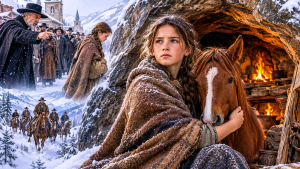
She built a second chamber and began taming a pale brown mustang mare,
whom she named Whisper.
Fallen aspen logs and strips of rawhide became a door
she could close against the wind. The first snow fell on November 12.
It came early, wet and heavy,
driven by a wind that pushed through every crack in the valley.
Alma stood in the cave entrance and watched the flakes erase the ground.
She felt no pride in being right.
She thought of the people in Brierwood—of the children, the old,
and even the adults who had sent her away.
She knew how quickly the cold could turn a mistake into a death.
Storms followed. The snow deepened. Temperatures dropped to forty below,
and the wind seemed to search every home for a way in.
In Brierwood, cattle froze in ravines and drifts.
The Harrigan ranch lost hundreds of head.
The general store’s shelves emptied before Christmas. By February,
families were burning furniture to keep one room warm,
and children were growing sick.
Fourteen-year-old Thomas Merser remembered Alma.
He had heard her warnings and seen the town drive her away.
Now he urged his father to send a search party north.
Five men rode into the mountains with what little food they could spare.
On the third day, they saw smoke rising from a cliff.
They knocked on a wooden door fitted so neatly into the
sandstone that it seemed to be part of the rock. Alma opened it.
Behind her, the men saw carved stone walls, a glowing hearth,
stacks of firewood, dried meat, and Whisper in a sheltered chamber.
The girl they had expected to find dead looked thin, but alive.
Thomas swallowed hard. “The people are starving.”
Alma looked past him toward the storm. “How many are left?”
“Mostly women and children,” he said. His voice broke.
“Some men went out for food. They never came back.”
Alma studied the valley where Brierwood lay hidden beneath the snow.
The people who had called her dangerous now needed the
knowledge she had tried to share.
“There’s a valley three miles east,” she said.
“The cliffs keep the snow from drifting deep.
There’s game there, and caves where families can shelter.”
Thomas stared at her. “Would you help us, after what we did?”
Alma stepped away from the door, letting the warmth spill into the storm.
“Come inside,” she said. “We have work to do.”
Part 2 “Come inside,” she said. “We have work to do.”
The men stepped into Alma’s cave, carrying the cold with them.
She gave them broth and a place by the fire.
No one asked why she had enough food to share.
They could see the answer in the smoke-blackened hearth,
the stacked wood, and the careful order of the room.
Alma listened while Thomas told her what had happened in Brierwood.
Twenty-three people were dead. Others were too weak to travel far.
Children were sick. The Reverend refused to join them.
He said the town should stay and pray.
“Prayer won’t make a road through the snow,” Alma said.
“We leave at first light.” She divided the work.
The strongest men would clear a path.
Others would carry food and blankets.
Thomas would ride with her at the front,
and the remaining horses would pull whatever the survivors could save.
Alma showed the men how to pack for cold, how to read the wind,
and how to avoid the gullies where snow could swallow a person whole.
At dawn, she led them toward Brierwood. The journey took three days.
The snow was waist-deep in places,
and the wind erased their tracks almost as soon as they made them.
Twice, Alma turned the column away from slopes that looked safe but were not.
Once,
she stopped everyone beneath a ridge until the roar of a hidden slide passed through the valley.
At last they reached the town. Families emerged from dark homes,
carrying children and whatever food remained.
Some people could barely stand.
They looked at Alma with shame, gratitude, and fear.
Then a shout rose from the church.
Reverend Woodmore had come out, refusing the blankets they offered.
He pointed at Alma and demanded that no one follow her.
“She brought this ruin upon us,” he cried.
“God will protect the faithful.” Alma saw movement behind him:
a child collapsed in the snow,
and a mother stumbling toward the church steps. Thomas turned to help.
But the frozen ground beneath the churchyard cracked
with a sound like a gunshot. The slope above Brierwood began to move.
Part 3 The mountain did not roar at first. It made a low,
distant sound that could have been wind moving through a ravine.
Then the sound deepened.
Snow broke loose along the ridge above Brierwood and slid down the slope in a white sheet,
gathering speed as it swallowed trees and rocks. “Move!”
Alma shouted. The crowd scattered.
Thomas sprinted toward the child who had fallen.
Her mother reached for her, but her legs gave way. Alma ran toward them,
grabbed the child beneath the arms,
and dragged her clear as the first wave of snow swept across the churchyard.
Thomas caught the mother by her coat and hauled her toward a stone wall.
The reverend stood frozen on the steps,
one hand gripping the pulpit Bible he had carried outside.
“Reverend!” Thomas yelled.
Woodmore stared at the wall of snow racing toward him.
His certainty vanished.
For a moment he looked like any frightened old man—small, cold, and human.
Alma reached him first. She seized his sleeve and pulled.
He stumbled down the steps just as the avalanche struck the church’s side.
The building shuddered. Its roof groaned beneath the snow.
The crowd pressed into the lee of the stone wall.
Snow and wind blinded them. A wagon overturned. A horse screamed.
Someone called for a son, someone else for a sister.
Alma kept her voice steady,
telling the families to stay low and hold on to one another.
The slide passed in minutes, but the silence afterward felt longer.
When the snow settled, the church stood half-buried, its bell tower gone.
The road north had disappeared.
The town was trapped beneath a new wall of snow. Alma counted heads.
The child was alive, though her mother’s ankle was badly twisted.
Thomas had a cut across his forehead.
Reverend Woodmore sat in the snow, clutching the Bible to his chest.
He was breathing hard, unable to meet Alma’s eyes.
“Can we still get out?” he asked. “We can,” Alma said.
“But we have to leave now. The slope could move again.” No one argued.
She set the order of travel. The injured would ride in the wagons.
The children would walk between adults,
tied together with strips of cloth so no one could vanish in the storm.
Men would take turns breaking trail.
Anyone who could carry a bundle would carry one.
Everything else stayed behind. People turned back toward their homes,
longing for keepsakes and the little they had left. Alma stopped them.
“You can come back for it in spring,” she said.
“If you stay, there may not be a spring for you.”
She did not say it harshly.
She said it as her father had taught her to speak about weather:
without anger, without bargaining,
and without pretending that the truth would soften if spoken gently.
The people left their houses. The first day north was slow.
The snow was so deep that even the strongest men sank to their hips.
Alma chose a route through a stand of pines, where the trunks broke the wind.
She moved from one familiar landmark to another: a split boulder,
a stream bend,
the ridge where Silas had once shown her elk tracks crossing an old trail.
She watched the sky and the trees.
She listened for the cracks that warned of shifting snow.
Whenever the wind changed, she stopped and waited.
At midday, one of the older ranchers insisted they were heading the wrong way.
He had hunted in the region for decades and believed he knew the land.
“The trail to the east is shorter,” he said.
“There’s no reason to drag the whole town around the ridge.”
Alma studied the slope ahead.
Fresh snow had gathered over a hollow, hiding a steep drop.
“Your trail crosses that hollow,” she said. “The snow is hollow there.
If we go across, it may give way.” The rancher scoffed.
“You’re a child.” Thomas stepped between them.
“She got us out of the churchyard.”
“That doesn’t make her right about everything.” “No,” Thomas answered.
“But it gives us reason to listen.”
The rancher looked at the waiting families.
A baby whimpered inside a blanket.
The mother with the injured ankle shivered in a wagon.
At last, he lowered his eyes and followed Alma.
They went around the ridge. Less than an hour later,
a section of the slope broke away behind them,
taking the trail the rancher had proposed.
He stared at the empty space where the snow had been.
Alma did not scold him. She only said, “We keep moving.”
That evening, they sheltered beneath an overhang.
Alma showed the adults how to bank snow around the opening to block drafts,
leaving a small gap for air.
She divided the food into measured portions and made
sure the weakest received broth first.
Some people had brought precious tins and jars,
but their lids were frozen shut.
Alma warmed them near a fire and opened them with the tip of her knife.
Reverend Woodmore remained apart from the others. He had not eaten.
Thomas brought him a bowl. “You should drink.” “I don’t deserve it.”
Thomas looked toward Alma,
who was checking the bindings on the injured woman’s splint.
“That isn’t the question.” The reverend took the bowl,
but his hands trembled so much that broth spilled over his gloves.
For a while, no one spoke. The wind pushed snow past the entrance.
A child began to cry, and Alma moved closer,
telling her a story about a fox that had slept through a storm in a hollow tree.
She changed the ending so the fox woke to find spring arriving.
The child fell asleep before the story ended.
The following morning, the group pressed on.
They reached the sheltered valley just before dusk.
The cliffs did as Alma had promised: they blocked the strongest wind,
and the snow was not as deep. Tracks marked the valley floor—moose,
deer, and smaller animals searching for shelter.
The people stared at the caves in the rock.
Some were shallow, barely more than alcoves.
Others opened into broad chambers. Alma walked them through the network,
assigning each family a place according to its size and needs.
She kept the deepest chamber for the injured and the youngest children,
where the stone held warmth longest.
Then came the work of making shelter.
Alma showed them how to seal cave entrances with logs, branches,
and packed snow.
She explained how to keep a fire burning without filling a room with smoke,
how to use a narrow crack in the rock as a chimney,
and why a hearth should warm the stone around it rather than only the air above the flames.
She divided the adults into teams. One group gathered firewood.
Another gathered roots and pine nuts.
Hunters followed tracks into the lower valley,
where the wind had left patches of ground exposed.
The first hunters returned with a young deer before dawn.
They brought it to Alma, expecting her to decide how it should be divided.
“Make a list of every person,” she said.
“The children, the sick, the adults. Then share it by need.
We’ll preserve what we can and eat the rest while it is fresh.”
A few adults frowned at being given orders by a girl.
Then the children began to cough, and no one wasted time arguing.
The caves changed as the days passed. Blankets covered sleeping ledges.
Fires warmed the stone.
Meat hung in the smoke, and roots were stored in cool, dry spaces.
People who had never trapped a rabbit learned to set snares.
People who had never collected food from the woods followed Alma’s instructions,
one plant at a time.
She refused to let anyone eat a root they could not identify.
She showed them how to test the soil,
where to look for nuts beneath the snow,
and how to tell fresh animal tracks from old ones.
The work was difficult.
It was also something people could do with their hands
when worry threatened to overwhelm them.
By the second week, the caves held eighty-nine survivors.
Not everyone made it there.
Three people died along the route north, despite the group’s efforts.
Twenty-three had already died in Brierwood before the evacuation began.
Their names were written on a page from the town ledger
and placed inside the safest chamber.
One name was missing: Reverend Woodmore had refused to leave the church.
The avalanche forced him to come,
but he still kept his distance from the community.
He slept alone in a shallow cave and rarely spoke.
Alma did not chase him. She had enough work to do.
For a time, the winter eased. Then a new storm arrived from the north,
carrying a wind colder than any they had yet faced.
The fires needed constant tending, and the hunters…
The fires needed constant tending, and the hunters could no longer travel far.
Food had to last.
The adults began to worry that they had not gathered enough.
Thomas sat beside Alma in the main cave while she sharpened a stone scraper.
“Do you think we’ll survive?” he asked.
“I think we have a better chance here than in town,” Alma said.
“But we still have to pay attention.” “Everyone’s looking to you.”
“Then everyone needs to learn to look for themselves.”
She handed him the scraper. “Tomorrow,
you’ll show the younger children how to tell an old trail from a new one.”
Thomas looked down at the tool. “I’m not sure I know how.”
“You’ve been watching me.” That was how Alma taught them:
one person at a time, and then each person taught another.
She did not make herself the only source of knowledge.
She showed the hunters what signs to notice,
then asked them to explain what they saw.
She showed the adults how to keep the caves warm and
made them responsible for checking each other’s work.
One night, a fire went out in a smaller cave.
A family woke shivering, and their youngest child had a fever.
People rushed in with blankets and hot stones.
Alma moved the family to a warmer chamber and sat with
the child until the fever eased. The child’s father thanked her,
then asked if she had learned how to do that from her own father.
“Some of it,” she said.
“Some I learned by paying attention after he was gone.”
The man lowered his head. “I’m sorry we didn’t listen.”
Alma adjusted the blanket around the child. “I know.”
“Can you forgive us?” She was quiet before she answered.
“I don’t know yet.” The man nodded.
It was the first time anyone had asked without demanding an answer.
The storm lasted six days. When it finally passed,
the hunters found that the snow had buried much of the valley.
But beneath the cliffs, game had remained.
The people knew where to look now.
They found fresh tracks and returned with meat.
The winter did not become easy. It became possible.
By March, the worst cold began to loosen its grip.
Snow still covered the high ground, but the wind softened.
The children grew stronger.
The adults repaired clothing and checked the food stores.
They began planning how to return to Brierwood when the roads cleared.
Reverend Woodmore spent more time near the main cave.
One afternoon, he approached Alma while she was mending a rabbit pelt.
“I was wrong,” he said. Alma kept stitching. “About the storm?”
“About you. About the things you knew.
I thought your warning threatened my authority.
I told myself I was protecting the town.” “Were you?”
He had no easy answer. “I was protecting my pride.”
The needle passed through the hide. Alma pulled the thread tight.
“People died,” she said. “I know.” “You told them I was evil.”
“I know.” “You made them believe that listening to me was a sin.”
The reverend’s face tightened.
He looked older than he had in September, though only a few months had passed.
“I can’t take that back.” “No,” Alma said. “You can’t.”
He accepted the words.
He did not ask her to comfort him or make him feel forgiven.
He sat a little way from her, and for several minutes neither of them spoke.
At last Alma asked,
“Will you help the children learn to read when we go back?”
He turned toward her. “If you’ll let me.” “I’ll ask them.”
That spring, when the snow began to retreat,
the survivors returned to Brierwood.
The town had been changed by the winter.
Some houses had collapsed beneath the snow.
The church was damaged, its bell tower gone.
The ranching economy had been shattered.
Many of the people who had once laughed at Alma were dead.
They held their first meeting outdoors, beneath a clear sky.
No one wanted to gather in the damaged church. Thomas spoke first.
He had lost his father and two uncles.
His voice shook as he looked across the survivors.
“We sent a child into the wilderness to die,” he said.
“We called her a liar when she told the truth.
We punished her because it was easier than admitting we might be wrong.”
He turned toward Alma.
She stood beside Whisper, her hands resting on the mare’s reins.
“She saved us,” Thomas continued.
“She gave us shelter, food, and the knowledge to survive.
We owe her our lives, and words cannot make that debt disappear.”
Others spoke. Mothers told how their children had survived in the caves.
Hunters described the game they found in the valley.
Adults apologized for being silent when Alma was driven away.
Some wept as they spoke. When it was Alma’s turn,
she looked over the people who had once sent her away.
Some faces were familiar.
Others belonged to children who had been too young to
understand what was happening.
“My father said the mountains don’t judge,” she began.
“They don’t care if you’re rich or poor, young or old.
They only care whether you’re prepared.” She looked toward the cliffs.
“He also said people can choose to be different.
We can be cruel, or we can learn.
We can fear what we don’t understand, or we can listen.”
She took a breath. “I don’t forgive what happened to me.
Maybe one day I will. Maybe I won’t. But I’m glad the children lived.
I’m glad you lived. If you want to learn what I know, I will teach you.”
The people listened without interrupting.
“The mountains have no mercy,” Alma said.
“That doesn’t mean we have to behave like the mountains.
We can choose to be different.”
Reverend Woodmore stepped forward after she finished.
He did not take the place of honor or ask to speak first.
He stood beside the others and admitted what he had done.
He apologized without defending himself.
Then, true to Alma’s question, he offered to teach the children to read.
A few families returned to Brierwood permanently.
Many rebuilt their homes, but the town never became what it had been.
The survivors built stronger shelters and kept larger stores of food.
They diversified what they grew and learned to watch the land closely.
When someone reported an early migration, strange weather,
or a change in the animals, people listened.
Alma did not move back into town.
She remained in her cliffside home and expanded it over the years.
She made new chambers, repaired the hearth,
and built a shelter where travelers could wait out storms.
Whisper grew old beside her. The cave,
once just a narrow crack in the rock,
became a refuge large enough to hold many people.
Children from Brierwood began visiting.
At first, they came in small groups, carrying questions and notebooks.
Alma taught them how to track animals, identify useful plants,
set snares, store food, and read the weather.
She also taught them to speak up when they saw danger,
even if the people around them did not want to hear it.
Her students carried those lessons beyond the valley. In time,
people in the Wyoming ranges began using the phrase “listen to the animals” to mean more than watching wildlife.
It meant paying attention to the signs others dismissed,
and treating a warning as a reason to prepare rather than a reason to silence the messenger.
Alma lived in the cliff house for sixty-three years.
She died in the winter of 1949 at seventy-four,
surrounded by the people and the land she had spent her life learning from.
She was buried beside her father,
near the grave she had dug when she was nine.
Silas’s hunting knife passed to her most devoted student,
then to another,
carrying the story of a girl who had survived the wilderness and returned with the knowledge to save a town.
The cliff house still stood decades later.
Visitors came to see the chambers, the stone hearth,
and the place where Whisper had once rested. Above the entrance,
Alma had carved a short inscription: **The mountains told me.
I told you. Now we both know. ** It was not a boast.
It was a reminder: the warning had always been there.
The animals had given it. Silas had taught it.
Alma had tried to share it.
The town had nearly died because it confused certainty
with wisdom and authority with truth. It survived because,
at last,
its people learned to listen—and because the girl they had cast out chose to open the door.
*This story is fictional and created for entertainment.
It does not represent any organization or individual,
or encourage inappropriate behavior.