THE LITTLE HOUSE THAT REFUSED TO FREEZE J…
PART 1 — THE LITTLE HOUSE THAT REFUSED TO FREEZE January 15, 1888.
Dakota Territory. The seven men riding across the frozen prairie were
prepared to find two dead children.
Instead, they found something none of them could explain.
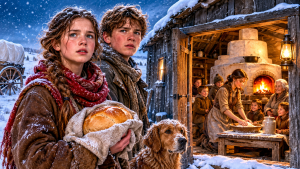
Fresh bread. A sleeping dog.
Nine people sitting comfortably inside a tiny shack.
And a floor so warm that one of the rescuers dropped to
his knees just to touch it.
Outside, the temperature had plunged to 40 degrees below zero. Inside,
a fifteen-year-old orphan girl was kneading bread as though it were an ordinary Sunday morning.
Thomas Mercer, the leader of the rescue party, stood in the doorway,
unable to speak.
He had seen people burn their furniture to survive the blizzard.
He had found families huddled around dead stoves. At one homestead,
he had discovered a mother frozen with her baby still in her arms.
But this?
A twelve-by-fourteen-foot shack made of rough lumber and tar paper?
And somehow, it was warmer than his own house. “How?” he whispered.
The girl looked at him. Then she glanced toward the enormous white clay
structure standing in the middle of the room.
“My grandmother,” she answered softly. “She taught me how.”
But what Mercer didn’t know was that six months earlier,
almost everyone in the county had called that girl a fool.
And one powerful man had been waiting for her to die.
Six months earlier,
Leisel Krauss had stood beside her mother’s grave in Nebraska,
holding a battered leather notebook against her chest. She was fifteen.
Her brother, Stellin, was eighteen.
Their father, Wilhelm, had died of typhoid fever. Seventeen days later,
their mother, Marta, had collapsed from exhaustion and grief.
In less than three weeks, the children had lost everything.
Almost everything. They still possessed forty-three dollars,
an exhausted horse, a failing wagon, and a brown dog named Copper.
And somewhere in Dakota Territory,
their father had claimed 160 acres of prairie land.
“We should stay near town,” Stellin said quietly. “Find work.
Find somewhere safe.” Leisel shook her head. “Father wanted that land.”
“Father is gone.” Her lips trembled. “I know.” For a moment,
she looked as though she might collapse beneath the weight of those words.
Then she pressed the notebook against her heart.
“Mother told us to keep going. So we keep going.”
They arrived near Freeman in August 1887.
The land was worse than Stellin had imagined. No trees.
No shelter from the wind. No proper house.
Only a miserable little shack with paper-covered walls,
a broken iron stove, and a dirt floor.
The nearest affordable fuel was miles away.
Winter would arrive in a few months.
And they barely had enough money for food.
Three days later, land agent Leonard Voss rode onto their property.
He inspected the shack, glanced at the children, and opened his notebook.
“Survival prospects,” he muttered while writing. “None.”
Stellin stiffened. “What does that mean?” “It means,” Voss replied,
closing his notebook,
“that two children cannot survive a Dakota winter alone.
I expect this property to be available again by spring.”
Leisel stepped forward. “We won’t leave.” Voss smiled.
“We shall see, little girl.” He rode away without looking back.
What neither sibling knew was that a wealthy rancher had
already expressed interest in their land.
And Voss had been promised money if the claim became available.
Their failure would make someone else richer.
That night, Stellin sat beside their broken stove.
“We don’t have enough money for coal,” he said.
“And there isn’t enough timber within forty miles.”
Leisel opened her grandmother’s notebook.
Its pages were yellow, its handwriting faded.
But the drawings were still clear.
“What if we don’t need much coal or timber?” she asked. Stellin frowned.
“Then what are we supposed to burn?” She turned the book toward him.
“Almost anything that burns cleanly enough.
But the secret isn’t the fuel.” “Then what is it?”
Leisel touched the drawing. “Keeping the heat after the fire goes out.”
Their grandmother, Elsa Brandt,
had survived seventy-two brutal winters on the Ukrainian steppe.
She had taught Leisel about something called a masonry stove.
Unlike an ordinary iron stove,
which heated quickly and cooled almost as quickly,
this enormous clay structure absorbed heat and released it slowly over many hours.
Its hidden passages guided hot gases through thick
masonry before they escaped through the chimney.
The stove required careful construction, properly fired bricks,
and a sound chimney. Leisel had helped build one when she was eleven.
She remembered her grandmother’s rough hands guiding hers through wet clay.
“Remember, little bird,” Elsa had told her, “the cold is strong.
But knowledge can make us stronger.” Now that memory was all Leisel had.
The next morning, she walked to a creek half a mile away.
She knelt beside the muddy bank. Dug her fingers into the earth.
And smiled for the first time since her mother died.
“Clay,” she whispered.
For the next two months, the children worked from sunrise until darkness.
Stellin hauled buckets of heavy earth.
Leisel mixed clay and straw and shaped hundreds of bricks.
Their hands blistered. Their backs ached. Their money dwindled.
And the neighbors laughed. “They’re building a house out of mud!”
Martha Lungren told everyone.
A young farmer named Tobias Hagen even bet five dollars
that the orphans would not live until Christmas.
Father Brennan questioned their strange foreign knowledge.
Garrett Whitmore, an experienced farmer,
warned them that winter would kill them. But not everyone mocked them.
Bridget Callahan, a nineteen-year-old neighbor, began helping carry bricks.
She asked thoughtful questions and soon found herself
looking forward to Stellin’s quiet smile.
Old Ingmar Dahl recognized the design from his youth in Europe.
And Hinrich Vogler, a skilled brickmaker, recognized something more.
When he heard their grandmother’s name, his face went pale.
“Elsa Brandt?” he repeated. “Your grandmother was Elsa Brandt?”
Leisel nodded. Vogler removed his hat.
“That woman was famous where I grew up.
She taught men twice her age how to build stoves that lasted generations.”
He studied Leisel’s work. Then he said something she would never forget.
“I can see her hands in yours.”
He helped them fire stronger bricks and complete the stove safely.
By early November,
the enormous white structure stood finished in the center of the shack.
Leisel lit the first fire. The flames burned briefly. Then died.
Stellin waited. Ten minutes passed. Twenty.
She knelt beside the stove
She knelt beside the stove. The floor was warm, too.
Tears filled her eyes. “Grandmother,” she whispered, “it works.”
But the true test was still coming.
On January 12, 1888, the morning arrived strangely mild.
Stellin went outside to repair a fence. Copper followed him.
Leisel was preparing breakfast when she glanced through the window.
Something enormous was moving toward them from the west.
Not an ordinary snow cloud. A towering wall of white. “STELLIN!”
she screamed. Within seconds, the wind swallowed her voice.
The temperature plunged. The sky disappeared.
Then Stellin disappeared, too.
Leisel grabbed the rope she had kept beside the doorway for emergencies.
She tied one end securely to the house and went searching.
Twenty steps into the storm, she could barely see her own hands.
Then she heard Copper barking. She followed the sound.
Her fingers struck something solid. Stellin.
He had fallen in the snow, his body shaking uncontrollably.
Together, they followed the rope home.
Leisel dragged him inside and slammed the door. For hours,
she wrapped her brother in blankets and watched over him while the clay stove radiated precious warmth.
Outside, the blizzard grew worse.
By the next morning, the thermometer had plunged toward forty below.
Across the prairie, houses were going cold.
Families were running out of fuel. People were dying.
Leisel sat beside Stellin, listening to the wind tear at their walls.
She had no idea that the warmth beneath her feet would
soon become the last hope for several neighboring families.
And someone who had once told her she would die was
already fighting through the storm toward her door.
PART 2 — THE KNOCK THAT CHANGED EVERYTHING ❄️ Then
someone began pounding on the door. Leisel froze.
Stellin lifted his head from the blankets.
“Don’t open it,” he whispered.
“The wind—” Another desperate blow struck the wooden door. Then a voice.
“PLEASE! SOMEBODY HELP!” Leisel rushed forward.
When she pulled the door open,
a man stumbled inside and collapsed onto the warm floor.
It was Garrett Whitmore.
The same farmer who had warned them that their strange
clay stove would never survive a Dakota winter.
His beard was covered in ice. His hands were trembling.
His lips had turned blue. Leisel closed the door and knelt beside him.
“Mr. Whitmore!” He struggled to breathe. “My wife,” he gasped.
“My boy…” Leisel brought him warm water.
After several minutes, he explained.
His entire winter supply of firewood had been buried beneath six feet of snow.
Their iron stove had gone cold. They had burned chairs, tables,
cabinets, and even sections of their wooden floor. Now nothing remained.
His wife, Constance, had lost feeling in her fingers.
Their fifteen-year-old son, Ezra, could barely stand.
“They’re still inside the house,” Garrett whispered.
“I left them there.” Leisel looked toward the window.
The storm was merciless. “How far?” “Two miles.”
Stellin immediately understood. “No, Leisel.” She turned toward him.
“You almost froze bringing me home. You cannot go out again!”
Garrett lowered his eyes. “I shouldn’t have come,” he whispered.
Leisel thought about the grave she had seen near Freeman Church.
Nelly Whitmore. Seven years old.
Garrett’s daughter, who had died during a winter storm years before.
Now another child was waiting in a freezing house.
And Leisel knew what she had to do.
“Keep the stove warm,” she told Stellin. He grabbed her wrist.
“You’re all I have left.” Her eyes filled with tears.
“And they’re all Mr. Whitmore has left.” At four that afternoon,
the wind weakened just enough for Leisel to see a short distance ahead.
She wrapped herself in every warm garment she owned. Took her compass.
Checked the route Garrett had described. Then stepped into the blizzard.
Each breath hurt. Snow filled her boots. Ice formed along her eyelashes.
Twice she sank almost to her waist in drifts.
After forty-five agonizing minutes, she reached the Whitmore farmhouse.
Inside, Constance lay curled against the wall.
Ezra sat beside her, barely conscious. The stove was black and cold.
Leisel knelt beside them. “Your husband is safe,” she said.
“I’ve come to take you to him.” Ezra slowly opened his eyes.
“You’re the girl who built the clay stove?” “Yes.”
“Everyone said you were foolish.” “I know.” He stared at her.
“Will you teach me how?” Leisel managed a small smile.
“First, you have to survive.”
They wrapped themselves in blankets and stepped outside.
For twenty minutes, they struggled through the snow.
Then the wind changed direction. The white wall returned.
Constance stumbled. Ezra tried to catch her.
And suddenly, all three were on their knees.
Leisel reached for her compass. It slipped from her frozen fingers.
Disappeared beneath the snow. She searched desperately. Nothing.
Around them, the prairie had vanished. No fence. No road.
No farmhouse. No sign of home.
Then Ezra whispered the words Leisel feared most.
“I can’t feel my legs anymore.” She looked toward the endless white.
For the first time since leaving Nebraska,
she wondered whether she had finally asked too much of herself.
And then, somewhere in the storm,
she heard something that made her blood run cold. A dog barking.
Not nearby. Far away. Moving farther away. Was it Copper?
Or was she hearing things?
PART 3 — THE SECRET THAT SAVED NINE LIVES AND CHANGED AN
ENTIRE TOWN The barking came again. Leisel lifted her head.
Through the roaring wind, she heard three sharp barks,
followed by a desperate whine. Her heart began pounding.
“Please,” she whispered. “Please let that be you.”
Then a brown shape emerged from the blowing snow. Copper.
His coat was covered in ice, his paws sinking into the drifts.
But he was alive. And somehow, he had found her. “Copper!”
The dog bounded toward her, pressing his wet nose against her trembling hands.
Leisel wrapped her arms around him.
For one brief moment, she forgot the storm.
Then Ezra groaned behind her. Reality returned.
“Can you lead us home, boy?” she whispered into Copper’s fur.
The dog barked. Turned. And began walking.
What Leisel did not know was that Copper had become
frantic shortly after she left the shack. He had scratched at the door.
Whined. Paced. And refused to settle beside the warm stove.
Stellin had finally opened the door to look outside,
and Copper had slipped past him into the snow. “Come back!”
Stellin shouted. But the dog disappeared into the storm.
Now, hours later, he had somehow found Leisel.
She helped Ezra stand while Constance struggled to her feet.
“Follow the dog,” Leisel said. Constance looked at her in disbelief.
They moved slowly
They moved slowly. A few steps. Then a pause.
Sometimes Copper disappeared into the white, only to return,
barking impatiently. Leisel was terrified of losing him.
She was even more terrified of stopping.
Her grandmother’s voice returned to her. Fear can warn you, little bird.
But you must never let it do all your thinking.
She forced herself to remember the journey. The rise in the ground.
The shallow creek crossing. The stretch of fence that curved east.
At last, her boot struck something buried beneath the snow.
A familiar fence post.
She dropped to her knees and brushed away the ice.
She recognized the shape of the broken upper rail. They were close.
“Copper,” she whispered. “Take us home.” The dog barked again.
And moments later, a faint shape appeared through the snow.
A roof. A door. The Krauss shack. Leisel began to cry.
She had not cried when her father died.
She had not cried at her mother’s funeral.
She had not cried through months of hunger, ridicule, or exhausting work.
But now, with two lives depending on her,
tears streamed down her frozen cheeks. “We made it,” she whispered.
She pushed open the door. Warm air rushed over them.
Stellin stood beside the stove.
He looked at Leisel, at Constance, at Ezra, and finally at Copper.
For a moment, he seemed unable to believe what he was seeing.
Then he hurried forward. “You’re home.” Leisel nodded. “Yes.”
And for the first time since Nebraska,
she understood how much those two words meant.
Constance Whitmore stopped just inside the doorway. She closed her eyes.
For nearly two days, she had felt nothing but cold. Cold in her fingers.
Cold in her feet. Cold so deep it seemed to have entered her bones.
Now gentle warmth surrounded her.
She opened her eyes and saw the enormous white stove.
“Dear Lord,” she whispered. Her husband, Garrett, rose from the floor.
“Constance!” He crossed the room and pulled her into his arms.
She buried her face against his shoulder.
Their son collapsed onto the blankets beside the stove.
Garrett knelt beside him. “Ezra?” The boy opened his eyes.
“I’m here, Pa.” Garrett put both hands over his face. Years earlier,
he had buried his little daughter, Nelly, after a winter illness.
He had never forgiven himself for failing to keep her warm.
And now he had come terrifyingly close to losing another child.
He turned toward Leisel. The words caught in his throat.
“I told you that stove was foolish.” Leisel said nothing.
“I told you that you would die in this house.” His eyes filled.
“And then you walked through a blizzard to save my family.”
Leisel reached for another blanket. “Your wife needs to rest, Mr.
Whitmore.” He shook his head. “No. You need to hear this.”
He stood. “You were right.”
Those three words seemed harder for him to say than anything else.
“I had sixteen years of experience on this prairie.
You had a notebook and your grandmother’s memory.”
He looked at the warm floor. “And you knew something I didn’t.”
Leisel lowered her eyes.
“Grandmother used to say that surviving winter isn’t
always about making a bigger fire.” She touched the stove.
“Sometimes it’s about learning how not to waste the warmth.”
Garrett remained silent for a long time. Then he reached for her hand.
“Thank you for bringing my family home.” But the storm was not finished.
That evening, another knock came. Father Brennan stood outside,
barely recognizable beneath his snow-covered coat.
He had walked through the storm after his own stove had failed.
Leisel brought him inside. The priest sank onto the warm floor.
For several minutes, he said nothing.
Then he looked toward the white clay stove.
“Is this the thing you built from your grandmother’s notebook?”
“Yes, Father.” He placed his palm against the masonry.
His expression changed. “I remember what I said in October.”
Leisel remembered, too.
He had warned the congregation against trusting strange
traditions brought from distant countries.
He had made people suspicious of the knowledge she carried.
“I was afraid of what I didn’t understand,” he said. She looked at him.
“I thought that because something was unfamiliar, it must be wrong.”
He swallowed. “Will you forgive me?”
Leisel glanced around the little room. At Stellin.
At the sleeping Whitmore family. At Copper curled beside the stove.
Then she smiled gently. “You’re warm now, Father. That’s what matters.”
The old priest bowed his head.
It was the first time Leisel had seen him cry.
Before midnight, Bridget Callahan arrived with her widowed mother.
The roof of their house had been badly damaged.
They were shaking so violently that Stellin rushed
forward before either woman could speak. “Bridget!” She tried to smile.
“I told you I’d come back.” He pulled her inside. For months,
Stellin had struggled to express what he felt for the red-haired girl who helped him carry bricks.
Now he held her hands between his own and refused to let go.
“You frightened me,” he whispered.
“Then perhaps you should have asked me to stay before the blizzard.”
Even through her exhaustion, she managed a weak laugh.
And Stellin, for the first time in days, laughed with her.
Near dawn, old Ingmar Dahl appeared at the door.
The seventy-two-year-old Norwegian had recognized
Leisel’s stove months earlier.
Now he had struggled through the snow after conditions eased,
determined to see whether it had survived.
He stepped inside, removed his hat, and examined the white masonry.
Then he nodded. “Your grandmother knew her work.” Leisel smiled.
“Yes, she did.” He looked around the room. Nine people. All alive.
All sheltered from a storm that had destroyed stronger houses.
“She would be proud of you, child.” Leisel’s smile faded.
Her chin trembled. “I wish she could see it.”
Ingmar placed a hand on her shoulder.
“Perhaps she can, in everything you have built.” By noon on January 15,
the storm had weakened enough for a rescue party to reach the Krauss homestead.
Thomas Mercer expected tragedy. He knew the orphans had little money,
no proper supply of wood,
and a shack that barely deserved to be called a house.
He approached with six other men. No smoke rose from the chimney.
His stomach tightened. He knocked. No answer.
The snow had packed hard against the door. The men began digging.
At last, Mercer pulled the door open.
And warm air rushed against his frozen face. He stopped.
The smell of fresh bread drifted into the snow.
Inside, Leisel stood beside a small table, shaping dough.
Nine people were gathered around a large white masonry stove.
The brown dog raised his head, looked at the strangers,
and went back to sleep. Mercer stared.
He had found families burning furniture just to survive another hour.
And here, in the poorest-looking house in the coun…
And here, in the poorest-looking house in the county,
people were warm enough to sleep on the floor. He approached the stove.
Touched it. Then knelt and pressed his hand against the earth.
“Good heavens.” He looked up at Leisel. “How much fuel have you burned?”
She pointed toward the remaining bundles of dried prairie grass.
“Not much.” “That cannot be right.” “It is.” He stared at her.
“How can a little grass keep this entire house warm for three days?”
Leisel opened the old leather notebook. She showed him the drawings.
“The fire heats the bricks,” she explained.
“The bricks keep releasing warmth long after the flames are gone.”
Mercer studied the carefully drawn passages inside the stove.
“And your grandmother designed this?” “She taught me how to build it.”
He glanced around. “How old are you?” “Fifteen.”
For a long moment, Mercer said nothing. Then he took out his notebook.
He wrote down everything.
Because he understood that he had found something more
important than an unusual stove.
He had found knowledge that could help other families survive.
When the storm finally ended, the full scale of the tragedy became clear.
More than two hundred people had lost their lives across the Great Plains.
Entire families were gone.
Children had died trying to find their way home.
Some people had frozen only a short distance from shelter.
The survivors carried memories that would haunt them for years.
Garrett Whitmore returned to his ruined farmhouse with his wife and son.
The furniture was gone. The floorboards had been torn apart for fuel.
The iron stove stood cold in the corner.
Constance looked around the devastated kitchen.
“We cannot live through another winter like that.”
Garrett stood beside her. “No,” he said. “We won’t.”
A week later, he returned to Leisel’s shack.
This time, he carried tools. “What are those for?” Leisel asked.
Garrett removed his hat. “I want to learn.” She stared at him.
“You?” He nodded.
“I spent years believing that experience made me wise.”
He looked toward the stove.
“Then I met a girl who reminded me that wisdom isn’t measured by age.”
From the doorway, Ezra smiled. “And she already promised to teach me.”
Leisel laughed. “Then I suppose I have two students.”
But there was still one person who had no intention of
celebrating the Krauss children’s survival. Leonard Voss.
The land agent had expected their claim to fail.
He had already discussed the property with a wealthy
rancher who wanted to expand his holdings.
The arrangement had been simple. If the children abandoned the claim,
Voss would recommend that the land become available again.
The rancher would reward him for helping arrange the purchase.
But the children had survived.
Worse, the entire county was now talking about them.
Their little shack had become a symbol of courage.
And Thomas Mercer had written an official account of what he had witnessed.
When Voss arrived in late February, Leisel was standing beside the stove.
“Well,” he said, studying the white masonry,
“you appear to have made certain improvements.” “Yes, sir.”
He walked around the room. Tapped the bricks. Examined the walls.
Then opened his notebook. “I must review the status of your claim.”
Stellin stepped forward. “We’ve worked this land since August.”
“I am aware.” “We’ve made improvements.” “Obviously.”
“And we intend to stay.” Voss closed his notebook.
For several seconds, nobody spoke.
Then he noticed a second notebook on Leisel’s table. Mercer’s report.
The rescue leader had recorded the condition of the homestead,
the improvements the children had made,
and the people who had survived there. Voss recognized the handwriting.
He also recognized the consequences of challenging a
claim that now had witnesses throughout the county.
“Improvements adequate,” he said stiffly. Leisel watched him.
“Does that mean we can stay?” Voss hesitated.
Then he spoke the words she had dreamed of hearing. “Claim valid.”
It was not a final deed.
They still had years of residence and cultivation to
complete before the land could legally become theirs.
But it meant that Voss’s attempt to dismiss them had failed.
For now, their right to continue working the claim had been acknowledged.
He put on his hat. Walked to the door. And left without apologizing.
Stellin watched him ride away. “Did we win?”
Leisel looked around the shack. At the stove. At the table.
At the warm earth beneath her boots. “No,” she said softly.
“Not yet.” Then she smiled. “But we’re going to.” Spring arrived.
And something remarkable happened.
The same neighbors who had laughed at Leisel’s mud
bricks began asking her to teach them.
Constance Whitmore was the first to build a new masonry stove.
Garrett hauled the bricks. Ezra helped prepare the mortar.
Hinrich Vogler supervised the more difficult construction,
ensuring the firebox, chimney, and heating passages were properly built.
When the stove was completed, Constance lit the first fire.
The family waited. Then Garrett touched its warm surface.
His eyes filled.
“This house,” he whispered, “will never feel the same again.”
In March, another visitor arrived at Leisel’s door. Martha Lungren.
The woman who had spread rumors about the children losing their minds.
She stood outside for a long moment before speaking.
“I said terrible things about you.” Leisel waited.
“I called you foolish. I laughed at your bricks.” Martha swallowed.
“My sister-in-law died in the blizzard.” Her voice broke.
“Her wood was buried beneath the snow. Her stove went cold.”
Leisel’s expression softened. Martha looked at the white stove.
“I cannot bring her back.” “No,” Leisel whispered.
“But perhaps I can help someone else’s sister survive.”
She looked at Leisel. “Will you teach me?” Leisel opened the door wider.
“Come inside.” By summer,
Martha had become one of the strongest supporters of masonry heating in Turner County.
She organized neighbors to help elderly families, widows,
and struggling settlers.
Hinrich Vogler trained young men in proper stove construction.
Even Tobias Hagen,
who had once bet money that the Krauss children would die,
became an apprentice. He never mentioned his cruel wager again.
Instead, he worked. And worked. Perhaps that was his apology.
By the following winter, seventeen homesteads had working masonry stoves.
The knowledge that one grandmother had carried across an
ocean was spreading from family to family.
In 1890, Stellin married Bridget Callahan. Their wedding was modest.
But everyone noticed the way Stellin looked at his bride.
He had once been a frightened eighteen-year-old boy with
nothing but a failing wagon and a promise to his dead parents.
Now he had a home. A future.
town thought he was foolish
town thought he was foolish.
At the reception, Bridget held Leisel’s hands.
“Do you remember when I first came to see your bricks?” Leisel laughed.
“You asked a hundred questions.” “And you answered every one.”
Bridget glanced at Stellin. “I’m glad I was curious.”
“So am I,” Leisel replied. The two women embraced. In 1892,
five years after the siblings arrived in Dakota,
they completed the requirements for their homestead.
They stood together to sign the final documents.
One hundred and sixty acres. Legally theirs.
Stellin’s hand trembled as he signed. Leisel noticed.
“Are you frightened?” He shook his head.
“I was just thinking about Father.” She looked down. “So was I.”
“He never got to see this land.” “No,” she whispered. “But we did.”
Outside the office, Stellin took her hand. “We kept our promise.”
And Leisel finally cried the tears she had been holding since Nebraska.
A year later, another wedding brought the community together.
Leisel Krauss married Ezra Whitmore.
The boy she had rescued from a freezing farmhouse had
grown into a capable young man. He had learned to make bricks.
To build stoves. To work the land. And, over five years of friendship,
he had learned that the girl who saved his life possessed a strength he wanted beside him for the rest of his days.
Father Brennan officiated. Garrett Whitmore stood beside his son.
After the ceremony, he found Leisel alone near the church.
“May I tell you something?” “Of course.”
He looked toward the little cemetery. “Do you remember Nelly?”
Leisel nodded. “Your daughter.” “She would have been your age now.”
His eyes glistened.
“I sometimes wonder what kind of woman she would have become.”
Leisel took his hand.
“Then I’ll try to live a life she would have been proud of.”
Garrett lowered his head. He never forgot those words. The years passed.
The tiny tar-paper shack was eventually replaced by a proper farmhouse.
The land grew productive. Children were born. Then grandchildren.
The notebook survived.
Bridget added observations about stove construction and maintenance.
Leisel taught her children what Elsa Brandt had taught her.
How to recognize good clay. Why a stove required careful craftsmanship.
How to respect fire and learn from those who had
mastered the work before them.
And why knowledge was never something to hoard. In 1901, Copper died.
He had grown old beside the family he had followed out of Nebraska.
On his final morning, he lay beside the warm stove,
his head resting on his paws. Leisel found him there.
She sat down beside him and stroked his fur.
“You brought us home, old boy,” she whispered. “And you helped us stay.”
They buried him beneath an oak tree.
Stellin carved a small wooden marker. COPPER — THE BEST LISTENER.
For years afterward, whenever Leisel passed that tree,
she remembered the terrible afternoon when a brown dog had appeared out of the blizzard.
And the three people who had followed him home. In 1928, Stellin died.
Leisel stood beside his grave and remembered the boy who
had held her hand at their mother’s funeral.
The brother who had hauled hundreds of buckets of clay
without fully understanding why.
The young man who had trusted her when no one else believed.
She missed him every day. Ezra had died several years earlier.
And by January 1934, Leisel was nearing the end of her own life.
A winter storm was gathering outside.
Her children and grandchildren sat near her bed.
The farmhouse was quiet. The windows were rimmed with frost.
And in the kitchen, the great masonry stove radiated its familiar warmth.
One granddaughter held the battered leather notebook.
“Grandmother,” she asked, “why did you keep this old book for so long?”
Leisel smiled faintly.
“Because your great-great-grandmother loved us before she ever knew us.”
The child frowned. “I don’t understand.” Leisel reached for her hand.
“She knew winter would come. She knew there would be hard days.
So she taught me something that could help us live through them.”
She glanced toward the kitchen. “That was her gift.”
The granddaughter looked at the notebook.
“Will it belong to me someday?” “Yes.” “What should I do with it?”
Leisel’s eyes filled with tears. “Use it.” She paused.
“Improve what you can. Keep what works.
And when someone needs what you know…”
Her voice became almost a whisper. “Teach them.”
Outside, the snow continued falling. Inside, the family drew closer.
Leisel looked toward the kitchen one final time.
Then she spoke in the language of her childhood. Der Boden ist warm.
The floor is warm. Those were her last words. Years later,
descendants would still speak about the January morning when rescuers arrived expecting two frozen orphans and instead found fresh bread and nine survivors.
They would remember the brave girl who built a stove from clay.
The brother who trusted her. The neighbors who learned humility.
The dog who helped bring her home.
And the grandmother whose wisdom survived an ocean crossing,
two generations,
and one of the fiercest storms the prairie had ever known.
But perhaps the most important part of Leisel’s story
was never the stove itself. It was what she chose to do with it.
She could have kept her knowledge to herself.
She could have remembered every insult.
She could have closed her door against the people who had laughed at her.
Instead, she opened it. And because she opened it, other people lived.
That is the kind of legacy no winter can destroy. A house can collapse.
Money can disappear. Land can change hands.
Even the people we love eventually leave us.
But the lessons they give us can keep helping people long after they are gone.
Somewhere, perhaps in an old kitchen drawer,
there is a notebook no one has opened for years.
Somewhere, there is a recipe written in a grandmother’s handwriting.
A piece of advice a mother repeated. A skill a father tried to teach.
A small lesson that once seemed ordinary. And perhaps one day,
someone will need that knowledge more than they ever imagined.
Because sometimes the greatest inheritance is not gold. It is not money.
It is not land. Sometimes the greatest inheritance is knowing how to
keep the floor warm when the whole world turns cold. And sometimes,
the most powerful thing we can do is open our door to someone who once doubted us.
THE END. If Leisel’s story moved you,
leave a in the comments to honor the grandparents, parents,
and elders who passed their wisdom down to us.
What is one lesson your grandmother, grandfather,
or parents taught you that you still carry today?
Share it in the comments.
Someone reading your words might need that wisdom more than you know.
Disclaimer:
This story is entirely fictional and created for entertainment purposes only.
It does not represent any organization or individual,
nor does it encourage inappropriate behavior.