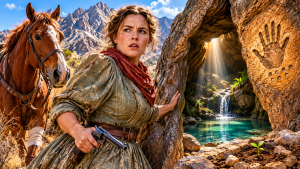
PART 1 🌵 New Mexico Territory, 1886
PART 1 🌵 New Mexico Territory, 1886.
Hetty Brazwell raised her dead husband’s revolver until
the barrel hovered six inches from the space between her
horse’s eyes. 😢 Copper,
the old chestnut she had loved for sixteen years, stood on three legs.
His injured ankle had swollen to twice its size overnight.
The bandage was black with dried blood, stiff as old leather.
The smell rising from beneath it told her everything.
She had watched enough cattle go lame on her husband’s
ranch to know when a wound had stopped healing. She steadied her grip.
The trigger felt warm under her finger. Copper didn’t look at her.
His ears turned north,
toward a jagged line of stone rising from the desert like the spine of something ancient.
🏔️ The miners called those mountains the Sawbacks.
They had no name on any government map. No wagon roads. No claims.
No known water. Nobody in the town of Ashfall went near them.
Then Copper started walking. His ruined leg dragged.
But his good hooves struck the hardpan with purpose.
Hetty lowered the gun. 💔 Sixteen years ago,
her husband Rosco had bought that horse as a bright copper yearling who chewed through two lead ropes before his first birthday.
Copper had hauled timber for their barn.
He had stood patient while seed bags were loaded across his back each spring.
He was the last living thing that had known Rosco.
Now he was limping toward a mountain range where even
rattlesnakes struggled to find shade.
There was no good reason to follow him. Hetty followed anyway.
☀️ The summer of 1886 had stripped the territory down to its bones.
Creek beds cracked like old pottery.
Cattle skulls lay beside empty troughs.
The well Rosco dug their first year on the land had
given its last muddy cup five mornings before she left.
Rosco himself had been in the ground eleven months,
taken by the fever that swept the valley.
His grave lay beneath a cottonwood that had shed every leaf before June,
bare against the sky like a hand reaching for something it couldn’t name.
🥀 Before leaving,
Hetty had knelt at that grave and pressed a few seeds into the powdered soil with her thumb.
They would never grow there. She knew it. Her lips moved anyway,
a prayer for dead ground to remember what it once could do.
She did not look back.
Looking back required believing something worth returning to still existed.
Now she carried an empty canteen, a handful of dried beans,
six cartridges, a hunting knife,
and a small leather pouch of seeds pressed against her ribs.
Three days of walking. Her tongue felt like dust in her mouth.
She was a large woman. 🤍 The word didn’t capture the full truth of it.
Hetty carried a frame that made doorways feel narrow and left deep bootprints in soft ground,
the way a draft horse leaves deeper tracks than a saddle pony.
Every step in the broken country cost her more than it
would cost a lighter person. Her knees burned. Her lungs ached.
Sweat soaked through her patched dress.
Yet above that heavy body sat a face that made strangers stare.
Round and soft,
with pale gray eyes clear as spring water and skin the color of fresh cream.
“The face of heaven sitting on the body of the whole
earth,” Rosco used to tell her at the kitchen table.
She would throw a pinch of flour at him,
and he would laugh until his coffee went cold.
☕ She had not laughed in eleven months.
By afternoon the ground tilted upward.
Loose stones shifted under her boots. Twice she slipped.
The second time she went down on one knee and stayed there a full minute,
breathing through the pain. Copper waited.
He turned his head and looked at her with one dark eye,
then faced forward again. Patient, the way old horses learn to be.
She pushed herself up and kept climbing. The canyon narrowed.
Red sandstone closed in until the sky became a thin bright strip overhead.
The wind died. The silence pressed on her ears.
Beneath her ragged breathing she caught a faint steady rhythm,
not quite dripping. Closer to tapping.
💧 Then Copper stopped before a wall of solid granite, thirty feet high,
with no gap, no trail, and nowhere left to go.
This is it, Hetty thought. This is where we both die.
Copper nudged her shoulder. She pushed him away. He nudged her again.
Then he turned sideways, pressed his body against the rock,
and vanished into the mountain.
😳 Hetty froze, the revolver hanging useless at her side.
From somewhere beyond the stone came the faint click of hooves,
a breath of cold air, and a smell she hadn’t known in months.
Wet earth. 🌱 She found a hidden crack behind a leaning slab,
barely eighteen inches wide. She was far wider than eighteen inches.
She exhaled every breath she had and forced herself in.
Stone bit her back.
For three terrible seconds she was stuck, unable to move forward or back.
Then something tore, the rock released her, and she stumbled into darkness.
Cold air. A beam of light falling through the roof of the mountain.
A pool of water so clear she could count the grains of sand on the bottom.
And beside it, dark rich soil, an old ring of fire stones,
and a hand carved into the granite, five fingers spread wide,
with seven seed marks beneath it. 🖐️🌾 Copper was drinking.
Hetty dropped to her knees and plunged both hands into the water,
sobbing as she drank.
For the first time in three days, she could breathe.
Then Copper’s head snapped toward the entrance, both ears locked forward.
Outside, a horseshoe struck loose stone.
And a man’s voice said, low and calm: “The tracks go in here.”
😨 PART 2 “The tracks go in here.”
Hetty dragged Copper back from the pool and pressed her hand over his muzzle.
She looked around the chamber. One pool. One ring of stones.
One entrance. No back door.
She wedged herself into a bend in the passage and…
She wedged herself into a bend in the passage and put
one eye to a finger-wide gap. Three riders.
The leader wore a pale hat and the permanent sunburn of
a wealthy man who rode land rather than worked it.
The tracker read Copper’s drag marks like a book. “Shod.
Favoring the right front.” A child could have followed them.
They squeezed through the crack one by one.
Moments later the pale-hatted man stood in the chamber, hat in his hand,
studying the pool the way a man appraises merchandise.
His name was Harland Slade.
“So the old stories were right,” he said softly.
Then he began talking to his men, and Hetty heard everything.
Slade owned the only working well in Ashfall.
He had been selling water at two dollars a gallon to
families who had no choice.
By winter, half the homesteads would be abandoned.
He would buy the land for pennies before the territorial assessor ever came.
“If these people find water,” he said, “they do not have to buy from me.
Unless I own the spring first.” Hetty understood in that moment.
Slade hadn’t merely profited from the drought.
He had bought it, like a man buying a siege.
Slade carved his mark into the granite, an S inside a circle.
Then the tracker turned toward the alcove where Copper stood.
A few inches of copper-colored tail stuck out against the gray stone.
His hand dropped to his holster. Hetty raised the revolver.
A rifle shot cracked outside, then another.
Slade’s men scrambled out of the chamber. When the silence returned,
she cut his mark from the wall with Rosco’s knife until nothing remained but scratches.
Then she did the hardest thing she had ever done.
She left her horse hidden on the ridge and walked six
miles through the desert night to warn Ashfall.
The blacksmith Gideon Pratt, wooden leg and all, listened without a word.
A fourteen-year-old boy named Emmett insisted on helping.
And when Hetty climbed back to the hollow where she had left Copper,
she found only a cut rope and the tracks of many boots.
Slade had taken her horse.
She crawled along the ridge until she could look down
through the chimney shaft. Slade had torn up the garden soil.
Iron stakes ringed the pool.
And Copper stood tied just five feet short of the water. Thirsty.
In a room full of it. Something older than grief moved behind her ribs.
That night, seven townspeople crept through a dry wash,
slipped sideways through the stone,
and stood in the dark chamber beside Hetty. They cut Copper loose.
He drank. And Hetty found Slade’s papers beside the pool,
proof of a plan that had never been about water at all.
Then the sound came from outside. Picks striking granite.
Slade was widening the fissure. Torchlight poured through the gap.
Boots filled the passage.
Hetty climbed the moss wall and pressed herself into the shadows of a narrow shelf as Slade stepped into the chamber,
lifting his lantern. The light swept the pool. The stakes.
The shotguns. Then it began to rise toward the shelf where she lay.
PART 3 The lantern light stopped just short of her boots.
Slade’s eyes traveled the chamber. He counted the rifles aimed at him,
the iron stakes,
the old blacksmith with a forge hammer in one fist and a paper in the other.
“Mr. Slade,” said Gideon, his voice steady as an anvil.
“I am holding a contract you signed four days ago.
It promises water to three ranches at three dollars a gallon.
You signed it before you found this spring. Before you filed a claim.
Before you ever set foot in the Sawbacks.” Slade’s jaw tightened.
“Where did you get that?” “Your survey kit.
Inside this chamber, on public land.”
Gideon let the paper hang in the lantern light.
“A territorial judge will read this as a monopoly by design.
You never meant to sell this water. You meant to bury it.”
For a long moment, no one breathed.
“This changes nothing,” Slade said at last.
His voice stayed quiet, but something beneath it had cracked.
“I will file the claim. I will pay the lawyers.
These people will spend every cent they have fighting a
battle they cannot afford. Time is on my side.”
“Time is not yours to own, Mr. Slade.” Every head lifted.
Hetty’s voice fell from the darkness above like something with weight.
“You cannot buy a season. You cannot file a claim on the rain.
You came into this mountain thinking you could put your
name on water the way you put it on a well.
But this spring was running before anyone with a name walked this ground.
It will run after every name in this territory has turned to dust.
Including yours. Including mine.” Slade raised the lantern.
The light caught her boots, the torn dress,
the broad shape of her body pressed against the stone. “Come down, Mrs.
Brazwell.” “Not until your men put down their guns.”
The silence stretched like a held note about to break.
Then Durkin, the man with the rope, let his arm drop.
The revolver pointed at the floor.
“You owe me three months’ wages,” he said, without turning around.
Slade’s head swung toward him. “You will be paid from the land sales.”
“There are no land sales.” Durkin’s voice was flat,
the voice of a man reading a ledger that had finally come clear.
“There is no payment.
You’ve been spending money you plan to steal from people
too thirsty to argue.” Behind him, the younger guard,
the one who had told horse-race stories by the fire,
set his rifle down on the stone and took a slow step backward.
And then Copper moved.
The old horse walked out of the shadows on his scarred leg,
his hooves ringing against stone.
He crossed directly between the rifles,
between the lantern light and the dark,
He stopped at the pool, lowered his muzzle, and dr…
He stopped at the pool, lowered his muzzle, and drank. Nobody moved.
The only sound in the chamber was a thirsty horse swallowing,
and it filled the room completely. Slade watched him.
Something shifted behind his eyes. It wasn’t quite defeat.
A man like Slade didn’t know how to feel defeat.
It was something closer to recognition.
The horse drank because it was thirsty.
The spring flowed because stone held water.
The moss grew because moisture fed it. None of it needed a claim.
None of it recognized his mark. Hetty climbed down from the shelf.
Her arms shook. Her knees buckled when her boots hit the floor.
She caught herself against the moss wall and left a handprint in the green,
the same open-fingered shape as the ancient one carved above.
🖐️ She walked to the pool and stood beside Copper,
facing Slade across the water. His shadow was tall and narrow.
Hers was broad and heavy, filling the space behind her like a second wall.
“Five hundred dollars,” Slade said.
The quiet authority was gone, and the words came fast and clipped.
“Five hundred, and I release the water contracts.
Every ranch gets well water at fifty cents. Below cost. I take the loss.
You keep the spring.” Hetty almost laughed.
Five hundred dollars would rebuild her homestead.
Cheap water would save the ranches.
A reasonable person might have taken it.
She looked at Copper’s wet muzzle, at the scarred ankle,
at the garden soil Slade had torn apart.
“The spring does not belong to me.” Slade blinked.
“It belongs to Ashfall. Every family.
Every child carrying a half-empty cup.
Every rancher who mortgaged his seed money to fill a barrel.”
She laid her bandaged hand on Copper’s neck. “You can sell a well, Mr.
Slade, because a well is a hole you dug. You cannot sell a spring.
A spring is a gift the mountain gave.” Gideon stepped forward.
“Here is what happens next. This contract goes to the judge in Santa Fe.
A boy is already riding there with a letter requesting a
hold on any claim you file.
When the judge sees both papers side by side,
he will understand what you built. Not a water company. A siege.”
Slade looked at the contract. At Gideon. At Durkin, arms crossed,
who had already chosen which side of the door he was standing on.
“Everything I did was legal,” Slade said slowly.
“Every price I charged was within my rights.”
“Legal is not the same as right,” said Gideon.
“And you know the difference. The law lets you do what you did.
It also gives the people you did it to a voice in what happens next.”
Slade’s eyes made one last circuit of the chamber.
He wasn’t counting people now. He was counting what he had lost.
The spring, the monopoly, the land that depended on both.
The whole future he had measured with rope and carved into stone,
dissolving like salt in the pool at his feet. He set the lantern down.
He walked to the fissure without another word. His men followed.
At the entrance,
the tracker who had started all of this by reading a horse’s prints paused and looked back at Hetty.
“Ma’am,” he said quietly. “Your horse has a good walk.
Considering the leg.” Then he was gone. Hooves faded down the draw,
moving south,
back toward the desert that had started all of this by giving water to no one.
Durkin stayed. “I’m owed three months’ pay,” he said.
Gideon looked at Hetty.
She studied the man who had roped her horse and chased
her through that canyon. “Can you lay stone? Can you dig?”
“I can work.” “Then work. Three months of labor for the town.
After that, we’re even.” Durkin searched her face.
He found the gray eyes, the steady mouth, no bluff anywhere.
He nodded once. Then he sat against the wall,
pulled his hat over his eyes, and was asleep within minutes.
Gideon stared at the pool,
where Slade’s forgotten lantern still burned on the rim,
its flame doubled and trembling in the water. “What now?”
he asked. Hetty smiled. It was a small smile, but it reached her eyes.
“Now we rebuild.” The work began before sunrise. Not with seven people.
With all forty families of Ashfall.
Gideon walked to town on his wooden leg and came back by
midmorning with the first group. Men carried picks and shovels.
Women carried seed sacks and clean bottles.
Children carried tin cups and coils of rope.
Hetty let them in six at a time,
watching each face as they stepped out of the stone and saw the pool for the first time.
A woman named Sarah Lund,
who had buried her husband six weeks earlier after he collapsed hauling water from Slade’s well,
dropped to her knees beside the water. She had three children under ten.
She put both hands into the pool and held them there without drinking,
while tears ran down a face that had forgotten how to make moisture.
A rancher named Fenton, bent nearly double from his ruined back,
filled a single bucket and sat on the chamber floor with it held against his chest,
staring into the water like it held the reflection of a year he’d never expected to survive.
Hetty watched them all from beside the moss wall,
her broad shadow falling across the garden soil like shade from something permanent.
Copper grazed at her side, pulling tufts of green from the wall.
By evening, five barrels stood full beneath canvas tarps.
Men built a stone catch basin below the spring,
and Hetty taught Will Hulcom what her father had taught her at fourteen.
Choose stones with flat faces.
Set them so gravity holds them without mortar.
Angle the floor toward the center so the water gathers
instead of spreading thin.
Women marked garden beds beneath the chimney shaft,
measuring where the light fell at each hour. Martha Foss,
who had once kept a kitchen garden alive through three drought years,
supervised the planting with ruthless efficiency.
the boy was sunburned,
the boy was sunburned,
and he carried a folded paper stamped with the seal of the Territorial Land Office.
All claims on the Sawback Range, Section 14,
were under administrative hold pending review of a community petition.
The petition of the township of Ashfall,
signed by thirty-seven residents,
had been filed by one Emmett Foss on behalf of everyone.
He placed it in Hetty’s hands in front of the fissure.
Gideon, Doc, Margaret, the Hulcom brothers, and Martha stood behind her.
Durkin, who had hauled stone for three days without a single complaint,
stood beside them.
“The clerk said Slade’s rider never arrived,” Emmett croaked.
Nobody would ever know why. Perhaps the man turned back.
Perhaps he decided that filing papers for a man who owed
him wages wasn’t worth dying of thirst on the territorial road.
All that mattered was that the paper in Hetty’s hand was
the only claim that existed. She handed Emmett her canteen.
Then she folded the document and tucked it into her pocket,
next to the seed pouch. Weeks passed.
Stone walls rose around the catch basin,
fitted by hands that had learned the craft by watching Hetty.
Bean vines climbed rope lines strung between the very
iron stakes Slade had driven into the rock. She left them in place.
They served the plants better than they had ever served
the man who planted them. Squash leaves spread across the dark soil.
Corn pushed up in short rows beneath the light shaft.
Margaret planted tomatoes from seeds she’d hoarded in a
tobacco tin for two years. Outside, Ashfall was still brown.
The drought hadn’t broken.
But water barrels stood beside doorways again.
Children carried cups without being told to save half for later.
Livestock drank from troughs clear enough to reflect the sky.
The price of survival fell from three dollars a gallon to nothing.
Slade’s well still ran. He cut his price to twenty-five cents, then ten.
Almost nobody bought.
His monopoly didn’t fall to a lawsuit or a gunfight.
It fell the way every monopoly on a necessity eventually falls,
to the quiet existence of something free.
Hetty never filed a claim and never signed a deed.
The petition declared the spring common land for the use of all.
Gideon wrote it, Doc witnessed it, and every adult in Ashfall signed.
Copper’s wound closed into a pale scar around his ankle.
The swelling faded.
His gait returned to the steady four-beat walk she had
known for sixteen years.
One evening, Hetty climbed above the fissure alone.
The sun hung low over the desert, painting the territory in amber and rose.
Far below,
a narrow line of people moved toward Ashfall with full water skins,
small dark marks against a vast still page. She reached into her pocket.
The pouch held two seeds.
She had given all the others to the garden inside the mountain.
These two she had been saving for ground that could see open sky.
She pressed the first into the thin, rocky soil by the fissure with her thumb.
Six inches away, she pressed the second.
She covered them with loose dirt, cupped her hands,
and poured a little water from her canteen over the spot.
Copper lifted his head from the scrub and watched her the way he’d watched her for sixteen years,
with the quiet certainty of an animal who knew this woman did things for reasons that revealed themselves in time.
She brushed the dirt from her fingers. Thick, calloused hands,
scarred across both palms from rope and stone and iron.
She spread them wide against the sunset. Five fingers open.
The same shape as the one carved inside the mountain.
🖐️ Somewhere below, a person laughed beside a water barrel.
The sound floated up through the evening, thin and light,
the laugh of someone who had stopped counting sips.
Hetty stayed until the first stars appeared above the Sawbacks.
Copper stood close, his flank warm against her hip.
She looked south toward Ashfall.
She looked north toward the mountain holding the spring in its granite bones.
She looked down at two small spots of wet earth where
something waited to grow.
Then she walked down to the fissure and slipped inside, sideways,
on an exhale, the way she always did.
The mountain received her the way it received the water,
through narrow places, over rough stone,
into the quiet where living things begin. The chamber was empty.
The garden beds glowed in the last light from the chimney shaft.
The pool held a single star.
Above the fire ring she had rebuilt from Slade’s scattered stones,
the carved hand watched over everything.
She sat beside the water and laid her palm flat on the stone floor.
Cool. Somewhere far beneath it,
water moved through channels older than memory, older than names,
older than the very idea of ownership.
It rose because pressure found a weakness in the rock.
It gathered here because the shape of the chamber made a
low place for it to rest. Nobody had built it. Nobody had earned it.
Nobody deserved it more than anyone else.
It simply existed, the way light exists. The way breath exists.
Given without invoice. Received without debt.
Rosco had said it on his last day, the doctor told her.
The ground remembers what she plants.
She pressed her hand over her heart,
where the empty seed pouch rested against her ribs. It did.
If this story touched your heart,
share it with someone who needs a little hope today. (Note:
This story is entirely fictional and created for entertainment purposes only.
It does not represent any organization or individual,
nor does it encourage inappropriate behavior.