PART 1 — The Daughter They Left Behind
The last thing I heard before everything went black was my mother complaining about the flight.
“Rebecca, don’t you dare ruin this morning. Your sister has waited her whole life for this celebration.”
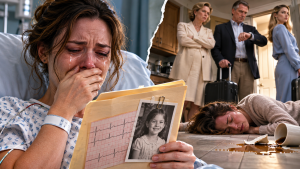
I was lying on the cold kitchen floor, unable to move my arms.
My chest felt as though someone had wrapped a belt around it and pulled until I couldn’t breathe.
My father stood over me holding his suitcase.
He checked his watch.
Then he said six words I would never forget.
“She’ll be fine. We’re going.”
My name is Evelyn Carter. I was thirty-five years old when I finally learned why my parents had never loved me the way they loved my younger sister.
For twenty-six years, I believed there was something wrong with me.
I was the difficult daughter.
The emotional daughter.
The daughter who always needed something.
My younger sister, Rebecca, was different.
She was the beautiful one. The successful one. The daughter whose birthday parties required professional photographers and whose smallest disappointments became family emergencies.
That morning, Rebecca was celebrating her engagement at a luxury resort in Miami.
My parents had spent nearly forty thousand dollars organizing the event.
They had purchased first-class tickets, booked an oceanfront suite, and hired a photographer to document every moment.
I was supposed to drive them to the airport.
Instead, I collapsed while pouring coffee.
At first, I thought I had simply stood up too quickly.
Then my heart began racing.
The room tilted.
My fingers went numb.
I tried to reach for the counter, but my knees folded beneath me.
The ceramic mug shattered.
Coffee spread across the kitchen tiles.
My mother screamed.
Not because I had fallen.
Because the coffee had splashed onto her cream-colored shoes.
“Evelyn! Look what you’ve done!”
I tried to answer.
Nothing came out.
My father crouched beside me for approximately three seconds.
He touched my shoulder.
Then he stood up.
“You’ve had these episodes since you were little. Stop making everyone panic.”
I wanted to tell him this one was different.
I wanted to explain that I couldn’t feel my left hand.
But the words were trapped somewhere inside my throat.
Rebecca appeared in the doorway wearing a pale blue travel outfit.
She looked at me.
Then she looked at our parents.
“Seriously? Today?”
My mother sighed.
“Your sister has always had terrible timing.”
I remember the sound of suitcase wheels rolling across the tiles.
I remember the front door opening.
And I remember Rebecca saying, “Are we going to miss boarding?”
My father answered immediately.
“Not because of this.”
Then the door closed.
And I was alone.
I don’t know how long I lay there.
A neighbor later told me she heard the crash and came through the unlocked back door.
She found me barely conscious, with my breathing shallow and my pulse dangerously irregular.
She called 911.
By the time the ambulance arrived, my heart had developed a life-threatening rhythm.
One of the paramedics told me afterward that I had been incredibly lucky.
Another ten minutes, and there might not have been anyone left to save.
But luck was not what I felt when I woke up in the hospital.
I felt abandoned.
And the worst part was that I wasn’t surprised.
PART 2 — Nine Days of Silence
The hospital room was quiet except for the steady beeping of the monitor beside my bed.
A woman in green scrubs stood near the window.
She introduced herself as Nurse Margaret Ellis.
“You gave us quite a scare,” she said.
I tried to sit up.
A sharp pain traveled through my chest.
She immediately adjusted my pillow.
“Easy. You’ve been through a serious cardiac event.”
I swallowed.
“My parents?”
She looked toward the empty chair.
“Have you been able to contact them?”
I stared at her.
That was my answer.
Over the next two days, doctors performed tests, adjusted medication, and monitored my heart.
I learned that the electrical signals controlling my heartbeat were behaving abnormally.
I also learned that this problem might not have been new.
Dr. Hannah Mercer, a cardiologist in her early forties, studied my test results with a troubled expression.
“Evelyn, have you ever been evaluated for an inherited rhythm disorder?”
I shook my head.
“I fainted a lot when I was younger.”
“How often?”
I hesitated.
“Several times a year.”
“Did your parents take you to a specialist?”
“I don’t remember.”
She put down her pen.
“What did they tell you caused the fainting?”
I almost laughed.
“Attention seeking.”
Dr. Mercer didn’t smile.
Instead, she asked a question no one had ever asked me.
“Who told you that?”
“My mother.”
The doctor was silent for a moment.
Then she said, “I want to request your childhood medical records.”
I didn’t understand why those records would matter.
My parents had always insisted that nothing serious was wrong with me.
I believed them.
Even after collapsing in a kitchen while they boarded an airplane.
That evening, I opened my phone.
The family group chat was full of photographs.
Rebecca standing beneath an arch of white roses.
My mother holding champagne.
My father smiling beside an expensive swimming pool.
A photograph of all three of them appeared at 7:42 p.m.
The caption read:
Nothing matters more than family.
I stared at those words until my eyes burned.
Then I checked my private messages.
There was one from my mother.
It had arrived six hours after I was admitted.
Hope you’re feeling better. Please don’t make us feel guilty about enjoying Rebecca’s special week.
I typed three different replies.
I deleted all of them.
Finally, I wrote:
I’m in the hospital. The doctors say it was serious.
She responded the next morning.
You always worry too much. We’ll discuss it when we’re home.
No phone call.
No questions.
No visit.
On the fourth day, Nurse Margaret noticed me staring at my screen.
“Still nothing?”
I shook my head.
She pulled the chair closer.
“Can I ask you something?”
“Sure.”
“Is there someone else we should contact?”
I thought about it.
There had once been someone.
My grandfather.
But he had died years earlier.
And there was another person I hadn’t spoken to in almost a decade.
My older brother, Nathan.
My parents told everyone he had abandoned the family.
They said he was selfish.
Unstable.
Ungrateful.
I believed them for years.
Then I remembered something strange.
When I was seventeen, Nathan had told me:
“If you ever get seriously sick, call me before you call them.”
I had laughed.
He hadn’t.
Now, lying beneath hospital blankets, I wondered why.
PART 3 — The Forgotten Box
On the fifth morning, Dr. Mercer entered my room carrying a large envelope.
She looked unusually serious.
“We located some of your childhood records.”
I sat up.
“Did they find anything?”
“Yes.”
She took a seat.
“At nine years old, you were evaluated after collapsing during a school field trip.”
I remembered that day.
A science museum.
A hot afternoon.
A teacher holding my hand.
The terrifying sensation of my heart beating too fast.
My mother had arrived at the school furious.
She accused me of embarrassing her.
I had never forgotten that.
Dr. Mercer continued.
“The pediatric cardiologist who examined you identified a concerning electrical abnormality. He recommended additional testing and ongoing monitoring.”
I frowned.
“My parents said the tests were normal.”
“They weren’t.”
The room suddenly seemed very small.
She placed a copy of an old medical report in front of me.
My name was printed at the top.
My date of birth.
The hospital name.
And beneath it, several lines of clinical notes.
I couldn’t understand most of the terminology.
But I recognized one sentence.
Further assessment is strongly recommended due to risk of potentially fatal arrhythmia.
I read it three times.
“Potentially fatal?”
Dr. Mercer nodded.
“There was a serious concern, yes. We cannot know exactly what would have happened with earlier treatment, but you should have received follow-up care.”
I swallowed.
“Why didn’t I?”
She hesitated.
“That is something we need to investigate carefully.”
She turned another page.
It was a follow-up appointment record.
The appointment had been canceled.
There was a note indicating the family had declined additional evaluation.
My hands began trembling.
“Who canceled it?”
“The record lists your mother as the person who called.”
I felt cold.
Not sad.
Not angry.
Cold.
Because something from my childhood suddenly made sense.
When I was nine, Rebecca had been seven.
She had been preparing for a regional children’s dance competition.
My mother had spent months arranging lessons, costumes, and travel.
The weekend of my follow-up appointment was the same weekend as Rebecca’s competition.
I remembered being told that we couldn’t go to the hospital.
I remembered my mother saying, “Your sister has worked too hard for us to miss this.”
And I remembered my father adding, “You aren’t dying, Evelyn.”
Now I understood something horrifying.
He hadn’t known that.
Neither of them had.
They had simply decided it didn’t matter enough to find out.
But the next page was worse.
A folded letter was attached to the original specialist’s report.
At the bottom were two signatures.
My mother’s.
And my father’s.
The letter documented that the risks of refusing additional investigation had been explained.
They had acknowledged those risks.
I stared at the signatures.
Then I began to cry.
Not loudly.
I simply sat there with tears falling onto the hospital blanket.
For twenty-six years, I had wondered why I wasn’t good enough to deserve the same attention as my sister.
Now I was looking at evidence that my parents had been warned about a danger to my life.
And had walked away.
PART 4 — The Brother Who Wasn’t Supposed to Know
That afternoon, I asked Nurse Margaret for my phone.
My hands shook so badly that I entered the wrong number twice.
When Nathan answered, I couldn’t speak.
“Hello?”
I closed my eyes.
“Evelyn?”
Hearing him say my name broke something inside me.
“Nathan.”
There was a long silence.
Then his voice changed.
“What’s wrong?”
I tried to explain.
The collapse.
The hospital.
The childhood records.
The canceled appointments.
When I finished, Nathan didn’t sound surprised.
He sounded devastated.
“Where are you?”
I told him.
“I’ll come.”
“You live three hours away.”
“I know.”
“Nathan, you don’t have to—”
“Evelyn.”
I stopped.
“You should have called me years ago.”
He arrived that evening wearing a wrinkled work shirt, with exhaustion written across his face.
I hadn’t seen him since I was twenty-six.
He looked older.
There was gray in his beard.
But the moment he stepped into the room, I recognized the brother who used to hide my favorite cookies from Rebecca.
He crossed the room and hugged me carefully around the monitoring wires.
For several minutes, neither of us spoke.
Then he pulled back.
“Did they finally tell you?”
I stared at him.
“Tell me what?”
Nathan looked toward the folder on my bed.
His expression hardened.
“Oh, Evelyn.”
He sat down.
“What did you find?”
I showed him the paperwork.
He read every page.
When he reached the letter, he closed his eyes.
“I knew about the missed appointment,” he said. “I didn’t know they signed this.”
I felt my stomach drop.
“You knew?”
“I was twelve. I heard them arguing.”
“About me?”
He nodded.
“Dad said the doctors were exaggerating. Mom said they couldn’t keep spending money and time on your tests when Rebecca needed so much attention.”
I stared at him.
“But why didn’t you tell me?”
“I tried.”
I shook my head.
“No.”
Nathan leaned forward.
“Remember when you were sixteen and I offered to take you to a doctor?”
I remembered.
My parents had accused him of trying to frighten me.
They said he was turning me against them.
Nathan continued.
“I was twenty by then. I had started working. I wanted to pay for an independent evaluation.”
“What happened?”
“Dad found out.”
He paused.
“He told me if I kept interfering, I wasn’t welcome in the house.”
I remembered the fight.
The shouting.
The broken picture frame.
Nathan leaving with a duffel bag.
My parents told me he had stolen money.
They said he was irresponsible.
They told Rebecca and me that he had chosen his own life over his family.
Nathan looked down.
“I wrote to you, Evelyn. Birthday cards. Letters. I sent you money when I heard you were struggling through college.”
My heart began pounding.
“I never got anything.”
“I know.”
“How?”
“Because one of my letters came back opened. Mom had written on the envelope that you didn’t want contact.”
I pressed my hand over my mouth.
All those years.
All that loneliness.
And the one person who had tried to protect me had been deliberately pushed away.
Nathan reached into his pocket.
He removed a small, folded photograph.
It showed two children sitting on a porch.
A twelve-year-old boy with messy hair.
And a little girl holding a stuffed rabbit.
On the back, in crooked handwriting, were five words.
I’ll always look after Evie.
I couldn’t stop crying.
Because suddenly I understood why Nathan had never truly abandoned me.
He had been the first person my parents punished for refusing to ignore me.
PART 5 — The Phone Call That Changed Everything
On the sixth day, my father finally called.
I watched his name appear on the screen.
For a moment, I considered letting it ring.
Then I answered.
“Hello.”
“Evelyn. Your mother says you’re still in the hospital.”
“Yes.”
He sighed.
“You’ve always had trouble recovering from these little episodes.”
I stared at the cardiac monitor.
“Dad, my heart almost stopped.”
A pause.
“Well, you’re talking now.”
I closed my eyes.
Nathan was sitting beside the window.
He heard every word.
My father continued.
“We’ll be home in three days. Make sure you’re ready. Your mother wants to have a family dinner when we return.”
“Ready for what?”
“To come home, obviously.”
I felt something settle inside me.
For the first time, I didn’t feel the need to explain myself.
“I’m not going home with you.”
He laughed.
“Don’t be dramatic.”
“I’m thirty-five years old.”
“And you’re our daughter.”
“That didn’t seem important when I was lying on your kitchen floor.”
His voice became sharp.
“We had a flight to catch.”
“I was unconscious.”
“You’ve fainted before.”
“Because I have a heart condition.”
Silence.
I continued.
“A condition doctors warned you about when I was nine.”
The line went quiet.
Then he said, “Who told you that?”
Not what condition?
Not are you safe?
Not what do you need?
Who told you?
I looked at Nathan.
He nodded once.
I said, “I have the records.”
My father took a breath.
“Evelyn, you don’t understand what was happening back then.”
“Then explain it.”
“We had two children with very different needs.”
“Three,” I said.
“What?”
“You had three children. Nathan existed too.”
Another silence.
My father’s voice dropped.
“Is he there?”
“Yes.”
“Put him on.”
“No.”
“Evelyn—”
“You can speak to him when he’s ready.”
Then I ended the call.
My hand trembled.
Nathan reached over and turned my phone face down.
“You did well.”
I shook my head.
“I feel terrible.”
“I know.”
“I’ve never hung up on Dad.”
Nathan gave me a sad smile.
“That’s because he trained you to believe ending a conversation was worse than being hurt by it.”
That night, for the first time in years, I slept without dreaming about disappointing my parents.
PART 6 — What the Missing Years Had Cost
The following morning, Dr. Mercer explained the treatment plan.
The team had identified a significant rhythm disorder that required careful long-term management.
I needed medication, regular specialist appointments, and a detailed plan for emergencies.
Additional testing would determine whether I needed an implanted device to reduce the risk of a future life-threatening episode.
The medical team also discussed whether other relatives should be evaluated for inherited risk.
I listened carefully.
For once, I didn’t apologize for asking questions.
I asked about work.
Exercise.
Driving.
Medication.
Warning signs.
What to do if symptoms returned.
Dr. Mercer answered each question patiently.
At the end, she said something that stayed with me.
“Your medical history does not have to remain a mystery. You deserve to understand what is happening in your own body.”
That afternoon, Nathan helped me make a list of documents I needed.
Medical records.
Insurance details.
Emergency contacts.
My employer’s leave forms.
My parents had always made decisions for me when I was sick.
They had kept my paperwork.
They knew the passwords to old accounts.
They still had a spare key to my apartment.
At thirty-five, I suddenly realized how much control I had allowed them to keep.
I changed my emergency contact to Nathan.
I updated my medical privacy permissions.
I called my apartment manager and arranged to replace the lock.
Then I made one more call.
To an attorney.
Not because I wanted revenge.
Because I wanted to understand what had happened.
Attorney Daniel Pierce listened to the facts without interrupting.
He explained that historical medical decisions could be difficult to evaluate legally, especially after so many years.
Records, applicable laws, and the circumstances of the original decision would matter.
He did not promise a lawsuit.
He did not promise punishment.
He promised to examine the documents carefully.
For some reason, that felt better than someone telling me everything would be fine.
I was tired of comforting words that didn’t mean anything.
I wanted the truth.
Even if the truth hurt.
PART 7 — The Nine-Year-Old Girl in the Photograph
On the eighth evening, Nathan brought me a small cardboard box.
“I found this when I moved,” he said. “I wasn’t sure whether to give it to you.”
Inside were several childhood photographs.
School certificates.
An old birthday card.
A drawing of a house.
And a small notebook with purple flowers on the cover.
I recognized it immediately.
My childhood diary.
I had believed it was lost.
I opened it carefully.
The handwriting was uneven.
Some pages had stickers.
Others were covered in little drawings.
Then I found an entry dated two weeks after my ninth birthday.
Today I got dizzy again.
Mom says I should stop worrying everyone.
Rebecca got a beautiful new costume.
Dad says if I’m good and don’t complain, maybe we can go for ice cream after her competition.
I stared at the page.
The next entry was worse.
I heard Mom say doctors make people scared so they can get money.
I don’t want to cost too much.
I closed the notebook.
Nathan looked at me.
“Are you okay?”
I shook my head.
Then I said something I had never been able to say aloud.
“I thought I was expensive to love.”
My brother covered his face.
I kept talking.
“When I needed school supplies, I felt guilty. When I got sick, I apologized. When I was accepted into engineering school, I almost didn’t tell them because Rebecca had just failed an audition.”
I looked down at the small purple notebook.
“I spent my whole life trying to be convenient.”
Nathan’s eyes filled with tears.
“You were a child.”
“I know.”
“You didn’t owe them convenience.”
I looked at the photograph of nine-year-old me.
A girl with crooked bangs.
A missing front tooth.
A smile that showed no awareness of how much heartbreak was waiting for her.
And for the first time, I didn’t feel embarrassed by her neediness.
I felt protective.
I wished I could reach back through twenty-six years, take her hand, and tell her she was worth the trouble.
PART 8 — They Came Back With Suitcases
On the ninth morning, Nurse Margaret entered my room.
“Evelyn, your parents are here.”
My stomach tightened.
Nathan was sitting beside my bed.
He put down his coffee.
“Do you want me to leave?”
“No.”
“Are you sure?”
I nodded.
“For once, I don’t want to face them alone.”
Moments later, my father stepped through the doorway.
He wore a crisp white shirt and expensive sunglasses hanging from his collar.
My mother followed carrying a designer handbag.
Rebecca came behind them.
Her engagement ring glittered beneath the fluorescent lights.
My mother looked around the room.
“Oh, Evelyn. You’re still connected to all these machines?”
I didn’t answer.
My father approached the bed.
“Where do we sign to take you home?”
Nurse Margaret stepped between us.
“Mr. Carter, your daughter is an adult. Her discharge arrangements are her decision, in consultation with her medical team.”
He frowned.
“We’re her parents.”
“I understand.”
“Then why are you making this difficult?”
Margaret remained calm.
“I’m not.”
Rebecca crossed her arms.
“Can we please not turn this into another scene? I’m exhausted from traveling.”
I looked at her.
She had spent nine days at a resort.
I had spent nine days wondering whether my heart would fail again.
And somehow, she was the exhausted one.
My mother reached for my hand.
“Sweetheart, let’s forget this unpleasantness and get everyone home.”
I pulled my hand away.
Her expression changed.
“Evelyn?”
“I know about the appointment.”
My father’s jaw tightened.
“What appointment?”
“The specialist you refused to take me back to when I was nine.”
My mother went very still.
Rebecca looked confused.
“What are you talking about?”
I reached for the folder beside my bed.
The copies were neatly arranged.
Medical report.
Follow-up recommendation.
Appointment cancellation.
Acknowledgment of risk.
Two signatures.
I handed the papers to my father.
He glanced at the first page.
Then the second.
His face changed.
My mother whispered, “Where did you get those?”
“From my medical history.”
She looked toward Nathan.
And finally noticed him.
Her mouth fell open.
“Nathan?”
He stood.
“Hello, Mom.”
My father’s face flushed.
“What is he doing here?”
Nathan answered quietly.
“Something you should have done nine days ago.”
My father pointed toward the door.
“You have no business interfering in this family.”
Nathan didn’t move.
“I was part of this family until you decided protecting Evelyn was a betrayal.”
Rebecca stared at him.
“Nathan, please. This is ridiculous.”
He looked at her.
“Do you know what happened when Evelyn was nine?”
Rebecca shook her head.
He pointed at the folder.
“Our parents were told she needed additional cardiac evaluation. They declined it.”
My sister frowned.
“Because they couldn’t afford it?”
I looked at her.
“We don’t know that money was the reason. But they didn’t even try to reschedule.”
My mother suddenly spoke.
“It was a very stressful time.”
I felt my heart pounding.
“Then tell me what happened.”
She looked at the floor.
My father answered instead.
“We made the decision we thought was best.”
“For whom?” I asked.
He didn’t reply.
“For me?” I continued. “Or for the daughter whose dance competition you didn’t want to miss?”
My mother’s eyes filled with tears.
“Evelyn, please.”
I was crying too.
But I kept talking.
“You knew the doctor was worried something serious could happen to me.”
My father looked away.
“You survived.”
I stared at him.
Then I said the words that finally ended my childhood.
“Surviving your decision does not make your decision acceptable.”
No one spoke.
Even Rebecca lowered her eyes.
PART 9 — The Secret My Mother Couldn’t Defend
My mother sat down heavily.
Her hands were trembling.
“I didn’t know you would remember that competition.”
I stared at her.
“I didn’t remember the hospital paperwork. I remembered being told my sister mattered more.”
She began crying.
My father moved toward her.
“That’s enough, Evelyn.”
“No.”
My voice surprised all of us.
It was quiet.
But it didn’t shake.
“For thirty-five years, you’ve told me when I was allowed to speak. Not today.”
Rebecca looked from me to our parents.
“Mom, did you really know she might have a heart problem?”
My mother wiped her face.
“The doctors wanted more testing.”
“Did you ever take her?”
“We were busy.”
Rebecca stared at her.
“That isn’t an answer.”
My father turned toward her.
“Don’t start.”
But Rebecca wasn’t looking at him anymore.
She was looking at me.
I saw something unfamiliar in her expression.
Not annoyance.
Confusion.
Perhaps even shame.
My mother finally whispered, “I kept thinking we would make another appointment.”
“Why didn’t you?”
She didn’t answer.
I waited.
Then she said, “And after a while, nothing terrible happened.”
I looked toward the monitor.
“Until it did.”
My father became angry.
“You’re acting like we wanted you hurt.”
“I didn’t say that.”
“Then stop accusing us.”
I took a slow breath.
“You don’t have to want someone hurt to choose not to protect them.”
He opened his mouth.
Then closed it.
I looked at my mother.
“Do you know what I needed when I was nine?”
She began crying harder.
“Evelyn—”
“I needed someone to believe me.”
I pointed toward the medical file.
“Instead, you taught me not to believe myself.”
That hurt more than the missed appointments.
It explained why I had ignored symptoms for years.
Why I had worked through dizziness.
Why I had dismissed the pounding in my chest.
Why I had believed pain was a character flaw.
My parents had not merely failed to follow up on a medical warning.
They had taught me that asking for help was something to be ashamed of.
PART 10 — The Sister Who Had Always Been Chosen
Rebecca was the first to leave the room.
I assumed she was angry.
Twenty minutes later, she returned alone.
Her makeup was smudged.
She sat beside my bed without speaking.
Finally, she asked, “Were you really lying there when we left?”
I nodded.
“Were you conscious?”
“Barely.”
She pressed her lips together.
“I thought you were having another one of your spells.”
“That’s what Mom and Dad always called them.”
Rebecca looked down at her engagement ring.
“I believed them.”
“I know.”
She began twisting the ring around her finger.
“They told me you were jealous of my engagement.”
I didn’t say anything.
“They told me you were trying to get everyone to stay home.”
I swallowed.
“Were you worried about me?”
She hesitated.
Then she shook her head.
“No.”
The honesty hurt.
But it was the first honest answer she had given me in years.
“I was angry,” she continued. “I thought you were doing it deliberately.”
I looked toward the window.
Rebecca started crying.
“I left you on the floor.”
“Yes.”
“I saw you.”
“Yes.”
She covered her mouth.
“I don’t know how to explain that.”
“Maybe you can’t.”
She nodded.
For once, she didn’t ask me to make her feel better.
After a long silence, she said, “I don’t expect you to forgive me.”
I looked at her.
That was the first time Rebecca had ever acknowledged that my forgiveness belonged to me.
She reached into her handbag.
Removed a tissue.
Then said, “I canceled the family dinner.”
I blinked.
“What?”
“Mom wanted everyone to come over tonight and pretend nothing happened.”
“And?”
“I told her I wasn’t coming.”
I watched her carefully.
She was still my sister.
Still the woman who had laughed when I fell.
One conversation could not erase that.
But something had changed.
She was finally looking at me as a person.
Not an obstacle.
Not competition.
Not an inconvenience.
A person.
And though I wasn’t ready to forgive her, I was willing to remember that moment.
PART 11 — The Life I Chose After the Hospital
I was discharged under my own arrangements.
Nathan drove me to my apartment.
He carried my overnight bag.
Bought groceries.
Helped organize my prescriptions.
And wrote the dates of my follow-up appointments on a calendar beside the refrigerator.
He didn’t make speeches about family duty.
He just showed up.
For the first few weeks, I was frightened by every unusual heartbeat.
Recovery was not simple.
There were medical appointments, medication adjustments, and nights when I worried about what could happen while I slept.
But there was also something I had never experienced.
Peace.
My phone no longer rang with demands to pick up my mother’s shopping.
No messages telling me to help Rebecca choose wedding decorations.
No pressure to apologize for being upset.
I had told my parents that I needed space.
My father responded with a long message about everything he had sacrificed.
My mother sent photographs of me as a baby.
Neither offered a clear acknowledgment of what they had done.
I stopped responding.
Not because I wanted to punish them.
Because I no longer wanted to spend my life arguing for the right to be treated carefully.
One Sunday afternoon, Nathan visited with his wife, Claire, and their two children.
His youngest daughter climbed onto the sofa beside me.
She was eight.
She asked whether my heart was still sick.
“A little,” I said. “But the doctors are helping me.”
She considered this seriously.
“Does it hurt?”
“Sometimes it’s uncomfortable.”
She slipped her small hand into mine.
“Then we should be extra gentle.”
I looked at Nathan.
He was watching us from the doorway.
Something inside me softened.
That little girl had understood in ten seconds what my parents had failed to understand in twenty-six years.
When someone is hurting, you don’t ask whether helping them is convenient.
You help.
PART 12 — The Letter I Never Expected
Three months later, a letter arrived.
It was from my mother.
Not a text.
Not a photograph.
A handwritten letter.
For several days, I left it unopened.
Then I sat at my kitchen table and read it.
She wrote about my childhood.
About being overwhelmed.
About how she had convinced herself my fainting was harmless because accepting the alternative frightened her.
She admitted she had used Rebecca’s activities as excuses.
She admitted she had allowed my father to dismiss the doctors’ concerns.
And she acknowledged something I had never expected her to say.
I taught you that your pain was inconvenient because I did not want to face how badly I had failed you.
I reread that sentence several times.
Then I cried.
Not because the apology fixed everything.
It didn’t.
But because, for the first time, she wasn’t demanding that I forget.
She was acknowledging what I remembered.
At the end, she wrote:
I understand that you may never want the relationship we had before. I hope someday we can build a more honest one, but I know that choice belongs to you.
I folded the letter.
Placed it in a drawer.
And went outside for a walk.
I wasn’t ready to answer.
That was okay.
Healing didn’t require a deadline.
PART 13 — The Wedding Invitation
Six months after my collapse, Rebecca sent me a wedding invitation.
It arrived in a thick ivory envelope.
Inside was a handwritten note.
I would love for you to come, but I understand if you don’t. You don’t have to explain yourself.
I placed the card on my kitchen counter.
For a week, I walked past it without opening it again.
Then Rebecca called.
I answered.
“Hi, Evie.”
“Hi.”
She sounded nervous.
“I wanted to ask how you’ve been feeling.”
I told her about my latest appointment.
She listened.
Asked questions.
Didn’t interrupt.
Then she said, “I’ve been seeing a counselor.”
I was surprised.
“Really?”
“Yes.”
She hesitated.
“I started because I couldn’t stop thinking about what happened.”
We talked for nearly an hour.
She told me about childhood memories that now seemed different.
How our parents had praised her for winning.
How they had blamed me for needing attention.
How she had learned to measure love by being the easiest person to celebrate.
“I thought being chosen meant I was better,” she said quietly.
I didn’t answer.
She continued.
“Now I think it meant they were teaching both of us something terrible.”
I stared at the invitation.
She asked, “Would you consider coming to the wedding?”
I took a breath.
“I don’t know.”
“That’s okay.”
“And if I come, I’m not sitting with Mom and Dad.”
“I understand.”
“And I won’t make a speech about how perfect our family is.”
Rebecca gave a small, sad laugh.
“I wouldn’t ask you to.”
After we ended the call, I looked at the card again.
This time, I didn’t feel trapped.
I felt like I had a choice.
PART 14 — The Day I Finally Stopped Competing
The wedding was held in a garden outside Savannah.
I attended with Nathan and Claire.
For the first time in my adult life, I went to a family celebration without being assigned a list of chores.
I wore a dark green dress.
My hair was pinned loosely at the back.
I carried a small handbag containing my medication and emergency information.
Nathan offered me his arm as we walked toward the ceremony.
“You okay?”
I nodded.
“Actually, yes.”
Across the garden, I saw my parents.
My father looked older.
My mother stood beside him holding a tissue.
They saw us.
Neither approached.
Rebecca had arranged our seating on the opposite side of the garden.
I appreciated that.
During the ceremony, I watched my sister exchange vows.
She looked happy.
When she turned toward the guests, our eyes met.
She smiled.
I smiled back.
And something remarkable happened.
I didn’t feel jealous.
I didn’t feel overlooked.
I didn’t wonder why my parents loved her more.
Because I had finally understood that their favoritism was never a reliable measurement of my worth.
After the ceremony, Rebecca approached me.
“Thank you for coming.”
“You look beautiful.”
She hugged me gently.
For a moment, we were simply two sisters.
Not the favorite.
Not the forgotten.
Just two women who had grown up in the same house and were slowly learning how differently they had experienced it.
Later, my mother approached.
She stopped several feet away.
“Evelyn.”
“Mom.”
She looked at me for a long moment.
“I’m glad you’re here.”
“Thank you.”
Her eyes filled.
“I miss you.”
I nodded.
“I know.”
She waited.
Perhaps hoping I would say it back.
I wasn’t ready.
So I didn’t.
And for once, I didn’t hate myself for that.
PART 15 — What the Folder Really Gave Me
A year after my collapse, I returned to the hospital for a routine cardiac follow-up.
My condition required ongoing care, but with treatment and monitoring, I had begun rebuilding a life that no longer revolved around hiding my symptoms.
I had returned to work.
Started taking gentle evening walks.
Reconnected with old friends.
And spent more weekends with Nathan’s family than I ever thought possible.
Nurse Margaret happened to be working that afternoon.
She recognized me immediately.
“Evelyn!”
I smiled.
She hugged me.
“How are you doing?”
“Better.”
She studied my face.
“Much better, I’d say.”
We talked for a few minutes.
Then I thanked her.
“For what?” she asked.
“For not treating me like I was a problem when I needed help.”
Her expression softened.
“Oh, sweetheart. That wasn’t something you should ever have had to earn.”
I carried those words with me all the way home.
That evening, I opened the drawer where I kept my childhood diary and the copies of my medical records.
The faded pages were still painful to read.
But they no longer held the same power over me.
I looked at the photograph of nine-year-old Evelyn.
The little girl holding the stuffed rabbit.
The girl who believed she had to stay quiet to deserve love.
I placed the photograph in a new frame.
Then I set it on my bookshelf.
Not to remind myself of what had been taken from me.
But to remember the girl who had survived long enough for me to finally protect her.
My parents left me lying on a kitchen floor because they believed my sister’s celebration mattered more than my emergency.
Nine days later, a forgotten medical file showed me that the pattern had begun when I was nine.
But the greatest revelation wasn’t contained in a doctor’s report.
It came afterward.
When my brother showed up.
When I learned to ask for help.
When I stopped apologizing for being sick.
When I finally understood that family love is not proven by shared blood, expensive celebrations, or beautiful photographs.
It is proven in the ordinary moments when someone needs you and you decide to stay.
My parents had taught me what abandonment felt like.
The people who helped me recover taught me what love could be.
And at thirty-six years old, I no longer needed to be the daughter my parents chose.
I had finally become the woman who chose herself.
THE END