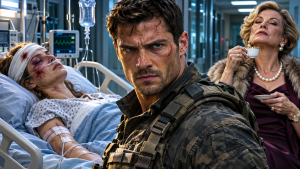
Returning from a covert deployment, I froze when I found my wife in the ICU with twenty-seven broken bones and a fractured skull. Outside her room, my billionaire mother-in-law casually sipped espresso and sneered: “You are just an expendable soldier, go back to your sandbox!” The detective warned: “Captain, this family owns the entire county.” Staring at my wife’s swollen face, I murmured: “Good. My authority reaches far beyond this county.” They thought their wealth made them untouchable, but they had no clue that the man who had just come home was…
Twenty-seven distinct fractures: Twenty-seven broken bones. I stood frozen as Dr. Higgins read my wife’s medical report.
“Captain Alexander Sinclair, her left femur is severely damaged, accompanied by intracranial bleeding, three fractured ribs, and extensive injuries suggesting she tried to defend herself. Someone restrained your wife. This doesn’t resemble an ordinary burglary. It looks like a message deliberately planned.”
I pressed my trembling palm against the cold glass of the ICU. Rosalie, the woman who had once been the only light in my world, now lay motionless beneath life-support equipment. I’d spent seven months on the battlefield, but nothing had ever made me feel this helpless.
The pain in my chest slowly turned to ice as I walked into the waiting lounge.
The Miller family occupied luxurious leather chairs, casually enjoying their coffee. Catherine Miller, my mother-in-law, adjusted her pearl necklace and regarded me with chilling indifference.
“Such a tragedy, Alexander. But there’s no need to worry anymore. I’ve already signed the papers to transfer Rosalie to our private family facility tomorrow morning.”
“Why are you rushing to make decisions when she hasn’t even regained consciousness?”
Catherine gave a faint, contemptuous smile.
“You’re just a soldier. You have no idea how the Miller family handles these matters. Go back to where you belong.”
I looked directly at her. No argument. No outburst. I simply replied:
“You’re absolutely right, Catherine. I am a soldier.”
Leaving the lounge, I retrieved the encrypted satellite phone from my tactical bag. The call connected directly to a classified unit within the Pentagon.
“Overlord Actual.”
I tightened my grip on the phone, staring toward the ICU.
“Authorize Protocol Blackout. Domestic target. I want the entire operation underway before midnight.”
Silence followed for several seconds.
“Protocol Blackout approved, Overlord.”
The Miller family continued sipping their coffee, completely unaware that the phone call they’d just dismissed might turn the entire world they’d built upside down.
PART 2
I sat beside Rosalie’s bed for three hours without moving.
The nurses had let me in after Dr. Higgins signed off, and I’d pulled a plastic chair close enough to hold the two fingers on her right hand that weren’t wrapped in a splint. The ventilator breathed for her in slow, mechanical sighs. Her face was so swollen I could barely find the woman I’d married underneath it.
I found her anyway. I always would.
We met six years ago at the VA hospital in Fayetteville. She was a volunteer reading to veterans who’d lost their sight, and I was a second lieutenant visiting a sergeant from my first platoon. She’d been reading Lonesome Dove aloud, doing all the voices badly, and the old Marines in that ward were laughing so hard one of them pulled out his IV. I’d laughed too. She’d turned around and pointed the paperback at me like a weapon.
“If you’re going to laugh at my Gus McCrae, soldier, you’d better sit down and do it better.”
I sat down. I never really stood back up.
When we married at the county courthouse two years later, Rosalie had invited her family. Catherine sent a crystal vase and a note that said Best of luck. Nobody from the Miller family came.
“Captain Sinclair?”
The voice came from the doorway. It was the detective from the lounge, a heavyset man in his late fifties with a gray mustache and a tie loosened at the throat. His badge read Det. Raymond Dawson.
“I wanted to say something before I clock out,” he said quietly. “Twenty-six years on the job. I’ve never seen a scene like your house. And I’ve never been pulled off a case an hour after I got it.”
“Pulled off?”
“Sheriff Pruitt reassigned it at eight o’clock. And by the time I drove back to your place to walk it again, a private cleaning crew was already inside. Hired by the Miller family, out of ‘compassion,’ the paperwork says.” He shook his head. “Blood, glass, the back door, all of it. Gone. Most of the evidence is gone, Captain.”
I looked at my wife. Then at him.
“Why are you telling me this, Detective?”
He held my gaze for a long moment. “Because I have a daughter about her age. And because when I told you this family owns the county, I meant it as a warning. I didn’t expect you to look relieved.”
At 11:52 p.m., my phone buzzed once. A single word: Arrived.
Three black SUVs had pulled into the hospital’s service lot. The first person out was Major Elena Vasquez, my executive officer for four years and the most frighteningly competent human being I had ever known. Behind her came Special Agent Marcus Cole of the Defense Criminal Investigative Service, a tall man with an accountant’s glasses and a linebacker’s shoulders. Last was Staff Sergeant Theo Park, our signals and data specialist, already carrying two hard-shell laptop cases.
Vasquez didn’t salute in a civilian hospital. She just put her hand on my shoulder and squeezed once.
“Sir. I’m so sorry.”
“Status.”
She shifted straight into business, because she knew that’s what I needed.
“Protocol Blackout is live as of eleven fifty-five. U.S. Marshals will post a twenty-four-hour protective detail on Mrs. Sinclair within the hour. A federal magistrate in Raleigh signed an emergency order at eleven-forty. Nobody moves her out of this hospital without federal approval. Preservation letters are going out to every bank, phone carrier, and cloud provider connected to the Miller family.”
Dawson, still standing nearby, let out a low whistle. “Who exactly are you people?”
Agent Cole extended a hand. “Interagency task force. Procurement fraud against the Department of Defense. Captain Sinclair commands the field element.”
“Procurement fraud,” Dawson repeated. “What does that have to do with an assault?”
Vasquez glanced at me. Something in her expression made my stomach tighten.
“Sir,” she said carefully, “you need to see this before anything else.”
Theo opened a laptop on the counter of the empty nurses’ station. On the screen was a corporate organization chart, a spiderweb of shell companies, holding firms, and trusts.
“We’ve had an open file on this network for eleven months,” Theo said. “Body armor contracts. Ceramic ballistic plates. About forty-two million dollars in federal money. We traced it through six shell companies but never found who sat on top.”
He clicked once. The final layer of the web resolved.
Ironclad Tactical Solutions, LLC. Wholly owned subsidiary of Miller Holdings Group.
I stopped breathing.
“We didn’t know it was your wife’s family, sir,” Vasquez said softly. “Her maiden name never came up in your personnel file. When you called tonight and said ‘Miller,’ Theo ran the name against our case database just to be thorough. That’s when it lit up.”
Ironclad Tactical Solutions. I knew that name. Every soldier in my unit knew that name. It was stamped on the plates we had carried into the field for the last two years.
It was stamped on the plate Sergeant Danny Reyes was wearing the night he died.
Before I could say anything, a night nurse approached with a clear plastic bag. “Captain Sinclair? These are your wife’s personal effects from the ER. Her ring, her watch, and her phone.”
The phone’s screen was cracked. Theo looked at me. “Do you know her passcode, sir?”
I did. It was the date we met.
The phone unlocked. The most recent file in her voice memo app had been recorded at 9:14 p.m. on the night of the attack. It was forty-one seconds long.
I pressed play.
Rosalie’s voice came out in a ragged whisper, so close to the microphone I could hear her breath shaking.
“Alex. If you’re hearing this, I’m so sorry. I should have told you everything. Listen to me. Whatever happens, you can’t trust—”
A crash. Wood splintering.
Then my wife screamed.
PART 3
The recording ended with a sound I would hear for the rest of my life.
Nobody in that hallway spoke. Theo silently stopped the playback. Vasquez looked at the floor. Detective Dawson took off his reading glasses and pressed his thumb and finger against his eyes.
“Copy everything on that phone,” I said finally. My voice sounded like it belonged to someone else. “Every file. Every message.”
Theo worked through the night. By four in the morning, he’d found a hidden folder Rosalie had created in her notes app eight weeks earlier. It was titled simply For Alex.
Inside were thirty-two voice memos and dozens of photographed documents.
My wife had been building a case.
For three years, Rosalie had volunteered as program director for the Hearts for Heroes Foundation, the Miller family’s flagship charity for wounded veterans. It was the only family connection she’d kept, because she believed in the work. In her memos, she explained in that calm, organized voice of hers how she’d noticed that donations kept flowing into the foundation while grants to veterans kept shrinking. Money was being routed through the foundation into a vendor account.
The vendor was Ironclad Tactical Solutions.
Memo twenty-two had been recorded in the car. I could hear rain on the windshield.
“I found a quality control report today in an old email archive. It says Batch 7-C of the ceramic plates failed independent ballistic testing. Failed, Alex. Someone signed off on a passing result anyway, and the plates shipped. I looked up where Batch 7-C went.” A long pause. Her voice broke. “Danny’s unit. Danny’s vest. I’m so sorry. I’m so sorry, baby. I couldn’t tell you over a satellite call. I needed to tell you in person, with my arms around you.”
I walked out of the room before anyone could see my face.
Danny Reyes had been my best friend since basic training. He had a laugh like a car alarm and a six-year-old daughter named Mia who’d sent him crayon drawings of sunflowers every month. Eight months ago, in a valley I’m not allowed to name, Danny took a round directly to the center of his chest plate. It should have stopped it. It didn’t.
The Army called it a catastrophic equipment anomaly. I carried his dog tags home to his widow myself.
And the people who’d sold him that plate had been sitting in leather chairs, sipping espresso, telling me to go back to my sandbox.
At 7:00 a.m., Catherine Miller arrived exactly as she had promised.
She came with a private ambulance crew, two security guards, and a silver-haired attorney named Preston Hale, whose suit cost more than my car. She walked down the ICU corridor as if she owned it, which, considering the Miller name was etched over the hospital’s new cardiac wing, she arguably did.
She stopped short when she saw the two U.S. Marshals posted on either side of Rosalie’s door.
“What is this?” she demanded.
Deputy Marshal Kendra Hollis, a compact woman with a stare like a sniper’s, handed Hale a copy of the federal order without a word. The attorney read it once, then again, and his tan visibly faded.
“Catherine,” he murmured, “this is a federal court order. We can’t move her.”
“That’s absurd.” Catherine turned to me, eyes blazing. “You did this. You have no right to keep my daughter in this place.”
“I’m her husband,” I said evenly. “I have every right. And as of midnight, Catherine, Rosalie is a protected federal witness.”
The word witness hit her like a slap. For just one second, her flawless composure cracked. The color drained from her face, and her hand drifted to her pearl necklace, gripping it as if it were a lifeline.
“Witness,” she whispered. “Witness to what?”
“I think you know.”
“Mom? Alex?”
A warm, familiar voice carried down the hall. Grant Miller, Rosalie’s older brother, jogged toward us in a quarter-zip sweater, his hair still damp from a shower. Grant was the only Miller who’d ever been kind to me. At our wedding, he’d been the one family member who called afterward, slightly drunk, to apologize for the rest of them.
He pulled me into a hard hug.
“Brother, I’m so sorry. I just landed from Charlotte. I came straight here.” He looked through the glass at Rosalie, and his eyes filled with tears. “God, Rosie.”
He turned to his mother. “Mom, stop. Let Alex make the decisions. He’s her husband.”
Catherine stared at her son for a long moment. Then, without another word, she turned and walked away, her guards trailing behind her.
Grant put his hand on my shoulder. “Whatever you need, Alex. Lawyers, money, private investigators. I’ll put up a million-dollar reward for information. We’re going to find whoever did this.”
“Thank you, Grant,” I said.
And I meant it. That was the worst part.
That night, I fell asleep in the chair beside Rosalie’s bed for the first time in forty hours.
At 2:37 a.m., an alarm tore me awake.
Rosalie’s oxygen saturation was plunging. Ninety-one. Eighty-six. Seventy-nine. Her heart rate spiked into a jagged red line. Dr. Higgins burst through the door with a team behind him, shouting orders, and I was pushed against the wall as they swarmed her.
Higgins traced her IV line with his hand, stopped at the injection port, and went pale.
“Someone added something to her line,” he said. “This isn’t anything I ordered.”
I spun toward the doorway. Deputy Marshal Hollis was already there, her face white.
“Nobody came through that door, sir. Nobody except the nurse who did the two o’clock check. She had a valid badge.”
“What nurse?” Higgins snapped. “There’s no two o’clock check on this unit tonight.”
PART 4
They saved her. It took eleven minutes, a reversal agent, and a doctor who refused to give up, but they saved her.
When Rosalie’s numbers finally stabilized, Dr. Higgins sank into the chair I’d been sleeping in and stared at his hands. “Whoever did this knew exactly what they were doing,” he said. “The dose was calculated for her weight. If you hadn’t been in this room, Captain, if that alarm had gone off at a nurses’ station instead of beside you, we would have lost her.”
I didn’t answer. I couldn’t.
By sunrise, Theo had pulled the hospital’s badge access logs. The badge used at 2:29 a.m. belonged to a night nurse named Tanya Brooks.
Tanya Brooks had been home in bed with the flu for three days. Her physical badge was sitting on her kitchen counter.
“It was cloned,” Theo said. “Somebody copied the chip. That takes equipment and access to the hospital’s credential system.”
“Cameras?”
He pulled up the footage. A woman in pale blue scrubs walked down the ICU corridor at 2:28 a.m., head down, a surgical cap and mask hiding everything but her eyes. She knew where every camera was. She never looked up once.
But Theo had pulled the parking lot cameras as well. At 2:14 a.m., a dark sedan pulled into the employee lot. The plates were obscured with mud. But when the driver’s door opened, the cabin light came on for half a second.
Detective Dawson leaned over Theo’s shoulder, squinted at the frozen frame, and swore quietly.
“See the radio mounted under the dash? And the cage behind the front seats? That’s an unmarked county vehicle. The Sheriff’s Office runs six of them.”
“Can you find out who signed one out last night?”
Dawson straightened up slowly. “I can try. But understand what you’re asking, Captain. If I pull that log, I’m finished in this county. Pension, career, everything.”
I met his eyes. “I’m not ordering you, Detective. You’re not under my command. I’m asking.”
He was quiet for a moment. Then he picked up his coat.
“My daughter would never speak to me again if I said no,” he said. “Give me two hours.”
While Dawson worked, I went to see the sheriff myself.
Sheriff Wade Pruitt held court every morning in a back booth at the Copper Kettle Diner on Main Street. He was in his sixties, broad and sunburned, with a white Stetson resting on the table beside his eggs. Two deputies sat at the counter, watching the room.
He didn’t stand when I slid into the booth across from him.
“Captain Sinclair,” he drawled. “Heard you brought some federal friends to my county. That’s real disrespectful.”
“Someone tried to murder my wife in her hospital bed last night, Sheriff.”
“Terrible. Just terrible.” He buttered his toast. “Hospitals are dangerous places. Medical errors happen all the time.”
“Someone used one of your vehicles.”
His knife paused for just a fraction of a second. Then he continued buttering.
“Son, let me tell you how things work here. The Millers built that hospital. They paved these roads. They pay for the new uniforms my boys wear, the new cruisers, the Little League field. Folks around here love the Miller family. Now you show up after seven months away, your marriage clearly having some troubles,” he smiled thinly, “and suddenly there’s federal agents everywhere. People talk. People start wondering if maybe the husband had something to do with all this.”
“Is that a threat, Sheriff?”
“It’s local advice.” He took a bite of toast. “Go home, Captain. Let us handle this.”
“Funny,” I said, standing. “That’s the second time this week someone’s told me to go home.”
I leaned down so only he could hear.
“Here’s my advice, Sheriff. Keep your receipts. You’re going to need them.”
Back at the hospital, the first good news in four days was waiting for me. Dr. Higgins met me at the ICU door, and he was almost smiling.
“Her pressure’s down. The bleeding has stopped. We started lightening her sedation an hour ago. She’s been stirring.”
I was beside her in three strides.
Rosalie’s eyelids fluttered. Her right eye, the one that wasn’t swollen shut, cracked open. It wandered across the ceiling, then the window, then found my face.
I watched her recognize me. I watched tears spill out of the corner of that one brown eye and run down into her bandages.
“Hey, Gus,” I whispered, the old joke. My voice broke on it. “I’m home. I’m here. You’re safe.”
The breathing tube kept her from speaking. Her fingers twitched against mine, urgent, frustrated. Then she turned my hand palm up and began tracing letters into it with her fingertip, slowly, painfully.
G.
R.
A.
Her eyes were wide, desperate, fixed on mine.
N.
T.
Then the sedation pulled her back under, and her hand went still in mine.
PART 5
Grant.
I sat in the hospital chapel for an hour, staring at a stained-glass window donated, of course, by the Miller family. I kept replaying his hug in the hallway, the tears in his eyes, his promise of a million-dollar reward.
Whatever you need, brother.
Vasquez found me there just before noon. She sat down in the pew beside me and placed a tablet on the seat between us.
“Theo’s been inside the family’s financials all morning, sir. You need to see both halves of this.”
The first half was Grant.
Behind his easy charm and expensive quarter-zips, Grant Miller was drowning. Over four years, he’d lost more than eleven million dollars, mostly in high-stakes private poker games in Las Vegas and Atlantic City. He owed a great deal of money to a private lending group in Nevada that the FBI had been watching for a decade. And according to state incorporation records, he was the listed chief executive officer of Ironclad Tactical Solutions.
“He signed the federal contracts,” Vasquez said. “His name is on the Batch 7-C certification.”
I closed my eyes.
“And the second half?”
She swiped the screen.
“On the night of the attack, at 10:51 p.m., about ninety minutes after Rosalie’s voice memo was cut off, Catherine Miller personally authorized a four-million-dollar wire transfer from her private trust to a numbered account in the Cayman Islands.”
I stared at the number. Four million dollars. Ninety minutes after my wife screamed.
“A payment for services rendered,” I said.
“That’s what it looks like, sir,” Vasquez agreed. “Or a cleanup fee. Either way, we have the son’s motive and the mother’s money.”
“Rosalie wrote ‘Grant.’”
“She did. But she was heavily sedated, sir. She could have meant ‘Grant did this.’ Or ‘Get Grant.’ Or ‘Grant knows.’ We don’t have enough yet.”
That afternoon, against Vasquez’s advice, I drove out to the Miller estate.
Halcyon House sat on four hundred acres of rolling Carolina horse country behind iron gates and a long avenue of live oaks. A maid led me through the marble foyer to the glass conservatory, where Catherine was tending orchids as if her daughter wasn’t lying in an ICU with a breathing tube.
“Alexander.” She didn’t look up from the flowers. “Have you come to apologize for humiliating me in front of my attorney?”
“I’ve come to ask you about four million dollars.”
Her pruning shears stopped.
For a long moment, the only sound was the humidifier hissing overhead. Then she set the shears down on the potting bench with exaggerated care.
“My finances are none of your concern.”
“They are when the money moves ninety minutes after your daughter is beaten nearly to death.”
She finally turned to face me. Her face was as cold and smooth as marble, but her hands were trembling. She clasped them together to hide it.
“Get out of my house,” she whispered.
Grant caught up with me on the front steps. He looked worried, glancing back toward the conservatory windows.
“Alex, wait. I heard some of that. Listen, I didn’t want to say anything, but…” He lowered his voice. “Mom has always been furious that Rosie wouldn’t fall in line. The charity, the marriage to you, refusing her trust fund. Mom doesn’t forgive disobedience. I’m not saying she would ever hurt her, but…” He trailed off, rubbing the back of his neck. “Just be careful who you trust in this family.”
I studied him for a long moment.
“That’s good advice, Grant,” I said. “I’ll keep it in mind.”
That night, I couldn’t sleep. I sat at the kitchen table of the small rental house the task force had secured for me near the hospital. I’d taken out the folded letter I carried in my breast pocket, the one Mia Reyes had given me at her father’s funeral. It was written in purple marker.
Dear Captin Alex. Thank you for bringing Daddy home. Mommy says you were his best friend. Please keep being a hero so other daddys come home to.
Other daddies.
The Army had quietly pulled the remaining Batch 7-C plates last month after a second failure in testing. But nobody had ever traced the problem back to its source. Nobody had ever been held responsible.
Until now.
At 2:10 a.m., there was a knock at the door.
It wasn’t the agents’ knock. It was soft, hesitant. I pulled my sidearm from the counter and approached the door from the side, the way I’d been trained.
“Who is it?”
“It’s Catherine.”
I opened the door.
My mother-in-law stood on the porch alone in the pouring rain. No driver. No security. No pearls. Her silver hair was plastered to her face, and her mascara was running down her cheeks in dark streaks. She looked twenty years older than the woman I’d seen in the conservatory.
“Alexander,” she said, her voice shaking. “Please let me in. I need to tell you the truth before they kill me too.”
PART 6
I’d seen Catherine Miller furious, contemptuous, and icy. I had never seen her afraid.
I gave her a towel and a mug of coffee. She wrapped both hands around it like it was the only warm thing left in the world. For a long time, she said nothing. Then she looked up at me.
“My husband is not in Switzerland,” she said.
Richard Miller. The patriarch. Three years ago, he’d announced his retirement from Miller Holdings, handed the reins to Grant, and moved to a lake house outside Geneva. Rosalie barely spoke of him. When she did, it was with a kind of quiet dread.
“He’s been in Geneva perhaps four months out of three years,” Catherine went on. “The rest of the time, he runs everything from a private office in Charlotte. Grant’s name is on the paperwork, but Grant has never made a decision in his life. Richard built Ironclad. Richard bought the testing lab. Richard decided which results the government would see.”
“Did you know the plates were defective?”
She closed her eyes. “I knew there were problems. I didn’t ask what kind. That’s how you survive thirty-one years married to Richard Miller. You don’t ask.”
“And the four million dollars?”
“Richard called me that night at ten-thirty. He said there had been an incident at Rosalie’s house and that he needed money moved from my trust immediately, through accounts the auditors wouldn’t watch. I didn’t know what had happened. I swear on my life, I didn’t know.” Her voice cracked. “I found out the next morning, the same as everyone else. And I understood exactly what I’d paid for.”
“You could have gone to the police.”
She laughed, a terrible, hollow sound. “Which police? Wade Pruitt has been on Richard’s payroll since before Rosalie could walk.”
“Then why push to move her to your family facility? Why rush it?”
“Because I couldn’t control who walked into that hospital,” she whispered. “At Ashgrove, every nurse and every guard answers to me, not to Richard. I thought I could keep her alive there.” She stared into her coffee. “I couldn’t tell you why. I didn’t know whether you were safe to trust. So I did what I always do. I was cruel, because cruelty makes people leave.”
I studied her face. Rain dripped from her hair onto the table.
“You called me an expendable soldier.”
Catherine flinched.
“My father was a machinist’s mate in the Navy,” she said quietly. “Thirty years. He came home smelling like diesel fuel, and he’d lift me up over his head in our trailer in Norfolk, and I thought he was the strongest man alive. I married Richard at twenty-two and spent the next three decades pretending that girl never existed.” She lifted her eyes to mine. “When Rosalie brought you home, you looked exactly like him. Steady hands. Honest eyes. She chose the life I abandoned, Alexander, and I hated you for reminding me what I’d thrown away.”
Neither of us spoke for a long moment.
“And Grant?” I finally asked.
“Grant is weak,” Catherine said. “Weak, frightened, and desperate for his father’s approval his whole life. He’s done terrible things for money. But Grant could never hurt his sister. They were inseparable as children. He used to sleep on the floor of her room during thunderstorms.”
“Rosalie wrote his name in my hand.”
Catherine’s face crumpled. “Then God help us. I don’t know my own family anymore.”
“Do you have proof of any of this? Documents? The real test results?”
“The original lab data is on a server at Ironclad’s facility outside Charlotte. Only Richard and Grant have access. If Richard knows federal agents are involved, he’ll have already wiped it.” She set the mug down. “I’ve told you everything. If Richard finds out I came here tonight—”
“You’ll have protection,” I said. “Marshals will escort you home.”
I was reaching for my phone to call Hollis when it rang in my hand. Agent Marcus Cole.
“Sir, we’ve got a problem. We put a soft tail on Grant Miller this afternoon, standard procedure. He gave our surveillance team the slip just after midnight, heading east on Route 17.”
“Find him.”
“We did, sir. His car. A county patrol found it twenty minutes ago, abandoned in a ditch at the county line.” Cole hesitated. “Driver’s door wide open. Engine still running. There’s blood on the steering wheel.”
Behind me, I heard a sharp intake of breath. Catherine had heard every word.
The mug slipped from her fingers and shattered on the floor.
PART 7
By dawn, the search for Grant Miller had spread across three counties.
The FBI brought in dogs. The state police sent a helicopter. Theo sat hunched over his laptops in the hospital’s spare conference room, working through cell tower records, license plate readers, and toll cameras.
The blood on the steering wheel was Grant’s. The lab confirmed it within four hours. There wasn’t much of it, Cole assured me, consistent with a blow to the head rather than anything worse. But nobody had seen him since midnight.
Catherine refused to leave the hospital. She sat in the chapel for hours, staring at the stained glass her own money had paid for, a Marshal standing quietly at the back.
At ten o’clock that morning, Sheriff Wade Pruitt held a press conference on the courthouse steps.
I watched it on the television in the ICU waiting room with Vasquez and Dawson. Pruitt stood behind a podium with his Stetson in his hand, his face arranged into an expression of solemn grief.
“The Miller family has been the heart of this community for three generations,” he told the cameras. “Today, one of their children is missing, and another is fighting for her life. Our investigation has led us to a person of interest who has a documented history of combat-related stress, who was seen in a heated altercation with the Miller family, and who was the last known person to speak privately with Mrs. Catherine Miller before she suffered injuries last night.”
“Injuries?” Dawson muttered. “She cut her finger on a coffee mug.”
“This morning,” Pruitt continued, “I signed a warrant for the arrest of Captain Alexander Sinclair on charges of obstruction of justice and assault.”
Vasquez actually laughed out loud, an angry bark of disbelief.
Twenty minutes later, five sheriff’s deputies marched into the ICU corridor.
Leading them was a big deputy with a shaved head and a cold, flat stare. His nameplate read Brandt. He stopped three feet from me with his hand resting on his holster, and I noticed something that made the back of my neck prickle: a half-healed scratch running across his jawline, the kind fingernails leave.
“Alexander Sinclair, you’re under arrest. Turn around and put your hands behind your back.”
I didn’t move.
Detective Dawson stepped between us. “Kyle, you need to think very carefully about what you’re doing.”
“Get out of the way, Ray, or you’re coming with him.”
“I’d advise against both,” a calm voice said.
Special Agent Marcus Cole walked down the corridor, flanked by four U.S. Marshals and an assistant U.S. attorney carrying a thin leather folder.
Cole stopped beside me and addressed Brandt in the mild, patient tone of a man explaining arithmetic.
“Deputy, Captain Sinclair is the commanding officer of the field element of Joint Task Force Overlord. That’s a federal interagency task force operating under a joint charter from the Department of Defense Inspector General and the U.S. Department of Justice. He reports directly to the Deputy Secretary of Defense and the Deputy Attorney General.” He paused. “He is also, at this moment, a cooperating federal official inside an active federal investigation in which your sheriff is a named subject.”
The assistant U.S. attorney opened her folder. “A federal judge reviewed your warrant forty minutes ago and stayed it. Interfering with a federal witness and a federal officer is a felony, Deputy. I’d strongly encourage you to call your union representative.”
Brandt’s jaw tightened. His eyes flicked to me, then to Cole, then to the Marshals, whose hands rested loosely near their own holsters.
Slowly, he took his hand off his weapon.
“This isn’t over,” he muttered.
“No,” I agreed. “It isn’t.”
As the deputies retreated, Cole handed me a single sheet of paper. “Federal subpoena on the Sheriff’s Office vehicle logs came back an hour ago. The unmarked sedan in the hospital lot that night was signed out by Deputy Kyle Brandt.”
I watched Brandt’s broad back disappear around the corner.
“And there’s more,” Theo said, appearing in the doorway with a laptop. “I identified two burner phones that pinged towers near your house the night of the attack, sir. Both burners went silent at 9:40 p.m. and reactivated two hours later at the same location: a hunting cabin on Pruitt family land, about fifteen miles north of here.”
“Who’s the second phone?”
“Registered through four fake identities, but its billing traces back to a security consulting firm in Charlotte. Owner is a former private military contractor named Silas Crane. He was dishonorably discharged in 2011 for excessive force against detainees.” Theo turned the screen toward me. “And Crane Security has been on a monthly retainer with Miller Holdings for six years. Payments approved personally by Richard Miller.”
Before I could answer, Dr. Higgins stuck his head out of Rosalie’s room.
“Captain. We just took her breathing tube out. She’s asking for you.”
I don’t remember crossing the hallway.
Rosalie was propped up on pillows, her face still bruised purple and yellow, her voice a raw, scraped whisper. But her eyes were clear. She was there. She was back.
She reached for me with her good hand and pulled me close.
“Alex,” she rasped. “Listen to me. You have to find him.”
“Find who, sweetheart?”
“Grant.” Her fingers tightened painfully around mine. “Grant didn’t hurt me, Alex. Grant saved my life.”
PART 8
It took Rosalie almost an hour to tell the story. Her voice kept giving out, and Dr. Higgins made her stop twice to rest. I held her hand the entire time.
Three weeks before the attack, she’d confronted Grant with the Batch 7-C report.
“I showed him Danny’s name,” she whispered. “I watched him read it. Alex, he fell apart. He sat on my kitchen floor and cried like a little boy. He said he never knew the plates had failed. He said Dad handled all the testing, and he just signed whatever Dad put in front of him. He said he’d make it right. He’d talk to Dad. He’d make him stop.”
“And then?”
“And then two nights later, they came.” Her breathing quickened, and I squeezed her hand until it slowed. “Two men. One was a deputy, I recognized the uniform pants and the boots. The other was older, with gray hair and a scar through his eyebrow. He was the one who gave the orders. He kept asking where I’d hidden my copies. I wouldn’t tell him.”
Silas Crane. Theo had pulled his photo an hour earlier. The scar was in it.
“I scratched the deputy’s face,” she said, and a fierce flicker of satisfaction crossed her ruined features. “Hard.”
I thought of the half-healed scratch on Kyle Brandt’s jaw, and something cold and steady settled in my chest.
“They were going to kill me,” Rosalie said. “I knew it. And then Grant came through the back door.”
Grant had overheard his father on the phone at Halcyon House that evening, giving instructions to “remind Rosalie what family loyalty means.” He’d driven to her house as fast as he could.
“He fought them, Alex. My brother, who cried when we put the cat down, jumped on a man twice his size. They knocked him down. He got up again. Crane hit him with something, and he went down and stayed down for a minute.” Tears ran into her bandages. “When they ran, I think they thought I was already dead. Grant crawled to my landline and called 911 without giving his name. Then he dragged me onto the front porch so the ambulance would see me right away. He held my head in his lap until he heard the sirens. Then he ran.”
“Why would he run?”
“Because Dad would know he’d betrayed him.” She looked up at me. “The voice memo. ‘You can’t trust—’ I was going to say Dad. You can’t trust Dad. He’s not who anybody thinks he is.”
I pressed my forehead against her good hand.
“I should have been here,” I said. “I should have been here, Rosie.”
“No.” She pulled my face up to look at her. “You were doing your job. Bringing other people’s husbands home. That’s why I married you.” She tried to smile, and it hurt her, and she did it anyway. “I didn’t tell you about Danny over the phone because I couldn’t bear for you to hear it alone, ten thousand miles away. I wanted you home. I wanted to be holding you.”
“I’m home now.”
“I know.” Her eyes searched mine. “Alex, I’m so ashamed. Of my name. My family. What they did to Danny. To Mia.”
“Listen to me,” I said quietly. “You are not your father. You’re the woman who did the voices badly in a VA hospital so a ward full of blind Marines would laugh. You’re the woman who found the truth when nobody else bothered to look, and who refused to stay quiet even when it almost killed her. You’re not a Miller, Rosalie. You’re not even just a Sinclair. You’re you. And that’s the bravest person I know.”
She cried then, really cried, and I held her as carefully as I’ve ever held anything in my life.
At 4:52 that afternoon, my personal phone buzzed with a call from an unknown number.
“Alex.” Grant’s voice. Hoarse, terrified, barely above a whisper. “Is she awake? Is Rosie okay?”
“She’s awake. She told me everything, Grant. Where are you?”
He let out a shaky sob of relief. “Thank God. Thank God.” Then his voice tightened. “Listen, I don’t have long. Crane’s men ran me off the road last night. I got away into the woods. I’ve got something you need. The day after Rosie confronted me, I copied the original lab data off the Ironclad server. Every real test result, every fake one, every email from my father telling the lab director what numbers to put in. I’ve got it on a drive.”
“Then bring it in. We’ll protect you.”
“They’re watching everything, Alex. The roads. My accounts. Pruitt has every deputy in the county looking for me.” He swallowed. “The old boathouse on Lake Carrow. On our grandfather’s property. Rosie will know it. Come alone at dawn. I’ll give you everything. And then I’ll turn myself in. I swear.”
The line went dead.
Vasquez argued with me for an hour. Cole argued for another one. In the end, we compromised: I would go in alone, with a federal surveillance team set back half a mile in the trees and a helicopter on standby.
Lake Carrow was wrapped in mist when I arrived at 5:45 a.m. The water was flat and gray as slate. The old Miller boathouse stood at the end of a sagging dock, its paint peeling, its windows dark.
The door was standing open.
“Grant?” I called softly.
Nothing.
I stepped inside. The air smelled of mildew and gasoline. A camping lantern lay on its side, still warm. An overturned chair. A smear of fresh blood on the floorboards. A torn strip of quarter-zip sweater caught on a nail.
And in the middle of the floor, a cell phone began to ring.
I picked it up. The screen glowed in the dim light.
The caller ID read: DAD.
I answered on the fourth ring.
“Captain Sinclair.” The voice on the other end was deep, polished, and completely unhurried. A voice that had spent decades in boardrooms and country clubs and Senate fundraising dinners. “I don’t believe we’ve ever had the pleasure. I wasn’t invited to your wedding either. I’m told it was charming.”
“Where’s Grant, Richard?”
“Safe. Somewhat bruised, but safe. My son has always had a flair for melodrama.” A faint sigh. “Let’s be reasonable men. You’ve made your point. Your little task force has embarrassed my family. My wife has apparently lost her nerve. And my son has stolen some files he doesn’t understand.”
In my earpiece, Theo’s voice was tense and quiet. “Keep him talking, sir. I’m working on the trace.”
“So here’s my offer,” Richard continued. “In one hour, my plane leaves the county airfield. Grant will be on it with me. We’ll go somewhere quiet, and the Miller family will simply cease to be your problem. Rosalie will receive a generous trust. Your career will flourish. And all of this unpleasantness will become,” he paused delicately, “an unfortunate hospital tragedy that’s no one’s fault.”
“And if I say no?”
“Then my son goes for a swim over the Atlantic, Captain. And you’ll spend the rest of your life knowing you could have saved him.” His voice dropped. “You’re a soldier. Soldiers understand acceptable losses.”
“Got him,” Theo whispered in my ear. “Cell tower confirms. He’s at the Pruitt County Regional Airfield. Hangar Three.”
“You’re right, Richard,” I said. “I am a soldier. And soldiers also understand something else.”
“What’s that?”
“Never tell the enemy where you’re going.”
I hung up and started running.
Protocol Blackout had been designed for exactly this moment, and every piece of it moved at once.
Within four minutes, a federal order from Washington grounded every aircraft registered to Miller Holdings and its shell companies. The FAA issued an immediate notice closing the county airfield to all departures. At the same time, Treasury officials executed a sweeping asset freeze on every account the task force had traced over eleven months: forty-one accounts in nine countries, from Charlotte to Geneva to the Cayman Islands. Richard Miller’s empire, built over three generations, went dark between one breath and the next.
By the time my SUV skidded onto the airfield’s access road, an FBI tactical team had surrounded Hangar Three, and two state police cruisers had pinned a white Gulfstream jet against the hangar doors.
The standoff lasted eleven minutes.
Silas Crane had always been a careful man, and careful men can count. When he saw thirty federal agents, two armored vehicles, and a helicopter overhead, he slid his weapon across the concrete and lay face down on the tarmac with his hands laced behind his head.
They found Grant in the back of a hangar storage room, zip-tied to a chair, a gash on his forehead and one eye swollen shut. When an agent cut him loose, he stumbled out into the gray morning light and saw me.
“Alex,” he gasped. “I’m sorry. I’m so sorry.”
I caught him before he fell. “You saved her life, Grant. You saved my wife’s life. We’ll sort out everything else later.”
He sobbed against my shoulder like a child.
Richard Miller walked out of the Gulfstream on his own.
He was seventy years old, tall and silver-haired, wearing a navy cashmere overcoat and an expression of mild irritation, as if he’d been inconvenienced by a delayed lunch reservation. Two FBI agents fell in on either side of him, but he barely seemed to notice them. His gaze swept across the tarmac and settled on me.
“So you’re the soldier,” he said.
“I’m the soldier.”
He studied my face with clinical interest. “My daughter always had peculiar taste.”
I reached into my pocket and pulled out a set of dog tags on a beaded chain. I held them up so the stamped letters caught the light.
REYES, DANIEL A.
“Sergeant Daniel Reyes,” I said. “Thirty-one years old. Husband. Father of a seven-year-old girl named Mia, who draws sunflowers. He was wearing one of your plates the night it failed. You signed off on his death to save eleven dollars and forty cents per unit. I did the math.”
For the first time, something flickered across Richard’s face. Not guilt. Calculation.
“A tragic anomaly,” he said smoothly. “The plates passed certified independent testing. I’m sure your little task force has enjoyed playing detective, but Grant’s stolen files prove nothing. My attorneys will establish within a week that they’ve been fabricated. The original lab data was destroyed in a server failure two days ago. Very unfortunate. There’s nothing left, Captain. It’s my word against a gambling addict and a battered girl on painkillers.”
He smiled at me, thin and cold.
“I’ll be home for dinner by the weekend.”
Behind us, a car door opened.
Catherine Miller stepped out of an FBI sedan. She was wearing a simple gray coat. No pearls. No makeup. She was carrying a heavy cardboard banker’s box in both arms, and she walked across the tarmac without looking at anyone except her husband.
She set the box down on the concrete at his feet.
“Not everything, Richard,” she said.
He stared at her. For the first time, he looked genuinely uncertain.
“Thirty-one years,” Catherine said quietly. “Thirty-one years of documents you put in front of me and told me to sign without reading. I read every single one of them. And I kept copies. Every transfer. Every trust. Every lab invoice. Every letter you wrote to the testing director. I kept them in a safe deposit box in Norfolk under my father’s name, because I always knew, somewhere deep inside, that one day you’d destroy someone I loved.”
Richard’s face went white.
“Catherine,” he said, his voice dropping into a warning. “Think very carefully about what you’re doing.”
“I have,” she said. “I’ve thought about nothing else for a week.”
She turned to Agent Cole.
“I’m prepared to testify. Against my husband. Against all of it.”
Then Catherine Miller turned to me, and for the first time since I’d known her, she looked me straight in the eyes without contempt.
“Alexander,” she said, her voice trembling. “Please. Take me to my daughter. There’s something I should have said to her a long time ago.”
PART 10
Eight months later, on a bright April morning, the federal jury in Raleigh delivered its verdicts.
Richard Miller was convicted on thirty-four counts, including wire fraud, conspiracy to defraud the United States, obstruction of justice, and conspiracy to commit murder. The judge sentenced him to forty-two years in federal prison. He was seventy-one years old. When the sentence was read, he turned around in his chair and looked at the gallery, searching for his family.
None of them looked back.
Silas Crane received life without parole. Deputy Kyle Brandt, whose DNA matched the skin found under Rosalie’s fingernails, received thirty years. Brandt’s cousin, a records clerk at the hospital who had cloned Tanya Brooks’s badge and later confessed to impersonating a nurse that night, received eighteen.
Sheriff Wade Pruitt resigned two days after the arrests and was convicted of racketeering, bribery, and witness tampering. In the special election that followed, the county voted in a new sheriff by the widest margin in its history.
His name was Raymond Dawson.
Grant Miller pleaded guilty to fraud and testified against his father for four days. His testimony, Catherine’s documents, and the lab files he’d stolen formed the core of the government’s case. The judge, citing his cooperation and the fact that he had saved his sister’s life, sentenced him to four years. On the day he reported to prison, Rosalie hugged him at the gate for a long time. He had been attending Gamblers Anonymous meetings three times a week. He told me he’d never felt freer in his life.
“I spent forty years trying to be Dad’s son,” he said. “I think I’d rather try being Rosie’s brother.”
Ironclad Tactical Solutions ceased to exist. The Department of Defense recalled every plate the company had ever shipped and replaced them, at no cost to taxpayers, using funds seized from Miller Holdings. Sixty-two hundred soldiers received new body armor. A Senate subcommittee opened hearings on defense testing oversight, and Rosalie, walking now with only a cane, testified before Congress in a navy dress and flat shoes. The photograph of her raising her right hand ran on the front page of newspapers across the country.
The Hearts for Heroes Foundation was rebuilt from the ground up under a new, independent board. Rosalie became its executive director, and she insisted on a salary of one dollar a year.
Its very first grant established the Daniel Reyes Scholarship Fund.
Mia Reyes would never have to worry about paying for college. On the day the fund was announced, she presented Rosalie with a drawing of two sunflowers holding hands.
“That’s you and Captain Alex,” she explained seriously. “Daddy says sunflowers always face the light.”
Rosalie had to excuse herself for a few minutes after that.
Catherine sold Halcyon House in June. She donated most of her remaining personal wealth to a compensation fund for the families of soldiers injured or killed while wearing Ironclad armor, and she moved into a small brick house in Norfolk, Virginia, three blocks from the trailer park where she’d grown up.
She drove four hours each way, twice a week, to sit with Rosalie at her physical therapy sessions. At first, the silence between them was heavy and awkward. Catherine didn’t know how to be a mother without being in charge. Rosalie didn’t know how to be a daughter without bracing herself.
But they kept showing up. Slowly, they learned.
One evening in July, Catherine found me alone on our back porch watching the fireflies. She sat down beside me without asking. We’d been polite since the trial. We had not yet been honest.
“I never apologized to you,” she said. “Not properly.”
“You testified against your husband of thirty-one years. I think that says a lot.”
“That was for Rosalie. And for the Reyes girl.” She folded her hands in her lap. “This is for you. I called you expendable. I told you to go back to your sandbox. I looked at the finest man my daughter could ever have chosen and saw nothing but my own shame.” She took a long breath. “I’m sorry, Alexander. Truly. Can you forgive me?”
I was quiet for a while, watching the fireflies blink on and off over the lawn.
“Forgiveness isn’t something I can hand you once, Catherine,” I said finally. “It’s more like a door. I’ll keep it open. But you have to walk through it every day.”
She nodded slowly. Her eyes were wet.
“Then I’ll walk through it,” she said. “Every day I have left.”
In September, nearly a year after the night that changed everything, Rosalie and I drove to the Outer Banks.
We rented a little cottage on stilts in Rodanthe, gray-shingled, with a porch facing the Atlantic. Rosalie had graduated from her cane two weeks earlier. On our first morning, she walked across the warm sand all by herself, barefoot, slow and careful, and then she stopped at the edge of the water and turned back to me with her arms held up in triumph like an Olympic champion.
I clapped like an idiot. A family a few yards away clapped too, without having the faintest idea why.
That afternoon, she sat down in the sand and started building a castle.
“Come on, Captain,” she said, patting the sand beside her. “My mother gave you very specific instructions once.”
I laughed. “She told me to go back to my sandbox.”
“So.” Rosalie gestured grandly at the endless beach. “Welcome home.”
I sat down beside her, and for an hour we built a ridiculous, lopsided fortress with four towers and a moat that the tide kept stealing. When it was finished, Rosalie pressed a small white shell into the top of the tallest tower like a flag.
Then she reached into the pocket of her sundress and handed me a small folded slip of paper.
It was an ultrasound image.
I stared at the blurry gray shape for a very long time. When I looked up, she was crying and smiling at the same time.
“Dr. Higgins says everything looks perfect,” she whispered. “Healthy and strong. Due in April.”
I couldn’t speak. I just pulled her into my arms, sand and salt and tears and all, and held on while the waves came in and washed away the moat of our castle, and neither of us cared.
“If it’s a boy,” Rosalie murmured against my shoulder, “I was thinking about Daniel.”
“And if it’s a girl?”
She smiled. “Then I was thinking she should have a grandmother who loves her for exactly who she is. And an uncle who’s learning to be brave. And a father who always, always comes home.”
The sun was going down over the Atlantic, painting the water gold and pink. I thought about everything that had brought us here. The ICU. The voice memo. The dog tags. The phone ringing in an empty boathouse. The woman in a gray coat setting a box down on the tarmac.
People like Richard Miller believe power is something you can buy. Something measured in acres and accounts and the number of people who are afraid of you. They believe that a soldier’s life is expendable, that a daughter’s silence can be purchased, that the truth will stay buried if you pour enough money on top of it.
They’re wrong.
Real power is a nurse who refuses to give up. A detective who risks his pension because his daughter is watching. A brother who throws himself at men twice his size. A mother who finally finds the courage to stop being afraid. A woman who keeps telling the truth even when it costs her twenty-seven broken bones.
Family isn’t the name over the gates or the money in the trust. Family is who shows up. Who stays. Who chooses you, again and again, especially when it’s hard.
And dignity isn’t something anyone can give you or take away. It’s what you decide to keep, no matter how hard the world tries to strip it from you.
I’m just a soldier. I’ve never pretended to be anything else.
But on that beach, holding my wife and the small blurry promise of our child, I finally understood that the greatest authority I had ever held was never in a phone call to the Pentagon.
It was in the simple, unbreakable promise I’d made in a VA hospital six years ago, sitting down beside a woman doing all the voices badly:
I’m here. I’m staying. You’re safe.
The tide rolled in, warm around our ankles, and I held my family close as the light faded over the water.
For the first time in a very long time, I was home.
THE END