Part 1
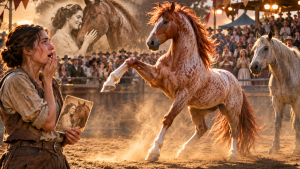
The day Clara Whitfield lost her job, she spent almost every dollar she had left on a horse everyone in Abilene had already sentenced to death. Three weeks later, hundreds of people would crowd around a Kansas arena and watch that same “useless” animal do something no one could explain. But on that scorching morning, Clara had no idea she was about to risk her last twenty dollars—and possibly her life.
Elias Boon fired her before the summer heat had finished rising from the corral dust. Clara had been awake since first light, feeding horses, checking the troughs, patching a broken fence post, and rubbing liniment into a mare’s swollen knee. She had noticed the injury before any man with a louder title bothered to look.
None of that mattered inside Boon’s polished office. He leaned back behind his expensive desk as if Clara’s future were nothing more than an inconvenience he wanted removed before lunch. “You’re too soft,” he said.
Clara stood across from him with her hat clasped between both hands and dust clinging to the hem of her skirt. Too soft—that was what certain men called a woman who understood the difference between teaching a horse and terrifying it into obedience. It was also what they called her whenever she refused to confuse cruelty with strength.
Boon pushed a small pay envelope across the desk. “Collect your things. I want you off my property by noon.” There was no gratitude for the long mornings, the midnight foalings, or the horses she had kept alive when everyone else had given up.
Outside the office, Hank Driscoll waited by the corral fence with his thumbs hooked through his belt. His grin widened when he saw the envelope in Clara’s hand. “Reckon that’s what happens when a woman forgets she’s working on a cattle ranch and not some pet hospital.”
Clara said nothing and kept walking. She had thirty-one dollars and forty cents, one good dress, her mother’s silver hair comb, and no family or job waiting for her in Abilene. Every step toward the main gate felt like another door closing behind her.
She was forty feet from freedom when a violent crash exploded from the old punishment barn. A rope snapped tight against wood, followed by the heavy thud of something enormous striking a wall. Then Clara heard a sound that froze her beneath the Kansas sun.
A horse was groaning. It was not the scream of a wild animal trying to attack, nor the furious cry of a stallion fighting restraint. It was the low, broken sound of a creature in unbearable pain.
Clara told herself to keep walking. She had been fired, humiliated, and ordered off the property, which meant Boon’s animals were no longer her responsibility. His men, his methods, and his cruelty belonged to someone else now.
Then the groan came again, weaker than before. Clara stopped at the gate, closed her eyes, and knew she would hate herself forever if she ignored it. She turned around.
The punishment barn was dim and suffocating, its air thick with dust, sweat, and old leather. Tied to the center post with two heavy ropes stood the largest red roan stallion Clara had ever seen. His powerful body trembled, his eyes were white with terror, and the skin around his neck had been rubbed raw and burned by the ropes.
Hank Driscoll stepped from the shadows holding a coiled whip. “Get away from him.” Clara ignored the warning and slowly moved closer, speaking softly enough that only the horse could hear.
The stallion flinched, but he did not strike. Beneath the fear, Clara saw intelligence in his eyes—and something else no one had bothered to recognize. He was not vicious; he was waiting for the next person to hurt him.
“What happens to him?” Clara asked. Hank’s grin returned as he rested the whip against his shoulder and glanced toward the terrified animal.
“Monday morning, Monroe comes.” Everyone in the county knew Monroe’s name because he was the man ranchers called when an animal was no longer worth feeding, treating, or saving. Clara looked at the stallion’s bleeding neck and felt something inside her harden.
“What’s his name?” she whispered. Hank laughed as though the question itself was ridiculous.
“The hands call him Useless.”
Clara reached into her pocket and wrapped her fingers around the small envelope Elias Boon had given her. Then she looked Hank directly in the eyes and said, “Tell Boon I’ll give him twenty dollars for the horse.”
The barn went silent. Hank stared at her for a moment, then laughed so loudly the stallion jerked against the ropes. But Clara did not move, because the red roan had turned his head toward her—and for the first time, the fear in his eyes had been replaced by something dangerously close to hope.
Hank stopped laughing only when he realized Clara was serious.
“You’ve got no barn.”
“I’ll find one.”
“No pasture.”
“I’ll find that too.”
“You ain’t even got a job.”
“That isn’t the horse’s fault.”
The stallion’s breathing remained fast, but his head had lowered slightly.
Hank studied Clara as though deciding whether foolishness was contagious. “Boon won’t sell.”
“Then ask him.”
“He’ll think you’re touched.”
“He already fired me. I’m not worried about his opinion.”
Ten minutes later Elias Boon entered the barn wearing his white shirt and an expression of profound irritation.
“You want that animal?”
“Yes.”
“For twenty dollars?”
“Yes.”
Boon looked at the stallion, then at Clara.
“You understand there’s no guarantee he won’t break your neck.”
“I understand.”
“And once he leaves here, you don’t come asking me to take him back.”
“I won’t.”
Something about that answer seemed to annoy him more.
He summoned his clerk.
A bill of sale was written on a single sheet of paper.
One red roan stallion. Ownership transferred as is. Twenty dollars.
Clara signed.
When she placed the money on the clerk’s desk, she felt strangely hollow.
Eleven dollars and forty cents remained between her and absolute poverty.
Hank tossed her the ends of the ropes.
“There. He’s yours.”
The stallion immediately recoiled.
Clara dropped both ropes.
Hank blinked.
“What are you doing?”
“Giving him a choice.”
“A horse doesn’t—”
“I know what a horse is.”
She stood several feet away.
For a long time, nothing happened.
The barn seemed to hold its breath.
Then Clara turned toward the open door and walked.
Behind her came the scrape of a hoof.
She continued.
Another step.
Then another.
By the time she reached the sunlight, the red roan was following her with both ropes dragging loose through the dust.
Hank said nothing.
Neither did Boon.
Clara led the stallion slowly toward the road.
She had no idea where they were going.
That problem became urgent halfway to town.
Fortunately, Amos Reed found her first.
The elderly blacksmith was driving his wagon toward Boon’s ranch when he spotted Clara walking beside a horse that appeared to have been assembled from equal parts muscle, exhaustion, and suspicion.
He pulled the team to a stop.
“Clara?”
“Morning, Amos.”
“I heard Boon dismissed you.”
“News travels quickly.”
“Bad news owns a faster horse.”
His eyes shifted toward the stallion.
“And what exactly is this?”
“My financial planning.”
Amos stared at her.
“How much?”
“Twenty dollars.”
He removed his hat.
“For the horse?”
“Yes.”
“How much money do you have left?”
“Do you want the comforting answer or the accurate one?”
“The accurate one.”
“Eleven dollars and forty cents.”
Amos replaced his hat.
“Clara Whitfield, your mother would have—”
He stopped.
Clara looked away.
People had an unfortunate habit of invoking her mother whenever Clara did anything reckless, generous, stubborn, or difficult to explain.
“Would have what?”
Amos sighed.
“Probably done the same fool thing.”
That almost made Clara smile.
Amos owned a neglected paddock behind his smithy. The grass was poor but sufficient, the fence sturdy, and an old lean-to offered shade. He agreed to let Clara use it in exchange for cleaning stalls and helping with his two aging carriage horses.
By evening, the stallion stood alone beneath the cottonwood tree.
Clara had washed his rope wounds without tying him.
He had allowed it, barely.
Whenever her hands approached his face, his muscles hardened.
Whenever she stepped back, he followed.
“You need a name,” she said.
One ear tilted toward her.
“I refuse to call you what they did.”
She studied his reddish coat glowing beneath the lowering sun.
“Rowan.”
The stallion blinked.
“It’s a tree. Strong wood. Red berries.”
He lowered his nose toward the water bucket.
“Rowan,” she repeated.
This time his ear turned immediately.
Clara froze.
Coincidence.
It had to be.
She tried another word.
“Samuel.”
No reaction.
“George.”
Nothing.
“Rowan.”
His head lifted.
Clara stared.
“Someone called you that before.”
The horse remained motionless.
For reasons she couldn’t explain, Clara felt suddenly cold.
She approached his left shoulder.
Beneath the dirt and sweat was an old scar she had noticed earlier. She had assumed it came from a harness or badly fitted tack.
Now she dampened a cloth and cleaned around it.
The scar was not random.
It formed lines.
A mark.
A brand that someone had attempted to alter.
Clara leaned closer.
Her breath caught.
Beneath the damaged skin she could still make out the original shape.
A narrow W.
Above it—
a small five-pointed star.
Clara stepped backward so quickly she nearly dropped the cloth.
She knew that mark.
She had seen it burned into fence posts, tack boxes, saddles and barn doors throughout her childhood.
The star over the W had belonged to only one horse farm in Dickinson County.
Whitfield Farm.
Her parents’ farm.
A farm that had closed twelve years earlier.
A farm whose last red roan stallion, according to everything Clara had ever been told, had died the winter her mother did.
Rowan watched her silently beneath the cottonwood tree.
Clara whispered the name she had not spoken since she was fifteen.
“Redwood?”
The stallion took one slow step toward her.
And bowed his head.
Part 2
Clara did not sleep.
Her rented room above Mrs. Bellamy’s boardinghouse was barely large enough for a bed, washstand and chair, but that night it seemed cavernous.
Every time she closed her eyes she saw the brand.
The star.
The W.
And the stallion lowering his head when she spoke a name buried in twelve years of memory.
Redwood.
She had been fifteen when her mother died.
Evelyn Whitfield had trained horses differently from most people Clara knew. She rarely raised her voice. She never used force when patience would do, and she insisted that a horse remembered far more than people believed.
“Fear has a long memory,” Evelyn once told her.
“So does kindness.”
Redwood had been four then, an enormous red roan colt with a white mark beneath his forelock shaped like a crooked crescent.
Clara remembered brushing him.
She remembered stealing apples for him.
She remembered her mother teaching him to follow without a rope.
Then came pneumonia, hospital bills, her mother’s death, and a winter in which grief turned the Whitfield house quiet.
Her father sold the farm the following spring.
He told Clara Redwood had died during a fever outbreak shortly before the sale.
Clara had believed him.
Until now.
At dawn she returned to Amos’s paddock carrying two apples.
Rowan stood beneath the cottonwood.
“Redwood.”
His head rose.
There was no hesitation this time.
Clara walked through the gate.
“Come here.”
The stallion remained where he was.
She stopped.
“All right.”
She sat on an overturned water trough instead.
For nearly twenty minutes she ignored him.
Eventually, curiosity won.
Rowan approached.
His nose moved over her shoulder.
Then her hair.
Then he breathed softly against her sleeve.
Clara broke the apple in half.
“I used to steal these for you.”
Rowan accepted one piece.
“You bit me once.”
His ears tilted.
“I deserved it. I was waving it under your nose.”
He ate the other half.
Clara reached toward his forelock.
He flinched.
She lowered her hand immediately.
“I know.”
Instead she waited.
A minute later Rowan lowered his head enough to permit her fingers near the white hairs.
There it was.
A crescent.
Smaller than Clara remembered.
Or perhaps the horse was larger.
Her throat tightened.
“You can’t be.”
Yet every sign said otherwise.
Amos arrived carrying coffee and found Clara sitting in the grass.
“He answers to Redwood,” she said.
The old man stopped.
“What?”
She showed him the brand.
Amos’s face changed.
He knew it too.
“Where did Boon get him?”
“I don’t know.”
“Does Boon know?”
“I don’t know that either.”
Amos rubbed a hand across his jaw.
“I shod Redwood once.”
Clara looked up sharply.
“You did?”
“Your mother brought him when he was three. Young fool kicked a bucket across the forge and nearly frightened himself to death.”
That sounded familiar enough to hurt.
Amos stepped into the paddock.
The stallion watched him suspiciously.
“Redwood,” Amos said.
One ear turned.
The blacksmith exhaled.
“Well.”
Clara waited.
Amos looked older suddenly.
“What aren’t you telling me?”
He avoided her eyes.
“Amos.”
“Your father came to see me after Evelyn died.”
“For what?”
“He needed money.”
Clara’s stomach tightened.
“I know that.”
“No. More money than you knew.”
Her mother’s illness had lasted months. Doctors. Medicines. Travel.
“He sold some horses privately before the farm auction.”
“Redwood?”
“I don’t know.”
“You just said—”
“I said he needed money. I didn’t say he told me what he sold.”
Clara stood.
“Why would he tell me Redwood died?”
Amos shook his head.
“Maybe because you loved him.”
“That makes no sense.”
“Grieving people rarely do.”
Clara turned toward Rowan.
For twelve years she had remembered her father standing in the kitchen, unable to look at her.
Redwood’s gone, Clara.
Fever.
Quick, at least.
She had cried for the horse nearly as hard as she had cried for her mother.
Now grief rearranged itself.
Not vanished.
Changed.
By noon Clara had another problem.
Food.
Rowan required hay.
Clara required food as well, though that seemed temporarily less urgent.
She walked to the general store and asked Mr. Carver whether he needed help.
He didn’t.
The hotel laundry didn’t.
The livery stable owner glanced at her skirt and said he wanted a man.
At the railway depot, the freight supervisor said the same thing.
By sunset Clara had earned twenty-five cents carrying groceries for Mrs. Hanover and another fifteen mending a torn feed sack.
It was not enough.
She returned to the paddock discouraged.
A man stood beside the fence.
Tall.
Dark hat.
Gray coat despite the heat.
He appeared to be in his late forties.
Rowan stood at the opposite end of the paddock watching him.
“Can I help you?” Clara asked.
The stranger turned.
His eyes were pale blue.
“You bought that horse from Elias Boon.”
It was not a question.
“Yes.”
“For twenty dollars.”
Apparently bad news wasn’t the only thing in Abilene with a fast horse.
“Who are you?”
“Gideon Shaw.”
The name meant nothing to her.
He looked toward Rowan.
“How long have you had him?”
“One day.”
Gideon’s expression revealed nothing.
“Has he done anything unusual?”
Clara’s pulse quickened.
“What would you consider unusual?”
“Answered to an old name.”
Silence settled between them.
Clara took one step closer.
“You know this horse.”
Gideon looked at her.
“I knew a horse that looked like him.”
“What was his name?”
Gideon hesitated.
That hesitation answered more than words.
“Redwood?” Clara asked.
His face went still.
Clara felt the world narrow.
“Who are you?”
Gideon looked at her carefully.
Then at the horse.
Finally he said, “I worked for your mother.”
Clara stared at him.
“I knew every horse she trained during her last five years.”
“Why don’t I remember you?”
“Because I wasn’t at Whitfield Farm.”
Her confusion deepened.
Gideon reached into his coat.
Rowan backed away immediately.
“Easy,” Clara said.
Gideon withdrew an old photograph.
He handed it to her.
The image was faded at the edges.
A woman stood in an unfamiliar arena beside a younger red roan horse.
The woman’s face was unmistakable.
Evelyn Whitfield.
Clara’s mother.
Clara turned the photograph over.
Handwriting covered the back.
July 8.
Redwood completed the full liberty pattern today.
No reins.
No rope.
No mistakes.
E.W.
Clara looked up.
“My mother never performed in an arena.”
“Yes,” Gideon said quietly.
“She did.”
Part 3
Gideon Shaw returned the following morning.
Clara almost wished he hadn’t.
The photograph had spent the night on the table beside her bed, where she had examined it so many times she could have redrawn every shadow.
Her mother’s clothes were different from those Clara remembered.
Dark trousers beneath a long split riding skirt.
Hair pinned high.
One hand resting on Redwood’s shoulder.
Behind them stood a painted sign.
PRAIRIE STAR EXHIBITION COMPANY.
Clara had never heard the name.
Gideon sat across from her in Amos Reed’s workshop while the blacksmith pretended not to listen.
“Start from the beginning,” Clara said.
Gideon folded his hands.
“In 1881, Prairie Star hired your mother to train three horses.”
Clara stared.
“She was already married.”
“Yes.”
“She had me.”
“Yes.”
“She never left the farm.”
“She did. Four times.”
Amos’s hammer stopped.
Clara looked toward him.
He became extremely interested in a horseshoe.
“You knew?”
“Some.”
Clara returned her attention to Gideon.
“Why?”
“Money.”
The answer was painfully ordinary.
Whitfield Farm had always appeared prosperous to a child.
Children rarely saw mortgages.
“Your father had a bad harvest,” Gideon continued. “Your mother was one of the best horse trainers in Kansas. Prairie Star offered her more money for six weeks of work than the farm earned in half a year.”
“What was Prairie Star?”
“A traveling exhibition. Horse demonstrations, shooting contests, rope work. Nothing grand.”
“And Redwood?”
“Prairie Star’s owner, Francis Bell, saw him at Whitfield Farm.”
Clara stiffened.
“He wanted to buy him?”
“At first.”
Gideon smiled faintly.
“Your mother told him she would sooner sell her kitchen stove.”
That sounded exactly like Evelyn.
“So Bell hired both of them.”
The photograph suddenly made sense.
“Why didn’t she tell me?”
“You were eleven.”
“I would have remembered her leaving.”
“You stayed with your aunt in Junction City those summers.”
Clara remembered.
Aunt Ruth.
Three summers in a row.
She had been told her mother was helping a sick cousin.
Another lie.
Or half-truth.
Families, Clara was discovering, were built from both.
“What was the liberty pattern?”
Gideon looked toward the paddock.
“A sequence your mother developed. The horse worked loose. No bridle. No reins. He moved from voice, posture and hand signals.”
“That doesn’t sound impossible.”
“It isn’t.”
“Then why did people make such a fuss?”
“Because Evelyn could stand in the center of a ring while Redwood moved forty feet away and still respond to signals most spectators couldn’t even see.”
Clara thought of her mother in the photograph.
“How?”
“Trust. Repetition.”
His eyes returned to Clara.
“And Redwood was unusually intelligent.”
She walked toward the paddock.
The stallion stood beneath the cottonwood.
“Show me.”
Gideon shook his head.
“I haven’t handled him in eleven years.”
“You said you worked with my mother.”
“I prepared equipment. Set rails. Kept schedules. Evelyn did the training.”
“Then tell me what she did.”
Gideon hesitated.
“Raise your right hand.”
Clara did.
Rowan’s head lifted.
“Palm toward him.”
She turned it.
The stallion’s ears locked forward.
“Now lower your hand slowly.”
Clara obeyed.
Rowan lowered his head.
Her heart thudded.
“Again.”
She raised her hand.
Lowered it.
The horse bowed his head.
Amos came outside.
“Well, I’ll be.”
Gideon seemed less astonished.
“He remembers.”
Clara’s eyes burned unexpectedly.
“After twelve years?”
“Some things stay.”
She entered the paddock.
Rowan approached.
Over the next hour Gideon reconstructed fragments.
A step backward when Clara touched two fingers to her chest.
A turn when she opened one shoulder.
A halt when she exhaled and lowered both hands.
Nothing dramatic.
Nothing magical.
But each response felt like hearing sentences spoken in her mother’s voice.
Then Clara tried something Gideon hadn’t instructed.
She hummed.
Four notes.
An old melody.
Blue Prairie.
Her mother used to hum it while washing dishes.
Rowan froze.
Gideon’s face drained of color.
Clara stopped.
“What?”
“Where did you learn that?”
“My mother.”
Rowan moved.
One step sideways.
Then another.
He crossed his front feet neatly.
Clara watched.
Without any signal she understood, the stallion circled her.
Once.
Twice.
Then stopped directly in front of her.
He bent one foreleg.
And bowed.
Amos removed his spectacles.
Gideon whispered, “That’s the ending.”
“To what?”
“The Whitfield Pattern.”
Clara stared at Rowan.
“I didn’t tell him to do that.”
“No.”
“You did?”
“No.”
“Then why?”
Gideon looked at her.
“Because Evelyn used that melody as the final cue.”
Clara swallowed.
The horse remained bowed until she touched his forehead.
Then he rose.
For the first time since buying him, Clara understood the true scale of what had happened.
She had not purchased an untrained animal.
She had purchased a horse with a history.
A horse who remembered a dead woman’s hands.
And someone, somewhere, had tried very hard to erase where he came from.
“Who changed his brand?” Clara asked.
Gideon’s expression darkened.
“I don’t know.”
“But you know who owned him after my father.”
“Yes.”
“Who?”
“Francis Bell.”
Clara waited.
Gideon removed his hat.
“Bell purchased Redwood from your father six months after Evelyn died.”
The words landed heavily.
“So my father sold him.”
“Yes.”
“And lied.”
Gideon looked down.
“I can’t tell you why.”
Clara could.
Money.
Grief.
Shame.
Maybe mercy, poorly attempted.
Maybe all four.
“What happened after Bell bought him?”
“Redwood performed for another five years.”
“Five?”
“He became Prairie Star’s most popular horse.”
Clara stared.
“And then?”
“The company failed.”
“Why?”
“Bell died. Debts were called in. Horses were sold across three states.”
“And Redwood disappeared.”
“For a while.”
Gideon looked toward him.
“I found him two years ago in Wichita.”
Clara’s head snapped around.
“You knew where he was?”
“For one afternoon.”
“What happened?”
“He was sold before I could get the money together.”
“To Boon?”
“No.”
“Then who?”
Gideon didn’t answer immediately.
“Gideon.”
“To a dealer named Nathan Vale.”
Clara had never heard the name.
“Where is he?”
“Dead.”
The mystery seemed determined to produce a closed door for every one Clara opened.
“How did Rowan reach Boon?”
“I don’t know.”
Amos came closer.
“Clara, maybe it doesn’t matter.”
She turned.
“It matters to me.”
“I understand.”
“No, I don’t think you do.”
Her voice rose before she could stop it.
“Twelve years ago I was told this horse was dead. Yesterday I learned my mother lived a life I knew nothing about. Today I learned my father lied to me. Someone changed Redwood’s brand, passed him through who knows how many hands, and by last week people were preparing to destroy him because he was supposedly vicious.”
Rowan lifted his head at her tone.
Clara immediately softened her voice.
“Sorry.”
The horse relaxed.
That simple reaction embarrassed her.
She had spent two days preaching patience to everyone around her.
Now the past had pulled anger from her as easily as a thorn from cloth.
Gideon watched her.
“You’re more like Evelyn than you know.”
Clara looked at him.
“I barely know who Evelyn was anymore.”
“Yes, you do.”
He nodded toward Rowan.
“You knew what he needed in that barn before you knew his name.”
For the first time that day, Clara had no answer.
That afternoon she took a temporary job at Mrs. Bellamy’s boardinghouse washing linens and preparing breakfast.
The wages were modest.
The work exhausted her.
Every spare hour went to Rowan.
He gained strength quickly.
The swelling around his neck diminished.
His coat brightened.
But one fear remained.
Ropes.
Whenever a rope tightened near him, terror returned.
So Clara never tightened one.
She carried a lead rope beside him.
Then across her shoulder.
Then loosely around her hands.
Three days passed before Rowan allowed the rope to touch his neck without retreating.
Clara considered that victory greater than any performance.
On the fourth evening she returned to the paddock and found an envelope nailed to the fence.
No name.
Inside was a newspaper clipping.
ABILENE SUMMER HORSE EXHIBITION
OPEN DEMONSTRATION – AUGUST 23
$150 PRIZE FOR BEST HORSEMANSHIP DISPLAY
Someone had circled the prize.
On the back, written in unfamiliar handwriting, were seven words.
LET THE WHITFIELD HORSE BE SEEN AGAIN.
Clara looked toward the road.
It was empty.
She turned to Gideon.
“Did you leave this?”
His face answered before his mouth did.
“No.”
Amos took the paper.
“Then who did?”
Beyond them Rowan stood beneath the tree, watching the western road.
And far beyond the paddock, a lone rider disappeared over the hill.
Part 4
Clara did not enter the exhibition.
Not immediately.
One hundred and fifty dollars could change her circumstances.
It could pay several months’ rent.
It could feed Rowan through winter.
It could give her enough to leave Abilene and begin somewhere Boon’s opinion meant nothing.
But putting Rowan into an arena three weeks after rescuing him felt uncomfortably close to using him.
That night she unfolded the anonymous clipping again.
LET THE WHITFIELD HORSE BE SEEN AGAIN.
The sentence bothered her more each time she read it.
Someone knew.
Someone had recognized Rowan.
“Then find out who,” Amos said the next morning.
“How?”
“The same way mysteries were solved before dime novels convinced everyone they require revolvers and thunderstorms.”
Clara looked at him.
“How’s that?”
“Ask boring questions.”
So she did.
Her first stop was the county records office.
The clerk, Miss Margaret Finch, was a woman of thirty-five who wore narrow spectacles and treated ledgers with more affection than most people treated relatives.
Clara explained that she was tracing ownership of a horse.
Miss Finch regarded her over the rims of her spectacles.
“Do you possess a date of sale?”
“Several possible dates.”
“Seller?”
“Possibly Francis Bell. Possibly Nathan Vale.”
“County?”
“Possibly this one.”
Miss Finch sighed.
“You have brought me a remarkably poor mystery.”
“I’ve had a remarkably poor week.”
That earned the smallest hint of a smile.
They searched.
Two hours later, Miss Finch located Francis Bell’s estate records.
Prairie Star’s property had been sold after his death.
Wagons.
Saddles.
Costumes.
Ten horses.
Clara ran one finger down the list.
Bay mare.
Gray gelding.
Black pony.
Red roan stallion, twelve years, trained.
Sold for ninety-eight dollars.
Purchaser—
Nathan Vale.
“There.”
Miss Finch leaned closer.
“April 14, 1887.”
Clara copied the information.
“What about Vale?”
Another search.
Nathan Vale had been a livestock trader who died unexpectedly the previous winter.
His property had been dispersed by his brother.
“Samuel Vale,” Miss Finch read.
“Address?”
“Abilene.”
Clara stared.
Nathan Vale’s brother had lived in Abilene the entire time.
By noon she stood outside a modest house three blocks from the railway depot.
Samuel Vale answered.
He was sixty, thin, and cautious.
“Yes?”
“Mr. Vale? My name is Clara Whitfield.”
The man’s expression changed almost imperceptibly.
That was enough.
“You know the name.”
“No.”
“You do.”
He glanced toward the street.
“Come inside.”
His parlor smelled of pipe tobacco and cedar.
Clara placed the sale record on his table.
“Your brother owned a red roan stallion.”
Samuel sat.
“Nathan owned many horses.”
“This one had a star over W brand.”
Silence.
“You remember him.”
Samuel rubbed his forehead.
“My brother wasn’t always careful about where animals came from.”
“Did he steal Redwood?”
“No.”
The answer came quickly.
“He bought him legally. I saw the papers.”
“What happened?”
Samuel looked uncomfortable.
“Nathan tried to resell him.”
“To whom?”
“Several people.”
“Why several?”
“Because nobody kept him.”
Clara frowned.
“He was dangerous?”
“No.”
Samuel’s answer surprised her.
“He refused.”
“Refused what?”
“Everything.”
Different trainers bought him.
Different farms.
The horse stopped performing.
Wouldn’t take the ring.
Wouldn’t tolerate ropes.
Wouldn’t respond to commands.
Each owner concluded something was wrong.
“Then Nathan bought him back twice,” Samuel said.
“Why?”
“He believed the horse was too valuable to abandon.”
Clara thought about that.
“Who changed the brand?”
Samuel went quiet.
“My brother.”
“Why?”
“To increase his sale value?”
“No.”
Samuel shook his head.
“To hide it.”
Clara’s body went still.
“From whom?”
“A man named Everett Crane.”
The name meant nothing to her.
“Who was he?”
“Francis Bell’s former business partner.”
Samuel stood and opened a desk drawer.
“He believed Bell’s entire company should have belonged to him after Bell died. Claimed the horses were partnership property, not Bell’s personal estate.”
“Was he right?”
“Court said no.”
“But he wanted Redwood.”
“Very much.”
“Why?”
Samuel looked at her.
“Because Redwood was famous.”
Clara almost laughed.
The horse Hank called Useless.
Famous.
Samuel continued.
“Nathan changed the brand because Crane kept following sales. He thought he’d protect the horse by making him harder to identify.”
It was a clumsy kindness.
But perhaps kindness nevertheless.
“What happened next?”
“Nathan sold him to a farmer near Salina.”
“Then?”
“Farmer died. Estate sale.”
“And eventually Boon?”
“Possibly.”
Clara sat quietly.
No great conspiracy.
No secret theft.
Just death, debt, bad luck and a succession of people who had misunderstood the horse in front of them.
Somehow that seemed sadder.
“Did you leave a clipping at my paddock?”
Samuel looked bewildered.
“What clipping?”
Clara believed him.
Before she left, Samuel stopped her.
“There is something else.”
He disappeared upstairs and returned with a small wooden box.
Inside lay a brass bell.
The leather strap attached to it was cracked with age.
Stamped into the brass were the letters:
P.S.E.C.
Prairie Star Exhibition Company.
“Nathan kept it with the horse’s papers,” Samuel said.
Clara lifted it.
The bell gave a soft chime.
At once she remembered Rowan’s reaction at Boon’s barn whenever metal struck wood.
“Did they use this in performances?”
Samuel nodded.
“I think so.”
Clara carried the bell home.
That evening Gideon recognized it immediately.
“Evelyn’s finish bell.”
“What did it do?”
“After the final bow, she rang it once.”
Clara looked at Rowan.
She gently moved the bell.
A quiet note drifted across the paddock.
Rowan raised his head.
Then something extraordinary happened.
He walked to the center of the enclosure.
Stopped.
And looked at Clara.
Waiting.
Gideon whispered, “He thinks it’s time.”
“For the pattern?”
“Yes.”
Clara did not move.
She could enter the exhibition.
The question was no longer whether Rowan remembered.
He did.
The question was whether Clara had the right to ask him to remember in front of hundreds of strangers.
She placed the bell down.
Rowan remained waiting.
Finally Clara entered the paddock.
“No performance,” she said softly.
She held out her hand.
“Just us.”
Rowan walked to her.
Later that night there was another envelope beneath her boardinghouse door.
Clara opened it.
No message.
Only a photograph.
This one showed three horses standing beside Evelyn Whitfield.
Redwood was in the center.
On either side stood a black mare and a gray gelding.
Across the bottom, in Evelyn’s handwriting, were three names.
REDWOOD. LARK. SUNDAY.
Clara turned the photograph over.
A single sentence had been written recently.
REDWOOD WASN’T THE ONLY ONE THEY LOST.
Part 5
The second anonymous message changed Clara’s mind.
Not about entering the exhibition.
About asking questions.
She took the photograph to Gideon.
He recognized the horses.
“Lark and Sunday.”
“Were they part of the liberty act?”
“Yes.”
“Where are they?”
“Lark died years ago.”
“And Sunday?”
Gideon hesitated.
“I don’t know.”
“Who does?”
“Possibly whoever sent this.”
Clara turned the photograph over.
“Why hide?”
“Maybe they think you won’t believe them.”
“Then they have badly underestimated how strange my week has been.”
Amos suggested placing a notice in the newspaper.
Clara chose something subtler.
She left an envelope beneath the fence where the first clipping had appeared.
Inside she wrote:
I’M LISTENING.
The next morning the envelope was gone.
Nothing replaced it.
Meanwhile, August 23 approached.
Clara continued working with Rowan without deciding whether they would enter.
His trust came in layers.
First he permitted the rope around his neck.
Then a blanket across his back.
Then a saddle.
Clara never mounted.
Not yet.
One afternoon Jonah Hale appeared at the paddock.
Clara had known Jonah since childhood. He repaired wagons at his uncle’s shop and possessed the irritating habit of seeing through her excuses.
“I heard you bought Boon’s devil horse.”
“He isn’t a devil horse.”
“I suspected that part was embellished.”
He leaned against the fence.
“I also heard he belonged to your mother.”
“Apparently Abilene has eliminated the need for newspapers.”
Jonah smiled.
“I came to see if you needed anything.”
“I need money.”
“Anything I possess.”
She laughed despite herself.
“I need a lighter saddle.”
“That I can help with.”
He returned with an old stock saddle that had belonged to his sister.
Together they adjusted it.
Rowan tolerated Jonah but watched every movement.
“He likes you,” Clara said.
Jonah looked at the horse’s flattened ear.
“I’d hate to meet somebody he dislikes.”
Clara smiled.
It had been days since laughter felt easy.
Jonah became a regular visitor.
He repaired the paddock gate.
Helped haul hay.
Never tried to handle Rowan without asking.
That mattered to Clara.
One evening he found her sitting on the fence after a difficult session.
Rowan had panicked when the saddle cinch tightened.
No one was hurt.
But Clara felt defeated.
“Maybe Boon was right,” she said.
Jonah sat beside her.
“About what?”
“Maybe I’m too soft.”
“Did the horse need you to be harder today?”
“No.”
“Then it sounds like Boon was wrong.”
Clara glanced at him.
“You make things sound simple.”
“I repair wagon wheels. Most problems are either loose, cracked, bent or missing.”
“People aren’t wagon wheels.”
“That’s why I prefer wagon wheels.”
She laughed again.
Then Rowan approached the fence and nudged Clara’s shoulder.
Jonah watched him.
“You know what I think?”
“What?”
“He doesn’t care whether you win a prize.”
Clara looked at Rowan.
“No.”
“Maybe you shouldn’t either.”
That night Clara made her decision.
She entered the Abilene Summer Horse Exhibition.
But not the riding competition.
She registered for the open horsemanship demonstration.
No requirement to mount.
No speed.
No cattle.
No forced obstacles.
Just horse and handler.
When the clerk asked what she planned to demonstrate, Clara answered truthfully.
“I don’t know yet.”
News spread.
By the next day three people offered wagers on whether Clara would make it through the gate.
Boon heard.
He arrived at Amos’s paddock just before sunset.
Hank accompanied him.
“I understand you’re taking my old horse to the exhibition.”
“My horse,” Clara corrected.
Boon’s mouth tightened.
“I sold him because he wasn’t worth feeding.”
“Then you shouldn’t be concerned.”
“I don’t like people making it look as though I didn’t know what I owned.”
Clara studied him.
“You didn’t.”
Hank snorted.
Boon ignored him.
“I’ll give you fifty dollars.”
“No.”
“One hundred.”
Clara’s heartbeat jumped.
One hundred dollars would solve several immediate problems.
But she already knew the answer.
“No.”
Boon’s expression sharpened.
“You paid twenty.”
“He isn’t merchandise to me.”
“All horses are merchandise to somebody.”
“Maybe that’s where we disagree.”
Boon looked past her at Rowan.
The horse stood calmly beneath the tree.
Not rearing.
Not striking.
Not useless.
Just standing.
Something uncomfortable crossed Boon’s face.
Perhaps embarrassment.
Perhaps regret.
“Two hundred,” he said.
Hank stared at him.
Clara did too.
“No.”
Boon seemed genuinely astonished.
“You have eleven dollars to your name.”
“Not anymore.”
It was technically true.
She had nine dollars and eighty cents.
“Clara,” Boon said, almost gently, “pride is expensive.”
“So is selling something you can’t replace.”
For several seconds they faced one another.
Then Boon nodded.
“Your choice.”
He left.
Hank followed.
At the gate Hank turned back.
“That horse will show what he really is once there’s a crowd.”
Clara looked at Rowan.
“Maybe.”
Hank smiled.
Then she added, “That’s what I’m counting on.”
Two nights later Clara finally mounted Rowan.
No audience.
No announcement.
Jonah stood outside the fence and Gideon waited near the gate.
Clara placed one foot in the stirrup.
Rowan stiffened.
She stepped down.
Waited.
Tried again.
On the fourth attempt she settled into the saddle.
Rowan did not move.
Clara’s hands trembled.
Not from fear.
Memory.
Her mother had once lifted her onto Redwood’s back when Clara was twelve.
Only for ten seconds.
You don’t hold a horse together with reins, Evelyn had said.
You ask him to carry you.
Now Clara loosened the reins.
“Whenever you’re ready.”
Rowan took one step.
Then another.
He walked one circle around the paddock.
Clara was crying before she realized it.
She dismounted after less than two minutes.
Jonah came through the gate.
“That’s all?”
“For tonight.”
“You waited twelve years. I suppose two minutes is enough.”
Clara rested her forehead against Rowan’s neck.
The horse stood quietly.
The next morning an envelope waited beneath the fence.
Inside was one sentence.
IF YOU ENTER THE ARENA, RING THE BELL.
Below it was a meeting place.
Old railway water tower.
Sunset.
Clara went.
The person waiting beneath the tower was not a mysterious stranger.
It was a woman Clara recognized.
Margaret Finch.
The county records clerk.
“You?” Clara said.
Margaret removed her spectacles.
“My maiden name was Bell.”
Clara stopped.
“Francis Bell was my father.”
Part 6
Margaret Bell Finch looked nothing like the daughter of a traveling showman.
She looked like someone who would object if a ledger were shelved three inches out of place.
Perhaps, Clara thought, that was precisely what years of traveling had done to her.
“You sent the messages.”
Margaret nodded.
“Why not simply talk to me?”
“Because I didn’t know what you wanted.”
“What I wanted?”
“Money. Attention. Revenge. People do peculiar things when they discover something valuable.”
Clara almost smiled.
“I spent nearly everything I had buying a horse scheduled to be put down.”
“Yes.”
Margaret adjusted her spectacles.
“That improved my opinion of you.”
“I’m relieved.”
Margaret almost smiled back.
They sat on an old timber beneath the abandoned water tower.
“My father admired your mother,” Margaret began.
“Gideon said they worked together.”
“They argued constantly.”
“That sounds more believable.”
“Father wanted bigger crowds. Your mother wanted quieter arenas. Father wanted tricks. Evelyn called them lessons.”
Clara could hear her mother saying it.
“What happened to the horses?”
“After Father died, his estate became complicated.”
“I know about Nathan Vale.”
Margaret nodded.
“Redwood went to Vale. Lark went to a family in Nebraska. Sunday disappeared before the auction.”
“Stolen?”
“We never proved it.”
“And Redwood?”
“I followed him as long as I could.”
“Why?”
Margaret looked out across the prairie.
“Because my father asked me to.”
She reached into her handbag and removed a folded letter.
“My father knew he was dying. He wrote instructions about the animals. He said they should go to people who understood them.”
“But Redwood went to a trader.”
“Debts overruled wishes.”
Margaret unfolded the letter.
“One line mentioned your mother.”
She handed it to Clara.
The handwriting was shaky.
If anything happens to Redwood, find Evelyn’s girl. The horse knew her once.
Clara read the sentence twice.
“My father knew me?”
“He met you once.”
“I don’t remember.”
“You were eight.”
Margaret smiled.
“You stole his hat.”
Clara stared.
Then, unexpectedly, she remembered a huge black hat slipping over her eyes and her mother laughing.
The memory struck with such warmth that Clara had to look away.
“Why didn’t you find me?”
“I tried.”
“When?”
“Seven years ago. You’d moved to Topeka.”
Clara had worked in a dress shop there.
“Then five years ago you were in Wichita.”
A hotel stable.
“Then Emporia.”
A breeding farm.
Margaret sighed.
“You moved frequently.”
“I was looking for work.”
“And I was always six months behind.”
The absurdity of it made Clara laugh softly.
“All this time?”
“All this time.”
“Then you saw Rowan at Boon’s.”
“Yes.”
“When?”
“Six weeks ago.”
“Why didn’t you buy him?”
Margaret’s face tightened.
“Boon wouldn’t sell.”
Clara blinked.
“He sold him to me for twenty dollars.”
“After six weeks of trying to handle him.”
Understanding dawned.
“You knew Monroe was coming.”
“Yes.”
“That was why you were watching the ranch.”
“Yes.”
“Why didn’t you tell me immediately?”
“I watched you walk him out with the ropes dragging.”
Margaret’s voice softened.
“I thought my father had finally been right about something.”
Clara looked down at the letter again.
The horse knew her once.
“But why the exhibition?”
Margaret took a long breath.
“Because I have something that belongs to you.”
She removed another folded document.
“A contract?”
“Your mother’s training notes.”
Clara’s heart jumped.
“Where?”
“In my father’s papers.”
“Why didn’t you give them to me?”
“I didn’t know whether Redwood remembered.”
“And the bell proves it?”
“Partly.”
Margaret looked toward town.
“The Whitfield Pattern was never written publicly. Only your mother, my father and Gideon saw the complete performance.”
“Gideon says he doesn’t remember all of it.”
“He doesn’t.”
“Do you?”
“No.”
“Then what happens if I ring the bell?”
Margaret met her eyes.
“Perhaps nothing.”
That answer unsettled Clara more than certainty would have.
“Or?”
“Perhaps Redwood finishes what he remembers.”
Clara thought of the horse circling her while she hummed.
“Why does that matter?”
“Because your mother’s notes contain a letter.”
“To whom?”
“You.”
The air seemed to leave Clara’s lungs.
“What?”
“Evelyn wrote it shortly before she became ill.”
Margaret’s expression was gentle.
“My father never mailed it because your mother told him to give it to you only if Redwood ever found his way home.”
Clara stood.
“That makes no sense.”
“I know.”
“My mother couldn’t have known—”
“She didn’t know what would happen.”
“Then why?”
“I think she was afraid the farm might fail.”
Clara paced beneath the water tower.
“You’ve had a letter from my mother for twelve years?”
“Yes.”
“Give it to me.”
Margaret shook her head.
Anger flared.
“Margaret.”
“There is one instruction on the envelope.”
“What?”
Margaret took out a small cream envelope.
Clara recognized her mother’s handwriting immediately.
To Clara.
Beneath it:
When Redwood remembers the whole pattern.
Clara stared.
“That is absurd.”
“Possibly.”
“She was dying.”
“Not when she wrote it.”
“Then she was being dramatic.”
Margaret’s mouth twitched.
“Also possible.”
Clara wanted to seize the envelope.
Instead she closed her eyes.
Her mother had made a request.
Strange or not, Clara understood requests.
“What if he doesn’t remember?”
“Then I give it to you anyway.”
Clara opened her eyes.
Margaret smiled faintly.
“I respect the dead, Clara. I don’t take orders from them indefinitely.”
That finally made Clara laugh.
By the time she returned to the paddock, sunset had faded.
Rowan waited at the gate.
Clara placed both hands against his face.
“Apparently we’re going to an exhibition.”
His ears moved forward.
“And apparently you know more about it than I do.”
He breathed against her palms.
The next five days passed quickly.
Clara did not teach Rowan the Whitfield Pattern.
She couldn’t.
Instead she rebuilt confidence.
Walking.
Stopping.
Turning.
Standing beneath applause from Amos, Jonah, Gideon and eventually three neighborhood children recruited specifically to make noise.
The first time they clapped, Rowan fled twenty feet.
The tenth time, he flicked one ear.
Progress.
The evening before the exhibition, Clara brushed him until his roan coat gleamed.
Jonah sat on the fence.
“Nervous?”
“Terrified.”
“Good.”
She looked up.
“Good?”
“Means you understand it matters.”
Clara smiled.
“What if we walk into that arena and he does nothing?”
“Then he does nothing.”
“And everybody laughs?”
“I’ll laugh at them.”
She studied him.
“That’s your plan?”
“I didn’t say it was a complicated plan.”
The next morning Abilene woke to clear skies.
By noon wagons crowded the road toward the fairgrounds.
By two, word had spread beyond anyone’s expectation.
The twenty-dollar horse.
Boon’s killer stallion.
The forgotten Prairie Star horse.
Stories multiplied.
By four o’clock more than five hundred people surrounded the exhibition ring.
Clara stood outside the gate holding a loose lead rope.
Rowan breathed beside her.
Across the ring she saw Elias Boon.
Hank.
Amos.
Gideon.
Margaret.
Jonah stood nearest the gate.
“You can still leave,” he said.
Clara looked at Rowan.
The announcer called her name.
The gate opened.
Clara dropped the lead rope.
“No,” she said quietly.
“I think we’ve spent enough years leaving.”
And together they walked into the arena.
Part 7
The crowd became quiet in stages.
At first people continued talking.
Then they noticed Clara carried no whip.
Then they noticed she had dropped Rowan’s lead rope outside the gate.
By the time she reached the center of the arena, several hundred people had fallen silent.
Rowan stopped beside her.
His muscles were tight.
Clara could feel his uncertainty without touching him.
The grandstand.
Flags.
Children.
Boots striking boards.
Every sound had a memory attached to it.
Some good.
Some not.
Clara turned toward him.
“You don’t owe them anything.”
A few people near the rail heard.
Most did not.
She raised one hand.
Rowan looked at it.
She lowered her palm.
His head descended.
A murmur passed through the crowd.
Clara stepped backward.
Rowan followed.
She moved right.
He turned.
Nothing spectacular.
Just attention.
Trust made visible.
Clara kept her movements small.
The crowd grew quieter.
Then somewhere behind the grandstand a crate fell.
Wood struck wood.
Rowan exploded sideways.
Gasps.
Clara did not grab him.
She couldn’t.
There was no rope.
The stallion galloped toward the far rail.
People recoiled.
Hank’s voice carried from somewhere behind her.
“Told you!”
Clara stayed where she was.
Rowan stopped thirty feet away.
His head was high.
Eyes wide.
The old fear had returned.
Clara lowered both arms.
“Rowan.”
His ear turned.
Not enough.
She tried again.
“Redwood.”
The other ear turned.
The arena disappeared.
No Boon.
No Hank.
No prize.
Only a frightened horse deciding what came next.
Clara began to hum.
Blue Prairie.
Four notes.
Then four more.
Rowan’s head lowered.
The crowd became so quiet Clara could hear a flag snapping above the entrance.
She continued humming.
Rowan walked toward her.
One step.
Two.
Ten.
He stopped.
Then moved sideways.
Clara’s breath caught.
She had not cued him.
Rowan crossed one leg over another in the smooth lateral step Gideon had shown her.
Then again.
He began a circle.
Once.
Twice.
The crowd watched without moving.
Gideon stood at the rail with one hand covering his mouth.
Rowan stopped opposite Clara.
He backed six steps.
Turned.
Trotted toward the eastern rail.
Then curved around the arena in a wide arc.
Clara suddenly understood.
“He’s doing it,” Margaret whispered from somewhere behind her.
The Whitfield Pattern.
But Clara did not know the next movement.
Rowan did.
The stallion changed direction.
He crossed the arena diagonally.
Stopped before a wooden pedestal used for mounting.
Tapped it once with his hoof.
Then returned to Clara.
The spectators erupted into applause.
Rowan recoiled.
Clara raised both hands.
The applause weakened.
“Please,” she called.
“Quiet.”
To her astonishment, hundreds of people obeyed.
Clara returned to the melody.
Rowan relaxed.
He circled her at a trot.
Slowed.
Turned inward.
Then he performed a movement so precise several experienced horsemen along the rail leaned forward simultaneously.
He walked backward around Clara.
A complete circle.
No rope.
No visible command.
When he finished, Clara’s eyes were wet.
This was not merely something he remembered.
This was a conversation she had inherited without knowing the language.
Rowan stopped.
Waiting.
Clara realized something was missing.
The bell.
Margaret stood beside the gate holding it.
Clara nodded.
Margaret passed it to Jonah.
Jonah carried it into the ring.
He did not approach Rowan.
He handed it to Clara.
“Whatever happens,” he whispered, “he already came back.”
Clara closed her fingers around the old brass.
She looked at Rowan.
The horse’s attention locked on it.
Clara rang the bell once.
The clear note floated over the arena.
Rowan stood absolutely still.
Then he turned away from Clara.
A collective breath moved through the spectators.
The stallion walked toward the center of the ring.
Stopped.
And looked toward the empty western gate.
Clara’s heart began beating harder.
Nothing happened.
Ten seconds.
Twenty.
Then Rowan lifted his head and gave a low call.
Not frightened.
Searching.
Another horse answered.
From outside the arena.
A sharp whinny.
Rowan’s entire body changed.
He rushed three steps toward the gate.
Stopped himself.
Called again.
The answering horse cried louder.
People began turning.
A gray horse appeared beyond the western fence.
An elderly gelding.
Thin but bright-eyed.
A woman led him through the gathering crowd.
Margaret gasped.
“No.”
Gideon grabbed the rail.
The woman reached the gate.
She was perhaps seventy.
Sun-browned face.
White hair.
Her gray gelding stared at Rowan.
Rowan stared back.
Then both horses began calling.
Clara looked at Gideon.
“What is it?”
He could barely speak.
“Sunday.”
The third horse from the photograph.
The one who had disappeared twelve years ago.
The old woman opened the gate.
Sunday walked inside.
No one stopped him.
Rowan moved forward.
So did Sunday.
They met at the center of the arena.
Noses touched.
For several seconds the entire fairground seemed suspended around them.
Then Rowan stepped sideways.
Sunday followed.
Clara stopped breathing.
They moved together.
One step.
Two.
Turn.
Circle.
The exact mirrored movements of a pattern neither horse had performed together in more than a decade.
Someone in the grandstand whispered, “How?”
No one answered.
Rowan turned.
Sunday turned.
They crossed the arena in opposite directions, met in the center, and stopped shoulder to shoulder.
Then both horses bent one foreleg.
And bowed.
Five hundred people remained silent.
Not because anyone had told them to.
Because no one seemed willing to break what they were seeing.
Clara rang the bell.
Once.
Both horses rose.
The old woman who had brought Sunday into the arena was crying.
Clara approached her.
“Who are you?”
The woman wiped her face.
“Ruth Whitfield.”
Clara stared.
The name struck harder than the bell.
“Aunt Ruth?”
The woman smiled through tears.
Clara had not seen her mother’s sister since she was sixteen.
They had lost contact after Ruth moved west.
“I’ve been trying to find you,” Ruth said.
Clara looked at Sunday.
“You had him?”
“For twelve years.”
“Why?”
Ruth’s expression changed.
“Because your mother gave him to me.”
Clara froze.
Before she could ask another question, the announcer approached uncertainly.
“I believe,” he said, glancing around at the speechless crowd, “the judges have reached their decision.”
Laughter rolled through the stands, breaking the spell.
Then applause began.
Not wild.
Not mocking.
Something warmer.
It rose until the boards beneath Clara’s boots seemed to vibrate.
Rowan did not flee.
He stood beside Sunday.
Listening.
Clara placed her hand against his shoulder.
Three weeks earlier, men had called him useless.
Now hundreds of people were standing for him.
But Clara barely heard them.
She was looking at Aunt Ruth.
Because Ruth was holding another envelope.
And Clara recognized the handwriting.
Her mother’s.
“This,” Ruth said, “is the part nobody ever told you.”
Part 8
The prize ceremony lasted ten minutes.
Clara remembered almost none of it.
She and Rowan were awarded the one hundred and fifty dollars.
Sunday received an honorary ribbon, which he promptly attempted to eat.
The crowd laughed.
Reporters asked questions.
Clara answered as briefly as possible.
No, she had not trained the entire routine.
No, she couldn’t explain exactly how the horses remembered.
Yes, Rowan had been purchased for twenty dollars.
No, he was not for sale.
That last answer she repeated six times.
By sunset Clara, Ruth, Margaret, Gideon, Amos and Jonah gathered in Amos’s workshop.
Sunday occupied the paddock beside Rowan.
The two horses stood within inches of one another.
Twelve lost years apparently required very little explanation between them.
Clara sat across from Ruth.
“You knew where I was?”
“Not until Margaret wrote me.”
“When?”
“Five days ago.”
Clara looked at Margaret.
“I found Ruth’s address among Father’s papers after you came to the records office.”
Ruth placed the envelope on the table.
“I brought Sunday as soon as I could.”
Clara looked at her aunt.
“Why did Mother give him to you?”
Ruth’s face softened.
“Because she knew your father might have to sell the farm.”
Clara’s throat tightened.
“Did she know she was dying?”
“No.”
That mattered.
“She knew money was bad,” Ruth continued. “She gave me Sunday so at least one horse would be safe from the sale.”
“And Redwood?”
“She refused to part with him.”
“Until Father sold him.”
“After Evelyn died.”
Clara looked at the envelope.
“My father told me Redwood died.”
Ruth nodded sadly.
“He told me too.”
“Why?”
“I think he was ashamed.”
The answer was simple.
Painfully human.
“He loved Evelyn,” Ruth said. “He also owed more money than the farm was worth. Redwood was the only animal valuable enough to settle the hospital debt.”
Clara looked down.
For years she had remembered her father as a liar.
Now she saw a grieving widower at a kitchen table covered in bills.
Understanding did not erase hurt.
But it changed its shape.
“He should have told me.”
“Yes.”
Ruth did not defend him.
That helped.
Margaret placed her own envelope beside Ruth’s.
“Your mother wrote two letters.”
“Why two?”
“One for you.”
Ruth touched the other.
“One for your father.”
Clara frowned.
“Did he read it?”
“He never received it.”
“Why?”
“Evelyn gave it to me and told me to wait until he stopped blaming himself.”
Ruth smiled sadly.
“He never did.”
Clara stared at her aunt.
“And you kept it?”
“I was angry with him.”
“For selling Redwood?”
“For many things.”
Ruth looked toward the floor.
“Sometimes anger convinces us delay is wisdom.”
No one spoke.
“I waited too long,” she said.
It was not dramatic.
Just true.
And because it was true, Clara believed her.
Clara opened the first letter.
The paper trembled slightly.
My Clara,
If this reaches you, then Redwood has done what I always believed horses could do better than people: find his way toward someone who remembers him kindly.
Clara stopped reading.
Her vision blurred.
Jonah quietly placed a handkerchief beside her.
She continued.
I don’t know what your life will become. Parents make the mistake of imagining we can prepare our children for every road. We cannot.
I can teach you how to sit a horse.
I can teach you how to mend a rein.
I can teach you how to tell fear from anger.
But I cannot teach you which life to choose.
So I will tell you only this:
Never let someone make you ashamed of gentleness.
Gentleness is not surrender.
Patience is not weakness.
And listening is not the same thing as obeying.
A horse taught me that.
Perhaps one day one will remind you.
Clara pressed the page against her chest.
No one interrupted.
After a long while she finished the letter.
At the bottom her mother had written:
If Redwood remembers the pattern, give him an apple for me.
Clara laughed through tears.
Outside, Rowan lifted his head as though he’d heard.
Later she brought him an apple.
Sunday demanded half.
“Apparently inheritance has terms,” Jonah said.
Clara divided it.
The next morning Abilene’s newspaper carried the headline:
THE TWENTY-DOLLAR WONDER
Clara disliked it immediately.
Rowan was not a wonder.
He was a horse.
A remarkably intelligent horse with a complicated history, but still a horse.
More troubling were the visitors.
By breakfast, three men had arrived asking to buy him.
By noon, six.
One offered five hundred dollars.
Another eight hundred.
A representative from a traveling show offered one thousand.
Clara refused them all.
“You realize,” Mrs. Bellamy told her, “that one thousand dollars is rather more than eleven dollars and forty cents.”
“Nine dollars and eighty cents.”
“Even worse.”
“I have prize money now.”
“Then you may finally pay me for Tuesday’s supper.”
Clara smiled.
“I intend to.”
The attention brought one unexpected consequence.
Elias Boon came to see her.
Alone.
No Hank.
He removed his hat before entering the paddock.
“I was wrong.”
Clara stared.
Boon looked uncomfortable.
It might have been the first apology his mouth had practiced in years.
“About the horse?”
“And you.”
Clara waited.
“I thought handling meant control.”
He looked toward Rowan.
“Maybe I was wrong about that too.”
Clara could have humiliated him.
The newspaper reporter was nearby.
Several townspeople were watching.
Instead she said, “You can learn.”
Boon nodded.
Then he held out a folder.
“These came with the horse when I bought him.”
Clara’s expression hardened.
“You had papers?”
“Not useful ones. Old invoices. I never read them closely.”
She accepted the folder.
“Where did you buy him?”
“A livestock auction outside Salina.”
The final missing step.
Inside the folder was a receipt.
A veterinary note.
Two old bills of sale.
And one piece of paper that did not belong.
A page torn from a notebook.
Clara recognized Evelyn’s handwriting.
She looked at Boon.
“Where did this come from?”
He shook his head.
“It was already there.”
Clara read.
Redwood learns quickest when Sunday demonstrates first. Lark prefers to lead. Together they are something none of them are separately.
Below that:
If anyone continues this work, the three must never be divided.
Clara looked toward the paddock.
Rowan.
Sunday.
Two horses.
She remembered the photograph.
Redwood.
Lark.
Sunday.
“Lark died in Nebraska,” Gideon said later.
Margaret shook her head.
“How do you know?”
“Bell’s old groom told me.”
“When?”
“Ten years ago.”
“Did he see the body?”
Gideon paused.
“No.”
Clara looked at her mother’s note.
The three must never be divided.
Outside, Rowan suddenly called.
Sunday answered.
Then, faintly—
from somewhere beyond the road—
a third horse answered them.
Everyone in the workshop went still.
Clara stood.
The call came again.
High.
Clear.
From the eastern hill.
Ruth whispered, “That can’t be.”
Clara walked toward the door.
On the distant ridge stood the silhouette of a black horse.
Beside it was a rider.
Watching them.
Part 9
The rider did not flee.
That fact alone made Clara less afraid.
She walked to the road.
Jonah followed.
“So much for mysteries before breakfast,” he muttered.
The rider approached slowly.
The black horse beneath him was old.
Her face had gone mostly gray.
But she carried herself with unmistakable elegance.
Rowan called again.
The mare answered.
Sunday began pacing the fence.
The rider stopped twenty feet from Clara.
He was a boy.
Seventeen at most.
“Miss Whitfield?”
“Yes.”
“My grandfather told me to find you.”
Clara glanced at the mare.
“What’s her name?”
The boy swallowed.
“Lark.”
Behind Clara, Gideon made a sound halfway between a laugh and disbelief.
Lark.
The supposedly dead mare.
The third horse in the photograph.
Still alive.
Barely, perhaps.
But alive.
The boy dismounted.
“My name’s Thomas Avery.”
“Where did you get her?”
“My grandfather.”
“Who was your grandfather?”
“Peter Avery.”
Gideon stepped closer.
“Bell’s groom.”
Thomas nodded.
“He died four days ago.”
Gideon removed his hat.
The boy took a folded letter from his pocket.
“He told me if he died before he could make things right, I had to bring Lark to Abilene.”
“Make what right?” Clara asked.
Thomas looked ashamed despite having done nothing himself.
“My grandfather took her.”
Silence.
“From Prairie Star?”
“Yes.”
“When Bell died, he thought the horses would be mistreated if they were sold. He couldn’t save all three.”
“So he stole Lark.”
Thomas nodded.
“He took her to Nebraska.”
The report of Lark’s death had been deliberate.
Peter had hidden her.
“She lived on his farm?”
“All these years.”
“Why bring her now?”
Thomas looked at Lark.
“She stopped eating after he died. Then we saw the newspaper.”
He handed Clara the clipping.
THE TWENTY-DOLLAR WONDER.
“My grandfather saw Rowan’s picture before he passed.”
Thomas’s eyes filled.
“He said, ‘Take her home.’”
Clara looked toward the paddock.
“Open the gate,” she told Amos.
No one needed further instruction.
Lark walked through.
Rowan reached her first.
Sunday followed.
The reunion was quieter than the arena spectacle.
No crowd.
No music.
No applause.
Three old horses stood beneath a cottonwood tree and breathed one another’s scent.
Lark touched noses with Rowan.
Then Sunday.
She closed her eyes.
Clara felt suddenly intrusive.
“They remember,” Thomas whispered.
“Yes.”
The horses did not perform.
They did not bow.
They did nothing anyone would pay to see.
They simply stood together.
Clara thought that was more beautiful.
Over the next week the excitement surrounding Rowan slowly faded.
Another story reached the newspaper.
Then another.
Abilene resumed being a town rather than an audience.
Clara preferred it.
She used forty dollars of the prize money to rent a larger pasture from Amos.
Twenty-five went toward feed.
Ten paid Mrs. Bellamy.
Five bought supplies.
The rest she guarded carefully.
Thomas stayed several days while Lark recovered from the journey.
Margaret began organizing Prairie Star’s surviving papers.
Gideon helped identify photographs.
Ruth told stories Clara had never heard about Evelyn.
Not heroic stories.
Better ones.
Evelyn burning biscuits.
Evelyn cheating at cards.
Evelyn once falling into a trough while attempting to demonstrate balance.
For twelve years Clara had remembered her mother as someone almost sacred.
Now she remembered her as human.
It felt like getting part of her back.
One evening Jonah found Clara repairing the paddock fence.
“What happens now?”
She hammered another nail.
“To the fence?”
“To you.”
Clara stopped.
She had spent weeks reacting.
To losing her job.
Finding Rowan.
Discovering her mother’s history.
Entering the exhibition.
She had not considered the future.
“I need work.”
Jonah leaned on the post.
“You have work.”
“I have three elderly horses eating money at remarkable speed.”
“You also have people bringing horses to the road every morning.”
That was true.
Since the exhibition, owners had begun seeking her advice.
A mare that wouldn’t load.
A gelding afraid of harness.
A young colt considered stubborn.
Clara had helped several without charging.
“You could train horses.”
“I was fired from training horses.”
“You were fired from Boon’s ranch.”
“An important distinction?”
“To me.”
She looked across the paddock.
Rowan grazed beside Sunday.
Lark rested beneath the tree.
“What would I call it?”
Jonah considered.
“Clara’s House for Financially Ruinous Horses.”
She laughed.
“No.”
“Whitfield Training.”
The name caught her.
Whitfield.
For years the name had felt like something behind her.
Now it sounded different.
Forward.
“I don’t have land.”
“Amos does.”
“I don’t have a barn.”
“I can build one.”
“I don’t have clients.”
Three wagons waited outside the fence.
Jonah looked toward them.
Clara conceded the point.
“Maybe.”
“That’s the longest word you’ve said all week.”
Later she asked Amos.
The old blacksmith pretended to consider.
“Hm.”
Clara waited.
“Hm.”
“Amos.”
“I enjoy being consulted.”
“Can I rent the south pasture and old barn?”
“Yes.”
“That quickly?”
“I decided three days ago.”
Clara hugged him.
He complained loudly.
She ignored him.
Whitfield Training opened unofficially the following Monday.
Her first paying customer was Mrs. Hanover, whose pony refused to cross puddles.
Her second was a farmer whose mare wouldn’t enter a trailer.
Her third surprised her.
Elias Boon.
He arrived leading the mare with the swollen knee Clara had treated on the morning he fired her.
“She still favors it,” he said.
Clara examined the leg.
“She needs rest.”
“My foreman says work through it.”
“Your foreman is wrong.”
Boon sighed.
“I suspected you’d say that.”
“Then why come?”
He looked toward Rowan.
“Because apparently I’ve been wrong about several things.”
Clara took the mare.
Boon paid without argument.
It was, Clara decided, a start.
Hank never returned.
That was fine too.
By September, Clara’s little training yard was booked for two weeks.
By October, Rowan’s neck had completely healed.
He never returned to public exhibition.
People asked.
Clara always said no.
The Whitfield Pattern belonged to memory now.
One cool evening Margaret arrived carrying a thick folder.
“I finished sorting Father’s papers.”
Clara poured coffee.
“Anything interesting?”
“Mostly invoices.”
“Good.”
“And this.”
Margaret placed a map on the table.
Three locations were marked.
Abilene.
Nebraska.
Salina.
Lines connected them.
Clara frowned.
“What is this?”
“I don’t know.”
Beneath the map was another page in Evelyn’s handwriting.
Not horse training notes.
Names.
Dates.
Seven horses.
Redwood.
Sunday.
Lark.
And four Clara had never heard of.
“What are these?”
Margaret shook her head.
“At first I assumed they were Prairie Star animals.”
“They weren’t?”
“No.”
Clara looked at the final note.
All seven carry the star over W.
Her breath caught.
“The Whitfield brand?”
Margaret nodded.
“But my parents never owned seven performance horses.”
“Apparently they did.”
Clara stared at the list.
One name had been underlined twice.
Morrow.
Beside it:
Foaled 1885.
Never sold.
Clara looked up.
“My mother died in 1888.”
“Yes.”
“Then where is Morrow?”
Margaret slid one last paper across the table.
A livestock advertisement.
Dated two months earlier.
FOR SALE: AGED CHESTNUT GELDING.
OLD BRAND UNKNOWN.
Below it was a rough sketch.
A star.
Over a W.
The location was Dodge City.
Clara stared at it.
Jonah entered carrying firewood.
He saw her face.
“What happened?”
Clara handed him the advertisement.
He read it.
Then sighed.
“No.”
“No what?”
“I know that look.”
“What look?”
“The one that cost you twenty dollars last time.”
Clara smiled.
Outside, Rowan raised his head beneath the autumn moon.
Maybe the past had not finished finding her.
Or maybe, Clara thought, she had finally learned how to go looking for it.
Part 10
Clara did not leave for Dodge City the next morning.
That surprised Jonah.
It surprised Clara too.
Three weeks earlier she would have ridden halfway across Kansas on the strength of a sketch and a feeling.
Now she had responsibilities.
Clients.
Horses.
Bills.
A life that had finally begun to take shape.
Mystery could wait two days.
Apparently personal growth, Clara discovered, was occasionally inconvenient.
She wrote to the seller first.
A reply arrived ten days later.
The chestnut gelding had been sold.
Clara felt disappointment settle over her.
Then she read the next line.
The purchaser had left a forwarding address.
Council Grove.
Jonah studied the letter.
“Well.”
“Well what?”
“The road got shorter.”
Clara smiled.
She did not leave immediately then either.
Winter approached.
The barn roof needed work.
Rowan needed his feet trimmed.
Lark required warmer feed.
Sunday had developed the irritating habit of opening gate latches.
Life demanded attention.
Clara found she liked that.
The past no longer felt like a fire she had to chase.
It could be a trail.
Trails waited.
By December, Whitfield Training had acquired a painted sign.
Jonah made it.
Amos complained that the lettering leaned.
Margaret claimed it added personality.
Ruth returned west but promised to visit in spring.
Thomas took Lark home after two months.
The morning they left, Rowan and Sunday stood at the fence.
Lark called once.
Rowan answered.
Then she followed Thomas down the road.
No tragedy.
No dramatic goodbye.
Just distance.
This time Clara understood that leaving was not always losing.
Sometimes it was simply going.
Sunday remained with Ruth’s permission.
Rowan remained wherever Clara was.
When snow came, the red roan grew a thick winter coat.
Children from town occasionally stood outside the fence hoping to see the famous bow.
Clara never asked him to perform it.
Once, when a little girl named Emma waited nearly an hour, Clara finally said, “He doesn’t do tricks anymore.”
Emma looked disappointed.
Rowan walked over.
He lowered his head.
Emma touched his nose.
Her disappointment vanished.
Clara smiled.
Maybe that was enough.
In January, Elias Boon returned.
Not with an injured horse.
With an offer.
“I want you to supervise my horse program.”
Clara nearly laughed.
“You fired me.”
“I remember.”
“For being soft.”
“I remember that too.”
“And now?”
“Now I’m paying three men to fix problems you prevented.”
It was possibly the closest Elias Boon would ever come to eloquence.
“How much?”
He named a figure more than twice her old wage.
Clara looked around her little barn.
The repaired roof.
The shelves Jonah built.
The training ring Amos helped fence.
The mare sleeping peacefully in the corner.
“No.”
Boon blinked.
“You didn’t even consider it.”
“I did.”
“For three seconds.”
“I’m efficient now.”
He almost smiled.
“What would it take?”
“Nothing.”
Boon studied her.
“You like this?”
Clara looked toward Rowan.
“Yes.”
Boon nodded slowly.
“Then I suppose I understand.”
She doubted he completely did.
But he was learning.
So was she.
By March, Whitfield Training had enough work that Clara hired help.
Her first employee was a sixteen-year-old girl named Elsie Moran who had been rejected by two ranches because they wanted boys.
On Elsie’s first morning Clara found her standing nervously beside a difficult gelding.
“What if I do something wrong?” Elsie asked.
“You will.”
The girl looked alarmed.
Clara smiled.
“So will I.”
“What do I do then?”
“Notice. Learn. Try again.”
Elsie nodded.
Clara handed her a brush.
“And don’t ever let anyone convince you fear is the same thing as respect.”
The words sounded familiar.
Not identical to Evelyn’s.
They belonged to Clara now.
That spring Rowan turned sixteen.
Amos insisted he was too old to be admired so much.
Rowan responded by stealing Amos’s hat.
Gideon laughed until he had to sit down.
Margaret began writing a history of Prairie Star.
She gave Clara the first page.
It did not begin with Francis Bell.
It began with Evelyn Whitfield.
Clara read it twice.
“You don’t have to do that.”
“Yes,” Margaret said.
“I do.”
“Why?”
“Because records should be accurate.”
That was the most Margaret Finch answer imaginable.
In April, Jonah finally asked Clara the question everyone in town had apparently been expecting except Clara.
They were repairing a gate at sunset.
“Would you object if I continued hanging around here permanently?”
Clara kept tightening the hinge.
“You already do.”
“I meant officially.”
She stopped.
Jonah looked suddenly less confident than she had ever seen him.
Clara enjoyed that for approximately three seconds.
“Officially how?”
He cleared his throat.
“Clara.”
“Yes?”
“You are enjoying this.”
“A little.”
He smiled.
“Would you consider marrying me?”
Clara looked toward Rowan.
“Don’t ask him.”
“I wasn’t.”
“He’s terrible at financial decisions.”
“Learned from you.”
She laughed.
Then took Jonah’s hand.
“Yes.”
His expression changed so completely that she wished she could keep the moment somewhere.
No crowd.
No announcement.
No spectacle.
Just yes.
Their wedding would not happen until autumn.
Amos immediately began complaining about expenses no one had asked him to pay.
Summer returned.
Nearly one year after Clara walked out of Boon’s ranch with eleven dollars and forty cents, she stood beneath the cottonwood tree brushing Rowan.
His scars had faded.
Not disappeared.
Faded.
Clara had come to appreciate the difference.
Some wounds did not vanish.
They stopped controlling what happened next.
“You’re getting gray,” she told him.
Rowan turned and looked at her.
“So am I.”
He sneezed against her dress.
“Thank you.”
Margaret appeared at the gate.
She held an envelope.
Clara groaned.
“No.”
Margaret smiled.
“You don’t even know what it is.”
“Every important envelope you’ve given me has resulted in travel, revelations or financial trouble.”
“This one may achieve all three.”
“Burn it.”
Margaret handed it over.
The postmark read Council Grove.
Clara opened it.
Inside was a photograph.
An elderly chestnut gelding stood beside a barn.
His shoulder was visible.
Star.
W.
The Whitfield mark.
Behind the photograph was a letter.
Dear Miss Whitfield,
Your inquiry reached me through three different people, so I suppose Kansas has decided we ought to meet.
The chestnut is called Morrow.
He came to us in October.
He is safe and will remain so.
But I don’t believe Morrow is the horse you truly need to ask about.
With him came an old tack trunk.
Inside were your mother’s records.
Among them was a list of eight horses.
Not seven.
Eight.
Clara stopped reading.
Margaret watched her.
“What?”
Clara continued.
The eighth was never entered in the Whitfield Farm books.
Your mother wrote only one sentence beside the name:
Keep this one hidden until Clara is old enough to understand.
Clara’s hands went cold.
Below the letter was another photograph.
Not a horse.
A young Evelyn Whitfield stood beside a tall man Clara did not recognize.
Between them was a dark foal.
On the back, in Evelyn’s handwriting, were four words.
FOR CLARA.
WHEN SHE’S READY.
And beneath them—
a name.
Northwind.
Jonah approached from the barn.
“What is it?”
Clara handed him the photograph.
He read the writing.
Then looked at her.
“Well?”
Clara turned toward Rowan.
The old stallion was standing beneath the cottonwood.
A year earlier she had believed losing her job was the ending of her life in Abilene.
Then twenty dollars changed everything.
A horse everyone else had dismissed had returned her mother’s voice, her father’s truth, an aunt, a profession, a home, and a future she had never imagined.
Perhaps that was why Clara no longer feared unanswered questions.
Answers mattered.
But so did the roads between them.
She folded the photograph carefully.
“Council Grove isn’t far.”
Jonah sighed.
“I knew you were going to say that.”
Amos shouted from the forge.
“If anybody’s leaving, fix my south gate first!”
Margaret laughed.
Rowan lifted his head.
Clara walked to him and placed one hand against his neck.
“Do you know Northwind?”
Rowan’s ears moved forward.
Clara froze.
Jonah noticed.
“So that’s a yes?”
“No.”
Rowan stepped toward the eastern fence.
Then stopped.
He stared toward the distant prairie.
And gave a low, carrying call.
They waited.
At first there was only wind.
Grass.
The faint creak of the barn.
Then, from somewhere far beyond the eastern hills—
so distant Clara almost believed she imagined it—
another horse answered.
Jonah slowly removed his hat.
Margaret stared toward the horizon.
Clara smiled.
Not because she understood.
Because she didn’t.
She opened the paddock gate.
The road beyond Abilene stretched gold beneath the evening sun.
And this time, Clara Whitfield had more than eleven dollars and forty cents in her pocket.
She had somewhere to return to.
Someone willing to travel beside her.
And an old red roan who had already taught her the most important thing she knew:
Being lost was not the same as being gone.
-THE END–