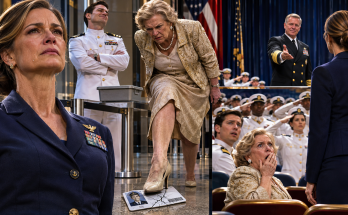
Kyle kept looking at the framed photograph.
I had noticed him doing it several times since dinner.
At first, I thought he was simply studying the uniform.
Then I realized he was trying to decide whether to ask something.
We were sitting in my home in Alexandria.
Christmas dinner was finished.
The kitchen still carried the smell of the meal we had prepared together.
The terrible cookies Kyle had insisted on baking sat nearby.
Neither of us wanted another.
That alone was enough to make me smile.
For the first time in years, I had spent an entire evening with my brother without feeling that I needed to defend myself.
We had cooked.
We had argued about music.
We had laughed.
Nothing extraordinary.
And somehow, that had made the evening extraordinary to me.
Kyle shifted in his chair.
"Paige, can I ask you something?"
I looked at him.
"You already did."
He smiled.
"Very funny."
I waited.
He glanced toward the photograph again.
Then he leaned forward.
"Does it ever bother you that people don't really know what you've accomplished?"
I didn't answer immediately.
The question was simple enough.
But I understood what he was asking.
He wasn't talking about the Navy.
Not entirely.
He was talking about us.
About Mom.
About the years when he had believed I spent my days handling paperwork for more important people.
About the graduation when a three-star admiral had recognized my work before an entire auditorium.
I rested my hands in my lap.
For a long moment, I looked at the photograph too.
There I was.
Rear Admiral Paige Donovan.
Thirty years of service behind that image.
Years of difficult decisions.
Assignments that had taken me away from home.
People whose judgment I trusted.
Responsibilities I had accepted knowing that mistakes could carry serious consequences.
I had never expected everyone to understand those things.
Most people couldn't.
Not because they lacked intelligence.
Because much of the work happened far from public view.
And because some responsibilities were difficult to explain without reducing them to something much simpler.
I looked back at Kyle.
"That used to bother me more than I admitted."
He nodded slowly.
"I thought it might."
I took a breath.
"Not with strangers."
He frowned.
"What do you mean?"
I glanced toward the photograph.
"Strangers don't owe me much beyond ordinary respect."
I looked at him again.
"But family is different."
He lowered his eyes.
I hadn't intended to make him uncomfortable.
I wasn't trying to remind him of his behavior at Coronado.
But I wasn't going to hide the truth either.
"For a long time, I wanted Mom to understand what my work meant."
Kyle listened.
"I wanted her to ask about it."
I smiled sadly.
"Sometimes I would have settled for her remembering my rank."
He looked down at his hands.
I continued.
"I kept thinking the next promotion would make a difference."
The admission embarrassed me a little.
Not because I was ashamed of wanting my mother's approval.
Because I had spent so many years pretending I didn't need it.
I had told colleagues that my family wasn't interested in Navy matters.
I had laughed when Mom described me as a glorified office assistant.
I had convinced myself that it was easier not to correct her.
But every time she dismissed my work, something inside me became quieter.
I remembered sending the promotion announcement.
I had been pleased with myself that day.
Not because I expected a celebration.
Because I knew what it had taken to reach that point.
I wanted to share the news with my mother.
So I mailed it.
And waited.
She never mentioned it.
I told myself she hadn't received it.
Then, at Coronado, I learned she had put it away deliberately.
I looked at Kyle.
"She knew."
He nodded.
"I know."
"That was harder than realizing she didn't understand."
He looked thoughtful.
"Because she could have asked."
"Yes."
I paused.
"She could have asked."
The room became quiet.
Not uncomfortable.
Just quiet.
Kyle looked toward the framed picture.
"At the graduation, when Admiral Rourke said your name, I didn't know what to think."
I smiled faintly.
"I noticed."
He gave a short laugh.
"I probably looked ridiculous."
"You looked surprised."
"That's generous."
I shook my head.
"It was a surprising situation."
He leaned back.
"I thought you had arranged something."
I raised my eyebrows.
"Really?"
He nodded.
"For about two seconds."
I couldn't help laughing.
Then he looked embarrassed.
"I know how that sounds."
I looked at him.
"Tell me anyway."
He took a breath.
"I thought you wanted to show everybody you outranked whatever I had accomplished."
The words hurt.
Even after everything.
Even after his apology.
Even after the evening we had shared.
They hurt because I finally understood how deeply he had believed our mother's interpretation of me.
I looked down at my hands.
Kyle noticed.
"I'm not saying I believe that now."
"I know."
"I just want you to understand how I was thinking."
I nodded.
"Go on."
He rubbed his forehead.
"Mom always made it sound like you couldn't stand anyone else getting attention."
I looked at him.
"Was that how you remembered me when you were little?"
He didn't answer immediately.
Then he shook his head.
"No."
I waited.
"You were the person who taught me to swim."
I smiled.
"I mostly stood in the water until you stopped being afraid."
"That's not how I remember it."
I looked at him.
"How do you remember it?"
He studied the floor.
"You kept telling me I could do it."
I felt my throat tighten.
"You could."
He nodded.
"I know."
He looked up.
"But you also promised you'd catch me."
I thought about the photograph.
The same one he had sent back to me.
The towel.
His wet hair.
That enormous grin.
I had spent so much time remembering the jump that I had almost forgotten what came before it.
The waiting.
The fear.
The way he needed reassurance.
Kyle looked at me.
"I used to think you could do anything."
I laughed softly.
"That was a pretty serious misunderstanding."
He smiled.
"Maybe."
Then his expression changed.
"Somewhere along the way, Mom convinced me that you thought the same thing about yourself."
I let the words settle.
He wasn't blaming everything on her.
I knew that.
We had already discussed his responsibility.
But he was explaining how the distance had grown.
I had stopped sharing.
He had stopped asking.
Mom had filled the silence.
And because we rarely challenged her version of events, her story became easier to believe than our own memories.
I looked at him.
"I made mistakes too."
He shook his head.
"Paige."
"I did."
He waited.
"I could have called you more often."
He started to object.
I raised a hand.
"I know my assignments weren't always simple. But there were times when I assumed you didn't want to hear from me."
He nodded reluctantly.
"And I accepted that instead of asking."
He looked thoughtful.
"Maybe we both did."
"Yes."
I leaned back.
"But there's one difference."
He met my eyes.
"I didn't tell you that you weren't worth my time."
His expression tightened.
"I know."
"I didn't make jokes about your service."
He nodded.
"And I never wanted you to feel that your success took anything away from mine."
He swallowed.
"I believe you."
I felt something loosen inside me.
Those words still mattered.
I believe you.
At Coronado, they had been almost impossible to imagine coming from him.
Now he said them without hesitation.
I looked toward the photograph.
"Your Trident was yours, Kyle."
He nodded.
"You earned it."
"I know."
"Your instructors determined that you met the standard."
He looked down briefly at his hands.
I continued.
"My rank didn't change that."
He smiled faintly.
"No."
"And Pacific Shield didn't make you qualify."
He shook his head.
"No."
I paused.
"But the work helped the people searching for you when something went wrong."
His expression grew serious.
"That's the part I've been thinking about."
I waited.
He looked toward the kitchen.
Then back at me.
"Before that accident, I thought planning was something that happened far away from the real work."
I understood.
Many people thought that.
Sometimes even people with operational experience underestimated the importance of coordination until they experienced a failure.
He continued.
"I knew there were systems behind what we did."
He hesitated.
"But I didn't think much about the people building them."
I nodded.
"Most people don't until something breaks."
He looked at me.
"And your framework was already there."
"Yes."
"Because you'd insisted on testing it."
"Because a lot of people had worked to make it useful."
He smiled slightly.
"You always do that."
"Do what?"
"Give everyone else credit."
I thought about that.
"Because they earned it."
He nodded.
"I understand that now."
I looked down for a moment.
There had been a time when hearing Kyle acknowledge my work would have felt like winning something.
That wasn't how it felt now.
It felt quieter.
Better.
I wasn't interested in defeating the version of me our mother had created.
I wanted my brother to know me without needing that version at all.
Kyle looked at the framed photograph again.
"Did you know Rourke was going to recognize you?"
I shook my head.
"No."
"Not even a warning?"
"I knew the organizers were aware I was attending."
He nodded.
"But I didn't expect him to turn the room toward me."
Kyle gave a small laugh.
"Mom definitely didn't."
I looked at him.
He stopped smiling.
"Sorry."
I shook my head.
"It's all right to remember what happened."
He looked relieved.
I continued.
"We just don't need to turn it into another contest."
He nodded.
"I don't want that either."
I looked toward the kitchen.
The cookies were still sitting where we had left them.
They looked almost respectable from a distance.
I smiled.
"Speaking of accomplishments, I think your baking career needs some attention."
Kyle stared at me.
Then he laughed.
"You're never letting that go, are you?"
"Not immediately."
He picked up one of the cookies and examined it.
"I still think they're edible."
"That's a generous description."
He shook his head.
"You've become very judgmental."
I laughed.
We sat there for a while.
Talking.
Laughing.
Occasionally falling quiet.
I realized I wasn't measuring every word.
I wasn't wondering whether he would repeat something to Mom.
I wasn't waiting for him to make another joke about serving coffee.
The ease felt unfamiliar.
And precious.
Eventually, he returned to his original question.
"So does it bother you now?"
I knew what he meant.
The lack of recognition.
The people who didn't know what I had done.
I thought about the training boat.
About the six personnel aboard.
About the search teams working through difficult conditions.
About the procedures we had tested before anyone knew exactly when they would be needed.
Then I thought about my mother at the registration table.
And the auditorium turning toward me.
I looked at Kyle.
"Not the way it used to."
He waited.
I smiled slightly.
"The people who needed that work know why it mattered."
He looked down.
Then he raised his eyes.
"Well, I know now."
I felt tears gather.
Not from sadness alone.
From relief.
From hearing my brother say something I had stopped expecting.
I nodded.
"Yes."
He smiled.
"And I'm glad."
I looked at him for a long moment.
He wasn't asking me to explain my value.
He wasn't trying to compare our careers.
He was simply telling me he understood.
For the first time in years, I felt no need to add anything.
I let the words remain between us.
And I was grateful.