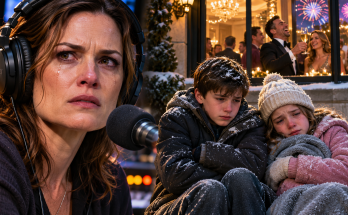
Dad was the first person I looked at after Calvin finished explaining why he and Molly had been kept outside.
He seemed smaller than usual.
He was standing in his own kitchen, but he looked as though he didn't know where to put his hands.
I asked him why he hadn't collected the children.
He swallowed.
Then he told me about the truck.
It had broken down before he could reach Ross's house.
He hadn't simply forgotten about the arrangement.
He hadn't decided to leave the children waiting.
He had called Ross as soon as he realized there would be a delay.
That was when I learned the part that made the whole night worse.
Ross had told our father the children were already indoors.
He had assured him there was no problem.
Dad had believed him.
Of course he had.
Ross was his son.
The children were Ross's niece and nephew.
And there was a full house of relatives inside.
Why would Dad imagine they had been turned away?
I watched my father's expression while he explained.
He couldn't look at Calvin for long.
He seemed to be searching for something he could have done differently.
He said he had accepted Ross's word.
He repeated that he thought the children were safe.
I could hear the guilt in his voice.
I put a hand on his shoulder.
I told him he had been lied to.
That was important.
Dad had made arrangements.
He had called when his truck failed.
Ross had been given the opportunity to tell the truth.
He had chosen not to.
I turned back to Calvin.
I needed to understand how the evening had unfolded.
I asked whether he and Molly had tried the door again.
He said they had knocked once.
The music was loud.
Nobody answered.
I imagined the sound of their small hands against that door.
Inside, people were celebrating.
Outside, my children were trying to be heard.
Calvin said they stayed where Ross had told them to stay.
At first, he expected Grandpa to arrive soon.
He knew Grandpa was supposed to watch them.
He didn't want to disobey Uncle Ross.
And he didn't want to cause trouble.
That last part made something tighten in my chest.
My son thought being a good child meant remaining quiet when something was wrong.
I asked why he hadn't called me.
He looked surprised that I would ask.
Then he explained that I was working.
He knew I was on the radio.
He knew Marcus was at the hospital.
And he didn't think it was serious enough to interrupt either of us.
I had to look away.
For years, I had taught Calvin to be considerate.
I had praised him when he handled small problems without complaining.
I had been proud of how responsible he was becoming.
Now I wondered whether I had made him feel responsible for too much.
He was twelve.
Twelve.
He should not have been deciding whether his little sister was cold enough to justify calling her parents.
He should have been indoors with a plate of food.
Instead, he was trying to solve an adult's failure.
I asked when he had become worried.
He took a few seconds before answering.
It was around nine-thirty, he said.
Molly had been shivering earlier.
Then she became very quiet.
And after a while, she wasn't shaking as much.
I felt sick.
I knew enough from Marcus's work at the hospital to understand that a child becoming unusually quiet in freezing weather wasn't reassuring.
It could mean something was seriously wrong.
I looked at Molly.
She was standing close enough to touch me.
Her face was tired.
She hadn't said much since I arrived.
I pulled her closer.
Then I put my other arm around Calvin.
I held them both.
I didn't ask Calvin to continue immediately.
There was nothing useful about making him hurry.
Eventually, he told me they had thought about leaving.
Home was more than four miles away.
They knew it was a long distance.
They also knew it was dark and cold.
So they had stayed near the house, hoping someone would come.
I thought about how frightened they must have been.
But Calvin hadn't used that word.
He had described the evening almost like a problem he was supposed to manage.
The door.
The cold.
Grandpa not arriving.
Molly getting quieter.
He gave me the facts.
That was how I knew he was still trying to protect me.
I wished he would cry.
I wished he would be angry.
I wished he would tell me how unfair it had been.
Instead, he sat at the kitchen table and answered my questions.
At about ten-fifty, someone finally noticed them.
That someone was not Ross.
It wasn't Allison.
It wasn't one of the guests.
It was Lamar, an older man who lived on the opposite side of the street.
He had seen the children outside.
He came over and brought them into his home.
He helped them warm up.
He gave them blankets.
He made sure they had something warm to drink.
And he tried contacting the adults who were supposed to be responsible for them.
He had called me twice.
Those were the calls I hadn't answered.
I looked at my phone again.
The number was still there.
Two missed calls.
Both from a man who had done what my own brother would not.
I couldn't stop staring at them.
Dad told me he had reached the children soon afterward.
Lamar had kept them safe until he arrived.
I was grateful.
More grateful than I knew how to express at that moment.
I also felt ashamed.
A stranger had recognized that my children needed help.
Their uncle had been only a few steps away.
I had never met Lamar before.
I knew nothing about his daily life.
But he had seen two children in the cold and decided they belonged somewhere warm.
That was all it had taken.
He hadn't needed a family meeting.
He hadn't needed anyone's permission.
He had simply acted like a decent person.
I would think about that again weeks later.
For now, I was sitting in Dad's kitchen, trying to understand how Ross could have done something so careless.
I kept looking at the clock.
The children had arrived shortly before eight.
They had been taken inside Lamar's house shortly before eleven.
Nearly three hours.
In below-freezing weather.
I repeated the timeline in my head.
I wanted it to be wrong.
I wanted to discover that Calvin had misunderstood something.
Maybe there had been confusion about which door to use.
Maybe someone inside thought Dad had collected them.
Maybe Ross hadn't known they were still waiting.
But the facts were already pointing in another direction.
Ross had answered the door himself.
He had told them to remain outside.
And when Dad called, Ross had said they were indoors.
That wasn't confusion.
It was a deliberate lie.
I was still holding Molly when she finally spoke.
She asked about the chocolate fountain.
At first, I didn't understand why that mattered to her.
I remembered how excited she had been before the party.
I told her I believed Ross had arranged one.
She nodded.
Then she explained that she had seen it.
Through the window.
People had been standing around it.
They were dipping strawberries into the chocolate.
Molly had watched them.
For a long time.
I looked at her.
She wasn't accusing anyone.
She wasn't asking why the other children had been allowed to eat while she waited outdoors.
She was simply telling me what she remembered.
That made it worse.
My nine-year-old daughter had spent part of her New Year's Eve looking through a window at a celebration she had expected to attend.
She could see people enjoying themselves.
She could see the food.
She could see the warmth inside the house.
But she couldn't go in.
I imagined her standing beside Calvin.
Trying to understand why everyone else belonged there.
Trying to be patient because her uncle had told her to wait.
And watching the strawberries.
I had been angry before.
Now I felt something harder and quieter.
It wasn't the kind of anger that made me want to scream.
It made me certain that something had to change.
I had spent years overlooking Ross's need to be admired.
I had dismissed his exaggerations.
I had told myself he was difficult but not dangerous.
He was family.
That had always been my explanation.
I couldn't use it anymore.
He had placed his own convenience above the safety of two children.
And when our father called, he had protected himself with a lie.
I didn't understand how somebody could make that decision.
I still don't.
But I understood that I was finished pretending it was harmless.
I got Calvin and Molly ready to leave.
Dad looked exhausted.
He apologized again.
I told him I knew what Ross had said to him.
I didn't want my father carrying blame that belonged elsewhere.
Then I took my children home.
The drive felt longer than it was.
Neither child said much.
I didn't force a conversation.
They had already been through enough.
I wanted to get them somewhere familiar.
Somewhere they knew the door would open.
At home, I made sure they were comfortable.
They needed rest.
They needed warmth.
And they needed to understand that they had not done anything wrong.
I told Calvin that if he was ever frightened or worried about Molly, he could contact me.
It didn't matter whether I was working.
It didn't matter whether Marcus was busy.
His safety mattered more than a radio program.
More than any job.
I wished I had made that clearer before.
Molly stayed close to me.
I didn't blame her.
I would have stayed close, too.
Once the children were settled, I contacted Marcus.
He needed to know what had happened.
I told him about Ross.
About Dad's truck.
About Lamar.
About the hours outside.
I told him what Calvin had said about Molly becoming quiet.
There were parts of that conversation where neither of us said much.
Marcus worked around emergencies every day.
He understood why I was frightened.
He also understood how badly things might have ended.
I was grateful that the children were home.
I was grateful Lamar had intervened.
But gratitude didn't erase what Ross had done.
I needed time to think.
And because thinking through records and details had always helped me stay calm, I turned toward something practical.
The family account.
It had existed for a simple reason.
Our relatives had wanted a shared fund for celebrations and occasional emergencies.
Birthdays.
Holiday meals.
Family gatherings.
The kinds of expenses that were easier when everyone contributed a little.
It wasn't supposed to make anyone rich.
It was supposed to make family life easier.
The account was registered in my name.
I handled it because I was organized and comfortable dealing with bank records.
I put in one hundred dollars each month.
Mom added seventy-five when she was able.
Dad sometimes contributed money from his pension.
Ross had been given access to a debit card.
He was allowed to use it for approved family expenses.
I had trusted him to respect that arrangement.
At the time, I didn't consider that a mistake.
We had all understood what the money was for.
At least, I thought we had.
But that morning, I kept remembering how often Ross had talked about paying for the New Year's celebration himself.
He had been proud of the catering.
Proud of the decorations.
Proud of the whole expensive evening.
And I suddenly wondered whether the family account had helped him pay for it.
I didn't have proof.
I didn't want to accuse him without checking.
So I opened the banking application.
The screen loaded.
I selected the family account.
Then I began scrolling through the recent transactions.
At first, I was only looking for charges connected to New Year's Eve.
I expected to find a few ordinary entries.
Maybe a payment toward something everyone had agreed to share.
Instead, the first thing I noticed was how little Ross had deposited.
He had put money into the account four times during the year.
Each deposit was one hundred and fifty dollars.
Six hundred dollars altogether.
I checked again.
There wasn't another payment.
Then I started looking at what had been spent.
And the first large charge that caught my attention had nothing to do with a family celebration.
It was for tires.
I stared at the amount.
One thousand two hundred and fifty dollars.
Paid from the family account.
On December twelfth.
I scrolled farther.
There was another transaction on December twentieth.
Three hundred and fifty dollars.
An online anniversary gift registry.
Then I reached the payments made around New Year's Eve.
Catering.
Rental tables.
A chocolate fountain.
All three had been charged to the same account.
The family account.
The one my mother and I had been helping build.
The one Dad occasionally supported with money from his pension.
Ross had used it to finance the celebration he claimed to be paying for himself.
I sat still with the phone in my hand.
The chocolate fountain was there in the transaction history.
The same one Molly had watched through the window.
The same one she hadn't been allowed to approach.
For a few seconds, I couldn't make myself scroll any farther.
I had expected to find evidence of a selfish decision.
Instead, I was beginning to understand how that decision had been paid for.