The first announcement didn’t frighten anyone.
The second one made two hundred passengers stop breathing.
And the third would change the life of a Navy fighter pilot forever.
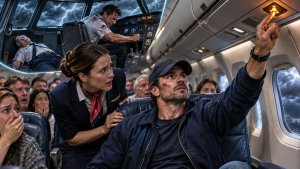
“Ladies and gentlemen, if there is a fighter pilot on board, or any military pilot experienced with jets, please press your call button immediately.”
Lieutenant Commander Aaron Rucker slowly lifted his head.
He was sitting in seat 8B aboard Cascade Airlines Flight 442, traveling from Dallas to Seattle, with a connecting flight to Anchorage.
He had flown fighter jets for years.
He had landed on aircraft carriers in violent seas.
He had faced emergencies most passengers couldn’t imagine.
But he had never flown a Boeing 767.
And right now, somewhere behind the closed cockpit door, two professional airline pilots were fighting for their lives.
Aaron looked toward the flight attendant standing in the aisle.
Then he reached up.
And pressed the button.
Forty minutes earlier, the flight had been completely ordinary.
Aaron was returning from a military assignment.
He wore jeans, a navy-blue jacket, and a baseball cap pulled low over his eyes.
Nothing about him suggested he was an experienced naval aviator.
The passenger beside him, a retired schoolteacher named Helen, had spent most of the journey talking about her grandchildren.
Aaron had listened politely.
Then fallen asleep.
He woke when the airplane dropped.
Not gradually.
Not gently.
It fell with a violent jolt that slammed his shoulder against the seat belt.
Overhead compartments rattled.
A woman screamed.
Somewhere behind him, a drink cart crashed into the aisle.
Aaron grabbed the armrests.
Then instinctively looked toward the window.
The clouds outside were dark.
The airplane rolled slightly.
Corrected.
Then rolled again.
He frowned.
Something wasn’t right.
Turbulence itself didn’t concern him.
He’d flown through worse.
What concerned him was what happened afterward.
The aircraft kept making small, uneven corrections.
Too many.
Too quickly.
As though someone at the controls was struggling.
Aaron glanced at his watch.
Then waited for an announcement from the captain.
None came.
Five minutes passed.
Then ten.
Finally, the cabin speakers crackled.
“Ladies and gentlemen, this is your chief flight attendant speaking. If there is a doctor or nurse on board, please press your call button.”
Helen turned toward Aaron.
“A doctor? Because of some turbulence?”
Aaron didn’t answer immediately.
He was studying the flight attendants.
Their faces were controlled.
But their movements were hurried.
“Something happened up front,” he said quietly.
Helen frowned.
“What do you mean?”
“I think somebody’s hurt.”
Another announcement came.
“If there is a qualified airline pilot traveling as a passenger, please identify yourself to a member of the cabin crew immediately.”
Aaron sat straighter.
Helen looked at him.
“Aren’t you a pilot?”
“I fly military aircraft.”
“That’s still flying.”
“Not the same kind.”
He glanced toward the cockpit.
“If there’s an airline pilot aboard, they need that person first.”
But nobody answered.
No call lights appeared.
The flight attendants moved quickly from section to section.
Whispering.
Asking questions.
Returning to the front.
Then the third announcement came.
This time, the flight attendant’s voice trembled.
“Is there a fighter pilot on board? Any military pilot who has flown jets?”
Helen looked directly at Aaron.
“Well?”
He closed his eyes for one second.
Then pressed the call button.
The chief flight attendant arrived almost immediately.
“Sir?”
Aaron stood.
“Lieutenant Commander Aaron Rucker. United States Navy. I fly F/A-18 Super Hornets.”
The man’s face changed.
“My name is Marcus. Please come with me.”
Aaron followed him down the aisle.
Passengers stared.
A little boy whispered to his mother.
“Is that the pilot?”
His mother pulled him closer.
Marcus opened the cockpit door.
And Aaron stepped into a scene he would never forget.
The captain lay unconscious near the rear of the cockpit.
A nurse was kneeling beside him, pressing gauze against a bleeding head wound.
In the right seat sat First Officer Nathan Lewis.
He was pale.
Sweating.
And holding the control column with his left hand.
His right arm was visibly injured.
Aaron looked at Marcus.
“What happened?”
“Captain Albright left the cockpit briefly. I came in to sit with the first officer as required.”
Marcus swallowed.
“Then we hit severe turbulence. The captain had just returned and was still standing. He struck the ceiling and collapsed.”
Aaron looked at the first officer.
“And him?”
“He was wearing his lap belt, but not his shoulder restraint. He was thrown sideways.”
Nate Lewis gave a weak smile.
“Apparently, I picked a bad day to skip the shoulder harness.”
Aaron approached him.
“How are you doing?”
“Been better.”
“Can you keep flying?”
Nate looked toward the instruments.
“Not much longer.”
Aaron noticed the man’s injured arm.
Then the way the airplane was drifting.
“Autopilot?”
“Tried it twice. Keeps disconnecting.”
Aaron scanned the flight deck.
The Boeing’s controls were unfamiliar.
The display arrangement was different from his fighter.
The aircraft weighed many times more than anything he’d flown.
And behind him sat two hundred and nine other people depending on someone to keep it in the air.
Nate looked up.
“You airline?”
“Navy.”
The first officer closed his eyes.
“Twelve years in the Air Force before I joined Cascade, and now the Navy shows up to rescue me.”
Aaron almost smiled.
“Let’s save the jokes for the ground.”
He looked at the captain’s seat.
Then at Nate.
“I’m taking the left seat.”
Nate nodded.
Aaron carefully settled into position.
He placed his hands on the controls.
Felt the airplane resisting.
And immediately noticed something.
“She isn’t trimmed correctly.”
Nate exhaled.
“My injured arm. I’ve been fighting it the whole time.”
Aaron made the necessary adjustment.
The control pressure eased.
For the first time since entering the cockpit, he felt the airplane settle.
“That’s better,” Aaron said.
Nate looked toward the instruments.
“Much better.”
Aaron took a breath.
Then pressed the radio transmit button.
“Mayday, Mayday, Mayday. Seattle Center, Cascade Four Four Two Heavy. Both pilots are injured. This is Lieutenant Commander Aaron Rucker, United States Navy, taking control.”
A moment later, a voice answered.
“Cascade Four Four Two Heavy, Seattle Center. Mayday received. How many souls on board?”
Aaron looked at Marcus.
“Passenger count?”
“Two hundred and ten, including crew.”
Aaron swallowed.
“Two hundred and ten souls.”
The controller paused.
Then asked the question Aaron had been dreading.
“Commander, how many flight hours do you have in a Boeing 767?”
Aaron stared through the windshield.
Clouds stretched endlessly ahead.
“Zero.”
A brief silence followed.
Then Aaron added:
“About two thousand hours in Navy fighters.”
The controller’s voice remained steady.
“Understood. We’re connecting you with a company training captain.”
Aaron tightened his grip on the controls.
A second voice came through his headset.
Female.
Calm.
Experienced.
“Cascade Four Four Two, this is Captain Jane Sutter. I’ve flown the 767 for thirty-one years.”
Aaron let out a slow breath.
“Good to hear you, Captain.”
“From now until touchdown, I’m staying with you.”
He looked toward the vast instrument panel.
Then back at the dark clouds.
“Jane, I should tell you something.”
“Go ahead.”
“I’ve landed on aircraft carriers. I’ve flown through combat. I’ve handled emergencies in aircraft that were falling apart.”
He paused.
“But I’ve never landed anything this big.”
Jane answered without hesitation.
“Then today you’re going to learn.”
And Aaron realized that the most difficult flight of his life had only just begun.
PART 2 — EIGHT HUNDRED FEET
The first problem was the autopilot.
The second was the weather.
And the third was running out of time.
Aaron stared at the instrument panel while Jane guided him from the ground.
“Look beneath the windshield,” she instructed. “Find the flight-control panel and the autopilot engagement switches.”
Aaron located them.
“Got it.”
“Try engaging the left autopilot now that you’ve corrected the trim.”
He pressed the switch.
For a moment, nothing seemed to change.
Then the control indicators settled.
The aircraft maintained its heading.
Aaron stared.
“Jane?”
“Yes, Navy?”
“It’s holding.”
“Good. Now take a breath.”
He slowly removed his hands from the controls.
For the first time in twenty minutes, the airplane was flying steadily.
But the relief lasted only seconds.
“Jane, I’ve got another problem.”
“Tell me.”
“I don’t see any indication that automatic landing is available.”
Jane consulted the aircraft information being relayed to her.
Then answered carefully.
“We’ve been told there may have been damage to the overhead systems during the turbulence.”
Aaron glanced toward the unconscious captain.
“So what does that mean?”
“It means we may be able to use the autopilot for most of the approach, but you should prepare to fly the final portion manually.”
Aaron stared through the windshield.
Heavy clouds surrounded them.
“How low is the ceiling?”
“Eight hundred feet.”
He swallowed.
“Eight hundred.”
“That’s right.”
“And the wind?”
“Southwest, gusting to twenty-five knots.”
Aaron looked down at the controls.
Then toward the first officer.
Nate was breathing hard.
His face had turned gray.
The nurse leaned forward.
“He needs medical attention immediately.”
Aaron looked at Marcus.
“Can you help her move him once it’s safe?”
Marcus nodded.
Nate shook his head weakly.
“I’m staying.”
Aaron leaned toward him.
“Listen to me. You’ve already kept this airplane alive longer than anyone should have had to in your condition.”
Nate gave a faint smile.
“That’s a compliment?”
“Best one I’ve got.”
The nurse checked him again.
Then looked at Aaron.
“We need to get him out of this seat.”
Nate’s eyes fluttered.
“Commander?”
“Yeah?”
“Don’t let her drop.”
Aaron looked at the controls.
Then at the injured pilot.
“I won’t.”
A few minutes later, Nate lost consciousness.
Marcus and the nurse carefully moved him from the cockpit.
The captain was already receiving care nearby.
And suddenly Aaron was alone at the controls.
Alone in an airplane filled with people.
Alone in weather he couldn’t see through.
Alone in a cockpit designed for two highly trained airline pilots.
He pressed the microphone button.
“Jane?”
“I’m here.”
“I’ve lost the first officer.”
Her voice remained calm.
“Then it’s you and me, Navy.”
Aaron closed his eyes briefly.
“Understood.”
Jane continued.
“We’re going to take this one step at a time. The airplane is stable, and air traffic control is giving us priority.”
Aaron nodded.
Even though she couldn’t see him.
“What’s next?”
“Seattle is preparing the runway. We have emergency crews ready. I’ll coordinate with the controller and walk you through the aircraft’s procedures.”
He looked toward the approach charts.
“Any better weather nearby?”
“Not close enough to help the injured crew. Seattle is our best option.”
Aaron took a breath.
“Then Seattle it is.”
In the passenger cabin, fear was spreading.
People had seen the injured captain carried out.
They had watched the nurse rush forward.
They had heard the announcement asking for a fighter pilot.
And now nobody knew what to believe.
A woman in row twenty-two was crying.
A teenager held his phone in trembling hands.
A father tried to calm his young son.
Then Marcus appeared at the front of the cabin.
He picked up the microphone.
“Ladies and gentlemen, I need your attention.”
The cabin grew quiet.
“Both members of our flight crew were injured during severe turbulence.”
A frightened murmur moved through the passengers.
Marcus continued.
“A qualified Navy pilot who was traveling with us is now in the cockpit. He is receiving assistance from experienced aviation professionals on the ground.”
Someone began crying harder.
“We’re making an emergency approach into Seattle. Emergency services are ready to meet us.”
Marcus paused.
“I’m not going to tell you there is nothing to worry about. But I am going to tell you that everyone involved is working to bring this airplane down safely.”
For a moment, nobody spoke.
Then a woman in the front row raised her hand.
“Is the Navy pilot alone?”
Marcus looked at her.
“Yes, ma’am.”
She swallowed.
Then whispered:
“God help him.”
At fourteen thousand feet, Aaron began preparing for descent.
Jane’s voice came through his headset.
“Take your time. Read each instruction back to me.”
Aaron nodded.
“Copy.”
The controller issued a new heading.
“Cascade Four Four Two Heavy, turn left heading one-eight-zero. Descend and maintain four thousand.”
Aaron selected the heading and altitude.
The aircraft began turning.
“She’s responding,” he said.
“Good,” Jane answered. “Keep monitoring your instruments.”
The descent continued.
Twelve thousand feet.
Ten thousand.
Eight thousand.
Then Aaron felt something strange.
The airplane seemed to be banking.
His inner ear insisted they were turning.
But the displays showed the wings nearly level.
“Jane, it feels like we’re rolling.”
“Trust your instruments.”
“My body says otherwise.”
“Your body doesn’t know what the clouds are doing. The instruments do.”
Aaron forced himself to focus.
He had spent years learning the same lesson in fighter training.
But fatigue and unfamiliar controls were making everything harder.
He looked at the attitude indicator.
Wings level.
Stable descent.
“Copy,” he whispered.
Jane’s voice softened.
“That’s it. Keep flying the airplane you can see on the instruments, not the one your senses are inventing.”
The approach continued.
The controllers had cleared surrounding traffic.
Emergency vehicles were gathering near the runway.
At the airport, firefighters stood beside their trucks.
Paramedics prepared stretchers.
The tower watched Cascade 442 descend through the cloud cover.
Inside the cockpit, Aaron followed Jane’s guidance while managing the aircraft’s changing configuration.
Landing gear.
Flaps.
Speed.
Checklist items.
One task at a time.
There were moments when the workload felt overwhelming.
His instincts wanted to make rapid corrections.
The Boeing wanted patience.
Jane reminded him repeatedly.
“Small movements.”
Aaron looked toward the windshield.
Nothing.
Only gray cloud.
“Jane, I still can’t see the ground.”
“I know.”
The altitude kept decreasing.
One thousand feet.
Nine hundred.
Eight hundred fifty.
Aaron leaned forward.
“Come on.”
The cloud seemed endless.
“Where is it?”
Jane’s voice remained steady.
“Keep the approach stable.”
Then the gray began to thin.
Shapes appeared below.
Runway lights.
Wet pavement.
The unmistakable outline of an airport emerging through the rain.
Aaron’s heart slammed against his ribs.
“Runway in sight.”
Jane answered immediately.
“Good. You’re going to take manual control. Remember, this airplane responds differently from your fighter.”
He looked toward the landing lights.
“Understood.”
“Small corrections. Gentle hands.”
Aaron reached for the control.
Disconnected the autopilot.
And took the weight of the airplane into his hands.
“Autopilot off.”
He inhaled.
“I have control.”
The aircraft drifted in the gusting wind.
Aaron made a correction.
The runway moved slightly in the windshield.
He corrected again.
Too much.
The airplane rolled.
“Easy, Navy,” Jane warned. “Don’t chase it.”
Aaron steadied his hands.
“Light touch.”
“That’s right.”
Five hundred feet.
The runway rushed closer.
The crosswind pushed again.
Aaron’s mind flashed back to the deck of an aircraft carrier.
The arresting cables.
The violent touchdown.
The controlled aggression needed to land a fighter on a moving ship.
Then Jane spoke sharply.
“Remember, this isn’t a carrier.”
Aaron swallowed.
“I know.”
“Don’t plant it on the runway. Let the airplane settle.”
The radio crackled.
“Cascade Four Four Two Heavy, Seattle Tower. Runway one-six left. Cleared to land.”
Aaron looked toward the centerline.
Then answered.
“Cleared to land.”
The airplane descended.
Two hundred feet.
One hundred.
Fifty.
Jane’s voice filled his headset.
“Easy. Gentle.”
Aaron felt the wind.
Saw the runway lights.
And fought every instinct his military training had built into him.
Then came the most terrifying moment of the entire flight.
The aircraft began to drift sideways.
And Aaron realized he had only seconds to bring it back to the runway centerline.
PART 3 — WELCOME HOME, NAVY
For one second, Aaron thought they were going to miss the runway.
The wind shoved against the aircraft.
The nose shifted.
The wet pavement appeared to slide sideways beneath the windshield.
He made a small correction.
Then another.
Not too much.
Not too quickly.
Jane’s voice remained steady.
“That’s it, Navy. Hold her.”
Aaron tightened his focus.
He could hear his own breathing.
The radio.
The altitude callouts.
And somewhere beneath everything, the steady roar of the engines.
“Thirty.”
The runway filled the windshield.
“Twenty.”
He eased the nose.
Reduced power.
“Ten.”
Then the wheels touched.
A deep rumble passed through the aircraft.
For one awful moment, Aaron expected the airplane to bounce.
But it stayed down.
The speed brakes deployed.
The engines roared into reverse thrust.
He maintained directional control while the aircraft slowed along the wet runway.
A hundred knots.
Eighty.
Sixty.
The end of the runway remained ahead.
The airplane continued decelerating.
Then, at last, it stopped.
Aaron stared through the windshield.
He couldn’t move.
Couldn’t speak.
For several seconds, all he heard was his own breathing.
Then he pressed the radio button.
“Seattle Tower, Cascade Four Four Two Heavy.”
His voice trembled.
“We’re stopped on the runway.”
A brief silence followed.
Then the controller answered.
“Cascade Four Four Two Heavy, emergency vehicles are approaching. Outstanding flying, Commander Rucker.”
Aaron leaned back.
Closed his eyes.
And finally let himself breathe.
Then Jane’s voice came through his headset.
“Welcome home, Navy.”
He laughed once.
A broken, exhausted sound.
“Thank you, Jane.”
“You did the hard part.”
He shook his head.
“Couldn’t have done it without you.”
In the passenger cabin, nobody moved at first.
Then someone began crying.
A man in the rear of the aircraft whispered:
“We’re alive.”
A woman grabbed her husband’s hand.
A child looked toward the window.
Then the applause started.
Not polite applause.
Not the kind people give after an ordinary landing.
It was desperate.
Overwhelming.
The sound of two hundred people realizing they had been given another chance.
Some hugged strangers.
Some prayed.
Others simply sat motionless, too shaken to speak.
Marcus picked up the microphone.
“Ladies and gentlemen, we have landed safely in Seattle.”
The applause grew louder.
“Please remain seated while emergency services attend to the injured flight crew.”
His voice cracked.
Then he added:
“Thank you for remaining calm. And thank you to the passenger who stepped forward when we needed him.”
Aaron stayed in the cockpit until the emergency teams arrived.
He watched as paramedics took Captain Albright and First Officer Lewis to the waiting ambulances.
Only then did he finally stand.
His legs felt strangely weak.
He’d flown jets through combat.
Landed on moving carriers.
Faced mechanical failures over open water.
But nothing had ever frightened him quite like flying two hundred and ten people toward a runway in an aircraft he barely knew.
When he stepped into the cabin, passengers began standing.
A middle-aged man extended his hand.
“Thank you.”
A woman touched his shoulder.
“You saved my family.”
Aaron looked embarrassed.
“I had a lot of help.”
Then Helen, the retired teacher from the seat beside him, approached.
Her eyes were wet.
“Well,” she said.
Aaron smiled tiredly.
“Well what?”
“I told you there would be somebody.”
He laughed.
“You did.”
Helen hugged him.
And for a moment, he let himself be held by a stranger who had nearly died beside him.
Near the aircraft door, Marcus was speaking with the nurse who had treated the injured pilots.
She wore a simple gray sweater.
There was dried blood on the cuff of her sleeve.
Her name was Rebecca.
Aaron approached.
“How are they?”
Rebecca looked up.
“The emergency teams have both of them. They’re getting the care they need.”
He nodded.
“Thank you for staying with them.”
She smiled faintly.
“I just did what I could.”
Aaron looked at the stained sweater.
“You did more than that.”
She glanced toward the cockpit.
“And you?”
He shook his head.
“I had someone talking me through every step.”
Rebecca laughed softly.
“Sounds like neither of us did it alone.”
Aaron smiled.
“That’s right.”
Then Marcus appeared beside them.
“Commander, there’s someone who wants to speak with you.”
Aaron turned.
“Who?”
Marcus held out a phone.
“Captain Jane Sutter.”
Aaron took it.
“Jane?”
Her voice came through clearly.
“Navy.”
He laughed.
For a moment, neither spoke.
Then Jane said:
“How are you feeling?”
Aaron looked toward the runway.
Emergency lights flashed beyond the windows.
“Like I need a week off.”
She laughed.
“You’ve earned it.”
He swallowed.
“Jane, thank you.”
“You listened. That’s what mattered.”
Aaron shook his head.
“You kept two hundred and ten people alive.”
Her voice softened.
“We all did.”
Two hours later, Aaron sat in an airport conference room giving his account to investigators.
He described the turbulence.
The injured pilots.
The difficulties with the flight controls.
The radio guidance.
And the approach.
He answered every question as carefully as he could.
Outside, news reporters had already begun gathering.
Phones were ringing.
Videos were spreading across social media.
Some passengers had recorded the emergency announcement.
Others had filmed the applause after landing.
And somewhere online, people were already calling Aaron Rucker a hero.
He didn’t feel like one.
He felt exhausted.
And terribly aware of how close everything had come to ending differently.
Then Marcus stepped into the room.
“Commander?”
Aaron looked up.
“Yes?”
“I thought you’d want to know. We just received an update.”
Aaron stood.
“The pilots?”
Marcus nodded.
“Both are expected to recover.”
Aaron closed his eyes.
For several seconds, he didn’t speak.
Then he lowered his head.
“Thank God.”
Marcus smiled.
“Captain Albright is awake.”
Aaron looked up.
“Really?”
“And Nate Lewis asked the doctor one question.”
Aaron waited.
Marcus laughed.
“He wanted to know whether the Navy scratched his airplane.”
Aaron burst out laughing.
For the first time since the emergency began, he laughed without fear.
Later that afternoon, Aaron was taken to the hospital to meet the injured pilots.
Captain Albright lay in bed with a bandage around his head.
His face was bruised.
But he was awake.
When Aaron entered, the captain tried to sit up.
“Commander Rucker?”
Aaron approached.
“Captain.”
Albright extended his hand.
“I hear you borrowed my airplane.”
Aaron smiled.
“Hope you don’t mind.”
The captain laughed weakly.
“Depends. Did you bring it back?”
“In one piece.”
“Then we’re good.”
They shook hands.
For a moment, the humor disappeared.
Albright looked at him.
“Thank you.”
Aaron nodded.
“Glad I was there.”
Then a voice came from the doorway.
“Navy.”
Aaron turned.
Nate Lewis sat in a wheelchair, his right arm immobilized.
He looked pale but alert.
Aaron grinned.
“Air Force.”
Nate smiled.
“Told you the Navy would eventually come crawling to us for help.”
Aaron laughed.
“You were unconscious for the good part.”
Nate shook his head.
“Typical Navy. Takes all the credit.”
They laughed.
Then Nate grew serious.
“You saved my life.”
Aaron looked at him.
“You kept that airplane flying when you were badly hurt.”
Nate’s eyes filled.
“I thought we were going to lose her.”
Aaron nodded.
“I know.”
Nate looked down.
Then whispered:
“Thank you for taking over.”
Aaron reached out and squeezed his good shoulder.
“Anytime.”
That evening, Aaron finally called home.
His wife, Emily, answered on the second ring.
“Hey, stranger.”
He smiled.
“Hey.”
“Did you make your connection?”
Aaron looked toward the airport windows.
“Not exactly.”
She laughed.
“What happened?”
He hesitated.
Then said:
“There was a problem with the flight.”
Silence.
“What kind of problem?”
“Both pilots got hurt.”
Emily stopped breathing.
“Aaron?”
“I’m okay.”
“Where are you?”
“Seattle.”
“What happened?”
He looked down.
Then answered quietly:
“I had to help land the airplane.”
There was a long silence.
Then Emily whispered:
“You did what?”
Aaron closed his eyes.
And suddenly the emotions he’d held back for hours threatened to overwhelm him.
“I had to fly it, Em.”
His voice broke.
“I wasn’t sure I could.”
She began crying.
“But you did.”
He nodded.
Even though she couldn’t see him.
“Yeah.”
He swallowed.
“We made it.”
Three days later, Aaron returned home to Anchorage.
His family met him at the airport.
Emily ran toward him before he reached the baggage claim.
She threw her arms around him.
He held her tightly.
Their two children followed.
His youngest son looked up.
“Dad, did you really fly a big airplane?”
Aaron smiled.
“Yeah, buddy.”
“Bigger than your fighter?”
“Much bigger.”
His daughter frowned.
“Were you scared?”
Aaron thought about the clouds.
The damaged cockpit.
The runway appearing at eight hundred feet.
The wind pushing against the aircraft.
Then he nodded.
“Yes.”
His daughter looked surprised.
“But you’re a Navy pilot.”
Aaron knelt beside her.
“Being trained doesn’t mean you never get scared.”
She thought about that.
“Then how did you do it?”
He smiled.
“I listened to people who knew more than I did.”
In the weeks that followed, the story of Cascade Flight 442 traveled around the country.
People called Aaron brave.
Some called him extraordinary.
Others said he had performed the impossible.
But whenever reporters asked him about the landing, he gave the same answer.
“I wasn’t alone.”
He spoke about Captain Jane Sutter.
About the air traffic controllers.
About Marcus and the cabin crew.
About Rebecca, the nurse who cared for the injured pilots.
And about Nate Lewis, who had kept flying while badly hurt.
He insisted that the passengers had survived because many people worked together.
Not because one man had suddenly become a superhero.
During one interview, a reporter asked:
“Commander, what was the most frightening moment?”
Aaron thought for a long time.
Then answered:
“When the first officer lost consciousness.”
“Why?”
“Because until then, there was still someone beside me who knew that airplane.”
He paused.
“After that, I realized I had to trust a voice over the radio.”
The reporter leaned forward.
“And you did?”
Aaron smiled.
“Yes.”
“Why?”
“Because she knew what she was doing.”
A month later, Cascade Airlines organized a private gathering for the passengers and crew.
Captain Albright attended.
So did Nate Lewis, still recovering.
Marcus stood near the entrance greeting families.
Rebecca came with her husband.
And Jane Sutter flew in to meet Aaron in person.
When she entered the room, Aaron recognized her immediately from the warmth in her smile.
She approached.
“Navy?”
He turned.
“Jane?”
They embraced.
For several seconds, neither spoke.
Then Jane stepped back.
“You look younger than I expected.”
Aaron laughed.
“And you sound exactly like I expected.”
She smiled.
“Calm?”
“Terrifyingly calm.”
They laughed.
Then Jane asked:
“Do you remember what I told you at eight hundred feet?”
Aaron nodded.
“Trust the instruments.”
“And?”
“Small movements. Light touch.”
She smiled.
“Good student.”
Aaron looked at her.
Then said something he had been wanting to say since the landing.
“I knew how to fly before that day.”
Jane nodded.
“But you taught me how to listen when everything in me wanted to take control.”
Her expression softened.
“That may be the hardest lesson any pilot learns.”
Years later, Aaron would remember that flight differently from the way the newspapers described it.
He wouldn’t remember the applause first.
Or the headlines.
Or the photographs.
He would remember a trembling first officer refusing to let go of the controls.
A nurse kneeling beside an injured captain.
A flight attendant asking strangers for help.
A calm woman on the radio.
And the sight of a wet runway emerging through gray cloud when he had almost given up hope of seeing it.
He would remember that nobody involved had known whether the ending would be a happy one.
They simply kept doing the next necessary thing.
One decision.
One instruction.
One breath.
One small movement at a time.
Because courage is rarely the absence of fear.
Often, it is the willingness to keep working while fear is sitting right beside you.
And sometimes, the person who saves your life isn’t the strongest person in the room.
It is the one who knows what to do next.
Aaron had spent years learning to land fighter jets on aircraft carriers.
But on the day two hundred and ten people needed him most, his greatest skill wasn’t strength.
It wasn’t speed.
It wasn’t even courage.
It was the ability to listen.
To trust.
And to accept help.
That afternoon, after the reunion, Aaron and Jane stood beside a window overlooking the runway.
An airliner lifted into the sky.
Aaron watched it disappear into the clouds.
Then Jane smiled.
“Still planning to fly fighters?”
He laughed.
“Absolutely.”
“No interest in changing careers?”
Aaron shook his head.
“I think one airline landing is enough for me.”
Jane laughed.
Then reached for her coat.
“Take care of yourself, Navy.”
Aaron smiled.
“You too, Jane.”
She started walking away.
Then stopped.
Turned.
And said the two words he would remember for the rest of his life.
“Welcome home.”
Aaron looked through the window one last time.
Then whispered:
“Thanks for getting us there.”