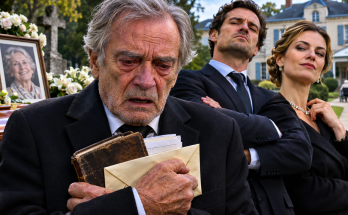
Back in 1966, my daddy had my marriage annulled six days after the wedding and sent the boy I loved away. Sixty years later, that boy, a widower now, wrote to me. My daughter said, “He’s after your pension, Mama, and I already called the senior apartments.”
The thing about losing someone when you’re young is that life keeps going, but a question can stay right where you left it. I had a husband after Rudy, and I loved him. I worked at the hospital for thirty-eight years. Still, I had wondered why Rudy left without saying goodbye.
At the hospital, the doctors called me Olive Oyl. I had long, skinny legs, and I always kept a ward clerk’s pencil behind my ear. I never minded the name. Rudy never called me that.
“Morning, Olive,” he’d say at the Texaco, like it was the prettiest name in Oklahoma.
He pumped gas and smelled like it. We were seventeen and eighteen, and I thought a dollar ninety-eight could buy the whole future. That was what his dime-store ring cost. It turned my finger green, but I wore it like a diamond.
In June of 1966, we drove across the Red River to the courthouse in Denison, Texas. We got married there. Six days later, my father found out.
He came to Rudy’s rented room with the county sheriff and a paper from the judge. I was under eighteen, so Daddy could undo the marriage, and he did.
“She’s seventeen,” Daddy told the sheriff. “Undo it.”
I stood there while he pulled the ring off my finger and threw it at Rudy’s feet. I was young enough to think someone would stop him. Nobody did.
That night, Rudy left town. He didn’t say goodbye. He didn’t fight. Mama told me later that he’d taken fifty dollars from Daddy to go. I didn’t believe her at first. After enough time passed with no letter, I did.
Mama made a quilt that summer, with a wedding ring pattern. She said it was for my hope chest. I kept it, even though I couldn’t have told anyone why. I didn’t want to put it away, and I didn’t want to look at it, either.
I married Gerald in 1970. He was a good man, a lineman, and we had fifty-three years together. I buried him three Octobers ago. I miss him in the plain places, like reaching for the coffee tin and remembering he used to leave it open.
This September, a letter came to the hospital where I’d worked. It was addressed to Olive Barnes, my maiden name. The girls in Admitting drove it to my house.
My hands knew the handwriting before my head did.
Rudy was seventy-eight. He’d been in the Navy, then worked as a mechanic in Ada, two hours south of Norman. His wife of fifty-one years had died in 2023. He’d seen my picture on my granddaughter’s Facebook, holding a pie at the county fair. Under it, she’d written that I’d worked thirty-eight years at the hospital.
“I’d like to buy you a cup of coffee,” he wrote. “Three sugars, if you still take it that way.”
I sat down on the kitchen floor with the letter in my hand. I still take it that way. I hum old country songs when I’m nervous, and I hummed one sitting there, though I couldn’t tell you which one.
Trista found the letter on my counter the next Sunday. She read it standing up, and her face went hard.
“Mama, he’s after your pension. And this house.”
“Trista, he’s seventy-eight. He has his own house.”
“Men like that always have a story.”
The next weekend, she came over with flattened moving boxes in her trunk. She said they were for my closets, just to get a head start. Then she told me she’d already called the senior apartments by the hospital. They had a one-bedroom opening in January.
I was scared of falling in the shower with nobody to hear. I was scared of my daughter deciding where I slept. And I was scared of one old man in Ada telling me I’d remembered it all wrong.
My friend Mavis, who’d worked at the hospital with me, said something that made the fear worse. We were having lunch when she told me Trista had already been saying I forgot things.
“Olive, you cross her, she’ll tell your doctor you’re not right in the head.”
Maybe she would. Maybe I was a foolish old woman chasing a boy who’d left. But I’d spent sixty years wondering why he went without one word.
So last Saturday I put on my good blue blouse and drove to Ada.
I didn’t tell Trista. I didn’t tell anybody. I sang along with the old country station the whole way, and I cried twice.
Rudy’s house was small and white. There was a bass boat in the carport and petunias that needed water. I sat in my car with my purse in my lap for fifteen minutes before I could make myself get out.
I walked up the steps. Before I could knock, the door swung open.
He was old. Of course he was. So was I. But he had the same crooked grin, and he was holding a little velvet box open in his big, spotted hand. My dime-store ring was inside it, gone black with sixty years.
“I saw your car,” he said. “I been standing at that window for fifteen minutes.”
“Why didn’t you come out?” I said. My voice came out about seventeen.
“I didn’t know if you came to slap me or hug me.”
I didn’t know either.
“Rudy, why did you leave without one word?”
His grin went away. He looked down at that box.
“Olive,” he said, “your mama came out to my truck that night, and she told me you wanted me gone.”
I stared at him. “She told me you took fifty dollars from Daddy.”
“I know.”
The answer was so quick that it hurt. I gripped the strap of my purse.
“She said you’d take it and leave town,” I said. “That you didn’t even try to stay.”
Rudy looked up at me. “I didn’t take a dollar from your daddy.”
He set the open box on the small table inside the doorway. His hand shook a little as he let go.
“Your mama brought the money herself,” he said. “She told me you’d asked her to tell me not to come back. She said you didn’t want to see me again, and you didn’t want to stand up to your daddy about it.”
I shook my head. “I never said that.”
“I know that now.”
“How could you know it now?”
“Because you drove two hours to ask me why I left.”
That answer got under my skin. I was glad he hadn’t come up with something polished, but I was angry he’d let so many years pass without asking me the same thing.
Rudy leaned against the doorframe. “Your mama said your daddy was furious. She said if I stayed, he’d find a way to make your life harder. She said you’d be sent away, or kept from working. I don’t know how much of that was true. I knew your daddy had a paper from a judge and the sheriff beside him.”
“She said I wanted you to go?”
“She told me you’d said it to her. Then she put the money in my hand and told me to leave that night.”
“Did you take it?”
“I did. I was eighteen, Olive. I was scared, and I had no business being proud about it. I needed a bus ticket and a place to sleep. I told myself I was doing what you wanted.”
I looked at the ring. “And you never thought to write?”
“I thought about it. I thought about it for years.” He rubbed his thumb over the edge of the box. “I was ashamed I’d left. Then I figured you’d married someone else. Later, I had a wife and a life. I should’ve written before all that. I didn’t. That part’s on me.”
I felt tears in my eyes, and I hated that they came so easily. “You let me believe you sold me for fifty dollars.”
“I know.”
“You could’ve told me.”
“I could have.” He held my gaze. “I should have.”
I had imagined that question for so long that I’d expected the answer to set something right. It didn’t. It changed one part of what I believed, and left the years in place.
“Did you keep it?” I asked, looking at the box.
“The ring? Yes.”
“Why?”
He looked at me for a while before he answered. “I loved you. I didn’t know what else to do with it.”
I sat down at the little table because my legs had started to shake. He went to the kitchen and brought out coffee. It had three sugars. I watched him measure them, and a small laugh came out of me before I could stop it.
“Still that way,” he said.
“Still.”
We talked for a long time. He told me about the Navy and the garage in Ada. He told me about his wife, and how he’d missed her after she died. He didn’t say anything unkind about her, and I was grateful. When I told him about Gerald, Rudy listened without trying to make himself part of that life.
It was what I needed from him. I wasn’t going to pretend Gerald hadn’t mattered just because Rudy had come back to my mind.
After a while, Rudy asked, “Does your daughter know you came down?”
“No.”
“Is she worried?”
“She’s more worried about what she thinks you want from me.”
His eyebrows lifted. “What does she think I want?”
“My pension. The house.”
Rudy glanced around his small kitchen. “I’ve got a house.”
“That’s what I told her.”
“I didn’t know what you did for work until I saw that picture. I don’t know what your pension is. I never asked you for anything.”
“I know.”
He waited, then said, “Do you want me to talk to her?”
I was nervous to have him in the same conversation with Trista. I was more nervous to let Trista keep deciding what I could do without ever hearing me say no.
“Yes,” I said. “But she needs to hear it from me first.”
On the drive home, I kept thinking about Mama’s lie and Rudy’s silence. It would have been easier if one of them had been all wrong and the other one had been all right. Neither of them was. Mama had chosen what she thought would protect me, and Rudy had chosen the easy way out. I’d been the one left with the story they’d made between them.
Trista called when I was nearly home. She asked where I’d been. I told her I’d gone to Ada to see Rudy.
She got quiet for a second.
“You went all that way alone?”
“I did.”
“You could’ve fallen. Your phone could’ve, ”
“I was careful. And I got there fine.”
“I’m not trying to boss you around, Mama.”
“You brought moving boxes to my house and called apartments without asking me.”
“I was trying to help.”
“Did you ask what I wanted?”
She didn’t answer right away. “I don’t want you living by yourself if you’re going to start making decisions like this.”
I pulled into my driveway and turned off the car. “Seeing an old friend is a decision. It doesn’t mean I can’t live here.”
“I’m trying to keep you safe.”
“I know you’re worried. But you don’t get to choose my home because you’re worried.”
She said she’d come by the next morning. I told her that was fine, but I wanted her to come without the boxes.
The next day, Trista stood in my kitchen with her purse still on her shoulder. She looked at the letter from Rudy on the table, then at the velvet box. I’d taken the ring home with me. Rudy had said I could keep it if I wanted, and I had.
“You took it?” she asked.
“I did.”
She picked up the letter. “He knew about your pension?”
“No.”
“How can you be sure?”
“Because he never asked. He’s got his own house, and he never asked me for money. We had coffee. That was all.”
“You can’t know what he’s thinking.”
“I can know what he’s done so far.”
She set the letter back down, carefully. “I just don’t want someone taking advantage of you.”
“Then ask me what’s happening. Don’t decide for me before I’ve even met him.”
Trista lowered herself into a chair. Her face was tired now, not hard. “I called the apartments because I was worried. You’re alone in that house, and if something happened, I’d be the one trying to figure it out.”
There it was. She was afraid of being responsible if I fell, and she’d turned that fear into a plan for me. I could understand it without agreeing to it.
“You could’ve talked to me,” I said.
“I thought you’d say no.”
“I might have.”
“That’s why I did it.”
I didn’t like hearing that. I didn’t like what I’d said back, either. “I don’t want you deciding where I sleep just because it’s easier for you.”
She looked down at her hands. “I’m sorry I brought the boxes.”
“Thank you.”
“And I’m sorry I said he was after your pension. I don’t know that.”
I thought of Rudy sitting at his kitchen table, owning his part in the years he’d let go by. “No, you don’t.”
Trista glanced at the ring. “What did he say about Grandma?”
“He said she told him I wanted him gone. She gave him money and told him I’d asked her to make him leave.”
“Grandma told you he took it from Grandpa.”
“Yes.”
“So she lied?”
“I don’t know everything she was thinking. But she told me something that wasn’t true.”
Trista picked up the velvet box and turned it gently in her hands. “And he believed her?”
“He said he did.”
“Why wouldn’t he check?”
“That’s the part I’m still mad about.”
I could see Trista wanted to say something in Rudy’s defense, but she let it go. I was glad. I didn’t need either one of them to be made innocent for the other to be wrong.
“I’m not moving to those apartments,” I said. “Not in January, and not because you already called.”
“All right.”
“And I’m not giving you the house.”
Her head came up. “I didn’t ask you to.”
“I know. But you’re talking about where I live as if the choice belongs to you.”
She pressed her lips together, then nodded. “It doesn’t.”
That was enough for that morning. I didn’t want to punish her for being scared, but I wasn’t going to let her turn her fear into authority over me.
When she left, the boxes were still in her trunk. I watched her back out, then went inside and called Rudy.
“Did I make your daughter hate me?” he asked when he answered.
“She doesn’t know you well enough to hate you.”
“That’s fair.”
“She’s sorry she accused you of wanting my money.”
“I’m glad. I don’t want anything from her, either.”
“I know.”
I told him I’d like to see him again, but I wasn’t promising anything beyond coffee and conversation. I had my own life, and I wasn’t going to pretend sixty years could be folded up and put away just because the ring fit in a box.
“That’s all I’m asking,” he said.
Next Saturday, we met at a coffee place in Norman. Rudy drove up, and I drove myself. He didn’t bring the ring. I had it in my purse, wrapped in the little velvet box, and I left it there.
We talked about Gerald, Rudy’s wife, the hospital, and how the town had changed. I told him I still hummed when I got nervous. He said he remembered. When the coffee came, I put in three sugars.
I called Trista later and told her the apartment call was finished. No one had promised me a place, and I wasn’t going. She said she understood. I told her I loved her, and that I still expected her to ask before making plans for my house.
She said she would.
That evening, I spread Mama’s quilt over the back of my chair and set the velvet box on the table beside it.