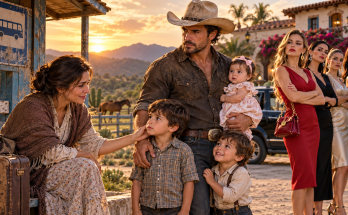
The little girl in the brown blanket was sleeping against her father's chest when I realized how frightened I had become of ordinary changes.
I wanted her to grow stronger.
I wanted her brother to keep feeding well.
I wanted Caleb to stop looking as though every quiet moment might be his children's last.
But I was also afraid.
Not of their recovery.
Of what would happen to me when they no longer needed what I could give.
I felt ashamed the moment I admitted that thought to myself.
These were two babies who had struggled to survive.
Their father had spent six weeks trying to keep them nourished after losing his wife.
I had walked three miles through the snow because I knew they needed help.
And now some selfish part of me was frightened by the idea that they might eventually manage without me.
I could hardly bear to look at myself honestly.
But ignoring the thought would not make it disappear.
I sat beside the window with Thomas's Bible resting on my knees.
I had opened it without knowing what I wanted to read.
The words remained on the page.
My thoughts kept returning to the twins.
The boy had cried loudly that morning.
I had been relieved to hear him.
His sister had fed slowly, with the same careful effort I had come to recognize.
I had watched her every movement.
Then Caleb had taken both children, and for a little while there was nothing I needed to do.
That was when the fear arrived.
What would happen when this little girl could feed without so much struggle?
What would happen when both babies were older?
What would happen when Caleb no longer needed a nursing woman?
I looked at my hands.
They were no longer as stiff and sore as they had been after my walk through the winter fields.
My body was beginning to recover from childbirth.
I had been eating more regularly.
I had allowed myself to rest.
Those were good things.
But recovery had brought another question.
Who was I when nobody needed me?
I had been Thomas's wife.
Then Ada's expectant mother.
Then a widow carrying the last part of the family I had imagined.
After Ada died, I became a woman dependent on her sister's charity.
Now I was helping Caleb feed his children.
Every place I had occupied seemed to depend on what someone else could call me.
Wife.
Mother.
Sister.
Guest.
Nursing woman.
I wondered whether there was anything left when those words were taken away.
The little boy began crying.
I looked up.
Caleb shifted the green blanket against his shoulder.
He was trying to quiet the child while keeping his daughter comfortable.
I put the Bible aside.
“Would you like me to take him?”
Caleb turned.
“If you're ready.”
I held out my arms.
He brought me his son.
The baby searched for milk almost immediately.
I settled him against my chest.
His hunger was unmistakable.
That was one thing I appreciated about him.
He did not pretend.
He did not worry whether his needs were inconvenient.
He wanted milk, and he let us know.
I had spent days at Martha's house trying not to need anything.
This tiny boy had no such hesitation.
I almost smiled.
“There you are,” I whispered.
He began feeding.
Caleb watched for a moment.
Then he looked toward the Bible.
“Were you reading?”
“Trying to.”
“I'm sorry.”
“You haven't interrupted anything important.”
He looked at the child.
“I think he might disagree.”
I smiled before I could stop myself.
It was a small smile.
Nothing remarkable.
Yet I felt it afterward.
For months, smiles had come with guilt.
Thomas had died.
Then Ada had died.
How could I find anything amusing?
But there was something quietly funny about a baby who expected the whole world to answer him immediately.
I could acknowledge that without feeling happy about what I had lost.
At least, I was trying to learn how.
The boy fed steadily.
Caleb returned his attention to the little girl.
Her breathing remained quiet.
I watched him check her face.
He noticed me watching.
“She's all right.”
“I know.”
He gave me a tired look.
“You say that, but you keep looking.”
“So do you.”
He glanced down.
“That I do.”
We had begun speaking like people who understood each other's habits.
Not perfectly.
We were still strangers in many ways.
I knew he loved his children.
I knew he missed Lydia.
I knew he was exhausted.
He knew I had lost Thomas and Ada.
He knew I was frightened of the little girl's weakness.
He knew I had walked away from Amos's authority to help him.
Those were important things.
But there was still much we did not know about one another.
And I thought perhaps that was appropriate.
We had not come together to form a new family.
We had come together because two children needed nourishment.
I needed to remember that.
After the boy finished, I held him close for a moment.
His little hand rested against my blouse.
I looked at the fingers.
I no longer counted them every time.
That surprised me.
At first, I had compared everything about the twins with Ada.
Their mouths.
Their hands.
Their breathing.
Their cries.
I had searched for my daughter in children who had never met her.
Now I was beginning to recognize the boy's movements as his own.
He was not a reminder every moment.
Sometimes he was simply himself.
I found that comforting.
Then I felt guilty for finding comfort.
I was becoming familiar with that pattern.
Relief.
Guilt.
Then the effort to remind myself that Ada was not being forgotten.
I looked toward the Bible.
Thomas's name seemed to live inside the worn cover.
I had brought it because I could not leave it behind.
Sometimes I held it just to feel something that had belonged to him.
But I had not needed to hold it every hour to remember my husband.
Why did I imagine my love for Ada worked differently?
I thought about that while the boy rested.
Then I passed him back to Caleb.
His sister began to stir.
The brown blanket moved slightly.
I rose before Caleb asked.
“Let me see her.”
He handed me the little girl.
Her face looked delicate beneath the edge of the blanket.
I settled her carefully.
She made a faint sound.
Then searched for milk.
I waited while she gathered the strength to feed.
I had become patient with those small pauses.
At first, every one had frightened me.
Now they still frightened me, but I knew how to remain calm while she tried.
That was a change.
Not in her alone.
In me.
I had learned that worry did not become useful merely because I showed it.
Sometimes the best thing I could do was hold her steadily.
Give her time.
Watch carefully.
And avoid frightening her father with every anxious thought.
She took some milk.
I felt the familiar relief.
Caleb remained nearby.
He was watching, though he tried not to make it obvious.
“She seems willing,” he said.
“Yes.”
“More than before?”
I considered my answer.
“I think she's managing better than she did that first night.”
His expression softened.
I continued before he could mistake the words for certainty.
“But I still want you to listen to the physician.”
He nodded.
“I will.”
I was relieved.
I did not want my willingness to nurse the children to become a substitute for the care they needed.
I knew too well that love could not correct everything wrong inside a baby's body.
Ada had taught me that.
I wished she had not.
But the knowledge remained.
The little girl continued feeding.
I thought about the physician who had sent Caleb searching for a nursing woman.
Without that advice, he might not have come to Amos's door.
Without hearing his voice, I might still be emptying milk onto frozen ground.
The thought made me pause.
I did not believe there was some grand design behind our losses.
I could not accept that Ada had died for the sake of someone else's children.
But I could acknowledge that one person's need had reached another person who could help.
That was enough.
I did not need to explain it as anything greater.
After the little girl rested, I remained in the chair.
Caleb took her.
I watched him settle both babies.
Then I looked down at my hands again.
He noticed.
“Are you tired?”
“A little.”
“You ought to rest.”
I smiled faintly.
“You tell me that often.”
“Because you don't always listen.”
I could not deny it.
He was right.
But this time, tiredness was not what troubled me.
I wanted to speak.
I was afraid of the answer.
Finally, I said, “Can I ask you something?”
Caleb looked at me.
“Of course.”
I glanced toward the twins.
“When they don't need nursing anymore, what happens?”
His expression changed.
He looked down at the green blanket.
Then at the brown.
I wondered whether I had been unfair to ask.
He was occupied with keeping them fed today.
The future was far beyond what he could comfortably imagine.
“I don't know,” he said.
I nodded.
It was the honest answer.
I appreciated it.
He looked back at me.
“Is that worrying you?”
I hesitated.
“Yes.”
He waited.
“I don't expect you to keep me here when there's no reason.”
His face tightened.
“That's not what I said.”
“I know.”
I felt embarrassed.
“I just don't want to assume.”
Caleb looked at the children.
Then he spoke carefully.
“They need you now.”
“Yes.”
“And you've helped them.”
“I hope so.”
He raised his eyes.
“You have.”
I wanted to believe him.
But the fear remained.
I had once belonged in a home because I was loved.
Then Thomas died.
At Martha's house, I had been allowed to remain because my sister offered charity.
Amos had made the limits clear.
I was frightened of finding myself in another household where my place lasted only as long as I was useful.
Caleb seemed to understand part of that.
He did not promise me a permanent home.
He did not speak about matters neither of us had considered.
He simply said, “We don't have to settle that today.”
I looked at the twins.
He was right.
We did not.
Their need was immediate.
The future could wait.
But I needed to learn something before it arrived.
I needed to stop believing that my worth vanished whenever I was no longer useful to someone.
That belief had followed me from Martha's farmhouse.
I had carried it three miles through the snow.
I had brought it into Caleb's home along with Thomas's Bible and my twelve cents.
And even now, while two babies depended on me, it was still there.
I thought of Ada.
She had lived for two hours and nineteen minutes.
She had never worked.
Never earned money.
Never made herself useful to anyone.
I had loved her completely.
I had not needed her to prove she deserved my arms.
The thought was so simple that I almost felt foolish for not seeing it sooner.
I had loved Ada because she was my daughter.
Because she existed.
Because she was herself.
Why was it so difficult to believe that a life had value without being measured against work?
I looked at the little girl in Caleb's arms.
She was still weak.
She could not do anything for her father except remain alive.
And he loved her.
Her brother needed constant attention.
Caleb loved him too.
There was no account being kept.
No calculation of what they contributed.
They were his children.
Their existence was enough.
I thought about how harshly I had judged myself.
How I had treated every meal as something to earn.
How I had tried to disappear inside Martha's house.
Perhaps my fear of becoming a burden had been doing more harm than I understood.
I was not ready to stop worrying.
But I was ready to question the worry.
That evening, when the twins had settled, I returned to Thomas's Bible.
I held it for a while.
I thought about the man who had shared my life.
I thought about the child whose fingers I had counted.
And I thought about the two babies sleeping nearby.
None could replace another.
None had to.
I had no guarantee that Cedar Run would remain my home.
I had no guarantee of what the coming weeks would bring.
But for the moment, I could rest without preparing myself to be sent away.
The twins needed me.
Caleb had welcomed my help.
And I was beginning to understand that even when their need changed, I would still be a person worthy of kindness.
Source: life5.aubtu.biz