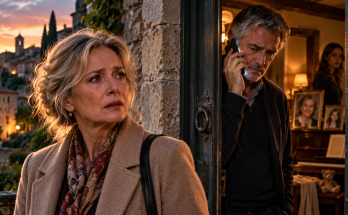
Elena remained in the doorway, one hand resting on the frame.
Daniel looked at her and immediately lowered his eyes.
Aurelio stood.
“I’m sorry,” he said. “He didn’t mean to trouble you.”
“He hasn’t troubled me.”
Elena knelt so Daniel could see her face.
“I heard what you asked.”
The boy looked uncertain.
“You don’t have to like us,” he whispered.
Elena’s expression softened.
“Oh, Daniel. I already think you’re very nice.”
“Then why are you leaving?”
“Because I came to this town for something that didn’t work out. And tomorrow I need to find somewhere I can begin again.”
The boy thought about it.
“My daddy fixes things.”
Aurelio looked away.
Elena smiled sadly.
“I’m sure he does.”
“He fixed Andrés’s truck.”
“Then he’s very good at fixing trucks.”
Daniel considered this acceptable.
He reached for his father’s hand.
Aurelio led him back toward his bedroom, giving Elena a grateful glance.
She closed the guest-room door.
But sleep did not come easily.
She kept thinking about Daniel’s serious eyes.
And about the father who had refused to make promises simply to keep her under his roof.
The next morning, Elena woke early.
She found the kitchen empty and began preparing coffee.
When Aurelio entered, she was arranging bread in a basket.
“You weren’t obliged to do that.”
“I know.”
“Then why?”
“Because I was awake.”
He smiled.
Soon the kitchen filled with noise.
Andrés arrived with his shirt backward.
Daniel corrected his younger brother’s account of a dream.
Sofía dropped her spoon repeatedly and laughed each time someone retrieved it.
Elena retrieved it twice.
On the third occasion, she placed it beyond the baby’s reach.
Sofía stared at her with enormous indignation.
Aurelio laughed so suddenly that Beatriz stopped pouring coffee.
“What?” he asked.
“Nothing,” his sister replied.
But she was smiling.
At nine o’clock, Aurelio carried Elena’s suitcase to the truck.
Daniel followed.
He stood beside the rear tire.
“Goodbye, Elena.”
“Goodbye, Daniel.”
He put both hands in his pockets, copying his father’s usual posture.
Then he turned away.
Elena climbed into the passenger seat before anyone could see her eyes filling.
The drive toward town passed quietly.
They were approaching the church when Elena noticed a white building beside the road.
A notice near the entrance advertised a vacancy at San Miguel Community School.
“Would you stop?” she asked.
Aurelio pulled over.
“Something wrong?”
“No. Perhaps something right.”
She hurried toward the school.
Aurelio remained in the truck.
Ten minutes passed.
Then twenty.
He began wondering whether he should go inside.
But Elena had asked him to wait, and he intended to honor that.
Nearly an hour later, she emerged carrying several papers.
Her expression had changed.
“What happened?” he asked.
“They need an administrative assistant.”
“And?”
“I start Monday.”
Aurelio grinned.
“Then congratulations are in order.”
Elena laughed.
For the first time since he met her, there was no sorrow beneath it.
Then her smile faded.
“I still need somewhere to live.”
Aurelio thought of the small cottage near the Los Laureles gate.
It had belonged to an estate administrator years earlier.
The rooms were modest but sound.
The cottage had its own entrance, kitchen, and porch.
“There may be a place available,” he said.
Elena studied him.
“At the ranch?”
“Yes.”
“I’d pay rent.”
“That wouldn’t be necessary.”
“Then I should look elsewhere.”
Aurelio nearly laughed.
“You drive a hard bargain, Mrs. Bustamante.”
“I need to know I can support myself.”
He nodded.
“Then we’ll agree on a fair rent.”
“And a proper arrangement.”
“Of course.”
For a moment, they looked at one another.
Then Elena smiled.
“Very well.”
By Sunday afternoon, the cottage was ready.
Beatriz helped clean it.
Andrés climbed into an empty packing box and refused to come out.
Sofía slept through most of the work.
Daniel disappeared with his aunt for nearly an hour.
When he returned, he carried a small green glass vase.
He approached Elena carefully and held it out with both hands.
“This is for your house.”
Elena accepted it.
“It’s beautiful.”
Daniel studied the floor.
“So you won’t be lonely.”
She had believed the worst part of her journey was arriving in Jalisco and discovering no one wanted her.
Now a five-year-old boy was giving her something he had chosen himself because he did not want her to feel alone.
Elena set the vase in the kitchen window.
“Thank you, Daniel.”
He nodded.
Then he looked at Aurelio.
“She’s staying?”
“For now,” his father answered.
Daniel seemed satisfied.
But that evening, as the children returned to the main house, Beatriz caught Aurelio watching the light in Elena’s cottage.
“You like her,” she said.
Aurelio frowned.
“She’s our tenant.”
“Of course.”
“And she’s starting a new job.”
“Certainly.”
“And she has enough trouble without anyone making assumptions.”
Beatriz crossed her arms.
“Then why have you checked that cottage window six times?”
Aurelio looked away.
Before he could answer, a telephone rang inside the house.
Beatriz went to pick it up.
When she returned, her expression had changed.
“That was Leonor Alcázar.”
Aurelio sighed.
“What does she want?”
“She says she’s coming to visit.”
“Then she can call first.”
“She also mentioned that her father chairs the board overseeing San Miguel School.”
Aurelio looked toward the cottage.
Beatriz continued quietly.
“And she’s been asking who the strange woman is who’s living on your property.”
At that very moment, Elena emerged onto her porch, holding Daniel’s green vase as she searched for the best place to catch the evening light.
Aurelio watched her turn it carefully between her hands.
He had offered a stranger one night’s shelter.
Now he understood that her new beginning could become entangled with the judgment of people who believed his money gave them a right to decide whom he welcomed.
He started toward the cottage to tell her what Beatriz had heard.
Aurelio crossed the narrow stretch of yard between the main house and Elena’s cottage.
She was placing the green vase on the windowsill when she noticed him approaching.
“Is everything all right?”
“Yes. But there’s something I think you ought to know.”
She waited.
“A woman named Leonor Alcázar has been asking about you. Her father serves on the board that oversees San Miguel School.”
Elena set down the vase.
“Why would she ask about me?”
Aurelio hesitated.
“We knew each other socially. My sister introduced us some months ago. Leonor was interested in marriage.”
“And you weren’t?”
“Not on the terms she wanted.”
Elena did not ask for details.
But Aurelio decided she deserved them.
“She wanted my children to live with their grandmother in Guadalajara while we began married life.”
Elena stared at him.
“All three?”
“Yes.”
“For how long?”
“A few years.”
Elena looked toward the big house.
Through a distant window, Andrés could be seen chasing Daniel around the dining table while Beatriz tried to settle Sofía.
“They live here,” Elena said.
“They do.”
“And she wanted to move them elsewhere?”
“She thought it would make marriage easier.”
Elena was quiet.
Then she asked, “Did she ever learn their names?”
Aurelio looked at her.
“Yes. But I don’t think she ever understood who they were.”
Elena folded her arms.
“Then I imagine she and I have very little in common.”
He smiled despite himself.
“I suspect that’s true.”
He explained that Leonor’s father had influence over the school, although he had no reason to believe Elena’s appointment was improper.
“If anyone questions your hiring,” he said, “you can answer them with your work.”
“I intend to.”
“And you needn’t worry about the cottage. Your agreement is with me.”
Elena appreciated his assurance.
But she also understood that small towns had long memories, and that the appearance of a strange woman living on a wealthy rancher’s land could invite curiosity.
“I’d rather no one believe I received the school position because of you,” she said.
“Neither would I.”
“Then whatever happens, please don’t interfere with my employment.”
Aurelio nodded.
“You have my word.”
***
The first weeks at San Miguel School gave Elena something she had almost forgotten she possessed.
Confidence.
Doña Adela Solano, the school director, was a stern woman whose sharp voice concealed a generous heart.
She placed Elena in charge of disordered files, enrollment records, and an office where years of papers had accumulated.
Elena worked with quiet determination.
She organized the archives, corrected registers, and began gathering donated books for a small lending library.
At first, there were only nine volumes.
The children treated them like treasures.
A month later, there were more.
Doña Adela watched Elena carefully.
“You’ve done more with those dusty shelves in four weeks than we’ve managed in two years.”
Elena smiled.
“I had some experience organizing school records in Aguascalientes.”
“Well, you brought it with you, and I’m grateful.”
Every afternoon, Elena walked back toward Los Laureles.
Sometimes Aurelio happened to be driving through town.
Often, his truck appeared just as she finished work.
After the fourth coincidence, Elena looked into the empty truck bed.
“Buying supplies again?”
Aurelio cleared his throat.
“Had business nearby.”
“Interesting.”
“What is?”
“How your business always seems to finish at exactly the same hour.”
He laughed.
It became a private joke between them.
Soon Elena was spending Saturday evenings at the main house.
She did not attempt to take Beatriz’s place in caring for the children.
She did not enter the household giving orders.
She simply became someone they enjoyed seeing.
Andrés brought her his wooden truck whenever something came loose.
Daniel liked sitting beside her while she sorted books.
Sofía reached toward her with both arms and became indignant whenever Elena was too slow to pick her up.
Aurelio watched these small changes with growing affection.
He had spent months searching for a woman willing to tolerate his children.
Elena seemed to enjoy them without treating their company as a favor to him.
There was another difference.
She had work she cared about.
She paid her rent.
She maintained her own home.
And when Aurelio offered unnecessary gifts, she declined them with such gentle firmness that he learned to stop offering.
He began asking instead whether she would like to accompany him and the children on an outing.
Sometimes she said yes.
Sometimes she was busy.
He learned to appreciate both answers.
***
Not everyone welcomed Elena.
At the market, conversations occasionally stopped when she approached.
At church, certain women watched her with open curiosity.
One afternoon, she heard someone refer to her as the woman Aurelio had picked up beside the road.
She kept walking.
But the words followed her.
When Doña Adela noticed her distraction at school, she invited her to sit.
“Someone’s been talking,” the older woman said.
Elena smiled weakly.
“It’s a small town.”
“That’s no excuse for unkindness.”
She leaned forward.
“Do your work well. Keep your papers in order. And don’t let people who know nothing about you decide what kind of person you are.”
Elena nodded.
But that warning soon became more important than either woman expected.
Leonor arrived at Los Laureles in a spotless white pickup.
She stepped onto the veranda wearing an elegant gray dress and an expression Aurelio recognized immediately.
She had come to inspect something.
“Aurelio,” she greeted him. “I thought we might speak.”
He offered her coffee.
They sat outside beneath the shade.
Leonor began by saying she had reconsidered their earlier conversations.
Perhaps, she admitted, she had been too blunt about the children.
“But surely you understand what I meant. They’re terribly young. Your mother could care for them in Guadalajara while we establish a household.”
Aurelio set down his cup.
“No.”
“You haven’t even considered it.”
“I considered it the first time you suggested it.”
Leonor’s smile tightened.
Then Elena crossed the courtyard with Sofía in her arms.
Andrés walked beside her, carrying his wooden truck.
Leonor followed them with her eyes.
“Who is that?”
“A friend.”
“She lives here?”
“She rents the cottage near the gate.”
“And carries your baby?”
“Sofía likes her.”
Leonor looked back at Aurelio.
“My father chairs the school board, you know.”
“I know.”
“People will ask questions about a woman from another town suddenly receiving a position at San Miguel.”
“Then they can examine her qualifications.”
Leonor stood.
“I only want what’s best for you.”
Aurelio rose as well.
“What’s best for me includes my children.”
He walked her to the truck.
She left without saying goodbye to Elena.
That night, Beatriz found her brother on the veranda.
“What did Leonor want?”
“The same thing she’s always wanted.”
“And?”
“She received the same answer.”
Beatriz looked toward the cottage.
“You’d better decide what you want before somebody else decides it for you.”
***
Aurelio’s birthday came at the end of September.
Beatriz organized a celebration despite his protests.
Elena helped prepare food.
Andrés covered himself in flour while attempting to knead dough.
Daniel counted the napkins four times, producing a different total on each attempt.
Sofía spent the afternoon striking two wooden spoons together.
By sunset, the courtyard glowed with strings of lights.
Ranch hands brought their families.
Music floated from the veranda.
For the first time in years, Aurelio looked around his own home and felt no desire to escape into work.
Daniel sat on his knee.
Andrés played near the table.
Sofía slept against Elena’s shoulder.
Beatriz was laughing with neighbors.
The picture was so ordinary that it almost frightened him.
He had begun wanting it to last.
Then headlights swept across the courtyard.
A white pickup entered.
Leonor stepped out, followed by her father, Don Ernesto Alcázar.
The music faltered.
Leonor approached carrying a bundle of envelopes.
“Happy birthday, Aurelio.”
He stood.
“Leonor, what is this?”
“Something I believe everyone should understand.”
She turned toward Elena.
“A few weeks ago, I visited a merchant named Hilario Mendieta.”
Elena went completely still.
Leonor continued.
“He told me about a woman who traveled from Aguascalientes expecting to marry him.”
Beatriz put down her glass.
Aurelio’s expression hardened.
“He changed his mind,” Leonor said. “And this woman arrived in our town with nowhere to go.”
She held up the letters.
“I thought everyone ought to know the circumstances under which Mrs. Bustamante came to Jalisco.”
Silence settled over the courtyard.
Elena felt every eye turn toward her.
Then Aurelio spoke.
“I knew.”
Leonor blinked.
“Excuse me?”
“She told me everything the first evening we met.”
“You knew she came here for another man?”
“Yes.”
“And you still brought her into your house?”
“I offered her a safe room for the night.”
He paused.
“And I would do it again.”
Leonor looked around as though expecting support.
Aurelio continued.
“Elena did nothing dishonest. She traveled here believing she had a future with someone who later decided otherwise. That’s painful, but it isn’t shameful.”
His voice remained calm.
“What is shameful is using another person’s disappointment to embarrass her before people who have gathered to celebrate a birthday.”
Beatriz rose.
“Well said.”
Leonor gathered her envelopes.
Her expression had turned pale.
Don Ernesto approached Elena before leaving.
His voice was courteous.
“The school board will review the qualifications surrounding your appointment next month.”
Elena lifted her chin.
“Of course, señor. My papers are in order.”
“We shall see.”
Then he followed his daughter to the truck.
The celebration ended early.
Later, Elena found Aurelio standing near the kitchen.
“You didn’t have to defend me publicly,” she said.
“Yes, I did.”
“People will talk.”
“People were already talking.”
He softened his voice.
“Your past isn’t a disgrace, Elena.”
She looked at him.
“I know. But hearing you say it before everyone mattered.”
He wanted to tell her much more.
Instead, he asked whether she would like him to walk her home.
She smiled.
“Yes.”
***
Over the following weeks, Elena assembled her professional records.
Doña Adela helped collect certificates, references from her former school in Aguascalientes, and the documents authorizing her employment.
They prepared the library’s lending records.
By then, the little collection had grown to seventeen books.
Parents signed statements describing the improvements Elena had made.
All of it was ordinary administrative work.
Yet Elena understood that her future could depend on being able to defend what she had earned.
During those weeks, Aurelio continued inviting her to spend time with the children.
They visited the peach orchard.
They watched the sunrise from a hillside.
They shared meals and conversations that neither wanted to end.
But Elena also began wondering whether her presence was creating hardship for people who had shown her kindness.
The town gossip.
The school review.
Leonor’s hostility.
Aurelio’s strained relationship with old acquaintances.
One evening, Elena wrote to her cousin in Guadalajara, asking whether a spare room remained available.
She placed the unfinished letter in her desk drawer.
Beside it stood Daniel’s green glass vase.
She looked at the vase for a long time.
***
A few days later, Hilario Mendieta came to San Miguel School.
Elena found him waiting near the church.
For a moment, she could hardly believe it.
“Hilario?”
He removed his hat.
“I came to apologize.”
They sat on a bench in clear view of the town square.
Hilario told her that Leonor had approached him, asking questions about their correspondence and suggesting he might try to reclaim Elena’s affection.
“I realized how badly I’d behaved,” he admitted. “I let you make that journey and then withdrew from our plans when it was too late for you to avoid the hurt.”
Elena listened.
He looked ashamed.
“You did nothing wrong, Elena. I told Leonor that. I came because I wanted you to hear it from me.”
“Thank you.”
“Would you ever consider—”
He stopped.
Elena shook her head gently.
“No, Hilario.”
He nodded.
“I thought not.”
They parted without anger.
For Elena, it felt as though a door that had been rattling in the wind for months had finally closed.
What she did not know was that Aurelio had seen them from his truck.
He had been passing through town and noticed Elena sitting beside an unfamiliar man.
He did not stop.
For two days, he avoided his usual trips past the school.
On the third, Elena found him repairing a fence near the small corral.
“Your truck must be broken,” she said.
Aurelio looked up.
“Why?”
“It hasn’t appeared outside the school lately.”
He set down the hammer.
“I saw you speaking to someone near the church.”
“Hilario.”
Aurelio nodded slowly.
“He came to apologize.”
“And?”
“And I wished him well.”
She studied his face.
“That’s all, Aurelio.”
He looked ashamed.
“I should have asked instead of making assumptions.”
“Yes,” she said gently. “You should have.”
Then she smiled.
“But you can begin again by walking me to the house. Beatriz says supper is ready.”
He laughed.
And followed her.
***
The school-board meeting came the following Tuesday.
Don Ernesto reviewed Elena’s credentials before the assembled trustees.
Doña Adela presented the records.
The references were complete.
The appointment had been properly authorized.
There was no legitimate basis for removing her.
Don Ernesto signed the confirmation.
“Mrs. Bustamante’s employment is ratified.”
Applause rose from the back of the room.
Elena felt relief sweep through her.
She had kept her position because she had earned it.
Outside, Leonor confronted Aurelio once more.
She admitted approaching Hilario.
She defended her actions as an attempt to protect Aurelio from making a mistake.
Then she repeated her offer.
Marriage.
Comfort.
A respected social position.
But only if his children lived elsewhere for several years.
Aurelio looked at her.
“My children aren’t the price of any marriage.”
Leonor stiffened.
“I’m trying to offer you a future.”
“I already have a family. I won’t begin another by sending them away.”
The words carried across the church courtyard.
Leonor looked toward her father.
Don Ernesto, standing on the steps, said nothing.
Then she walked to her truck and drove away.
Elena had heard everything.
But instead of feeling certain about her place in Aurelio’s future, she felt more deeply aware of the complications her arrival had caused.
Two days later, she finished her letter to Guadalajara.
She sealed the envelope.
Then she went to the little cottage and began sorting the belongings she would take.
***
On Sunday afternoon, Aurelio came to visit.
Elena sat on the porch sewing a loose button.
The green vase stood in the window.
He climbed the steps.
“You haven’t been to supper.”
“I’ve been busy.”
“Three evenings?”
She lowered her needle.
“Aurelio, I’m going to Guadalajara.”
He stopped.
“When?”
“At the end of the month.”
“Why?”
“Because your family has been good to me, and I can’t bear the thought of becoming the reason they suffer more trouble.”
He stood in silence.
Elena rose.
“I came here because a bus had already left. You showed me kindness when I had nothing. Beatriz welcomed me. Your children trusted me.”
Her voice trembled.
“But you have a life here, Aurelio. And I don’t want to become another difficulty you must manage.”
He took off his hat.
“You aren’t a difficulty.”
“Perhaps not. But everything became complicated after I arrived.”
He searched for something to say.
“I won’t stop you from leaving,” he answered finally.
Elena looked wounded.
Then she nodded.
“Thank you.”
Aurelio walked back to the truck.
He had respected her decision.
But as he drove toward the main house, he realized he had failed to tell her the one thing she had most needed to know.
He had never asked her to stay because he loved her.
And unless he found the courage to speak, she would leave believing she had never been wanted.
Aurelio parked outside the main house and remained behind the steering wheel.
Through the kitchen window, he could see Beatriz feeding Sofía.
Andrés was leaning over the back of a chair.
Daniel sat at the table drawing with colored pencils.
Everything looked as it always had.
Yet the thought of Elena leaving made the familiar scene feel strangely incomplete.
He entered quietly.
Beatriz took one look at him.
“What happened?”
“Elena’s going to Guadalajara.”
She set down the spoon.
“When?”
“End of the month.”
“And what did you say?”
“That I wouldn’t stop her.”
Beatriz closed her eyes.
“Aurelio.”
“What else could I say? It’s her decision.”
“Of course it’s her decision. But does she know what yours is?”
He looked away.
Beatriz handed Sofía to a nearby family helper and took her brother into the dining room.
“Sit down.”
He obeyed.
For once, she seemed determined not to tease him.
“Do you remember when I introduced you to all those women?”
“Yes.”
“And the list you made?”
“Yes.”
“Every one of those women admired something about you. Your ranch, your position, your house. Some genuinely liked you.”
Aurelio nodded.
“But the moment they understood how much of your life belonged to Daniel, Andrés, and Sofía, they began looking for ways to make the children less present.”
He said nothing.
Beatriz leaned closer.
“Then a woman arrived with a suitcase that weighed almost nothing. She didn’t know how much land you owned. She didn’t know how respected you were. She only knew you had three children.”
Aurelio remembered the bus stop.
The fading sunlight.
Elena’s exhausted face.
And her unexpected question.
What are their names?
Beatriz continued.
“She didn’t come here looking for a wealthy husband. She found work. She pays rent. She has a life of her own.”
“I know.”
“And she loves those children.”
He nodded.
“Then stop looking for a woman who might someday learn to tolerate your family.”
Aurelio looked up.
“She’s already here.”
The room fell silent.
At last, he said, “What if I tell her how I feel and she says no?”
Beatriz’s expression softened.
“Then she says no, and you respect it. But at least she’ll know you asked.”
He lowered his eyes.
“I’ve been afraid of asking anyone for something that matters.”
“Then perhaps it’s time you did.”
***
That night, Aurelio entered his study.
The house had grown quiet.
Daniel was asleep.
Andrés had finally surrendered after insisting he wasn’t tired.
Sofía rested in her crib.
Aurelio opened the bottom drawer of his desk.
He removed the folded list.
For months, it had represented his attempt to find a wife through sensible qualifications.
He spread it beneath the lamp.
A suitable family.
Good manners.
Comfortable in the countryside.
Able to manage social responsibilities.
Prepared to accept three young children.
He read the lines slowly.
Then he took out a pen.
One by one, he crossed them out.
He paused at the final requirement.
Prepared to accept three young children.
He remembered Leonor suggesting that his mother could raise them in Guadalajara.
He remembered the other women who had seemed disappointed when he mentioned their ages.
And he remembered Elena kneeling in front of Daniel without demanding a smile.
He crossed out the final line twice.
Then he wrote something different beneath it.
Not a qualification concerning wealth or manners.
A truth he had taken months to understand.
He folded the paper carefully.
***
On Monday afternoon, Elena was arranging clean clothes in the cottage when she heard Aurelio’s pickup.
She looked through the kitchen window.
He stood beside the truck holding his hat in one hand and the folded paper in the other.
He appeared more nervous than the day he had offered her shelter.
Elena opened the door.
“Good afternoon.”
“May I come in?”
“Of course.”
He entered but did not sit.
She noticed his expression.
“Has something happened to the children?”
“No. They’re fine.”
“Then what is it?”
Aurelio looked at the paper.
“I’ve come to tell you something I should have told you yesterday.”
Elena waited.
He held it out.
“My sister persuaded me to write this list months ago.”
She unfolded it.
Every original requirement had been crossed out.
She read them slowly.
Then she reached the final handwritten sentence.
A woman who understands that my children do not need to be merely accepted; they deserve to be loved.
Elena stared at the words.
Aurelio took a breath.
“I spent months meeting women who wanted to know what I could offer them.”
He smiled faintly.
“And I answered those questions as best I could. Then sooner or later, the children came into it.”
Elena looked up.
“I remember.”
“Some women thought the children made marriage too difficult. Others suggested arrangements that would have separated us.”
He shook his head.
“I began thinking I needed to find someone willing to accept them.”
Elena held the paper carefully.
“Then you arrived,” Aurelio continued.
“You were hurt, stranded, and trying to figure out where your life would go. Yet the first thing you asked after I told you about my children was their names.”
Her eyes filled.
“You’ve never treated them as obstacles, Elena.”
“They’re wonderful children.”
“They are.”
Aurelio stepped closer but left a respectful distance between them.
“Daniel watches the road for you after school.”
She smiled through her tears.
“Andrés brings you every broken toy in the house, even when I could fix it.”
“He likes to supervise repairs.”
“He certainly does.”
Aurelio laughed softly.
“And Sofía reaches for you before you’ve even crossed the room.”
He stopped.
“Then there’s me.”
Elena looked at him.
“I’ve been finishing work earlier for months. I told myself the children needed me home sooner.”
“They do.”
“Yes. But that isn’t the whole reason.”
His voice grew quieter.
“I wanted to see you.”
Elena pressed the folded paper against her chest.
“I look forward to the days you come for me,” he admitted. “The conversations on the veranda. The way you tell me when I’m wrong. The way you laugh when Andrés invents another story nobody understands.”
She wiped her cheek.
“Aurelio.”
“Please let me finish. I’m not very practiced at this.”
She nodded.
“For a long time, I believed my life was already settled. I had the children, the ranch, and responsibilities enough to fill every hour.”
He glanced toward the window.
“And I was grateful. Truly. But I had forgotten I might still look forward to another person’s company simply because I loved being near her.”
Elena’s lips trembled.
“I don’t want you to remain here because you’re afraid my children will miss you,” he continued.
“Nor because you feel you owe me anything for helping you that first evening.”
He took another breath.
“I want you to stay only if you want a life with me.”
The cottage was silent.
Aurelio looked into her eyes.
“I love you, Elena.”
She closed her eyes.
He waited.
When she opened them again, tears were running down her cheeks.
“I’ve tried not to love you,” she whispered.
Aurelio gave a small, astonished laugh.
“Have you?”
“Yes.”
“Why?”
“Because the last time I believed a man wanted to marry me, I gave up everything and arrived to discover he’d changed his mind.”
Her voice broke.
“I couldn’t bear doing that again.”
Aurelio listened without interruption.
“I found work here,” she continued. “I found a home I could pay for myself. And then somehow I found a family who made me want to come back every afternoon.”
She looked at him.
“I was frightened that loving you would put everything at risk.”
He stepped a little closer.
“Then whatever happens between us, Elena, your work remains yours. You needn’t abandon it. You don’t have to give up your independence.”
She smiled sadly.
“And the children?”
“The children are my responsibility. I hope you’ll love them, and I hope they’ll continue loving you. But I would never expect you to replace their mother.”
Elena shook her head.
“I wouldn’t want to.”
“I know.”
He hesitated.
“There’s something else I’d like to ask.”
She laughed softly through her tears.
“After all this, there’s more?”
“One question.”
“Ask.”
Aurelio took both her hands.
“Elena Bustamante, would you marry me?”
She looked at him for a long moment.
Then she smiled.
“Yes.”
He stood completely still.
“Yes?”
“Yes, Aurelio.”
He laughed with such relief that she began laughing too.
Then he drew her into his arms, gently enough that she could step away if she wished.
She held him tightly.
For the first time since she had climbed off the bus expecting a life with Hilario Mendieta, Elena felt that her future belonged entirely to her own choice.
***
On the short drive back to the main house, they tried to decide how to tell the children.
“Andrés won’t understand,” Aurelio said.
“He’ll understand that everyone’s happy.”
“Sofía will probably clap because everyone else is making noise.”
“And Daniel?”
Aurelio thought about his eldest son.
“He’ll ask whether you’re staying.”
Elena looked toward the house.
“Then I’ll tell him.”
Beatriz was waiting on the veranda with Sofía in her arms.
She tried to look surprised when the truck stopped.
She failed.
Andrés came running first.
“Elena!”
He wrapped both arms around her legs.
Sofía immediately began reaching toward her.
Then Daniel appeared in the doorway.
He stopped on the top step.
Elena crouched, just as she had the first evening they met.
“Daniel, I have something to tell you.”
He watched her carefully.
“I’m not going to Guadalajara.”
His eyes widened.
“You’re staying?”
“Yes.”
“With us?”
“If you’d like that.”
The little boy looked at his father.
Then back at Elena.
“You already belong with us.”
Elena covered her mouth.
Aurelio knelt beside them.
“Daniel, Elena and I are going to get married.”
The boy considered the announcement.
“Will she still work at the school?”
“Yes,” Elena answered.
“Will she still read with me?”
“Whenever we can.”
He nodded.
“Good.”
Then he stepped forward and hugged her.
Andrés immediately joined them, though he had no idea what had been decided.
Sofía squealed from Beatriz’s arms.
The older woman finally began to cry.
Aurelio looked at his sister.
“Are you crying?”
“Absolutely not.”
He grinned.
“Of course.”
***
The following months brought the ordinary work of combining two lives.
Elena continued at San Miguel School.
The little library grew beyond its original shelf, and the children’s enthusiasm brought more book donations from families throughout the district.
Doña Adela remained her fiercest supporter.
“You’ll continue working after the wedding?” she asked one afternoon.
“Of course.”
“Good. I’d hate to train someone else.”
Elena laughed.
The cottage remained hers until she chose to move into the main house after the marriage.
She and Aurelio discussed the household carefully.
Beatriz would continue visiting because she loved her nieces and nephews, not because Elena needed to replace her.
Aurelio remained responsible for the ranch and for the children’s daily care.
Elena wanted to be part of their family, but not to become an unpaid servant whose only duty was maintaining everyone else’s happiness.
Aurelio understood.
They spoke honestly about money, work schedules, and the children’s routines.
Sometimes the conversations were awkward.
But they discovered that affection became stronger when neither person had to conceal what mattered.
Daniel liked helping Elena arrange books.
Andrés preferred accompanying Aurelio to the workshops.
Sofía grew more confident on her feet and began wandering from room to room, determined to investigate everything.
Nothing in the household suddenly became perfect.
There were still broken toys.
Sleepless nights.
Children who refused vegetables.
Ranch problems requiring Aurelio’s attention when he would rather have remained at home.
And sometimes Elena felt tired after spending a full day organizing school records.
But the life they were building did not require perfection.
Only patience and a willingness to keep choosing one another.
***
They married in March at the small chapel near Los Laureles.
Beatriz organized the celebration.
The ranch hands helped set tables beneath the trees.
Neighbors brought food.
Doña Adela arrived carrying a carefully wrapped gift for the couple and news that the school library now contained forty books.
Andrés lost one shoe before the ceremony.
Aurelio searched for it beneath the benches.
Miguel, one of the ranch hands, finally suggested the boy might have hidden it himself.
Andrés denied everything with great conviction.
The shoe never appeared.
Sofía fell asleep halfway through the service.
Daniel remained solemn and alert, apparently determined to make certain his father did not forget any important words.
When Elena walked toward the altar, Aurelio looked at her with the same quiet wonder he had felt the day she asked his children’s names.
Their vows were simple.
They promised to care for one another, respect the family they already had, and build a future in which no one needed to disappear to make room for someone new.
Afterward, there was music beneath the laurel trees.
Beatriz cried again.
This time, no one pretended not to notice.
At sunset, Elena stood beside Aurelio watching the children play.
Daniel was explaining rules to Andrés.
Andrés was ignoring them.
Sofía was laughing at both.
Aurelio slipped his hand into Elena’s.
“Are you happy?”
She looked at the family gathered beneath the trees.
“Yes.”
He smiled.
“So am I.”
***
There was little more heard from Leonor Alcázar.
She moved to Monterrey later that year.
One December, a Christmas card arrived without a return address.
Inside was a short wish that Aurelio would someday understand how fortunate he was.
Elena placed the card away without resentment.
She had learned that people sometimes carried old wounds into decisions that hurt others.
It did not excuse their behavior.
But it helped her leave bitterness behind.
The children grew.
Daniel remained thoughtful and quiet.
Andrés continued telling stories that grew more elaborate every year.
Sofía learned to speak clearly and called Elena by her name with affection.
Nobody required her to use another.
Elena had not come to Los Laureles to replace the children’s mother.
That woman remained part of their history, remembered through photographs and stories Aurelio told when the children asked about her.
Elena entered their lives as someone new.
Someone who loved them.
And over time, that love became as ordinary and necessary as the familiar sound of their father’s truck returning at dusk.
The house did not become whole because Elena repaired something broken.
It had never been broken in the way outsiders imagined.
It had contained grief, certainly.
It had contained difficult responsibilities and moments of loneliness.
But it had also contained affection, laughter, and a father who refused to abandon his children.
Elena simply found a place within it.
And the family discovered that loving someone new did not diminish anyone who had come before.
***
The green glass vase remained in the kitchen window.
Daniel had chosen it for Elena when he was five because he worried she would be lonely.
She kept it through moves, repairs, and years of family life.
One anniversary, Aurelio filled it with flowers from the orchard.
He arranged them so badly that Elena laughed and rearranged every stem.
Afterward, they often left it empty.
It no longer needed flowers to remind her why it mattered.
Its value came from the little boy who had given it without asking for anything in return.
And sometimes, when the afternoon sun shone through the green glass, Elena remembered the woman she had been on the day she arrived in Jalisco.
Alone.
Ashamed.
Certain she had made a terrible mistake.
She wished she could tell that younger version of herself that the end of one promise was not the end of every possibility.
But perhaps that was something life had to teach her slowly.
***
Many years later, Aurelio and Elena drove along the road where they had first met.
Their children were grown.
Los Laureles remained a working estate, though Aurelio had begun passing more responsibilities to the next generation.
The fields were green after the summer rain.
Near a bend in the road, they passed an old bus stop.
The tin roof had rusted.
The wooden bench leaned slightly to one side.
Aurelio slowed the pickup.
Elena smiled.
“Don’t tell me.”
He pulled over.
“I almost kept driving that afternoon.”
“You’ve told me a hundred times.”
“Ten seconds,” he insisted. “Another ten seconds, and I might never have stopped.”
Elena laughed.
They got out.
She walked toward the bench and sat where she had sat years earlier, holding a suitcase that contained almost everything she owned.
Aurelio stood beside her.
“What were you thinking that afternoon?” he asked.
Elena looked down the empty road.
“That I’d made the worst mistake of my life.”
“Coming to Jalisco?”
“Yes.”
She smiled faintly.
“I’d given up my room and my furniture. I’d traveled all that way because I believed a man wanted to marry me.”
She looked toward the hills.
“When Hilario refused, I thought it proved something terrible about me. That I was foolish. That I had hoped for too much. That no one would want a woman starting over at thirty-eight.”
Aurelio sat beside her.
“And then?”
“Then a stranger stopped his truck and told me the last bus was gone.”
He smiled.
“I remember.”
“He offered me a room. I wasn’t sure whether to trust him.”
“A sensible woman.”
“An exhausted one.”
They laughed.
Elena reached for his hand.
“I thought coming here had been the mistake,” she said. “But it wasn’t. Believing that one man’s rejection determined my worth—that was the mistake.”
Aurelio held her fingers gently.
“For months before I met you, I wondered whether any woman could love a man with three small children.”
“And?”
“I was asking the wrong question.”
Elena looked at him.
“My children were never an obstacle to happiness. They were already the finest part of my life.”
She smiled.
“And I was fortunate enough to meet them.”
Aurelio nodded.
“You were the first person who asked their names before asking anything about my money or my house.”
“I had already seen enough men make promises about a future they weren’t prepared to share.”
He laughed softly.
“And what did you see in me?”
Elena pretended to think.
“A very serious rancher with a dusty hat.”
“Anything else?”
“A man who loved his children more than his pride.”
Aurelio looked at her.
“And I thought,” she continued, “that any man who could love them that well might still have some kindness left for another person.”
They sat quietly while a breeze moved through the grass.
No bus appeared.
No traveler waited beside the road.
The afternoon was ordinary.
Yet Aurelio reached for Elena’s hand with the same care he had shown when she first accepted his offer of help.
He had never needed a woman who would rescue him from fatherhood.
He had needed someone who could share a life already full of love.
And Elena had never needed a wealthy rancher to save her from rejection.
She had needed the chance to build a future that belonged to her, with work she valued, choices she controlled, and people she freely loved.
They rose from the bench.
Aurelio opened the passenger door.
Elena glanced back at the lonely bus stop.
Once, she had sat there believing nobody was coming.
Now she understood that her life had not begun when a man stopped to help her.
It had begun changing when she realized she was still allowed to hope.
She climbed into the truck.
Aurelio took his place behind the wheel.