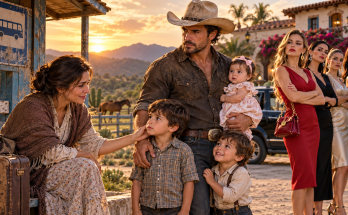
I learned more about Caleb Foster by watching him with his children than I could have learned from asking questions.
He was careful.
Sometimes too careful.
He checked their blankets repeatedly.
He listened whenever one of them moved.
And when the little girl went quiet, his whole face changed.
I knew that look.
I had worn it myself.
I did not need to ask what he was thinking.
He was afraid of another death.
The fear seemed to follow him from one small task to the next.
He could sit with both babies resting against him and still appear unable to relax.
Sometimes he looked at them with an expression I could not easily name.
Love.
Exhaustion.
Disbelief.
All of it seemed to be there.
I wondered whether he had imagined being a father like this.
Surely he and Lydia had expected their children to arrive into a very different household.
I imagined the two of them waiting for the twins.
Perhaps they had spoken about how much work two infants would require.
Perhaps they had worried about ordinary things.
Sleep.
Food.
Clothes.
The demands of running Cedar Run Ranch while raising children.
I could not know what they had said.
I had never met Lydia.
And I did not want to invent a version of her simply to make sense of the house.
But her absence was impossible to ignore.
It was there every time Caleb needed another pair of hands.
It was there whenever both babies cried at once.
It was there when he looked toward me, uncertain whether he should ask for help.
He had lost his wife six weeks earlier.
Six weeks.
I kept returning to that number.
It was hardly any time at all.
And yet he had already been required to live an entire new life without her.
I knew something about that.
Thomas had been dead five months.
People sometimes spoke as though five months ought to have changed me.
As though the passage of time automatically taught a person how to be alone.
It had not.
I still remembered his death whenever I saw his Bible.
I still thought of him whenever someone mentioned a road or a wagon.
I still wondered what he would have said if he had been beside me.
I could not imagine Caleb feeling much differently about Lydia.
One afternoon, while the babies were resting, I found him staring at his daughter's brown blanket.
He had been adjusting its edge.
Then he simply stopped.
I recognized the stillness.
It was the sort that came when the mind traveled somewhere the body could not follow.
I did not interrupt immediately.
I had learned that grief sometimes needed a moment of privacy.
Then the little girl moved.
Caleb returned his attention to her.
He adjusted the blanket again.
I was sitting nearby.
“She's comfortable?” I asked.
He nodded.
“I think so.”
I watched him.
His daughter was still weaker than her brother.
We both knew that.
But she had continued trying to feed.
Every attempt mattered.
I wanted to ask Caleb whether the physician had expected her to recover once she received enough milk.
I wanted certainty.
But the physician was not there to answer.
I had no right to turn my guesses into promises.
So I watched the baby instead.
She moved her mouth slightly.
I felt relief.
Caleb noticed.
“You keep watching her.”
“So do you.”
He gave a faint, tired smile.
“I suppose I do.”
I looked down at my hands.
“I can't help it.”
He did not ask why.
He already knew about Ada.
He knew how I had watched her struggle to breathe.
He knew how little time I had been given.
Perhaps he understood that every quiet infant would frighten me for the rest of my life.
After a while, Caleb spoke.
“Lydia should be here.”
The words were so sudden that I looked up.
He was still watching his daughter.
I did not know what to say.
There was nothing to correct.
Nothing to explain.
Lydia should have been there.
Thomas should have been alive.
Ada should have been growing stronger every day.
The world had not given us those things.
But that did not make wanting them unreasonable.
“Yes,” I said.
Caleb looked at me.
I could see that he had not expected such a simple answer.
I did not tell him that everything happened for a reason.
I did not tell him he had to be strong.
I did not tell him he should be grateful that his children had survived their birth.
He was grateful.
I could see it.
But gratitude could not replace Lydia.
And I knew how much it hurt when people spoke as though a surviving part of one's life should cancel the part that was gone.
He looked back at the brown blanket.
“I don't know how she would have managed two at once.”
I thought about that.
“Perhaps she would have been just as tired as you.”
He gave a small breath that might have been a laugh.
“Perhaps.”
I was glad to hear it.
Not because anything was amusing about Lydia's death.
Because for one moment, he was thinking about his wife as a living woman who might have complained about being tired.
Not only as someone who had died.
I understood how important that could be.
I wanted people to remember Thomas before the accident.
I wanted them to remember that he had been my husband, not merely the man killed on the logging road.
And I wanted Ada remembered as a child who had lived, not simply a baby who had died.
I wondered whether Caleb wanted the same for Lydia.
I suspected he did.
But I did not ask him to tell me everything about her.
He had spoken her name.
That was enough for the moment.
The boy began to cry.
His voice broke the quiet.
Caleb looked down at the green blanket.
“There he goes.”
I held out my arms.
“Bring him here.”
The movement was becoming familiar.
Caleb passed me his son.
I adjusted the blanket.
The baby searched for milk.
He had grown less frantic during feeding than he had been on the night I arrived.
At least, that was how it seemed to me.
I was careful not to claim more than I could observe.
But I could feel him making steady efforts.
And he no longer seemed quite so desperate every time I held him.
I hoped that meant the regular nourishment was helping.
I thought of the physician again.
I wanted Caleb to continue relying on medical advice rather than my judgment alone.
I could nurse the babies.
I could hold them.
I could notice when something worried me.
But I could not diagnose the cause of every weakness.
I was a grieving mother.
Not a doctor.
That distinction mattered.
The boy settled against me.
I looked toward his father.
Caleb was watching with an expression that had become familiar.
Relief mixed with disbelief.
I wondered whether he still expected the milk to stop.
Whether he feared the next feeding would be as difficult as the ones before I arrived.
I knew what it was to stop trusting good moments.
After Ada died, even ordinary comfort had seemed suspicious.
I could sit beside Martha's stove and feel warm.
Then remember that my daughter was cold beneath the earth.
I could eat supper and suddenly feel ashamed that I was hungry.
I could wake after a few hours of sleep and feel guilty for having rested.
Grief made simple things difficult.
I watched the boy feed.
For a little while, neither Caleb nor I spoke.
Then I asked, “Have you been able to sleep?”
He gave me a look that answered before he spoke.
“Some.”
I almost smiled.
“That sounds like my answer.”
He nodded.
“I suppose it does.”
I understood why he was reluctant to admit how exhausted he was.
He was the children's father.
For six weeks, he had been the one responsible for everything they needed.
Rest might feel dangerous to him.
It certainly felt dangerous to me.
I thought of the first time I lay down at Cedar Run.
I had listened for every cry.
I had been afraid to close my eyes.
But Caleb had promised to wake me.
He had kept that promise.
And I had begun to learn that I could trust him with his own children.
That should have been obvious.
But fear had made me unreasonable.
Now I saw that he needed to learn something similar.
He could trust me to help.
He did not have to keep both babies in his arms every moment.
He did not have to face every feeding alone.
I looked at him.
“You can rest when they're settled.”
He glanced toward his daughter.
“I know.”
“Knowing isn't the same as doing it.”
He looked at me.
I realized I sounded like someone scolding him.
I softened my voice.
“I'm not telling you what to do.”
He gave a small nod.
“I understand.”
“I just know what happens when you keep going after you're exhausted.”
He looked at my face.
I suspected he was remembering that I had walked three miles so soon after giving birth.
I could hardly claim to be sensible about rest.
The thought embarrassed me.
“I haven't been very good at it either,” I admitted.
That made him smile faintly.
“Apparently not.”
I felt a brief warmth in my chest.
It was not happiness exactly.
Just the comfort of sharing an ordinary human moment.
We were both tired.
We were both frightened.
Neither of us knew how to manage everything.
Perhaps we did not need to pretend otherwise.
The boy finished feeding.
I held him until he settled.
Then Caleb took him.
His daughter began to stir.
I watched the brown blanket move.
The little girl's mouth opened.
I went toward her.
Caleb handed her over without hesitation.
I noticed that.
The first night, he had tightened his arms when I offered to help.
He had been uncertain about allowing a stranger to hold his children.
Now he trusted me enough to pass his daughter over when she needed feeding.
The change had happened quietly.
I had not noticed it until that moment.
I felt grateful.
And responsible.
Trust was not something I wanted to take lightly.
The girl searched slowly.
I adjusted her position.
She made a small effort.
Then another.
I watched her carefully.
“That's it,” I whispered.
Caleb remained nearby.
I could see him listening.
The baby swallowed.
I felt relief.
But I did not allow myself to relax completely.
Her weakness still mattered.
We had to remain attentive.
The girl paused.
I waited.
Then she continued.
I thought of Lydia.
I wondered what she would have felt watching her daughter struggle.
The thought brought tears to my eyes.
I had lost my child.
Lydia had lost the chance to know hers.
The twins had lost their mother before they could understand what a mother was.
There was no fair way to compare those losses.
I had been tempted to do so in my own mind.
To ask whether my grief was greater because Ada died.
Or whether Caleb's was greater because Lydia died leaving two infants behind.
But grief was not something that could be measured like a sack of grain.
There was no prize for suffering more.
We had each lost people we loved.
That was enough.
After the little girl rested, I kept her against me.
I watched her face.
Caleb stood beside the chair.
For a moment, neither of us moved.
Then he said, “I don't know what would have happened if you hadn't come.”
I looked up.
I did not want him to finish that thought.
Neither did he.
I could see it.
I thought of Amos closing the front door.
The bolt sliding into place.
The sound had seemed final.
Yet the story had not ended there.
I had walked through the snow.
Caleb had opened another door.
The babies had taken milk.
I did not know what would happen next.
But I knew that my choice had mattered.
I looked down at the girl.
She was resting.
Her brother was quiet against Caleb.
For the moment, both children were comfortable.
I allowed myself to feel grateful.
Not certain.
Not victorious.
Only grateful.
Then I remembered something that had troubled me since the first evening.
I had come because Lydia was gone.
I was needed because another woman had died.
I could not forget that.
I did not want to become comfortable in her absence.
Caleb seemed to understand without my saying it.
He had not treated me as though I were taking Lydia's place.
He had treated me as someone helping his children.
That distinction made it possible for me to remain.
I could honor Ada.
He could honor Lydia.
And the twins could receive the care they needed.
We did not have to pretend that one person's presence erased another person's death.
For the first time, I began to understand that helping Caleb did not require either of us to leave the people we loved behind.
Source: life5.aubtu.biz