I had spent years being useful to strangers.
I knew how to feed hungry workers.
I knew how to make a little flour last through one more meal.
I knew how to work when my feet hurt and my hands were sore.
But kneeling beside Molly Walker, I was painfully aware of what I didn't know.
I wasn't a doctor.
I couldn't look at her pale face and name exactly what had happened.
All I knew was that she had been hungry, weak, and trying to do more than her small body could manage.
And now she needed help.
Her father sat beside her.
He had finally put the shotgun aside.
But his hands were shaking.
I noticed because he kept trying to smooth the front of her blue dress.
His fingers wouldn't stay steady.
"She hasn't opened her eyes," he said.
"I know."
"She should've woken up."
I couldn't promise him anything.
So I didn't.
I leaned closer and watched Molly carefully.
The kitchen was quiet enough that I could hear her breathing.
It was faint.
But it was there.
I held on to that sound.
Her father kept one hand around hers.
He was holding it gently now.
As though he finally understood how little she was.
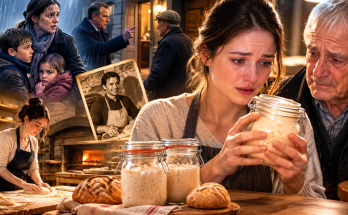
I looked at the apron.
The knots were tight.
One had been pulled so firmly that I could barely fit a finger beneath it.
"May I loosen this?"
He followed my eyes.
"Why?"
"It's pulled tight around her waist."
He hesitated.
Then nodded.
I worked carefully at the first knot.
The fabric had been tied and retied until the strings twisted together.
I remembered Molly standing at the stove, determined to do everything properly.
I could imagine her pulling those strings tight each morning.
Trying to make herself look like the grown woman who once wore the apron.
I loosened the first knot.
Then the second.
The cloth relaxed around her.
Her father watched.
"That belonged to her mother."
He said it without looking at me.
I stopped for a moment.
Then continued folding the loose fabric away from Molly's waist.
"I wondered."
He stared at the apron.
"She started wearing it after…"
His voice faded.
I waited.
He didn't finish.
I didn't ask him to.
I had spent enough time around sorrow to know that some sentences couldn't be completed just because a stranger was listening.
He touched the edge of the cloth.
"She used to stand in here with her mother."
I looked toward the stove.
I pictured Molly watching someone else knead bread.
Learning where the plates belonged.
Being allowed to help with little things.
There was nothing wrong with a child learning those skills.
The trouble came when the child stopped being a helper and became the person responsible.
I had seen that happen before.
Sometimes in poor families.
Sometimes in wealthy ones.
It wasn't always caused by cruelty.
Sometimes it happened because adults were too overwhelmed to notice the weight settling on smaller shoulders.
Her father looked around the kitchen.
"I thought keeping the ranch running was enough."
He spoke so quietly I almost didn't hear.
I looked at him.
He was staring at the cupboard.
The crooked door.
The flour.
The empty cans.
"I thought if I kept working, things would get better."
I didn't know how to answer that.
Work had carried me through most of my life.
It had fed me.
Sheltered me.
Kept me from thinking too much about the things I didn't have.
But it had never solved loneliness.
No amount of bread could make a dead silence disappear from a house.
No amount of scrubbing could replace somebody who was missing.
I looked at Molly.
Her face was still pale.
"She was trying to help you," I said.
He nodded.
"She always does."
"She thinks you need her to."
His eyes lifted.
I saw the words reach him.
He looked down at the apron again.
"She's just a little girl."
I wanted to say that I had been telling him that since he walked into the kitchen.
But the words would have been cruel.
He already knew.
And knowing it now seemed to hurt him enough.
He rubbed his face with his free hand.
Dust came away on his fingers.
I wondered when he had last slept properly.
Or eaten a meal that somebody else had prepared without expecting him to do anything in return.
He looked worn down.
Not simply tired from a day's work.
Worn down in the way people become when they keep moving because stopping would mean feeling everything they have been avoiding.
Molly stirred.
It was such a small movement that I almost doubted it.
Her fingers shifted against her father's hand.
He straightened immediately.
"Molly?"
I leaned closer.
Her eyelids moved.
Then settled again.
The rancher's breathing caught.
"Did you see that?"
"Yes."
"She's waking up?"
"I hope so."
I wasn't willing to promise more.
He bent toward her.
"Sweetheart, it's Papa."
His voice had changed.
The harshness was gone.
He sounded almost afraid to make himself heard.
I thought about how Molly had flinched when he shouted earlier.
He must have remembered too.
Because he spoke even more softly.
"You're all right. I'm here."
Molly's lips moved slightly.
No words came.
Her father looked at me.
"What do I do?"
"Keep talking to her gently."
He nodded.
I watched him brush hair away from her forehead.
His hand was steadier now.
"Come on, Molly."
She moved again.
Her eyes opened a little.
Then closed.
The rancher made a sound I had never heard from a grown man before.
It was almost a sob.
Almost a laugh.
He bent closer.
"That's it, sweetheart."
I stayed beside them.
I didn't touch her.
Not yet.
I wanted to give them that moment without making myself part of it.
Molly's eyes opened again.
She looked confused.
Her gaze moved across the ceiling.
Then toward her father.
He smiled with such sudden relief that his whole face changed.
"There you are."
She blinked.
Her lips moved.
"Papa?"
The word was faint.
But he heard it.
So did I.
He took a shaking breath.
"I'm right here."
She looked toward me.
For a moment, she seemed unsure where she was.
Then her eyes moved toward the stove.
I could almost see her trying to remember what had happened.
"The beans," she whispered.
Her father stared at her.
"What?"
"The supper."
I felt a sharp ache in my chest.
She had fainted.
She had frightened us both half to death.
And the first thing she worried about was whether her father's meal had been ruined.
I looked at him.
He was staring at her with an expression I couldn't bear to study for long.
"The supper can wait," he said.
Molly frowned faintly.
"I didn't finish."
"You don't have to."
She looked confused.
Her father swallowed.
"You hear me? You don't have to."
I saw her try to understand.
She had spent so much time believing the kitchen was her responsibility that his words seemed strange.
She looked toward me again.
"Miss Abigail?"
"I'm here, sweetheart."
Her eyes rested on my face.
"Did he make you go?"
I glanced at her father.
He looked away.
"No," I said. "I'm still here."
She seemed relieved.
Then her eyelids grew heavy again.
I felt the rancher stiffen.
"She's tired," I said.
He looked frightened.
I understood why.
After seeing her collapse, even an ordinary movement seemed dangerous.
Molly was awake only briefly.
But she had spoken.
She knew us.
That mattered.
Still, I didn't want either of us to pretend the danger had passed simply because she had opened her eyes.
"She needs proper care," I said quietly.
Her father nodded.
This time, he didn't argue.
He looked at Molly.
"You're not cooking anymore."
She frowned.
"Papa, you need supper."
"I can get my own supper."
She looked toward the stove.
"But you don't know how."
Under different circumstances, I might have laughed.
Her father almost did.
The sound caught in his throat.
"I'll manage."
Molly looked doubtful.
I could understand that.
I had tasted enough badly prepared beans to know she had a fair reason for concern.
But her father wasn't discussing the beans anymore.
He was trying to tell her something much larger.
And I wasn't certain she understood it yet.
He brushed her hair back.
"You've been doing too much."
Molly looked away.
"I don't mind."
"I know."
"I wanted to help."
"I know that too."
Her voice grew smaller.
"Was I bad?"
The rancher froze.
I felt my stomach tighten.
I had heard children ask that question before.
Usually after an adult's anger had frightened them.
It was the sort of question that revealed more than the child intended.
Her father shook his head quickly.
"No."
Molly watched him.
"Because I let her cook?"
He glanced toward me.
Then back at her.
"No, sweetheart."
"I didn't ask first."
His face changed.
I could see him remembering the shotgun.
The shouting.
The way he had ordered me out.
I wondered whether he understood that Molly thought she was responsible for all of it.
He bent closer.
"You haven't done anything wrong."
Molly's eyes filled.
"But you were angry."
He closed his eyes for a moment.
When he opened them, they were wet.
"I was frightened."
She stared at him.
He swallowed.
"I came in and didn't know who was here. I shouldn't have shouted like that."
Molly said nothing.
He looked toward the table.
The shotgun was still where he had set it aside.
Then he looked back at his daughter.
"I scared you."
She hesitated.
Finally, she nodded.
Just once.
He lowered his head.
"I'm sorry."
The words were quiet.
But I heard them clearly.
I wondered how often he had apologized to her before.
Not because I thought he was cruel.
Because grief could make people forget that children needed more than food and shelter.
They needed patience.
They needed explanations.
They needed to know that an adult's fear wasn't their fault.
Molly looked toward me.
I gave her a small smile.
She seemed to relax.
Her father kept holding her hand.
"I don't want you worrying about the cooking."
She frowned.
"Who'll do it?"
He looked at the stove.
Then at the cupboard.
Then at me.
I could see the question forming.
I wasn't certain I wanted to hear it.
I had spent years moving from one kitchen to another.
I had learned not to mistake a moment of gratitude for a permanent welcome.
People often wanted help while something was wrong.
Once the trouble passed, they remembered they had no place for me.
I knew that pattern too well.
And I had already been ordered out of this house at gunpoint.
The rancher seemed to remember it too.
He looked uncomfortable.
For a moment, neither of us spoke.
Molly's eyes moved between us.
Then she reached toward my hand.
Her fingers were weak.
But she caught two of mine.
"Will you stay until supper?"
I looked down at her.
She wasn't asking for much.
Just the rest of one meal.
I thought about the road.
The heat.
The blisters on my heels.
My satchel lying near the cupboard.
I thought about how close I had come to leaving this child alone with her father's anger and fear.
Then I looked at the man beside her.
He was waiting for my answer.
Not ordering.
Not threatening.
Waiting.
"I can stay until supper," I said.
Molly gave the smallest smile.
Her father looked down at her hand holding mine.
And for the first time, I saw him consider that the stranger he had threatened might be someone his daughter actually needed.
Source: newsfeed.cafex.biz