I should have felt relieved when Molly opened her eyes.
Instead, I felt responsible.
It wasn't sensible.
I had arrived at the Walker ranch looking for water.
I hadn't come to take charge of anybody's household.
I certainly hadn't come expecting to argue with an armed father over a pot of beans.
But Molly had held my hand and asked me to stay.
And I had said yes.
That changed something.
A promise made to a child shouldn't be treated lightly.
Especially a child who already seemed afraid that everything good might disappear if she asked for too much.
Her father was still kneeling beside her.
He looked exhausted.
The shotgun remained where he had set it aside.
I kept noticing it.
I couldn't help myself.
The thing had been pressed against my neck only a short while earlier.
Every time I glanced toward the table, I remembered the cold metal.
I wondered whether I would ever feel comfortable in that kitchen.
Then I wondered why I was thinking about comfort at all.
I had agreed to finish supper.
Nothing more.
Molly shifted against the floorboards.
Her father immediately leaned toward her.
"Easy, sweetheart."
She looked up at him.
"I'm all right."
I heard those words and felt my shoulders tighten.
There they were again.
The same words she had used when I first asked whether she was hungry.
The same words her father said she offered every morning.
I'm all right.
I was beginning to dislike them.
Not because Molly meant to deceive anyone.
Because they had become her way of keeping the peace.
Her father heard it too.
I could tell by the way his mouth changed.
"You don't have to say that," he told her.
She looked confused.
"Say what?"
"That you're fine when you aren't."
Molly stared at him.
He waited.
She looked down at the apron.
"I don't want you worrying."
He swallowed.
I turned my face away.
That small sentence had been sitting beneath everything Molly did.
She wasn't trying to prove she could cook.
Not really.
She was trying to protect her father from one more burden.
And he had mistaken that effort for independence.
I understood how easily that could happen.
A quiet child rarely drew attention.
A capable child received praise.
An obedient child made the day easier.
Adults sometimes forgot to ask what it cost the child to be all three.
Molly's father brushed a loose strand of hair away from her face.
"Worrying about you is my job."
She looked at him.
He seemed surprised by his own words.
Then he repeated them.
"My job, Molly. Not yours."
I watched her consider that.
She had been given a difficult truth.
One that contradicted what she had been doing for some time.
I didn't expect her to accept it in a minute.
Her father looked toward me.
"Should she get up?"
I considered the question.
I didn't want to pretend to know more than I did.
"Not too quickly."
He nodded.
We waited beside her.
The kitchen seemed to have become very still.
The pot was off the hottest part of the stove.
The skillet had cooled.
A little flour remained scattered across the counter.
Nothing had changed in the room.
And yet everything felt different.
I looked at Molly's empty plate.
It had a crack running from the edge toward the middle.
I had noticed it when I first entered.
I remembered thinking that somebody should replace it before it broke completely.
Now I was thinking about how little had been placed on it.
Beans.
Day after day.
Enough to keep her quiet.
Not enough to make her strong.
I wondered whether her father had seen what she ate.
Or whether he simply assumed that because food was in the cupboard, his daughter was eating properly.
There was a difference.
A terrible one.
Molly turned toward me.
"Did the bread burn?"
I smiled.
"No."
She looked relieved.
"Good."
"The beans came close, though."
Her eyes widened.
I could see her preparing to apologize.
I spoke before she could.
"That was my fault. I let them sit too long."
She looked puzzled.
"You were helping me."
"I was."
"Then it wasn't your fault."
I considered that.
Children sometimes offered more mercy than adults deserved.
I had been ready to accept responsibility for a pot of beans.
Molly refused to let me.
Yet she seemed willing to take responsibility for nearly everything else that happened inside that house.
I looked at her father.
He was listening.
I wondered whether he heard the same contradiction.
His face suggested he did.
He looked at Molly.
"Never mind the supper."
She frowned.
"But you're hungry."
He hesitated.
Then nodded.
"I am."
She looked toward the stove.
Before she could speak, he continued.
"But that doesn't mean you have to fix it."
Molly studied him.
"Who will?"
He looked at me.
I waited.
Then he answered his daughter.
"I will."
I nearly smiled.
Molly's expression was worth seeing.
She looked as though he had announced he intended to fly across the pasture.
"You can't."
He raised his eyebrows.
"Can't I?"
"You burn things."
He glanced toward me.
I looked away quickly.
I didn't want to laugh in his face.
Not after everything that had happened.
But Molly's certainty was remarkable.
She had no doubt about her father's shortcomings in the kitchen.
He sighed.
"Well, perhaps I'll learn."
Molly considered that.
Then she looked toward me again.
"Miss Abigail knows."
Her father was quiet.
I felt the old discomfort rise inside me.
I knew what was coming.
Or thought I did.
A man who needed a cook.
A woman with nowhere to go.
A child who had grown attached because somebody had given her warm bread.
I had seen arrangements begin with less.
And I had seen them end badly.
I reminded myself that I had promised only one supper.
Molly's father looked at the stove.
Then at me.
"You really made all that from what was in the cupboard?"
"Yes."
He looked surprised.
"There wasn't much."
"There was enough for a simple meal."
He glanced toward the opened cans.
"I thought beans would do."
I chose my words carefully.
"Sometimes they do."
He looked at me.
I added nothing.
I didn't need to.
He could see his daughter lying on the floor.
He could see the flour.
He could smell the onion and herbs.
He could understand the difference without another lecture.
Molly's eyes began to close again.
Her father noticed immediately.
"Sweetheart?"
She opened them.
"I'm listening."
"You can rest."
She looked troubled.
"But supper."
He shook his head.
"I told you. That's not your worry."
Her lips pressed together.
Then she nodded.
I could tell she wasn't entirely convinced.
But she stopped trying to rise.
I looked at her father.
"She shouldn't be lifting heavy things."
"I know."
"Or trying to cook alone when she's feeling weak."
"I know that too."
His answers were quiet.
I stopped.
I had spent the afternoon correcting him.
Some of it had been necessary.
But he was beginning to hear me now.
There was no reason to keep striking the same sore place.
I looked around the room.
The pitcher still sat near the window.
There was a little water left.
I remembered how grateful I had been for my first drink.
It seemed like another lifetime.
I had crossed that threshold as a stranger.
A tired woman nobody had invited.
Now I was sitting on the floor with a frightened father and his daughter.
I couldn't say what that made me.
Not a friend.
Not family.
Certainly not welcome in any ordinary sense.
But I had become involved.
And I couldn't pretend otherwise.
The rancher followed my gaze toward the pitcher.
"You came in thirsty."
I looked at him.
"Yes."
He rubbed his forehead.
"I never even offered you anything."
I almost laughed.
"You had other things on your mind."
He looked ashamed.
I hadn't intended to make him feel worse.
But he had begun noticing the small courtesies he had overlooked.
That seemed important.
He looked toward the front door.
"How far had you walked?"
"A fair distance."
"In this heat?"
"Yes."
He stared at my boots.
They were dusty and worn.
The leather at the heels had rubbed my feet raw.
I tried to tuck them beneath my skirt.
I didn't want pity.
Pity usually came with questions.
And questions often led to someone deciding I was too troublesome to keep around.
But the rancher had already seen them.
"You're hurt."
"Only blisters."
He looked doubtful.
"Those look worse than blisters."
"They'll mend."
He leaned back on his heels.
For a moment, he looked as though he wanted to ask something else.
Then Molly spoke.
"Miss Abigail was going to leave."
Her father turned.
She was watching him carefully.
"You told her to."
He lowered his eyes.
I wished she hadn't said it.
Not because it was untrue.
Because the shame on his face was becoming difficult to watch.
He looked toward the shotgun.
Then away.
"Yes," he said.
Molly's mouth trembled.
"She didn't do anything wrong."
He was quiet.
Then he nodded.
"I know."
Those two words mattered.
I looked at him.
He looked back at me.
For the first time, there was no accusation in his eyes.
Only exhaustion.
And something that might have been regret.
"I was frightened," he said.
I didn't answer immediately.
He seemed to expect me to.
I could have told him that fear wasn't an excuse.
I could have reminded him how close the gun had been to my neck.
I could have described the moment I thought I might die in his kitchen.
All of that would have been true.
But Molly was listening.
And her father already looked as though he knew what he had done.
So I said the simplest thing I could.
"I know you were."
He swallowed.
"That doesn't make it right."
I looked at him.
No.
It didn't.
I was glad he understood.
Molly reached for his hand.
He took it immediately.
She looked toward me.
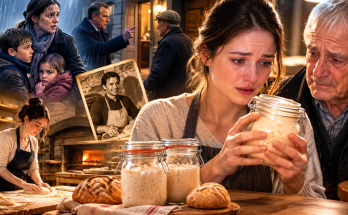
"Will you still make the bread?"
I felt something soften inside my chest.
Such a small request.
After the gun.
After the fall.
After all the fear.
She still wanted bread.
I looked at the stove.
The dough remained where I had left it.
There was enough for a few more pieces.
I stood carefully.
My knees ached.
The rancher watched me rise.
He didn't reach for the gun.
I went to the counter.
I picked up the dough.
Then I looked back at Molly.
"Of course I will."
She smiled.
Not much.
But enough.
And I understood that finishing supper was no longer just about feeding a hungry child.
It was about giving her one ordinary thing she could count on.
Source: newsfeed.cafex.biz