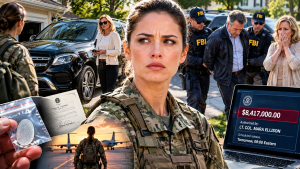
I Returned From Baghdad and Found My $154,200 Mercedes in My Parents’ Driveway—7 Minutes Later, the FBI Arrested My Father, and My Mother Revealed a Secret That Could Destroy Me
I had been home from Baghdad for eleven minutes when I saw my $154,200 Mercedes sitting in my parents’ driveway—the same SUV I had locked inside secure storage fourteen months earlier. My mother stood beside it holding the key fob and told me, “Stop being dramatic.” I didn’t argue. Seven minutes later, the FBI blocked both ends of the street, and my father was in handcuffs.
My name is Colonel Mara Ellison.
The first thing I noticed wasn’t my mother.
It was the scratch above the rear wheel.
Three inches long.
Silver showing through black paint.
My duffel bag slipped from my hand.
“Why is my car here?”
Mom’s fingers tightened around the key fob.
“You just got home. Come inside.”
“The vehicle was in bonded storage. Nobody could release it without me.”
Behind her, my father stepped onto the porch.
“Technically,” he said, “that isn’t true.”
That one word made my blood run cold.
Three months earlier in Baghdad, FBI Special Agent Daniel Cho had shown me a forged power of attorney bearing my signature.
Someone had been accessing accounts in my name.
Now my car was sitting in front of me.
Mom sighed.
“Your father handled some things while you were gone. Your brother needed transportation. We used it for business appointments.”
Then I noticed a parking decal on the windshield.
**RIVERSTONE EXECUTIVE CLUB.**
I knew that name.
Riverstone Logistics Group had appeared on a military reimbursement I had supposedly approved while I was actually in Mosul.
That invoice led investigators to dozens more.
Shell companies.
Federal housing grants.
Military subcontracting payments.
Millions of dollars.
And one mailing address tied everything together.
A Richmond post-office box opened by my father.
Mom snapped her fingers at me.
“Stop being dramatic.”
I picked up my duffel bag and walked toward the street.
Then I texted Daniel Cho.
**Vehicle confirmed here.**
His answer came immediately.
**Stay outside.**
Minutes later, black SUVs entered the neighborhood.
No sirens.
Federal agents poured out.
Mom’s face went white.
Daniel crossed the street.
“We have a federal search warrant.”
Dad stepped away from my Mercedes.
“This is unnecessary.”
Daniel looked at him.
“Richard Ellison, turn around and place your hands behind your back.”
Dad stared at me.
“What did you do?”
Then Daniel said quietly:
“We have the Riverstone ledgers.”
My father stopped resisting.
An agent cuffed him.
Mom stumbled backward.
“I don’t understand.”
Then another agent ran from the house carrying a laptop inside an evidence sleeve.
“We found the credential station.”
My stomach tightened.
“What credential station?”
Daniel looked at me.
“Someone built a replica of your authentication setup in your father’s office. We found a cloned access token.”
“And a biometric reader.”
“That won’t work without my fingerprint.”
Daniel said nothing.
Then I noticed my mother’s hand buried inside her cardigan pocket.
“Mom. Take your hand out.”
She slowly obeyed.
Inside her fist was a clear plastic bag.
Daniel took it.
A thin silicone membrane rested inside.
A molded fingerprint.
Mine.
Then I remembered the care package she had mailed overseas.
Cookies.
Socks.
And a “family keepsake card” she had insisted I press my fingers onto.
My father suddenly shouted, “Elaine did it!”
Mom snapped, “Shut up.”
Daniel opened the recovered laptop.
Then his expression changed.
“Mara, there’s more.”
On the screen was a federal wire authorization.
**$8,417,000.**
Authorized by:
**LT. COL. MARA ELLISON.**
Scheduled release:
**Tomorrow, 08:00 Eastern.**
The digital signature had been created less than an hour before my plane landed.
I looked at my mother.
She stared straight back at me.
Then, loud enough for every FBI agent on the street to hear, she said:
“Mara, you need to stop pretending you don’t know what you did.”
PART 2: The Keepsake Card 005
“Mara, you need to stop pretending you don’t know what you did.”
For a moment, nobody moved.
The agents stood around us in a careful circle, their coats dark against the pale afternoon, while the neighborhood watched from behind curtains and half-closed doors.
I could hear the faint ticking of my Mercedes cooling in the driveway.
I could hear my own breathing.
Most of all, I could hear the sentence repeating inside my mind.
You need to stop pretending.
“Mother,” I said, “I have been in the air for sixteen hours.”
Elaine’s face tightened.
“That doesn’t mean you’re innocent.”
Daniel stepped between us, not quite blocking my view of her, but making it clear that the conversation had changed.
“Mrs. Ellison, you’ll have an opportunity to speak with counsel.”
“I don’t need counsel to recognize my own daughter.”
“You may not understand what the evidence shows yet.”
“I understand perfectly.”
Her voice carried across the street.
Several neighbors turned away.
I felt the old instinct rise in me, the one that had carried me through inspections, deployments, and rooms where everyone expected me to lose control.
Stand still.
Listen carefully.
Do not answer emotion with emotion.
I looked at Daniel.
“Am I under investigation?”
“You are a material witness at this stage.”
“At this stage?”
“The authorization is scheduled for tomorrow morning.”
“And if the transfer goes through?”
“It won’t.”
His answer was immediate, but his expression remained guarded.
“We have contacted the receiving institution and obtained an emergency hold.”
“Then why are you still here?”
“Because the signature was generated through a system connected to your credentials, and because the person who created it may still have access to whatever source data was used.”
His eyes moved briefly toward the house.
“Your father’s office contained equipment designed to reproduce your authentication process.”
I looked at Richard.
He stood beside the porch with his hands cuffed behind him.
He had aged since I saw him last.
Or perhaps I had simply stopped seeing him as the man who had taught me to balance a checkbook, repair a flat tire, and read a map without turning it upside down.
“You told me the car was for Caleb,” I said.
Richard’s mouth opened, but no answer came.
Mom looked toward him.
“You said she knew.”
“Elaine,” he warned.
“You said the account was protected.”
“Not here.”
“You said nobody would connect it to her.”
His eyes hardened.
“That’s enough.”
Daniel heard every word.
He turned to one of the agents.
“Separate interviews.”
The agent led my father toward an unmarked SUV.
Richard glanced at me as he passed.
There was no apology in his face.
There was calculation.
That hurt more than anger would have.
My mother remained near the porch, clutching her cardigan closed with one hand.
I studied her carefully.
She had always been composed in public.
Even when my brother broke his arm falling from the garage roof, she had calmly directed the neighbors, called the ambulance, and only cried after the doors closed.
Now her hands were trembling.
“Did you know about the fingerprint?” I asked.
She looked down.
That was answer enough.
Daniel’s expression softened, but his voice did not.
“Mrs. Ellison, we need to know how the mold was made.”
“It was a card.”
“What kind of card?”
“A keepsake.”
I felt the cold move through me.
“The card I pressed my fingers on?”
Elaine closed her eyes.
“It was something your father said he needed.”
“For what?”
“He told me it was part of an identity verification process.”
“What identity verification process requires a silicone impression?”
“I didn’t know it was silicone.”
“You mailed it to Baghdad.”
“I mailed a card.”
“You told me it was for the family album.”
“I was wrong.”
The words came out so quietly that I almost missed them.
She lifted her eyes to mine.
“I was wrong, Mara.”
A gust of wind carried the smell of wet leaves across the lawn.
I remembered that card.
It had arrived in a padded envelope during my second month in Mosul.
The front showed an old photograph of our family standing in front of the house, all four of us squinting into the sun.
On the back, my mother had written, Press your fingers here and send it back.
She had said the card would become part of a framed family keepsake.
I had laughed at the idea.
I had pressed both thumbs and two fingers into the soft material, then mailed it with a note teasing her for becoming sentimental.
Three weeks later, she had sent me a photograph of the finished frame.
The card was visible beneath glass beside pictures of Caleb and me as children.
I had never questioned it.
“Where is the frame?” I asked.
Elaine’s lips parted.
“I don’t know.”
“Where is it?”
“Your father kept it in his office.”
“Why?”
“I thought he was protecting it.”
“From what?”
She looked toward the house.
“From being found.”
Daniel signaled to an agent, who disappeared inside.
I stayed where I was, just beyond the edge of the driveway.
I did not want to step into the house.
It had been mine once, in the unspoken way a childhood home belongs to someone long after they leave.
The porch swing still hung beneath the front window.
The brass lantern still leaned slightly to the left.
A row of clay pots stood beside the steps, most of them filled with dead herbs because my mother never remembered to water them.
Everything looked ordinary.
That was the terrible part.
Nothing in the house announced that a federal transfer had been prepared in my name.
Nothing showed that my parents had taken a part of me and turned it into a key.
Daniel came to stand beside me.
“You don’t have to go inside.”
“I know.”
“Are you all right?”
“No.”
He nodded as though that answer was more useful than a false one.
“I need to explain something before we proceed.”
“Go ahead.”
“The $8.417 million isn’t sitting in one account.”
“Where is it?”
“Most of it originated in federal housing and military subcontracting programs.”
“And Riverstone?”
“Riverstone received payments through a sequence of shell companies.”
He lowered his voice.
“The money was moved in pieces, then consolidated through a clearing account connected to your authorization.”
I looked toward the house.
“What does my father have to do with that account?”
“His company appears to have been used as a laundering hub.”
The word landed with blunt finality.
Laundering.
Not an accounting error.
Not an aggressive business strategy.
A criminal network built around money that had been intended for people who needed homes, repairs, and services.
“Did he steal it?”
“We’re still tracing the money.”
“Daniel.”
He met my eyes.
“We have records showing Richard directed transfers, approved invoices, and communicated with individuals connected to the shell companies.”
I pressed my fingers against my palm.
My father had spent twenty-five years telling everyone that Riverstone Logistics was a family business built from one delivery van and a borrowed garage.
He had taken pride in the company’s growth.
He had paid for Caleb’s first car with money from Riverstone.
He had helped me buy the Mercedes after my promotion, insisting it was a reward for service and not a gift.
I had thought the money represented sacrifice.
Now I wondered how much of it had traveled through accounts that never belonged to him.
“Was my car part of it?”
“The vehicle seems to have been used for meetings and transport.”
“Transport of what?”
“We don’t know yet.”
I looked at the silver scratch above the rear wheel.
“How did you get it out of storage?”
Daniel did not answer immediately.
That pause told me there was another layer.
“Your father presented a release authorization.”
“My signature?”
“Possibly.”
“Possibly?”
“The storage company received an electronic authorization through a portal linked to your military email.”
“I was deployed.”
“We know.”
“Then how did it pass verification?”
“We’re examining the access logs.”
I closed my eyes.
For fourteen months, I had trusted the locked gate, the security cameras, and the procedures designed to protect property belonging to deployed personnel.
I had trusted my father when he said he could handle practical matters at home.
I had trusted my mother when she asked for a fingerprint on a card.
I had trusted the people who had raised me.
A woman approached from the sidewalk and stopped several yards away.
She was carrying a grocery bag and staring at the agents.
I recognized her as Mrs. Alvarez from two houses down.
She had once brought my mother soup after a winter surgery.
Her gaze moved from my father in handcuffs to me in my uniform.
I wanted to tell her that I had not known.
I wanted to tell her that the house behind me had not felt dangerous until the government vehicles arrived.
Instead, I stood silently while she turned and walked away.
An agent emerged from the house carrying a cardboard evidence box.
Daniel opened it on the hood of an SUV.
Inside were folders, two external drives, several phones, and a framed photograph wrapped in a clear bag.
The photograph showed my family on the beach when I was nine.
My father had one arm around Elaine.
Caleb was missing a front tooth.
I was holding a plastic bucket filled with shells.
Behind the picture, visible through the glass, was the keepsake card.
The impressions I had made were still visible.
I felt something inside me give way.
“Why did you keep that?” I asked my mother.
She stared at the frame.
“I thought it was a memory.”
“You knew what he did with it.”
“I knew he wanted it.”
“That isn’t the same thing.”
“I know.”
“Then tell me the truth.”
She flinched.
It was the first time I had seen my mother look afraid of me.
Not because I might hurt her.
Because I might finally understand her.
“Your father told me Riverstone was going under,” she said.
Daniel motioned to an agent, who began recording.
Elaine continued.
“He said the company had lost two major contracts and that the bank would take the house if he couldn’t cover the payroll.”
“That still doesn’t explain the money.”
“He said investors were helping him restructure.”
“Investors don’t need my fingerprint.”
“I didn’t know what the fingerprint was for.”
“You mailed it.”
“I thought it was for the card.”
“You knew he had it.”
“I knew he had the card.”
Her voice cracked.
“I did not know he had made a mold.”
I wanted to believe the distinction mattered.
Part of me needed it to matter.
Another part of me remembered every conversation I had with her during deployment.
How she asked whether I had received a new access badge.
How she wanted to know when my leave had been approved.
How she casually mentioned the name of my commanding officer even though I had never discussed him with her.
At the time, those questions had sounded like a mother trying to stay connected.
Now they seemed like pieces of a pattern I had refused to see.
“Did you know about Riverstone?” I asked.
She looked past me toward the street.
“I knew your father was handling money through the company.”
“That is not an answer.”
“I knew he had accounts I didn’t understand.”
“Did you know the money was stolen?”
“No.”
“Did you suspect?”
Her silence lengthened.
“Yes.”
The admission was almost inaudible.
Daniel remained still, but I saw the recorder in his hand tilt slightly.
“Why didn’t you tell anyone?”
Elaine drew a shaky breath.
“Because he said Caleb would lose everything.”
“Caleb wasn’t involved.”
“He worked for Riverstone.”
“Did he know?”
“I don’t think so.”
“You don’t think so?”
“He believed the sealed packages were shipping documents.”
“What packages?”
She looked toward Daniel.
“I don’t know.”
My mother had always been afraid of uncertainty.
When I was a child, she labeled every box in the basement.
She kept duplicate keys in a jar and emergency numbers beside every phone.
Now she was admitting that my father’s business had contained sealed packages she could not explain.
“Did he threaten you?” I asked.
Her shoulders lowered.
“Not the way you mean.”
“Then what way?”
“He said he would leave.”
“That’s not a crime.”
“He said he would sell the house.”
“That’s his house too.”
“He said he would take Caleb with him and tell everyone I had helped him.”
I stared at her.
“You did help him.”
Her face crumpled slightly.
“I know.”
The agent near the SUV looked away, giving us the privacy that the street and the federal warrant could not provide.
I felt anger rise, hot and immediate.
My mother had helped take my identity.
She had helped create the conditions that made me appear responsible for millions of dollars.
Whether she understood the entire scheme or not, she had participated.
But beneath the anger was a memory of her sitting beside my bed when I had pneumonia at twelve.
Her hand on my forehead.
Her voice reading the same chapter three times because I kept falling asleep.
Love did not erase betrayal.
Betrayal did not erase love.
That was the part nobody prepared you for.
Daniel spoke gently.
“Mara, there’s something else.”
I looked at him.
“We found a folder on the laptop.”
“Another account?”
“Not exactly.”
He opened the evidence sleeve containing the laptop and turned the screen toward me.
The folder sat on the desktop beneath several financial files.
Its name was simple.
PROJECT HOMECOMING.
My pulse changed.
“What is that?”
“We haven’t opened everything yet.”
“Why not?”
“Because one file appears to contain personal travel information, and we wanted you to see it before we proceed.”
I leaned closer.
The folder held photographs, scanned documents, and a spreadsheet.
The first file displayed my flight itinerary.
Not the flight I had taken from Baghdad.
The flight I had originally been scheduled to take two weeks earlier.
Beside it were details of my military leave request, the name of the base transportation officer, and the code assigned to my return clearance.
I scrolled.
There were notes about my layover.
The time I was expected to land.
The number of bags I had checked.
Even the name of the driver assigned to collect me.
Only my family and my command had known those details.
“Who gave him this?” I asked.
Daniel’s face had gone still.
“We don’t know yet.”
I continued scrolling.
At the bottom of the spreadsheet was a column labeled final window.
The entry read:
MARA PRESENT — TRANSFER BEFORE 0800.
The house seemed to tilt around me.
My father had known when I would return.
He had known enough to schedule the final transfer before I could report the forged authorization.
But the date on the document was not the date of my actual flight.
It had been changed after my return was delayed.
Someone had updated the file from inside the system.
Daniel leaned toward the screen.
“Look at the metadata.”
I did.
The last revision had been made at 06:14 that morning.
The location field showed a network connection from a military facility.
Not my father’s office.
Not Riverstone.
A military facility.
Then another file opened automatically beneath the spreadsheet.
It was a scanned message addressed to Richard.
The sender’s name had been erased, but the signature remained.
Quartermaster.
The message contained only one sentence.
She lands today, and the house must be ready.
Part 3 – The Mileage Between Us
The word stayed on the screen between us.
Quartermaster.
I had heard it used in briefings, in supply corridors, and in the dry language of military logistics, where every movement was reduced to a request number and every request had an accountable name attached to it.
It was not a name.
It was a function.
A person who knew what moved, when it moved, and who had authorized the movement.
“Can you identify the sender?” I asked.
Daniel shook his head.
“The account was routed through an encrypted service.”
“Then trace the originating device.”
“We’re working on it.”
“That isn’t what I asked.”
His eyes met mine.
“We have a preliminary location.”
The answer chilled me more than it should have.
“Military facility?”
“Yes.”
Behind us, the front door opened.
An agent stepped onto the porch carrying a folder and a clear evidence bag.
“Agent Cho,” he called.
Daniel walked toward him, and I followed.
The agent glanced at me before lowering his voice.
“We found a second laptop in the garage office.”
My father had always called that room the dispatch annex, as though giving it an official name made the stacks of invoices and old computers seem more legitimate.
“What’s on it?” Daniel asked.
“Transportation records, mileage logs, and photographs.”
“Photographs of what?”
The agent looked at me.
“Colonel Ellison’s vehicle.”
A familiar pressure formed beneath my ribs.
“Take us there,” Daniel said.
The garage smelled of oil, damp cardboard, and the cedar blocks my mother had placed in the storage cabinets years ago.
My Mercedes had not been the only vehicle connected to Riverstone.
Two delivery vans sat along the rear wall, their white sides marked with the company’s blue compass logo.
I had seen those vans in family photographs.
Caleb had posed beside one at his high school graduation, grinning while my father held a bottle of sparkling cider.
Now one of the garage doors stood open, revealing a row of plastic bins and a workbench covered with shipping labels.
The agent placed the second laptop on a folding table.
“It was powered down, but the drive was not encrypted.”
Daniel put on gloves and opened it.
The first screen contained a spreadsheet with dates, destinations, and vehicle identification numbers.
My Mercedes appeared repeatedly.
“Those are not personal trips,” I said.
“No,” Daniel replied.
The locations formed a rough map across Virginia, Maryland, and the District of Columbia.
Some were warehouses.
Others were hotel garages, private airfields, and office buildings connected to companies I had never heard of.
“What did they transport?” I asked.
“We’re checking the associated manifests.”
Daniel clicked through several folders.
Most held ordinary shipping records.
Pallet counts.
Fuel receipts.
Delivery confirmations.
Then he opened a folder labeled E-17.
Inside were photographs of sealed gray cases stacked in the rear of my vehicle.
I recognized the scratch above the wheel in the first image.
I recognized the beige stitching on the driver’s seat.
I even recognized the small paper crane Caleb had tucked into the cup holder after I bought the car.
The date on the photograph was six months after I had deployed.
“Who drove it?” I asked.
The agent enlarged the image.
A partial reflection appeared in the rear window.
The face was indistinct, but the jacket was familiar.
It belonged to Caleb.
I stared at the screen.
“No.”
Daniel looked at me.
“You recognize him?”
“That’s my brother.”
The agent opened another photograph.
Caleb stood beside the vehicle at a loading dock, one hand resting on a gray case.
He was younger by a few years, thinner in the face, and smiling toward someone outside the frame.
He looked completely at ease.
As if he believed he was doing ordinary work.
“Call him,” Daniel said.
I took out my phone.
Caleb answered on the fourth ring.
“Hey, Mara.”
His voice held the casual warmth of someone who had not yet heard that the ground beneath the family had shifted.
“Where are you?”
“At the shop.”
“What shop?”
“The tire place on Broad.”
“Why?”
There was a pause.
“Because one of the delivery vans has a bad valve stem.”
I glanced at Daniel.
He nodded toward the phone.
“Caleb, did you ever drive my Mercedes?”
Silence filled the line.
Then he said, “Dad asked me to.”
“When?”
“Sometimes.”
“How many times?”
“I don’t know.”
“Did you transport sealed cases?”
Another pause, longer this time.
“Who told you about that?”
“Answer me.”
“I thought they were documents.”
“What kind of documents?”
“Shipping records, invoices, customs packets, things like that.”
“Where did you take them?”
“Warehouses, mostly.”
“Did you open them?”
“No.”
“Did you know the vehicle was supposed to be in secure storage?”
His breathing changed.
“I thought Dad had permission.”
“He didn’t.”
“I didn’t know that.”
“You knew it was my car.”
“I knew it was the family car.”
“It was not a family car.”
The words came out harder than I intended.
Caleb went quiet.
I could hear traffic moving behind him.
“Mara,” he said, “I’m sorry.”
“Were you paid?”
“Dad gave me hours.”
“That isn’t what I asked.”
“He put the deliveries on my payroll.”
“Were there extra payments?”
“I got bonuses.”
“How much?”
“I don’t remember.”
“Caleb.”
“I don’t remember, okay?”
His voice cracked on the last word.
I closed my eyes.
He was thirty-one years old, but I could still see the boy who had followed me through the woods behind our house, carrying a plastic compass and insisting he knew the way home.
He had always trusted my father’s confidence.
That trust had become another instrument in Richard’s hands.
“Come to the house,” I said.
“I can’t.”
“Why?”
“Because I don’t know what to say.”
“Neither do I.”
“I didn’t do anything wrong.”
“I need you to tell Daniel everything you know.”
“Am I in trouble?”
“I don’t know.”
That answer frightened him.
I heard him swallow.
“Are you going to let them arrest me?”
“No.”
I wanted the promise to be stronger than the evidence.
“I’m going to make sure they understand what you knew and what you didn’t.”
“Does Mom know?”
“She’s here.”
“Is Dad arrested?”
“Yes.”
Caleb exhaled shakily.
“I’ll come.”
He ended the call before I could answer.
Daniel looked at the photographs again.
“Your brother may be exactly what he says he is.”
“Or he may be better at lying than I thought.”
“You don’t believe that.”
“I don’t know what I believe.”
That was the honest answer, and it made me feel more exposed than any admission I had made since returning home.
An agent opened another file.
“This may help.”
The screen showed an electronic vehicle log.
Every trip in the Mercedes had been recorded through a fleet-tracking device, though no device had ever been listed in the storage company’s inventory.
The log included departure times, destinations, and driver entries.
Most of the driver fields were blank.
One name appeared repeatedly.
C. Ellison.
Beside it were routes ending at three locations.
A Riverstone warehouse in Fredericksburg.
A private hangar outside Manassas.
And a parking garage beneath a hotel in Arlington.
I recognized the hotel.
It was near the headquarters of a military contractor that had recently won a housing-repair contract.
“Did Caleb ever mention Arlington?” I asked.
Daniel shook his head.
“Not yet.”
“Could the tracker have been installed by Riverstone?”
“Probably.”
“Could it have been installed before the car went into storage?”
“We’ll need to examine the device.”
The agent opened a maintenance record.
The tracker had been activated two days after my deployment.
The authorization had been submitted through the storage portal.
The signature attached to it was mine.
Another forged document.
Another use of my identity.
I rested my hands on the edge of the table.
Someone had not simply borrowed my car.
They had built an entire administrative shadow around me.
My name moved through systems while I was thousands of miles away.
My signature opened doors.
My fingerprint unlocked them.
My family carried the physical evidence from one place to another.
And somewhere inside the military structure I had trusted, a person had supplied the details that made the deception possible.
Daniel studied my face.
“You should sit down.”
“I’m not fainting.”
“I didn’t say you were.”
“I know what you meant.”
“You’ve been awake for most of a day, and you’ve just learned your brother drove a vehicle through a network connected to an eight-million-dollar transfer.”
“I can remain upright.”
“You have always been very good at remaining upright.”
The words were gentle, but they touched something I had kept carefully sealed.
I looked away.
“When I was deployed, everyone told me my family was proud.”
“They probably were.”
“Pride is not the same as honesty.”
“No.”
The second laptop chimed.
The agent leaned over the screen.
“We have a deleted folder recovering now.”
The files appeared one at a time.
Photographs.
Invoices.
Scanned identification documents.
Then a message archive.
Most of the conversations were between Richard and an account saved under the name Quartermaster.
The messages were brief and practical.
The schedule has changed.
Use the alternate authorization.
Do not send through Riverstone email.
Her return window remains uncertain.
I read each line twice.
The timestamps covered nearly two years.
The earliest conversation began shortly after I had received my promotion.
Daniel highlighted a message dated three months before my first deployment.
Her credentials will be sufficient if the system accepts remote verification.
My mouth went dry.
“Remote verification,” I said.
Daniel nodded.
“Your father didn’t design this alone.”
The next message appeared.
The daughter must remain outside the process.
My father had replied:
She will. She trusts us.
I felt the room narrow.
For a moment, I was back in Baghdad, sitting across from Daniel in a secure office while he explained that someone had forged my signature.
I remembered telling him that my family could not be involved.
I remembered defending my father.
He had built his business from nothing.
He had worked too hard to risk everything.
I had said those words with certainty.
Now they seemed like testimony offered on behalf of a stranger.
The garage door rattled in the wind.
My mother appeared in the doorway.
She had removed the cardigan and was holding it over one arm.
Her face looked smaller without the garment’s protective folds.
“Caleb is on his way,” she said.
I turned toward her.
“Did you know he used my car?”
Her eyes moved to the photographs.
“I knew he drove it.”
“Did you know where?”
“He told me he delivered packages for your father.”
“What kind of packages?”
“He said they were business documents.”
“Did you ask why business documents needed my vehicle?”
“Your father told me the company vans were being inspected.”
“Did you believe that?”
She looked at the floor.
“I wanted to.”
“That is not belief.”
“It was easier than asking questions I was afraid to have answered.”
Her honesty made my anger more difficult to hold.
I wanted her to be completely guilty.
A clear villain would have given me somewhere to place the pain.
Instead, she stood in the doorway with the exhausted face of a woman who had made one compromise, then another, until the original line had disappeared beneath her feet.
“You knew about the bonuses,” I said.
“I knew Caleb was being paid.”
“Extra money.”
“Your father called them performance incentives.”
“Did you ever see the accounts?”
“No.”
“Did you ever ask?”
“Once.”
“What did he say?”
“That Caleb was helping keep Riverstone alive.”
“And you accepted that?”
“I accepted many things because I was afraid of what would happen if I didn’t.”
“You keep saying afraid.”
“I was.”
“Of your husband?”
“Of losing the family.”
I looked at her.
“You helped him use me to hold it together.”
Her eyes filled, but she did not look away.
“Yes.”
The word struck harder than denial.
Daniel gave us a moment before asking, “Mrs. Ellison, did Richard ever mention someone at Colonel Ellison’s command?”
She pressed the cardigan against her chest.
“He mentioned a man named Hale.”
My breath stopped.
“What did he say?”
“Only that Colonel Hale understood the military systems.”
“Victor Hale?”
She nodded uncertainly.
“Is he your superior?”
“He was my brigade commander during my first overseas assignment.”
“Was?”
“He’s now at command headquarters.”
Daniel and I exchanged a glance.
“What exactly did Richard say?” Daniel asked.
Elaine frowned, searching her memory.
“He said Hale had helped him understand the remote approval process.”
“When did he say that?”
“Last winter.”
“Why didn’t you tell us?”
“Because I didn’t know if the name mattered.”
“You knew it was connected to my military records.”
“I knew Richard spoke to him.”
“How often?”
“Not often.”
“Did you hear them together?”
“No.”
“Then how do you know?”
She hesitated.
“He left voice messages.”
Daniel’s attention sharpened.
“Where are those messages?”
Elaine looked toward the house.
“I saved them.”
“Why?”
“Because I thought I might need proof.”
The admission changed the air around us.
My mother had not been entirely passive.
She had been frightened, compromised, and silent, but somewhere beneath that fear she had begun collecting pieces of the truth.
“Where are they?” I asked.
“In the kitchen.”
An agent accompanied her inside.
Daniel remained beside me.
“If those messages identify Hale, they may establish coordination.”
“Or they may only prove my father knew him.”
“Either way, they matter.”
I stared at the photograph of Caleb beside my car.
“Do you think my brother is telling the truth?”
“About not knowing the contents of the packages?”
“His story is plausible.”
“That is not the same as true.”
“You’re very careful.”
“It keeps innocent people from becoming collateral damage.”
I studied him.
“Is that what I am?”
“What?”
“Collateral damage.”
“No.”
“Then what am I?”
He considered the question.
“The person whose identity was used.”
“That sounds passive.”
“It doesn’t mean you’re powerless.”
I wanted to believe him.
Outside, a vehicle turned into the street.
Caleb’s old sedan stopped behind the federal SUVs.
He stepped out slowly, hands visible, looking from the agents to the house.
He had grown a beard while I was away.
A small scar crossed his chin, one I did not remember seeing before.
For the first time, I wondered what else had changed while I was gone.
He entered the garage without speaking.
His eyes moved to the photographs.
When he saw himself beside my Mercedes, his face drained of color.
“I didn’t know they were watching me,” he said.
“No one said they were.”
“They took those pictures?”
“Apparently.”
He stepped closer to the screen.
“I remember that day.”
“Tell me.”
“Dad said the delivery was urgent.”
“Where did you go?”
“To the Fredericksburg warehouse.”
“What was in the cases?”
“I don’t know.”
“Who gave them to you?”
“A man named Victor.”
Daniel’s head lifted.
“Victor what?”
“I never knew his last name.”
“What did he look like?”
Caleb rubbed his hands together.
“Older. Gray hair. Tall. He had a military bearing.”
My pulse began to pound.
“Did he wear a uniform?”
“No.”
“Did he have any identifying marks?”
Caleb closed his eyes.
“He wore a ring.”
“What kind?”
“Black stone, silver edge.”
I remembered that ring.
Victor Hale had worn it during my promotion ceremony.
He had told me it belonged to his father, a quartermaster sergeant who had served in Korea.
Caleb continued.
“He knew your name.”
“What did he say?”
“He said, ‘Your sister’s schedule has changed.’”
No one moved.
“Did he say anything else?” Daniel asked.
Caleb looked at me.
“He said the final delivery had to happen before you came home.”
A phone began ringing inside the evidence room.
One of the agents answered it, listened, and then turned toward Daniel.
“Agent Cho, the voice messages are ready.”
Daniel nodded.
The agent placed a small recorder on the table and pressed play.
Static filled the garage.
Then my father’s voice emerged.
“Victor, she’s coming back sooner than expected.”
A second voice answered.
Calm.
Familiar.
“Then we move the transfer forward.”
My skin went cold.
Hale’s voice continued.
“And Richard, if Mara asks questions, remind her that loyalty is not the same as suspicion.”
The message ended.
For several seconds, the only sound was the wind moving through the open garage door.
Then another file began playing by itself.
My father’s voice was softer this time.
“She trusts you more than she trusts me.”
Hale answered:
“That is why the last authorization must carry her name.”
Daniel reached for the recorder.
Before he could stop it, a third voice entered the message.
A woman’s voice.
My mother’s voice.
And she was not speaking to my father.
She was speaking directly to Colonel Victor Hale.
“Please,” Elaine said in the recording, “don’t use my daughter again.”
Part 4 – The Man Behind the Name
The recording ended with my mother’s voice hanging in the garage like a thread pulled tight.
“Please,” she had said, “don’t use my daughter again.”
No one spoke.
The wind moved through the open door, lifting the corner of a shipping manifest on the table.
Caleb stared at Elaine as if he had never heard her speak before.
Daniel reached for the recorder and stopped it.
“Mrs. Ellison,” he said, “when was that recorded?”
She stood in the kitchen doorway, one hand gripping the frame.
“I don’t know.”
“You saved it.”
“I didn’t write down the date.”
“Where did you get it?”
“From Richard’s phone.”
“Did he know you had it?”
“No.”
“Why did you keep it?”
Elaine looked at me.
“Because I was afraid that one day you would come home and nobody would believe you.”
The words landed more heavily than any accusation.
I thought of the plastic fingerprint mold in Daniel’s evidence bag.
I thought of the card I had pressed my fingers into because my mother had asked me to preserve a family memory.
Now she was telling me she had kept evidence because she knew that memory had been turned against me.
“You knew Hale was involved,” I said.
“I knew his name.”
“You spoke to him.”
“I begged him to stop.”
“You still helped them.”
Her eyes lowered.
“Yes.”
Caleb moved away from the table.
“You said Dad was handling everything.”
“I wanted you to stay out of it.”
“You let me drive the packages.”
“I didn’t know what was inside.”
“But you knew something was wrong.”
“I knew enough to be afraid.”
He laughed once, without humor.
“That is not the same as protecting us.”
Elaine flinched.
“No,” she said. “It isn’t.”
Daniel turned to the agent beside him.
“Secure the recorder and make a duplicate for transcription.”
The agent placed it in an evidence sleeve.
I watched my mother’s hands.
They were trembling again, but she did not hide them.
“Tell me everything,” I said.
She swallowed.
“I don’t know everything.”
“Tell me what you know.”
Elaine looked toward the house, then back at me.
“Your father met Victor Hale through a veterans’ business network.”
“When?”
“Years ago.”
“How many?”
“Before you joined the military.”
That detail unsettled me more than it should have.
I had believed the scheme began after my promotion, when my credentials became useful.
Instead, the relationship had existed before I had any idea that my identity could become valuable.
“What kind of network?” Daniel asked.
“Business owners who had served.”
“Was Riverstone part of it?”
“Richard attended meetings at first because he wanted contracts.”
“Did Hale attend?”
“Sometimes.”
“Was he in uniform?”
“Never at the meetings.”
Elaine clasped her hands.
“He said he wanted to help veterans build legitimate companies.”
“And did he?”
“Some of them.”
Her answer was careful.
It sounded like someone separating the truth from the lies she had repeated to herself.
“Your father trusted him,” she continued.
“Why?”
“Hale understood procurement systems, contracting language, and military procedures.”
“Those things are public knowledge,” Daniel said.
“Not all of them.”
She looked at me.
“Your father used to say Hale could see the spaces between the rules.”
The phrase made my stomach tighten.
It sounded like Richard.
It sounded like the man who had once taught me that every lock had a weakness if you studied it long enough.
“Did Hale recruit him?” I asked.
“I think so.”
“You think?”
“Richard never described it as recruitment.”
“What did he call it?”
“A partnership.”
Daniel opened a notebook.
“Mrs. Ellison, did Hale ever visit this house?”
“Several times.”
“When?”
“Mostly when you were deployed.”
“Did he meet Caleb?”
“Yes.”
“Did he meet you?”
“Yes.”
“Did he discuss Colonel Ellison’s credentials?”
Elaine glanced at me.
“He asked questions.”
“What kind?”
“Whether you used a physical token or a digital one.”
I felt my jaw tighten.
“Did you answer?”
“I didn’t understand what he was asking.”
“But Richard did.”
“Yes.”
“Did you?”
“No.”
Her voice broke slightly.
“I knew your father was proud of you.”
“That does not explain access to my records.”
“He said Hale needed to verify that your identity would be accepted by a remote system.”
“And you believed him?”
“I believed that if I asked too many questions, he would know I was suspicious.”
“You were suspicious.”
“I was afraid of being certain.”
Daniel closed the notebook.
“Where is Richard’s phone?”
“In the office.”
“Which one?”
“His desk drawer.”
An agent went into the house.
I remained beside the worktable, staring at the image of Caleb beside my Mercedes.
He had not known what he carried.
But he had known enough to feel uneasy.
He had seen the gray cases.
He had met a man connected to Hale.
He had heard my return date discussed as though it were a deadline.
The pieces were not innocent simply because he had not understood their shape.
“Caleb,” I said, “when Victor gave you the cases, did he ever ask you to sign anything?”
He shook his head.
“He asked me to confirm the vehicle number.”
“How?”
“On a tablet.”
“Did it use your name?”
“I entered my employee number.”
“Did it ask for a fingerprint?”
“No.”
“Did you use my name?”
“Not that I remember.”
“Did you see anyone else access the system?”
He rubbed his forehead.
“Sometimes Dad did.”
“And Victor?”
“Once.”
“Where?”
“At the hangar.”
“What was he doing?”
“Standing behind Dad.”
“That is not an answer.”
“I don’t know what he was doing.”
“Try.”
Caleb looked toward the garage door.
“He had a laptop open.”
“What did you see?”
“A map.”
“Of what?”
“Your deployment route, I think.”
The room seemed to lose warmth.
“You saw my deployment route?”
“I didn’t know it was yours at the time.”
“Why did you think it was mine now?”
“Because Victor said you were in Mosul.”
I turned toward Daniel.
He had gone very still.
“Did Victor know where I was stationed?” he asked.
Caleb nodded.
“He said the schedule had to stay flexible because your command might change your movements.”
Daniel wrote something down.
My mother closed her eyes.
“I didn’t know that,” she whispered.
I looked at her.
“You knew he had access to my records.”
“I knew he spoke as if he did.”
“That is not a distinction anymore.”
“No.”
The agent returned with Richard’s phone in an evidence bag.
“There’s a passcode,” he said.
Elaine stared at it.
“Try the anniversary date,” she said.
The agent entered the numbers.
The phone unlocked.
I almost laughed.
Of course it did.
My father had used the date of his marriage as a key to the life he had built around secrecy.
Messages filled the screen.
Many were ordinary.
Supplier disputes.
Payroll questions.
A reminder from the bank.
Then the archive loaded.
The contact saved as Quartermaster appeared near the top.
There were hundreds of messages.
Daniel opened the most recent thread.
The first message was from Richard.
She lands today.
Hale had replied:
Then the authorization must be released before she reaches the house.
Richard:
The delay has complicated the timing.
Hale:
Her return was not supposed to change.
Richard:
The command moved her flight.
Hale:
That is why we have alternate access.
I felt the blood drain from my face.
The date of my return had not merely been discovered.
It had been managed.
Someone had expected me to arrive two weeks earlier.
When my flight changed, they had adjusted the plan.
“Keep reading,” Daniel said.
The next message appeared.
Her car remains available.
Hale answered:
Use the vehicle for the final transfer if necessary.
Richard:
Caleb is handling the route.
Hale:
He must not know the contents.
Caleb stared at the screen.
“I told you.”
“I know,” I said.
Richard had written again.
Elaine is asking questions.
Hale:
Give her the family explanation.
Richard:
She may speak to Mara.
Hale:
Then remind her what happens when a family refuses to protect itself.
My mother made a small sound.
Daniel looked at her.
“Did he threaten to harm you?”
“No.”
“Then what did he mean?”
“He meant the house.”
“The house?”
“He knew I was afraid of losing it.”
“He used that fear against you.”
Elaine nodded.
“He said if the operation failed, the bank would take everything.”
Daniel scrolled further.
A message from Hale appeared.
The daughter’s credentials carry more weight than yours.
Richard answered:
She trusts me.
Hale:
Trust is useful only when it remains unquestioned.
I had spent my entire adult life believing trust was a form of strength.
Hale had treated it as a resource.
Something to be extracted and spent.
A new message appeared, dated four years earlier.
Begin with the keepsake.
I looked at my mother.
She covered her mouth.
The next line followed.
Her overseas assignment provides the distance we need.
Then Richard replied:
Elaine will send it.
I stepped away from the table.
The garage wall pressed against my back.
The card had not been a desperate improvisation after the money began moving.
It had been part of the plan from the beginning.
My mother had not simply made one terrible mistake because my father was afraid of bankruptcy.
She had been asked to gather the piece of me they needed years before the final transfer.
“Four years,” I said.
Elaine began to cry silently.
“I didn’t know what it was for.”
“But you sent it.”
“He told me it was a keepsake.”
“And when did you realize?”
She wiped her cheek.
“After the first time he asked about your leave schedule.”
“When was that?”
“About a year later.”
“Why didn’t you destroy the frame?”
“I tried.”
“Your father stopped you?”
“He said the card belonged to the family.”
“That was a lie.”
“I know.”
“Why did you stay?”
Her face tightened with pain.
“Because by then I had already helped.”
The confession was quiet, but it filled the garage.
“I thought leaving would expose you before I could protect you.”
“You didn’t protect me.”
“I thought I was buying time.”
“You bought him time.”
Elaine nodded.
“Yes.”
For several seconds, I could not speak.
Daniel did not interrupt.
He allowed the silence to exist, which was perhaps the only mercy available to us.
The agent examining the phone called from the table.
“There’s an attachment.”
He opened it.
A scanned document filled the screen.
It was a personnel summary.
My name appeared at the top.
Beneath it were deployment locations, leave dates, security procedures, and authentication protocols.
At the bottom was a digital approval.
V. Hale.
I recognized the formatting.
It belonged to my command.
“This was not merely copied,” Daniel said.
“No.”
“It was exported from an internal system.”
“Can you prove Hale accessed it?”
“The signature is not enough.”
He opened the file properties.
The document had been downloaded from a command network.
The user ID was partially obscured.
Only the last four characters remained visible.
VH-17.
My breath caught.
“Hale’s command identifier ends in seventeen,” I said.
Daniel looked at me.
“Are you certain?”
“I saw it on classified routing documents during my first deployment.”
He turned to the agent.
“Preserve the metadata and contact cyber operations.”
The agent nodded.
I looked at the document again.
The dates were not all accurate.
Some contained details that had never been included in official reports.
My travel schedule.
My authentication procedures.
The fact that I used a fingerprint reader during remote authorization.
Whoever accessed the file had more than general personnel information.
They had studied the precise habits that made me trustworthy.
I remembered Victor Hale during my promotion ceremony.
His hand on my shoulder.
His voice telling the assembled officers that integrity was not a word we wore on our uniforms but a discipline we practiced when nobody was watching.
I had admired him.
I had trusted him.
He had written the speech.
Daniel must have noticed my expression.
“You knew him well?”
“He mentored me.”
“How closely?”
“He recommended me for the command.”
“Did he have access to your records during that process?”
“Of course.”
“Did he know about your family?”
“He met my parents.”
“Did he know about the Mercedes?”
“He helped me negotiate the purchase.”
Daniel’s gaze sharpened.
“What do you mean?”
“Hale knew a veteran-owned dealership. He said they could give me a fair price.”
I looked through the glass door toward the driveway.
The Mercedes sat where my mother had first shown it to me.
I remembered the day I bought it.
Richard had handed me the keys and told me I had earned something beautiful.
Hale had stood beside him, smiling.
At the time, it had felt like a celebration of my service.
Now the memory seemed arranged.
The vehicle had not been selected at random.
It had been purchased through people Hale could influence.
Its storage records had later been altered through credentials he understood.
The car had become part of the operation because its history was clean, its ownership was credible, and its driver was me.
An agent opened another attachment.
This one contained a photograph of the Mercedes at the dealership.
I was standing beside it with my father.
Hale appeared in the background.
But there was something else.
A yellow envelope rested on the hood.
Written across it in black marker were two words.
HOME PROJECT.
Daniel enlarged the image.
The writing was Richard’s.
“What is Project Homecoming?” I asked.
No one answered.
The agent searched the phone.
A folder with the same title appeared in the archive.
Inside were photographs from my childhood, scans of family documents, old school records, and copies of my military awards.
At first, it looked like a scrapbook.
Then Daniel opened a spreadsheet.
Every item had been cataloged by date, location, and identifying value.
My birth certificate.
My passport.
My deployment orders.
My signature samples.
My fingerprints.
My mother’s handwriting.
My father’s handwriting.
Caleb’s employment records.
Even photographs of the interior of our house.
The last column was labeled use.
Some entries were marked identity, some access, and others cover.
My childhood had been reduced to inventory.
My family had been organized into functions.
“Why would they need all this?” Caleb whispered.
Daniel answered without looking up.
“To make the operation appear personal and legitimate.”
“Legitimate to whom?”
“Banks, storage companies, contractors, anyone who saw familiar names and assumed trust.”
I stared at the photographs.
There was one of me at twelve, standing beside my mother in the backyard.
Another showed Caleb repairing a bicycle.
A third showed my father in front of the first Riverstone delivery van.
The images had been taken long before the fraud expanded.
They had been gathered over years.
Hale had not simply exploited a family.
He had cultivated one.
My mother stepped closer to the table.
“I didn’t know about the folder.”
“You knew about the frame.”
“I knew Richard kept photographs.”
“Not this.”
She shook her head.
“He told me the business required records.”
“Did he ever ask for my awards?”
“He asked me to send copies.”
“Why?”
“He said investors liked seeing that the company supported veterans.”
I looked at Daniel.
“Did Riverstone advertise that?”
“On its website.”
“Using my name?”
“Your photograph appeared in a veterans’ outreach section.”
I felt a quiet, profound disgust.
Not because my service had been mentioned.
Because my life had been used as a seal of approval for people who did not deserve it.
Caleb sat down heavily on an overturned crate.
“Dad used us,” he said.
The sentence seemed to take something from him.
My anger remained, but beneath it was sorrow.
He had wanted to believe our father’s work mattered.
He had wanted to belong to the business.
Now he was discovering that even his labor had been part of a structure designed by people who had never considered what it would cost him.
Daniel opened one final message.
It was from Hale to Richard, sent six months earlier.
When she returns, do not let her speak to Cho before the transfer.
Richard replied:
She may contact him immediately.
Hale:
Then make the accusation first.
I looked at the line.
“The accusation,” I said.
Daniel’s face hardened.
“They wanted your mother to accuse you.”
“To make me look guilty.”
“To create confusion before the authorization cleared.”
Elaine’s eyes widened.
“He told me to say you had approved the transfer.”
“You did say it.”
“I was supposed to make you hesitate.”
“Why?”
“So you would not call the investigators.”
The truth settled over us.
My mother had not merely repeated something she believed.
She had been instructed to attack my certainty.
To make me question my own memory before I could report the crime.
I remembered her standing beside the Mercedes, holding the key fob, telling me to stop being dramatic.
Those words had not been hers.
They had been chosen for their effect.
The agent at the door suddenly received a message on his phone.
He read it, then turned toward Daniel.
“Cyber operations has confirmed the internal user ID.”
Daniel took the phone.
His eyes moved across the screen.
Then he looked at me.
“Colonel Hale’s credentials were used to access the personnel file.”
My chest tightened.
“Was he physically at the facility?”
“They’re checking.”
“Can they arrest him?”
“We need a warrant and corroborating evidence.”
“What if he leaves?”
“He may already know the investigation is active.”
As if summoned by the words, another agent hurried into the garage.
“Agent Cho.”
Daniel turned.
“We received a notice from headquarters.”
“What kind?”
“Hale left the command facility forty-three minutes ago.”
“Destination?”
“No flight plan filed.”
“Vehicle?”
“Government sedan missing from the motor pool.”
Daniel looked at the timestamp.
My mother moved closer.
“What does that mean?”
“It means he knows.”
A second agent entered behind him, carrying a sealed envelope.
“This was found in Hale’s office.”
Daniel opened it carefully.
Inside was a single printed photograph.
My family stood together in front of the house.
The same photograph shown on the keepsake card.
But this version had been altered.
A red line circled me.
Across the bottom, someone had written:
THE KEY RETURNS HOME.
Daniel turned the photograph over.
On the back was a handwritten address.
Not Richard’s office.
Not Riverstone.
A rural airfield outside Fredericksburg.
Beneath the address was one final line.
If Hale runs, Richard knows where he will go.
My father was still in federal custody.
And yet, as Daniel reached for his phone, Richard’s device began ringing from the evidence table.
The caller identification displayed a name none of us expected.
Mara Ellison.
I stared at my own name glowing on the screen.
Then the call connected by itself, and Victor Hale’s voice said, “You were never supposed to see the whole file.”
Part 5 – The Price of Truth
Victor Hale’s voice remained on the line.
“You were never supposed to see the whole file.”
For one suspended moment, I could not tell whether I was hearing him through the phone or remembering him from every room where I had once trusted him.
Daniel reached for the device, but I lifted my hand.
“Don’t disconnect.”
Hale gave a quiet, almost weary laugh.
“You always did prefer complete information.”
“You used my identity.”
“I used the credibility attached to it.”
“That is not a distinction.”
“It is in court.”
His voice was calm, controlled, and familiar enough to make my skin prickle.
“You built the system,” I said.
“I refined a system that already existed.”
“You recruited my father.”
“Your father came looking for opportunity.”
“You accessed my records.”
“I accessed information that was available to people with proper clearance.”
“Was your clearance proper?”
A pause followed.
It was the first sign that I had reached something real.
Daniel motioned for an agent to trace the call.
Hale continued before the silence could settle.
“Your father is going to tell them I created everything.”
“He has already started.”
“Of course he has.”
“Are you saying he is innocent?”
“No.”
The answer surprised me.
“Richard is ambitious, vain, and careless,” Hale said.
“He expanded the operation because he believed money could make him important.”
“But you designed it.”
“I designed the access model.”
“You used my family.”
“I used what your family offered.”
My mother drew in a sharp breath.
Caleb stood beside her, his face drained of color.
I looked at both of them before speaking.
“Why call me?”
“Because you deserve to know what happens next.”
“I’m listening.”
“The transfer will be released if the receiving institution does not receive a complete cancellation package by six o’clock.”
Daniel raised two fingers, signaling that the call was being traced.
Hale continued.
“Your signature is embedded in more than one authorization.”
“How many?”
“Enough that your career will not survive an investigation unless the source of the signatures is established.”
“You mean unless you are caught.”
“I mean unless the truth is documented correctly.”
“You don’t get to define the truth.”
“No,” he said.
“But you are about to choose which version survives.”
The line went silent.
Then he added, “Richard has offered prosecutors a story.”
My father.
Even in custody, he was moving pieces.
“What story?”
“That Elaine organized the identity theft, and Caleb knowingly transported the funds.”
My mother closed her eyes.
Caleb looked toward me.
“He said that?” I asked.
“Hale’s answer was measured.
“Your father has decided that a family divided is easier to bargain with than a family united.”
“Why would he blame my mother?”
“Because he believes she will accept the blame to protect Caleb.”
The truth of that struck with humiliating precision.
My mother had already admitted that she would sacrifice herself for the family.
Richard knew it.
He had built his defense around it.
Daniel mouthed, “Keep him talking.”
I nodded.
“What do you want?”
“Your cooperation.”
“You have no authority to ask for it.”
“I am offering you a way to preserve your name.”
“By helping you escape?”
“By providing the original access records.”
“You have them?”
“I have copies.”
“Where?”
“The airfield.”
Daniel’s eyes sharpened.
Hale continued.
“Richard kept the financial ledgers, but I kept the authentication logs.”
“Why?”
“Because I never trusted him to understand the difference between leverage and evidence.”
“Yet you trusted yourself.”
“I trusted my preparation.”
I looked at the photograph circled in red.
“The key returns home.”
“That was a phrase.”
“It was written on a photograph of me.”
“It was a reminder.”
“Of what?”
“That every system has a human point of failure.”
My hand tightened around the phone.
“You thought I was a point of failure.”
“No.”
His voice softened.
“I thought you were the one person your family would never suspect.”
The admission carried no apology.
That absence hurt more than anger would have.
Daniel leaned closer.
“Ask him about the insider,” he whispered.
“Who else is involved?”
Hale did not answer immediately.
“There are people who helped without understanding the full purpose.”
“Names.”
“Not over this line.”
“Then give me one.”
“Your father used Riverstone to move money.”
“That is not a name.”
“He could not have done it without access to procurement schedules.”
“Who supplied them?”
“You are asking questions you already know how to answer.”
“My command?”
“Your command was not a single person.”
“Was it someone close to me?”
Another pause.
“Closer than you think.”
The trace technician pointed to the screen and shook his head.
The signal was moving through several relays.
Daniel wrote on a pad.
Keep him engaged.
I turned away from the others.
“Did you recruit Richard before or after I entered the military?”
“Before.”
“Did you plan to use me from the beginning?”
“No.”
I did not believe him.
“Then when did the plan change?”
“When your credentials began opening doors that his could not.”
“And you waited four years to use them.”
“Preparation takes time.”
“What happened to legitimate veterans’ businesses?”
“Some prospered.”
“Because you used their contracts to move stolen money?”
“Not all of them knew.”
“That is not an answer.”
“It is the only honest one you are going to get.”
His words settled over the room.
The men and women who had accepted contracts through Riverstone.
The drivers who had delivered sealed packages.
The people who had signed invoices without knowing what stood behind them.
A network could be full of guilty people, frightened people, and people who had simply trusted the wrong voice.
That did not lessen the harm.
It made the truth harder to separate.
“Where is the money now?” I asked.
“Some is in accounts your father controls.”
“Some?”
“The remainder is scheduled to move tomorrow.”
“To where?”
“A foreign clearing bank.”
Daniel’s expression changed.
I felt the shift in the room.
“How much?”
“Eight point four million.”
“The transfer is on hold.”
“For now.”
“What happens if we do nothing?”
“Your authorization releases automatically at eight.”
Daniel wrote quickly.
Can you stop it?
I spoke the question aloud.
“Can you stop the transfer?”
“Yes.”
“Why haven’t you?”
“Because the cancellation requires my authentication.”
“You created the system.”
“I created the original system.”
“And the current one?”
“Your father altered portions of it.”
“Then why involve me?”
“Because the final authorization carries your identity.”
I looked at the screen displaying the forged document.
The signature seemed less like ink than a doorway someone had opened and left waiting.
“What do you want in return?”
“A safe departure.”
Daniel shook his head.
I ignored him.
“And what happens to my mother and brother?”
“Your father will take the blame for the financial decisions.”
“You just said he planned to blame them.”
“He will change his position if I provide him with the evidence.”
“Evidence against whom?”
“Against everyone.”
The answer made my stomach turn.
Hale was not offering mercy.
He was offering control.
“You want immunity.”
“I want the truth recorded before prosecutors decide it for me.”
“You want to choose what survives.”
“Yes.”
His honesty was almost worse than his lies.
I heard movement beyond the garage.
An agent approached Daniel and whispered something.
Daniel’s face tightened.
He showed me the message.
Richard had requested a formal interview.
His attorney had notified prosecutors that he was prepared to cooperate immediately.
The condition was simple.
He wanted immunity for Elaine and Caleb in exchange for testimony against Hale.
I read the message twice.
My mother saw my expression.
“What is it?”
“Dad is offering a deal.”
“For us?”
“For you and Caleb.”
Her shoulders sagged.
“What does he want?”
“To testify against Hale.”
“That sounds like a good thing.”
“He wants immunity for you both.”
Caleb looked at me.
“Would that help?”
“It might protect you.”
“And Mom?”
“Possibly.”
Elaine shook her head.
“No.”
The word carried more certainty than I expected.
“No,” she repeated.
“I will not accept protection that requires him to lie about what I did.”
My mother turned toward the phone.
“Richard is making a deal?”
“Apparently.”
“He’ll say I arranged the fingerprint.”
“He may.”
“Then let him.”
Caleb stared at her.
“Mom.”
“I helped him.”
“You didn’t know everything.”
“I knew enough to ask questions and chose not to.”
“That doesn’t make you the architect.”
“It makes me responsible for my part.”
Hale was still listening.
“You see?” he said.
“Your mother understands the value of a coherent story.”
“Do not speak about her as if she is a piece on a board.”
“Everyone is a piece on a board when the game is large enough.”
“No.”
I felt something inside me steady.
“That is how you think.”
“It is how institutions think.”
“Then institutions can be changed.”
“By people willing to sacrifice themselves?”
“By people willing to tell the truth.”
Hale sighed.
“You sound like the officer I mentored.”
“I am not that officer anymore.”
“No.”
He sounded almost proud.
“You have finally learned that loyalty without judgment is only another form of obedience.”
The sentence reached deeper than I wanted it to.
He had taught me that lesson.
He had then used my obedience against me.
“I will meet you at the airfield,” I said.
Daniel’s head snapped up.
“No,” he mouthed.
Hale asked, “Alone?”
“No.”
“Then there is no reason to come.”
“There is a reason.”
“What?”
“You want the evidence authenticated.”
“I want a witness who understands it.”
“I understand it.”
“You understand your anger.”
“I understand that you used my name.”
“That is not enough.”
“It is enough to bring you out of hiding.”
Silence.
Then Hale said, “You have become more like your father than you realize.”
I looked at Richard’s phone.
At the messages where he had written that I trusted him.
At the evidence of every deliberate choice.
“No,” I said.
“I am trying to become less like both of you.”
The line clicked.
For a moment I thought he had disconnected.
Then he said, “If you go to the airfield, bring the keepsake card.”
My mother went rigid.
“Why?”
“Because it contains the original mold.”
“We have it.”
“You have a copy.”
Daniel’s eyes lifted.
“What does he mean?” he asked.
Hale continued.
“The card was made from a master impression.”
My mouth went dry.
“Where is the master?”
“Your mother knows.”
I turned toward Elaine.
She had gone pale.
“Mother?”
Elaine shook her head.
“No.”
“Where is it?”
“I don’t know.”
Hale spoke again.
“She knows where your father kept it.”
My mother closed her eyes.
The room seemed to contract around her.
“Elaine,” I said, “where?”
She covered her face with both hands.
“I thought it had been destroyed.”
“Where was it?”
“In the house.”
“Where?”
“In the old sewing cabinet.”
I remembered the cabinet.
It had belonged to my grandmother and sat in the upstairs hallway beneath a framed picture of our family.
My mother had never allowed anyone to move it.
“Why would he keep it there?”
“He told me it was a backup.”
“A backup for what?”
“For your identity.”
Hale’s voice softened.
“Bring the master to the airfield, Mara.”
“And if I don’t?”
“The transfer proceeds.”
“Can you initiate it?”
“Yes.”
“Then why wait?”
“Because I want to know whether you are willing to save your family by doing something honest.”
The call ended.
No dramatic announcement followed.
No alarm sounded.
Only the hum of the garage lights remained, steady and indifferent.
Daniel took the phone from my hand.
“We are not going to that airfield.”
“He has the original authentication logs.”
“He may also have a way to destroy them.”
“And he can release the transfer.”
“We can stop the transfer without giving him anything.”
“Can we stop it permanently?”
“We can seek an emergency order.”
“Before eight?”
“We have people working on it.”
“That is not certainty.”
“No,” he said.
“It is not.”
My mother moved toward the house.
“I need to get the cabinet.”
An agent stepped in front of her.
“We’ll search it.”
“No.”
She looked at me.
“I need to show Mara.”
The request was not directed at Daniel.
It was directed at me.
I followed her inside.
The house smelled of dust, coffee, and the faint lavender detergent she had used since I was a child.
Every room seemed to contain a version of us that no longer existed.
In the hallway, the sewing cabinet stood beneath the family photograph.
Its wooden doors were carved with small flowers, their edges softened by decades of hands.
My mother unlocked it with a key she wore on a chain around her neck.
Inside were spools of thread, folded fabric, old buttons, and a tin box.
She removed the box and set it on the floor.
Her fingers shook as she opened it.
At first I saw only photographs.
Then a false bottom lifted.
Beneath it lay a thin metal case.
My mother’s breath caught.
“I thought this was empty.”
The case contained a clear sheet of hardened material.
A fingerprint impression had been pressed into it.
Beside it was a handwritten note.
The ink had faded, but the words remained legible.
Mara Ellison — primary identity reference.
My stomach turned.
Daniel examined it through the open doorway.
“This is not the same as the silicone mold.”
“No,” my mother whispered.
“It is the source.”
A second item lay beneath the sheet.
A letter.
The envelope bore my father’s handwriting, but the address was mine.
I opened it.
Inside was a single page.
Mara,
If you are reading this, then something has gone wrong.
Your mother will tell you she did not understand.
She is telling the truth.
I will tell you I did what I had to do.
That will also be true.
The next line had been crossed out several times before he wrote it again.
I never intended for you to be harmed.
I stopped reading.
Daniel waited.
“What does it say?” he asked.
I folded the page.
“It is from my father.”
“Keep it.”
“I’m not giving him another piece of evidence until I understand what it means.”
My mother sat on the floor beside the cabinet.
“I knew there was something hidden there.”
“You said you thought it had been destroyed.”
“I found the case last year.”
“Why didn’t you open it?”
“Because Richard told me it contained old family records.”
“You believed him?”
“I believed that opening it would make the fear real.”
The words were painfully familiar.
My mother had spent years standing beside doors she was afraid to open.
I had spent years believing that courage meant never admitting the doors existed.
Daniel’s phone rang.
He listened, then looked at me.
“The bank has extended the hold.”
“For how long?”
“Until seven-thirty.”
“An hour.”
“Maybe longer.”
“Maybe.”
He nodded.
“We have a warrant request moving through the court.”
“And Hale?”
“His vehicle was found abandoned near the airfield.”
“Then he may already be there.”
“Or he wants us to think he is.”
Caleb had been silent throughout the search.
Now he spoke.
“What happens to Mom if Dad lies?”
Daniel answered carefully.
“Prosecutors will evaluate her actions based on evidence, coercion, and cooperation.”
“She could go to prison.”
“Yes.”
Caleb looked at me.
“And me?”
“You may be treated as a witness if they establish you did not know what you were carrying.”
“But I took the bonuses.”
“Receiving money is not the same as knowingly participating in fraud.”
“What if they don’t believe me?”
I thought of the photographs.
The vehicle logs.
The messages proving Hale had instructed Richard to keep Caleb ignorant.
“We will give them everything,” I said.
Caleb stared at me.
“Everything?”
“Yes.”
“Even if it hurts Mom?”
My mother closed her eyes.
I felt the old instinct to protect my family rise within me.
It was powerful.
It had been formed in childhood, strengthened by distance, and disguised as love.
But protection that required falsehood was not protection.
It was another locked room.
“I will not hide evidence,” I said.
Caleb looked down.
“Then they could take her.”
“Yes.”
My mother reached for his hand.
“Your sister is right.”
He looked at her.
“You don’t have to agree.”
“I do.”
Her fingers closed around his.
“I have spent too long confusing silence with loyalty.”
The sentence broke something open in me.
Not forgiveness.
Not yet.
But the possibility that our family could finally speak without arranging the truth around someone else’s comfort.
Daniel stepped into the hallway.
“We need to move.”
“Where?”
“Federal office.”
“What about the airfield?”
“You are not going.”
“Hale asked for the master.”
“And we will use it as evidence.”
“He may release the transfer.”
“Then we stop him through the system.”
“What if the system is his?”
“Then we expose that too.”
His confidence was not absolute.
It was chosen.
That made it more credible.
We carried the metal case and the original letter into the front room.
Agents photographed the cabinet, the hidden compartment, and every object inside it.
My mother sat beside Caleb on the sofa.
Neither spoke.
The family photograph remained on the wall above them.
In it, we were younger, sunburned, and certain that the future was something people inherited.
An agent approached Daniel with a tablet.
“Sir, the court has granted the emergency order.”
Daniel read the screen.
“The bank has been instructed to maintain the freeze.”
A breath moved through the room.
It was not relief.
Not yet.
“Can Hale override it?” I asked.
“Not without access to the receiving institution.”
“Does he have that?”
“We don’t know.”
The agent’s expression shifted.
“What?”
“There is a second authorization.”
Daniel looked at him.
“Where?”
“Attached to the same transfer.”
“Whose identity?”
The agent turned the tablet toward us.
The document displayed a name.
For several seconds, I could not understand what I was seeing.
Then the room seemed to fall silent around me.
The second authorization was not signed by Mara Ellison.
It was signed by Elaine Ellison.
My mother rose slowly from the sofa.
“I never signed that.”
Daniel looked at the timestamp.
“It was created the same morning as Mara’s.”
Caleb shook his head.
“Mom couldn’t have done that.”
The agent enlarged the signature.
It was my mother’s handwriting.
Not a digital approximation.
A nearly perfect copy of the looping E and the long final stroke she used when signing holiday cards.
Beneath it, the authorization granted access to a protected family account.
The account number was unfamiliar.
Daniel entered it into the tracing system.
His face changed.
“What is it?” I asked.
He looked at my mother.
“This account belongs to you.”
Elaine stared at the screen.
“No.”
Daniel scrolled further.
“It was opened eleven years ago.”
“I never opened an account.”
“Your name is listed as the sole beneficiary.”
“Beneficiary of what?”
He turned the tablet toward me.
The account balance appeared.
$2,300,000.
My mother gripped the back of the sofa.
“I have never seen that money.”
Daniel looked at the transfer history.
“There are deposits dating back to the year Mara received her first overseas assignment.”
My father’s letter pressed against the inside pocket of my uniform.
I thought of his words.
I never intended for you to be harmed.
Then another line appeared on the screen.
A scheduled transfer from Elaine’s account had been set for the following morning.
Recipient:
Mara Ellison.
Purpose:
Restitution and protection.
At the bottom of the authorization was a note from an unknown sender.
If the daughter chooses truth, give her the part of the family that was never stolen.
My mother began to cry.
Daniel stared at the screen.
Caleb looked from her to me.
And I realized that the final secret was not what my father had taken from us.
It was what he had been trying, in his own broken and unforgivable way, to return.
Part 6 – One Honest Mile
The account balance remained on the screen between us, impossible and silent.
My mother kept one hand on the back of the sofa as though the room had shifted beneath her.
“I never opened that account,” she said again.
Daniel’s voice was gentle.
“That does not mean you created it.”
“Then who did?”
I looked at the metal case on the table, the letter inside my pocket, and the authorization bearing my mother’s copied signature.
“Find out,” I said.
Daniel nodded to the forensic accountant.
The woman connected a secure drive to the tablet and began reviewing the account history.
Deposits appeared in small groups at first, then larger transfers.
Some came from Riverstone subsidiaries.
Others came from accounts linked to contractors under investigation.
But the descriptions did not match ordinary laundering transfers.
They were marked with phrases such as reserve, recovery, and family protection.
“That does not make stolen money clean,” Daniel said.
“I know,” I replied.
The accountant scrolled farther.
“Most of the funds were never withdrawn.”
“Never?”
“Not by your mother.”
“Then who moved them?”
She opened the authorization records.
“The deposits were made by an intermediary.”
“Who?”
The name appeared beneath the account history.
Richard Ellison.
My mother closed her eyes.
“He put money in my name.”
“Apparently,” Daniel said.
“Why?”
I took my father’s letter from my pocket.
He had written that he never intended for me to be harmed.
That sentence no longer felt like an explanation.
It felt like the beginning of one.
“Read it,” Daniel said.
I handed him the page.
He studied it, then looked at me.
“There is more writing beneath the visible layer.”
The forensic examiner placed the letter beneath a special light.
Faint indentations appeared where my father had pressed the pen harder than the paper could absorb.
The crossed-out lines became visible.
I thought I could build a way out before they used you.
Another sentence emerged beneath it.
Hale said the account would remain untouched until the operation ended.
My mother sat down.
“Richard knew?”
“He knew enough,” I said.
The examiner adjusted the light.
A final line appeared.
If I fail, the money must be returned before anyone calls it mine.
Daniel read it twice.
“That may establish intent to conceal and intent to restore,” he said.
“It does not excuse him.”
“No.”
My mother stared at the letter.
“He was trying to protect you.”
“He used me,” I said.
“Both can be true.”
I looked at her.
She had spent years making excuses for my father, but this was not an excuse.
It was a distinction.
A painful one.
Richard had not been innocent.
He had not been trapped in the same way she had.
He had chosen the scheme, expanded it, and placed our identities inside it.
But somewhere along the way, perhaps when Hale made clear that the final transfer would carry my name, Richard had tried to create a private reserve for the family he had endangered.
He had built a lifeboat after setting the house on fire.
Daniel’s phone rang.
He listened for several seconds.
Then he said, “Put him through.”
My father’s voice came from the speaker.
“Mara?”
I stood very still.
The room seemed to remember him.
The garage office.
The driveway.
The years of accepting his certainty as proof of goodness.
“You requested a deal,” I said.
“I requested protection for your mother and Caleb.”
“You also offered to blame them.”
“I was trying to force the prosecutors to listen.”
“You don’t force people to listen by lying.”
His breath moved across the line.
“I know that now.”
The apology did not arrive quickly.
It sounded as though he had to move through every version of himself before reaching it.
“I was afraid,” he continued.
“You were ambitious.”
“Yes.”
“You were greedy.”
“Yes.”
“You used my identity.”
“Yes.”
My mother lowered her head.
Caleb stood beside her, listening.
“I told myself I was building something that would keep this family secure,” Richard said.
“You built a criminal network.”
“I know.”
“You made Caleb carry packages.”
“I did not know what Hale would put in them.”
“But you knew enough to keep him uninformed.”
“Yes.”
“You let Mom send my fingerprint.”
“I believed the system would only be used to move money temporarily.”
“You believed a lot of things that benefited you.”
He was quiet.
Then he said, “You are right.”
The simplicity of the answer unsettled me.
I had expected defensiveness.
I had expected him to reach for the explanations that had protected him for years.
Instead, he sounded tired.
Not defeated.
Finally aware.
“The account in your mother’s name,” I said.
“I opened it.”
“Why?”
“To separate legitimate family assets from the money Hale controlled.”
“Where did the money come from?”
“Some of it came from Riverstone profits.”
“Which profits?”
“The contracts that were legitimate.”
“Can you prove that?”
“Yes.”
“Will you give prosecutors the records?”
“Yes.”
“And the rest?”
“The rest came from money I knew had been diverted.”
My mother closed her eyes.
Richard continued.
“I moved it into Elaine’s name because Hale wanted access to it, and I thought if I kept it untouched, I could return it.”
“You did not return it.”
“I kept waiting for the right moment.”
“There is no right moment after a crime.”
“I understand that now.”
His voice broke slightly.
“I thought I could control the damage.”
“You could not.”
“No.”
“Did Hale know about the account?”
“He knew there was a reserve.”
“Did he know the amount?”
“I don’t think so.”
“Why did he create the transfer to me?”
“He wanted you to appear to benefit from the scheme.”
“And the note?”
“I wrote it.”
The room became quiet.
“Why didn’t you tell me?”
“Because by the time I understood what Hale intended, I was already implicated.”
“You could have called.”
“He said he would expose everything and make sure you were charged before you could defend yourself.”
“That was his threat.”
“It was also believable.”
I looked at my mother.
She had been living inside the same fear, but fear had not erased her responsibility.
It did not erase his either.
“Dad,” I said, “I am giving the investigators every record.”
“I know.”
“That includes the account.”
“It must.”
“That includes Mom’s involvement.”
“I know.”
“That includes yours.”
“I expect nothing less.”
The answer hurt because it sounded sincere.
Not absolution.
Acceptance.
Daniel took the phone.
“Mr. Ellison, prosecutors will need a formal statement.”
“You’ll have it.”
“And the location of Colonel Hale.”
“I don’t know where he is.”
“You provided the airfield.”
“He used it as a fallback location.”
“Did he leave any vehicles or equipment there?”
“There is a storage shed behind the main hangar.”
“What is inside?”
“Backup drives and printed records.”
Daniel looked at me.
“We need the access code.”
Richard gave it to him.
Then my father said, “Mara?”
I took the phone back.
“What?”
“I am sorry.”
I waited.
He did not add that he had done it for us.
He did not say that I should understand.
He did not ask me to forgive him.
For the first time in my life, my father apologized without placing a condition beneath it.
“I believe you are sorry,” I said.
His breathing changed.
“That does not mean I forgive you.”
“I know.”
“It does not mean we will be a family the way we were.”
“I know.”
“It means I will tell the truth.”
“That is enough for now.”
The call ended.
No one spoke for a while.
Outside, evening had begun to gather along the street.
The neighbors’ windows reflected the fading light instead of curious faces.
The house looked smaller than it had that morning.
Or perhaps the lies had made it seem larger.
Daniel coordinated the search of the airfield.
Agents found the storage shed exactly where Richard had described it.
Inside were hard drives, ledgers, printed communications, and a locked case containing the original authentication logs.
Hale had not been there.
But he had left enough of himself behind to make escape impossible.
The logs showed that he had accessed my personnel records, created the remote verification system, and directed Richard through each stage of the operation.
They also revealed two contractors who had knowingly assisted him.
Those men were later charged.
Several others were cleared after their testimony confirmed they had believed the packages contained legitimate documents.
Caleb’s records matched their accounts.
He had transported sealed cases, accepted payroll bonuses, and followed instructions he believed came from a lawful family business.
The mileage logs proved where he had driven.
The messages proved what he had not known.
His testimony helped distinguish ignorance from intent.
That distinction mattered.
It did not erase his embarrassment, but it kept a frightened young man from being turned into the villain of a crime he had never understood.
Hale was found three days later at a rural airport in Pennsylvania.
He had used an expired veteran-business credential and was carrying a passport under an old variation of his middle name.
He did not resist arrest.
According to Daniel, Hale only asked whether the transfer had been stopped.
“It was,” Daniel told him.
Hale nodded as though he had expected nothing else.
The $8.417 million remained frozen.
Investigators traced the funds through the shell companies, recovered most of the diverted money, and returned it to the federal programs from which it had been taken.
The remainder was recovered through property seizures and restitution agreements.
The account in my mother’s name was placed under court supervision.
Every dollar was examined.
Legitimate family assets were separated from stolen funds.
The rest was returned.
There was no secret inheritance waiting to save us.
There was only accountability, records, and the slow work of making restitution.
That was harder than a miracle.
It was also real.
My mother entered a cooperation agreement.
Her sentence was reduced because she preserved the voice messages, surrendered the fingerprint source, testified against Richard and Hale, and accepted responsibility for her part.
She did not escape consequences.
Neither did she disappear beneath them.
During the months before sentencing, she began counseling for coercive control and learned to describe fear without using it as a shield.
When I visited her, our conversations were difficult.
Sometimes we spoke about the case.
Sometimes we spoke about ordinary things, like the herb pots outside the kitchen or the neighbor’s new dog.
The ordinary moments mattered because they reminded us that a relationship could be rebuilt without pretending the damage had not occurred.
One afternoon, she returned a small evidence box to me through her attorney.
Inside was the hardened fingerprint reference and the silicone mold, both labeled and sealed.
“I thought you should have it,” she said.
I held the box without opening it.
“It belongs in evidence.”
“The case is closed.”
“It belongs nowhere near our family.”
She nodded.
“Then keep it as a reminder.”
“Of what?”
“That love without boundaries can become permission.”
I looked at her.
She had changed.
Not completely.
People did not become new simply because they confessed.
But she no longer reached for comfort before truth.
“I am still angry,” I said.
“You should be.”
“I may be angry for years.”
“I understand.”
“I may never trust you the way I did.”
“I hope you learn to trust yourself first.”
The answer stayed with me.
Trusting myself had been the quiet lesson beneath everything.
I had trusted my family so completely that I ignored the signs inside my own memory.
I had trusted Hale because he spoke the language of honor.
I had trusted systems because I believed procedures could not be manipulated by people who knew them well.
Now I understood that trust was not blindness.
It was a choice renewed by evidence.
Caleb was cleared after testifying.
He left Riverstone before the company was dissolved and spent several months repairing cars at a small garage outside Richmond.
The owner had served in the Army and understood that a person could be inexperienced without being dishonest.
Caleb worked hard.
He stopped accepting explanations that began with “your father knows best.”
He learned to ask where a package came from, who authorized it, and what was inside.
Later, he began helping at a veterans’ community center, where he spoke privately with younger veterans approached by fraudulent recruiters and questionable business networks.
He never described himself as a hero.
He simply told them what he wished someone had told him.
“If the opportunity depends on secrecy,” he would say, “walk away.”
My father pleaded guilty to fraud, identity theft, conspiracy, and money laundering.
His testimony helped convict Hale, but it did not erase his own choices.
He received a substantial sentence and agreed to surrender the family home, the Riverstone properties, and the remaining assets connected to the scheme.
The house was sold to repay victims.
I visited it once before the closing.
The sewing cabinet was gone.
So was the family photograph from the hallway.
The rooms stood empty, stripped of furniture and false comfort.
In the kitchen, sunlight fell across the floor where my mother had once placed a bowl of peaches.
I expected grief to overcome me.
Instead, I felt something quieter.
The house had not been our family.
It had only held us.
What mattered now was what we chose to carry forward.
Months later, an independent review restored my security clearance.
The review confirmed that my credentials had been compromised without my knowledge and that I had cooperated fully with investigators.
I returned to service with new procedures, new passwords, and a caution that did not harden into suspicion.
Daniel attended the hearing.
Afterward, he gave me a cup of coffee from the machine outside the conference room.
“You look disappointed,” he said.
“I thought reinstatement would feel more dramatic.”
“Most good outcomes are administrative.”
“That is a very Daniel Cho answer.”
“I have many.”
“Do any of them involve celebration?”
“Sometimes I allow a pastry.”
I smiled for the first time that day.
He noticed, but did not make too much of it.
That was one of the reasons I trusted him.
He never treated another person’s relief as an invitation to claim it.
By autumn, my mother had begun restitution work through a veterans’ support program.
She answered phones, organized transportation, and helped families complete financial forms without signing documents they did not understand.
She told me that every time someone asked her to trust a process, she explained how to verify it.
“It is not enough to mean well,” she said.
“You have to know what your name is being used to authorize.”
I believed her.
Not because her words erased the past.
Because they were now followed by consistent action.
Caleb found a legitimate job with a transportation company that conducted background checks, documented every shipment, and kept its accounts open to inspection.
He was nervous before the interview.
I drove him there in a temporary sedan borrowed from Daniel’s office.
“You know,” I told him, “you could walk in without apologizing for the rest of the family.”
“I know.”
“Do you?”
He looked out the window.
“I’m trying.”
“That is enough.”
He smiled faintly.
“Would Dad have said that?”
“No.”
“What would he have said?”
“Probably that confidence was the first step toward convincing people you deserved the job.”
Caleb laughed.
“That sounds exactly like him.”
The interview went well.
He was hired two days later.
The Mercedes was recovered after the evidence examination.
Its tracker was removed.
The storage company replaced the damaged security seals and repaired the scratch above the rear wheel.
I considered selling it.
For a while, every time I saw the vehicle, I remembered the driveway, the fingerprint mold, and my mother saying I needed to stop pretending.
But the car also carried other memories.
The day my father helped me choose it.
The first long drive after my promotion.
The paper crane Caleb had tucked into the cup holder.
A vehicle could be misused without becoming the meaning of your life.
I had the interior cleaned and the paint repaired.
The scratch remained visible beneath the new finish, a faint line no one else would notice.
I kept it there.
Not as punishment.
As proof that repair did not require pretending nothing had happened.
On a cold Saturday morning, I drove to the veterans’ community center.
My mother was waiting inside with coffee.
Caleb arrived ten minutes later in a borrowed jacket, carrying a folder from his new employer.
We sat around a small wooden table near the windows.
The meal was simple.
Soup, bread, fruit, and the kind of coffee that tasted better because someone had made it for you.
For a while, nobody mentioned court dates, evidence, or sentences.
Caleb talked about his first week at the transportation company.
My mother asked whether the supervisor had explained the retirement plan.
He teased her for asking practical questions before dessert.
She told him practical questions were how people avoided disasters.
I watched them and felt the familiar ache of love beside the unfamiliar shape of boundaries.
The two could exist together.
That was what I had learned.
My mother reached into her purse and placed a small envelope on the table.
“I brought something.”
Inside was a photograph.
Not the altered one Hale had kept.
A different photograph.
It showed the three of us standing beside the Mercedes the day I bought it.
My father was in the background, smiling toward the camera.
I studied the image.
“Why did you bring this?”
“I thought you should decide whether to keep it.”
I turned the photograph over.
On the back, my mother had written the date.
Nothing else.
No explanation.
No request.
I looked at Caleb.
“What do you think?”
He shrugged.
“It is a picture of us before we knew what was happening.”
“We did not know,” I said.
“That does not make the day false.”
My mother watched me carefully.
I slid the photograph into my wallet.
“I’ll keep it.”
Her eyes filled.
She did not reach for my hand.
That was another change.
She let the choice belong to me.
After lunch, we walked outside.
The Mercedes waited at the curb, its black paint reflecting the pale sky.
The repaired scratch showed only when the light struck at an angle.
Caleb stood beside the passenger door.
“You still sure you want me riding in this?”
“No.”
He laughed.
“I’m kidding.”
“I know.”
He opened the door, then paused.
“Where are we going?”
“To your interview.”
“I already have the job.”
“You have orientation tomorrow.”
“Then why are you driving me?”
“Because you asked.”
“I asked six months ago.”
“I was busy.”
“With a federal investigation.”
“Among other things.”
He got in.
My mother remained on the sidewalk.
For a moment, I saw her as she had stood in the driveway on the day I came home, holding the key fob and trying to make the truth smaller by calling me dramatic.
Now she held nothing.
No key.
No card.
No secret.
Only herself.
“I’ll call tonight,” I told her.
“I know.”
The answer was simple.
It did not demand more than I had promised.
I started the engine.
Caleb adjusted the seat and looked out at the center.
“You think we’ll be okay?”
I placed both hands on the wheel.
“We will be honest.”
“That is not the same thing.”
“No,” I said.
“It is better.”
We pulled away from the curb.
The community center grew smaller in the rearview mirror.
Ahead, the road opened through the morning traffic, ordinary and full of turns.
For the first time in a long time, I did not need to know every mile before I drove it.
I only needed to choose the next one carefully.
And this time, every mile belonged to us.
–THE END–PLEASE COMMENT “YES,” AND LIKE AND SHARE THIS POST ON FACEBOOK TO GIVE US THE MOTIVATION TO SHARE EVEN MORE STORIES