THE MOTHER THEY UNDERESTIMATED
My son’s Army graduation was supposed to be the proudest day of his life.
I had promised myself I would sit quietly in the back, clap when his name was called, take a few photographs, and drive home to Ohio before anyone could turn the occasion into another reminder of everything I had supposedly failed to become.
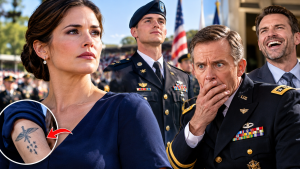
I never expected a lieutenant colonel to look at my wrist and turn white.
I certainly never expected him to snap to attention in front of hundreds of people.
And I had no idea that one faded tattoo would reopen a military mystery that had haunted me for twenty-one years.
“Major Carter,” he whispered, his voice trembling. “We were told you never made it out.”
Then he asked the question I had spent two decades praying nobody would ever ask.
“What happened to Unit Raven?”
To understand why those four words nearly brought me to my knees, you need to understand the life I had built around keeping my past buried.
And the man who had spent years convincing our son that I was nobody.
PART ONE: THE WOMAN NOBODY RESPECTED
Three weeks before the graduation, my son, Caleb, came into my kitchen carrying his dress uniform.
He was twenty-three years old, tall enough to look me directly in the eye without bending his head, and serious in a way that reminded me of the little boy who used to line up his toy soldiers along the windowsill.
“Mom, I need to talk to you about graduation.”
I turned off the kitchen faucet.
“Is something wrong?”
“No. Nothing like that.”
He placed the uniform carefully on a chair.
“Dad is coming. Marissa is coming, too. Grandpa Dale said he’ll be there.”
I nodded.
His father, Franklin Hayes, had served four years in the military before leaving and spending the next two decades telling anyone who would listen that his brief service had made him an expert on everything military.
He loved talking about discipline, courage, and sacrifice.
He was less enthusiastic about discussing the years I had served.
“Sounds like a full house,” I said.
Caleb rubbed the back of his neck.
“Dad knows the battalion commander. He’s invited a few people.”
“And?”
“And I just don’t want there to be any drama.”
I almost smiled.
“Caleb, when have I ever caused drama at one of your events?”
He gave me a look that told me he knew exactly what I was doing.
“Mom.”
“All right. I’ll behave.”
“That’s not what I mean.”
I knew it wasn’t.
Franklin had spent years making my life sound like an unfortunate detour in his otherwise respectable story.
I was Olivia Carter, the divorced mechanic who lived in a small house on the wrong side of town. I wore practical shoes, drove an aging Ford, and worked long hours repairing engines for people who couldn’t afford dealership prices.
To Franklin’s family, I was the woman who had never quite amounted to anything.
They didn’t know I had once commanded a small military intelligence team.
They didn’t know I had been wounded overseas.
They didn’t know that, for years, I had awakened in the middle of the night hearing the voices of men who would never come home.
And they certainly didn’t know why a faded black tattoo ran along my forearm.
Caleb noticed it when I reached for a dish towel.
The sleeve of my shirt had slipped back.
A broken wing. A downward-pointing blade. Seven small markings arranged beneath them.
His eyes lingered.
“Are you going to cover that up at graduation?”
I pulled my sleeve down.
“I bought a dress with long sleeves.”
He sighed.
“Mom, I wasn’t asking because I’m embarrassed by you.”
I looked at him.
“Then why?”
“Because every time somebody asks about it, you act like they’re trying to hurt you.”
I wanted to tell him that sometimes a question could open a door you had spent twenty years trying to keep shut.
Instead, I touched his cheek.
“I’m coming to see you graduate. That’s all that matters.”
He hugged me before leaving.
After the door closed, I stood alone in the kitchen, staring at the place where his uniform had rested.
I had raised my son to believe that honesty mattered.
Yet I had spent his entire life hiding the most important part of mine.
I told myself I was protecting him.
Perhaps, in the beginning, I had been.
But there was another truth I had never wanted to admit.
I was afraid that if Caleb knew what I had done, what I had lost, and what I still blamed myself for, he might never look at me the same way again.
So I kept quiet.
And Franklin filled the silence with his own version of my life.
PART TWO: THE GRADUATION
The Georgia sun was merciless on graduation morning.
Families crowded the grounds of Fort Mason, carrying bouquets, cameras, American flags, and folding chairs. Young soldiers stood in immaculate formations while officers moved between groups of relatives.
I parked my old Ford at the far end of the lot.
For a moment, I remained behind the wheel.
My hands rested on the steering wheel, and I stared at my reflection in the rearview mirror.
Navy-blue dress.
Silver earrings.
Hair pinned neatly back.
Nothing about me suggested the woman I had once been.
That was exactly how I wanted it.
“Just here for Caleb,” I whispered.
Then I stepped outside.
Inside the reception hall, Franklin was already holding court.
He stood near the front with Marissa, his current wife, and several officers whose names I didn’t recognize. He was laughing loudly, one hand resting on the shoulder of a colonel as though they were old friends.
When he saw me, his expression changed.
“Well, I’ll be damned. Olivia actually made it.”
Marissa glanced at my shoes.
“That’s a lovely dress,” she said, in the particular tone people use when they mean the opposite.
“Thank you.”
Franklin leaned toward his companions.
“My ex-wife. She’s always been a little difficult to pin down.”
One of the men offered a polite smile.
I walked away.
I had learned long ago that some people interpreted every response as an invitation to continue.
I found the seat Caleb had reserved for me near the back.
It was perfectly fine.
I didn’t need to sit beside the officers.
I didn’t need anyone to recognize me.
I only wanted to see my son walk across that stage.
Then Lieutenant Colonel Daniel Mercer entered the hall.
I recognized his name from the program before I recognized his face.
He was older now, with silver hair and deep lines around his eyes. He moved through the crowd, greeting families and speaking briefly with graduates.
I lowered my head and studied the program.
Perhaps he wouldn’t see me.
Perhaps I could watch the ceremony, congratulate Caleb, and return home without opening the past.
Then I reached for a pen.
My sleeve slid backward.
The tattoo appeared.
Mercer stopped in the middle of a sentence.
His eyes fixed on my forearm.
At first, he simply stared.
Then his face drained of color.
The officer beside him followed his gaze.
Mercer took one slow step toward me.
Then another.
“Ma’am?”
I looked up.
For one terrible second, neither of us spoke.
His lips parted.
“No,” he whispered. “It can’t be.”
I felt my heart begin to pound.
“Lieutenant Colonel?”
He looked at the broken wing again.
The recognition was unmistakable.
He straightened so abruptly that a nearby conversation stopped.
Then he snapped to attention.
“Major Carter.”
The room went quiet around us.
I stood.
“Please don’t.”
He stared at me as if he were looking at a ghost.
“We were told you were dead.”
Behind him, Franklin’s smile vanished.
Caleb turned from across the room.
Mercer swallowed.
Then came the question.
“What happened to Unit Raven?”
I couldn’t answer.
For twenty-one years, I had tried to make that name disappear from my life.
Now it had followed me into the one place I had promised myself would remain untouched by the past.
“I’m afraid you’ve mistaken me for someone else,” I said.
Mercer’s expression hardened with recognition.
“No, ma’am. I haven’t.”
Franklin approached, his curiosity quickly overtaking his embarrassment.
“Is there a problem, Colonel?”
Mercer didn’t look at him.
“I need to speak with Mrs. Carter.”
Franklin laughed.
“Mrs. Carter? About what?”
Then he turned toward the surrounding guests.
“Whatever this is, I hope it doesn’t involve another one of Olivia’s little misunderstandings.”
Mercer finally looked at him.
“Sir, I suggest you stop speaking.”
Franklin froze.
Nobody had ever spoken to him that way in a room full of people.
Mercer turned back to me.
“May we talk privately?”
I looked at Caleb.
My son was watching me with wide eyes.
He had never seen me look frightened.
Not like this.
“Caleb,” I said quietly, “I need a few minutes.”
He approached.
“Mom, do you know this officer?”
Mercer answered before I could.
“Yes, son.”
“From where?”
Mercer looked at me.
“From a place where neither of us expected to survive.”
For the first time in his life, Caleb had no idea what to say.
And for the first time in mine, I knew that silence was no longer going to protect either of us.
PART THREE: THE WOMAN WHO NEVER CAME HOME
The conference room overlooked the parade ground.
Outside, young soldiers moved in precise formations beneath the bright Georgia sky.
Inside, Daniel Mercer closed the door and stood motionless for several seconds.
Then he addressed me by a title I hadn’t heard in decades.
“Major Carter.”
I closed my eyes.
“Daniel, please.”
He lowered his head.
“I’m sorry.”
I walked to the window.
“How did you recognize me?”
He almost laughed, but there was no humor in it.
“You’re asking how I recognized the woman who carried me through six miles of mountain terrain with a shattered shoulder?”
I turned.
He had been twenty-five during Operation Nightfall.
A young lieutenant with more determination than experience, he’d refused to leave a wounded soldier behind even when our extraction window was closing.
When the route was compromised, our team was scattered.
Three soldiers never made it home.
Mercer and I survived.
At least, that was what I had believed.
“What do you mean, you were told I was dead?”
His face changed.
“After the final extraction, we were informed that you hadn’t survived the operation.”
“But I was evacuated eleven days later.”
“I know that now.”
He reached inside his jacket and removed a folded document.
“Three years ago, I was assigned to a historical records review. I wasn’t searching for you. I was reviewing old operational assessments when I found the designation Raven.”
My fingers went cold.
He placed the document on the table.
“Most of the information is still restricted. But this supplemental review was available through the authorized records process.”
I stared at the heading.
OPERATION NIGHTFALL — SUPPLEMENTAL REVIEW.
I didn’t want to open it.
For twenty-one years, I had lived with the certainty that one decision I made during that operation had cost three men their lives.
I had chosen the mountain route because intelligence indicated that the western approach had been compromised.
The intelligence was wrong.
Or so I had been told.
I unfolded the paper.
My eyes moved down the page.
Then stopped.
The review stated that the route compromise had occurred before I assumed operational control and that the subsequent investigation had found no evidence that my team caused the failure.
I read the passage again.
And again.
“They told me it was my decision,” I whispered.
Mercer pulled out a chair.
“They were wrong.”
“They said I misunderstood the intelligence.”
“The review contradicts that.”
“They told me three men died because I made the wrong call.”
His expression crumpled.
“Olivia, I’m sorry.”
I pressed the paper against the table.
The room seemed to tilt.
For two decades, I had carried those deaths as a personal sentence. I had replayed the final hours over and over, searching for the moment when I should have done something differently.
I had left the Army believing that my career was finished and that I no longer deserved to wear the uniform.
Now, for the first time, an official document challenged the story I had been telling myself.
“Who was responsible for the original findings?” I asked.
“Colonel Harold Voss chaired the internal review.”
I stared at him.
I remembered Voss visiting me in the hospital.
I remembered his controlled expression and the way he spoke about duty, national security, and the necessity of silence.
He had told me that certain aspects of the operation could never be discussed.
I had accepted that explanation.
I had never imagined the official account might also have been incomplete.
“Why wasn’t I informed?”
Mercer shook his head.
“I don’t know. Your records listed restricted contact information, and the official documentation showed you as separated from service. I tried to locate you through authorized channels.”
I gave a bitter smile.
“I’ve been repairing engines in Ohio.”
He looked at my hands.
The faint scars across my knuckles were still visible.
“You always said machines were easier than people.”
“They usually are.”
For a moment, neither of us spoke.
Then he asked the question I had feared since the beginning.
“Why did you disappear?”
I looked at the document.
“Because I believed I had failed the men who trusted me.”
Mercer leaned forward.
“You didn’t abandon them.”
“I couldn’t save all of them.”
“No commander can guarantee that every soldier comes home.”
His voice broke slightly.
“But you stayed when you could have left. You went back for us. You carried people who couldn’t walk. You made decisions with the information you had.”
I turned away.
“Three of them died.”
“Yes.”
He paused.
“And they deserved to come home. But their deaths do not make you guilty of something the evidence says you didn’t cause.”
I wanted to believe him.
I wanted to put the document down and walk outside into the sunshine as though twenty-one years of regret could be erased by a few paragraphs.
But grief doesn’t work that way.
It doesn’t vanish simply because someone finally tells you that you were wrong to blame yourself.
Still, something inside me began to loosen.
Then a knock sounded at the door.
Caleb entered, his graduation cap in his hand.
Behind him stood Colonel Reeves.
Caleb looked from Mercer to me.
“Mom, Dad’s telling everyone you were involved in some military scandal.”
I closed my eyes.
Of course he was.
Franklin had seen a situation he couldn’t control, so he had begun inventing an explanation that placed him back at the center of it.
Caleb approached the table.
“Is any of that true?”
I looked at my son.
“No.”
“Then who are you?”
The question hurt more than I expected.
Not because he was accusing me.
Because he had spent his entire life watching me refuse to answer it.
I took a breath.
“My name is Olivia Carter. Before I became a mechanic, I served twelve years in the United States Army.”
Caleb sat down slowly.
“I was a military intelligence officer,” I continued. “I held the rank of major. I served with a small operational team known as Raven.”
His eyes widened.
“A major?”
“Yes.”
“Why didn’t you ever tell me?”
I looked down at my hands.
“Because I believed my final operation had ended in a terrible failure. I thought telling you would mean explaining things I couldn’t bear to discuss.”
“But you could have told me who you were.”
He was right.
“I could have.”
I swallowed.
“I was afraid you would look at me differently.”
Caleb’s eyes filled with tears.
“Mom, I spent years believing Dad when he said you had never accomplished anything.”
I felt the words land inside me.
“He told me you were weak. That you couldn’t handle responsibility. That he had to do everything for our family.”
I closed my eyes.
“I know.”
“No, you don’t.” His voice cracked. “You weren’t there when he said it. You weren’t there when I started wondering whether he was right.”
I reached for his hand.
“I’m sorry.”
He looked at the document on the table.
“Did you really save these soldiers?”
Mercer answered quietly.
“She saved my life.”
Caleb stared at him.
Then at me.
And suddenly, I saw the moment when the story he had believed for twenty-three years began to collapse.
PART FOUR: THE TRUTH FRANKLIN COULDN’T CONTROL
Caleb stood and walked toward the window.
For several seconds, he stared at the soldiers assembling outside.
Then he turned back.
“Why did Dad never tell me you served?”
I answered honestly.
“He knew I had served before we met. He didn’t know the details of my final assignment.”
“But he knew enough to understand that you weren’t the person he described.”
I didn’t answer.
Caleb shook his head.
“He made me ashamed of you.”
His words were quiet, but they filled the room.
“I used to worry that people would see our house and our car and think we weren’t successful. I thought I had to work harder than everyone else to prove I wasn’t like you.”
My chest tightened.
“Caleb, you were never responsible for your father’s opinions.”
“But I believed them.”
He wiped his eyes.
“And you never told me the truth.”
I nodded.
“I thought I was protecting you.”
“Maybe you were protecting yourself, too.”
I looked at him.
He wasn’t trying to hurt me.
He was finally telling me how my silence had hurt him.
“Yes,” I whispered. “I think I was.”
He stood still for a moment.
Then he walked over and wrapped his arms around me.
I held him tightly.
“I’m sorry I didn’t trust you with the truth,” I whispered.
He pressed his forehead against mine.
“You should have let me be proud of you.”
That was when I finally began to cry.
Not because I had been recognized by an officer.
Not because the Army might someday correct my record.
Because my son was holding me, and for the first time in years, I didn’t feel as though I had to hide from the person I loved most.
A few minutes later, we returned to the reception hall.
Franklin was waiting near the front with Marissa and his father, Dale.
The moment he saw us, he raised his voice.
“There you are. I hope we’ve cleared up whatever confusion this has caused.”
Caleb stopped.
“Dad, leave it alone.”
Franklin ignored him.
“I’ve already spoken to several people. Apparently, your mother has some story about being a major.”
I looked at him calmly.
“It’s not a story.”
He laughed.
“Olivia, don’t embarrass yourself.”
Then Lieutenant Colonel Mercer stepped forward.
“Mr. Hayes, Major Carter’s service is not in question.”
Franklin turned toward him.
“With respect, Colonel, you don’t know what she’s like in private.”
Mercer’s expression became cold.
“I know what she was like when I was wounded and unable to walk. I know what she did when she had every reason to leave me behind.”
He paused.
“And I know I am alive because she refused to abandon her people.”
The surrounding conversations faded.
Franklin’s smile disappeared.
Colonel Reeves joined us.
“Mrs. Carter’s previous service has been confirmed through the records available to us. Any questions concerning the historical operation should be handled through the appropriate channels.”
Franklin stared at me.
“You never told me any of this.”
I held his gaze.
“You never made an effort to understand me.”
“That isn’t fair.”
“No,” I replied. “What wasn’t fair was the way you treated me when you thought I was nobody.”
His face reddened.
Marissa looked away.
Dale remained silent.
Franklin lowered his voice.
“You’re making me look like a fool.”
I almost laughed.
For years, I had believed that if Franklin ever learned the truth about me, he would finally understand how wrong he had been.
Now I realized that his greatest concern wasn’t my past.
It was his reputation.
“I didn’t come here to compete with you,” I said. “I came to watch our son graduate.”
Caleb stepped beside me.
“And that’s what she’s going to do.”
Franklin turned toward him.
“Son, you’re letting this get out of hand.”
“No. I’m finally understanding what has been happening all these years.”
His voice was steady.
“You taught me to respect the uniform. You taught me that service mattered. But when it came to Mom, you acted as if her work and her life meant nothing.”
Franklin opened his mouth.
Caleb continued.
“You don’t have to understand everything about her past. But you don’t get to humiliate her because she doesn’t fit the story you want to tell.”
The silence was absolute.
Then Caleb looked directly at his father.
“If you can’t treat Mom with respect today, find another seat.”
Franklin glanced around the room.
Nobody came to his defense.
For the first time, he had to face the consequences of his own words without someone else stepping in to soften them.
Marissa touched his arm.
“Franklin. Let’s go.”
He followed her, his face rigid with embarrassment.
I watched him disappear into the crowd.
Then I turned to Caleb.
“You didn’t have to do that.”
He shook his head.
“Yes, I did.”
He offered me his arm.
“Come on, Mom. Your seat is up front.”
PART FIVE: THE LETTER FROM A DEAD SOLDIER
When Caleb’s name was announced, I stood with the other families.
He crossed the stage with his shoulders squared and his head held high.
For a moment, I saw the little boy who used to fall asleep against my shoulder during long car rides.
Then I saw the man he had become.
A soldier.
A son.
Someone learning that strength wasn’t measured by how loudly you could command a room, but by how faithfully you stood beside the people who depended on you.
When his eyes found mine, he smiled.
I clapped until my hands hurt.
After the ceremony, Daniel Mercer approached me with a small envelope.
“There’s something else you should have.”
I looked at the faded paper.
“What is it?”
“A letter from Thomas Ellison.”
My breath caught.
Thomas had been one of Raven’s most dependable soldiers. He was twenty-seven when we deployed, with a wife named Sarah and a baby daughter he had seen only twice.
He had been the first to volunteer for difficult assignments and the last to complain when things went wrong.
He had also been one of the three men we lost.
“Where did you get this?”
“Sarah found it among his belongings. She gave it to me years later, hoping I might find you.”
I stared at the handwriting on the envelope.
Major Carter.
My hands began to shake.
I opened it carefully.
The first line nearly broke me.
Ma’am, if this reaches you, it probably means I didn’t make it home.
I covered my mouth.
The letter continued.
You always told us that leadership wasn’t about being the strongest person in the room. It was about being the last person willing to leave when someone needed help.
I want you to know that the men trusted you. Every one of us.
If something happens to me, don’t carry it like you failed us. We knew the risks when we volunteered.
Take care of yourself, Major. And if you ever get the chance, go home and build the quiet life you keep talking about.
You deserve one.
At the bottom, Thomas had added one final sentence.
And for God’s sake, stop pretending you don’t want a family.
I laughed through my tears.
It sounded exactly like him.
Thomas had teased me for years because I kept photographs of my brother’s children in my field notebook.
He insisted I could plan a complex operation but couldn’t admit that I wanted a family of my own.
I pressed the letter against my chest.
For twenty-one years, I had imagined that the men I lost would condemn me if they could speak.
Instead, one of them had left me a message asking me to live.
Caleb stood beside me.
“Mom?”
I handed him the letter.
He read it carefully.
When he finished, he looked up.
“He knew you pretty well.”
I nodded.
“He did.”
Mercer waited before speaking.
“Thomas’s daughter graduated from college last year. She’s a nurse now.”
I looked at him.
“His little girl?”
“Yes. Her name is Emily.”
I remembered the photograph of a baby wrapped in a yellow blanket.
Now she was a grown woman.
“Does she know about me?”
“She knows her father served with you. I believe she’d like to hear your memories of him.”
I looked at the letter again.
For years, I had avoided contacting the families because I feared seeing their grief reflected in their faces.
But Thomas had asked me to stop punishing myself.
Perhaps the first step was finally meeting the people he had loved.
“I’d like to meet her,” I said.
Mercer smiled.
“I’ll help arrange it.”
PART SIX: THE LIFE I HAD BEEN TOO AFRAID TO LIVE
That evening, Caleb and I ate sandwiches beside the pool at my hotel.
He had declined his father’s invitation to an expensive dinner.
Instead, he sat across from me in his uniform, asking questions I had spent years avoiding.
“Were you scared during those missions?”
“Sometimes.”
“Even when you were in charge?”
“Especially then.”
He considered that.
“Why?”
“Because being responsible for people doesn’t mean you stop being afraid. It means you learn to make decisions while you’re afraid.”
He looked at the tattoo on my arm.
“Is that why you kept it?”
I traced the faded wing.
“Because I didn’t want to forget them.”
He lowered his eyes.
“I used to think it meant you had done something terrible.”
“I know.”
“I’m sorry.”
I reached across the table and took his hand.
“You were a child. You believed what you were told.”
He hesitated.
“Why did you marry Dad?”
I thought about the woman I had been before Franklin.
I had been tired of secrecy and long deployments. I wanted a home, a family, and someone who could make ordinary life feel safe.
Franklin had been charming then.
He made me laugh. He didn’t demand explanations about the parts of my service I couldn’t discuss.
At first, I mistook his lack of curiosity for acceptance.
When the marriage deteriorated, I kept hoping the man I had married would return.
Instead, I learned how easy it was to remain in an unhappy life when leaving felt like another decision you might get wrong.
“I stayed too long because I was afraid,” I told Caleb. “Not because of you. Because I didn’t trust myself to start over.”
He squeezed my hand.
“I wish you hadn’t been alone with all of that.”
“So do I.”
He looked toward the dark water.
“Do you think you’ll ever go back to the Army?”
“No.”
“Why not?”
I smiled.
“Because I like fixing engines.”
He laughed.
I told him about the first car I repaired after leaving the service. It belonged to an elderly neighbor who couldn’t afford a replacement. When the engine finally started, she had cried with relief.
For the first time in years, I had fixed something without wondering whether someone might die because of my decisions.
That small moment had meant more to me than I could explain.
“I’m not ashamed of being a mechanic,” I said. “It’s honest work. It helps people. And I chose it.”
Caleb nodded.
“Then I’m proud of you for that, too.”
Those words stayed with me long after he returned to his room.
For the first time, I understood that I didn’t need to become someone extraordinary to deserve respect.
I had been worthy of it all along.
PART SEVEN: THE RECORD THAT NEEDED TO BE CORRECTED
When I returned to Ohio, I opened the metal box I had kept hidden in my bedroom dresser.
Inside were photographs, old identification cards, military decorations, a folded American flag, and a battered field notebook.
I lifted a photograph of Raven.
Seven young soldiers stood in front of a transport aircraft.
Thomas was laughing.
Mercer had one arm around another soldier.
I stood in the center, pretending to be annoyed that someone had taken the picture without asking.
Three of those men would never grow old.
Four of us had been given more years than we expected.
I placed Thomas’s letter beside the photograph.
Then I called Daniel Mercer.
“I want to request my complete personnel records,” I told him. “And whatever portions of the operational review I’m legally entitled to receive.”
“Good,” he said.
“I also want to find out whether the families were informed that the later review changed the findings.”
There was a pause.
“I don’t know whether they were.”
“Then I want to find out.”
The process was slow.
There were forms, identity checks, administrative delays, and documents that remained restricted. Some records were incomplete. Others contained extensive redactions.
I did not demand classified details.
I did not ask anyone to reveal information that should remain protected.
I wanted something simpler.
An accurate account of what had happened.
With guidance from the appropriate military records offices, I submitted a formal request for review of my personnel file and the findings associated with Operation Nightfall.
Mercer provided a statement describing what he remembered.
Other surviving personnel contributed their recollections through the proper channels.
Eventually, I received confirmation that the supplemental findings would be considered as part of the administrative review.
There was no guarantee of a particular outcome.
But someone was finally examining the record.
And for the first time in twenty-one years, I was no longer carrying the entire burden alone.
Meanwhile, Caleb called me every Sunday.
Sometimes he wanted advice about his military career.
Sometimes he complained about the food.
Sometimes he simply wanted to talk.
He stopped asking me to cover the tattoo.
He started asking about the people in the photographs.
And slowly, our relationship became something neither of us had known how to build before.
A relationship based on honesty.
Not because I suddenly told him every operational detail.
Some information was still not mine to share.
But because I finally stopped pretending that my past was something shameful.
PART EIGHT: THE APOLOGY THAT CAME TOO LATE
Franklin called nearly two months after graduation.
I was changing the oil in an old pickup when my phone rang.
“Olivia.”
I recognized his voice immediately.
“Franklin.”
He cleared his throat.
“Caleb hasn’t been answering my calls much.”
“Perhaps you should give him some space.”
He sighed.
“People have been asking questions about you.”
“About what?”
“Your military service. Your rank. Why I never mentioned any of it.”
I leaned against the workbench.
Even now, he seemed more troubled by how the revelation reflected on him than by how he had treated me.
“Franklin, your relationship with Caleb is between you and him.”
“I know.”
“Then talk to him. And listen when he answers.”
A long silence followed.
Finally, he said, “I suppose I owe you an apology.”
I waited.
“I shouldn’t have made those comments about your job. Or your house. Or the way you lived.”
“No,” I said. “You shouldn’t have.”
“I was angry after the divorce.”
“I understand that.”
“And I said things I didn’t mean.”
I looked around the garage.
At the tools I had purchased one paycheck at a time.
At the shelves Caleb had helped me install when he was sixteen.
At the life I had built without Franklin’s approval.
“Maybe you didn’t mean them,” I said. “But you kept saying them for years.”
He didn’t respond.
“I hope you find a way to repair your relationship with Caleb. But I’m not going to pretend those years never happened.”
I ended the call.
I felt no satisfaction.
No sudden triumph.
Only relief.
For years, I had waited for Franklin to become someone capable of understanding me.
Now I understood that I didn’t need his permission to move forward.
His opinion had shaped my life for too long.
It would not shape the rest of it.
PART NINE: THE DAUGHTER OF THE MAN WE LOST
In early spring, I traveled to Virginia to meet Thomas Ellison’s family.
His widow, Sarah, lived in a modest brick house surrounded by flowering dogwood trees.
When she opened the door, we recognized each other immediately.
We were older than the women in the photographs Thomas had carried overseas.
But we still remembered the people we had been.
Sarah embraced me without asking a single question.
We stood in the doorway for a long time, holding each other.
Eventually, she stepped back and wiped her cheeks.
“Tom used to write about you.”
I smiled through my tears.
“I hope he didn’t complain too much.”
She laughed.
“He said you were the only officer who could frighten a room full of soldiers and then stay up all night helping one of them write a letter home.”
I looked down.
“That sounds like him.”
Inside, photographs covered the walls.
Thomas holding baby Emily.
Thomas fishing beside a lake.
Thomas standing in uniform, smiling with the confidence of a young man who believed he had a long life ahead of him.
Then Emily entered the room carrying a tray of coffee.
She was a grown woman now, with her father’s dark eyes.
When she saw me, she stopped.
“You’re Major Carter?”
I stood.
“Olivia is fine.”
She set down the tray.
“My dad wrote about you in his journal.”
My throat tightened.
“He did?”
“He said you always made sure everyone got a chance to call home when communications were available.”
I smiled.
“He was usually the first person asking.”
Emily laughed.
Then her expression grew serious.
“Can I ask you something?”
“Of course.”
“Was he afraid?”
I looked at Sarah.
Then back at Emily.
I could have told her a polished story about courage.
I could have pretended Thomas had never doubted himself.
But he deserved better than that.
“Yes,” I said softly. “Sometimes.”
Emily’s eyes filled.
“But he did his job anyway?”
“Yes.”
I reached for the photograph I had brought.
It showed the seven members of Raven before our final deployment.
Thomas stood in the center, laughing at something Mercer had said.
I handed it to her.
“I thought you should have this.”
Emily studied the picture.
Then she touched her father’s face.
“I’ve never seen this one.”
“It’s how I remember him most.”
She held the photograph carefully against her chest.
“Thank you.”
We spent the afternoon talking about Thomas.
His terrible handwriting.
His off-key singing.
His habit of saving the last piece of chocolate for whoever was having the worst day.
The way he spoke about his wife and daughter whenever he thought nobody was listening.
I had spent twenty-one years remembering the dead only through the moments when they died.
That afternoon, I remembered how they had lived.
Before I left, Sarah took my hands.
“Olivia, Tom loved serving with you.”
I couldn’t speak.
“And I don’t want you spending the rest of your life punishing yourself for surviving.”
My eyes filled.
She squeezed my hands.
“You came home. Make something beautiful out of that.”
On the drive back to Ohio, I pulled into a rest area and cried.
Not because I had finally earned forgiveness.
Thomas’s family had never demanded that I earn it.
I cried because I was beginning to understand that the punishment I had carried for two decades had never been something they had asked me to bear.
PART TEN: WHAT HONOR REALLY MEANS
The following autumn, Caleb came home on leave.
He arrived carrying a duffel bag, two coffees, and a grin that reminded me of the little boy who used to run into the kitchen after school.
“Permission to enter, Major?”
I rolled my eyes.
“Don’t start.”
He laughed and kissed my cheek.
We spent the weekend repairing his old car, eating takeout, and arguing over which movie to watch.
On Sunday afternoon, he found me in the living room studying the photograph of Raven.
“Mom?”
I looked up.
“Yeah?”
“Do you ever miss it?”
“The Army?”
He nodded.
I studied the faces in the photograph.
“Sometimes.”
“What part?”
“The people.”
He sat beside me.
“Not the missions?”
I shook my head.
“No.”
He considered that.
“I think I understand.”
He looked around the room.
The walls were no longer bare.
There was a photograph of Caleb at graduation.
A picture of Mercer and me during his visit to Ohio.
A photograph of Sarah, Emily, and me standing beneath the dogwood trees.
And the old picture of Raven had a place of honor on the shelf.
“You’ve changed the house,” Caleb said.
“I suppose I have.”
“It’s better.”
I smiled.
“Thank you.”
He hesitated.
“There’s something else I’ve been thinking about.”
I waited.
“One of the soldiers in my unit is having a difficult time. He’s younger than most of us, and some of the others give him a hard time because he struggles with certain things.”
“What have you done?”
“I’ve been helping him train after duty.”
I felt a quiet warmth spread through my chest.
“Good.”
Caleb shrugged.
“I keep thinking about what Mercer said. About how you refused to leave people behind.”
I looked at my son.
He wasn’t trying to become a legend.
He wasn’t searching for glory.
He was learning that leadership meant caring for the people beside you, especially when doing so offered no reward.
I touched his shoulder.
“Caleb, I’m proud of you.”
He smiled.
“I know, Mom.”
Then he glanced at the tattoo on my forearm.
“You know, I used to think that thing meant you had a dangerous past.”
I looked down at the faded ink.
“And now?”
He thought for a moment.
“Now I think it means you survived one.”
I felt my eyes sting.
For the first time, I didn’t reach for my sleeve.
The broken wing and downward-pointing blade remained visible.
They no longer felt like evidence of something I needed to hide.
They were reminders of the people I had loved, the promises I had tried to keep, and the life I had been fortunate enough to continue living.
That evening, Caleb and I drove toward the lake.
The autumn sun stretched across the road, and the trees glowed gold and red.
At a stoplight, he glanced at me.
“Mom?”
“Yes?”
“Thank you for coming to my graduation.”
I laughed.
“Of course I came.”
“No. I mean thank you for finally letting me know you.”
I looked out the window.
For twenty-one years, I had believed that silence was the only way to protect the people I loved.
Now I understood that silence could leave them alone with the wrong story.
I had made mistakes.
I had hidden truths I should have shared.
I had allowed fear to shape too many of my choices.
But I had also raised a good man.
A man who understood that honor had little to do with medals, rank, or the opinions of people who wanted to feel important.
It had everything to do with how you treated someone when there was nothing to gain.
When we arrived at the lake, Caleb opened the passenger door for me.
“Since when are you such a gentleman?”
“Good upbringing,” he replied.
I laughed and stepped outside.
The wind caught my sleeve, exposing the old tattoo.
I let it remain uncovered.
Somewhere behind us lay the years I had spent hiding.
Somewhere ahead lay the years I still had to live.
And for the first time in a very long time, I wasn’t afraid of either.
My son had gone to graduation believing he knew who his mother was.
He left that day understanding that there was more to me than he had ever imagined.
But the greatest revelation wasn’t that I had once been a major.
It wasn’t that a lieutenant colonel remembered me as the officer who saved his life.
It wasn’t even that the military record I had carried in my heart for twenty-one years might finally be corrected.
It was that I had never needed a uniform to prove my worth.
I had been a soldier.
I was a mother.
I was a mechanic.
I was a woman who had survived grief, rebuilt her life, and finally learned to stop apologizing for existing.
And those parts of me had never been in conflict.
They had always belonged to the same person.
Me.
THE END